Evolution of Wireless
Communication Technology
By
N. Uday Kumar
Technical Support Engineer
Scientech Technologies Pvt. Ltd. INDIA
Outline
 Electromagnetic Radiation Spectrum
 Need for Modulation
 Shannon Capacity Theorem
 Spread Spectrum Modulation-CDMA
 Multiple Access Schemes-FDMA,TDMA,CDMA,OFDM
 Multi Carrier System-OFDM
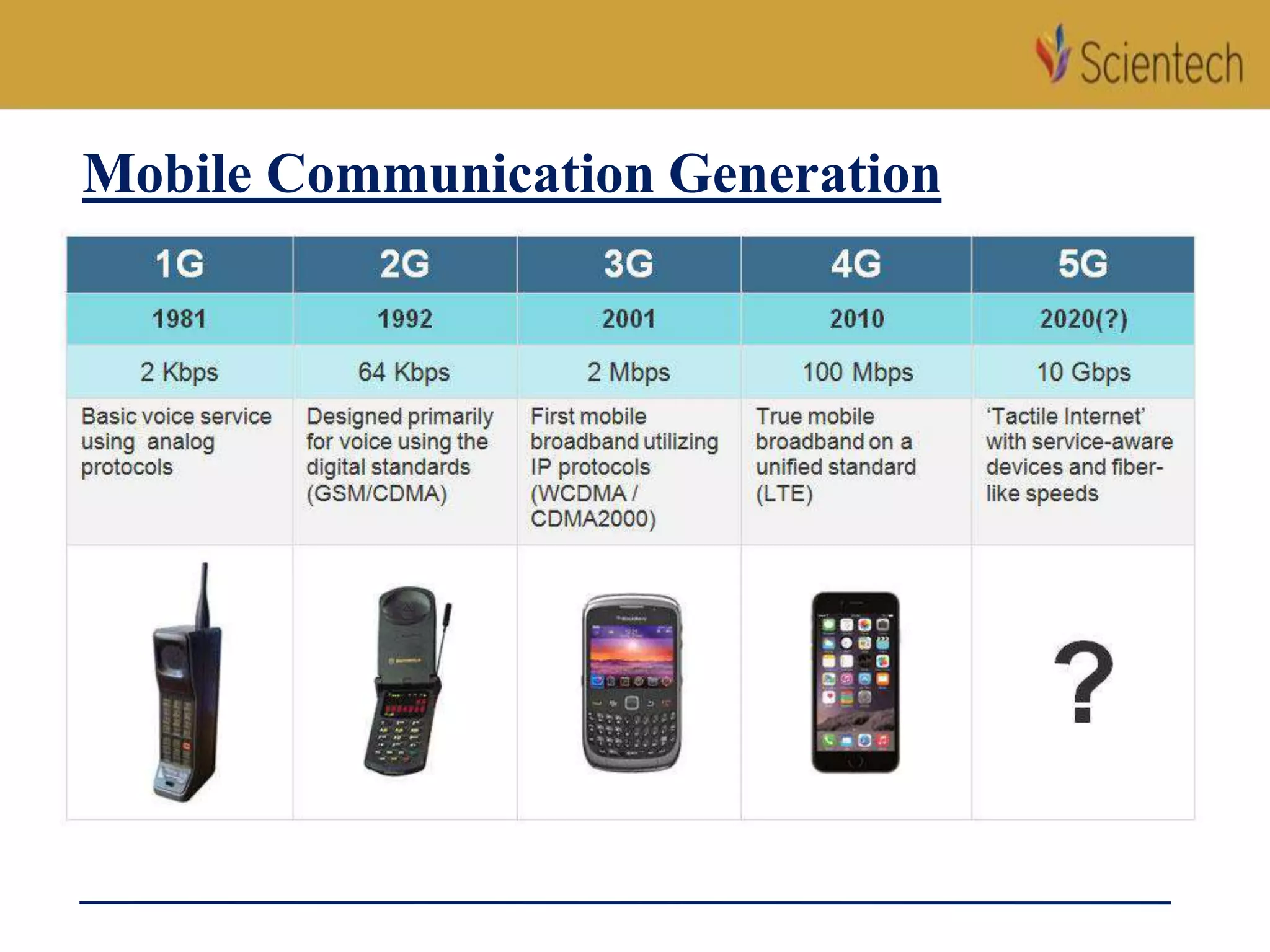
 Mobile Communication Generation
References
Need for Modulation
• Increases the range of communication
• Reduction in the height of antenna
For the transmission of radio signals, the antenna height must be multiple of λ/4
λ = c /f
The minimum antenna height required to transmit a baseband signal of f = 10 kHz
let us consider a modulated signal at f = 1 MHz
• Multiplexing is possible
Shannon Capacity Theorem
Data rate governs the speed of data transmission
1.Noiseless Channel
BitRate = 2 * Bandwidth * log2(L)
2.Noisy Channel : Shannon Capacity
C = B * log2 (1+ S/N)
C: capacity (bits/s)
B: bandwidth (Hz)
S/N: linear Signal-to-Noise ratio
• A telephone line normally has a bandwidth of 3000 Hz (300 to 3300
Hz) assigned for data communication. The SNR is usually 3162.
What will be the capacity for this channel?
C = 3000 * log2(1 + SNR) = 3000 * 11.62 = 34860 bps=34Kbps
Example of Nyquist and Shannon Formulations
Spectrum of a channel between 3MHz and 4MHz; SNR = 24dB
B = 4MHz – 3 MHz = 1 MHz
SNR dB = 24dB = 10 log10 (SNR)
SNR = 251
Using Shannon’s formula
C = 10^6 x log2 (1 + 251) = 10^6 x 8 = 8Mbps
• For Error free transmission R≤C
Where R is rate of information transmission
C is channel Capacity
Spread Spectrum Modulation-CDMA
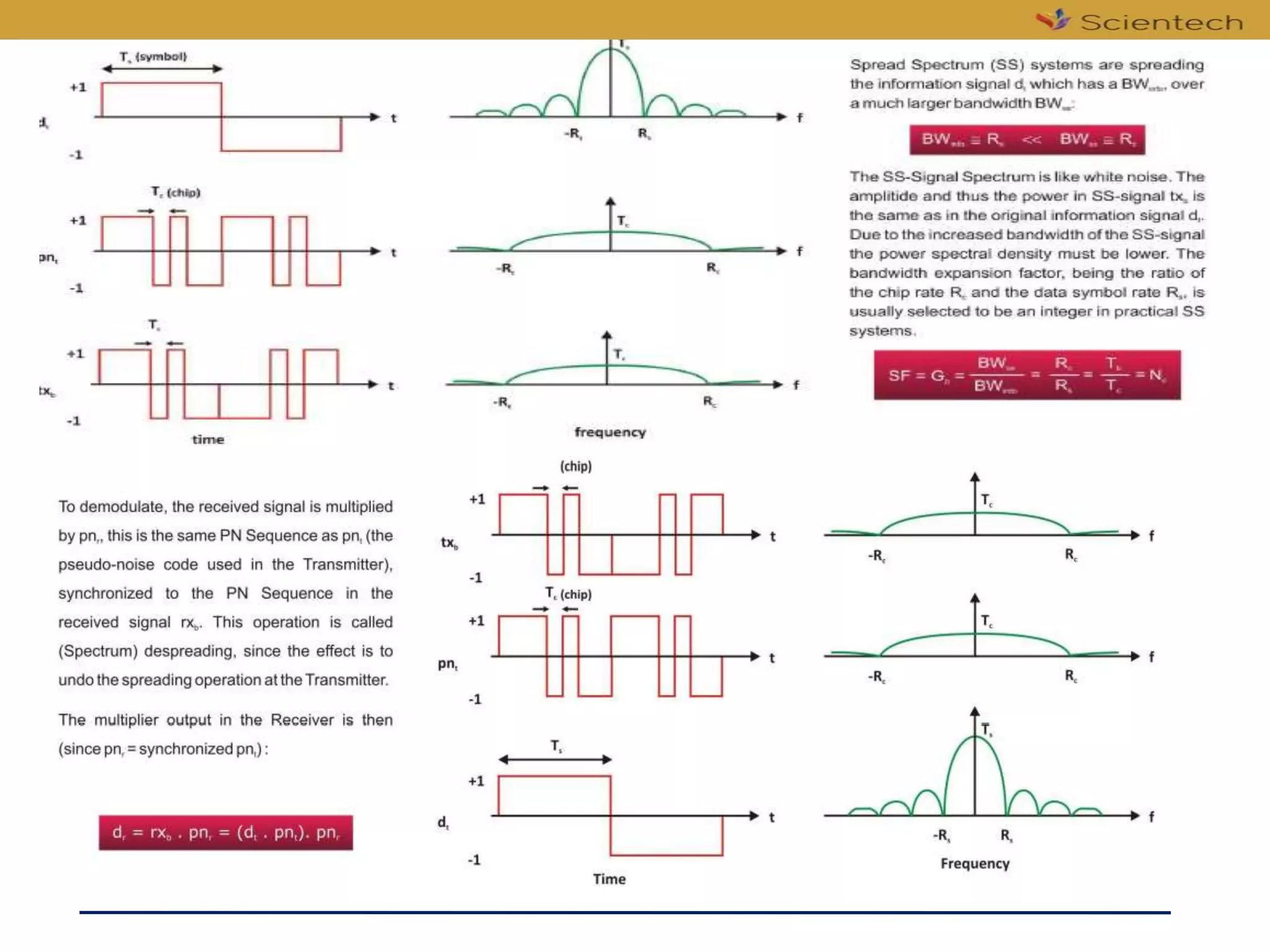
• Spread Spectrum is a type of modulation that spreads data
transmission across available frequency band, in excess of
minimum bandwidth required to send the information.
• Spreading makes signal resistive to noise and other
interference.
• Spread Spectrum has many unique properties that cannot be
found in other techniques like
o the ability to eliminate or alleviate multi-path interference,
o communication privacy due to unknown random codes,
o multi user handling capacity over a single frequency, and
low power spectral density since signal is spread over a
large frequency band.
Spread Spectrum Advantages
• As the signal is spread over a large frequency band, the
power spectral density is getting very small, so other
communications systems do not suffer from this kind of
communications.
• Random access can be dealt with as a large number of
codes can be generated and as a result large number of
users can be permitted
• In this technique without knowing the spreading code, it
is (nearly) impossible to recover the transmitted data.
Hence security is more
Direct Sequence Spread Spectrum (DS-SS)
• It is a second time modulation for already existing modulation signal
• In a DS-SS system, each user is assigned a unique code sequence
that allows the user to spread the information signal across the
assigned frequency band
• Signals from the various users are separated at the receiver by cross
correlation of the received signal with each of the possible user code
sequences.
• Possible narrow band interference is also suppressed in this process.
By designing these code sequences to have relatively small cross-
correlation, the cross-talk inherent in the demodulation of the signals
received from multiple transmitters is minimized. This multiple
access method is CDMA, which is a form of a DS-SS system
Processing Gain
• The ratio of transmitted bandwidth to information bandwidth
is called the processing gain Gp of the DS-SS system:
Gp = Bt / Bi
• Where, Bt is the transmission bandwidth and Bi is the
bandwidth of the information bearing signal.
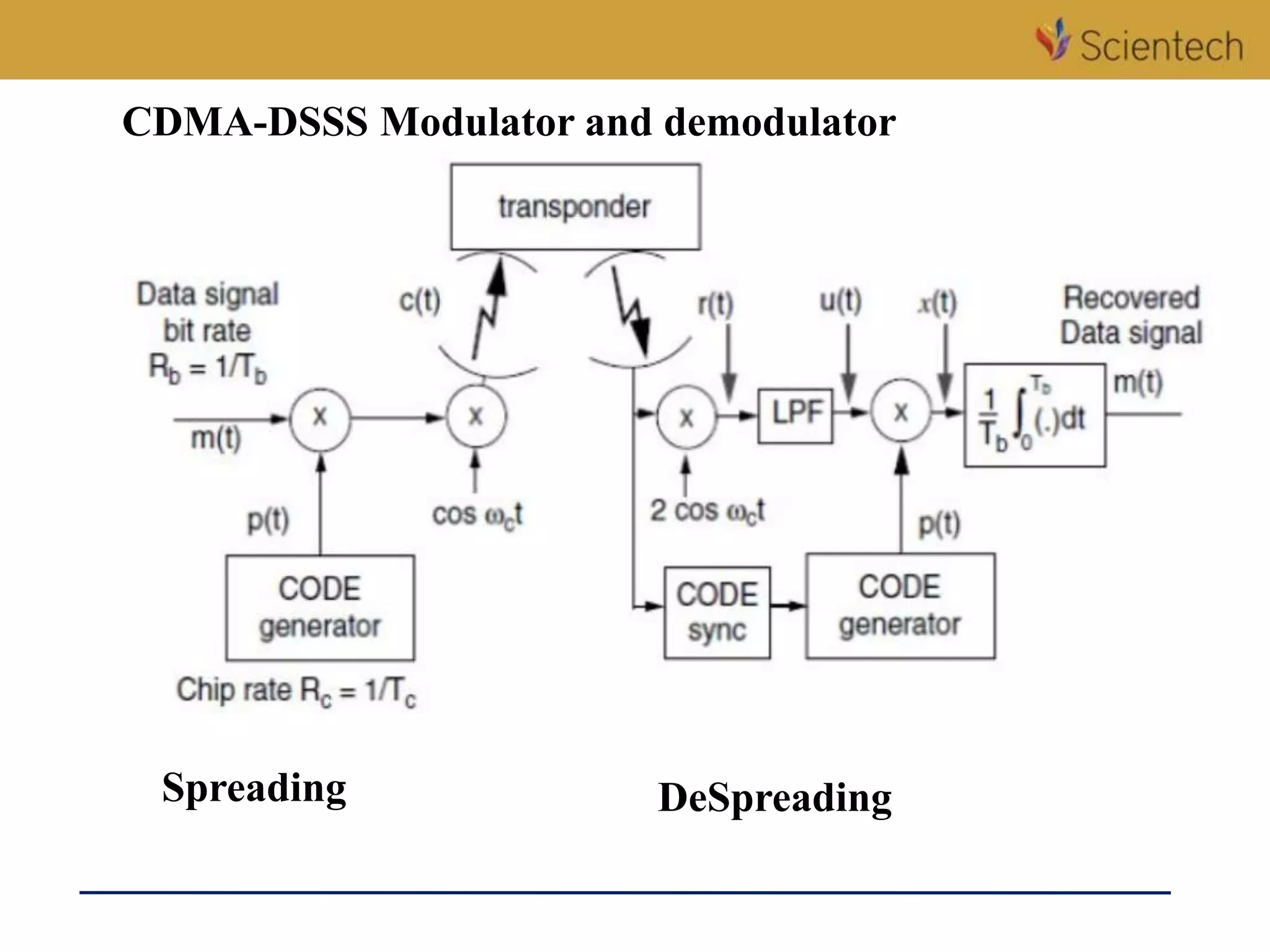
CDMA-DSSS Modulator and demodulator
Spreading DeSpreading
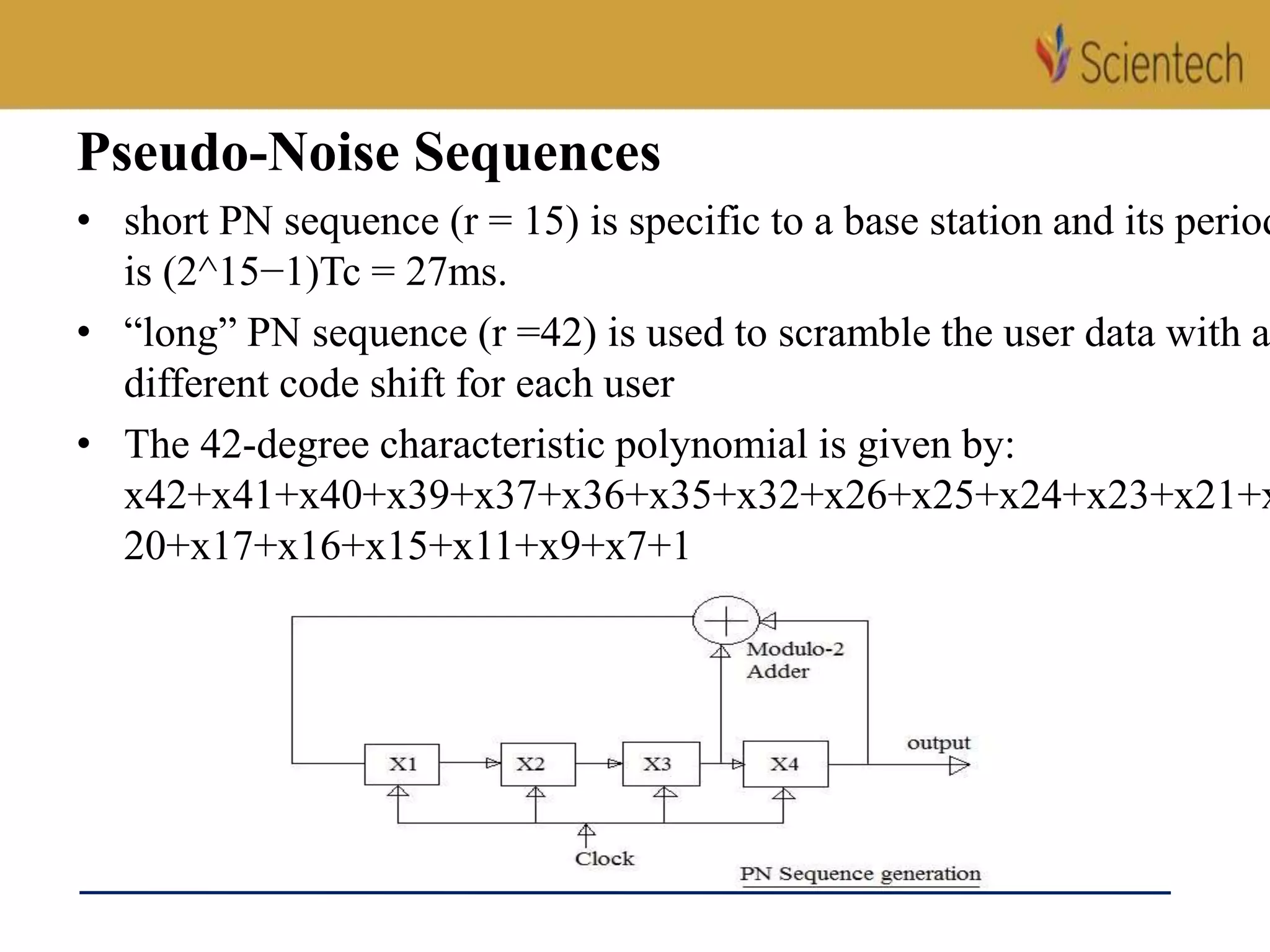
Pseudo-Noise Sequences
• short PN sequence (r = 15) is specific to a base station and its period
is (2^15−1)Tc = 27ms.
• “long” PN sequence (r =42) is used to scramble the user data with a
different code shift for each user
• The 42-degree characteristic polynomial is given by:
x42+x41+x40+x39+x37+x36+x35+x32+x26+x25+x24+x23+x21+x
20+x17+x16+x15+x11+x9+x7+1
Multiple Access Schemes
Simultaneous transmission of multiple data streams over a same medium
is called Multiple Access.
The types are..
1. Frequency Division Multiple Access
2. Time Division Multiple Access
3. Code Division Multiple Access
4. Orthogonal Frequency Division Multiple Access
Multi Carrier System-OFDM
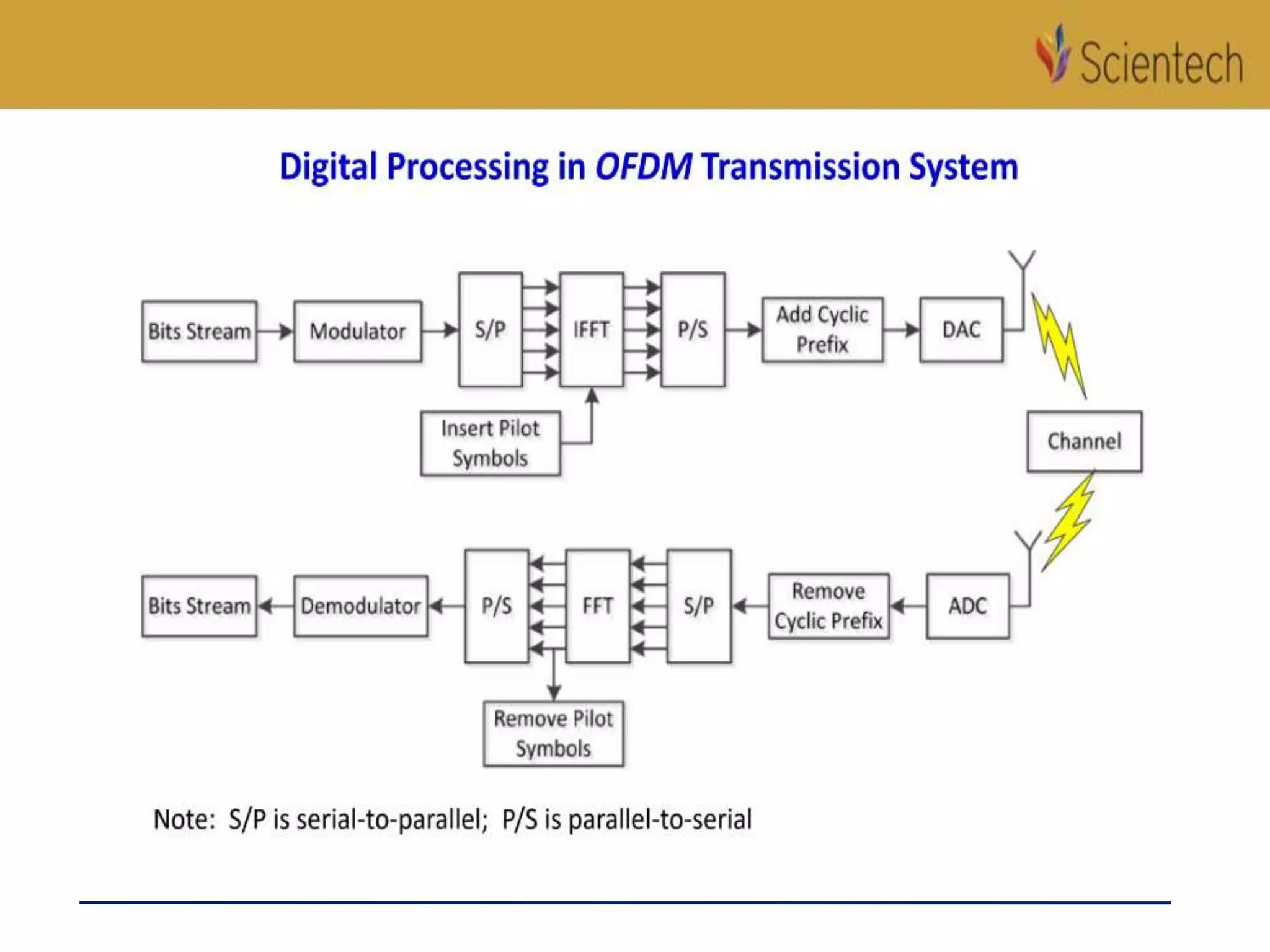
OFDM is a Digital multi-carrier modulation scheme, extending
the concept of single sub carrier modulation, by using multiple
subcarriers over the channel.
• So it is a question of how to share the spectrum with these users. In
OFDM the question of multiplexing is applied to independent
signals but these independent signals are sub-set of the one main
signal
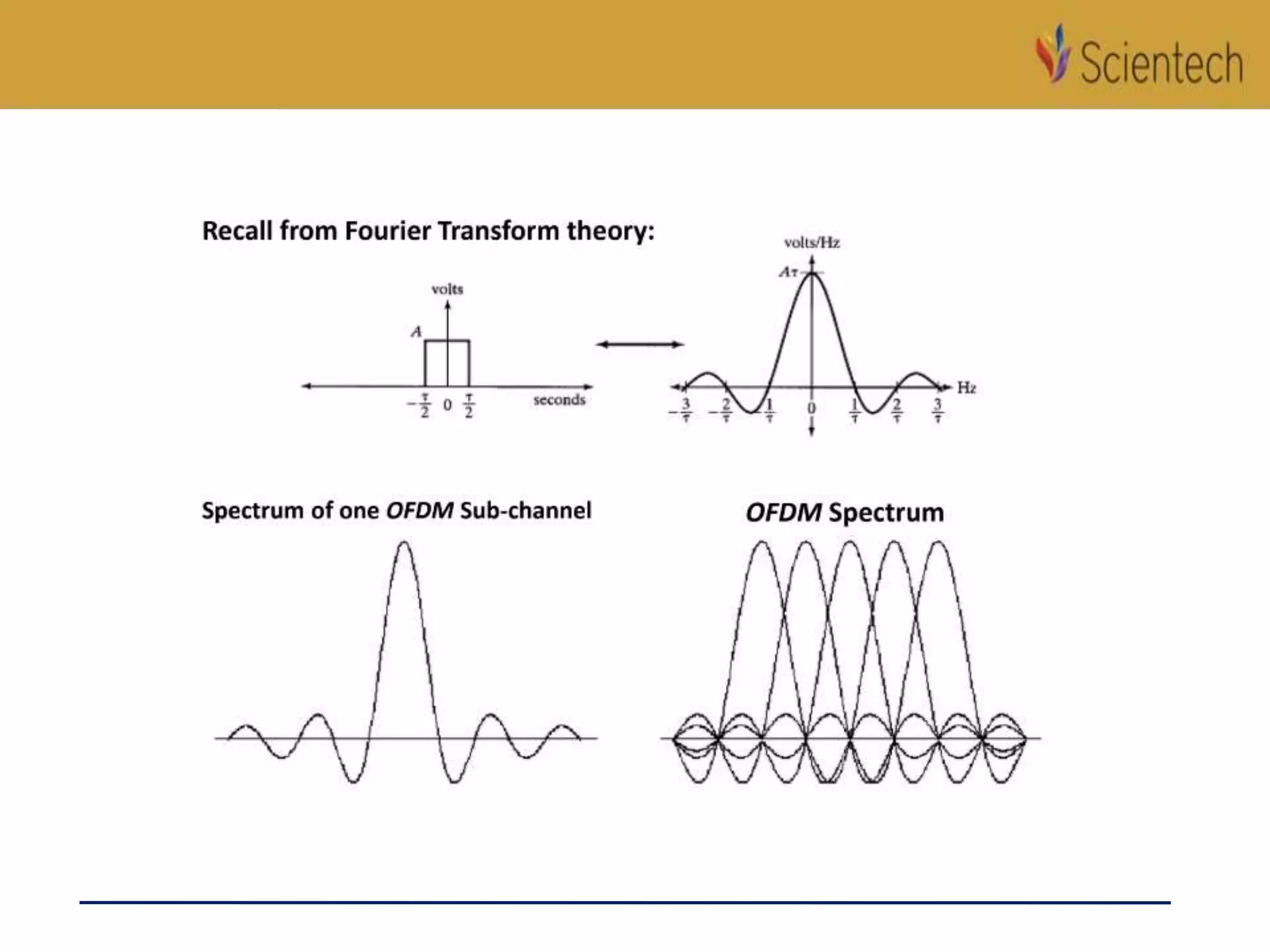
• Rather than transmit a high-rate stream of data with a single carrier,
OFDM makes use of a large number of closely spaced orthogonal
sub-carriers that are transmitted in parallel.
• Each subcarrier is modulated with (16-QAM or 64 –QAM, PSK at
low symbol rate , all sub carriers signals with a communication
channel are orthogonal to one another.
• Cross talk eliminated and inter carrier guard bands are not required.
FDM Vs OFDM
Functional Block Diagram of OFDM
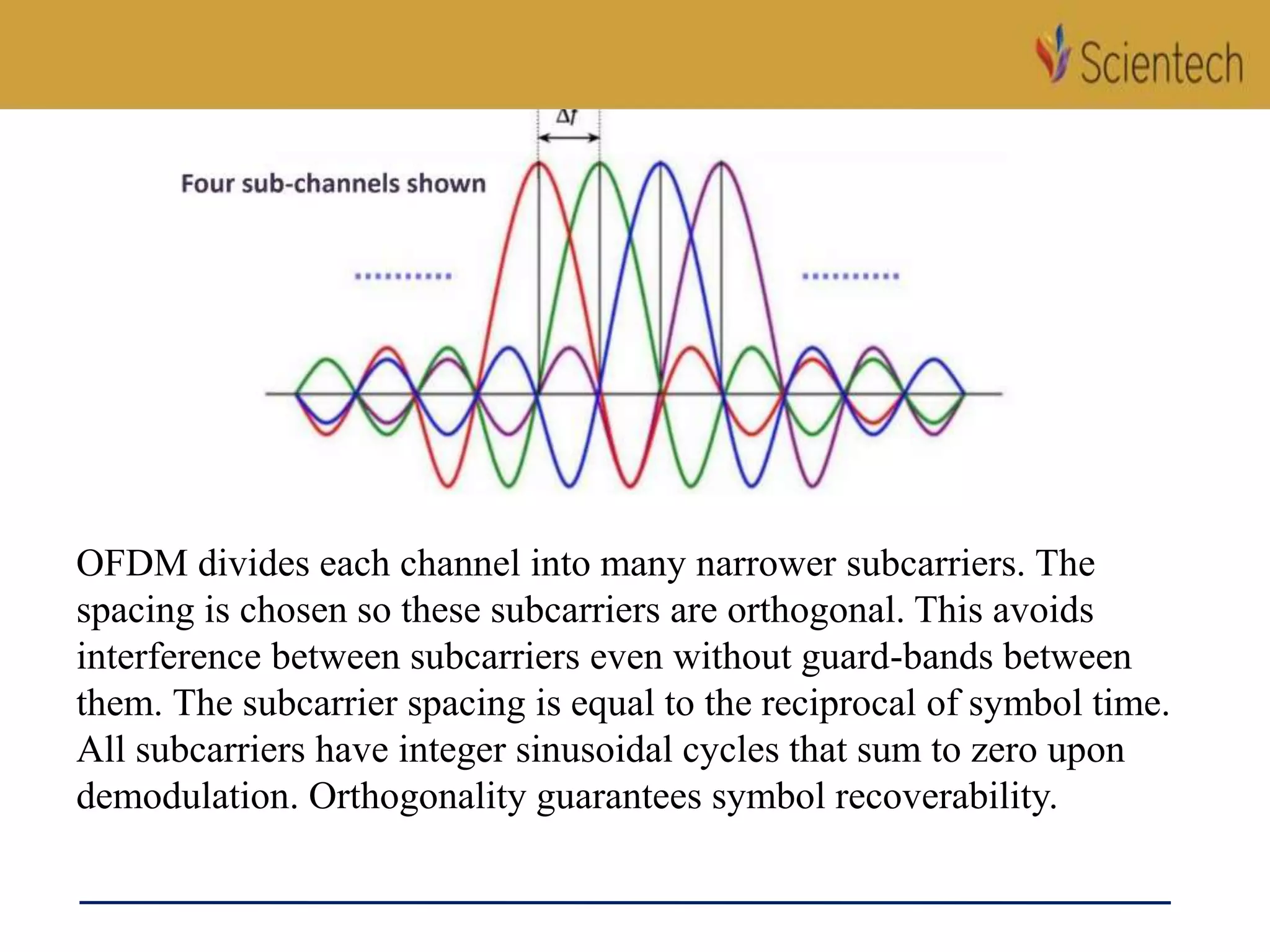
OFDM divides each channel into many narrower subcarriers. The
spacing is chosen so these subcarriers are orthogonal. This avoids
interference between subcarriers even without guard-bands between
them. The subcarrier spacing is equal to the reciprocal of symbol time.
All subcarriers have integer sinusoidal cycles that sum to zero upon
demodulation. Orthogonality guarantees symbol recoverability.
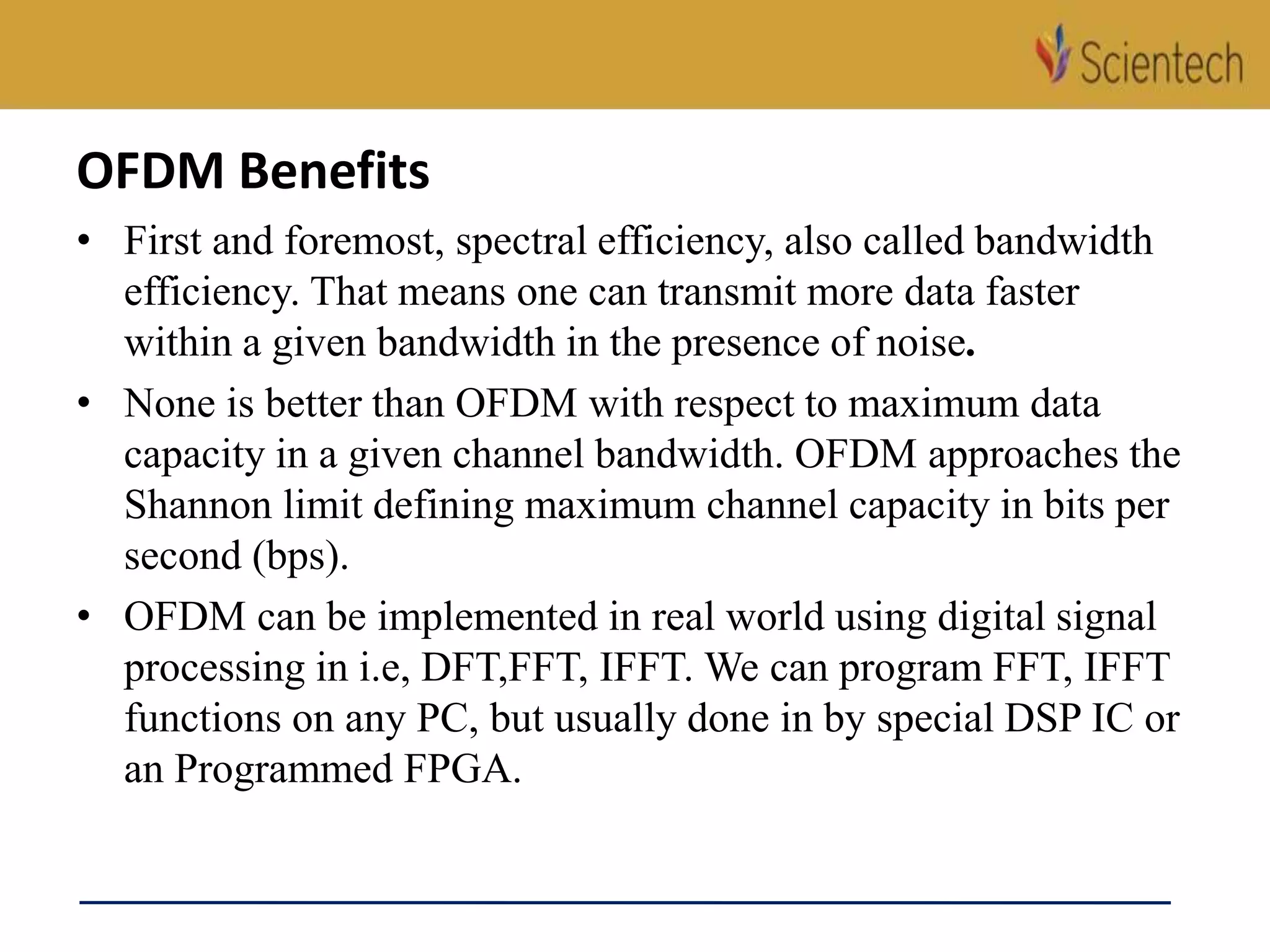
OFDM Benefits
• First and foremost, spectral efficiency, also called bandwidth
efficiency. That means one can transmit more data faster
within a given bandwidth in the presence of noise.
• None is better than OFDM with respect to maximum data
capacity in a given channel bandwidth. OFDM approaches the
Shannon limit defining maximum channel capacity in bits per
second (bps).
• OFDM can be implemented in real world using digital signal
processing in i.e, DFT,FFT, IFFT. We can program FFT, IFFT
functions on any PC, but usually done in by special DSP IC or
an Programmed FPGA.
Mobile Communication Generation
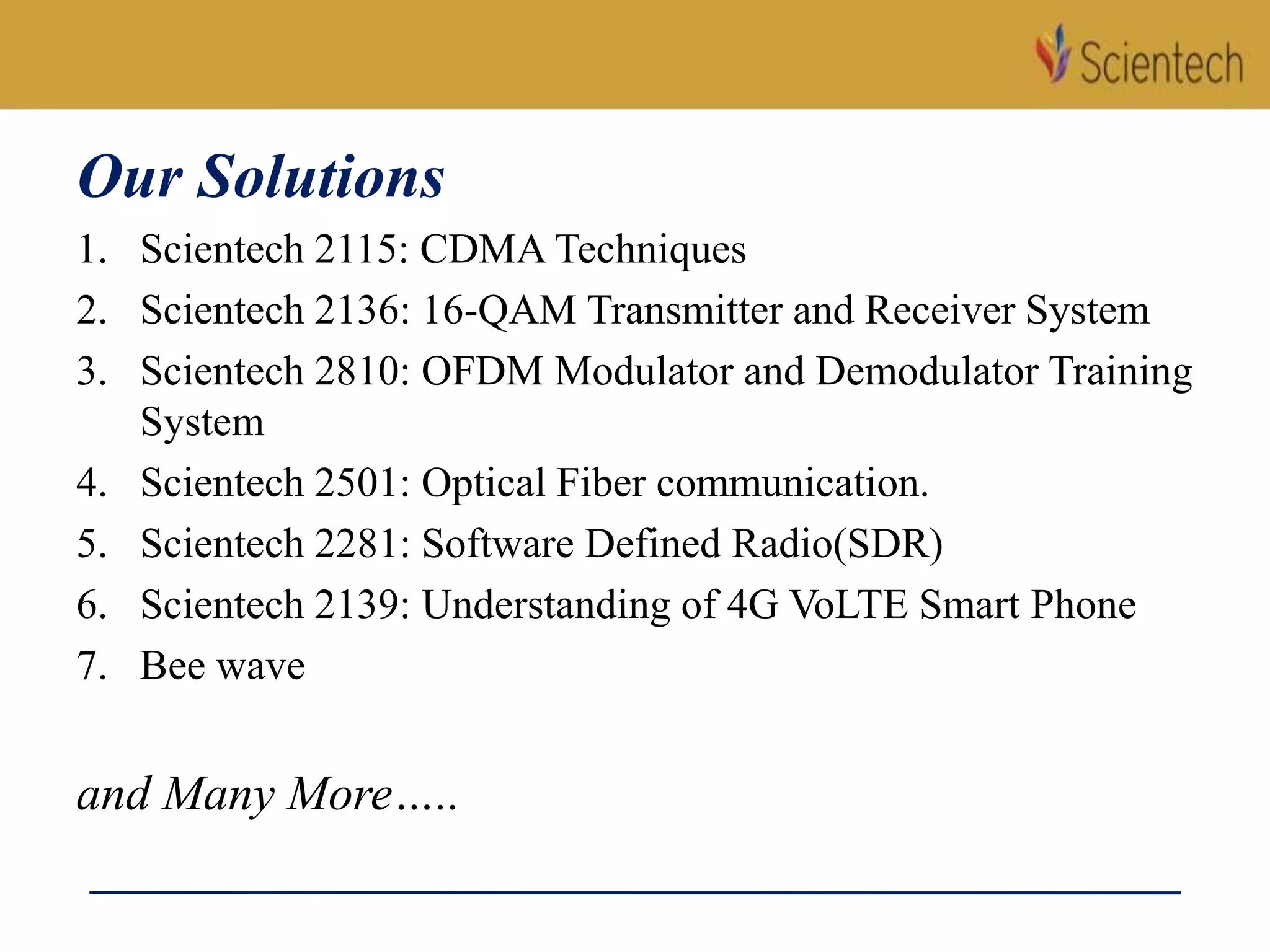
Our Solutions
1. Scientech 2115: CDMA Techniques
2. Scientech 2136: 16-QAM Transmitter and Receiver System
3. Scientech 2810: OFDM Modulator and Demodulator Training
System
4. Scientech 2501: Optical Fiber communication.
5. Scientech 2281: Software Defined Radio(SDR)
6. Scientech 2139: Understanding of 4G VoLTE Smart Phone
7. Bee wave
and Many More…..
References:
[1]. “Evolution of Wireless Communication Technology” by Mr.
Satish Thakare .
[2].Lecture notes of “ Importance of Shannon channel capacity
theorem” by Dr. G. Kiran Kumar.
[3]. Technical documents on communications solutions of Scientech.
Thank You

Evolution of Wireless Communications

  • 1.
    Evolution of Wireless CommunicationTechnology By N. Uday Kumar Technical Support Engineer Scientech Technologies Pvt. Ltd. INDIA
  • 2.
    Outline  Electromagnetic RadiationSpectrum  Need for Modulation  Shannon Capacity Theorem  Spread Spectrum Modulation-CDMA  Multiple Access Schemes-FDMA,TDMA,CDMA,OFDM  Multi Carrier System-OFDM  Mobile Communication Generation References
  • 5.
    Need for Modulation •Increases the range of communication • Reduction in the height of antenna For the transmission of radio signals, the antenna height must be multiple of λ/4 λ = c /f The minimum antenna height required to transmit a baseband signal of f = 10 kHz let us consider a modulated signal at f = 1 MHz • Multiplexing is possible
  • 6.
    Shannon Capacity Theorem Datarate governs the speed of data transmission 1.Noiseless Channel BitRate = 2 * Bandwidth * log2(L) 2.Noisy Channel : Shannon Capacity C = B * log2 (1+ S/N) C: capacity (bits/s) B: bandwidth (Hz) S/N: linear Signal-to-Noise ratio • A telephone line normally has a bandwidth of 3000 Hz (300 to 3300 Hz) assigned for data communication. The SNR is usually 3162. What will be the capacity for this channel? C = 3000 * log2(1 + SNR) = 3000 * 11.62 = 34860 bps=34Kbps
  • 7.
    Example of Nyquistand Shannon Formulations Spectrum of a channel between 3MHz and 4MHz; SNR = 24dB B = 4MHz – 3 MHz = 1 MHz SNR dB = 24dB = 10 log10 (SNR) SNR = 251 Using Shannon’s formula C = 10^6 x log2 (1 + 251) = 10^6 x 8 = 8Mbps • For Error free transmission R≤C Where R is rate of information transmission C is channel Capacity
  • 8.
    Spread Spectrum Modulation-CDMA •Spread Spectrum is a type of modulation that spreads data transmission across available frequency band, in excess of minimum bandwidth required to send the information. • Spreading makes signal resistive to noise and other interference. • Spread Spectrum has many unique properties that cannot be found in other techniques like o the ability to eliminate or alleviate multi-path interference, o communication privacy due to unknown random codes, o multi user handling capacity over a single frequency, and low power spectral density since signal is spread over a large frequency band.
  • 9.
    Spread Spectrum Advantages •As the signal is spread over a large frequency band, the power spectral density is getting very small, so other communications systems do not suffer from this kind of communications. • Random access can be dealt with as a large number of codes can be generated and as a result large number of users can be permitted • In this technique without knowing the spreading code, it is (nearly) impossible to recover the transmitted data. Hence security is more
  • 10.
    Direct Sequence SpreadSpectrum (DS-SS) • It is a second time modulation for already existing modulation signal • In a DS-SS system, each user is assigned a unique code sequence that allows the user to spread the information signal across the assigned frequency band • Signals from the various users are separated at the receiver by cross correlation of the received signal with each of the possible user code sequences. • Possible narrow band interference is also suppressed in this process. By designing these code sequences to have relatively small cross- correlation, the cross-talk inherent in the demodulation of the signals received from multiple transmitters is minimized. This multiple access method is CDMA, which is a form of a DS-SS system
  • 11.
    Processing Gain • Theratio of transmitted bandwidth to information bandwidth is called the processing gain Gp of the DS-SS system: Gp = Bt / Bi • Where, Bt is the transmission bandwidth and Bi is the bandwidth of the information bearing signal.
  • 12.
    CDMA-DSSS Modulator anddemodulator Spreading DeSpreading
  • 14.
    Pseudo-Noise Sequences • shortPN sequence (r = 15) is specific to a base station and its period is (2^15−1)Tc = 27ms. • “long” PN sequence (r =42) is used to scramble the user data with a different code shift for each user • The 42-degree characteristic polynomial is given by: x42+x41+x40+x39+x37+x36+x35+x32+x26+x25+x24+x23+x21+x 20+x17+x16+x15+x11+x9+x7+1
  • 15.
    Multiple Access Schemes Simultaneoustransmission of multiple data streams over a same medium is called Multiple Access. The types are.. 1. Frequency Division Multiple Access 2. Time Division Multiple Access 3. Code Division Multiple Access 4. Orthogonal Frequency Division Multiple Access
  • 16.
    Multi Carrier System-OFDM OFDMis a Digital multi-carrier modulation scheme, extending the concept of single sub carrier modulation, by using multiple subcarriers over the channel. • So it is a question of how to share the spectrum with these users. In OFDM the question of multiplexing is applied to independent signals but these independent signals are sub-set of the one main signal • Rather than transmit a high-rate stream of data with a single carrier, OFDM makes use of a large number of closely spaced orthogonal sub-carriers that are transmitted in parallel. • Each subcarrier is modulated with (16-QAM or 64 –QAM, PSK at low symbol rate , all sub carriers signals with a communication channel are orthogonal to one another. • Cross talk eliminated and inter carrier guard bands are not required.
  • 17.
    FDM Vs OFDM FunctionalBlock Diagram of OFDM
  • 20.
    OFDM divides eachchannel into many narrower subcarriers. The spacing is chosen so these subcarriers are orthogonal. This avoids interference between subcarriers even without guard-bands between them. The subcarrier spacing is equal to the reciprocal of symbol time. All subcarriers have integer sinusoidal cycles that sum to zero upon demodulation. Orthogonality guarantees symbol recoverability.
  • 21.
    OFDM Benefits • Firstand foremost, spectral efficiency, also called bandwidth efficiency. That means one can transmit more data faster within a given bandwidth in the presence of noise. • None is better than OFDM with respect to maximum data capacity in a given channel bandwidth. OFDM approaches the Shannon limit defining maximum channel capacity in bits per second (bps). • OFDM can be implemented in real world using digital signal processing in i.e, DFT,FFT, IFFT. We can program FFT, IFFT functions on any PC, but usually done in by special DSP IC or an Programmed FPGA.
  • 22.
  • 23.
    Our Solutions 1. Scientech2115: CDMA Techniques 2. Scientech 2136: 16-QAM Transmitter and Receiver System 3. Scientech 2810: OFDM Modulator and Demodulator Training System 4. Scientech 2501: Optical Fiber communication. 5. Scientech 2281: Software Defined Radio(SDR) 6. Scientech 2139: Understanding of 4G VoLTE Smart Phone 7. Bee wave and Many More…..
  • 24.
    References: [1]. “Evolution ofWireless Communication Technology” by Mr. Satish Thakare . [2].Lecture notes of “ Importance of Shannon channel capacity theorem” by Dr. G. Kiran Kumar. [3]. Technical documents on communications solutions of Scientech.
  • 25.