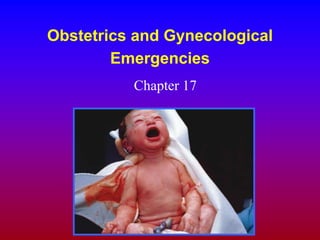
Obstetrics and Gynecological
Emergencies
Chapter 17
Topic Overview
• Reproductive Anatomy
• Normal Delivery
• Care/Resuscitation of Newborn
• Abnormal deliveries
• Predelivery emergencies
• Gynecologic emergencies
Anatomy
Childbirth
• Terms & Definitions
– Crowning
• When the presenting part of the baby first
bulges from the vaginal opening
– Cephalic presentation - Head first
– Breech presentation
• Limb
• Frank
LABOR
• First Stage
• Begins with regular contractions, then thinning and
gradual dilation of the cervix and ends when the
cervix if fully dilated
• Second Stage
• Begins when the baby’s head enters the birth canal
until the baby is born
• Third Stage
• Following the birth of the baby until the placenta is
delivered
Your Role
• Materials Needed
– Need OB kit (if available)
– Gloves
– Towels and drapes
– 4 x 4s
– Bulb syringe
– Umbilical tape or clamps
– Scissors or scalpel for cutting the cord
Childbirth
– A baby blanket
– Several sanitary napkins
– Plastic bag
– Standard BSI precautions
Childbirth Delivery Kit
Normal Delivery
• Transport Decision (911 Call)
– Based on evaluation
– Number of prior births
– Distance to hospital or birthing center
– Complications expected
• Delivery Precautions
– Use of BSI
– Keep mother out of bathroom
– Do not hold mother’s knees together
Childbirth
• Evaluating the Mother
– Patient name, age
– Which pregnancy?
– Gravida, Para and AB
– How long in labor
– Ask the patient if she feels the need to move
her bowels
– Check for Crowning**
– Time uterine contractions
Childbirth
– Vital signs if time allows
– Remember if this first baby and crowing or
urge to push is not present then transport can
be effect
– DO NOT LET MOTHER GO TO THE
BATHROOM
Childbirth
• Preparing for Delivery
– Control the scene
– BSI
– Position the patient
– Remove clothing that
can obstruct view of
delivery
– Create a sterile field
– Position OB kit or
available materials
Childbirth
The Delivery
Crowning of Infant’s Head
Delivery of Head - Prevent
Explosive Delivery
Delivery of the Head
Delivery Procedures
• If amniotic sac has not broken,
puncture sac and pull away
from baby's face.
• Determine if umbilical cord is
around baby’s neck. If so,
clamp and cut cord.
• Suction mouth, then
nose
• Aid in birth of upper
shoulder
• Support the trunk
• Support the legs
Childbirth
• Delivery Procedures
– Wipe blood, mucus from nose and mouth
– Suction
– Warmth is critical!
– Wrap baby in warm towel, head lower than
trunk
– Keep infant level with vagina until cord is cut
• Clamp or tie cord;
then cut
• Evaluate baby
• Observe for
delivery of
placenta
• When placneta
delivers, place in a
plastic bag for
transport to hospital
Childbirth
– After Delivery Procedures
• Control vaginal bleeding after delivery
– DO PLACE ANYTHING IN THE VAGINA
– Place a sanitary napkin over the vaginal opening
– Have mother lower her legs
• **Massage the fundus
• **Nursing the baby can help the uterus contract and
return to normal
– Record time of delivery
Childbirth
• Vaginal Bleeding
– A loss of 55 cc is well tolerated.
– Treat for shock
Care of Newborn
• Position, dry, wipe, wrap
• Repeat clearing airway (suction)
• Cover the head
Normal Assessment
Findings Newborn
Appearance
Pulse
Grimace
Activity
Respiratory
effort
=
=
=
=
=
A
P
G
A
R
Color: No central cyanosis
Greater than 100/min.
Vigorous & crying
Good extremity motion
Normal, crying
Childbirth
Sign 0 1 2
Appearance
(Skin Color)
Blue/Pale Body Pink
Extremities
Blue
Completely
pink
Pulse Rate Absent Below 100 Above 100
Grimace No
Response
Grimaces Cries
Activity Limp Some
flexion of
extremities
Active
motion
Respiratory Absent Slow and
irregular
Strong Cry
Total Score
Resuscitation
of the Newborn
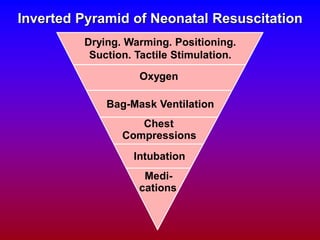
Inverted Pyramid of Neonatal Resuscitation
Drying. Warming. Positioning.
Suction. Tactile Stimulation.
Oxygen
Intubation
Medi-
cations
Bag-Mask Ventilation
Chest
Compressions
Breathing Effort
 If shallow, slow, or absent:
• Provide artificial ventilations,
40-60/minute.
• Reassess after 30 seconds.
• Continue as necessary.
Heart Rate
 If less than 100/minute:
• Provide artificial ventilations,
40-60/minute.
• Reassess after 30 seconds.
• If no improvement, continue
ventilations.
(Continued)
Heart Rate
 If less than 60-80/minute and
not responding to ventilation:
• Start chest compressions.
(Continued)
Heart Rate
If at any time the heart rate is less
than 60, begin ventilations and
compressions immediately.
Color
If central (trunk) cyanosis is
present with adequate breathing
and heart rate, administer
blow-by oxygen.
Childbirth
Complications / Abnormal
Deliveries
Complications
• Supine Hypotensive Syndrome
– The weight of the baby, placenta and
amniotic fluid can compress the vena cava
– Care
• Place mother on lateral left side
Complications
• Breach Birth
–Baby’s buttocks or lower extremities
presenting
• Greater risk of trauma, prolapsed cord
– Care
• Never pull on the babies legs
• High flow oxygen
• Place mother in head-down position with hips
elevated
Complications
– If body delivers support the body and
prevent an explosive delivery of the head
– If necessary to create an airway, place two
fingers of gloved hand into vagina making
a “V” with your fingers to create an airway.
Hope position until EMS arrives or baby
delivers
Complications
• Prolapsed Umbilical Cord
– Mother in head down and buttocks up
(kneeling with buttocks up)
– High flow oxygen
– Check cord for a pulse
– Wrap the cord in a towel to keep warm
– Insert gloved fingers in the vaginal and
pressure gently on the babies head or
buttocks to take pressure off the cord
Complications
• Limb Presentation
– High flow oxygen
– Do Not pull on the baby
Complications
• Multiple Births
– Delivery procedures the same for each
birth
• Prepare for multiple resuscitations
– Clamp the cord of the first baby
– 2nd baby may be born before or after the
placenta
– Care for first infant
– Maintain body temperature of the infants
Complications
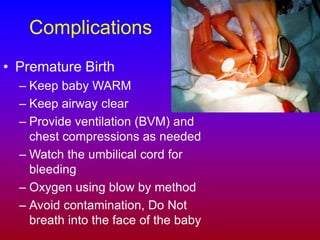
• Premature Birth
– Keep baby WARM
– Keep airway clear
– Provide ventilation (BVM) and
chest compressions as needed
– Watch the umbilical cord for
bleeding
– Oxygen using blow by method
– Avoid contamination, Do Not
breath into the face of the baby
Complications
• Pre-birth bleeding
– If you have any pre-birth bleeding place a
pad at the opening of the vagina
– Save any tissue which is passed
• Meconium
– Green or brown amniotic fluid indicates
presence of fecal matter
– Suggests fetal distress during labor
Complications
• Pre-Eclampsia
– High blood pressure and swelling of the
extremities
– The pregnant female needs to be
monitored closely
• Eclampsia
– Seizures during pregnancy
– Seizures are a dire emergency
– Mother should be transported by EMS
– Administer high-flow oxygen
Complications
• Fetal tissue goes to hospital
– Provide emotional support for mother
Complications
• Miscarriage (Spontaneous Abortion)
– Complete patient assessment
– treatment based on assessment
– 911 (Save all tissue expelled)
– Vital Signs
– Treat for shock
– Place a napkin over the vaginal opening
– Replace all blood soaked pads and keep
– Emotional support for the patient
Obstetrics and Gynecological
Emergencies
Trauma In Pregnancy- Patient Assessment
– Pulse will be 10-15 beats higher
– A pregnant female has 30-35% more blood
so signs of shock will be delayed
– Ask patient about any blows to the back,
pelvis or abdomen
– Ask if the patient is bleeding or has any
discharge (water has broken)
Obstetrics and Gynecological
Emergencies
Treatment for Pregnant Trauma Patient
– High flow oxygen
– Be ready to suction due due to nausea and
possible vomiting
– Activate EMS
– Provide emotional support
Gynecological Emergencies
Vaginal Bleeding
Can be potentially life-threatening
– Follow BSI precautions
– Assure airway
– Assess and treat for shock
– Provide oxygen
– Activate EMS if bleeding is severe
Gynecological Emergencies
Trauma to the External Genitalia
– Scene size up and look at the mechanism
of injury
– During initial assessment look for signs of
shock
– Treat like any soft-tissue injury
• Control bleeding with direct pressure
• Never pack vagina
– If signs of shock high flow O2
Gynecological Emergencies
Sexual Assault
– Treat scene as a crime scene
– Complete patient assessment and care
• Take care not to destroy evidence on the scene
• Activate EMS
– Provide comfort for the patient
– Non-judgemental attitude
– Psychological care required
Gynecological Emergencies
Sexual Assault
– Preserve potential evidence
– Discourage patient from bathing, voiding
Review Questions
• Describe the anatomy of the reproductive
system
• List the items you will need in a childbirth
kit
• What factors will determine whether 911
should transport or deliver at scene
Review Questions
• Describe the normal delivery process
• Describe the APGAR scoring system
• Describe the following, and the care for
each:
– Limb presentation
– Prolapsed cord
– Breech presentation
– Meconium

Childbirth_sum05Pic.ppt

  • 1.
  • 2.
    Topic Overview • ReproductiveAnatomy • Normal Delivery • Care/Resuscitation of Newborn • Abnormal deliveries • Predelivery emergencies • Gynecologic emergencies
  • 4.
  • 5.
    Childbirth • Terms &Definitions – Crowning • When the presenting part of the baby first bulges from the vaginal opening – Cephalic presentation - Head first – Breech presentation • Limb • Frank
  • 6.
    LABOR • First Stage •Begins with regular contractions, then thinning and gradual dilation of the cervix and ends when the cervix if fully dilated • Second Stage • Begins when the baby’s head enters the birth canal until the baby is born • Third Stage • Following the birth of the baby until the placenta is delivered
  • 7.
    Your Role • MaterialsNeeded – Need OB kit (if available) – Gloves – Towels and drapes – 4 x 4s – Bulb syringe – Umbilical tape or clamps – Scissors or scalpel for cutting the cord
  • 8.
    Childbirth – A babyblanket – Several sanitary napkins – Plastic bag – Standard BSI precautions
  • 9.
  • 10.
    Normal Delivery • TransportDecision (911 Call) – Based on evaluation – Number of prior births – Distance to hospital or birthing center – Complications expected • Delivery Precautions – Use of BSI – Keep mother out of bathroom – Do not hold mother’s knees together
  • 11.
    Childbirth • Evaluating theMother – Patient name, age – Which pregnancy? – Gravida, Para and AB – How long in labor – Ask the patient if she feels the need to move her bowels – Check for Crowning** – Time uterine contractions
  • 12.
    Childbirth – Vital signsif time allows – Remember if this first baby and crowing or urge to push is not present then transport can be effect – DO NOT LET MOTHER GO TO THE BATHROOM
  • 13.
    Childbirth • Preparing forDelivery – Control the scene – BSI – Position the patient – Remove clothing that can obstruct view of delivery – Create a sterile field – Position OB kit or available materials
  • 14.
  • 15.
  • 16.
    Delivery of Head- Prevent Explosive Delivery
  • 17.
  • 18.
    Delivery Procedures • Ifamniotic sac has not broken, puncture sac and pull away from baby's face. • Determine if umbilical cord is around baby’s neck. If so, clamp and cut cord.
  • 19.
    • Suction mouth,then nose • Aid in birth of upper shoulder
  • 20.
    • Support thetrunk • Support the legs
  • 21.
    Childbirth • Delivery Procedures –Wipe blood, mucus from nose and mouth – Suction – Warmth is critical! – Wrap baby in warm towel, head lower than trunk – Keep infant level with vagina until cord is cut
  • 22.
    • Clamp ortie cord; then cut • Evaluate baby
  • 23.
    • Observe for deliveryof placenta • When placneta delivers, place in a plastic bag for transport to hospital
  • 24.
    Childbirth – After DeliveryProcedures • Control vaginal bleeding after delivery – DO PLACE ANYTHING IN THE VAGINA – Place a sanitary napkin over the vaginal opening – Have mother lower her legs • **Massage the fundus • **Nursing the baby can help the uterus contract and return to normal – Record time of delivery
  • 25.
    Childbirth • Vaginal Bleeding –A loss of 55 cc is well tolerated. – Treat for shock
  • 27.
    Care of Newborn •Position, dry, wipe, wrap • Repeat clearing airway (suction) • Cover the head
  • 28.
    Normal Assessment Findings Newborn Appearance Pulse Grimace Activity Respiratory effort = = = = = A P G A R Color:No central cyanosis Greater than 100/min. Vigorous & crying Good extremity motion Normal, crying
  • 29.
    Childbirth Sign 0 12 Appearance (Skin Color) Blue/Pale Body Pink Extremities Blue Completely pink Pulse Rate Absent Below 100 Above 100 Grimace No Response Grimaces Cries Activity Limp Some flexion of extremities Active motion Respiratory Absent Slow and irregular Strong Cry Total Score
  • 30.
  • 31.
    Inverted Pyramid ofNeonatal Resuscitation Drying. Warming. Positioning. Suction. Tactile Stimulation. Oxygen Intubation Medi- cations Bag-Mask Ventilation Chest Compressions
  • 32.
    Breathing Effort  Ifshallow, slow, or absent: • Provide artificial ventilations, 40-60/minute. • Reassess after 30 seconds. • Continue as necessary.
  • 33.
    Heart Rate  Ifless than 100/minute: • Provide artificial ventilations, 40-60/minute. • Reassess after 30 seconds. • If no improvement, continue ventilations. (Continued)
  • 34.
    Heart Rate  Ifless than 60-80/minute and not responding to ventilation: • Start chest compressions. (Continued)
  • 35.
    Heart Rate If atany time the heart rate is less than 60, begin ventilations and compressions immediately.
  • 36.
    Color If central (trunk)cyanosis is present with adequate breathing and heart rate, administer blow-by oxygen.
  • 37.
  • 38.
    Complications • Supine HypotensiveSyndrome – The weight of the baby, placenta and amniotic fluid can compress the vena cava – Care • Place mother on lateral left side
  • 39.
    Complications • Breach Birth –Baby’sbuttocks or lower extremities presenting • Greater risk of trauma, prolapsed cord – Care • Never pull on the babies legs • High flow oxygen • Place mother in head-down position with hips elevated
  • 40.
    Complications – If bodydelivers support the body and prevent an explosive delivery of the head – If necessary to create an airway, place two fingers of gloved hand into vagina making a “V” with your fingers to create an airway. Hope position until EMS arrives or baby delivers
  • 41.
    Complications • Prolapsed UmbilicalCord – Mother in head down and buttocks up (kneeling with buttocks up) – High flow oxygen – Check cord for a pulse – Wrap the cord in a towel to keep warm – Insert gloved fingers in the vaginal and pressure gently on the babies head or buttocks to take pressure off the cord
  • 44.
    Complications • Limb Presentation –High flow oxygen – Do Not pull on the baby
  • 45.
    Complications • Multiple Births –Delivery procedures the same for each birth • Prepare for multiple resuscitations – Clamp the cord of the first baby – 2nd baby may be born before or after the placenta – Care for first infant – Maintain body temperature of the infants
  • 46.
    Complications • Premature Birth –Keep baby WARM – Keep airway clear – Provide ventilation (BVM) and chest compressions as needed – Watch the umbilical cord for bleeding – Oxygen using blow by method – Avoid contamination, Do Not breath into the face of the baby
  • 47.
    Complications • Pre-birth bleeding –If you have any pre-birth bleeding place a pad at the opening of the vagina – Save any tissue which is passed • Meconium – Green or brown amniotic fluid indicates presence of fecal matter – Suggests fetal distress during labor
  • 48.
    Complications • Pre-Eclampsia – Highblood pressure and swelling of the extremities – The pregnant female needs to be monitored closely • Eclampsia – Seizures during pregnancy – Seizures are a dire emergency – Mother should be transported by EMS – Administer high-flow oxygen
  • 49.
    Complications • Fetal tissuegoes to hospital – Provide emotional support for mother
  • 50.
    Complications • Miscarriage (SpontaneousAbortion) – Complete patient assessment – treatment based on assessment – 911 (Save all tissue expelled) – Vital Signs – Treat for shock – Place a napkin over the vaginal opening – Replace all blood soaked pads and keep – Emotional support for the patient
  • 51.
    Obstetrics and Gynecological Emergencies TraumaIn Pregnancy- Patient Assessment – Pulse will be 10-15 beats higher – A pregnant female has 30-35% more blood so signs of shock will be delayed – Ask patient about any blows to the back, pelvis or abdomen – Ask if the patient is bleeding or has any discharge (water has broken)
  • 52.
    Obstetrics and Gynecological Emergencies Treatmentfor Pregnant Trauma Patient – High flow oxygen – Be ready to suction due due to nausea and possible vomiting – Activate EMS – Provide emotional support
  • 53.
  • 54.
    Gynecological Emergencies Vaginal Bleeding Canbe potentially life-threatening – Follow BSI precautions – Assure airway – Assess and treat for shock – Provide oxygen – Activate EMS if bleeding is severe
  • 55.
    Gynecological Emergencies Trauma tothe External Genitalia – Scene size up and look at the mechanism of injury – During initial assessment look for signs of shock – Treat like any soft-tissue injury • Control bleeding with direct pressure • Never pack vagina – If signs of shock high flow O2
  • 56.
    Gynecological Emergencies Sexual Assault –Treat scene as a crime scene – Complete patient assessment and care • Take care not to destroy evidence on the scene • Activate EMS – Provide comfort for the patient – Non-judgemental attitude – Psychological care required
  • 57.
    Gynecological Emergencies Sexual Assault –Preserve potential evidence – Discourage patient from bathing, voiding
  • 58.
    Review Questions • Describethe anatomy of the reproductive system • List the items you will need in a childbirth kit • What factors will determine whether 911 should transport or deliver at scene
  • 59.
    Review Questions • Describethe normal delivery process • Describe the APGAR scoring system • Describe the following, and the care for each: – Limb presentation – Prolapsed cord – Breech presentation – Meconium