10/05/13 1
Hydraulic Fluid
Purpose & Properties
(Chapter 2)
10/05/13 2
Introduction
Fluids used in mobile and stationary
machinery must be effective in the
transmission of power from the source
to provide consistent and reliable
response, safe operation, and optimum
efficiency.
hydraulic fluids
a hydraulic fluid has four primary functions:
• Transmission of power
• Lubrication of moving parts
• Sealing of clearances between mating parts
• Dissipation of heat
essential properties of good
hydraulic fluid
• Good lubricity
• Ideal viscosity
• Chemical and environmental stability
• Large bulk modulus
• Fire resistance
• Good heat transfer capability
• Low density
• Foam resistance
• Non-toxicity
• Low volatility.
10/05/13 5
Compressibility
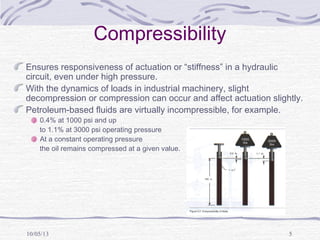
Ensures responsiveness of actuation or “stiffness” in a hydraulic
circuit, even under high pressure.
With the dynamics of loads in industrial machinery, slight
decompression or compression can occur and affect actuation slightly.
Petroleum-based fluids are virtually incompressible, for example.
0.4% at 1000 psi and up
to 1.1% at 3000 psi operating pressure
At a constant operating pressure
the oil remains compressed at a given value.
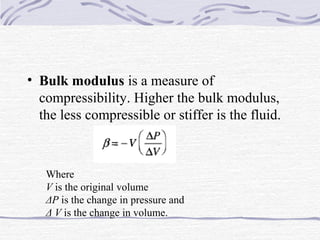
• Bulk modulus is a measure of
compressibility. Higher the bulk modulus,
the less compressible or stiffer is the fluid.
Where
V is the original volume
ΔP is the change in pressure and
Δ V is the change in volume.
10/05/13 7
Lubrication
All hydraulic systems have
components with moving parts that
have the potential to come in
contact with each other
Components need a lubricant to
prevent excess wear and the
production of excess heat
10/05/13 8
Sealing
Internal leakage is caused by
clearances inside hydraulic
components, affecting the efficiency
of systems
Internal leakage also has the potential
to create excess heat
10/05/13 9
Cooling
Any fluid used in hydraulic machinery
absorbs and carries heat away from heat
generating components such as cylinders
and pumps.
Some devices designed to maintain fluid
quality and ensure long trouble free
operation:
Baffled reservoirs
Coolers
Strainers
10/05/13 10
Fluid Properties
The fluids used in hydraulic systems must posses specific desirable
characteristics
It is sometimes necessary to compromise some properties in favor of
others that may be more important for a specific application
requirement; not all fluids have all the attributes in equal strength.
These properties include:
Viscosity and Viscosity Index
Pour Point
Lubricating Ability
Oxidation
Additives and Inhibitors
Rust and corrosion protection
Demulsibility
Fire resistance
10/05/13 11
Viscosity
Viscosity: Measure of the oil’s
resistance to flow.
Viscosity affects the fluid’s ability to be
pumped, transmitted through the
system, carry a load and maintain
separation between moving surfaces.
10/05/13 12
Viscosity too high (fluid is too thick)
(Problems)
High resistance to flow
Increased energy consumption due to increased friction,
increased input torque requirement at the pump
High temp. created by power loss to friction
Increased pressure drops due to increased resistance to
flow
Slow or sluggish operation/actuation
Inefficient separation of air from the oil in the reservoir
Pump cavitations
10/05/13 13
Viscosity too low (fluid is too thin)
Increased internal leakage
Excess wear, seizure, particularly of pumps, could
occur under heavy load because of a breakdown in
lubrication film between clearances of moving parts
Decreased pump effiency due to increased leakage &
possible cylinder blow-by. This could cause increased
cycle times or slower machine operation.
Internal leakage causing an increase in operating
temperatures.
Most hydraulic systems run with oil (150 – 300 SUS
or SSU) with the typical ISO viscosity grade (22 – 68)
10/05/13 14
Viscosity
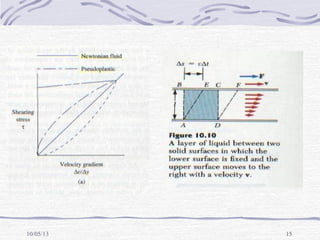
Coefficient of viscosity, dynamic viscosity, absolute
viscosity, or simply the viscosity of the fluid. (Same)
viscosity: resistance encountered when moving one
layer of liquid over another
μ = τ(Δy/Δυ) μ = (N*S)/m2
or Pa*s
Cgs system: use centipoise = poise/100
=0.001Pa*s
Usually given
10/05/13 15
10/05/13 16
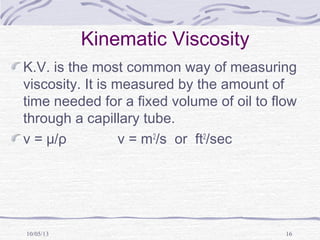
Kinematic Viscosity
K.V. is the most common way of measuring
viscosity. It is measured by the amount of
time needed for a fixed volume of oil to flow
through a capillary tube.
ν = μ/ρ ν = m2
/s or ft2
/sec
10/05/13 17
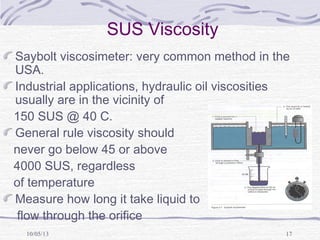
SUS Viscosity
Saybolt viscosimeter: very common method in the
USA.
Industrial applications, hydraulic oil viscosities
usually are in the vicinity of
150 SUS @ 40 C.
General rule viscosity should
never go below 45 or above
4000 SUS, regardless
of temperature
Measure how long it take liquid to
flow through the orifice
10/05/13 18
Viscosity Index
Viscosity index is an arbitrary number that
characterizes the variation of viscosity of a
fluid with variations of temperature.
fluid with a high viscosity index
exhibits a small change in
viscosity with temp.
fluid with a low viscosity index
exhibits a large change in
viscosity with temperature
10/05/13 19
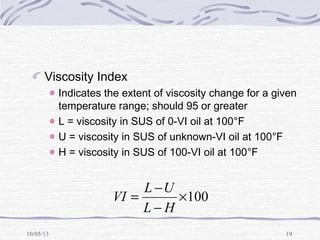
Viscosity Index
Indicates the extent of viscosity change for a given
temperature range; should 95 or greater
L = viscosity in SUS of 0-VI oil at 100°F
U = viscosity in SUS of unknown-VI oil at 100°F
H = viscosity in SUS of 100-VI oil at 100°F
100×
−
−
=
HL
UL
VI
10/05/13 20
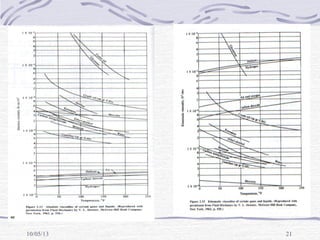
Viscosity & Temperature
Hydraulic oils is directly and sometimes
adversely affected by changes in temp.
For this reason, machinery should not
be put into high speed or heavily loaded
operation until the system fluid is
warmed up to operating temperatures
to provide adequate lubrication.
10/05/13 21
10/05/13 22
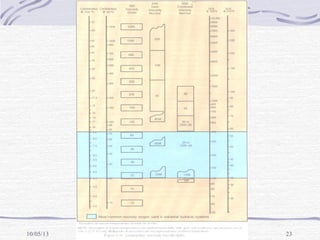
SAE
Viscosity
Number. &
ISO
Viscosity
Grades &
comparison
chart
10/05/13 23
10/05/13 24
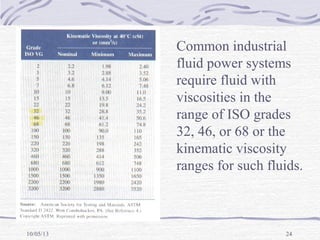
Common industrial
fluid power systems
require fluid with
viscosities in the
range of ISO grades
32, 46, or 68 or the
kinematic viscosity
ranges for such fluids.
10/05/13 25
Rust & Corrosion Protection
Corrosion is a chemical reaction between a metal and a
chemical – typically an acid
Extremely difficult to keep air and moisture out of hydraulic
systems
Both rust & corrosion contaminate the system & increase
component wear. Increase internal leakage past the
affected parts causing high temp. Cause components to
seize through heat & closure or running clearances with
debris
Particular care: Operating & cleaning equipment to prevent
the contamination of the hydraulic system with water or
cleaning solvents
10/05/13 26
Rust & Corrosion inhibitors
Rust inhibitors typically coat metal parts so natural air &
moisture do not interact with the metal to form oxide
compounds
Corrosive elements are often created through oxidation.
Care must be exercised whenever the hydraulic system
is exposed to atm. To min. the introduction of
incompatible elements that may react with the fluid
chemistry
Some materials such as alloys containing magnesium,
lead and zinc are very oxidize Should be avoided in
hydraulic systems
10/05/13 27
Pour Point
The pour point is:
lowest temperature at which an oil is
observed to flow
5°F (3°C) above the temperature at which
the oil in a test vessel shows no movement
when the container is held horizontally for
five seconds
Test Method ASTM D 97 (American Society for
Testing Materials)
10/05/13 28
Lubricating Ability
Lubricity is the ability of an oil to
lubricate hydraulic components with
adequate clearance to run a
substantial lubrication film.
Full-film lubrication and boundary
lubrication
10/05/13 29
Additives and Inhibitors
An additive is a chemical substance added to
fluid to improve certain properties.
An inhibitor is any substance that slows or
prevents chemical reactions, such as
corrosion or oxidation.
Some common additives and inhibitors:
anti-wear additives, antifoam agent, corrosion
inhibitor, demulsifier, EP additive, oxidation
inhibitor, pour point depressant, rust inhibitor

Hydrolic Fluid purpose & properties (chapter 2)

  • 1.
    10/05/13 1 Hydraulic Fluid Purpose& Properties (Chapter 2)
  • 2.
    10/05/13 2 Introduction Fluids usedin mobile and stationary machinery must be effective in the transmission of power from the source to provide consistent and reliable response, safe operation, and optimum efficiency.
  • 3.
    hydraulic fluids a hydraulicfluid has four primary functions: • Transmission of power • Lubrication of moving parts • Sealing of clearances between mating parts • Dissipation of heat
  • 4.
    essential properties ofgood hydraulic fluid • Good lubricity • Ideal viscosity • Chemical and environmental stability • Large bulk modulus • Fire resistance • Good heat transfer capability • Low density • Foam resistance • Non-toxicity • Low volatility.
  • 5.
    10/05/13 5 Compressibility Ensures responsivenessof actuation or “stiffness” in a hydraulic circuit, even under high pressure. With the dynamics of loads in industrial machinery, slight decompression or compression can occur and affect actuation slightly. Petroleum-based fluids are virtually incompressible, for example. 0.4% at 1000 psi and up to 1.1% at 3000 psi operating pressure At a constant operating pressure the oil remains compressed at a given value.
  • 6.
    • Bulk modulusis a measure of compressibility. Higher the bulk modulus, the less compressible or stiffer is the fluid. Where V is the original volume ΔP is the change in pressure and Δ V is the change in volume.
  • 7.
    10/05/13 7 Lubrication All hydraulicsystems have components with moving parts that have the potential to come in contact with each other Components need a lubricant to prevent excess wear and the production of excess heat
  • 8.
    10/05/13 8 Sealing Internal leakageis caused by clearances inside hydraulic components, affecting the efficiency of systems Internal leakage also has the potential to create excess heat
  • 9.
    10/05/13 9 Cooling Any fluidused in hydraulic machinery absorbs and carries heat away from heat generating components such as cylinders and pumps. Some devices designed to maintain fluid quality and ensure long trouble free operation: Baffled reservoirs Coolers Strainers
  • 10.
    10/05/13 10 Fluid Properties Thefluids used in hydraulic systems must posses specific desirable characteristics It is sometimes necessary to compromise some properties in favor of others that may be more important for a specific application requirement; not all fluids have all the attributes in equal strength. These properties include: Viscosity and Viscosity Index Pour Point Lubricating Ability Oxidation Additives and Inhibitors Rust and corrosion protection Demulsibility Fire resistance
  • 11.
    10/05/13 11 Viscosity Viscosity: Measureof the oil’s resistance to flow. Viscosity affects the fluid’s ability to be pumped, transmitted through the system, carry a load and maintain separation between moving surfaces.
  • 12.
    10/05/13 12 Viscosity toohigh (fluid is too thick) (Problems) High resistance to flow Increased energy consumption due to increased friction, increased input torque requirement at the pump High temp. created by power loss to friction Increased pressure drops due to increased resistance to flow Slow or sluggish operation/actuation Inefficient separation of air from the oil in the reservoir Pump cavitations
  • 13.
    10/05/13 13 Viscosity toolow (fluid is too thin) Increased internal leakage Excess wear, seizure, particularly of pumps, could occur under heavy load because of a breakdown in lubrication film between clearances of moving parts Decreased pump effiency due to increased leakage & possible cylinder blow-by. This could cause increased cycle times or slower machine operation. Internal leakage causing an increase in operating temperatures. Most hydraulic systems run with oil (150 – 300 SUS or SSU) with the typical ISO viscosity grade (22 – 68)
  • 14.
    10/05/13 14 Viscosity Coefficient ofviscosity, dynamic viscosity, absolute viscosity, or simply the viscosity of the fluid. (Same) viscosity: resistance encountered when moving one layer of liquid over another μ = τ(Δy/Δυ) μ = (N*S)/m2 or Pa*s Cgs system: use centipoise = poise/100 =0.001Pa*s Usually given
  • 15.
  • 16.
    10/05/13 16 Kinematic Viscosity K.V.is the most common way of measuring viscosity. It is measured by the amount of time needed for a fixed volume of oil to flow through a capillary tube. ν = μ/ρ ν = m2 /s or ft2 /sec
  • 17.
    10/05/13 17 SUS Viscosity Sayboltviscosimeter: very common method in the USA. Industrial applications, hydraulic oil viscosities usually are in the vicinity of 150 SUS @ 40 C. General rule viscosity should never go below 45 or above 4000 SUS, regardless of temperature Measure how long it take liquid to flow through the orifice
  • 18.
    10/05/13 18 Viscosity Index Viscosityindex is an arbitrary number that characterizes the variation of viscosity of a fluid with variations of temperature. fluid with a high viscosity index exhibits a small change in viscosity with temp. fluid with a low viscosity index exhibits a large change in viscosity with temperature
  • 19.
    10/05/13 19 Viscosity Index Indicatesthe extent of viscosity change for a given temperature range; should 95 or greater L = viscosity in SUS of 0-VI oil at 100°F U = viscosity in SUS of unknown-VI oil at 100°F H = viscosity in SUS of 100-VI oil at 100°F 100× − − = HL UL VI
  • 20.
    10/05/13 20 Viscosity &Temperature Hydraulic oils is directly and sometimes adversely affected by changes in temp. For this reason, machinery should not be put into high speed or heavily loaded operation until the system fluid is warmed up to operating temperatures to provide adequate lubrication.
  • 21.
  • 22.
  • 23.
  • 24.
    10/05/13 24 Common industrial fluidpower systems require fluid with viscosities in the range of ISO grades 32, 46, or 68 or the kinematic viscosity ranges for such fluids.
  • 25.
    10/05/13 25 Rust &Corrosion Protection Corrosion is a chemical reaction between a metal and a chemical – typically an acid Extremely difficult to keep air and moisture out of hydraulic systems Both rust & corrosion contaminate the system & increase component wear. Increase internal leakage past the affected parts causing high temp. Cause components to seize through heat & closure or running clearances with debris Particular care: Operating & cleaning equipment to prevent the contamination of the hydraulic system with water or cleaning solvents
  • 26.
    10/05/13 26 Rust &Corrosion inhibitors Rust inhibitors typically coat metal parts so natural air & moisture do not interact with the metal to form oxide compounds Corrosive elements are often created through oxidation. Care must be exercised whenever the hydraulic system is exposed to atm. To min. the introduction of incompatible elements that may react with the fluid chemistry Some materials such as alloys containing magnesium, lead and zinc are very oxidize Should be avoided in hydraulic systems
  • 27.
    10/05/13 27 Pour Point Thepour point is: lowest temperature at which an oil is observed to flow 5°F (3°C) above the temperature at which the oil in a test vessel shows no movement when the container is held horizontally for five seconds Test Method ASTM D 97 (American Society for Testing Materials)
  • 28.
    10/05/13 28 Lubricating Ability Lubricityis the ability of an oil to lubricate hydraulic components with adequate clearance to run a substantial lubrication film. Full-film lubrication and boundary lubrication
  • 29.
    10/05/13 29 Additives andInhibitors An additive is a chemical substance added to fluid to improve certain properties. An inhibitor is any substance that slows or prevents chemical reactions, such as corrosion or oxidation. Some common additives and inhibitors: anti-wear additives, antifoam agent, corrosion inhibitor, demulsifier, EP additive, oxidation inhibitor, pour point depressant, rust inhibitor