Hydraulic system Course
Presented by: Eng.Abubaker-A-Saad El noor
Customer Services Manager
Hydraulic Course
YOU WILL LEARN HOW TO
:
•
Identify hydraulic systems components
•
Describe essential hydraulic terms and understand their key applications
•
Recognized the impact hydraulic fluids have on components
• Describe the correct operation, control sequences and procedures
for the safe operation of various simple hydraulic systems
•
Initiate an effective inspection and maintenance program
•
Minimise forced outages and prevent serious damage to hydraulic equipment
•
Explain the latest technologies available for electro hydraulic systems
WHO SHOULD ATTEND
:
Hydraulic Course
• Plant Engineers
•
Operation, Maintenance, Inspection and Repair Managers, Supervisors and
Engineers
•
Mechanical Engineers
•
Design Engineers
•
Consulting Engineers
•
Plant Operations and Maintenance Personnel
•
Consulting Engineers
•
Process Technicians
•
Mechanical Technician
OBJECTIVES
Hydraulic Course
•
Work with basic hydraulic components
•
Understand how basic hydraulic components
function in a hydraulic circuit
•
Read Hydraulic schematics
•
Work safely with Hydraulic components and
systems
•
Troubleshoot simple hydraulics problems
•
Apply a simple preventative maintenance
program to lengthen hydraulic components life
•
Make simple repairs to hydraulic systems
After attending this highly practical two-day workshop you will be able to:
Introduction
Pressure and Force
Pascal's Law
Course Headlines
Hydraulic Basics Course
Part (1)
Fluid hydraulic
Introduction
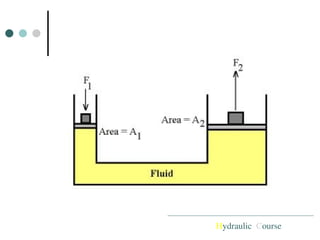
•Hydraulics is the science of transmitting force and/or motion through the
medium of a confined liquid. In a hydraulic device, power is transmitted by
pushing on a confined liquid.
•The word hydraulic is consist of (hydro)+(aulis) mean water + hose
• In 1948 Blaise Pascal discovered the following law :
(water transmit pressure equally through a container)
Pressure and Force
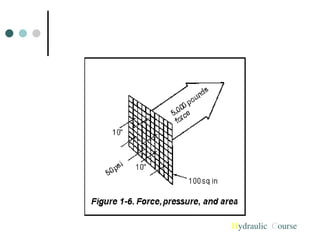
Pressure is force exerted against a specific area (force per unit area)
expressed in pounds per square inch (psi). Pressure can cause an
expansion, or resistance to compression, of a fluid that is being squeezed.
A fluid is any liquid or gas (vapor). Force is anything that tends to produce
or modify (push or pull) motion and is expressed in pounds
a. Pressure. An example of pressure is the air (gas) that fills an
automobile tire. As a tire is inflated, more air is squeezed into it than it
can hold. The air inside a tire resists the squeezing by pushing outward
on the casing of the tire. The outward push of the air is pressure. Equal
pressure throughout a confined area is a characteristic of any pressurized
fluid
.
Hydraulic Basics Course
For example, in an inflated tire, the outward push of the air is uniform throughout. If
it were not, a tire would be pushed into odd shapes because of its elasticity
.
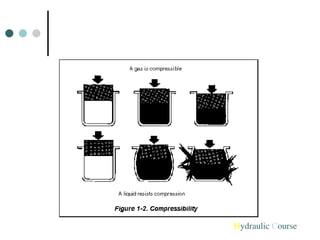
There is a major difference between a gas and a liquid. Liquids are slightly
compressible (Figure 1-2). When a confined liquid is pushed on, pressure builds up.
The pressure is still transmitted equally throughout the container. The fluid's
behavior makes it possible to transmit a push through pipes, around corners, and up
and down. A hydraulic system uses a liquid because its near incompressibility makes
the action instantaneous as long as the system is full of liquid
.
Hydraulic Course
Pressure and Force
Hydraulic Course
Hydraulic Course
•In 1795 Joseph Bramah successfully applied Pascal's Law,
Bernoulli total energy of liquid is constant
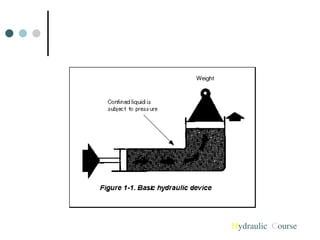
Figure 1-1 shows a simple hydraulic device. The transfer of energy
takes place because a quantity of liquid is subject to pressure. To
operate liquid-powered systems, the operator should have a
knowledge of the basic nature of liquids. This chapter covers the
properties of liquids and how they act under different conditions.
Pascal's law
Hydraulic Course
Hydraulic Course
Hydraulic oil and Fluid Properties
The board tasks of hydraulic oil can be classified boardly as follows:
• To transfer hydraulic energy.
•To lubricate all parts.
•To avoid corrosion.
•To remove impurities and abrasion.
•To dissipate heat.
Hydraulic Course
Selection Of Hydraulic Fluids
Hydraulic Course
When selecting a hydraulic fluid for a particular application, a number of
properties may need to be considered:
•Viscosity
•lubricity and wear reduction
•oxidation stability
•corrosion protection
•air and water separation characteristics
•bulk modulus (resistance to compression)
•pour point
•fire resistance
Viscosity
Hydraulic Basics Course
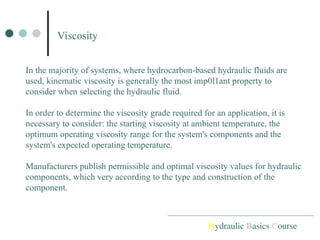
In the majority of systems, where hydrocarbon-based hydraulic fluids are
used, kinematic viscosity is generally the most imp0l1ant property to
consider when selecting the hydraulic fluid.
In order to determine the viscosity grade required for an application, it is
necessary to consider: the starting viscosity at ambient temperature, the
optimum operating viscosity range for the system's components and the
system's expected operating temperature.
Manufacturers publish permissible and optimal viscosity values for hydraulic
components, which very according to the type and construction of the
component.
MEASUREMENT OF VISCOSITY
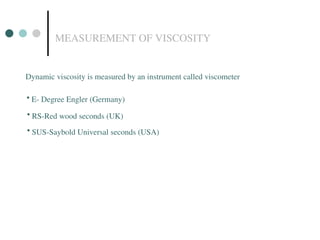
Dynamic viscosity is measured by an instrument called viscometer
• E- Degree Engler (Germany)
• RS-Red wood seconds (UK)
• SUS-Saybold Universal seconds (USA)
ISO VISCOSITY GRADE
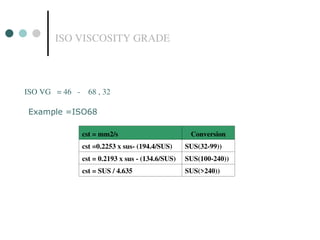
ISO VG = 46 - 68 , 32
Example =ISO68
Conversion
cst = mm2/s
SUS(32-99))
cst =0.2253 x sus- (194.4/SUS)
SUS(100-240))
cst = 0.2193 x sus - (134.6/SUS)
SUS(>240))
cst = SUS / 4.635
Hydraulic Course
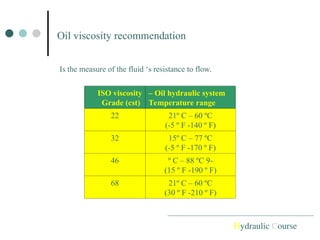
Oil hydraulic system
–
Temperature range
ISO viscosity
Grade (cst)
21º C – 60 ºC
(-5 º F -140 º F)
22
15º C – 77 ºC
(-5 º F -170 º F)
32
-
9
º C – 88 ºC
(15 º F -190 º F)
46
21º C – 60 ºC
(30 º F -210 º F)
68
Is the measure of the fluid ‘s resistance to flow.
Oil viscosity recommendation

Identify hydraulic systems components • Describe essential hydraulic terms

  • 1.
    Hydraulic system Course Presentedby: Eng.Abubaker-A-Saad El noor Customer Services Manager
  • 2.
    Hydraulic Course YOU WILLLEARN HOW TO : • Identify hydraulic systems components • Describe essential hydraulic terms and understand their key applications • Recognized the impact hydraulic fluids have on components • Describe the correct operation, control sequences and procedures for the safe operation of various simple hydraulic systems • Initiate an effective inspection and maintenance program • Minimise forced outages and prevent serious damage to hydraulic equipment • Explain the latest technologies available for electro hydraulic systems
  • 3.
    WHO SHOULD ATTEND : HydraulicCourse • Plant Engineers • Operation, Maintenance, Inspection and Repair Managers, Supervisors and Engineers • Mechanical Engineers • Design Engineers • Consulting Engineers • Plant Operations and Maintenance Personnel • Consulting Engineers • Process Technicians • Mechanical Technician
  • 4.
    OBJECTIVES Hydraulic Course • Work withbasic hydraulic components • Understand how basic hydraulic components function in a hydraulic circuit • Read Hydraulic schematics • Work safely with Hydraulic components and systems • Troubleshoot simple hydraulics problems • Apply a simple preventative maintenance program to lengthen hydraulic components life • Make simple repairs to hydraulic systems After attending this highly practical two-day workshop you will be able to:
  • 5.
    Introduction Pressure and Force Pascal'sLaw Course Headlines Hydraulic Basics Course Part (1) Fluid hydraulic
  • 6.
    Introduction •Hydraulics is thescience of transmitting force and/or motion through the medium of a confined liquid. In a hydraulic device, power is transmitted by pushing on a confined liquid. •The word hydraulic is consist of (hydro)+(aulis) mean water + hose • In 1948 Blaise Pascal discovered the following law : (water transmit pressure equally through a container)
  • 7.
    Pressure and Force Pressureis force exerted against a specific area (force per unit area) expressed in pounds per square inch (psi). Pressure can cause an expansion, or resistance to compression, of a fluid that is being squeezed. A fluid is any liquid or gas (vapor). Force is anything that tends to produce or modify (push or pull) motion and is expressed in pounds a. Pressure. An example of pressure is the air (gas) that fills an automobile tire. As a tire is inflated, more air is squeezed into it than it can hold. The air inside a tire resists the squeezing by pushing outward on the casing of the tire. The outward push of the air is pressure. Equal pressure throughout a confined area is a characteristic of any pressurized fluid . Hydraulic Basics Course
  • 8.
    For example, inan inflated tire, the outward push of the air is uniform throughout. If it were not, a tire would be pushed into odd shapes because of its elasticity . There is a major difference between a gas and a liquid. Liquids are slightly compressible (Figure 1-2). When a confined liquid is pushed on, pressure builds up. The pressure is still transmitted equally throughout the container. The fluid's behavior makes it possible to transmit a push through pipes, around corners, and up and down. A hydraulic system uses a liquid because its near incompressibility makes the action instantaneous as long as the system is full of liquid . Hydraulic Course Pressure and Force
  • 9.
  • 10.
  • 11.
    •In 1795 JosephBramah successfully applied Pascal's Law, Bernoulli total energy of liquid is constant Figure 1-1 shows a simple hydraulic device. The transfer of energy takes place because a quantity of liquid is subject to pressure. To operate liquid-powered systems, the operator should have a knowledge of the basic nature of liquids. This chapter covers the properties of liquids and how they act under different conditions. Pascal's law
  • 12.
  • 13.
  • 14.
    Hydraulic oil andFluid Properties The board tasks of hydraulic oil can be classified boardly as follows: • To transfer hydraulic energy. •To lubricate all parts. •To avoid corrosion. •To remove impurities and abrasion. •To dissipate heat. Hydraulic Course
  • 15.
    Selection Of HydraulicFluids Hydraulic Course When selecting a hydraulic fluid for a particular application, a number of properties may need to be considered: •Viscosity •lubricity and wear reduction •oxidation stability •corrosion protection •air and water separation characteristics •bulk modulus (resistance to compression) •pour point •fire resistance
  • 16.
    Viscosity Hydraulic Basics Course Inthe majority of systems, where hydrocarbon-based hydraulic fluids are used, kinematic viscosity is generally the most imp0l1ant property to consider when selecting the hydraulic fluid. In order to determine the viscosity grade required for an application, it is necessary to consider: the starting viscosity at ambient temperature, the optimum operating viscosity range for the system's components and the system's expected operating temperature. Manufacturers publish permissible and optimal viscosity values for hydraulic components, which very according to the type and construction of the component.
  • 17.
    MEASUREMENT OF VISCOSITY Dynamicviscosity is measured by an instrument called viscometer • E- Degree Engler (Germany) • RS-Red wood seconds (UK) • SUS-Saybold Universal seconds (USA)
  • 18.
    ISO VISCOSITY GRADE ISOVG = 46 - 68 , 32 Example =ISO68 Conversion cst = mm2/s SUS(32-99)) cst =0.2253 x sus- (194.4/SUS) SUS(100-240)) cst = 0.2193 x sus - (134.6/SUS) SUS(>240)) cst = SUS / 4.635
  • 19.
    Hydraulic Course Oil hydraulicsystem – Temperature range ISO viscosity Grade (cst) 21º C – 60 ºC (-5 º F -140 º F) 22 15º C – 77 ºC (-5 º F -170 º F) 32 - 9 º C – 88 ºC (15 º F -190 º F) 46 21º C – 60 ºC (30 º F -210 º F) 68 Is the measure of the fluid ‘s resistance to flow. Oil viscosity recommendation