


INTRODUCTION (Contd…)
                                      Lecture # 01 (b)

                                      CONTENTS OF TODAY’S LECTURE:
                                      • Physical properties of Fluids
                                       Density
                                       Specific Weight
                                       Specific Volume
FLUID MECHANICS-I                      Specific gravity
                                       Surface tension
CE-224


Engr. Fazal-E-Jalal
   Prepared by: Engr. Fazal-E-Jalal     Fluid Mechanics-I               1
Distinction between a Solid & Fluid
• Molecules of solid are usually closer together
  than those of a fluid.
• The attractive forces between the molecules
  of a solid are so large that a solid tends to
  retain its shape.
• In case of fluids, the attractive forces between
  the molecules are smaller.


Prepared by: Engr. Fazal-E-Jalal   Fluid Mechanics-I   2
Distinction between a Solid & Fluid
• An ideal elastic solid will deform under load
  and once load is removed will return to it’s
  original state. Plastic solids deform under
  action of applied loads and deformation
  continues as long as load is applied, providing
  the material does not rupture.
 The intermolecular cohesive forces in a fluid are not great
 enough to hold various elements of fluid together. Hence a
 fluid will flow under the action of slightest stress and flow will
 continue as the stress is present.
Prepared by: Engr. Fazal-E-Jalal   Fluid Mechanics-I             3
Distinction between a Gas and a Liquid
• A fluid may be either gas or a liquid. Gas
  molecules are much farther than those of a
  liquid. Hence a gas is very compressible. On
  removal of external pressure, it expands
  indefinitely.
• A liquid is relatively incompressible. If all
  pressure (except that of it’s vapor pressure) is
  removed, it does not expand but the cohesion
  holds the molecules together.
  Therefore a liquid may have FREE SURFACE i.e. a surface from which all
  pressure is removed, except that of it’s own vapor.
Prepared by: Engr. Fazal-E-Jalal   Fluid Mechanics-I                       4
Distinction between a Gas and a Liquid
• A vapor is a gas whose temperature and
  pressure are such that it is very near the liquid
  phase.
• Thus, steam is considered as a vapor because
  it’s state is not normally far from water.
     A Gas may be defined as:
     “A highly super-heated vapor, that is, it’s
     state is far removed from a liquid phase.”
     Thus, air is a gas.
Prepared by: Engr. Fazal-E-Jalal   Fluid Mechanics-I   5
Distinction between a Gas and a Liquid
• The volume of gas or liquid is greatly affected
  by changes in pressure or temperature or
  both.
• Whenever significant temperature or phase
  changes are involved in dealing with vapors
  and gases, the subject is largely dependent on
  heat phenomenon (Thermodynamics).
• Thus Fluid mechanics & Thermodynamics are
  inter related.

Prepared by: Engr. Fazal-E-Jalal   Fluid Mechanics-I   6
Density and Specific weight
• The density ƿ (rho) or mass density of a fluid is
  mass per unit volume while the specific weight ɣ
  (gamma)is it’s weight per unit volume. Specific
  wt. is the force exerted by gravity on unit weight
  of fluid.
• Units of Density: Slugs/ft3 (B.G system) and kg/m3
  (S.I system). Also, can be expressed as lb.sec2/ft4
  or N.s2/m4
• Units of Specific weight: lb/ft3 (B.G system) and
  N/m3 (S.I system).
Prepared by: Engr. Fazal-E-Jalal   Fluid Mechanics-I   7
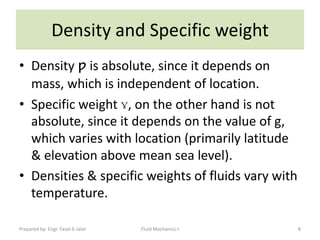
Density and Specific weight
• Density ƿ is absolute, since it depends on
  mass, which is independent of location.
• Specific weight ɣ, on the other hand is not
  absolute, since it depends on the value of g,
  which varies with location (primarily latitude
  & elevation above mean sea level).
• Densities & specific weights of fluids vary with
  temperature.

Prepared by: Engr. Fazal-E-Jalal   Fluid Mechanics-I   8
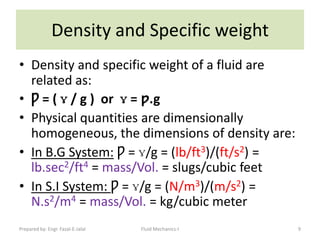
Density and Specific weight
• Density and specific weight of a fluid are
  related as:
• Ƿ = ( ɣ / g ) or ɣ = ƿ.g
• Physical quantities are dimensionally
  homogeneous, the dimensions of density are:
• In B.G System: Ƿ = ɣ/g = (lb/ft3)/(ft/s2) =
  lb.sec2/ft4 = mass/Vol. = slugs/cubic feet
• In S.I System: Ƿ = ɣ/g = (N/m3)/(m/s2) =
  N.s2/m4 = mass/Vol. = kg/cubic meter
Prepared by: Engr. Fazal-E-Jalal   Fluid Mechanics-I   9
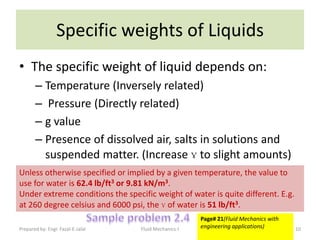
Specific weights of Liquids
• The specific weight of liquid depends on:
       – Temperature (Inversely related)
       – Pressure (Directly related)
       – g value
       – Presence of dissolved air, salts in solutions and
         suspended matter. (Increase ɣ to slight amounts)
Unless otherwise specified or implied by a given temperature, the value to
use for water is 62.4 lb/ft3 or 9.81 kN/m3.
Under extreme conditions the specific weight of water is quite different. E.g.
at 260 degree celsius and 6000 psi, the ɣ of water is 51 lb/ft3.
                                                       Page# 21(Fluid Mechanics with
Prepared by: Engr. Fazal-E-Jalal   Fluid Mechanics-I   engineering applications)       10
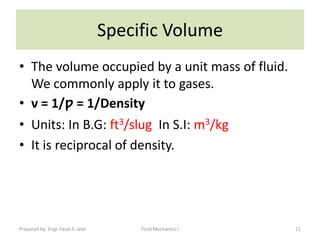
Specific Volume
• The volume occupied by a unit mass of fluid.
  We commonly apply it to gases.
• ν = 1/ƿ = 1/Density
• Units: In B.G: ft3/slug In S.I: m3/kg
• It is reciprocal of density.


Prepared by: Engr. Fazal-E-Jalal        Fluid Mechanics-I   11
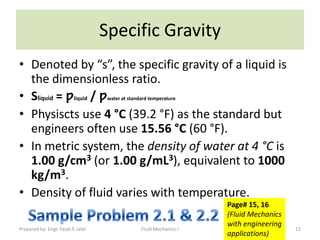
Specific Gravity
• Denoted by “s”, the specific gravity of a liquid is
  the dimensionless ratio.
• Sliquid = ƿliquid / ƿ             water at standard temperature


• Physiscts use 4 °C (39.2 °F) as the standard but
  engineers often use 15.56 °C (60 °F).
• In metric system, the density of water at 4 °C is
  1.00 g/cm3 (or 1.00 g/mL3), equivalent to 1000
  kg/m3.
• Density of fluid varies with temperature.
                                                                      Page# 15, 16
                                                                      (Fluid Mechanics
                                                                      with engineering
Prepared by: Engr. Fazal-E-Jalal                  Fluid Mechanics-I                      12
                                                                      applications)
Practice Problems
•    2.3.1
•    2.3.2                         (Fluid
•    2.3.3                         Mechanics with
•    2.3.4
•    2.3.5
                                   engineering
•    2.3.6                         applications)
•    2.3.7

Prepared by: Engr. Fazal-E-Jalal         Fluid Mechanics-I   13
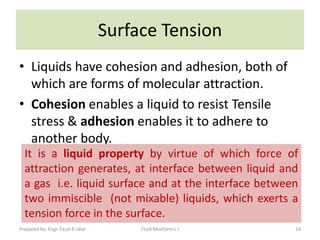
Surface Tension
• Liquids have cohesion and adhesion, both of
  which are forms of molecular attraction.
• Cohesion enables a liquid to resist Tensile
  stress & adhesion enables it to adhere to
  another body.
  It is a liquid property by virtue of which force of
  attraction generates, at interface between liquid and
  a gas i.e. liquid surface and at the interface between
  two immiscible (not mixable) liquids, which exerts a
  tension force in the surface.
Prepared by: Engr. Fazal-E-Jalal        Fluid Mechanics-I   14
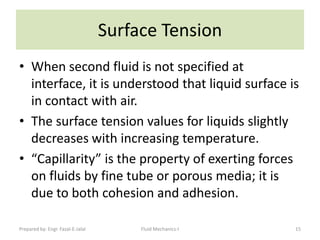
Surface Tension
• When second fluid is not specified at
  interface, it is understood that liquid surface is
  in contact with air.
• The surface tension values for liquids slightly
  decreases with increasing temperature.
• “Capillarity” is the property of exerting forces
  on fluids by fine tube or porous media; it is
  due to both cohesion and adhesion.

Prepared by: Engr. Fazal-E-Jalal        Fluid Mechanics-I   15
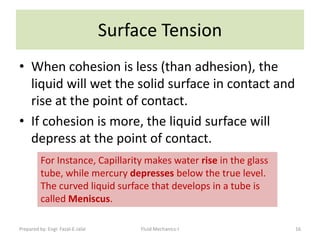
Surface Tension
• When cohesion is less (than adhesion), the
  liquid will wet the solid surface in contact and
  rise at the point of contact.
• If cohesion is more, the liquid surface will
  depress at the point of contact.
          For Instance, Capillarity makes water rise in the glass
          tube, while mercury depresses below the true level.
          The curved liquid surface that develops in a tube is
          called Meniscus.

Prepared by: Engr. Fazal-E-Jalal        Fluid Mechanics-I           16
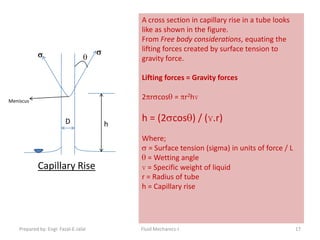
A cross section in capillary rise in a tube looks
                                           like as shown in the figure.
                                           From Free body considerations, equating the
                                           lifting forces created by surface tension to
                                           gravity force.

                                           Lifting forces = Gravity forces

Meniscus
                                           2 r cos = r2hɣ


                          D            h
                                           h = (2 cos ) / (ɣ.r)
                                           Where;
                                              = Surface tension (sigma) in units of force / L
                                             = Wetting angle
             Capillary Rise                ɣ = Specific weight of liquid
                                           r = Radius of tube
                                           h = Capillary rise


    Prepared by: Engr. Fazal-E-Jalal       Fluid Mechanics-I                                    17
Surface Tension
• The expression h = (2 cos ) / (ɣ.r) can be used to
  compute the approximate capillary rise or
  depression in the tube.
• If the tube is clean, = 0 degree for water and
  about 140 degrees for mercury.
• The equation overestimates the amount of
  capillary rise or depression, particularly for larger
  diameter tubes.
• For tube diameters larger than 0.5 inch, capillary
  effects are negligible.
Prepared by: Engr. Fazal-E-Jalal        Fluid Mechanics-I   18
Surface Tension
• Surface tension effects are generally negligible
  in most engineering situations. However, they
  can be important in problems involving
  capillary rise.
                                     As in soil water zone, without capillary
                                     most forms of vegetable life would
                                     perish. Similarly, while calculating
                                     pressures and taking reading one shall
                                     keep in mind that reading is correct if
                                     and only surface tension effect is zero.


Prepared by: Engr. Fazal-E-Jalal           Fluid Mechanics-I                    19
Surface Tension
• These effects are also important in hydraulic
  model studies when the model is small, in the
  break up of liquid jets, and in the formation of
  drops and bubbles.
• The formation of drops is extremely complex
  to analyze but is, for example, of critical
  concern in the design of inkjet printers, a
  multi-billion-dollar business.
                                                            Page# 39 (Fluid Mechanics
                                                            with engineering
                                                            applications)
Prepared by: Engr. Fazal-E-Jalal        Fluid Mechanics-I                               20
Practice Problems
•    2.12.1
•    2.12.2
                                        (Fluid Mechanics
•    2.12.3                             with engineering
•    2.12.4                             applications)
•    2.12.5


Prepared by: Engr. Fazal-E-Jalal         Fluid Mechanics-I   21
Standard Atmosphere
• First adopted in 1920’s in USA and Europe to
  satisfy need for standardization of aircraft
  instruments and aircraft performance.
• ICAO (International Civil Aviation
  Organization) Standard Atmosphere
       – Upto 32 km
• ISO (International Standards Organization)
  Standard Atmosphere.
       – Upto 50 km

Prepared by: Engr. Fazal-E-Jalal   Fluid Mechanics-I   22
Standard Atmosphere
• U.S Standard Atmosphere: (Last revised in
  1976). Incorporates ICAO and ISO standards.
       – Upto 86 km (and extends as far as 1000 km for
         some quantities)

     The standard absolute pressure behave very
     differently from temperature, decreasing quite
     rapidly and smoothly to almost zero at an altitude
     30 km.

Prepared by: Engr. Fazal-E-Jalal   Fluid Mechanics-I      23
Standard Atmosphere
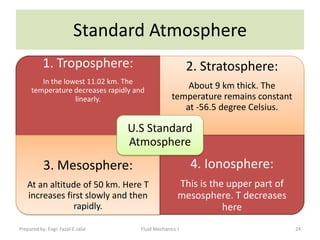
           1. Troposphere:                               2. Stratosphere:
        In the lowest 11.02 km. The
     temperature decreases rapidly and
                                                      About 9 km thick. The
                  linearly.                       temperature remains constant
                                                     at -56.5 degree Celsius.

                                   U.S Standard
                                   Atmosphere
           3. Mesosphere:                                4. Ionosphere:
   At an altitude of 50 km. Here T                   This is the upper part of
   increases first slowly and then                   mesosphere. T decreases
                rapidly.                                        here
Prepared by: Engr. Fazal-E-Jalal     Fluid Mechanics-I                           24
Vapor Pressure of Liquids
• All liquids tend to evaporate or
  vaporize, which they do by projecting
  molecules into the space above their surfaces.
• If this is a confined space, the partial pressure
  exerted by the molecules increases until the
  rate at which the molecules re-enter the liquid
  = the rate at which they leave, we call the
  vapor pressure as Saturation pressure.

Prepared by: Engr. Fazal-E-Jalal   Fluid Mechanics-I   25
Vapor Pressure of Liquids
 • At any given temperature, if the pressure on
   the liquid surface falls below the saturation
   pressure, a rapid rate of evaporation results,
   known as Boiling.
        – Thus we can refer to the saturation pressure as
          the Boiling pressure for a given temperature, and
          it is of practical importance for liquids.
We call the rapid vaporization and recondensation of liquid as it briefly passes
through a region of low absolute pressure cavitation. This phenomenon is often
very damaging and so we must avoid it.

 Prepared by: Engr. Fazal-E-Jalal   Fluid Mechanics-I                         26
Vapor Pressures of Liquids
• The very low vapor pressure of mercury makes
  it particularly suitable for use in Barometers.


Prepared by: Engr. Fazal-E-Jalal   Fluid Mechanics-I   27
Prepared by: Engr. Fazal-E-Jalal   Fluid Mechanics-I   28

1b. introduction

  • 1.
    INTRODUCTION (Contd…) Lecture # 01 (b) CONTENTS OF TODAY’S LECTURE: • Physical properties of Fluids  Density  Specific Weight  Specific Volume FLUID MECHANICS-I  Specific gravity  Surface tension CE-224 Engr. Fazal-E-Jalal Prepared by: Engr. Fazal-E-Jalal Fluid Mechanics-I 1
  • 2.
    Distinction between aSolid & Fluid • Molecules of solid are usually closer together than those of a fluid. • The attractive forces between the molecules of a solid are so large that a solid tends to retain its shape. • In case of fluids, the attractive forces between the molecules are smaller. Prepared by: Engr. Fazal-E-Jalal Fluid Mechanics-I 2
  • 3.
    Distinction between aSolid & Fluid • An ideal elastic solid will deform under load and once load is removed will return to it’s original state. Plastic solids deform under action of applied loads and deformation continues as long as load is applied, providing the material does not rupture. The intermolecular cohesive forces in a fluid are not great enough to hold various elements of fluid together. Hence a fluid will flow under the action of slightest stress and flow will continue as the stress is present. Prepared by: Engr. Fazal-E-Jalal Fluid Mechanics-I 3
  • 4.
    Distinction between aGas and a Liquid • A fluid may be either gas or a liquid. Gas molecules are much farther than those of a liquid. Hence a gas is very compressible. On removal of external pressure, it expands indefinitely. • A liquid is relatively incompressible. If all pressure (except that of it’s vapor pressure) is removed, it does not expand but the cohesion holds the molecules together. Therefore a liquid may have FREE SURFACE i.e. a surface from which all pressure is removed, except that of it’s own vapor. Prepared by: Engr. Fazal-E-Jalal Fluid Mechanics-I 4
  • 5.
    Distinction between aGas and a Liquid • A vapor is a gas whose temperature and pressure are such that it is very near the liquid phase. • Thus, steam is considered as a vapor because it’s state is not normally far from water. A Gas may be defined as: “A highly super-heated vapor, that is, it’s state is far removed from a liquid phase.” Thus, air is a gas. Prepared by: Engr. Fazal-E-Jalal Fluid Mechanics-I 5
  • 6.
    Distinction between aGas and a Liquid • The volume of gas or liquid is greatly affected by changes in pressure or temperature or both. • Whenever significant temperature or phase changes are involved in dealing with vapors and gases, the subject is largely dependent on heat phenomenon (Thermodynamics). • Thus Fluid mechanics & Thermodynamics are inter related. Prepared by: Engr. Fazal-E-Jalal Fluid Mechanics-I 6
  • 7.
    Density and Specificweight • The density ƿ (rho) or mass density of a fluid is mass per unit volume while the specific weight ɣ (gamma)is it’s weight per unit volume. Specific wt. is the force exerted by gravity on unit weight of fluid. • Units of Density: Slugs/ft3 (B.G system) and kg/m3 (S.I system). Also, can be expressed as lb.sec2/ft4 or N.s2/m4 • Units of Specific weight: lb/ft3 (B.G system) and N/m3 (S.I system). Prepared by: Engr. Fazal-E-Jalal Fluid Mechanics-I 7
  • 8.
    Density and Specificweight • Density ƿ is absolute, since it depends on mass, which is independent of location. • Specific weight ɣ, on the other hand is not absolute, since it depends on the value of g, which varies with location (primarily latitude & elevation above mean sea level). • Densities & specific weights of fluids vary with temperature. Prepared by: Engr. Fazal-E-Jalal Fluid Mechanics-I 8
  • 9.
    Density and Specificweight • Density and specific weight of a fluid are related as: • Ƿ = ( ɣ / g ) or ɣ = ƿ.g • Physical quantities are dimensionally homogeneous, the dimensions of density are: • In B.G System: Ƿ = ɣ/g = (lb/ft3)/(ft/s2) = lb.sec2/ft4 = mass/Vol. = slugs/cubic feet • In S.I System: Ƿ = ɣ/g = (N/m3)/(m/s2) = N.s2/m4 = mass/Vol. = kg/cubic meter Prepared by: Engr. Fazal-E-Jalal Fluid Mechanics-I 9
  • 10.
    Specific weights ofLiquids • The specific weight of liquid depends on: – Temperature (Inversely related) – Pressure (Directly related) – g value – Presence of dissolved air, salts in solutions and suspended matter. (Increase ɣ to slight amounts) Unless otherwise specified or implied by a given temperature, the value to use for water is 62.4 lb/ft3 or 9.81 kN/m3. Under extreme conditions the specific weight of water is quite different. E.g. at 260 degree celsius and 6000 psi, the ɣ of water is 51 lb/ft3. Page# 21(Fluid Mechanics with Prepared by: Engr. Fazal-E-Jalal Fluid Mechanics-I engineering applications) 10
  • 11.
    Specific Volume • Thevolume occupied by a unit mass of fluid. We commonly apply it to gases. • ν = 1/ƿ = 1/Density • Units: In B.G: ft3/slug In S.I: m3/kg • It is reciprocal of density. Prepared by: Engr. Fazal-E-Jalal Fluid Mechanics-I 11
  • 12.
    Specific Gravity • Denotedby “s”, the specific gravity of a liquid is the dimensionless ratio. • Sliquid = ƿliquid / ƿ water at standard temperature • Physiscts use 4 °C (39.2 °F) as the standard but engineers often use 15.56 °C (60 °F). • In metric system, the density of water at 4 °C is 1.00 g/cm3 (or 1.00 g/mL3), equivalent to 1000 kg/m3. • Density of fluid varies with temperature. Page# 15, 16 (Fluid Mechanics with engineering Prepared by: Engr. Fazal-E-Jalal Fluid Mechanics-I 12 applications)
  • 13.
    Practice Problems • 2.3.1 • 2.3.2 (Fluid • 2.3.3 Mechanics with • 2.3.4 • 2.3.5 engineering • 2.3.6 applications) • 2.3.7 Prepared by: Engr. Fazal-E-Jalal Fluid Mechanics-I 13
  • 14.
    Surface Tension • Liquidshave cohesion and adhesion, both of which are forms of molecular attraction. • Cohesion enables a liquid to resist Tensile stress & adhesion enables it to adhere to another body. It is a liquid property by virtue of which force of attraction generates, at interface between liquid and a gas i.e. liquid surface and at the interface between two immiscible (not mixable) liquids, which exerts a tension force in the surface. Prepared by: Engr. Fazal-E-Jalal Fluid Mechanics-I 14
  • 15.
    Surface Tension • Whensecond fluid is not specified at interface, it is understood that liquid surface is in contact with air. • The surface tension values for liquids slightly decreases with increasing temperature. • “Capillarity” is the property of exerting forces on fluids by fine tube or porous media; it is due to both cohesion and adhesion. Prepared by: Engr. Fazal-E-Jalal Fluid Mechanics-I 15
  • 16.
    Surface Tension • Whencohesion is less (than adhesion), the liquid will wet the solid surface in contact and rise at the point of contact. • If cohesion is more, the liquid surface will depress at the point of contact. For Instance, Capillarity makes water rise in the glass tube, while mercury depresses below the true level. The curved liquid surface that develops in a tube is called Meniscus. Prepared by: Engr. Fazal-E-Jalal Fluid Mechanics-I 16
  • 17.
    A cross sectionin capillary rise in a tube looks like as shown in the figure. From Free body considerations, equating the lifting forces created by surface tension to gravity force. Lifting forces = Gravity forces Meniscus 2 r cos = r2hɣ D h h = (2 cos ) / (ɣ.r) Where; = Surface tension (sigma) in units of force / L = Wetting angle Capillary Rise ɣ = Specific weight of liquid r = Radius of tube h = Capillary rise Prepared by: Engr. Fazal-E-Jalal Fluid Mechanics-I 17
  • 18.
    Surface Tension • Theexpression h = (2 cos ) / (ɣ.r) can be used to compute the approximate capillary rise or depression in the tube. • If the tube is clean, = 0 degree for water and about 140 degrees for mercury. • The equation overestimates the amount of capillary rise or depression, particularly for larger diameter tubes. • For tube diameters larger than 0.5 inch, capillary effects are negligible. Prepared by: Engr. Fazal-E-Jalal Fluid Mechanics-I 18
  • 19.
    Surface Tension • Surfacetension effects are generally negligible in most engineering situations. However, they can be important in problems involving capillary rise. As in soil water zone, without capillary most forms of vegetable life would perish. Similarly, while calculating pressures and taking reading one shall keep in mind that reading is correct if and only surface tension effect is zero. Prepared by: Engr. Fazal-E-Jalal Fluid Mechanics-I 19
  • 20.
    Surface Tension • Theseeffects are also important in hydraulic model studies when the model is small, in the break up of liquid jets, and in the formation of drops and bubbles. • The formation of drops is extremely complex to analyze but is, for example, of critical concern in the design of inkjet printers, a multi-billion-dollar business. Page# 39 (Fluid Mechanics with engineering applications) Prepared by: Engr. Fazal-E-Jalal Fluid Mechanics-I 20
  • 21.
    Practice Problems • 2.12.1 • 2.12.2 (Fluid Mechanics • 2.12.3 with engineering • 2.12.4 applications) • 2.12.5 Prepared by: Engr. Fazal-E-Jalal Fluid Mechanics-I 21
  • 22.
    Standard Atmosphere • Firstadopted in 1920’s in USA and Europe to satisfy need for standardization of aircraft instruments and aircraft performance. • ICAO (International Civil Aviation Organization) Standard Atmosphere – Upto 32 km • ISO (International Standards Organization) Standard Atmosphere. – Upto 50 km Prepared by: Engr. Fazal-E-Jalal Fluid Mechanics-I 22
  • 23.
    Standard Atmosphere • U.SStandard Atmosphere: (Last revised in 1976). Incorporates ICAO and ISO standards. – Upto 86 km (and extends as far as 1000 km for some quantities) The standard absolute pressure behave very differently from temperature, decreasing quite rapidly and smoothly to almost zero at an altitude 30 km. Prepared by: Engr. Fazal-E-Jalal Fluid Mechanics-I 23
  • 24.
    Standard Atmosphere 1. Troposphere: 2. Stratosphere: In the lowest 11.02 km. The temperature decreases rapidly and About 9 km thick. The linearly. temperature remains constant at -56.5 degree Celsius. U.S Standard Atmosphere 3. Mesosphere: 4. Ionosphere: At an altitude of 50 km. Here T This is the upper part of increases first slowly and then mesosphere. T decreases rapidly. here Prepared by: Engr. Fazal-E-Jalal Fluid Mechanics-I 24
  • 25.
    Vapor Pressure ofLiquids • All liquids tend to evaporate or vaporize, which they do by projecting molecules into the space above their surfaces. • If this is a confined space, the partial pressure exerted by the molecules increases until the rate at which the molecules re-enter the liquid = the rate at which they leave, we call the vapor pressure as Saturation pressure. Prepared by: Engr. Fazal-E-Jalal Fluid Mechanics-I 25
  • 26.
    Vapor Pressure ofLiquids • At any given temperature, if the pressure on the liquid surface falls below the saturation pressure, a rapid rate of evaporation results, known as Boiling. – Thus we can refer to the saturation pressure as the Boiling pressure for a given temperature, and it is of practical importance for liquids. We call the rapid vaporization and recondensation of liquid as it briefly passes through a region of low absolute pressure cavitation. This phenomenon is often very damaging and so we must avoid it. Prepared by: Engr. Fazal-E-Jalal Fluid Mechanics-I 26
  • 27.
    Vapor Pressures ofLiquids • The very low vapor pressure of mercury makes it particularly suitable for use in Barometers. Prepared by: Engr. Fazal-E-Jalal Fluid Mechanics-I 27
  • 28.
    Prepared by: Engr.Fazal-E-Jalal Fluid Mechanics-I 28