Module 18: Protection Goals of Protection  Domain of Protection  Access Matrix  Implementation of Access Matrix  Revocation of Access Rights  Capability-Based Systems  Language-Based Protection
Protection Operating system consists of a collection of objects, hardware or software Each object has a unique name and can be accessed through a well-defined set of operations. Protection problem - ensure that each object is accessed correctly and only by those processes that are allowed to do so.
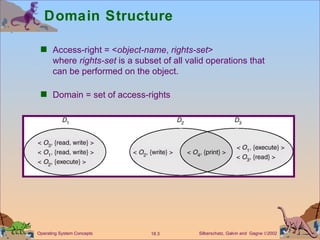
Domain Structure Access-right = < object-name ,  rights-set > where  rights-set  is a subset of all valid operations that can be performed on the object.  Domain = set of access-rights
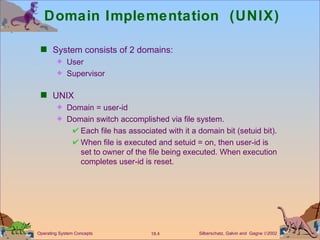
Domain Implementation  (UNIX) System consists of 2 domains: User Supervisor UNIX  Domain = user-id Domain switch accomplished via file system.  Each file has associated with it a domain bit (setuid bit). When file is executed and setuid = on, then user-id is set to owner of the file being executed. When execution completes user-id is reset.
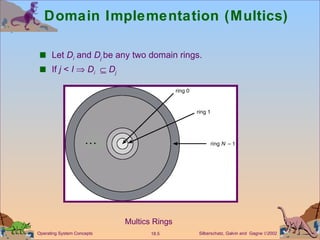
Domain Implementation (Multics) Let  D i  and  D j   be any two domain rings. If  j  <  I      D i      D j Multics Rings
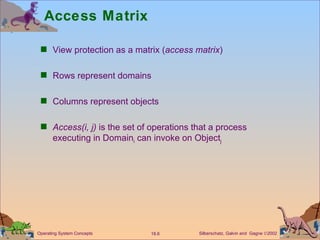
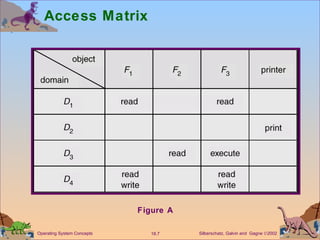
Access Matrix View protection as a matrix ( access matrix ) Rows represent domains Columns represent objects Access(i, j)  is the set of operations that a process executing in Domain i  can invoke on Object j
Access Matrix Figure A
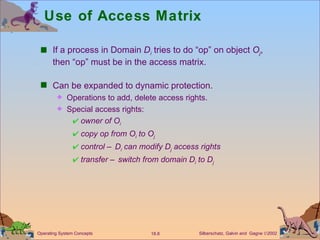
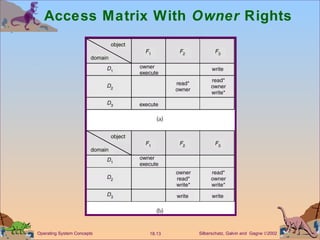
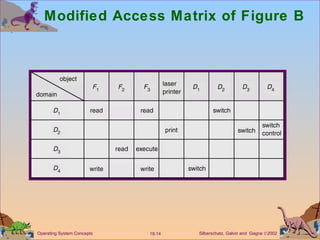
Use of Access Matrix If a process in Domain  D i   tries to do “op” on object  O j , then “op” must be in the access matrix. Can be expanded to dynamic protection. Operations to add, delete access rights. Special access rights: owner of O i copy op from O i  to O j control – D i  can modify D j  access rights transfer – switch from domain D i  to D j
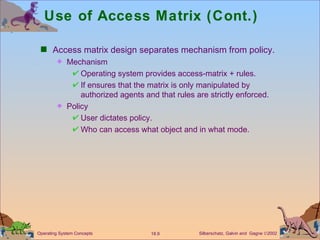
Use of Access Matrix (Cont.) Access matrix design separates mechanism from policy. Mechanism  Operating system provides access-matrix + rules. If ensures that the matrix is only manipulated by authorized agents and that rules are strictly enforced. Policy User dictates policy. Who can access what object and in what mode.
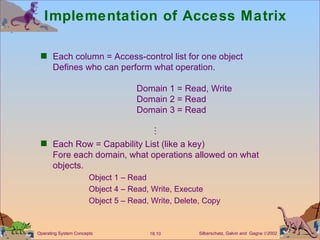
Implementation of Access Matrix Each column = Access-control list for one object  Defines who can perform what operation. Domain 1 = Read, Write Domain 2 = Read Domain 3 = Read    Each Row = Capability List (like a key) Fore each domain, what operations allowed on what objects. Object 1 – Read Object 4 – Read, Write, Execute Object 5 – Read, Write, Delete, Copy
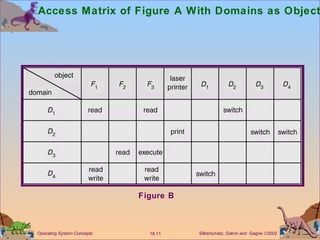
Access Matrix of Figure A With Domains as Objects Figure B
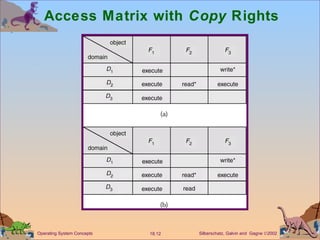
Access Matrix with  Copy  Rights
Access Matrix With  Owner  Rights
Modified Access Matrix of Figure B
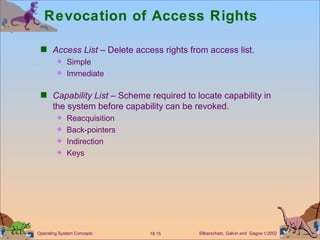
Revocation of Access Rights Access List  – Delete access rights from access list. Simple  Immediate Capability List  – Scheme required to locate capability in the system before capability can be revoked. Reacquisition Back-pointers Indirection Keys
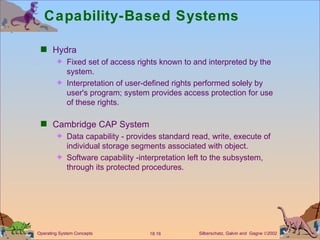
Capability-Based Systems  Hydra Fixed set of access rights known to and interpreted by the system. Interpretation of user-defined rights performed solely by user's program; system provides access protection for use of these rights. Cambridge CAP System  Data capability - provides standard read, write, execute of individual storage segments associated with object. Software capability -interpretation left to the subsystem, through its protected procedures.
Language-Based Protection Specification of protection in a programming language allows the high-level description of policies for the allocation and use of resources. Language implementation can provide software for protection enforcement when automatic hardware-supported checking is unavailable. Interpret protection specifications to generate calls on whatever protection system is provided by the hardware and the operating system.
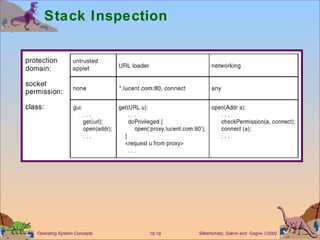
Protection in Java 2 Protection is handled by the Java Virtual Machine (JVM) A class is assigned a protection domain when it is loaded by the JVM. The protection domain indicates what operations the class can (and cannot) perform. If a library method is invoked that performs a privileged operation, the stack is inspected to ensure the operation can be performed by the library.
Stack Inspection

Ch18 OS

  • 1.
    Module 18: ProtectionGoals of Protection Domain of Protection Access Matrix Implementation of Access Matrix Revocation of Access Rights Capability-Based Systems Language-Based Protection
  • 2.
    Protection Operating systemconsists of a collection of objects, hardware or software Each object has a unique name and can be accessed through a well-defined set of operations. Protection problem - ensure that each object is accessed correctly and only by those processes that are allowed to do so.
  • 3.
    Domain Structure Access-right= < object-name , rights-set > where rights-set is a subset of all valid operations that can be performed on the object. Domain = set of access-rights
  • 4.
    Domain Implementation (UNIX) System consists of 2 domains: User Supervisor UNIX Domain = user-id Domain switch accomplished via file system. Each file has associated with it a domain bit (setuid bit). When file is executed and setuid = on, then user-id is set to owner of the file being executed. When execution completes user-id is reset.
  • 5.
    Domain Implementation (Multics)Let D i and D j be any two domain rings. If j < I  D i  D j Multics Rings
  • 6.
    Access Matrix Viewprotection as a matrix ( access matrix ) Rows represent domains Columns represent objects Access(i, j) is the set of operations that a process executing in Domain i can invoke on Object j
  • 7.
  • 8.
    Use of AccessMatrix If a process in Domain D i tries to do “op” on object O j , then “op” must be in the access matrix. Can be expanded to dynamic protection. Operations to add, delete access rights. Special access rights: owner of O i copy op from O i to O j control – D i can modify D j access rights transfer – switch from domain D i to D j
  • 9.
    Use of AccessMatrix (Cont.) Access matrix design separates mechanism from policy. Mechanism Operating system provides access-matrix + rules. If ensures that the matrix is only manipulated by authorized agents and that rules are strictly enforced. Policy User dictates policy. Who can access what object and in what mode.
  • 10.
    Implementation of AccessMatrix Each column = Access-control list for one object Defines who can perform what operation. Domain 1 = Read, Write Domain 2 = Read Domain 3 = Read  Each Row = Capability List (like a key) Fore each domain, what operations allowed on what objects. Object 1 – Read Object 4 – Read, Write, Execute Object 5 – Read, Write, Delete, Copy
  • 11.
    Access Matrix ofFigure A With Domains as Objects Figure B
  • 12.
    Access Matrix with Copy Rights
  • 13.
    Access Matrix With Owner Rights
  • 14.
  • 15.
    Revocation of AccessRights Access List – Delete access rights from access list. Simple Immediate Capability List – Scheme required to locate capability in the system before capability can be revoked. Reacquisition Back-pointers Indirection Keys
  • 16.
    Capability-Based Systems Hydra Fixed set of access rights known to and interpreted by the system. Interpretation of user-defined rights performed solely by user's program; system provides access protection for use of these rights. Cambridge CAP System Data capability - provides standard read, write, execute of individual storage segments associated with object. Software capability -interpretation left to the subsystem, through its protected procedures.
  • 17.
    Language-Based Protection Specificationof protection in a programming language allows the high-level description of policies for the allocation and use of resources. Language implementation can provide software for protection enforcement when automatic hardware-supported checking is unavailable. Interpret protection specifications to generate calls on whatever protection system is provided by the hardware and the operating system.
  • 18.
    Protection in Java2 Protection is handled by the Java Virtual Machine (JVM) A class is assigned a protection domain when it is loaded by the JVM. The protection domain indicates what operations the class can (and cannot) perform. If a library method is invoked that performs a privileged operation, the stack is inspected to ensure the operation can be performed by the library.
  • 19.