Op Rem
                       en       ixe
                          Le a      d fo
               by    Stu      rnin r
                  Jo s   dio       gD
                      hua : wee esig
                           Un k 2 n
                               der
                                   wo
                                       od


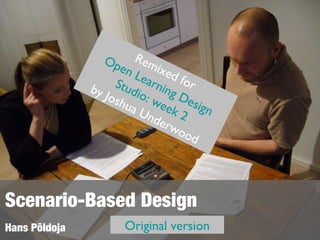
Scenario-Based Design
Hans Põldoja          Original version
http://creativecommons.org/licenses/by-sa/3.0/ee/
“Scenarios are stories.They are
 stories about people and their
  activities.” (John M. Carroll)


                               (Carroll, 1999)
Five reasons for scenario-based
            design
•   Vivid descriptions of experiences evoke reflection about design
    issues

•   Scenarios concretely fix and interpretation and a solution but are
    open-ended and easily revised

•   Scenarios can be written at multiple levels, from many
    perspectives and for many purposes

•   Scenarios can be abstracted and categorized

•   Scenarios anchor design discussion in activity and support
    participation among stakeholders and appropriate design
    outcomes.

                                                                      (Carroll, 1999)
An examp
                                            le…


http://www.edufeedr.org/wiki/Scenarios
You might write your story, make a video, use a cartoon, ...

You can work individually or collaboratively...

Ground your scenarios in: observed activity in related settings; by asking people
involved to contribute; your own experiences...


                                www.bitstrips.com
Some elements to include in scenarios

•   Setting — description of the starting state of the
    episode and objects that are involved

•   Actors

•   Goals

•   Actions — things that actors do

•   Events — things that happen to actors

•   Objects

                                                         (Carroll, 1999)
(Carroll, 1999)
Also
Think about what is missing in the example scenarios


What else would you want to know if you were
designing for the kinds of learning described?
Develop your own scenarios
Brainstorm components of your scenarios ( you may want to use
this template ) : http://goo.gl/Rmbwt

Actors (who is involved?), Goals (why?), Settings (where & when?), Objects (what
things are involved?), Actions (what happens to actors?), Events (what do actors do?),
Results (what learning is achieved?)

Develop a scenario/s (in whatever form you prefer).
Invite others to comment on your scenarios, do they make sense?
What else do they want to know?
Comment on others’ scenarios
(You can post and comment on scenarios here)
  http://cloudworks.ac.uk/cloudscape/view/2453
References & Resources
• Carroll, J.M. (1999). Five Reasons for Scenario-Based Design. In: Proceedings of the 32nd
  Hawaii International Conference on System Sciences.

• Palotta,V. (2007). Scenario-Based Design.
                             http://diuf.unifr.ch/pai/uc/miscellaneous/Scenario-based_Design.pdf
For more example scenarios see:

• links below Scenario-based design Poldoja, H
                            http://imkedesign.wordpress.com/2011/02/09/scenario-based-design-2/
• mobile learning for development example scenarios
                                                   http://www.ml4d.org/kb/DSs/
• LocalLearn scenarios
                       http://www.slideshare.net/yish/mobile-learning-day-locallearn-scenarios
For more about using scenarios in learning design see:

• The Learning Design Grid, Design Scenarios
    http://www.ld-grid.org/resources/representations-and-languages/design-scenarios
Photos
• Teemu Leinonen,
  http://lemill.org/trac/attachment/wiki/DesignSessionResults/finland-02.jpg

Scenario based contextual learning design

  • 1.
    Op Rem en ixe Le a d fo by Stu rnin r Jo s dio gD hua : wee esig Un k 2 n der wo od Scenario-Based Design Hans Põldoja Original version
  • 2.
  • 3.
    “Scenarios are stories.Theyare stories about people and their activities.” (John M. Carroll) (Carroll, 1999)
  • 4.
    Five reasons forscenario-based design • Vivid descriptions of experiences evoke reflection about design issues • Scenarios concretely fix and interpretation and a solution but are open-ended and easily revised • Scenarios can be written at multiple levels, from many perspectives and for many purposes • Scenarios can be abstracted and categorized • Scenarios anchor design discussion in activity and support participation among stakeholders and appropriate design outcomes. (Carroll, 1999)
  • 5.
    An examp le… http://www.edufeedr.org/wiki/Scenarios
  • 6.
    You might writeyour story, make a video, use a cartoon, ... You can work individually or collaboratively... Ground your scenarios in: observed activity in related settings; by asking people involved to contribute; your own experiences... www.bitstrips.com
  • 7.
    Some elements toinclude in scenarios • Setting — description of the starting state of the episode and objects that are involved • Actors • Goals • Actions — things that actors do • Events — things that happen to actors • Objects (Carroll, 1999)
  • 8.
  • 11.
    Also Think about whatis missing in the example scenarios What else would you want to know if you were designing for the kinds of learning described?
  • 12.
    Develop your ownscenarios Brainstorm components of your scenarios ( you may want to use this template ) : http://goo.gl/Rmbwt Actors (who is involved?), Goals (why?), Settings (where & when?), Objects (what things are involved?), Actions (what happens to actors?), Events (what do actors do?), Results (what learning is achieved?) Develop a scenario/s (in whatever form you prefer). Invite others to comment on your scenarios, do they make sense? What else do they want to know? Comment on others’ scenarios (You can post and comment on scenarios here) http://cloudworks.ac.uk/cloudscape/view/2453
  • 13.
    References & Resources •Carroll, J.M. (1999). Five Reasons for Scenario-Based Design. In: Proceedings of the 32nd Hawaii International Conference on System Sciences. • Palotta,V. (2007). Scenario-Based Design. http://diuf.unifr.ch/pai/uc/miscellaneous/Scenario-based_Design.pdf For more example scenarios see: • links below Scenario-based design Poldoja, H http://imkedesign.wordpress.com/2011/02/09/scenario-based-design-2/ • mobile learning for development example scenarios http://www.ml4d.org/kb/DSs/ • LocalLearn scenarios http://www.slideshare.net/yish/mobile-learning-day-locallearn-scenarios For more about using scenarios in learning design see: • The Learning Design Grid, Design Scenarios http://www.ld-grid.org/resources/representations-and-languages/design-scenarios
  • 14.
    Photos • Teemu Leinonen, http://lemill.org/trac/attachment/wiki/DesignSessionResults/finland-02.jpg