PROTECTION
In operating System
Presented By:
Md. Bellal Hossain Sohel Tanvir
ID: 163015023 ID: 163015039
Content
What is Protection
Goals of Protection
Principles of Protection
Domain of Protection
Example of protection
Conclusion
Revocation of Access Rights
Access Controls
What is Protection ?
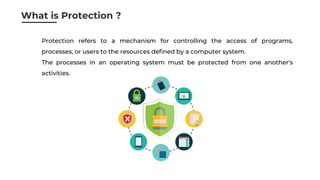
Protection refers to a mechanism for controlling the access of programs,
processes, or users to the resources defined by a computer system.
The processes in an operating system must be protected from one another's
activities.
Goals of Protection ?
Obviously to prevent malicious misuse of the system by users or programs.
To ensure that each shared resource is used only in accordance with system
policies, which may be set either by system designers or by system administrators.
To ensure that errant programs cause the minimal amount of damage possible
It is up to administrators and users to implement those mechanisms effectively
Principles of Protection?
The principle of least privilege dictates that programs, users, and systems be given
just enough privileges to perform their tasks
This ensures that failures do the least amount of harm and allow the least of harm
to be done
Typically each user is given their own account, and has only enough privilege to
modify their own files.
It is up to administrators and users to implement those mechanisms effectively
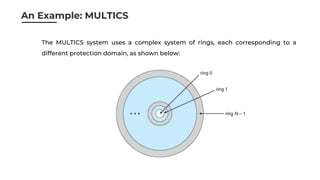
An Example: MULTICS
The MULTICS system uses a complex system of rings, each corresponding to a
different protection domain, as shown below:
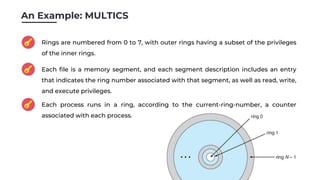
An Example: MULTICS
Rings are numbered from 0 to 7, with outer rings having a subset of the privileges
of the inner rings.
Each file is a memory segment, and each segment description includes an entry
that indicates the ring number associated with that segment, as well as read, write,
and execute privileges.
Each process runs in a ring, according to the current-ring-number, a counter
associated with each process.
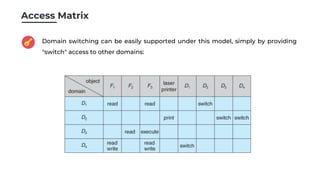
Access Matrix
The model of protection that we have been discussing can be viewed as an access
matrix, in which columns represent different system resources and rows represent
different protection domains. Entries within the matrix indicate what access that
domain has to that resource.
Access Matrix
Domain switching can be easily supported under this model, simply by providing
"switch" access to other domains:
Access Control
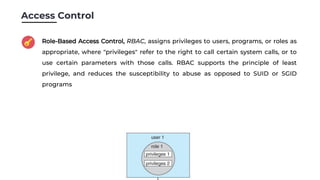
Role-Based Access Control, RBAC, assigns privileges to users, programs, or roles as
appropriate, where "privileges" refer to the right to call certain system calls, or to
use certain parameters with those calls. RBAC supports the principle of least
privilege, and reduces the susceptibility to abuse as opposed to SUID or SGID
programs
Revocation of Access Rights
Immediate versus delayed - If delayed, can we determine when the revocation will
take place?
Selective versus general - Does revocation of an access right to an object affect all
users who have that right, or only some users?
Partial versus total - Can a subset of rights for an object be revoked, or are all rights
revoked at once?
The need to revoke access rights dynamically raises several questions:
Temporary versus permanent - If rights are revoked, is there a mechanism for
processes to re-acquire some or all of the revoked rights?
Conclusion
As computer systems have become more sophisticated and pervasive in their
applications, the need to protect their integrity has also grown. Protection was
originally conceived as an adjunct to multiprogramming operating systems, so that
untrustworthy users might safely share a common logical name space, such as a
directory of files,
Protection
Protection

Protection

  • 1.
    PROTECTION In operating System PresentedBy: Md. Bellal Hossain Sohel Tanvir ID: 163015023 ID: 163015039
  • 2.
    Content What is Protection Goalsof Protection Principles of Protection Domain of Protection Example of protection Conclusion Revocation of Access Rights Access Controls
  • 3.
    What is Protection? Protection refers to a mechanism for controlling the access of programs, processes, or users to the resources defined by a computer system. The processes in an operating system must be protected from one another's activities.
  • 4.
    Goals of Protection? Obviously to prevent malicious misuse of the system by users or programs. To ensure that each shared resource is used only in accordance with system policies, which may be set either by system designers or by system administrators. To ensure that errant programs cause the minimal amount of damage possible It is up to administrators and users to implement those mechanisms effectively
  • 5.
    Principles of Protection? Theprinciple of least privilege dictates that programs, users, and systems be given just enough privileges to perform their tasks This ensures that failures do the least amount of harm and allow the least of harm to be done Typically each user is given their own account, and has only enough privilege to modify their own files. It is up to administrators and users to implement those mechanisms effectively
  • 6.
    An Example: MULTICS TheMULTICS system uses a complex system of rings, each corresponding to a different protection domain, as shown below:
  • 7.
    An Example: MULTICS Ringsare numbered from 0 to 7, with outer rings having a subset of the privileges of the inner rings. Each file is a memory segment, and each segment description includes an entry that indicates the ring number associated with that segment, as well as read, write, and execute privileges. Each process runs in a ring, according to the current-ring-number, a counter associated with each process.
  • 8.
    Access Matrix The modelof protection that we have been discussing can be viewed as an access matrix, in which columns represent different system resources and rows represent different protection domains. Entries within the matrix indicate what access that domain has to that resource.
  • 9.
    Access Matrix Domain switchingcan be easily supported under this model, simply by providing "switch" access to other domains:
  • 10.
    Access Control Role-Based AccessControl, RBAC, assigns privileges to users, programs, or roles as appropriate, where "privileges" refer to the right to call certain system calls, or to use certain parameters with those calls. RBAC supports the principle of least privilege, and reduces the susceptibility to abuse as opposed to SUID or SGID programs
  • 11.
    Revocation of AccessRights Immediate versus delayed - If delayed, can we determine when the revocation will take place? Selective versus general - Does revocation of an access right to an object affect all users who have that right, or only some users? Partial versus total - Can a subset of rights for an object be revoked, or are all rights revoked at once? The need to revoke access rights dynamically raises several questions: Temporary versus permanent - If rights are revoked, is there a mechanism for processes to re-acquire some or all of the revoked rights?
  • 12.
    Conclusion As computer systemshave become more sophisticated and pervasive in their applications, the need to protect their integrity has also grown. Protection was originally conceived as an adjunct to multiprogramming operating systems, so that untrustworthy users might safely share a common logical name space, such as a directory of files,