PROTECTION AND SECURITY
IN
OPERATING SYSTEM
LALFAKAWMA
M.Tech (C.S.E)
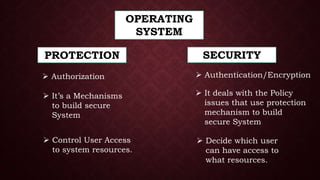
PROTECTION SECURITY
 Authorization  Authentication/Encryption
 It’s a Mechanisms
to build secure
System
 It deals with the Policy
issues that use protection
mechanism to build
secure System
OPERATING
SYSTEM
 Control User Access
to system resources.
 Decide which user
can have access to
what resources.
PROTECTION
• Protection deals with the access to the system resources.
• It determines that what files can be accessed or permeated by a
special user.
• The protection of the system should confirm the approval of the
process and users.
• Due to this, these licensed users and processes will care for the
central processing unit, memory and alternative sources.
• It refers to a mechanism which controls the access of programs,
processes, or users to the resources defined by a computer system.
NEED OF PROTECTION
• To prevent the access of unauthorized users
• To ensure that each active programs or processes in the system
uses resources only as the stated policy,
• To improve reliability by detecting latent errors.
PROTECTION DOMAIN
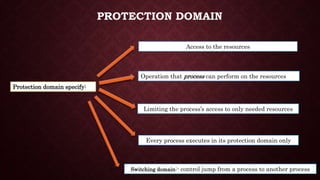
Limiting the process’s access to only needed resources
Protection domain specify:
Access to the resources
Operation that process can perform on the resources
Every process executes in its protection domain only
Switching domain:- control jump from a process to another process
PROTECTION DOMAIN
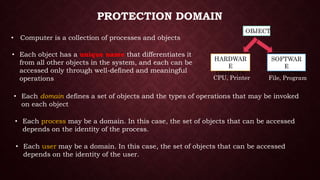
• Computer is a collection of processes and objects
OBJECT
HARDWAR
E
OBJECTS
SOFTWAR
E
OBJECTS
File, ProgramCPU, Printer
• Each object has a unique name that differentiates it
from all other objects in the system, and each can be
accessed only through well-defined and meaningful
operations
• Each domain defines a set of objects and the types of operations that may be invoked
on each object
• Each process may be a domain. In this case, the set of objects that can be accessed
depends on the identity of the process.
• Each user may be a domain. In this case, the set of objects that can be accessed
depends on the identity of the user.
PROTECTION DOMAIN
• Process operate within a protection domains, which specify the resources that the process may
access.
• Each domain defines a set of objects and the types of operations that may invoked on each object.
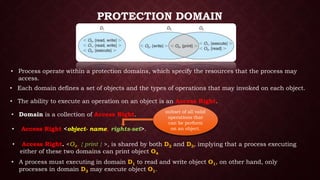
• The ability to execute an operation on an object is an Access Right.
• Domain is a collection of Access Right.
• Access Right <object- name, rights-set>.
subset of all valid
operations that
can be perform
on an object.
• Access Right. <O4, { print } >, is shared by both D2 and D3, implying that a process executing
either of these two domains can print object O4
• A process must executing in domain D1 to read and write object O1, on other hand, only
processes in domain D3 may execute object O1.
DESIGN PRINCIPAL FOR SECURE SYSTEMS
ECONOMY:
COMPLETE MEDIATION:
OPEN DESIGN:
SEPARATION OF PRIVILEGES:
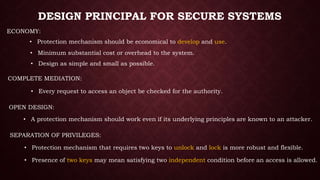
• Protection mechanism should be economical to develop and use.
• Minimum substantial cost or overhead to the system.
• Design as simple and small as possible.
• Every request to access an object be checked for the authority.
• A protection mechanism should work even if its underlying principles are known to an attacker.
• Protection mechanism that requires two keys to unlock and lock is more robust and flexible.
• Presence of two keys may mean satisfying two independent condition before an access is allowed.
DESIGN PRINCIPAL FOR SECURE SYSTEMS
LEAST PRIVILEGE:
• Minimum access rights that are sufficient for it to complete its task.
• If the requirement of the subject changes, the subject should acquire it by switching the domain.
LEAST COMMON MECHANISM:
• Minimizing the common portion of a mechanism, which are access by more than one user.
ACCEPTABILITY:
• Protection mechanism must be simple to use.
• Complex and obscure protection mechanism will deter users from using it.
FAIL-SAFE DEFAULTS:
• If design or implementation mistake is responsible for denial of an access, it will eventually
be discovered and be fixed.
THE ACCESS MATRIX MODEL
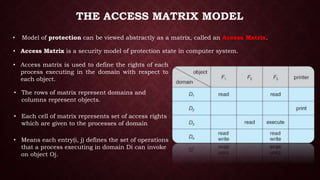
• Model of protection can be viewed abstractly as a matrix, called an Access Matrix.
• Access Matrix is a security model of protection state in computer system.
• Access matrix is used to define the rights of each
process executing in the domain with respect to
each object.
• The rows of matrix represent domains and
columns represent objects.
• Each cell of matrix represents set of access rights
which are given to the processes of domain
• Means each entry(i, j) defines the set of operations
that a process executing in domain Di can invoke
on object Oj.
THE ACCESS MATRIX MODEL
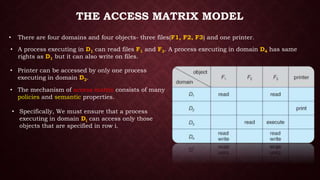
• There are four domains and four objects- three files(F1, F2, F3) and one printer.
• A process executing in D1 can read files F1 and F3. A process executing in domain D4 has same
rights as D1 but it can also write on files.
• Printer can be accessed by only one process
executing in domain D2.
• The mechanism of access matrix consists of many
policies and semantic properties.
• Specifically, We must ensure that a process
executing in domain Di can access only those
objects that are specified in row i.
THE ACCESS MATRIX MODEL
• Association between the domain and processes can be either static or dynamic.
• Access matrix provides an mechanism for defining the control for this association
between domain and processes.
• When we switch a process from one domain to
another, we execute a switch operation on an
object(the domain).
• We can control domain switching by including
domains among the objects of the access
matrix.
• Processes should be able to switch from one domain
(Di) to another domain (Dj) if and only is a switch
right is given to access(i, j).
• According to the matrix: a process executing in domain D2 can switch to domain D3 and D4.
• A process executing in domain D4 can switch to domain D1 and process executing in domain D1 can
switch to domain D2.
THE PROTECTION STATE OF SYSTEM
• It represented by Triplet( S,O,P )
O
P [s , o]
S
Subjects
Objects
Schematic Diagram of Access Matrix
Protection Domain and Access Matrix Model -Operating System

Protection Domain and Access Matrix Model -Operating System

  • 1.
    PROTECTION AND SECURITY IN OPERATINGSYSTEM LALFAKAWMA M.Tech (C.S.E)
  • 2.
    PROTECTION SECURITY  Authorization Authentication/Encryption  It’s a Mechanisms to build secure System  It deals with the Policy issues that use protection mechanism to build secure System OPERATING SYSTEM  Control User Access to system resources.  Decide which user can have access to what resources.
  • 3.
    PROTECTION • Protection dealswith the access to the system resources. • It determines that what files can be accessed or permeated by a special user. • The protection of the system should confirm the approval of the process and users. • Due to this, these licensed users and processes will care for the central processing unit, memory and alternative sources. • It refers to a mechanism which controls the access of programs, processes, or users to the resources defined by a computer system.
  • 4.
    NEED OF PROTECTION •To prevent the access of unauthorized users • To ensure that each active programs or processes in the system uses resources only as the stated policy, • To improve reliability by detecting latent errors.
  • 5.
    PROTECTION DOMAIN Limiting theprocess’s access to only needed resources Protection domain specify: Access to the resources Operation that process can perform on the resources Every process executes in its protection domain only Switching domain:- control jump from a process to another process
  • 6.
    PROTECTION DOMAIN • Computeris a collection of processes and objects OBJECT HARDWAR E OBJECTS SOFTWAR E OBJECTS File, ProgramCPU, Printer • Each object has a unique name that differentiates it from all other objects in the system, and each can be accessed only through well-defined and meaningful operations • Each domain defines a set of objects and the types of operations that may be invoked on each object • Each process may be a domain. In this case, the set of objects that can be accessed depends on the identity of the process. • Each user may be a domain. In this case, the set of objects that can be accessed depends on the identity of the user.
  • 7.
    PROTECTION DOMAIN • Processoperate within a protection domains, which specify the resources that the process may access. • Each domain defines a set of objects and the types of operations that may invoked on each object. • The ability to execute an operation on an object is an Access Right. • Domain is a collection of Access Right. • Access Right <object- name, rights-set>. subset of all valid operations that can be perform on an object. • Access Right. <O4, { print } >, is shared by both D2 and D3, implying that a process executing either of these two domains can print object O4 • A process must executing in domain D1 to read and write object O1, on other hand, only processes in domain D3 may execute object O1.
  • 8.
    DESIGN PRINCIPAL FORSECURE SYSTEMS ECONOMY: COMPLETE MEDIATION: OPEN DESIGN: SEPARATION OF PRIVILEGES: • Protection mechanism should be economical to develop and use. • Minimum substantial cost or overhead to the system. • Design as simple and small as possible. • Every request to access an object be checked for the authority. • A protection mechanism should work even if its underlying principles are known to an attacker. • Protection mechanism that requires two keys to unlock and lock is more robust and flexible. • Presence of two keys may mean satisfying two independent condition before an access is allowed.
  • 9.
    DESIGN PRINCIPAL FORSECURE SYSTEMS LEAST PRIVILEGE: • Minimum access rights that are sufficient for it to complete its task. • If the requirement of the subject changes, the subject should acquire it by switching the domain. LEAST COMMON MECHANISM: • Minimizing the common portion of a mechanism, which are access by more than one user. ACCEPTABILITY: • Protection mechanism must be simple to use. • Complex and obscure protection mechanism will deter users from using it. FAIL-SAFE DEFAULTS: • If design or implementation mistake is responsible for denial of an access, it will eventually be discovered and be fixed.
  • 10.
    THE ACCESS MATRIXMODEL • Model of protection can be viewed abstractly as a matrix, called an Access Matrix. • Access Matrix is a security model of protection state in computer system. • Access matrix is used to define the rights of each process executing in the domain with respect to each object. • The rows of matrix represent domains and columns represent objects. • Each cell of matrix represents set of access rights which are given to the processes of domain • Means each entry(i, j) defines the set of operations that a process executing in domain Di can invoke on object Oj.
  • 11.
    THE ACCESS MATRIXMODEL • There are four domains and four objects- three files(F1, F2, F3) and one printer. • A process executing in D1 can read files F1 and F3. A process executing in domain D4 has same rights as D1 but it can also write on files. • Printer can be accessed by only one process executing in domain D2. • The mechanism of access matrix consists of many policies and semantic properties. • Specifically, We must ensure that a process executing in domain Di can access only those objects that are specified in row i.
  • 12.
    THE ACCESS MATRIXMODEL • Association between the domain and processes can be either static or dynamic. • Access matrix provides an mechanism for defining the control for this association between domain and processes. • When we switch a process from one domain to another, we execute a switch operation on an object(the domain). • We can control domain switching by including domains among the objects of the access matrix. • Processes should be able to switch from one domain (Di) to another domain (Dj) if and only is a switch right is given to access(i, j). • According to the matrix: a process executing in domain D2 can switch to domain D3 and D4. • A process executing in domain D4 can switch to domain D1 and process executing in domain D1 can switch to domain D2.
  • 13.
    THE PROTECTION STATEOF SYSTEM • It represented by Triplet( S,O,P ) O P [s , o] S Subjects Objects Schematic Diagram of Access Matrix