the northern renaissance 
Bell Work: 
● #3 – Ch. 1/L2 
Vocabulary 
● #4 – Global Impact, pg. 
50. 
●Write the questions. 
 #5 - Ch. 1/L3 
vocabulary
the northern renaissance 
Objectives: 
● Explain the origins and characteristics of the 
Northern Renaissance. 
● Trace the impact of the Renaissance on German and 
Flemish painters. 
● Profile key Northern Renaissance writers. 
● Explain how printing spread ideas.
the northern renaissance 
By the end of the 15th century 
(1400’s), the ideas and 
values of Renaissance Italy 
began to spread north into 
England, France, Germany, 
and Flanders (part of 
present day France and the 
Netherlands)….
the northern renaissance 
Plague: 
● The bubonic plague 
had killed between 
75-200 million people 
in Europe. 
● 1450 – the population 
begins to grow again.
the northern renaissance 
War: 
● Hundred Years War (1337- 
1453) –a series of conflicts 
between England and 
France for control of the 
French throne. 
● After the war, many cities 
grew rapidly. 
● Urban merchants became 
wealthy (first in Flanders). 
● this increased the 
patronage of the arts.
the northern renaissance 
Artistic Ideas Spread: 
● Artists studied under 
Italian masters, copied 
technique, brought these 
ideas with them. 
● Northern European rulers 
purchased paintings, hired 
Italian artists and 
architects 
● There was a growing 
interest in realism and art 
that depicted every day 
life.
the northern renaissance 
The Renaissance Spreads: 
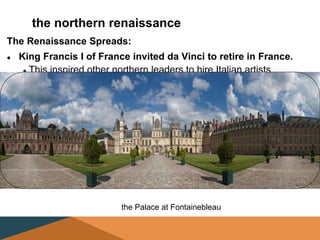
● King Francis I of France invited da Vinci to retire in France. 
● This inspired other northern leaders to hire Italian artists. 
the Palace at Fontainebleau
the northern renaissance 
The Renaissance 
Spreads: 
● 1494 – King Charles 
VIII of France 
invaded and claimed 
the throne of 
Naples. 
● This invasion 
forced many artists 
to head north into 
France and 
England.
the northern renaissance 
German Painters; 
● Albrecht Durer 
● travelled to Italy to study 
(1494). 
● famous for woodcuts and 
engravings. 
● used religious, mythical, 
and realistic landscapes. 
● popularity of his work 
helped spread 
Renaissance styles.
the northern renaissance 
Innsbruck Castle 
Courtyard 
The Revelation of St John: 4. 
The Four Riders of the 
Apocalypse,
the northern renaissance 
The 
Lamentation 
for Christ 
(1500)
the northern renaissance 
Hans Holbein the Younger 
● Durer’s emphasis on 
realism influenced other 
German artists like 
Holbein. 
● Holbein specialized in 
painting portraits. 
● Nearly photographic 
quality.
the northern renaissance 
Sir Thomas More (1527) The Ambassadors 
(1533)
the northern renaissance
the northern renaissance 
Flemish Painters 
● Flanders
the northern renaissance 
Flemish Painters 
● Flanders – the artistic center of northern 
Europe. 
● With the support of wealth merchant families, 
Flemish artists were able to flourish. 
● Jan van Eyck 
● the first great Flemish artist 
● used oil based paints to create a variety of subtle 
colors. 
● the use of oil based paints eventually spread to 
Italy. 
● Pieter Bruegel 
● the peak of Flemish painting (1550) 
● created scenes from everyday life (i.e. weddings, 
dances, and harvests)
the northern renaissance 
Jan van 
Eyck 
The 
Annunciation 
Portrait of a Man 
in a Turban
the northern renaissance 
Pieter 
Bruegel, 
The 
Weddin 
g 
Dance
the northern renaissance 
Pieter Bruegel, The Dutch 
Proverbs
the northern renaissance 
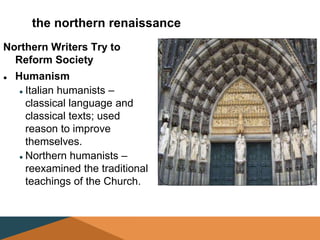
Northern Writers Try to 
Reform Society 
● Humanism 
● Italian humanists – 
classical language and 
classical texts; used 
reason to improve 
themselves. 
● Northern humanists – 
reexamined the traditional 
teachings of the Church.
the northern renaissance 
● The Church had failed to 
inspire people to live 
Christian lives. 
● Christian humanism = 
the reform of society 
and the Church. 
●EDUCATION!!!! 
● for women 
● founded schools for 
boys and girls.
the northern renaissance 
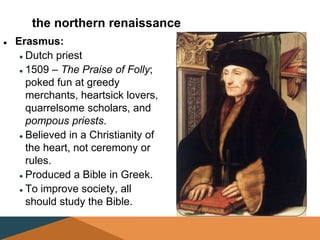
● Erasmus: 
● Dutch priest 
● 1509 – The Praise of Folly; 
poked fun at greedy 
merchants, heartsick lovers, 
quarrelsome scholars, and 
pompous priests. 
● Believed in a Christianity of 
the heart, not ceremony or 
rules. 
● Produced a Bible in Greek. 
● To improve society, all 
should study the Bible.
the northern renaissance 
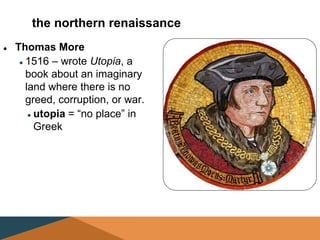
● Thomas More 
● 1516 – wrote Utopia, a 
book about an imaginary 
land where there is no 
greed, corruption, or war. 
● utopia = “no place” in 
Greek
the northern renaissance 
Women’s Reforms 
● Northern humanists 
promoted education for 
women, and founded schools 
for boys and girls. 
● Most Europeans couldn’t 
read. Those who could afford 
schooling typically sent their 
sons.
the northern renaissance 
Women’s Reforms 
● Christine de Pizan – highly 
educated female writer. 
● born in 1363 
● wrote in many books, short 
stories in French. 
● The Book of the City of 
Ladies - detailed some of 
the objections men had to 
educating women. 
● pg. 48
the northern renaissance 
The Elizabethan Age 
● The Renaissance reaches 
England in the mid-1500’s. 
● “Elizabethan Age” = Queen 
Elizabeth I reigned 1558- 
1603. 
● well educated 
● spoke French, Italian, 
Latin, and Greek 
● did much to promote the 
development of English art 
and literature.
the northern renaissance 
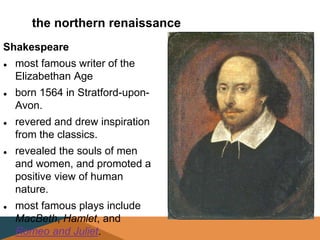
Shakespeare 
● most famous writer of the 
Elizabethan Age 
● born 1564 in Stratford-upon- 
Avon. 
● revered and drew inspiration 
from the classics. 
● revealed the souls of men 
and women, and promoted a 
positive view of human 
nature. 
● most famous plays include 
MacBeth, Hamlet, and 
Romeo and Juliet.
the northern renaissance 
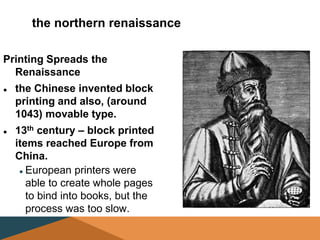
Printing Spreads the 
Renaissance 
● the Chinese invented block 
printing and also, (around 
1043) movable type. 
● 13th century – block printed 
items reached Europe from 
China. 
● European printers were 
able to create whole pages 
to bind into books, but the 
process was too slow.
the northern renaissance 
Printing Spreads the Renaissance 
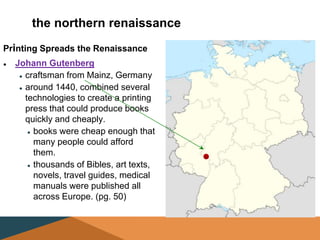
● Johann Gutenberg 
● craftsman from Mainz, Germany 
● around 1440, combined several 
technologies to create a printing 
press that could produce books 
quickly and cheaply. 
● books were cheap enough that 
many people could afford 
them. 
● thousands of Bibles, art texts, 
novels, travel guides, medical 
manuals were published all 
across Europe. (pg. 50)
the northern renaissance 
Legacy of the Renaissance 
● In art: 
● Realism 
● Secularism 
● Vernacular 
● Humanism 
In society: 
● printing spread ideas 
● literacy rates went up 
● published accounts of new discoveries, maps, 
and charts led to further discoveries. 
● Christian humanists 
● people began to question political structures and 
religious practices.

Ch.1/L2 - the Northern Renaissance

  • 2.
    the northern renaissance Bell Work: ● #3 – Ch. 1/L2 Vocabulary ● #4 – Global Impact, pg. 50. ●Write the questions.  #5 - Ch. 1/L3 vocabulary
  • 3.
    the northern renaissance Objectives: ● Explain the origins and characteristics of the Northern Renaissance. ● Trace the impact of the Renaissance on German and Flemish painters. ● Profile key Northern Renaissance writers. ● Explain how printing spread ideas.
  • 4.
    the northern renaissance By the end of the 15th century (1400’s), the ideas and values of Renaissance Italy began to spread north into England, France, Germany, and Flanders (part of present day France and the Netherlands)….
  • 5.
    the northern renaissance Plague: ● The bubonic plague had killed between 75-200 million people in Europe. ● 1450 – the population begins to grow again.
  • 6.
    the northern renaissance War: ● Hundred Years War (1337- 1453) –a series of conflicts between England and France for control of the French throne. ● After the war, many cities grew rapidly. ● Urban merchants became wealthy (first in Flanders). ● this increased the patronage of the arts.
  • 7.
    the northern renaissance Artistic Ideas Spread: ● Artists studied under Italian masters, copied technique, brought these ideas with them. ● Northern European rulers purchased paintings, hired Italian artists and architects ● There was a growing interest in realism and art that depicted every day life.
  • 8.
    the northern renaissance The Renaissance Spreads: ● King Francis I of France invited da Vinci to retire in France. ● This inspired other northern leaders to hire Italian artists. the Palace at Fontainebleau
  • 9.
    the northern renaissance The Renaissance Spreads: ● 1494 – King Charles VIII of France invaded and claimed the throne of Naples. ● This invasion forced many artists to head north into France and England.
  • 10.
    the northern renaissance German Painters; ● Albrecht Durer ● travelled to Italy to study (1494). ● famous for woodcuts and engravings. ● used religious, mythical, and realistic landscapes. ● popularity of his work helped spread Renaissance styles.
  • 11.
    the northern renaissance Innsbruck Castle Courtyard The Revelation of St John: 4. The Four Riders of the Apocalypse,
  • 12.
    the northern renaissance The Lamentation for Christ (1500)
  • 13.
    the northern renaissance Hans Holbein the Younger ● Durer’s emphasis on realism influenced other German artists like Holbein. ● Holbein specialized in painting portraits. ● Nearly photographic quality.
  • 14.
    the northern renaissance Sir Thomas More (1527) The Ambassadors (1533)
  • 15.
  • 16.
    the northern renaissance Flemish Painters ● Flanders
  • 17.
    the northern renaissance Flemish Painters ● Flanders – the artistic center of northern Europe. ● With the support of wealth merchant families, Flemish artists were able to flourish. ● Jan van Eyck ● the first great Flemish artist ● used oil based paints to create a variety of subtle colors. ● the use of oil based paints eventually spread to Italy. ● Pieter Bruegel ● the peak of Flemish painting (1550) ● created scenes from everyday life (i.e. weddings, dances, and harvests)
  • 18.
    the northern renaissance Jan van Eyck The Annunciation Portrait of a Man in a Turban
  • 19.
    the northern renaissance Pieter Bruegel, The Weddin g Dance
  • 20.
    the northern renaissance Pieter Bruegel, The Dutch Proverbs
  • 21.
    the northern renaissance Northern Writers Try to Reform Society ● Humanism ● Italian humanists – classical language and classical texts; used reason to improve themselves. ● Northern humanists – reexamined the traditional teachings of the Church.
  • 22.
    the northern renaissance ● The Church had failed to inspire people to live Christian lives. ● Christian humanism = the reform of society and the Church. ●EDUCATION!!!! ● for women ● founded schools for boys and girls.
  • 23.
    the northern renaissance ● Erasmus: ● Dutch priest ● 1509 – The Praise of Folly; poked fun at greedy merchants, heartsick lovers, quarrelsome scholars, and pompous priests. ● Believed in a Christianity of the heart, not ceremony or rules. ● Produced a Bible in Greek. ● To improve society, all should study the Bible.
  • 24.
    the northern renaissance ● Thomas More ● 1516 – wrote Utopia, a book about an imaginary land where there is no greed, corruption, or war. ● utopia = “no place” in Greek
  • 25.
    the northern renaissance Women’s Reforms ● Northern humanists promoted education for women, and founded schools for boys and girls. ● Most Europeans couldn’t read. Those who could afford schooling typically sent their sons.
  • 26.
    the northern renaissance Women’s Reforms ● Christine de Pizan – highly educated female writer. ● born in 1363 ● wrote in many books, short stories in French. ● The Book of the City of Ladies - detailed some of the objections men had to educating women. ● pg. 48
  • 27.
    the northern renaissance The Elizabethan Age ● The Renaissance reaches England in the mid-1500’s. ● “Elizabethan Age” = Queen Elizabeth I reigned 1558- 1603. ● well educated ● spoke French, Italian, Latin, and Greek ● did much to promote the development of English art and literature.
  • 28.
    the northern renaissance Shakespeare ● most famous writer of the Elizabethan Age ● born 1564 in Stratford-upon- Avon. ● revered and drew inspiration from the classics. ● revealed the souls of men and women, and promoted a positive view of human nature. ● most famous plays include MacBeth, Hamlet, and Romeo and Juliet.
  • 29.
    the northern renaissance Printing Spreads the Renaissance ● the Chinese invented block printing and also, (around 1043) movable type. ● 13th century – block printed items reached Europe from China. ● European printers were able to create whole pages to bind into books, but the process was too slow.
  • 30.
    the northern renaissance Printing Spreads the Renaissance ● Johann Gutenberg ● craftsman from Mainz, Germany ● around 1440, combined several technologies to create a printing press that could produce books quickly and cheaply. ● books were cheap enough that many people could afford them. ● thousands of Bibles, art texts, novels, travel guides, medical manuals were published all across Europe. (pg. 50)
  • 31.
    the northern renaissance Legacy of the Renaissance ● In art: ● Realism ● Secularism ● Vernacular ● Humanism In society: ● printing spread ideas ● literacy rates went up ● published accounts of new discoveries, maps, and charts led to further discoveries. ● Christian humanists ● people began to question political structures and religious practices.