REVIEWS


                                   The neuroscience of human
                                   intelligence differences
                                   Ian J. Deary, Lars Penke and Wendy Johnson
                                   Abstract | Neuroscience is contributing to an understanding of the biological bases of human
                                   intelligence differences. This work is principally being conducted along two empirical fronts:
                                   genetics — quantitative and molecular — and brain imaging. Quantitative genetic studies have
                                   established that there are additive genetic contributions to different aspects of cognitive
                                   ability — especially general intelligence — and how they change through the lifespan.
                                   Molecular genetic studies have yet to identify reliably reproducible contributions from
                                   individual genes. Structural and functional brain-imaging studies have identified differences in
                                   brain pathways, especially parieto-frontal pathways, that contribute to intelligence differences.
                                   There is also evidence that brain efficiency correlates positively with intelligence.

Raven’s Progressive
                                  People differ along mental continua. Such individual                and neuroscientific studies of general intelligence have
Matrices test                     differences are the domain of differential psychology.              yielded some clear results. Definitions of general intelli-
An established non-verbal test    Most research in this area of psychology focuses on cog-            gence are shown in BOX 1. The terms (general) cognitive
of inductive reasoning that is    nitive and personality differences, which can be investi-           ability, mental ability, intelligence and IQ (intelligence
often regarded as a good
marker of the general factor of
                                  gated as quantitative traits. Differential psychology has           quotient) — in IQ’s lay and technical usages — are used
intelligence.                     three main aims with respect to its traits of interest: to          interchangeably to describe the strong common core that
                                  describe them accurately, to discover the real-life impact          cognitive tests share. To illustrate the importance of scores
Non-verbal reasoning              of trait differences and to discover the aetiologies of trait       on psychometric tests, we first describe their characteris-
A broad subfactor of
                                  differences, including their biological bases. The field that       tics and their impact on life.
intelligence defined by tests
that do not rely on verbal
                                  investigates the biological bases of individual differences             Intelligence differences in the population approxi-
stimuli or responses. The term    in these traits is differential neuroscience. Here, we review       mately follow a normal distribution, with the exception
perceptual–organizational         the differential neuroscience of human intelligence.                of a slight excess at the lower end of the distribution
ability is often used                 Individual differences in intelligence are usually              caused by severe disorders that involve disrupted cogni-
synonymously.
                                  measured using psychometric tests. These tests cover                tive abilities. Males have a slight but consistently wider
                                  cognitive domains such as reasoning, processing speed,              distribution than females at both ends of the range1.
                                  executive function, memory and spatial ability. Although            Individual differences in human intelligence are among
                                  cognitive domains are sometimes considered to be                    the most robust observations in psychology. They are
                                  independent, differential psychology has firmly estab-              quite stable in rank order throughout development 2,
                                  lished that they are not: people who perform well in one            and even over long time spans. A single 45-minute test
                                  domain also tend to perform well in the others. This is             of general intelligence had a correlation of 0.63 (0.73
                                  recognized in the term ‘general intelligence’, which is             when disattenuated for restriction of range) in people
Centre for Cognitive Ageing       usually designated ‘g’ (discussed below and in BOX 1).              tested twice, at ages 11 and then 79 years3. General intel-
and Cognitive Epidemiology,       Some individual tests — such as Raven’s Progressive                 ligence differences are associated with important life
Department of Psychology,         Matrices test, which is used to assess non-verbal reasoning         outcomes, including school achievement 4. In a study
University of Edinburgh,
                                  — are good indicators of g. In this Review, we discuss              involving tens of thousands of children, general intel-
Edinburgh EH4 2EE,
Scotland, UK.                     how neuroscience provides information about the ori-                ligence at age 11 years had a correlation of over 0.8 with
All authors contributed           gins of differences in this general cognitive ability.              scores on national tests of educational achievement
equally to the work.                  We recognize that much of cognitive neuroscience                5 years later 5. General intelligence is strongly predictive
Correspondence to I.J.D.          tends to focus on the cognitive domains themselves.                 of occupational attainment, social mobility 6 and job
e-mail: i.deary@ed.ac.uk
doi:10.1038/nrn2793
                                  However, the neuroscientific aspect of general intelli-             performance7. People with higher general intelligence in
Published online                  gence is important because general intelligence is respon-          childhood or early adulthood have better health in middle
10 February 2010                  sible for much of the predictive validity of cognitive tests,       and later life, and are less likely to die young8. For example,


nATuRe RevIeWS | NeuroscieNce                                                                                                    voluMe 11 | MARcH 2010 | 201

                                                       © 2010 Macmillan Publishers Limited. All rights reserved
REVIEWS

 Box 1 | Definitions of intelligence                                                                    each of these possibilities is correct to some degree,
                                                                                                    for the following reasons. First, scores on cognitive abil-
 An early and seemingly circular definition of intelligence came from the American                  ity tasks of all kinds are positively correlated. This is
 psychologist E. G. Boring in 1923, when he stated, “Intelligence is what the tests                 known as the positive manifold. In typical test batteries
 test”105. Although this definition is often criticized by detractors of IQ (intelligence
                                                                                                    consisting of 10–15 different cognitive tasks involving
 quotient)‑type tests, it was taken out of context. The apparently dismissive comment
                                                                                                    a wide range of materials and content, a g factor almost
 came after a summary of strong empirical findings — for example, that the tests
 showed marked individual differences, that the differences were stable over time, that             always accounts for 40% or more of the total variance.
 children developed greater intelligence over time but tended to maintain the same                  Second, each individual cognitive test also shows a sub-
 rank order. The sentence immediately following the famous quote was that the famously              stantial amount of more specific variance, generally
 glib definition “is only the point of departure for a rigorous discussion of the tests.”           ranging from 20 to 50% of the total variance. Some of
 Boring was simply stating that the psychometric data had to be good and then linked                this is attributable to error variance or variance resulting
 to other evidence about the origins and outcomes of intelligence.                                  from factors such as fatigue and low mood and moti-
   A broader definition was agreed by 52 prominent researchers on intelligence:                     vation. However, some represents systematic variance
 “Intelligence is a very general capability that, among other things, involves the ability to       specific to each test, and therefore reflects the particular
 reason, plan, solve problems, think abstractly, comprehend complex ideas, learn quickly
                                                                                                    abilities involved in the test. Third, tests that are more
 and learn from experience. It is not merely book learning, a narrow academic skill, or
                                                                                                    similar in content are more closely correlated with each
 test‑taking smarts. Rather, it reflects a broader and deeper capability for
 comprehending our surroundings—‘catching on’, ‘making sense’ of things, or ‘figuring               other than with tests that have different content. That is,
 out’ what to do. Intelligence, so defined, can be measured, and intelligence tests                 people tend to have areas of relative strength and weak-
 measure it well”106.                                                                               ness in certain broad domains of cognitive ability. For
   Intelligence tests generally consist of either complex tasks that involve different              example, some are very good at solving various problems
 aspects of reasoning, such as the Ravens Progressive Matrices, or batteries of tasks that          involving spatial manipulation but not quite as good at
 require different kinds of cognitive performance, such as providing definitions of words           verbal problems, whereas others show the opposite pat-
 or visualizing three‑dimensional objects from two‑dimensional diagrams. Two properties             tern. These individual differences in broad cognitive
 of these kinds of tests are important. First, all intelligence tests — whether of single,          domains — though given much attention in cognitive
 unitary tasks or complex, multi‑faceted tasks — are correlated and tend to generate a
                                                                                                    neuroscience — contribute a small amount of variance
 strong general factor when applied to a large sample of people. Second, whatever our
                                                                                                    compared with g and the specific tests. Fourth, some of
 definition, intelligence should be assessed by its construct validity, meaning the
 accumulated evidence that the tests measure something of relevance: evidence on                    the variance also reflects individual differences in expo-
 practical outcomes of intelligence differences, consistency of psychometric structure,             sure to testing in general and exposure to the specific
 and relationships with biological structures and processes. By that criterion, intelligence        tests involved in particular.
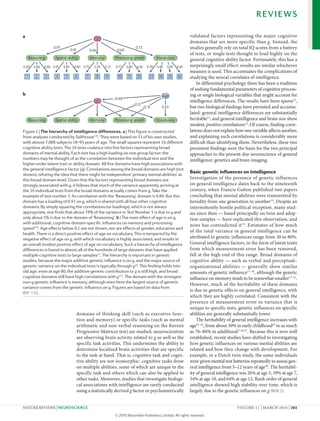
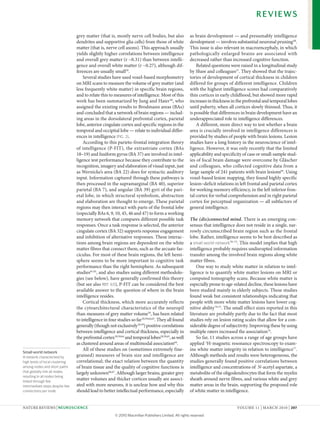
 is a core and valid facet of individual differences among humans. As this article shows,               An example of how the hierarchical structure of intelli-
 irrespective of definition and test used, data from brain‑imaging and genetic studies              gence variance emerges from test scores is shown in FIG. 1.
 show strong correlates with results from intelligence tests. This provides validity for            This general, hierarchical pattern of the components of
 psychometric intelligence measures, contrary to criticisms that such test scores (often            cognitive ability variance has been known for about a cen-
 expressed as IQ) are meaningless numbers.                                                          tury 10, and has been replicated in hundreds of datasets11.
                                                                                                    Spearman proposed that the general intelligence (mental
                                                                                                    ability) factor reflects a general cognitive ability that is
                              among one million men followed for approximately                      applicable to any kind of cognitive problem10. He termed
                              20 years after taking intelligence tests at about the age             it g, intending to avoid value judgements and arguments
                              of 20, an advantage in general intelligence of one stand-             by using a character that was free from prior connota-
                              ard deviation was associated with a 32% reduction in                  tions and misunderstandings. Despite this, g has been the
                              mortality 9. Intelligence is also important in everyday               subject of controversy ever since (BOX 2). It is important
                              decision-making 7.                                                    to emphasise g: it accounts for a substantial large amount
                                                                                                    of variance, it is the source of most of the predictive
                              The psychometric properties of intelligence                           power of cognitive tests and, as discussed below, it is the
                              Well-established results from differential psychology                 locus of most of the genetic variance.
                              studies have shown that it is inappropriate to assume that
                              performing any cognitive task involves only one relevant              From differential psychology to neuroscience
                              mental module (or faculty). consider the individual                   The neuroscience of intelligence is constrained by —
                              differences that are seen in a test of arithmetic involving           and must explain — the following established facts
                              fractions. Do some people perform better than others                  about cognitive test performance: about half of the vari-
                              because they differ on general intelligence, which we                 ance across varied cognitive tests is contained in gen-
                              know contributes to all cognitive tasks, irrespective of              eral cognitive ability; much less variance is contained
                              their content? or is there some cognitive faculty that                within broad domains of capability; there is some vari-
                              contributes to tasks involving mathematical tasks in                  ance in specific abilities; and there are distinct ageing
                              general, but not to other activities such as verbal and               patterns for so-called fluid and crystallized aspects of
                              spatial tasks? or do people differ on the specific ability            cognitive ability.
                              involved in doing fractional arithmetic in ways that have                 The existence of g creates a complicated situation
                              nothing to do with ability on any other cognitive task,               for neuroscience. The fact that g contributes substantial
                              even other mathematical tasks? or is it simply that people            variance to all specific cognitive ability tests is gener-
                              differ in their exposure to and practice with fractional              ally thought to indicate that g contributes directly in
                              arithmetic tasks?                                                     some way to performance on those tests. That is, when


202 | MARcH 2010 | voluMe 11                                                                                                   www.nature.com/reviews/neuro

                                                     © 2010 Macmillan Publishers Limited. All rights reserved
REVIEWS

a                                                            g
                                                                                                                           validated factors representing the major cognitive
                                                                                                                           domains that are more specific than g. Instead, the
                        0.97
                                      0.91            0.66                0.60
                                                                                         0.73                              studies generally rely on total IQ scores from a battery
                                                                                                                           of tests, or single tests thought to load highly on the
        Reasoning        Spatial ability              Memory             Processing speed                Vocabulary        general cognitive ability factor. Fortunately, this has a
0.89      0.86   0.80 0.91     0.83     0.80 0.75       0.78     0.72    0.77    0.80     0.82    0.78   0.89 0.90 0.85    surprisingly small effect: results are similar whichever
                                                                                                                           measure is used. This accentuates the complications of
    1      2        3    4      5        6        7      8       9        10      11       12       13    14   15     16   studying the neural correlates of intelligence.
                                                                                                                               In differential psychology there has been a tradition
                                                                                                                           of seeking fundamental parameters of cognitive process-
b                                                                                                           Age            ing or single biological variables that might account for
                                                                        –0.48
                                                             g                                                             intelligence differences. The results have been sparse12,
                                                                                        –0.15
                                                                                                –0.31       0.63           but two biological findings have persisted and accumu-
                                                                                                                           lated: general intelligence differences are substantially
        Reasoning        Spatial ability              Memory             Processing speed                Vocabulary        heritable13; and general intelligence and brain size show
                                                                                                                           modest, positive correlations14. of course, finding corre-
Figure 1 | The hierarchy of intelligence differences. a | This figure is constructed                                       lations does not explain how one variable affects another,
from analyses conducted by Salthouse120. They were based on 33 Reviews | Neuroscience
                                                              Nature of his own studies,                                   and explaining such correlations is considerably more
with almost 7,000 subjects 18–95 years of age. The small squares represent 16 different                                    difficult than identifying them. nevertheless, these two
cognitive ability tests. The 16 tests coalesce into five factors representing broad                                        persistent findings were the basis for the two principal
domains of mental ability. Each test has a high loading on one group factor; the                                           approaches to the present-day neuroscience of general
numbers may be thought of as the correlation between the individual test and the                                           intelligence: genetics and brain imaging.
higher-order latent trait or ability domain. All five domains have high associations with
the general intelligence factor (g). Correlations among the broad domains are high (not
                                                                                                                           Basic genetic influences on intelligence
shown), refuting the idea that there might be independent ‘primary mental abilities’ at
this broad domain level. Given that the factors representing broad domains are                                             Investigation of the presence of genetic influences
strongly associated with g, it follows that much of the variance apparently arriving at                                    on general intelligence dates back to the nineteenth
the 16 individual tests from the broad domains actually comes from g. Take the                                             century, when Francis Galton published two papers
example of test number 1. Its correlation with the ‘Reasoning’ domain is 0.89. But this                                    concluding that mental abilities were transmitted by
domain has a loading of 0.97 on g, which is shared with all four other cognitive                                           heredity from one generation to another 15. Despite an
domains. By simply squaring the correlations (or loadings), which is not always                                            intermittently hostile political reception, many stud-
appropriate, one finds that about 74% of the variance in Test Number 1 is due to g and                                     ies since then — based principally on twin and adop-
only about 5% is due to the domain of ‘Reasoning’. b | The main effect of age is on g,                                     tion samples — have replicated this observation, and
with additional, cognitive domain-specific influences on memory and processing
                                                                                                                           none has contradicted it 16. estimates of how much
speed120. Age effects below 0.1 are not shown, nor are effects of gender, education and
                                                                                                                           of the total variance in general intelligence can be
health. There is a direct positive effect of age on vocabulary. This is tempered by the
negative effect of age on g, with which vocabulary is highly associated, and results in                                    attributed to genetic influences range from 30 to 80%.
an overall modest positive effect of age on vocabulary. Such a hierarchy of intelligence                                   General intelligence factors, in the form of latent traits
differences is found in almost all of the hundreds of large datasets that have applied                                     from which measurement error has been removed,
multiple cognitive tests to large samples11. The hierarchy is important in genetic                                         fall at the high end of this range. Broad domains of
studies, because the major additive genetic influence is on g, and the major source of                                     cognitive ability — such as verbal and perceptual–
genetic variance on the individual tests is typically through g20. This finding holds into                                 organizational abilities — generally show similar
old age: even at age 80, the additive genetic contribution to g is still high, and broad                                   amounts of genetic influence17–20, although the genetic
cognitive domains still have high correlations with g121. The domain with the strongest                                    influence on memory tends to be somewhat smaller 17–21.
non-g genetic influence is memory, although even here the largest source of genetic
                                                                                                                           However, much of the heritability of these domains
variance comes from the genetic influence on g. Figures are based on data from
                                                                                                                           is due to genetic effects on general intelligence, with
REF. 120.
                                                                                                                           which they are highly correlated. consistent with the
                                                                                                                           presence of measurement error in variance that is
                                                                                                                           unique to specific tests, genetic influences on specific
                                             domains of thinking skill (such as executive func-                            abilities are generally substantially lower.
                                             tion and memory) or specific tasks (such as mental                                The heritability of general intelligence increases with
                                             arithmetic and non-verbal reasoning on the Raven’s                            age22–24, from about 30% in early childhood25 to as much
                                             Progressive Matrices test) are studied, neuroscientists                       as 70–80% in adulthood17,26,27. Because this is now well
                                             are observing brain activity related to g as well as the                      established, recent studies have shifted to investigating
                                             specific task activities. This undermines the ability to                      how genetic influences on various mental abilities are
                                             determine localized brain activities that are specific                        related and how they change with development. For
                                             to the task at hand. That is, cognitive task and cogni-                       example, in a Dutch twin study, the same individuals
                                             tive ability are not isomorphic: cognitive tasks draw                         were given mental test batteries repeatedly to assess gen-
                                             on multiple abilities, some of which are unique to the                        eral intelligence from 5–12 years of age28. The heritabil-
                                             specific task and others which can also be applied to                         ity of general intelligence was 26% at age 5, 39% at age 7,
                                             other tasks. Moreover, studies that investigate biologi-                      54% at age 10, and 64% at age 12. Rank order of general
                                             cal associations with intelligence are rarely conducted                       intelligence showed high stability over time, which is
                                             using a statistically derived g factor or psychometrically                    largely due to the genetic influences on g (BOX 3).


nATuRe RevIeWS | NeuroscieNce                                                                                                                       voluMe 11 | MARcH 2010 | 203

                                                                        © 2010 Macmillan Publishers Limited. All rights reserved
REVIEWS

                                  Box 2 | Controversies in intelligence and criticisms of g
                                  controversies involving intelligence
                                  Two types of controversy surround the measurement of intelligence: in some cases, empirical intelligence‑related data
                                  exist but have been missed, unappreciated, ignored or even rejected; in other cases, no definitive intelligence‑related
                                  data are yet available. Examples of the first type include arguments about whether there are ‘multiple intelligences’;
                                  whether genetic factors contribute to intelligence differences; and whether brain size is related to intelligence. The data
                                  on these issues are substantial and there are few to no contradictory data. Examples of the second type of controversy
                                  include debates about whether and to what extent intelligence tests may be biased for or against specific groups; the
                                  existence and causes of sex and ethnic differences in intelligence; the causes of the well‑known correlations among
                                  intelligence, education and social class; and the cause of the population‑level increases in IQ (intelligence quotient) test
                                  scores throughout the twentieth century in Western societies (known as the Flynn effect). The tools that are currently
                                  available to address these issues, such as tests of measurement invariance, are inadequate to resolve them. This is because,
                                  at present, we can only measure intelligent performance, which develops over time. Its development in an individual is
                                  therefore embedded in the individual’s environment of origin.
                                  criticisms of g
                                  g has been criticized on two major grounds. First, several theorists have proposed that domains of cognitive ability might
                                  be independent of one another. The best known of these are Thurstone’s ‘Primary Mental Abilities’ (PMA) and Gardner’s
                                  ‘Multiple Intelligences’ (MI). However, these theories have not held up well. Even Thurstone’s own PMA data contained a
                                  strong g factor107. Gardner has intentionally avoided empirical tests of his theory, but those that have been made show most
                                  of his MI to be correlated with one another108; and some of the MI, such as kinaesthetic ability, are not what psychologists
                                  would think of as ‘cognitive’ abilities at all. Second, Cattell and Horn suggested that, however robust it may be statistically,
                                  g might have no real importance in the brain because different batteries of ability test could give different values of g,
                                  resulting in different rank orders among individuals109. This is incorrect. As long as test batteries are reasonably diverse,
                                  g factors from different test batteries are almost perfectly correlated110. That is, as long as one administers enough tests, the
                                  general intelligence factor from one group of tests will agree closely in ranking with the general intelligence factor from
                                  any other group of tests.
                                    For more than a century, many people have dismissed the concept of g, but the near‑universal positive covariation among
                                  cognitive tests is a fact. The theories that do not accommodate this finding — such as those of Thurstone, Guilford, Sternberg
                                  and Gardner — fail the most basic empirical tests. Prominent accounts arguing that g is a necessary artefact of the statistical
                                  analyses — such as principal components analysis — are incorrect111. But there are more subtle and effective ways in which g
                                  has been questioned than the mere denial of the positive manifold, two of which deserve attention.
                                    First is the continuous and often heated debate between Spearman and Godfrey Thomson. Thomson suggested that the
                                  positive associations among cognitive tests might be explained not by individual differences in a single property —
                                  whatever g represented, such as the ‘mental energy’ proposed by Spearman himself — but by individual differences in the
                                  number or efficiency of ‘bonds’ in people’s brains. Thomson’s idea, borrowed from his friend R. L. Thorndike, was that
                                  brains were composed of a very large number of biological units (bonds) and that, when a person attempted to solve
                                  mental test items, each item sampled a number of these bonds. The degree to which tests overlapped in the bonds they
                                  sampled accounted for their correlation. Thomson could not specify what the brain’s units were — although guesses such
                                  as “neural arcs” suggest effective connections — but the theory implied that intelligence differences could lie in the
                                  number and/or efficiency of the bonds. Recent re‑evaluation of Thomson’s ideas has found that his and Spearman’s
                                  models of intelligence can both account for the psychometric patterning of tests’ intercorrelations, and that current
                                  neuroimaging, genetic and psychophysiological evidence cannot distinguish between them112. A computationally and
                                  conceptually modern version of this argument based on the supposition of mutual interactions between cognitive
                                  processes has also been proposed recently113.
                                    Second, one must recognize the success of at least one aspect of the Cattell–Horn theory of fluid and crystallized
                                  intelligence109. Fluid intelligence (gf) is intelligence‑as‑process, and is typically assessed using tests that require
                                  on‑the‑spot processing. Crystallized intelligence (gc) is intelligence‑as‑product, and is typically measured using tests that
                                  assess stored knowledge, such as vocabulary and general facts. Although the two are highly correlated, there is a marked
                                  difference in the extent to which they change with age: fluid intelligence changes like other physical abilities, whereas
                                  crystallized ability shows little age‑related decline. A neuroscientific account of intelligence differences must explain
                                  these differential trajectories.


                                 Shared genetic influences between brain structure–                   function34, and information processing capacity and
                                 function and intelligence? In adults, there are strong               efficiency as measured in tests of executive function35
                                 genetic influences on many brain structures and                      and inspection time26. variations in these structures and
Endophenotype                    regions — including on the density and the volume of                 functions may be endophenotypes for intelligence — that
A quantifiable phenotype with
                                 grey and white matter in corpus callosum, superior                   is, they might be intermediate physiological markers
an assumed intermediate role
in the pathway from genes to     frontal and temporal cortex, medial frontal cortex,                  that contribute directly to intelligence. Therefore, genes
complex phenotypes. It is        amygdala, hippocampus, Broca’s area, anterior cingulate              involved in intelligence might be more closely linked to
thought that the action of the   cortex, Heschl’s gyrus and postcentral gyrus — and on                these variations in brain structure and function than
endophenotype is easier to       overall brain volume; this explains 70–90% of the vari-              to intelligence itself. In fact, in all studies to date, the
understand biologically and
genetically than the action
                                 ance in these measures29–33. This is also true of aspects            genetic influences on these structures and functions
of the complex phenotype of      of brain functioning, such as the dynamic complexity of              were highly correlated with those on general intelli-
primary interest.                brain oscillations thought to be involved in executive               gence29,31,32,36. This important result — that at least some


204 | MARcH 2010 | voluMe 11                                                                                                     www.nature.com/reviews/neuro

                                                       © 2010 Macmillan Publishers Limited. All rights reserved
REVIEWS

 Box 3 | Measuring genetic influences on intelligence                                               temporal lobes, which develop rapidly in adolescence,
                                                                                                    showed stronger genetic influences during adolescence40.
 Many studies investigating genetic and environmental contributions to intelligence                 Total variance in overall brain morphology generally
 have been performed using monozygotic and dizygotic twins, but studies have also                   increased with age; however, for white matter, genetic
 made use of samples of adoptive and biological siblings, as well as parents and their
                                                                                                    variance increased over time, whereas environmental
 adoptive or biological offspring, with consistent results across different types of
                                                                                                    variance increased for grey matter.
 relationship groups114. There have also been systematic reviews of the genetic
 contribution to general intelligence115. The basic logic of such studies is
 straightforward: genetic influences can be inferred when closer biological relatives               Molecular genetic studies. Despite the high heritability of
 (identical twins, for example) are more similar for the trait of interest than less closely        intelligence, it is difficult to name even one genetic locus
 related pairs (ordinary siblings, for example). Shared environmental influences, by                that is reliably associated with normal-range intelligence
 contrast, are indicated by greater similarity between pairs of family members than                 in young, healthy adults, although some 300 genes are
 would be predicted on the basis of their biological relationship.                                  known to be associated with mental retardation41. After
   Kinship studies to determine the proportion of variance that can be attributed to                a thorough survey of more than 200 published studies
 genetic compared with environmental influences rely on the validity of some crucial                on the 50 or so genes that have been implicated in dif-
 assumptions. From a quantitative genetic perspective, arguably the most fundamental
                                                                                                    ferences in cognitive abilities, the author concluded that,
 of these is the assumption that genetic and environmental influences are independent,
                                                                                                    after 14 years of cognitive genetic research, there are no
 but this assumption is often false. An example that is relevant to the development of
 intelligence is the association of socioeconomic status (SES) with intelligence. There is          genes that we can conclusively say are responsible for the
 some evidence that, in childhood, genetic influences on IQ (intelligence quotient) but             variation in cognition or its decline with age in healthy,
 not on SES are stronger in higher SES environments116 (but see also REF. 117), possibly            normal individuals42.
 indicating that some genes involved in IQ tend to be expressed only in higher SES                      Most of the genes that have been investigated in
 environments (gene–environment interaction). But IQ and SES are generally                          studies to date are associated with neurotransmitters
 correlated118, suggesting that one’s intelligence can influence one’s SES or vice versa.           (two-thirds of the studies), disease, development or
 Moreover, parents pass both their genes for intelligence and the associated SES                    metabolism. Many studies have reported associations
 environment on to their offspring (gene–environment correlation). Understanding how                between particular polymorphisms and cognitive per-
 genes are involved in this correlation would help in interpreting the biological meaning
                                                                                                    formance, but the associations were often small and most
 of intelligence’s high heritability. Of note, the issue of gene–environment correlation
                                                                                                    could not be replicated in other samples13,42. There are,
 has not been addressed in the interaction studies conducted to date. Statistical designs
 exist to capture gene–environment interactions and correlations simultaneously in                  however, reliable associations, largely limited to older
 behaviour–genetic analyses119, but the techniques currently available are not                      people, between apolipoprotein e (APOE) polymorph-
 applicable to situations such as childhood SES, which is identical for twin offspring.             isms and general cognitive ability, episodic memory,
                                                                                                    processing speed and executive function, with the first
                                                                                                    two of these showing an increasing effect with age43. The
                              neural correlates of intelligence owe their associations              increased effect with age is possibly due to the fact that
                              to shared genetic influences — is drawn from multivari-               APoe has a role in neuronal repair 44.
                              ate genetic studies (BOX 4).                                              There may be faint signals in the noise among molecu-
                                  Brain development in childhood clearly involves                   lar genetic studies of intelligence that have been conducted
                              morphological change, which is under some form of                     so far. For example, a meta-analysis of 16 studies (total
                              genetic control37,38. A longitudinal brain imaging study              n >9,000) found that a common polymorphism in the gene
                              of children and adolescents examined twins and sin-                   that codes for catechol-O-methyltransferase (COMT)
                              gletons ranging from 5 to 18 years of age39. They were                was significantly and robustly associated with IQ scores
                              recruited in 2001, and have been assessed at approxi-                 (taken to represent general intelligence)45. However, the
                              mately 2-year intervals. In this sample, developmen-                  polymorphism accounted for only 0.1% of variance.
                              tal trajectories of cortical thickness more accurately                Further evidence for a contribution of the COMT poly-
                              predicted IQ at age 20 than did differences in cortical               morphism to intelligence has been provided by brain-
                              thickness at age 20 (REF. 39). There were strong genetic              imaging studies in humans, pharmacological studies in
                              influences (77–88% of the variance) on the thickness of               animals, and transgenic and gene-knockout studies
                              the mid-sagittal area of the corpus callosum, the volume              in animals46. The valine-to-methionine amino-acid
                              of the caudate nucleus, and grey and white matter vol-                substitution involved in this polymorphism reduces the
                              umes of the total cerebrum, parietal lobes and temporal               activity of this dopamine-degrading enzyme, and the
                              lobes. Genetic influences on the volumes of the cere-                 polymorphism is thought to affect dopamine function
                              bellum and lateral ventricles were smaller (both 49%).                in the prefrontal cortex.
                              Again, these data point to a distributed pattern of brain                 The val66Met polymorphism in the gene encoding
                              correlates of general intelligence, which is addressed                brain-derived neurotrophic factor (BDNF) is another
                              below. complicating the situation for brain-imaging                   genetic variant commonly studied in association with
                              studies, genetic influences on general intelligence that              cognitive abilities. Most studies report significant effects
                              were shared across brain regions were stronger than                   of this polymorphism on intelligence42,47; however, the
                              those specific to any one region39. Genetic influences on             studies differ with respect to which allele is associated
                              brain regions tended to be strongest when brain regions               with better cognitive performance. overall, candidate-
                              were under greatest development: for example, the pri-                gene studies of intelligence and specific cognitive
                              mary sensory motor cortex, which develops early in                    abilities have been criticized on a number of grounds:
                              childhood, showed stronger genetic influences during                  “Inadequate sample size, population stratification,
                              early childhood, and the dorsal prefrontal cortex and                 environmental exposure, publication bias, variation in


nATuRe RevIeWS | NeuroscieNce                                                                                                 voluMe 11 | MARcH 2010 | 205

                                                     © 2010 Macmillan Publishers Limited. All rights reserved
REVIEWS

                                    Box 4 | Multivariate genetic studies
                                    The methods used to estimate the proportions of variance that are attributable to genetic and environmental influences on
                                    one trait can be extended to estimate the genetic and environmental influences on the co‑variances among multiple traits.
                                    For example, is the correlation between intelligence and brain size due to genes that influence both traits, or is it due to
                                    environmental conditions that affect both? To what degree do the genetic and/or environmental influences on brain size
                                    also contribute to intelligence? Developing answers to these questions relies on comparing the cross‑relative co‑variance
                                    between the two traits. That is, we might measure the degree to which intelligence in one member of each twin pair in a
                                    sample co‑varies with the brain size in the other member of each twin pair, and compare the results in mono‑ and dizygotic
                                    twins. Genetic influences that are common to intelligence and brain size would be indicated when there is greater
                                    cross‑pair similarity in more closely biologically related pairs, and shared environmental influences would be indicated
                                    when there is greater similarity between pairs of family members than would be indicated by their biological relationship.
                                      Such comparisons result in two kinds of statistics. First, genetic and environmental correlations, like ordinary
                                    correlations, range from –1 to +1 and document the extent to which genetic and/or environmental influences on one trait,
                                    such as brain size, also influence the other trait, such as intelligence. Second, we can also estimate the extent to which the
                                    observed correlation between, for example, brain size and intelligence can be attributed to genetic and/or environmental
                                    influences. Results from one study indicated that various measures of brain size were correlated 0.24–0.29 with various
                                    measures of intelligence, and genetic influences on the measures of brain size were correlated 0.24–0.38 with genetic
                                    influences on intelligence. All of the observed correlations, however, could be attributed to genetic influences32. This
                                    emphasizes that genetic and environmental correlations are independent of the extent of genetic and/or environmental
                                    influences on the traits. One trait can be under strong genetic influence, but those genetic influences may not be related
                                    to those on another trait, even if that trait is also under strong genetic influence, and vice versa.
                                      Genetic and environmental correlations, like estimates of genetic and environmental influences, are statistical measures
                                    that quantify co‑variance and variance. They cannot, therefore, identify the specific genes involved, and provide little
                                    information about whether we should expect to be able to find any specific genes of measurable effect. Moreover, genetic
                                    and environmental correlations do not specify causes. It is certainly possible that a common set of genes may contribute
                                    directly to both traits, but genetic correlations may arise for other reasons as well. In particular, when one genetically
                                    influenced trait affects the development of another trait by influencing the (gene’s, brain’s or individual’s) environment,
                                    those genetic influences will also contribute to the genetic influences on the second trait. And specific genes that are of
                                    major importance to one trait may be of only minor importance to the other.


                                   classification and measurements are all examples that                such as height 51) is that a large number of genetic vari-
                                   may make one group’s findings different from those of                ants have small effects. There might also be roles for
                                   another”42.                                                          copy number variations and for rare variants in indi-
                                       At this point, it seems unlikely that single genetic             vidual differences in intelligence. consortia formed to
                                   loci have major effects on normal-range intelligence.                produce genome-wide scans will, in the near future,
                                   For example, a modestly sized genome-wide study of                   report genetic associations with cognitive functions based
                                   the general intelligence factor derived from ten separate            on subject samples of 10,000 and more. The reliability of
                                   test scores in the cAnTAB cognitive test battery did                 the results from these studies remains to be seen.
                                   not find any important genome-wide single nucleotide
                                   polymorphisms or copy number variants, and did not                   Brain imaging and intelligence differences
                                   replicate genetic variants that had previously been asso-            Bigger is better. Historically, the central working hypoth-
                                   ciated with cognitive ability 48. It is possible that genetic        esis in the neuroscience of human intelligence differ-
                                   variance in intelligence results from a mutation–selection           ences has been that size matters52,53. empirical research
                                   balance, which is the cross-generational accumulation of             in this tradition began in the nineteenth century, when
                                   many mildly harmful mutations that natural selection                 scholars such as Paul Broca and Francis Galton studied
                                   has not yet removed from the population49,50. Because                intellectual ability and achievement in relation to brain
                                   such variants would be rare, and our primary methods                 size. Brain size was mostly approximated by measures of
                                   of identifying genetic association require that variants             head size, sometimes validated by post-mortem infor-
                                   be common, this possibility would be consistent with                 mation. current data indicate that intelligence is corre-
                                   the fact that we can isolate genetic variants involved in            lated with head size (r ~0.20)54 and intracranial volume
                                   mental retardation but not variants involved in normal-              (r ~0.40)55. The clearest single body of evidence is that,
                                   range intelligence.                                                  in healthy people, total brain volume (measured using
                                       It would be easy to fill this Review with data from              structural MRI) is moderately correlated with intelli-
                                   studies that apparently show gene–intelligence asso-                 gence (r ~0.30–0.40)14,54. However, this does not mean
                                   ciations13,42,48. However, most of these studies’ findings           that the basis of this correlation is understood.
Mutation–selection balance         have not been replicable. even the associations between                  With the advent of MRI technology, it became pos-
An evolutionary genetic            genetic variations such as those in COMT and BDNF and                sible to extend the study of intelligence–size relations
explanation for the                intelligence in the normal range — for which the studies             to individual brain regions in vivo. These studies found
maintenance of genetic             are quite numerous — are still equivocal.                            associations between intelligence and volumes of fron-
variance in a trait, based on an
equilibrium between novel
                                       The emerging view of genetic influences on intel-                tal, parietal and temporal cortices as well as the hippo-
detrimental mutations and          ligence (and many other complex phenotypes that                      campus, all seldom larger than r = 0.25 (REFs 14,55–58).
purifying selection.               have been studied so far, particularly quantitative traits           using MRI, it is also possible to separate volumes of


206 | MARcH 2010 | voluMe 11                                                                                                      www.nature.com/reviews/neuro

                                                         © 2010 Macmillan Publishers Limited. All rights reserved
REVIEWS

                                  grey matter (that is, mostly nerve cell bodies, but also              as brain development — and presumably intelligence
                                  dendrites and supportive glia cells) from those of white              development — involves substantial neuronal pruning 68.
                                  matter (that is, nerve cell axons). This approach usually             This issue is also relevant in macroencephaly, in which
                                  yields slightly higher correlations between intelligence              pathologically enlarged brains are associated with
                                  and overall grey matter (r ~0.31) than between intelli-               decreased rather than increased cognitive function.
                                  gence and overall white matter (r ~0.27), although dif-                   Related questions were raised in a longitudinal study
                                  ferences are usually small59.                                         by Shaw and colleagues37. They showed that the trajec-
                                      Several studies have used voxel-based morphometry                 tories of development of cortical thickness in children
                                  on MRI scans to measure the volume of grey matter (and                differed for groups of different intelligence. children
                                  less frequently white matter) in specific brain regions,              with the highest intelligence scores had comparatively
                                  and to relate this to measures of intelligence. Most of this          thin cortices in early childhood, but showed more rapid
                                  work has been summarized by Jung and Haier 60, who                    increases in thickness in the prefrontal and temporal lobes
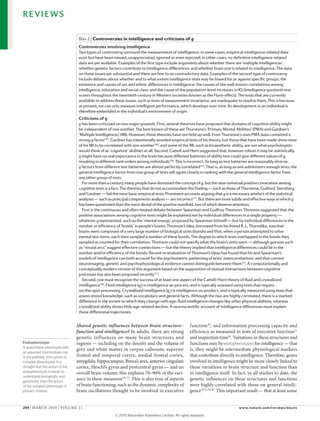
                                  assigned the existing results to Brodmann areas (BAs)                 until puberty, when all cortices slowly thinned. Thus, it
                                  and concluded that a network of brain regions — includ-               is possible that differences in brain development have an
                                  ing areas in the dorsolateral prefrontal cortex, parietal             underappreciated role in intelligence differences.
                                  lobe, anterior cingulate cortex and specific regions in the               A different, more direct way to test whether a brain
                                  temporal and occipital lobe — relate to individual differ-            area is crucially involved in intelligence differences is
                                  ences in intelligence (FIG. 2).                                       provided by studies of people with brain lesions. lesion
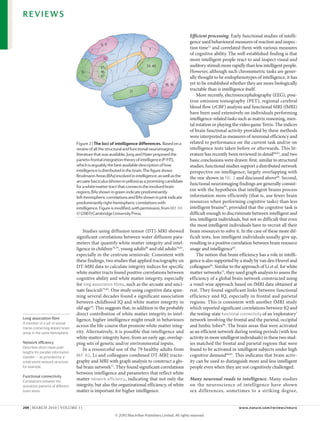
                                      According to this parieto-frontal integration theory              studies have a long history in the neuroscience of intel-
                                  of intelligence (P-FIT), the extrastriate cortex (BAs                 ligence. However, it was only recently that the limited
                                  18–19) and fusiform gyrus (BA 37) are involved in intel-              applicability and specificity of case or small-sample stud-
                                  ligence test performance because they contribute to the               ies of focal brain damage were overcome by Gläscher
                                  recognition, imagery and elaboration of visual input, just            and colleagues, who collected cognitive data from a
                                  as Wernicke’s area (BA 22) does for syntactic auditory                large sample of 241 patients with brain lesions69. using
                                  input. Information captured through these pathways is                 voxel-based lesion mapping, they found highly specific
                                  then processed in the supramarginal (BA 40), superior                 lesion–deficit relations in left frontal and parietal cortex
                                  parietal (BA 7), and angular (BA 39) gyri of the pari-                for working memory efficiency, in the left inferior fron-
                                  etal lobe, in which structural symbolism, abstraction                 tal cortex for verbal comprehension and in right parietal
                                  and elaboration are thought to emerge. These parietal                 cortex for perceptual organization — all subfactors of
                                  regions may then interact with parts of the frontal lobe              general intelligence.
                                  (especially BAs 6, 9, 10, 45, 46 and 47) to form a working
                                  memory network that compares different possible task                  The (dis)connected mind. There is an emerging con-
                                  responses. once a task response is selected, the anterior             sensus that intelligence does not reside in a single, nar-
                                  cingulate cortex (BA 32) supports response engagement                 rowly circumscribed brain region such as the frontal
                                  and inhibition of alternative responses. These interac-               lobe. Rather, intelligence seems to be best described as
                                  tions among brain regions are dependent on the white                  a small-world network70–73. This model implies that high
                                  matter fibres that connect them, such as the arcuate fas-             intelligence probably requires undisrupted information
                                  ciculus. For most of these brain regions, the left hemi-              transfer among the involved brain regions along white
                                  sphere seems to be more important to cognitive task                   matter fibres.
                                  performance than the right hemisphere. As subsequent                      one way to study white matter in relation to intel-
                                  studies61,62, and also studies using different methodolo-             ligence is to quantify white matter lesions on MRI or
                                  gies (see below), have generally confirmed this theory                computed tomography scans. Because white matter is
                                  (but see also REF. 63), P-FIT can be considered the best              especially prone to age-related decline, these lesions have
                                  available answer to the question of where in the brain                been studied mainly in elderly subjects. These studies
                                  intelligence resides.                                                 found weak but consistent relationships indicating that
                                      cortical thickness, which more accurately reflects                people with more white matter lesions have lower cog-
                                  the cytoarchitectural characteristics of the neuropil                 nitive ability 74,75. The small effect sizes reported in this
                                  than measures of grey matter volume59, has been related               literature are probably partly due to the fact that most
                                  to intelligence in four studies so far 29,59,64,65. They all found    studies rely on lesion rating scales that allow for a con-
                                  generally (though not exclusively29,59) positive correlations         siderable degree of subjectivity. Improving these by using
                                  between intelligence and cortical thickness, especially in            multiple raters increased the association76.
                                  the prefrontal cortex29,59,64 and temporal lobes29,59,65, as well         So far, 11 studies across a range of age groups have
                                  as clustered around areas of multimodal association64.                applied 1H-magnetic resonance spectroscopy to exam-
                                      All of these studies on (sometimes extremely fine-                ine white matter integrity in relation to intelligence77.
Small-world network
A network characterized by        grained) measures of brain size and intelligence are                  Although methods and results were heterogeneous, the
high levels of local clustering   correlational; the exact relation between the quantity                studies generally found positive correlations between
among nodes and short paths       of brain tissue and the quality of cognitive functions is             intelligence and concentrations of N-acetyl aspartate, a
that globally link all nodes,     largely unknown66,67. Although larger brains, greater grey            metabolite of the oligodendrocytes that form the myelin
resulting in all nodes being
linked through few
                                  matter volumes and thicker cortices usually are associ-               sheath around nerve fibres, and various white and grey
intermediate steps despite few    ated with more neurons, it is unclear how and why this                matter areas in the brain, supporting the proposed role
connections per node.             should lead to better intellectual performance, especially            of white matter in intelligence.


nATuRe RevIeWS | NeuroscieNce                                                                                                     voluMe 11 | MARcH 2010 | 207

                                                         © 2010 Macmillan Publishers Limited. All rights reserved
REVIEWS

                                                                                                        Efficient processing. early functional studies of intelli-
                                                                                                        gence used behavioural measures of reaction and inspec-
                                                 6, 9
                                                                              7                         tion time12 and correlated them with various measures
                                                                                                        of cognitive ability. The well-established finding is that
                                                  32                                                    more intelligent people react to and inspect visual and
                                                 45,                        39, 40                      auditory stimuli more rapidly than less intelligent people.
                                     10          46,                                                    However, although such chronometric tasks are gener-
                                                 47                                                     ally thought to be endophenotypes of intelligence, it has
                                                                                        18, 19          yet to be established whether they are more biologically
                                                                  21              37                    tractable than is intelligence itself.
                                                                                                            More recently, electroencephalography (eeG), posi-
                                                                                                        tron emission tomography (PeT), regional cerebral
                                                                                                        blood flow (rcBF) analysis and functional MRI (fMRI)
                                                                                                        have been used extensively on individuals performing
                                                                                                        intelligence-related tasks such as matrix reasoning, men-
                                                                                                        tal rotation or playing the video game Tetris. The indices
                                                                                                        of brain functional activity provided by these methods
                                                                                                        were interpreted as measures of neuronal efficiency and
                                   Figure 2 | The loci of intelligence differences. Based on a          related to performance on the current task and/or on
                                   review of all the structural and functional neuroimaging             intelligence tests taken before or afterwards. This lit-
                                                                    Nature Reviews | Neuroscience
                                   literature that was available, Jung and Haier proposed the           erature has recently been reviewed in detail60,83, and two
                                   parieto-frontal integration theory of intelligence (P-FIT),          basic conclusions were drawn: first, similar to structural
                                   which is arguably the best available description of how              studies, functional studies support a distributed network
                                   intelligence is distributed in the brain. The figure shows           perspective on intelligence, largely overlapping with
                                   Brodmann Areas (BAs) involved in intelligence, as well as the        the one shown in FIG. 2 and discussed above60. Second,
                                   arcuate fasciculus (shown in yellow) as a promising candidate
                                                                                                        functional neuroimaging findings are generally consist-
                                   for a white matter tract that connects the involved brain
                                   regions. BAs shown in green indicate predominantly                   ent with the hypothesis that intelligent brains process
                                   left-hemispheric correlations and BAs shown in pink indicate         information more efficiently (that is, use fewer brain
                                   predominantly right-hemispheric correlations with                    resources when performing cognitive tasks) than less
                                   intelligence. Figure is modified, with permission, from REF. 60      intelligent brains84, provided that the cognitive task is
                                   © (2007) Cambridge University Press.                                 difficult enough to discriminate between intelligent and
                                                                                                        less intelligent individuals, but not so difficult that even
                                                                                                        the most intelligent individuals have to recruit all their
                                       Studies using diffusion tensor (DT)-MRI showed                   brain resources to solve it. In the case of these more dif-
                                   significant correlations between water diffusion para-               ficult tests, less intelligent individuals usually give up,
                                   meters that quantify white matter integrity and intel-               resulting in a positive correlation between brain resource
                                   ligence in children78,79, young adults80 and old adults78,81,        usage and intelligence83.
                                   especially in the centrum semiovale. consistent with                     The notion that brain efficiency has a role in intelli-
                                   these findings, two studies that applied tractography on             gence is also supported by a study by van den Heuvel and
                                   DT-MRI data to calculate integrity indices for specific              colleagues85. Similar to the approach of li et al. for white
                                   white matter tracts found positive correlations between              matter networks71, they used graph analysis to assess the
                                   cognitive ability and white matter integrity, especially             efficiency of a global brain network constructed using
                                   for long association fibres, such as the arcuate and unci-           a voxel-wise approach based on fMRI data obtained at
                                   nate fasciculi75,82. one study using cognitive data span-            rest. They found significant links between functional
                                   ning several decades found a significant association                 efficiency and IQ, especially in frontal and parietal
                                   between childhood IQ and white matter integrity in                   regions. This is consistent with another fMRI study
                                   old age78. This suggests that, in addition to the probably           which reported significant correlations between IQ and
                                   direct contribution of white matter integrity to intel-              the resting-state functional connectivity of an ‘exploratory’
Long association fibre             ligence, higher intelligence might result in behaviours              network involving the frontal and the parietal, occipital
A member of a set of axonal
tracks connecting distant brain
                                   across the life-course that promote white matter integ-              and limbic lobes86. The brain areas that were activated
areas in the same hemisphere.      rity. Alternatively, it is possible that intelligence and            as an efficient network during resting periods (with less
                                   white matter integrity have, from an early age, overlap-             activity in more intelligent individuals) in these two stud-
Network efficiency                 ping sets of genetic and/or environmental inputs.                    ies matched the frontal and parietal regions that were
Describes short mean path
                                       In a resourceful use of the 79 healthy adults from               found to be activated in intelligent subjects under high
lengths for parallel information
transfer — as provided by a        REF. 82, li and colleagues combined DT-MRI tracto-                   cognitive demand60,83. This indicates that brain activ-
small-world network structure,     graphy and MRI with graph analysis to construct a glo-               ity can be used to distinguish more and less intelligent
for example.                       bal brain network71. They found significant correlations             people even when they are not cognitively challenged.
                                   between intelligence and parameters that reflect white
Functional connectivity
Correlations between the
                                   matter network efficiency, indicating that not only the              Many neuronal roads to intelligence. Many studies
activation patterns of different   integrity, but also the organizational efficiency, of white          on the neuroscience of intelligence have shown
brain areas.                       matter is important for higher intelligence.                         sex differences, sometimes to a striking degree,


208 | MARcH 2010 | voluMe 11                                                                                                       www.nature.com/reviews/neuro

                                                         © 2010 Macmillan Publishers Limited. All rights reserved
REVIEWS

                       with respect to which brain features correlate with                 Conclusions
                       intelligence. For example, in males, intelligence is                Results from genetic and brain-imaging studies performed
                       more strongly correlated with fronto-parietal grey                  to date can inform the design of the next phase of neuro-
                       matter volume whereas, in females, intelligence shows               science-based studies of intelligence. Such studies should
                       stronger correlations with white matter volume and                  have large samples and a developmental perspective,
                       grey matter volume in Broca’s area87. cortical thick-               include brain imaging and genetic testing, and be driven
                       ness in frontal regions correlates more strongly with               by theories about the brain underpinnings of intelligence
                       intelligence in females, whereas temporal-occipital                 differences. They should be psychometrically minded,
                       cortical thickness shows a stronger correlation with                which means that they should have subjects who are
                       intelligence in males59. White matter integrity seems               tested on adequate batteries of psychometric tests, and
                       to be more important for intelligence in females than               that the brain measurements should have due regard to
                       in males: males sometimes even show negative rela-                  the reliability and validity of their measures.
                       tions between intelligence and DT-MRI integrity                         The first adequately powered genome-wide studies
                       measures of fronto-parietal fibres after puberty. This              of intelligence are in progress. We anticipate that, like
                       suggests that, in males, cognitive functions are based              some other highly polygenic phenotypes such as height,
                       on fewer, but thicker and more tightly packed fibres                there will be much missing heritability 104. That is, we
                       than in females88. Males also seem to be more neuron-               expect some small effects from a large number of com-
                       ally efficient (that is, they show less brain activation)           mon genetic variants, but they will account for little of
                       than females during spatial cognitive tasks with                    intelligence’s high heritability. This means that other
                       intermediate difficulty levels, whereas females seem                sources of genetic variation will need to be examined.
                       to be more neuronally efficient than males during                   Studies using genetic sequencing — which will detect
                       verbal tasks of medium difficulty 89. This is consist-              rare genetic variants — and the study of copy-number
                       ent with established sex differences showing better                 variations will be important. Results from these are
                       spatial abilities in males and better verbal abilities              predicted by the ‘rare variant–common disease’ and
                       in females83,90. These patterns are interesting because             mutation load hypotheses. Rare genetic variants might
                       males and females show marked differences in brain                  be population specific and therefore might not always be
                       size54 and structure91–93, but negligible differences in            represented across samples. Studies that combine genetic
                       general intelligence94. Apparently, males and females               analysis with brain imaging will be increasingly useful.
                       can achieve similar levels of overall intellectual                  There is a welcome trend towards larger samples in neu-
                       performance by using differently structured brains in               roimaging and genetics, allowing for much more defi-
                       different ways84.                                                   nite results than those comprising most of the literature
                           Sex differences are a peculiar form of individual dif-          so far. However, it is still important to avoid statistical
                       ferences, because the two sexes are the only qualitatively          pitfalls — both genetic and imaging studies have been
                       different ‘morphs’ of the human species95. This makes               prone to type I and type II statistical errors.
                       it easy to group subjects by this variable. However, it                 In addition to studies of the association between
                       is likely that there is within-sex variation in how indi-           intelligence and genetic structure differences, there will
                       viduals use their brain. Two individuals might achieve              also be a need to examine individual differences in epi-
                       identical intelligence test scores through different neu-           genetic changes (for example, DnA methylation), gene
                       ronal routes because they have different brain structures           expression, proteomics, metabolomics, and gene–gene
                       or different expertise and training, or they might have             and gene–environment interactions that might account
                       used different cognitive strategies63,83,96,97.                     for individual differences in intelligence.
                           Similarly, people seem to be able to compensate for                 Studies of the biological functioning of intelligence
                       cognitive deficits (or respond to cognitive challenges) by          must recognize that people do not differ only in their
                       recruiting brain areas with hitherto only indirect rela-            general cognitive ability, but probably also in how they
                       tions to intelligence, especially frontal and correspond-           use their brain to reach particular levels of perform-
                       ing contralateral areas98. Such compensation results in a           ance. To understand the neuroscience of intelligence,
                       more distributed processing of information in the brain             we need to learn more about how brains can be used
                       and therefore more widespread activation patterns. This             differently for the same tasks, both within and across
                       is of particular interest in (but probably not exclusive            age and sex groups.
                       to) cognitive ageing 98,99. Although certain brain struc-               We have little understanding of how intelligence, as we
                       tures and functional pathways seem more likely to be                recognize it, develops. Intelligence is clearly a combination
                       involved in intelligence than others, there is also con-            of the ability to ‘figure things out on the spot’ and the abil-
                       siderable heterogeneity 63,65,97, which might be related to         ity to retain and repeat things that have been figured out
                       individual differences in strategies when solving cogni-            in the past. neuroimaging could help by comparing brain
                       tive tasks100. Individual differences in strategy are also          structure and activity in people with and without experi-
                       indicated by studies in which part of the variance in the           ence in solving cognitive test problems such as Raven’s
                       fMRI activation patterns101,102 was linked to genetic vari-         non-verbal reasoning test. Studies of the biology of intel-
                       ation103. There therefore seems to be substantial room              ligence will be most useful if they have a developmental
                       for differences in how individuals use their brains for             perspective, running from infancy to old age — not least
                       intelligent performance. This should be explored in                 because there is both continuity and change in the indi-
                       future studies.                                                     vidual differences across most of the course of a lifetime.


nATuRe RevIeWS | NeuroscieNce                                                                                         voluMe 11 | MARcH 2010 | 209

                                            © 2010 Macmillan Publishers Limited. All rights reserved
REVIEWS

                                             Performance on all of the cognitive tasks and abilities                          The brains of some people are more efficient than
                                         studied in neuroscience and genetics are confounded by                            those of others. The biological foundations of these
                                         general intelligence. Therefore, if researchers are prima-                        differences are of great interest to basic and applied
                                         rily interested in the brain areas or genes for a specific                        neuroscience. There are already some well-replicated
                                         cognitive ability, it might be helpful to statistically con-                      general findings. The differential neuroscience of human
                                         trol for g, which should isolate as well as possible what is                      intelligence therefore has a strong mandate and a firm
                                         unique to a single task (see REF. 97).                                            foundation from which to proceed.


1.    Johnson, W., Carothers, A. & Deary, I. J. Sex                         common genetic factors. Behav. Genet. 31, 593–602           38. Sowell, E. R., Thompson, P. M., Holmes, C. J.,
      differences in variability in general intelligence: a new             (2001).                                                         Jernigan, T. L. & Toga, A. W. In vivo evidence for post-
      look at the old question. Perspect. Psychol. Sci. 3,            19.   Posthuma, D. et al. Genetic correlations between                adolescence brain maturation in frontal and striatal
      518–531 (2008).                                                       brain volumes and the WAIS-III dimensions of verbal             regions. Nature Neurosci. 2, 859–861 (1999).
2.    Moffitt, T. E., Caspi, A., Harkness, A. R. & Silva, P. A. The         comprehension, working memory, perceptual                   39. Giedd, J. N., Schmitt, J. E. & Neale, M. C. Structural
      natural history of change in intellectual performance:                organization, and processing speed. Twin Res. 6,                brain magnetic imaging of pediatric twins. Hum. Brain
      Who changes? How much? Is it meaningful? J. Child                     131–139 (2003).                                                 Mapp. 28, 474–481 (2007).
      Psychol. Psychiatry 3, 455–506 (1993).                          20.   Rijsdijk, F. V., Vernon, P. A. & Boomsma, D. I.             40. Lenroot, R. K. et al. Differences in genetic and
3.    Deary, I. J., Whalley, L. J., Lemmon, H., Crawford, J. R.             Application of hierarchical genetic models to Raven             environmental influences on the human cerebral
      & Starr, J. M. The stability of individual differences in             and WAIS subtests: a Dutch twin study. Behav. Genet.            cortex associated with development in childhood and
      mental ability from childhood to old age: follow-up of                32, 199–210 (2002).                                             adolescence. Hum. Brain Mapp. 30, 163–174
      the 1932 Scottish Mental Survey. Intelligence 28,               21.   Finkel, D., Pedersen, N. L., McGue, M. &                        (2009).
      49–55 (2000).                                                         McClearn, G. E. Heritability of cognitive abilities in      41. Chelly, J., Khelfaoui, M., Francis, F., Cherif, B. &
4.    Johnson, W., McGue, M. & Iacono, W. G. Genetic and                    adult twins: comparison of Minnesota and Swedish                Bienvenu, T. Genetics and pathophysiology of mental
      environmental influences on academic achievement                      data. Behav. Genet. 25, 421–431 (1995).                         retardation. Eur. J. Hum. Genet. 14, 701–713 (2006).
      trajectories during adolescence. Dev. Psychol. 42,              22.   McCartney, K., Harris, M. J. & Bernieri, F. Growing up      42. Payton, A. The impact of genetic research on our
      513–542 (2006).                                                       and growing apart: a developmental meta-analysis of             understanding of normal cognitive ageing: 1995 to
5.    Deary, I. J., Strand, S., Smith, P. & Fernandes, C.                   twin studies. Psychol. Bull. 107, 226–237 (1990).               2009. Neuropsychol. Rev. 19, 451–477 (2009).
      Intelligence and educational achievement. Intelligence          23.   McGue, M., Bouchard, T. J., Iacono, W. G. & Lykken,         43. Wisdom, N. M., Callahan, J. L. & Hawkins, K. A. The
      35, 13–21 (2007).                                                     D. T. in Nature, Nurture, and Psychology (eds Plomin,           effects of apolipoprotein E on non-impaired cognitive
6.    Strenze, T. Intelligence and socioeconomic success: a                 R. & McClearn, G. E.) 59–76 (American Psychological             functioning: a meta-analysis. Neurobiol. Aging 12 Mar
      meta-analytic review of longitudinal research.                        Association, Washington DC, 1993).                              2009 (doi:10.1016/j.neurobiolaging.2009.02.003).
      Intelligence 35, 401–426 (2007).                                24.   Wilson, R. S. Synchronies in mental development: an         44. Bu, G. Apolipoprotein E and its receptors in
7.    Gottfredson, L. Why g matters: the complexity of                      epigenetic perspective. Science 202, 939–948 (1978).            Alzheimer’s disease: pathways, pathogenesis and
      everyday life. Intelligence 24, 79–132 (1997).                  25.   Spinath, F., Ronald, A., Harlaar, N., Price, T. S. &            therapy. Nature Rev. Neurosci. 10, 333–344 (2009).
      A thorough documentation of the findings relating                     Plomin, R. Phenotypic g early in life: on the etiology of   45. Barnett, J. H., Scoriels, L. & Munafo, M. R. Meta-
      general intelligence to life outcomes, including a                    general cognitive ability in a large population sample          analysis of the cognitive effects of the
      theoretical exposition of the reasons for the                         of twin children aged 2–4 years. Intelligence 31,               catechol-O-transferase gene Val158/108Met
      associations.                                                         195–210 (2003).                                                 polymorphism. Biol. Psychiatry 64, 137–144 (2008).
8.    Batty, G. D., Deary, I. J. & Gottfredson, L. S.                 26.   Edmonds, C. J. et al. Inspection time and cognitive         46. Goldman, D., Weinberger, D. R., Malhotra, A. K. &
      Premorbid (early life) IQ and later mortality risk:                   abilities in twins aged 7 to 17 years: age-related              Goldberg, T. E. The role of COMT Val158Met in
      systematic review. Ann. Epidemiol. 17, 278–288                        changes, heritability, and genetic covariance.                  cognition. Biol. Psychiatry 65, e1–2 (2009).
      (2007).                                                               Intelligence 36, 210–225 (2008).                            47. Miyajima, F. et al. Brain-derived neurotrophic factor
9.    Batty, G. D. et al. IQ in late adolescence/early                27.   Jacobs, N., van Os, J., Derom, C. & Thiery, E.                  polymorphism Val66Met influences cognitive abilities
      adulthood and mortality by middle age: cohort study                   Heritability of intelligence. Twin Res. Hum. Genet. 10,         in the elderly. Genes Brain Behav. 7, 411–417
      of one million Swedish men. Epidemiology 20,                          11–14 (2007).                                                   (2007).
      100–109 (2009).                                                 28.   Bartels, M., Rietveld, M. J. H., Van Baal, G. C. M. &       48. Need, A. C. et al. A genome-wide study of common
10.   Spearman, C. General intelligence, objectively                        Boomsma, D. I. Genetic and environmental influences             SNPs and CNVs in cognitive performance in the
      determined and measured. Am. J. Psychol. 15,                          on the development of intelligence. Behav. Genet. 32,           CANTAB. Hum. Mol. Genet. 18, 4650–4661 (2009).
      201–293 (1904).                                                       237–249 (2002).                                             49. Penke, L., Denissen, J. J. A. & Miller, G. F. The
11.   Carroll, J. B. Human Cognitive Abilities: A Survey of           29.   Hulshoff Pol, H. E. et al. Genetic contributions to             evolutionary genetics of personality. Eur. J. Pers. 21,
      Factor Analytic Studies. (Cambridge Univ. Press,                      human brain morphology and intelligence. J. Neurosci.           549–587 (2007).
      Cambridge, 1993).                                                     26, 10235–10242 (2006).                                         A theoretical argument that intergenerationally
      A careful re-analysis of over 460 correlation                   30.   Pennington, B. F. et al. A twin study of size variations        accumulated rare variants (mutation load) underlie
      matrices of cognitive ability tests, indicating a                     in the human brain. J. Cogn. Neurosci. 12, 223–232              much of the genetic variance in intelligence.
      three-stratum hierarchical structure of intelligence                  (2000).                                                     50. Penke, L., Denissen, J. J. A. & Miller, G. F. Evolution,
      with the g factor at the top.                                   31.   Peper, J. S., Brouwer, R. M., Boomsma, D. I.,                   genes, and inter-disciplinary personality research. Eur.
12.   Deary, I. J. Looking Down on Human Intelligence: From                 Kahn, R. S. & Hulshoff Pol, H. E. Genetic influences on         J. Pers. 21, 639–665 (2007).
      Psychometrics to the Brain. (Oxford Univ. Press,                      human brain structure: a review of brain imaging studies    51. Visscher, P. M. Sizing up human height variation.
      Oxford, 2000).                                                        in twins. Hum. Brain Mapp. 28, 464–473 (2007).                  Nature Genet. 40, 489–490 (2008).
13.   Deary, I. J., Johnson, W. & Houlihan, L. M. Genetic             32.   Posthuma, D. et al. The association between brain           52. Galton, F. Head growth in students at the University of
      foundations of human intelligence. Hum. Genet. 126,                   volume and intelligence is of genetic origin. Nature            Cambridge. Nature 38, 14–15 (1888).
      215–232 (2009).                                                       Neurosci. 5, 83–84 (2002).                                  53. Spitzka, E. A. A study of the brains of six eminent
      A detailed review of the quantitative and molecular                   The first empirical demonstration, using a twin                 scientists belonging to the American Anthropometric
      genetic literature on intelligence, indicating that                   study design and structural MRI, that the                       Society: together with a description of the skull of
      intelligence is heritable even though no robust                       correlation between brain size and intelligence is              Professor, E. D. Cope. Trans. Am. Philos. Soc. 21,
      association with a genetic variant has been found                     genetically mediated.                                           175–308 (1907).
      so far.                                                         33.   Thompson, P. M. et al. Genetic influences on brain          54. Rushton, J. P. & Ankney, C. D. Whole brain size and
14.   McDaniel, M. A. Big-brained people are smarter: a                     structure. Nature Neurosci. 4, 1253–1258 (2001).                general mental ability: a review. Int. J. Neurosci. 119,
      meta-analysis of the relationship between in vivo brain         34.   Anokhin, A. P., Muller, V., Lindenberger, U., Heath,            691–731 (2009).
      volume and intelligence. Intelligence 33, 337–346                     A. C. & Meyers, E. Genetic influences on dynamic            55. MacLullich, A. M. et al. Intracranial capacity and brain
      (2005).                                                               complexity of brain oscillations. Neurosci. Lett. 397,          volumes are associated with cognition in healthy
      A meta-analysis of the relationship between                           93–98 (2006).                                                   elderly men. Neurology 59, 169–174 (2002).
      structural MRI measures of full brain size and                  35.   Friedman, N. P. et al. Individual differences in            56. Witelson, S. F., Beresh, H. & Kigar, D. L. Intelligence
      intelligence, showing a robust positive relationship.                 executive function are almost entirely genetic in origin.       and brain size in 100 post-mortem brains: sex,
15.   Galton, F. Heredity, talent, and character. Macmillan’s               J. Exp. Psychol. Gen. 137, 201–225 (2008).                      lateralization and age factors. Brain 129, 386–398
      Magazine 12, 157–166; 318–327 (1865).                           36.   Miller, G. F. & Penke, L. The evolution of human                (2006).
16.   Plomin, R., DeFries, J. C., McClearn, G. E. & McGuffin,               intelligence and the coefficient of additive genetic        57. Andreasen, N. C. et al. Intelligence and brain structure
      P. Behavioral Genetics 5th edn (Worth, New York,                      variance in human brain size. Intelligence 35, 97–114           in normal individuals. Am. J. Psychiatry 150,
      2007).                                                                (2007).                                                         130–134 (1993).
17.   Johnson, W. et al. Genetic and environmental                    37.   Shaw, P. et al. Intellectual ability and cortical           58. Flashman, L. A., Andreasen, N. C., Flaum, M. &
      influences on the Verbal-Perceptual-Image Rotation                    development in children and adolescents. Nature 440,            Swayze, V. W. Intelligence and regional brain volumes
      (VPR) model of the structure of mental abilities in the               676–679 (2006).                                                 in normal controls. Intelligence 25, 149–160
      Minnesota Study of Twins Reared Apart. Intelligence                   A groundbreaking study showing that                             (1997).
      35, 542–562 (2007).                                                   developmental plasticity in cortical thickness              59. Narr, K. L. et al. Relationships between IQ and
18.   Posthuma, D., de Geus, E. J. & Boomsma, D. I.                         showed a stronger association with intelligence                 regional cortical gray matter thickness in healthy
      Perceptual speed and IQ are associated through                        than cortical thickness per se.                                 adults. Cereb. Cortex 17, 2163–2171 (2007).


210 | MARcH 2010 | voluMe 11                                                                                                                                www.nature.com/reviews/neuro

                                                                      © 2010 Macmillan Publishers Limited. All rights reserved
REVIEWS

60. Jung, R. E. & Haier, R. J. The Parieto-Frontal                82. Yu, C. et al. White matter tract integrity and               105. Boring, E. G. Intelligence as the tests test it. New
    Integration Theory (P-FIT) of intelligence: converging             intelligence in patients with mental retardation and             Republic 35, 35–37 (1923).
    neuroimaging evidence. Behav. Brain Sci. 30,                       healthy adults. Neuroimage 40, 1533–1541 (2008).            106. Gottfredson, L. S. Mainstream science on intelligence:
    135–154; discussion 154–187 (2007).                           83. Neubauer, A. C. & Fink, A. Intelligence and neural                an editorial with 52 signatories, history, and
    A detailed review of structural neuroimaging                       efficiency. Neurosci. Biobehav. Rev. 33, 1004–1023               bibliography. Intelligence 24, 13–23 (1997).
    correlates of intelligence supporting the conclusion               (2009).                                                     107. Johnson, W. & Bouchard, T. J. The structure of human
    that, in addition to frontal areas, a network of                   A detailed and critical review of the neural                     intelligence: it is verbal, perceptual, and image
    frontal and posterior brain areas are involved in                  efficiency hypothesis of intelligence based on                   rotation (VPR) not fluid and crystallized. Intelligence
    general cognitive functions.                                       functional neuroimaging data.                                    33, 393–416 (2005).
61. Colom, R., Jung, R. E. & Haier, R. J. General                 84. Haier, R. J. et al. Cortical glucose metabolic-rate          108. Visser, B. A., Ashton, M. C. & Vernon, P. A. Beyond g:
    intelligence and memory span: evidence for a common                correlates of abstract reasoning and attention studied           putting multiple intelligence theory to the test.
    neuroanatomic framework. Cogn. Neuropsychol. 24,                   with positron emission tomography. Intelligence 12,              Intelligence 34, 487–502 (2006).
    867–878 (2007).                                                    199–217 (1988).                                             109. Horn, J. L. in Intelligence: Measurement, Theory, and
62. Colom, R. et al. Gray matter correlates of fluid,             85. van den Heuvel, M. P., Stam, C. J., Kahn, R. S. &                 Public Policy (ed. Linn, R. L.) 29–73 (Univ. Illinois
    crystallized, and spatial intelligence: testing the P-FIT          Hulshoff Pol, H. E. Efficiency of functional brain               Press, Urbana, 1989).
    model. Intelligence 37, 124–135 (2009).                            networks and intellectual performance. J. Neurosci.         110. Johnson, W., te Nijenhuis, J. & Bouchard, T. J. Still just
63. Haier, R. J. et al. Gray matter and intelligence factors:          29, 7619–7624 (2009).                                            one g: consistent results from five test batteries.
    is there a neuro-g? Intelligence 37, 136–144 (2009).          86. Song, M. et al. Brain spontaneous functional                      Intelligence 32, 81–95 (2008).
64. Karama, S. et al. Positive association between                     connectivity and intelligence. Neuroimage 41,                    An empirical demonstration that g is not
    cognitive ability and cortical thickness in a                      1168–1176 (2008).                                                dependent on specific cognitive test batteries as
    representative US sample of healthy 6 to 18 year-olds.        87. Haier, R. J., Jung, R. E., Yeo, R. A., Head, K. &                 long as there is sufficient variety in the tests.
    Intelligence 37, 145–155 (2009).                                   Alkire, M. T. The neuroanatomy of general intelligence:     111. Gould, S. J. The Mismeasure of Man (Penguin,
65. Choi, Y. Y. et al. Multiple bases of human intelligence            sex matters. Neuroimage 25, 320–327 (2005).                      Harmondsworth, 1981).
    revealed by cortical thickness and neural activation.         88. Schmithorst, V. J. Developmental sex differences in the      112. Bartholomew, D. J., Deary, I. J. & Lawn, M.
    J. Neurosci. 28, 10323–10329 (2008).                               relation of neuroanatomical connectivity to                      A new lease of life for Thomson’s bonds model of
66. Luders, E., Narr, K. L., Thompson, P. M. & Toga, A. W.             intelligence. Intelligence 37, 164–173 (2009).                   intelligence. Psychol. Rev. 116, 567–579
    Neuroanatomical correlates of intelligence.                   89. Neubauer, A. C., Grabner, R. H., Fink, A. & Neuper, C.            (2009).
    Intelligence 37, 156–163 (2009).                                   Intelligence and neural efficiency: further evidence of     113. van der Maas, H. L. J. et al. A dynamical model of
67. Nachev, P., Mah, Y. H. & Husain, M. Functional                     the influence of task content and sex on the brain–IQ            general intelligence: the positive manifold of
    neuroanatomy: the locus of human intelligence. Curr.               relationship. Brain Res. Cogn. Brain Res. 25,                    intelligence by mutualism. Psychol. Rev. 113,
    Biol. 19, R418–R420 (2009).                                        217–225 (2005).                                                  842–861 (2006).
68. Luo, L. & O’Leary, D. D. M. Axon retraction and               90. Johnson, W. & Bouchard, T. J. Sex differences in             114. Bouchard, T. J. Genetic influence on human
    degeneration in development and disease. Annu. Rev.                mental abilities: g masks the dimensions on which                intelligence (Spearman’s g): how much? Ann. Hum.
    Neurosci. 28, 127–156 (2005).                                      they lie. Intelligence 35, 23–39 (2007).                         Biol. 36, 527–544 (2009).
69. Gläscher, J. et al. Lesion mapping of cognitive abilities     91. Chen, X., Sachdev, P. S., Wen, W. & Ansteyc, K. J. Sex       115. Bouchard, T. J. & McGue, M. Familial studies of
    linked to intelligence. Neuron 61, 681–691 (2009).                 differences in regional gray matter in healthy                   intelligence: a review. Science 212, 1055–1059
    The first brain-wide lesion study on intelligence                  individuals aged 44–48 years: a voxel-based                      (1981).
    based on a large sample, which allowed stronger                    morphometric study. Neuroimage 36, 691–699                  116. Turkheimer, E., Haley, A., Waldron, M.,
    inferences on the necessity of brain regions for                   (2007).                                                          D’Onofrio, B. M. & Gottesman, I. I. Socioeconomic
    general cognitive functions than other structural             92. de Courten-Myers, G. M. The human cerebral cortex:                status modifies heritability of IQ in young children.
    neuroimaging studies.                                              gender differences in structure and function.                    Psychol. Sci. 14, 623–628 (2003).
70. Sporns, O., Chialvo, D., Kaiser, M. & Hilgetag, C. C.              J. Neuropathol. Exp. Neurol. 58, 217–226 (1999).            117. van den Oord, E. J. & Rowe, D. C. An examination of
    Organization, development and function of complex             93. Luders, E. et al. Gender differences in cortical                  genotype-environment interactions for academic
    brain networks. Trends Cogn. Sci. 8, 418–425                       complexity. Nature Neurosci. 7, 799–800                          achievement in a US national longitudinal survey.
    (2004).                                                            (2004).                                                          Intelligence 25, 205–228 (1998).
71. Li, Y. et al. Brain anatomical network and intelligence.      94. Dykiert, D., Gale, C. G. & Deary, I. J. Are apparent sex     118. Deary, I. J. et al. Intergenerational social mobility
    PLoS Comput. Biol. 5, e1000395 (2009).                             differences in mean IQ scores created in part by                 and mid-life status attainment: influences of
72. Achard, S., Salvador, R., Whitcher, B., Suckling, J. &             sample restriction and increased male variance?                  childhood intelligence, childhood social factors,
    Bullmore, E. A resilient, low-frequency, small-world               Intelligence 37, 42–47 (2009).                                   and education. Intelligence 33, 455–472
    human brain functional network with highly connected          95. Penke, L. in The Evolution of Personality and Individual          (2005).
    association cortical hubs. J. Neurosci. 26, 63–72                  Differences (eds Buss, D. M. & Hawley, P. H.) (Oxford       119. Johnson, W. Genetic and environmental influences on
    (2006).                                                            Univ. Press, New York, in the press).                            behavior: capturing all the interplay. Psychol. Rev.
73. Bullmore, E. & Sporns, O. Complex brain networks:             96. Johnson, W. & Bouchard, T. J. Sex differences in                  114, 423–440 (2007).
    graph theoretical analysis of structural and functional            mental ability: a proposed means to link them to brain      120. Salthouse, T. A. Localizing age-related individual
    systems. Nature Rev. Neurosci. 10, 186–198 (2009).                 structure and function. Intelligence 35, 197–209                 differences in a hierarchical structure. Intelligence 32,
74. Frisoni, G. B., Galluzzi, S., Pantoni, L. & Filippi, M. The        (2007).                                                          541–561 (2004).
    effect of white matter lesions on cognition in the            97. Johnson, W., Jung, R. E., Colom, R. & Haier, R. J.           121. Petrill, A. A. et al. The genetic and environmental
    elderly: small but detectable. Nature Clin. Pract.                 Cognitive abilities independent of IQ correlate with             relationship between general and specific cognitive
    Neurol. 3, 620–627 (2007).                                         regional brain structure. Intelligence 36, 18–28                 abilities in twins age 80 and older. Psychol. Sci. 9,
75. Turken, A. et al. Cognitive processing speed and the               (2008).                                                          183–189 (1998).
    structure of white matter pathways: convergent                98. Park, D. C. & Reuter-Lorenz, P. The adaptive brain:
    evidence from normal variation and lesion studies.                 aging and neurocognitive scaffolding. Annu. Rev.            Acknowledgement
    Neuroimage 42, 1032–1044 (2008).                                   Psychol. 60, 173–196 (2009).                                The work was undertaken by The University of Edinburgh
76. Deary, I. J., Leaper, S. A., Murray, A. D., Staff, R. T. &    99. Cabeza, R. Hemispheric asymmetry reduction in older          Centre for Cognitive Ageing and Cognitive Epidemiology, part
    Whalley, L. J. Cerebral white matter abnormalities and             adults: the HAROLD model. Psychol. Aging 17,                of the cross-council Lifelong Health and Wellbeing Initiative.
    lifetime cognitive change: a 67 year follow up of the              85–100 (2002).                                              Funding from the Biotechnology and Biological Sciences
    Scottish Mental Survey 1932. Psychol. Aging 18,               100. Lohman, D. in Handbook of Intelligence (ed.                 Research Council, Engineering and Physical Sciences Research
    140–148 (2003).                                                    Sternberg, R. J.) 285–340 (Cambridge Univ. Press,           Council, Economic and Social Research Council and Medical
77. Jung, R. E. et al. Imaging intelligence with proton                New York, 2000).                                            Research Council is gratefully acknowledged.
    magnetic resonance spectroscopy. Intelligence 37,             101. Iaria, G., Petrides, M., Dagher, A., Pike, B. &
    192–198 (2009).                                                    Bohbot, V. D. Cognitive strategies dependent on the         Competing interests statement
78. Deary, I. J. et al. White matter integrity and cognition           hippocampus and caudate nucleus in human                    The authors declare no competing financial interests.
    in childhood and old age. Neurology 66, 505–512                    navigation: variability and change with practice.
    (2006).                                                            J. Neurosci. 23, 5945–5952 (2003).
79. Schmithorst, V. J., Wilke, M., Dardzinski, B. J. &            102. Rypma, B., Berger, J. S., Genova, H. M., Rebbechi, D.         DATABASES
    Holland, S. K. Cognitive functions correlate with white            & D’Esposito, M. Dissociating age-related changes in          Entrez Gene: http://www.ncbi.nlm.nih.gov/gene
    matter architecture in a normal pediatric population: a            cognitive strategy and neural efficiency using event-         APOE | BDNF | COMT
    diffusion tensor MRI study. Hum. Brain Mapp. 26,                   related fMRI. Cortex 41, 582–594 (2005).
    139–147 (2005).                                               103. Koten, J. W. et al. Genetic contribution to variation in      FURTHER INFORMATION
80. Chiang, M. C. et al. Genetics of brain fiber architecture          cognitive function: an fMRI study in twins. Science           Ian J. Deary’s homepage:
    and intellectual performance. J. Neurosci. 29,                     323, 1737–1740 (2009).                                        http://www.psy.ed.ac.uk/people/iand
    2212–2224 (2009).                                                  An empirical demonstration of heritable individual            Lars Penke’s homepage:
81. Charlton, R. A., McIntyre, D. J., Howe, F. A.,                     differences in fMRI activation patterns underlying            http://www.larspenke.eu/english.html
    Morris, R. G. & Markus, H. S. The relationship                     distinct cognitive strategies to solve a working              Wendy Johnson’s homepage:
    between white matter brain metabolites and cognition               memory task in remembering exposure to digits.                http://www.psy.ed.ac.uk/people/wjohnson/
    in normal aging: the GENIE study. Brain Res. 1164,            104. Manolio, T. A. et al. Finding the missing heritability of     All liNks Are AcTive iN The oNliNe pdf
    108–116 (2007).                                                    complex diseases. Nature 461, 747–753 (2009).


nATuRe RevIeWS | NeuroscieNce                                                                                                                         voluMe 11 | MARcH 2010 | 211

                                                                  © 2010 Macmillan Publishers Limited. All rights reserved

The neuroscience of human intelligence differences

  • 1.
    REVIEWS The neuroscience of human intelligence differences Ian J. Deary, Lars Penke and Wendy Johnson Abstract | Neuroscience is contributing to an understanding of the biological bases of human intelligence differences. This work is principally being conducted along two empirical fronts: genetics — quantitative and molecular — and brain imaging. Quantitative genetic studies have established that there are additive genetic contributions to different aspects of cognitive ability — especially general intelligence — and how they change through the lifespan. Molecular genetic studies have yet to identify reliably reproducible contributions from individual genes. Structural and functional brain-imaging studies have identified differences in brain pathways, especially parieto-frontal pathways, that contribute to intelligence differences. There is also evidence that brain efficiency correlates positively with intelligence. Raven’s Progressive People differ along mental continua. Such individual and neuroscientific studies of general intelligence have Matrices test differences are the domain of differential psychology. yielded some clear results. Definitions of general intelli- An established non-verbal test Most research in this area of psychology focuses on cog- gence are shown in BOX 1. The terms (general) cognitive of inductive reasoning that is nitive and personality differences, which can be investi- ability, mental ability, intelligence and IQ (intelligence often regarded as a good marker of the general factor of gated as quantitative traits. Differential psychology has quotient) — in IQ’s lay and technical usages — are used intelligence. three main aims with respect to its traits of interest: to interchangeably to describe the strong common core that describe them accurately, to discover the real-life impact cognitive tests share. To illustrate the importance of scores Non-verbal reasoning of trait differences and to discover the aetiologies of trait on psychometric tests, we first describe their characteris- A broad subfactor of differences, including their biological bases. The field that tics and their impact on life. intelligence defined by tests that do not rely on verbal investigates the biological bases of individual differences Intelligence differences in the population approxi- stimuli or responses. The term in these traits is differential neuroscience. Here, we review mately follow a normal distribution, with the exception perceptual–organizational the differential neuroscience of human intelligence. of a slight excess at the lower end of the distribution ability is often used Individual differences in intelligence are usually caused by severe disorders that involve disrupted cogni- synonymously. measured using psychometric tests. These tests cover tive abilities. Males have a slight but consistently wider cognitive domains such as reasoning, processing speed, distribution than females at both ends of the range1. executive function, memory and spatial ability. Although Individual differences in human intelligence are among cognitive domains are sometimes considered to be the most robust observations in psychology. They are independent, differential psychology has firmly estab- quite stable in rank order throughout development 2, lished that they are not: people who perform well in one and even over long time spans. A single 45-minute test domain also tend to perform well in the others. This is of general intelligence had a correlation of 0.63 (0.73 recognized in the term ‘general intelligence’, which is when disattenuated for restriction of range) in people Centre for Cognitive Ageing usually designated ‘g’ (discussed below and in BOX 1). tested twice, at ages 11 and then 79 years3. General intel- and Cognitive Epidemiology, Some individual tests — such as Raven’s Progressive ligence differences are associated with important life Department of Psychology, Matrices test, which is used to assess non-verbal reasoning outcomes, including school achievement 4. In a study University of Edinburgh, — are good indicators of g. In this Review, we discuss involving tens of thousands of children, general intel- Edinburgh EH4 2EE, Scotland, UK. how neuroscience provides information about the ori- ligence at age 11 years had a correlation of over 0.8 with All authors contributed gins of differences in this general cognitive ability. scores on national tests of educational achievement equally to the work. We recognize that much of cognitive neuroscience 5 years later 5. General intelligence is strongly predictive Correspondence to I.J.D. tends to focus on the cognitive domains themselves. of occupational attainment, social mobility 6 and job e-mail: i.deary@ed.ac.uk doi:10.1038/nrn2793 However, the neuroscientific aspect of general intelli- performance7. People with higher general intelligence in Published online gence is important because general intelligence is respon- childhood or early adulthood have better health in middle 10 February 2010 sible for much of the predictive validity of cognitive tests, and later life, and are less likely to die young8. For example, nATuRe RevIeWS | NeuroscieNce voluMe 11 | MARcH 2010 | 201 © 2010 Macmillan Publishers Limited. All rights reserved
  • 2.
    REVIEWS Box 1| Definitions of intelligence each of these possibilities is correct to some degree, for the following reasons. First, scores on cognitive abil- An early and seemingly circular definition of intelligence came from the American ity tasks of all kinds are positively correlated. This is psychologist E. G. Boring in 1923, when he stated, “Intelligence is what the tests known as the positive manifold. In typical test batteries test”105. Although this definition is often criticized by detractors of IQ (intelligence consisting of 10–15 different cognitive tasks involving quotient)‑type tests, it was taken out of context. The apparently dismissive comment a wide range of materials and content, a g factor almost came after a summary of strong empirical findings — for example, that the tests showed marked individual differences, that the differences were stable over time, that always accounts for 40% or more of the total variance. children developed greater intelligence over time but tended to maintain the same Second, each individual cognitive test also shows a sub- rank order. The sentence immediately following the famous quote was that the famously stantial amount of more specific variance, generally glib definition “is only the point of departure for a rigorous discussion of the tests.” ranging from 20 to 50% of the total variance. Some of Boring was simply stating that the psychometric data had to be good and then linked this is attributable to error variance or variance resulting to other evidence about the origins and outcomes of intelligence. from factors such as fatigue and low mood and moti- A broader definition was agreed by 52 prominent researchers on intelligence: vation. However, some represents systematic variance “Intelligence is a very general capability that, among other things, involves the ability to specific to each test, and therefore reflects the particular reason, plan, solve problems, think abstractly, comprehend complex ideas, learn quickly abilities involved in the test. Third, tests that are more and learn from experience. It is not merely book learning, a narrow academic skill, or similar in content are more closely correlated with each test‑taking smarts. Rather, it reflects a broader and deeper capability for comprehending our surroundings—‘catching on’, ‘making sense’ of things, or ‘figuring other than with tests that have different content. That is, out’ what to do. Intelligence, so defined, can be measured, and intelligence tests people tend to have areas of relative strength and weak- measure it well”106. ness in certain broad domains of cognitive ability. For Intelligence tests generally consist of either complex tasks that involve different example, some are very good at solving various problems aspects of reasoning, such as the Ravens Progressive Matrices, or batteries of tasks that involving spatial manipulation but not quite as good at require different kinds of cognitive performance, such as providing definitions of words verbal problems, whereas others show the opposite pat- or visualizing three‑dimensional objects from two‑dimensional diagrams. Two properties tern. These individual differences in broad cognitive of these kinds of tests are important. First, all intelligence tests — whether of single, domains — though given much attention in cognitive unitary tasks or complex, multi‑faceted tasks — are correlated and tend to generate a neuroscience — contribute a small amount of variance strong general factor when applied to a large sample of people. Second, whatever our compared with g and the specific tests. Fourth, some of definition, intelligence should be assessed by its construct validity, meaning the accumulated evidence that the tests measure something of relevance: evidence on the variance also reflects individual differences in expo- practical outcomes of intelligence differences, consistency of psychometric structure, sure to testing in general and exposure to the specific and relationships with biological structures and processes. By that criterion, intelligence tests involved in particular. is a core and valid facet of individual differences among humans. As this article shows, An example of how the hierarchical structure of intelli- irrespective of definition and test used, data from brain‑imaging and genetic studies gence variance emerges from test scores is shown in FIG. 1. show strong correlates with results from intelligence tests. This provides validity for This general, hierarchical pattern of the components of psychometric intelligence measures, contrary to criticisms that such test scores (often cognitive ability variance has been known for about a cen- expressed as IQ) are meaningless numbers. tury 10, and has been replicated in hundreds of datasets11. Spearman proposed that the general intelligence (mental ability) factor reflects a general cognitive ability that is among one million men followed for approximately applicable to any kind of cognitive problem10. He termed 20 years after taking intelligence tests at about the age it g, intending to avoid value judgements and arguments of 20, an advantage in general intelligence of one stand- by using a character that was free from prior connota- ard deviation was associated with a 32% reduction in tions and misunderstandings. Despite this, g has been the mortality 9. Intelligence is also important in everyday subject of controversy ever since (BOX 2). It is important decision-making 7. to emphasise g: it accounts for a substantial large amount of variance, it is the source of most of the predictive The psychometric properties of intelligence power of cognitive tests and, as discussed below, it is the Well-established results from differential psychology locus of most of the genetic variance. studies have shown that it is inappropriate to assume that performing any cognitive task involves only one relevant From differential psychology to neuroscience mental module (or faculty). consider the individual The neuroscience of intelligence is constrained by — differences that are seen in a test of arithmetic involving and must explain — the following established facts fractions. Do some people perform better than others about cognitive test performance: about half of the vari- because they differ on general intelligence, which we ance across varied cognitive tests is contained in gen- know contributes to all cognitive tasks, irrespective of eral cognitive ability; much less variance is contained their content? or is there some cognitive faculty that within broad domains of capability; there is some vari- contributes to tasks involving mathematical tasks in ance in specific abilities; and there are distinct ageing general, but not to other activities such as verbal and patterns for so-called fluid and crystallized aspects of spatial tasks? or do people differ on the specific ability cognitive ability. involved in doing fractional arithmetic in ways that have The existence of g creates a complicated situation nothing to do with ability on any other cognitive task, for neuroscience. The fact that g contributes substantial even other mathematical tasks? or is it simply that people variance to all specific cognitive ability tests is gener- differ in their exposure to and practice with fractional ally thought to indicate that g contributes directly in arithmetic tasks? some way to performance on those tests. That is, when 202 | MARcH 2010 | voluMe 11 www.nature.com/reviews/neuro © 2010 Macmillan Publishers Limited. All rights reserved
  • 3.
    REVIEWS a g validated factors representing the major cognitive domains that are more specific than g. Instead, the 0.97 0.91 0.66 0.60 0.73 studies generally rely on total IQ scores from a battery of tests, or single tests thought to load highly on the Reasoning Spatial ability Memory Processing speed Vocabulary general cognitive ability factor. Fortunately, this has a 0.89 0.86 0.80 0.91 0.83 0.80 0.75 0.78 0.72 0.77 0.80 0.82 0.78 0.89 0.90 0.85 surprisingly small effect: results are similar whichever measure is used. This accentuates the complications of 1 2 3 4 5 6 7 8 9 10 11 12 13 14 15 16 studying the neural correlates of intelligence. In differential psychology there has been a tradition of seeking fundamental parameters of cognitive process- b Age ing or single biological variables that might account for –0.48 g intelligence differences. The results have been sparse12, –0.15 –0.31 0.63 but two biological findings have persisted and accumu- lated: general intelligence differences are substantially Reasoning Spatial ability Memory Processing speed Vocabulary heritable13; and general intelligence and brain size show modest, positive correlations14. of course, finding corre- Figure 1 | The hierarchy of intelligence differences. a | This figure is constructed lations does not explain how one variable affects another, from analyses conducted by Salthouse120. They were based on 33 Reviews | Neuroscience Nature of his own studies, and explaining such correlations is considerably more with almost 7,000 subjects 18–95 years of age. The small squares represent 16 different difficult than identifying them. nevertheless, these two cognitive ability tests. The 16 tests coalesce into five factors representing broad persistent findings were the basis for the two principal domains of mental ability. Each test has a high loading on one group factor; the approaches to the present-day neuroscience of general numbers may be thought of as the correlation between the individual test and the intelligence: genetics and brain imaging. higher-order latent trait or ability domain. All five domains have high associations with the general intelligence factor (g). Correlations among the broad domains are high (not Basic genetic influences on intelligence shown), refuting the idea that there might be independent ‘primary mental abilities’ at this broad domain level. Given that the factors representing broad domains are Investigation of the presence of genetic influences strongly associated with g, it follows that much of the variance apparently arriving at on general intelligence dates back to the nineteenth the 16 individual tests from the broad domains actually comes from g. Take the century, when Francis Galton published two papers example of test number 1. Its correlation with the ‘Reasoning’ domain is 0.89. But this concluding that mental abilities were transmitted by domain has a loading of 0.97 on g, which is shared with all four other cognitive heredity from one generation to another 15. Despite an domains. By simply squaring the correlations (or loadings), which is not always intermittently hostile political reception, many stud- appropriate, one finds that about 74% of the variance in Test Number 1 is due to g and ies since then — based principally on twin and adop- only about 5% is due to the domain of ‘Reasoning’. b | The main effect of age is on g, tion samples — have replicated this observation, and with additional, cognitive domain-specific influences on memory and processing none has contradicted it 16. estimates of how much speed120. Age effects below 0.1 are not shown, nor are effects of gender, education and of the total variance in general intelligence can be health. There is a direct positive effect of age on vocabulary. This is tempered by the negative effect of age on g, with which vocabulary is highly associated, and results in attributed to genetic influences range from 30 to 80%. an overall modest positive effect of age on vocabulary. Such a hierarchy of intelligence General intelligence factors, in the form of latent traits differences is found in almost all of the hundreds of large datasets that have applied from which measurement error has been removed, multiple cognitive tests to large samples11. The hierarchy is important in genetic fall at the high end of this range. Broad domains of studies, because the major additive genetic influence is on g, and the major source of cognitive ability — such as verbal and perceptual– genetic variance on the individual tests is typically through g20. This finding holds into organizational abilities — generally show similar old age: even at age 80, the additive genetic contribution to g is still high, and broad amounts of genetic influence17–20, although the genetic cognitive domains still have high correlations with g121. The domain with the strongest influence on memory tends to be somewhat smaller 17–21. non-g genetic influence is memory, although even here the largest source of genetic However, much of the heritability of these domains variance comes from the genetic influence on g. Figures are based on data from is due to genetic effects on general intelligence, with REF. 120. which they are highly correlated. consistent with the presence of measurement error in variance that is unique to specific tests, genetic influences on specific domains of thinking skill (such as executive func- abilities are generally substantially lower. tion and memory) or specific tasks (such as mental The heritability of general intelligence increases with arithmetic and non-verbal reasoning on the Raven’s age22–24, from about 30% in early childhood25 to as much Progressive Matrices test) are studied, neuroscientists as 70–80% in adulthood17,26,27. Because this is now well are observing brain activity related to g as well as the established, recent studies have shifted to investigating specific task activities. This undermines the ability to how genetic influences on various mental abilities are determine localized brain activities that are specific related and how they change with development. For to the task at hand. That is, cognitive task and cogni- example, in a Dutch twin study, the same individuals tive ability are not isomorphic: cognitive tasks draw were given mental test batteries repeatedly to assess gen- on multiple abilities, some of which are unique to the eral intelligence from 5–12 years of age28. The heritabil- specific task and others which can also be applied to ity of general intelligence was 26% at age 5, 39% at age 7, other tasks. Moreover, studies that investigate biologi- 54% at age 10, and 64% at age 12. Rank order of general cal associations with intelligence are rarely conducted intelligence showed high stability over time, which is using a statistically derived g factor or psychometrically largely due to the genetic influences on g (BOX 3). nATuRe RevIeWS | NeuroscieNce voluMe 11 | MARcH 2010 | 203 © 2010 Macmillan Publishers Limited. All rights reserved
  • 4.
    REVIEWS Box 2 | Controversies in intelligence and criticisms of g controversies involving intelligence Two types of controversy surround the measurement of intelligence: in some cases, empirical intelligence‑related data exist but have been missed, unappreciated, ignored or even rejected; in other cases, no definitive intelligence‑related data are yet available. Examples of the first type include arguments about whether there are ‘multiple intelligences’; whether genetic factors contribute to intelligence differences; and whether brain size is related to intelligence. The data on these issues are substantial and there are few to no contradictory data. Examples of the second type of controversy include debates about whether and to what extent intelligence tests may be biased for or against specific groups; the existence and causes of sex and ethnic differences in intelligence; the causes of the well‑known correlations among intelligence, education and social class; and the cause of the population‑level increases in IQ (intelligence quotient) test scores throughout the twentieth century in Western societies (known as the Flynn effect). The tools that are currently available to address these issues, such as tests of measurement invariance, are inadequate to resolve them. This is because, at present, we can only measure intelligent performance, which develops over time. Its development in an individual is therefore embedded in the individual’s environment of origin. criticisms of g g has been criticized on two major grounds. First, several theorists have proposed that domains of cognitive ability might be independent of one another. The best known of these are Thurstone’s ‘Primary Mental Abilities’ (PMA) and Gardner’s ‘Multiple Intelligences’ (MI). However, these theories have not held up well. Even Thurstone’s own PMA data contained a strong g factor107. Gardner has intentionally avoided empirical tests of his theory, but those that have been made show most of his MI to be correlated with one another108; and some of the MI, such as kinaesthetic ability, are not what psychologists would think of as ‘cognitive’ abilities at all. Second, Cattell and Horn suggested that, however robust it may be statistically, g might have no real importance in the brain because different batteries of ability test could give different values of g, resulting in different rank orders among individuals109. This is incorrect. As long as test batteries are reasonably diverse, g factors from different test batteries are almost perfectly correlated110. That is, as long as one administers enough tests, the general intelligence factor from one group of tests will agree closely in ranking with the general intelligence factor from any other group of tests. For more than a century, many people have dismissed the concept of g, but the near‑universal positive covariation among cognitive tests is a fact. The theories that do not accommodate this finding — such as those of Thurstone, Guilford, Sternberg and Gardner — fail the most basic empirical tests. Prominent accounts arguing that g is a necessary artefact of the statistical analyses — such as principal components analysis — are incorrect111. But there are more subtle and effective ways in which g has been questioned than the mere denial of the positive manifold, two of which deserve attention. First is the continuous and often heated debate between Spearman and Godfrey Thomson. Thomson suggested that the positive associations among cognitive tests might be explained not by individual differences in a single property — whatever g represented, such as the ‘mental energy’ proposed by Spearman himself — but by individual differences in the number or efficiency of ‘bonds’ in people’s brains. Thomson’s idea, borrowed from his friend R. L. Thorndike, was that brains were composed of a very large number of biological units (bonds) and that, when a person attempted to solve mental test items, each item sampled a number of these bonds. The degree to which tests overlapped in the bonds they sampled accounted for their correlation. Thomson could not specify what the brain’s units were — although guesses such as “neural arcs” suggest effective connections — but the theory implied that intelligence differences could lie in the number and/or efficiency of the bonds. Recent re‑evaluation of Thomson’s ideas has found that his and Spearman’s models of intelligence can both account for the psychometric patterning of tests’ intercorrelations, and that current neuroimaging, genetic and psychophysiological evidence cannot distinguish between them112. A computationally and conceptually modern version of this argument based on the supposition of mutual interactions between cognitive processes has also been proposed recently113. Second, one must recognize the success of at least one aspect of the Cattell–Horn theory of fluid and crystallized intelligence109. Fluid intelligence (gf) is intelligence‑as‑process, and is typically assessed using tests that require on‑the‑spot processing. Crystallized intelligence (gc) is intelligence‑as‑product, and is typically measured using tests that assess stored knowledge, such as vocabulary and general facts. Although the two are highly correlated, there is a marked difference in the extent to which they change with age: fluid intelligence changes like other physical abilities, whereas crystallized ability shows little age‑related decline. A neuroscientific account of intelligence differences must explain these differential trajectories. Shared genetic influences between brain structure– function34, and information processing capacity and function and intelligence? In adults, there are strong efficiency as measured in tests of executive function35 genetic influences on many brain structures and and inspection time26. variations in these structures and Endophenotype regions — including on the density and the volume of functions may be endophenotypes for intelligence — that A quantifiable phenotype with grey and white matter in corpus callosum, superior is, they might be intermediate physiological markers an assumed intermediate role in the pathway from genes to frontal and temporal cortex, medial frontal cortex, that contribute directly to intelligence. Therefore, genes complex phenotypes. It is amygdala, hippocampus, Broca’s area, anterior cingulate involved in intelligence might be more closely linked to thought that the action of the cortex, Heschl’s gyrus and postcentral gyrus — and on these variations in brain structure and function than endophenotype is easier to overall brain volume; this explains 70–90% of the vari- to intelligence itself. In fact, in all studies to date, the understand biologically and genetically than the action ance in these measures29–33. This is also true of aspects genetic influences on these structures and functions of the complex phenotype of of brain functioning, such as the dynamic complexity of were highly correlated with those on general intelli- primary interest. brain oscillations thought to be involved in executive gence29,31,32,36. This important result — that at least some 204 | MARcH 2010 | voluMe 11 www.nature.com/reviews/neuro © 2010 Macmillan Publishers Limited. All rights reserved
  • 5.
    REVIEWS Box 3| Measuring genetic influences on intelligence temporal lobes, which develop rapidly in adolescence, showed stronger genetic influences during adolescence40. Many studies investigating genetic and environmental contributions to intelligence Total variance in overall brain morphology generally have been performed using monozygotic and dizygotic twins, but studies have also increased with age; however, for white matter, genetic made use of samples of adoptive and biological siblings, as well as parents and their variance increased over time, whereas environmental adoptive or biological offspring, with consistent results across different types of variance increased for grey matter. relationship groups114. There have also been systematic reviews of the genetic contribution to general intelligence115. The basic logic of such studies is straightforward: genetic influences can be inferred when closer biological relatives Molecular genetic studies. Despite the high heritability of (identical twins, for example) are more similar for the trait of interest than less closely intelligence, it is difficult to name even one genetic locus related pairs (ordinary siblings, for example). Shared environmental influences, by that is reliably associated with normal-range intelligence contrast, are indicated by greater similarity between pairs of family members than in young, healthy adults, although some 300 genes are would be predicted on the basis of their biological relationship. known to be associated with mental retardation41. After Kinship studies to determine the proportion of variance that can be attributed to a thorough survey of more than 200 published studies genetic compared with environmental influences rely on the validity of some crucial on the 50 or so genes that have been implicated in dif- assumptions. From a quantitative genetic perspective, arguably the most fundamental ferences in cognitive abilities, the author concluded that, of these is the assumption that genetic and environmental influences are independent, after 14 years of cognitive genetic research, there are no but this assumption is often false. An example that is relevant to the development of intelligence is the association of socioeconomic status (SES) with intelligence. There is genes that we can conclusively say are responsible for the some evidence that, in childhood, genetic influences on IQ (intelligence quotient) but variation in cognition or its decline with age in healthy, not on SES are stronger in higher SES environments116 (but see also REF. 117), possibly normal individuals42. indicating that some genes involved in IQ tend to be expressed only in higher SES Most of the genes that have been investigated in environments (gene–environment interaction). But IQ and SES are generally studies to date are associated with neurotransmitters correlated118, suggesting that one’s intelligence can influence one’s SES or vice versa. (two-thirds of the studies), disease, development or Moreover, parents pass both their genes for intelligence and the associated SES metabolism. Many studies have reported associations environment on to their offspring (gene–environment correlation). Understanding how between particular polymorphisms and cognitive per- genes are involved in this correlation would help in interpreting the biological meaning formance, but the associations were often small and most of intelligence’s high heritability. Of note, the issue of gene–environment correlation could not be replicated in other samples13,42. There are, has not been addressed in the interaction studies conducted to date. Statistical designs exist to capture gene–environment interactions and correlations simultaneously in however, reliable associations, largely limited to older behaviour–genetic analyses119, but the techniques currently available are not people, between apolipoprotein e (APOE) polymorph- applicable to situations such as childhood SES, which is identical for twin offspring. isms and general cognitive ability, episodic memory, processing speed and executive function, with the first two of these showing an increasing effect with age43. The neural correlates of intelligence owe their associations increased effect with age is possibly due to the fact that to shared genetic influences — is drawn from multivari- APoe has a role in neuronal repair 44. ate genetic studies (BOX 4). There may be faint signals in the noise among molecu- Brain development in childhood clearly involves lar genetic studies of intelligence that have been conducted morphological change, which is under some form of so far. For example, a meta-analysis of 16 studies (total genetic control37,38. A longitudinal brain imaging study n >9,000) found that a common polymorphism in the gene of children and adolescents examined twins and sin- that codes for catechol-O-methyltransferase (COMT) gletons ranging from 5 to 18 years of age39. They were was significantly and robustly associated with IQ scores recruited in 2001, and have been assessed at approxi- (taken to represent general intelligence)45. However, the mately 2-year intervals. In this sample, developmen- polymorphism accounted for only 0.1% of variance. tal trajectories of cortical thickness more accurately Further evidence for a contribution of the COMT poly- predicted IQ at age 20 than did differences in cortical morphism to intelligence has been provided by brain- thickness at age 20 (REF. 39). There were strong genetic imaging studies in humans, pharmacological studies in influences (77–88% of the variance) on the thickness of animals, and transgenic and gene-knockout studies the mid-sagittal area of the corpus callosum, the volume in animals46. The valine-to-methionine amino-acid of the caudate nucleus, and grey and white matter vol- substitution involved in this polymorphism reduces the umes of the total cerebrum, parietal lobes and temporal activity of this dopamine-degrading enzyme, and the lobes. Genetic influences on the volumes of the cere- polymorphism is thought to affect dopamine function bellum and lateral ventricles were smaller (both 49%). in the prefrontal cortex. Again, these data point to a distributed pattern of brain The val66Met polymorphism in the gene encoding correlates of general intelligence, which is addressed brain-derived neurotrophic factor (BDNF) is another below. complicating the situation for brain-imaging genetic variant commonly studied in association with studies, genetic influences on general intelligence that cognitive abilities. Most studies report significant effects were shared across brain regions were stronger than of this polymorphism on intelligence42,47; however, the those specific to any one region39. Genetic influences on studies differ with respect to which allele is associated brain regions tended to be strongest when brain regions with better cognitive performance. overall, candidate- were under greatest development: for example, the pri- gene studies of intelligence and specific cognitive mary sensory motor cortex, which develops early in abilities have been criticized on a number of grounds: childhood, showed stronger genetic influences during “Inadequate sample size, population stratification, early childhood, and the dorsal prefrontal cortex and environmental exposure, publication bias, variation in nATuRe RevIeWS | NeuroscieNce voluMe 11 | MARcH 2010 | 205 © 2010 Macmillan Publishers Limited. All rights reserved
  • 6.
    REVIEWS Box 4 | Multivariate genetic studies The methods used to estimate the proportions of variance that are attributable to genetic and environmental influences on one trait can be extended to estimate the genetic and environmental influences on the co‑variances among multiple traits. For example, is the correlation between intelligence and brain size due to genes that influence both traits, or is it due to environmental conditions that affect both? To what degree do the genetic and/or environmental influences on brain size also contribute to intelligence? Developing answers to these questions relies on comparing the cross‑relative co‑variance between the two traits. That is, we might measure the degree to which intelligence in one member of each twin pair in a sample co‑varies with the brain size in the other member of each twin pair, and compare the results in mono‑ and dizygotic twins. Genetic influences that are common to intelligence and brain size would be indicated when there is greater cross‑pair similarity in more closely biologically related pairs, and shared environmental influences would be indicated when there is greater similarity between pairs of family members than would be indicated by their biological relationship. Such comparisons result in two kinds of statistics. First, genetic and environmental correlations, like ordinary correlations, range from –1 to +1 and document the extent to which genetic and/or environmental influences on one trait, such as brain size, also influence the other trait, such as intelligence. Second, we can also estimate the extent to which the observed correlation between, for example, brain size and intelligence can be attributed to genetic and/or environmental influences. Results from one study indicated that various measures of brain size were correlated 0.24–0.29 with various measures of intelligence, and genetic influences on the measures of brain size were correlated 0.24–0.38 with genetic influences on intelligence. All of the observed correlations, however, could be attributed to genetic influences32. This emphasizes that genetic and environmental correlations are independent of the extent of genetic and/or environmental influences on the traits. One trait can be under strong genetic influence, but those genetic influences may not be related to those on another trait, even if that trait is also under strong genetic influence, and vice versa. Genetic and environmental correlations, like estimates of genetic and environmental influences, are statistical measures that quantify co‑variance and variance. They cannot, therefore, identify the specific genes involved, and provide little information about whether we should expect to be able to find any specific genes of measurable effect. Moreover, genetic and environmental correlations do not specify causes. It is certainly possible that a common set of genes may contribute directly to both traits, but genetic correlations may arise for other reasons as well. In particular, when one genetically influenced trait affects the development of another trait by influencing the (gene’s, brain’s or individual’s) environment, those genetic influences will also contribute to the genetic influences on the second trait. And specific genes that are of major importance to one trait may be of only minor importance to the other. classification and measurements are all examples that such as height 51) is that a large number of genetic vari- may make one group’s findings different from those of ants have small effects. There might also be roles for another”42. copy number variations and for rare variants in indi- At this point, it seems unlikely that single genetic vidual differences in intelligence. consortia formed to loci have major effects on normal-range intelligence. produce genome-wide scans will, in the near future, For example, a modestly sized genome-wide study of report genetic associations with cognitive functions based the general intelligence factor derived from ten separate on subject samples of 10,000 and more. The reliability of test scores in the cAnTAB cognitive test battery did the results from these studies remains to be seen. not find any important genome-wide single nucleotide polymorphisms or copy number variants, and did not Brain imaging and intelligence differences replicate genetic variants that had previously been asso- Bigger is better. Historically, the central working hypoth- ciated with cognitive ability 48. It is possible that genetic esis in the neuroscience of human intelligence differ- variance in intelligence results from a mutation–selection ences has been that size matters52,53. empirical research balance, which is the cross-generational accumulation of in this tradition began in the nineteenth century, when many mildly harmful mutations that natural selection scholars such as Paul Broca and Francis Galton studied has not yet removed from the population49,50. Because intellectual ability and achievement in relation to brain such variants would be rare, and our primary methods size. Brain size was mostly approximated by measures of of identifying genetic association require that variants head size, sometimes validated by post-mortem infor- be common, this possibility would be consistent with mation. current data indicate that intelligence is corre- the fact that we can isolate genetic variants involved in lated with head size (r ~0.20)54 and intracranial volume mental retardation but not variants involved in normal- (r ~0.40)55. The clearest single body of evidence is that, range intelligence. in healthy people, total brain volume (measured using It would be easy to fill this Review with data from structural MRI) is moderately correlated with intelli- studies that apparently show gene–intelligence asso- gence (r ~0.30–0.40)14,54. However, this does not mean ciations13,42,48. However, most of these studies’ findings that the basis of this correlation is understood. Mutation–selection balance have not been replicable. even the associations between With the advent of MRI technology, it became pos- An evolutionary genetic genetic variations such as those in COMT and BDNF and sible to extend the study of intelligence–size relations explanation for the intelligence in the normal range — for which the studies to individual brain regions in vivo. These studies found maintenance of genetic are quite numerous — are still equivocal. associations between intelligence and volumes of fron- variance in a trait, based on an equilibrium between novel The emerging view of genetic influences on intel- tal, parietal and temporal cortices as well as the hippo- detrimental mutations and ligence (and many other complex phenotypes that campus, all seldom larger than r = 0.25 (REFs 14,55–58). purifying selection. have been studied so far, particularly quantitative traits using MRI, it is also possible to separate volumes of 206 | MARcH 2010 | voluMe 11 www.nature.com/reviews/neuro © 2010 Macmillan Publishers Limited. All rights reserved
  • 7.
    REVIEWS grey matter (that is, mostly nerve cell bodies, but also as brain development — and presumably intelligence dendrites and supportive glia cells) from those of white development — involves substantial neuronal pruning 68. matter (that is, nerve cell axons). This approach usually This issue is also relevant in macroencephaly, in which yields slightly higher correlations between intelligence pathologically enlarged brains are associated with and overall grey matter (r ~0.31) than between intelli- decreased rather than increased cognitive function. gence and overall white matter (r ~0.27), although dif- Related questions were raised in a longitudinal study ferences are usually small59. by Shaw and colleagues37. They showed that the trajec- Several studies have used voxel-based morphometry tories of development of cortical thickness in children on MRI scans to measure the volume of grey matter (and differed for groups of different intelligence. children less frequently white matter) in specific brain regions, with the highest intelligence scores had comparatively and to relate this to measures of intelligence. Most of this thin cortices in early childhood, but showed more rapid work has been summarized by Jung and Haier 60, who increases in thickness in the prefrontal and temporal lobes assigned the existing results to Brodmann areas (BAs) until puberty, when all cortices slowly thinned. Thus, it and concluded that a network of brain regions — includ- is possible that differences in brain development have an ing areas in the dorsolateral prefrontal cortex, parietal underappreciated role in intelligence differences. lobe, anterior cingulate cortex and specific regions in the A different, more direct way to test whether a brain temporal and occipital lobe — relate to individual differ- area is crucially involved in intelligence differences is ences in intelligence (FIG. 2). provided by studies of people with brain lesions. lesion According to this parieto-frontal integration theory studies have a long history in the neuroscience of intel- of intelligence (P-FIT), the extrastriate cortex (BAs ligence. However, it was only recently that the limited 18–19) and fusiform gyrus (BA 37) are involved in intel- applicability and specificity of case or small-sample stud- ligence test performance because they contribute to the ies of focal brain damage were overcome by Gläscher recognition, imagery and elaboration of visual input, just and colleagues, who collected cognitive data from a as Wernicke’s area (BA 22) does for syntactic auditory large sample of 241 patients with brain lesions69. using input. Information captured through these pathways is voxel-based lesion mapping, they found highly specific then processed in the supramarginal (BA 40), superior lesion–deficit relations in left frontal and parietal cortex parietal (BA 7), and angular (BA 39) gyri of the pari- for working memory efficiency, in the left inferior fron- etal lobe, in which structural symbolism, abstraction tal cortex for verbal comprehension and in right parietal and elaboration are thought to emerge. These parietal cortex for perceptual organization — all subfactors of regions may then interact with parts of the frontal lobe general intelligence. (especially BAs 6, 9, 10, 45, 46 and 47) to form a working memory network that compares different possible task The (dis)connected mind. There is an emerging con- responses. once a task response is selected, the anterior sensus that intelligence does not reside in a single, nar- cingulate cortex (BA 32) supports response engagement rowly circumscribed brain region such as the frontal and inhibition of alternative responses. These interac- lobe. Rather, intelligence seems to be best described as tions among brain regions are dependent on the white a small-world network70–73. This model implies that high matter fibres that connect them, such as the arcuate fas- intelligence probably requires undisrupted information ciculus. For most of these brain regions, the left hemi- transfer among the involved brain regions along white sphere seems to be more important to cognitive task matter fibres. performance than the right hemisphere. As subsequent one way to study white matter in relation to intel- studies61,62, and also studies using different methodolo- ligence is to quantify white matter lesions on MRI or gies (see below), have generally confirmed this theory computed tomography scans. Because white matter is (but see also REF. 63), P-FIT can be considered the best especially prone to age-related decline, these lesions have available answer to the question of where in the brain been studied mainly in elderly subjects. These studies intelligence resides. found weak but consistent relationships indicating that cortical thickness, which more accurately reflects people with more white matter lesions have lower cog- the cytoarchitectural characteristics of the neuropil nitive ability 74,75. The small effect sizes reported in this than measures of grey matter volume59, has been related literature are probably partly due to the fact that most to intelligence in four studies so far 29,59,64,65. They all found studies rely on lesion rating scales that allow for a con- generally (though not exclusively29,59) positive correlations siderable degree of subjectivity. Improving these by using between intelligence and cortical thickness, especially in multiple raters increased the association76. the prefrontal cortex29,59,64 and temporal lobes29,59,65, as well So far, 11 studies across a range of age groups have as clustered around areas of multimodal association64. applied 1H-magnetic resonance spectroscopy to exam- All of these studies on (sometimes extremely fine- ine white matter integrity in relation to intelligence77. Small-world network A network characterized by grained) measures of brain size and intelligence are Although methods and results were heterogeneous, the high levels of local clustering correlational; the exact relation between the quantity studies generally found positive correlations between among nodes and short paths of brain tissue and the quality of cognitive functions is intelligence and concentrations of N-acetyl aspartate, a that globally link all nodes, largely unknown66,67. Although larger brains, greater grey metabolite of the oligodendrocytes that form the myelin resulting in all nodes being linked through few matter volumes and thicker cortices usually are associ- sheath around nerve fibres, and various white and grey intermediate steps despite few ated with more neurons, it is unclear how and why this matter areas in the brain, supporting the proposed role connections per node. should lead to better intellectual performance, especially of white matter in intelligence. nATuRe RevIeWS | NeuroscieNce voluMe 11 | MARcH 2010 | 207 © 2010 Macmillan Publishers Limited. All rights reserved
  • 8.
    REVIEWS Efficient processing. early functional studies of intelli- gence used behavioural measures of reaction and inspec- 6, 9 7 tion time12 and correlated them with various measures of cognitive ability. The well-established finding is that 32 more intelligent people react to and inspect visual and 45, 39, 40 auditory stimuli more rapidly than less intelligent people. 10 46, However, although such chronometric tasks are gener- 47 ally thought to be endophenotypes of intelligence, it has 18, 19 yet to be established whether they are more biologically 21 37 tractable than is intelligence itself. More recently, electroencephalography (eeG), posi- tron emission tomography (PeT), regional cerebral blood flow (rcBF) analysis and functional MRI (fMRI) have been used extensively on individuals performing intelligence-related tasks such as matrix reasoning, men- tal rotation or playing the video game Tetris. The indices of brain functional activity provided by these methods were interpreted as measures of neuronal efficiency and Figure 2 | The loci of intelligence differences. Based on a related to performance on the current task and/or on review of all the structural and functional neuroimaging intelligence tests taken before or afterwards. This lit- Nature Reviews | Neuroscience literature that was available, Jung and Haier proposed the erature has recently been reviewed in detail60,83, and two parieto-frontal integration theory of intelligence (P-FIT), basic conclusions were drawn: first, similar to structural which is arguably the best available description of how studies, functional studies support a distributed network intelligence is distributed in the brain. The figure shows perspective on intelligence, largely overlapping with Brodmann Areas (BAs) involved in intelligence, as well as the the one shown in FIG. 2 and discussed above60. Second, arcuate fasciculus (shown in yellow) as a promising candidate functional neuroimaging findings are generally consist- for a white matter tract that connects the involved brain regions. BAs shown in green indicate predominantly ent with the hypothesis that intelligent brains process left-hemispheric correlations and BAs shown in pink indicate information more efficiently (that is, use fewer brain predominantly right-hemispheric correlations with resources when performing cognitive tasks) than less intelligence. Figure is modified, with permission, from REF. 60 intelligent brains84, provided that the cognitive task is © (2007) Cambridge University Press. difficult enough to discriminate between intelligent and less intelligent individuals, but not so difficult that even the most intelligent individuals have to recruit all their Studies using diffusion tensor (DT)-MRI showed brain resources to solve it. In the case of these more dif- significant correlations between water diffusion para- ficult tests, less intelligent individuals usually give up, meters that quantify white matter integrity and intel- resulting in a positive correlation between brain resource ligence in children78,79, young adults80 and old adults78,81, usage and intelligence83. especially in the centrum semiovale. consistent with The notion that brain efficiency has a role in intelli- these findings, two studies that applied tractography on gence is also supported by a study by van den Heuvel and DT-MRI data to calculate integrity indices for specific colleagues85. Similar to the approach of li et al. for white white matter tracts found positive correlations between matter networks71, they used graph analysis to assess the cognitive ability and white matter integrity, especially efficiency of a global brain network constructed using for long association fibres, such as the arcuate and unci- a voxel-wise approach based on fMRI data obtained at nate fasciculi75,82. one study using cognitive data span- rest. They found significant links between functional ning several decades found a significant association efficiency and IQ, especially in frontal and parietal between childhood IQ and white matter integrity in regions. This is consistent with another fMRI study old age78. This suggests that, in addition to the probably which reported significant correlations between IQ and direct contribution of white matter integrity to intel- the resting-state functional connectivity of an ‘exploratory’ Long association fibre ligence, higher intelligence might result in behaviours network involving the frontal and the parietal, occipital A member of a set of axonal tracks connecting distant brain across the life-course that promote white matter integ- and limbic lobes86. The brain areas that were activated areas in the same hemisphere. rity. Alternatively, it is possible that intelligence and as an efficient network during resting periods (with less white matter integrity have, from an early age, overlap- activity in more intelligent individuals) in these two stud- Network efficiency ping sets of genetic and/or environmental inputs. ies matched the frontal and parietal regions that were Describes short mean path In a resourceful use of the 79 healthy adults from found to be activated in intelligent subjects under high lengths for parallel information transfer — as provided by a REF. 82, li and colleagues combined DT-MRI tracto- cognitive demand60,83. This indicates that brain activ- small-world network structure, graphy and MRI with graph analysis to construct a glo- ity can be used to distinguish more and less intelligent for example. bal brain network71. They found significant correlations people even when they are not cognitively challenged. between intelligence and parameters that reflect white Functional connectivity Correlations between the matter network efficiency, indicating that not only the Many neuronal roads to intelligence. Many studies activation patterns of different integrity, but also the organizational efficiency, of white on the neuroscience of intelligence have shown brain areas. matter is important for higher intelligence. sex differences, sometimes to a striking degree, 208 | MARcH 2010 | voluMe 11 www.nature.com/reviews/neuro © 2010 Macmillan Publishers Limited. All rights reserved
  • 9.
    REVIEWS with respect to which brain features correlate with Conclusions intelligence. For example, in males, intelligence is Results from genetic and brain-imaging studies performed more strongly correlated with fronto-parietal grey to date can inform the design of the next phase of neuro- matter volume whereas, in females, intelligence shows science-based studies of intelligence. Such studies should stronger correlations with white matter volume and have large samples and a developmental perspective, grey matter volume in Broca’s area87. cortical thick- include brain imaging and genetic testing, and be driven ness in frontal regions correlates more strongly with by theories about the brain underpinnings of intelligence intelligence in females, whereas temporal-occipital differences. They should be psychometrically minded, cortical thickness shows a stronger correlation with which means that they should have subjects who are intelligence in males59. White matter integrity seems tested on adequate batteries of psychometric tests, and to be more important for intelligence in females than that the brain measurements should have due regard to in males: males sometimes even show negative rela- the reliability and validity of their measures. tions between intelligence and DT-MRI integrity The first adequately powered genome-wide studies measures of fronto-parietal fibres after puberty. This of intelligence are in progress. We anticipate that, like suggests that, in males, cognitive functions are based some other highly polygenic phenotypes such as height, on fewer, but thicker and more tightly packed fibres there will be much missing heritability 104. That is, we than in females88. Males also seem to be more neuron- expect some small effects from a large number of com- ally efficient (that is, they show less brain activation) mon genetic variants, but they will account for little of than females during spatial cognitive tasks with intelligence’s high heritability. This means that other intermediate difficulty levels, whereas females seem sources of genetic variation will need to be examined. to be more neuronally efficient than males during Studies using genetic sequencing — which will detect verbal tasks of medium difficulty 89. This is consist- rare genetic variants — and the study of copy-number ent with established sex differences showing better variations will be important. Results from these are spatial abilities in males and better verbal abilities predicted by the ‘rare variant–common disease’ and in females83,90. These patterns are interesting because mutation load hypotheses. Rare genetic variants might males and females show marked differences in brain be population specific and therefore might not always be size54 and structure91–93, but negligible differences in represented across samples. Studies that combine genetic general intelligence94. Apparently, males and females analysis with brain imaging will be increasingly useful. can achieve similar levels of overall intellectual There is a welcome trend towards larger samples in neu- performance by using differently structured brains in roimaging and genetics, allowing for much more defi- different ways84. nite results than those comprising most of the literature Sex differences are a peculiar form of individual dif- so far. However, it is still important to avoid statistical ferences, because the two sexes are the only qualitatively pitfalls — both genetic and imaging studies have been different ‘morphs’ of the human species95. This makes prone to type I and type II statistical errors. it easy to group subjects by this variable. However, it In addition to studies of the association between is likely that there is within-sex variation in how indi- intelligence and genetic structure differences, there will viduals use their brain. Two individuals might achieve also be a need to examine individual differences in epi- identical intelligence test scores through different neu- genetic changes (for example, DnA methylation), gene ronal routes because they have different brain structures expression, proteomics, metabolomics, and gene–gene or different expertise and training, or they might have and gene–environment interactions that might account used different cognitive strategies63,83,96,97. for individual differences in intelligence. Similarly, people seem to be able to compensate for Studies of the biological functioning of intelligence cognitive deficits (or respond to cognitive challenges) by must recognize that people do not differ only in their recruiting brain areas with hitherto only indirect rela- general cognitive ability, but probably also in how they tions to intelligence, especially frontal and correspond- use their brain to reach particular levels of perform- ing contralateral areas98. Such compensation results in a ance. To understand the neuroscience of intelligence, more distributed processing of information in the brain we need to learn more about how brains can be used and therefore more widespread activation patterns. This differently for the same tasks, both within and across is of particular interest in (but probably not exclusive age and sex groups. to) cognitive ageing 98,99. Although certain brain struc- We have little understanding of how intelligence, as we tures and functional pathways seem more likely to be recognize it, develops. Intelligence is clearly a combination involved in intelligence than others, there is also con- of the ability to ‘figure things out on the spot’ and the abil- siderable heterogeneity 63,65,97, which might be related to ity to retain and repeat things that have been figured out individual differences in strategies when solving cogni- in the past. neuroimaging could help by comparing brain tive tasks100. Individual differences in strategy are also structure and activity in people with and without experi- indicated by studies in which part of the variance in the ence in solving cognitive test problems such as Raven’s fMRI activation patterns101,102 was linked to genetic vari- non-verbal reasoning test. Studies of the biology of intel- ation103. There therefore seems to be substantial room ligence will be most useful if they have a developmental for differences in how individuals use their brains for perspective, running from infancy to old age — not least intelligent performance. This should be explored in because there is both continuity and change in the indi- future studies. vidual differences across most of the course of a lifetime. nATuRe RevIeWS | NeuroscieNce voluMe 11 | MARcH 2010 | 209 © 2010 Macmillan Publishers Limited. All rights reserved
  • 10.
    REVIEWS Performance on all of the cognitive tasks and abilities The brains of some people are more efficient than studied in neuroscience and genetics are confounded by those of others. The biological foundations of these general intelligence. Therefore, if researchers are prima- differences are of great interest to basic and applied rily interested in the brain areas or genes for a specific neuroscience. There are already some well-replicated cognitive ability, it might be helpful to statistically con- general findings. The differential neuroscience of human trol for g, which should isolate as well as possible what is intelligence therefore has a strong mandate and a firm unique to a single task (see REF. 97). foundation from which to proceed. 1. Johnson, W., Carothers, A. & Deary, I. J. Sex common genetic factors. Behav. Genet. 31, 593–602 38. Sowell, E. R., Thompson, P. M., Holmes, C. J., differences in variability in general intelligence: a new (2001). Jernigan, T. L. & Toga, A. W. In vivo evidence for post- look at the old question. Perspect. Psychol. Sci. 3, 19. Posthuma, D. et al. Genetic correlations between adolescence brain maturation in frontal and striatal 518–531 (2008). brain volumes and the WAIS-III dimensions of verbal regions. Nature Neurosci. 2, 859–861 (1999). 2. Moffitt, T. E., Caspi, A., Harkness, A. R. & Silva, P. A. The comprehension, working memory, perceptual 39. Giedd, J. N., Schmitt, J. E. & Neale, M. C. Structural natural history of change in intellectual performance: organization, and processing speed. Twin Res. 6, brain magnetic imaging of pediatric twins. Hum. Brain Who changes? How much? Is it meaningful? J. Child 131–139 (2003). Mapp. 28, 474–481 (2007). Psychol. Psychiatry 3, 455–506 (1993). 20. Rijsdijk, F. V., Vernon, P. A. & Boomsma, D. I. 40. Lenroot, R. K. et al. Differences in genetic and 3. Deary, I. J., Whalley, L. J., Lemmon, H., Crawford, J. R. Application of hierarchical genetic models to Raven environmental influences on the human cerebral & Starr, J. M. The stability of individual differences in and WAIS subtests: a Dutch twin study. Behav. Genet. cortex associated with development in childhood and mental ability from childhood to old age: follow-up of 32, 199–210 (2002). adolescence. Hum. Brain Mapp. 30, 163–174 the 1932 Scottish Mental Survey. Intelligence 28, 21. Finkel, D., Pedersen, N. L., McGue, M. & (2009). 49–55 (2000). McClearn, G. E. Heritability of cognitive abilities in 41. Chelly, J., Khelfaoui, M., Francis, F., Cherif, B. & 4. Johnson, W., McGue, M. & Iacono, W. G. Genetic and adult twins: comparison of Minnesota and Swedish Bienvenu, T. Genetics and pathophysiology of mental environmental influences on academic achievement data. Behav. Genet. 25, 421–431 (1995). retardation. Eur. J. Hum. Genet. 14, 701–713 (2006). trajectories during adolescence. Dev. Psychol. 42, 22. McCartney, K., Harris, M. J. & Bernieri, F. Growing up 42. Payton, A. The impact of genetic research on our 513–542 (2006). and growing apart: a developmental meta-analysis of understanding of normal cognitive ageing: 1995 to 5. Deary, I. J., Strand, S., Smith, P. & Fernandes, C. twin studies. Psychol. Bull. 107, 226–237 (1990). 2009. Neuropsychol. Rev. 19, 451–477 (2009). Intelligence and educational achievement. Intelligence 23. McGue, M., Bouchard, T. J., Iacono, W. G. & Lykken, 43. Wisdom, N. M., Callahan, J. L. & Hawkins, K. A. The 35, 13–21 (2007). D. T. in Nature, Nurture, and Psychology (eds Plomin, effects of apolipoprotein E on non-impaired cognitive 6. Strenze, T. Intelligence and socioeconomic success: a R. & McClearn, G. E.) 59–76 (American Psychological functioning: a meta-analysis. Neurobiol. Aging 12 Mar meta-analytic review of longitudinal research. Association, Washington DC, 1993). 2009 (doi:10.1016/j.neurobiolaging.2009.02.003). Intelligence 35, 401–426 (2007). 24. Wilson, R. S. Synchronies in mental development: an 44. Bu, G. Apolipoprotein E and its receptors in 7. Gottfredson, L. Why g matters: the complexity of epigenetic perspective. Science 202, 939–948 (1978). Alzheimer’s disease: pathways, pathogenesis and everyday life. Intelligence 24, 79–132 (1997). 25. Spinath, F., Ronald, A., Harlaar, N., Price, T. S. & therapy. Nature Rev. Neurosci. 10, 333–344 (2009). A thorough documentation of the findings relating Plomin, R. Phenotypic g early in life: on the etiology of 45. Barnett, J. H., Scoriels, L. & Munafo, M. R. Meta- general intelligence to life outcomes, including a general cognitive ability in a large population sample analysis of the cognitive effects of the theoretical exposition of the reasons for the of twin children aged 2–4 years. Intelligence 31, catechol-O-transferase gene Val158/108Met associations. 195–210 (2003). polymorphism. Biol. Psychiatry 64, 137–144 (2008). 8. Batty, G. D., Deary, I. J. & Gottfredson, L. S. 26. Edmonds, C. J. et al. Inspection time and cognitive 46. Goldman, D., Weinberger, D. R., Malhotra, A. K. & Premorbid (early life) IQ and later mortality risk: abilities in twins aged 7 to 17 years: age-related Goldberg, T. E. The role of COMT Val158Met in systematic review. Ann. Epidemiol. 17, 278–288 changes, heritability, and genetic covariance. cognition. Biol. Psychiatry 65, e1–2 (2009). (2007). Intelligence 36, 210–225 (2008). 47. Miyajima, F. et al. Brain-derived neurotrophic factor 9. Batty, G. D. et al. IQ in late adolescence/early 27. Jacobs, N., van Os, J., Derom, C. & Thiery, E. polymorphism Val66Met influences cognitive abilities adulthood and mortality by middle age: cohort study Heritability of intelligence. Twin Res. Hum. Genet. 10, in the elderly. Genes Brain Behav. 7, 411–417 of one million Swedish men. Epidemiology 20, 11–14 (2007). (2007). 100–109 (2009). 28. Bartels, M., Rietveld, M. J. H., Van Baal, G. C. M. & 48. Need, A. C. et al. A genome-wide study of common 10. Spearman, C. General intelligence, objectively Boomsma, D. I. Genetic and environmental influences SNPs and CNVs in cognitive performance in the determined and measured. Am. J. Psychol. 15, on the development of intelligence. Behav. Genet. 32, CANTAB. Hum. Mol. Genet. 18, 4650–4661 (2009). 201–293 (1904). 237–249 (2002). 49. Penke, L., Denissen, J. J. A. & Miller, G. F. The 11. Carroll, J. B. Human Cognitive Abilities: A Survey of 29. Hulshoff Pol, H. E. et al. Genetic contributions to evolutionary genetics of personality. Eur. J. Pers. 21, Factor Analytic Studies. (Cambridge Univ. Press, human brain morphology and intelligence. J. Neurosci. 549–587 (2007). Cambridge, 1993). 26, 10235–10242 (2006). A theoretical argument that intergenerationally A careful re-analysis of over 460 correlation 30. Pennington, B. F. et al. A twin study of size variations accumulated rare variants (mutation load) underlie matrices of cognitive ability tests, indicating a in the human brain. J. Cogn. Neurosci. 12, 223–232 much of the genetic variance in intelligence. three-stratum hierarchical structure of intelligence (2000). 50. Penke, L., Denissen, J. J. A. & Miller, G. F. Evolution, with the g factor at the top. 31. Peper, J. S., Brouwer, R. M., Boomsma, D. I., genes, and inter-disciplinary personality research. Eur. 12. Deary, I. J. Looking Down on Human Intelligence: From Kahn, R. S. & Hulshoff Pol, H. E. Genetic influences on J. Pers. 21, 639–665 (2007). Psychometrics to the Brain. (Oxford Univ. Press, human brain structure: a review of brain imaging studies 51. Visscher, P. M. Sizing up human height variation. Oxford, 2000). in twins. Hum. Brain Mapp. 28, 464–473 (2007). Nature Genet. 40, 489–490 (2008). 13. Deary, I. J., Johnson, W. & Houlihan, L. M. Genetic 32. Posthuma, D. et al. The association between brain 52. Galton, F. Head growth in students at the University of foundations of human intelligence. Hum. Genet. 126, volume and intelligence is of genetic origin. Nature Cambridge. Nature 38, 14–15 (1888). 215–232 (2009). Neurosci. 5, 83–84 (2002). 53. Spitzka, E. A. A study of the brains of six eminent A detailed review of the quantitative and molecular The first empirical demonstration, using a twin scientists belonging to the American Anthropometric genetic literature on intelligence, indicating that study design and structural MRI, that the Society: together with a description of the skull of intelligence is heritable even though no robust correlation between brain size and intelligence is Professor, E. D. Cope. Trans. Am. Philos. Soc. 21, association with a genetic variant has been found genetically mediated. 175–308 (1907). so far. 33. Thompson, P. M. et al. Genetic influences on brain 54. Rushton, J. P. & Ankney, C. D. Whole brain size and 14. McDaniel, M. A. Big-brained people are smarter: a structure. Nature Neurosci. 4, 1253–1258 (2001). general mental ability: a review. Int. J. Neurosci. 119, meta-analysis of the relationship between in vivo brain 34. Anokhin, A. P., Muller, V., Lindenberger, U., Heath, 691–731 (2009). volume and intelligence. Intelligence 33, 337–346 A. C. & Meyers, E. Genetic influences on dynamic 55. MacLullich, A. M. et al. Intracranial capacity and brain (2005). complexity of brain oscillations. Neurosci. Lett. 397, volumes are associated with cognition in healthy A meta-analysis of the relationship between 93–98 (2006). elderly men. Neurology 59, 169–174 (2002). structural MRI measures of full brain size and 35. Friedman, N. P. et al. Individual differences in 56. Witelson, S. F., Beresh, H. & Kigar, D. L. Intelligence intelligence, showing a robust positive relationship. executive function are almost entirely genetic in origin. and brain size in 100 post-mortem brains: sex, 15. Galton, F. Heredity, talent, and character. Macmillan’s J. Exp. Psychol. Gen. 137, 201–225 (2008). lateralization and age factors. Brain 129, 386–398 Magazine 12, 157–166; 318–327 (1865). 36. Miller, G. F. & Penke, L. The evolution of human (2006). 16. Plomin, R., DeFries, J. C., McClearn, G. E. & McGuffin, intelligence and the coefficient of additive genetic 57. Andreasen, N. C. et al. Intelligence and brain structure P. Behavioral Genetics 5th edn (Worth, New York, variance in human brain size. Intelligence 35, 97–114 in normal individuals. Am. J. Psychiatry 150, 2007). (2007). 130–134 (1993). 17. Johnson, W. et al. Genetic and environmental 37. Shaw, P. et al. Intellectual ability and cortical 58. Flashman, L. A., Andreasen, N. C., Flaum, M. & influences on the Verbal-Perceptual-Image Rotation development in children and adolescents. Nature 440, Swayze, V. W. Intelligence and regional brain volumes (VPR) model of the structure of mental abilities in the 676–679 (2006). in normal controls. Intelligence 25, 149–160 Minnesota Study of Twins Reared Apart. Intelligence A groundbreaking study showing that (1997). 35, 542–562 (2007). developmental plasticity in cortical thickness 59. Narr, K. L. et al. Relationships between IQ and 18. Posthuma, D., de Geus, E. J. & Boomsma, D. I. showed a stronger association with intelligence regional cortical gray matter thickness in healthy Perceptual speed and IQ are associated through than cortical thickness per se. adults. Cereb. Cortex 17, 2163–2171 (2007). 210 | MARcH 2010 | voluMe 11 www.nature.com/reviews/neuro © 2010 Macmillan Publishers Limited. All rights reserved
  • 11.
    REVIEWS 60. Jung, R.E. & Haier, R. J. The Parieto-Frontal 82. Yu, C. et al. White matter tract integrity and 105. Boring, E. G. Intelligence as the tests test it. New Integration Theory (P-FIT) of intelligence: converging intelligence in patients with mental retardation and Republic 35, 35–37 (1923). neuroimaging evidence. Behav. Brain Sci. 30, healthy adults. Neuroimage 40, 1533–1541 (2008). 106. Gottfredson, L. S. Mainstream science on intelligence: 135–154; discussion 154–187 (2007). 83. Neubauer, A. C. & Fink, A. Intelligence and neural an editorial with 52 signatories, history, and A detailed review of structural neuroimaging efficiency. Neurosci. Biobehav. Rev. 33, 1004–1023 bibliography. Intelligence 24, 13–23 (1997). correlates of intelligence supporting the conclusion (2009). 107. Johnson, W. & Bouchard, T. J. The structure of human that, in addition to frontal areas, a network of A detailed and critical review of the neural intelligence: it is verbal, perceptual, and image frontal and posterior brain areas are involved in efficiency hypothesis of intelligence based on rotation (VPR) not fluid and crystallized. Intelligence general cognitive functions. functional neuroimaging data. 33, 393–416 (2005). 61. Colom, R., Jung, R. E. & Haier, R. J. General 84. Haier, R. J. et al. Cortical glucose metabolic-rate 108. Visser, B. A., Ashton, M. C. & Vernon, P. A. Beyond g: intelligence and memory span: evidence for a common correlates of abstract reasoning and attention studied putting multiple intelligence theory to the test. neuroanatomic framework. Cogn. Neuropsychol. 24, with positron emission tomography. Intelligence 12, Intelligence 34, 487–502 (2006). 867–878 (2007). 199–217 (1988). 109. Horn, J. L. in Intelligence: Measurement, Theory, and 62. Colom, R. et al. Gray matter correlates of fluid, 85. van den Heuvel, M. P., Stam, C. J., Kahn, R. S. & Public Policy (ed. Linn, R. L.) 29–73 (Univ. Illinois crystallized, and spatial intelligence: testing the P-FIT Hulshoff Pol, H. E. Efficiency of functional brain Press, Urbana, 1989). model. Intelligence 37, 124–135 (2009). networks and intellectual performance. J. Neurosci. 110. Johnson, W., te Nijenhuis, J. & Bouchard, T. J. Still just 63. Haier, R. J. et al. Gray matter and intelligence factors: 29, 7619–7624 (2009). one g: consistent results from five test batteries. is there a neuro-g? Intelligence 37, 136–144 (2009). 86. Song, M. et al. Brain spontaneous functional Intelligence 32, 81–95 (2008). 64. Karama, S. et al. Positive association between connectivity and intelligence. Neuroimage 41, An empirical demonstration that g is not cognitive ability and cortical thickness in a 1168–1176 (2008). dependent on specific cognitive test batteries as representative US sample of healthy 6 to 18 year-olds. 87. Haier, R. J., Jung, R. E., Yeo, R. A., Head, K. & long as there is sufficient variety in the tests. Intelligence 37, 145–155 (2009). Alkire, M. T. The neuroanatomy of general intelligence: 111. Gould, S. J. The Mismeasure of Man (Penguin, 65. Choi, Y. Y. et al. Multiple bases of human intelligence sex matters. Neuroimage 25, 320–327 (2005). Harmondsworth, 1981). revealed by cortical thickness and neural activation. 88. Schmithorst, V. J. Developmental sex differences in the 112. Bartholomew, D. J., Deary, I. J. & Lawn, M. J. Neurosci. 28, 10323–10329 (2008). relation of neuroanatomical connectivity to A new lease of life for Thomson’s bonds model of 66. Luders, E., Narr, K. L., Thompson, P. M. & Toga, A. W. intelligence. Intelligence 37, 164–173 (2009). intelligence. Psychol. Rev. 116, 567–579 Neuroanatomical correlates of intelligence. 89. Neubauer, A. C., Grabner, R. H., Fink, A. & Neuper, C. (2009). Intelligence 37, 156–163 (2009). Intelligence and neural efficiency: further evidence of 113. van der Maas, H. L. J. et al. A dynamical model of 67. Nachev, P., Mah, Y. H. & Husain, M. Functional the influence of task content and sex on the brain–IQ general intelligence: the positive manifold of neuroanatomy: the locus of human intelligence. Curr. relationship. Brain Res. Cogn. Brain Res. 25, intelligence by mutualism. Psychol. Rev. 113, Biol. 19, R418–R420 (2009). 217–225 (2005). 842–861 (2006). 68. Luo, L. & O’Leary, D. D. M. Axon retraction and 90. Johnson, W. & Bouchard, T. J. Sex differences in 114. Bouchard, T. J. Genetic influence on human degeneration in development and disease. Annu. Rev. mental abilities: g masks the dimensions on which intelligence (Spearman’s g): how much? Ann. Hum. Neurosci. 28, 127–156 (2005). they lie. Intelligence 35, 23–39 (2007). Biol. 36, 527–544 (2009). 69. Gläscher, J. et al. Lesion mapping of cognitive abilities 91. Chen, X., Sachdev, P. S., Wen, W. & Ansteyc, K. J. Sex 115. Bouchard, T. J. & McGue, M. Familial studies of linked to intelligence. Neuron 61, 681–691 (2009). differences in regional gray matter in healthy intelligence: a review. Science 212, 1055–1059 The first brain-wide lesion study on intelligence individuals aged 44–48 years: a voxel-based (1981). based on a large sample, which allowed stronger morphometric study. Neuroimage 36, 691–699 116. Turkheimer, E., Haley, A., Waldron, M., inferences on the necessity of brain regions for (2007). D’Onofrio, B. M. & Gottesman, I. I. Socioeconomic general cognitive functions than other structural 92. de Courten-Myers, G. M. The human cerebral cortex: status modifies heritability of IQ in young children. neuroimaging studies. gender differences in structure and function. Psychol. Sci. 14, 623–628 (2003). 70. Sporns, O., Chialvo, D., Kaiser, M. & Hilgetag, C. C. J. Neuropathol. Exp. Neurol. 58, 217–226 (1999). 117. van den Oord, E. J. & Rowe, D. C. An examination of Organization, development and function of complex 93. Luders, E. et al. Gender differences in cortical genotype-environment interactions for academic brain networks. Trends Cogn. Sci. 8, 418–425 complexity. Nature Neurosci. 7, 799–800 achievement in a US national longitudinal survey. (2004). (2004). Intelligence 25, 205–228 (1998). 71. Li, Y. et al. Brain anatomical network and intelligence. 94. Dykiert, D., Gale, C. G. & Deary, I. J. Are apparent sex 118. Deary, I. J. et al. Intergenerational social mobility PLoS Comput. Biol. 5, e1000395 (2009). differences in mean IQ scores created in part by and mid-life status attainment: influences of 72. Achard, S., Salvador, R., Whitcher, B., Suckling, J. & sample restriction and increased male variance? childhood intelligence, childhood social factors, Bullmore, E. A resilient, low-frequency, small-world Intelligence 37, 42–47 (2009). and education. Intelligence 33, 455–472 human brain functional network with highly connected 95. Penke, L. in The Evolution of Personality and Individual (2005). association cortical hubs. J. Neurosci. 26, 63–72 Differences (eds Buss, D. M. & Hawley, P. H.) (Oxford 119. Johnson, W. Genetic and environmental influences on (2006). Univ. Press, New York, in the press). behavior: capturing all the interplay. Psychol. Rev. 73. Bullmore, E. & Sporns, O. Complex brain networks: 96. Johnson, W. & Bouchard, T. J. Sex differences in 114, 423–440 (2007). graph theoretical analysis of structural and functional mental ability: a proposed means to link them to brain 120. Salthouse, T. A. Localizing age-related individual systems. Nature Rev. Neurosci. 10, 186–198 (2009). structure and function. Intelligence 35, 197–209 differences in a hierarchical structure. Intelligence 32, 74. Frisoni, G. B., Galluzzi, S., Pantoni, L. & Filippi, M. The (2007). 541–561 (2004). effect of white matter lesions on cognition in the 97. Johnson, W., Jung, R. E., Colom, R. & Haier, R. J. 121. Petrill, A. A. et al. The genetic and environmental elderly: small but detectable. Nature Clin. Pract. Cognitive abilities independent of IQ correlate with relationship between general and specific cognitive Neurol. 3, 620–627 (2007). regional brain structure. Intelligence 36, 18–28 abilities in twins age 80 and older. Psychol. Sci. 9, 75. Turken, A. et al. Cognitive processing speed and the (2008). 183–189 (1998). structure of white matter pathways: convergent 98. Park, D. C. & Reuter-Lorenz, P. The adaptive brain: evidence from normal variation and lesion studies. aging and neurocognitive scaffolding. Annu. Rev. Acknowledgement Neuroimage 42, 1032–1044 (2008). Psychol. 60, 173–196 (2009). The work was undertaken by The University of Edinburgh 76. Deary, I. J., Leaper, S. A., Murray, A. D., Staff, R. T. & 99. Cabeza, R. Hemispheric asymmetry reduction in older Centre for Cognitive Ageing and Cognitive Epidemiology, part Whalley, L. J. Cerebral white matter abnormalities and adults: the HAROLD model. Psychol. Aging 17, of the cross-council Lifelong Health and Wellbeing Initiative. lifetime cognitive change: a 67 year follow up of the 85–100 (2002). Funding from the Biotechnology and Biological Sciences Scottish Mental Survey 1932. Psychol. Aging 18, 100. Lohman, D. in Handbook of Intelligence (ed. Research Council, Engineering and Physical Sciences Research 140–148 (2003). Sternberg, R. J.) 285–340 (Cambridge Univ. Press, Council, Economic and Social Research Council and Medical 77. Jung, R. E. et al. Imaging intelligence with proton New York, 2000). Research Council is gratefully acknowledged. magnetic resonance spectroscopy. Intelligence 37, 101. Iaria, G., Petrides, M., Dagher, A., Pike, B. & 192–198 (2009). Bohbot, V. D. Cognitive strategies dependent on the Competing interests statement 78. Deary, I. J. et al. White matter integrity and cognition hippocampus and caudate nucleus in human The authors declare no competing financial interests. in childhood and old age. Neurology 66, 505–512 navigation: variability and change with practice. (2006). J. Neurosci. 23, 5945–5952 (2003). 79. Schmithorst, V. J., Wilke, M., Dardzinski, B. J. & 102. Rypma, B., Berger, J. S., Genova, H. M., Rebbechi, D. DATABASES Holland, S. K. Cognitive functions correlate with white & D’Esposito, M. Dissociating age-related changes in Entrez Gene: http://www.ncbi.nlm.nih.gov/gene matter architecture in a normal pediatric population: a cognitive strategy and neural efficiency using event- APOE | BDNF | COMT diffusion tensor MRI study. Hum. Brain Mapp. 26, related fMRI. Cortex 41, 582–594 (2005). 139–147 (2005). 103. Koten, J. W. et al. Genetic contribution to variation in FURTHER INFORMATION 80. Chiang, M. C. et al. Genetics of brain fiber architecture cognitive function: an fMRI study in twins. Science Ian J. Deary’s homepage: and intellectual performance. J. Neurosci. 29, 323, 1737–1740 (2009). http://www.psy.ed.ac.uk/people/iand 2212–2224 (2009). An empirical demonstration of heritable individual Lars Penke’s homepage: 81. Charlton, R. A., McIntyre, D. J., Howe, F. A., differences in fMRI activation patterns underlying http://www.larspenke.eu/english.html Morris, R. G. & Markus, H. S. The relationship distinct cognitive strategies to solve a working Wendy Johnson’s homepage: between white matter brain metabolites and cognition memory task in remembering exposure to digits. http://www.psy.ed.ac.uk/people/wjohnson/ in normal aging: the GENIE study. Brain Res. 1164, 104. Manolio, T. A. et al. Finding the missing heritability of All liNks Are AcTive iN The oNliNe pdf 108–116 (2007). complex diseases. Nature 461, 747–753 (2009). nATuRe RevIeWS | NeuroscieNce voluMe 11 | MARcH 2010 | 211 © 2010 Macmillan Publishers Limited. All rights reserved