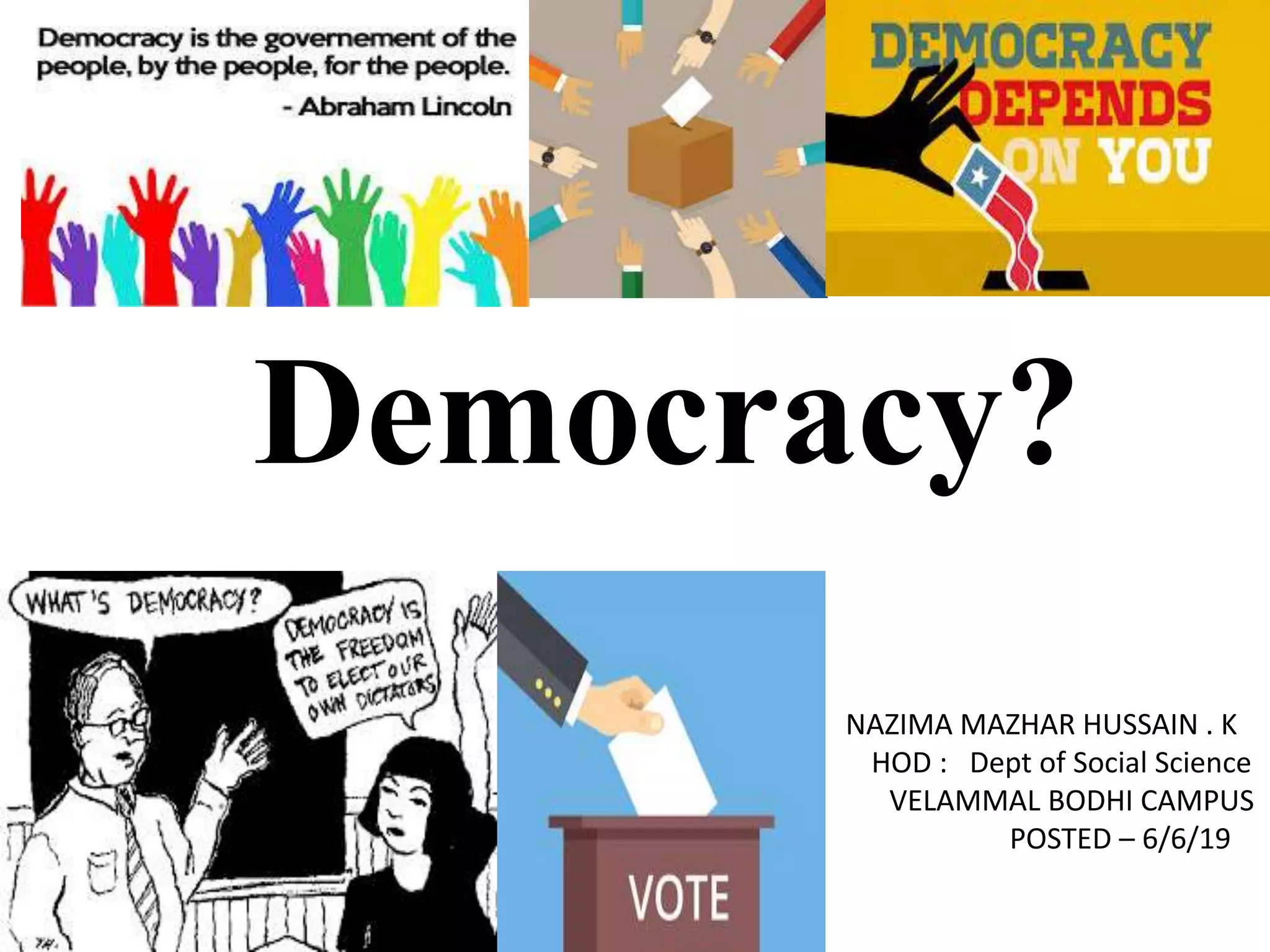
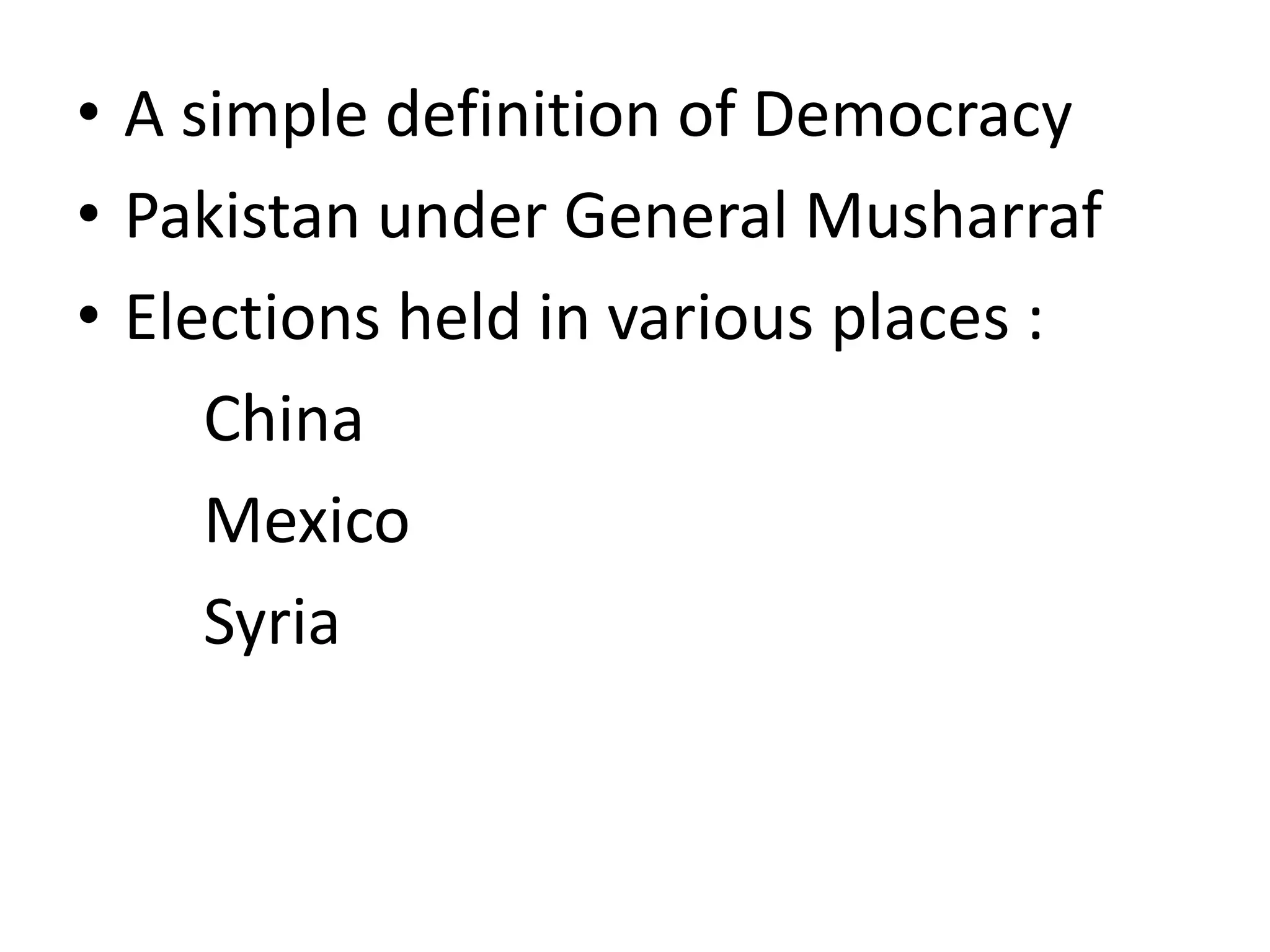
Democracy?
NAZIMA MAZHAR HUSSAIN . K
HOD : Dept of Social Science
VELAMMAL BODHI CAMPUS
POSTED – 6/6/19
• A simple definition of Democracy
• Pakistan under General Musharraf
• Elections held in various places :
China
Mexico
Syria
• Elections held in various places :
Saudi Arabia
Estonia
Fiji
Zimbabwe
• Features of Democracy
• Summary on Democracy
• Why Democracy?
• Arguments put forward against
democracy
• Arguments put forward for
democracy
• Two types of Democracy
Introduction
In this presentation we shall see
about : -
- What is Democracy?
- Why is Democracy needed?
A simple definition of
Democracy
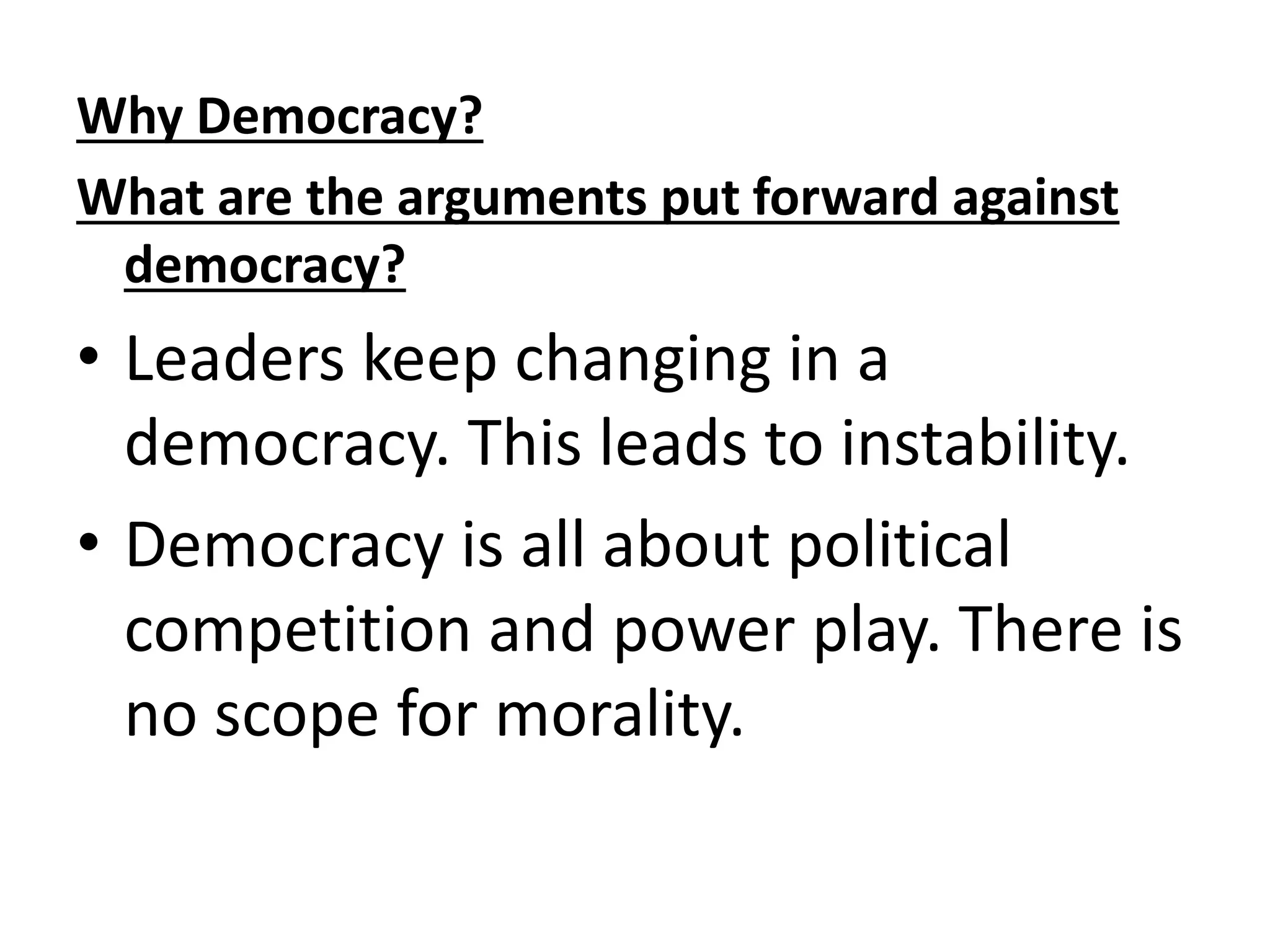
Democracy is a form of
government in which the
rulers are elected by the
people.
Pakistan
Why Pakistan under General Musharraf should
not be called a democracy?.
• In Pakistan, General Pervez Musharraf
led a military coup and overthrew a
democratically elected government and
declared himself the ‘Chief Executive’ of
the country.
• Later he conducted a referendum which
was based on malpractices and fraud. He
changed his designation as President in
2002.
• In August 2002 he issued a ‘Legal
Framework Order’ that amended the
constitution of Pakistan. According to
this Order, the President can dismiss
the national or provincial assemblies.
• The work of the civilian cabinet is
supervised by a National Security
Council which is dominated by
military officers.
• After passing this law, elected
representatives have some powers
but the final power rests with
military officers and General
Musharraf himself. Because of these
reasons Pakistan under General
Musharraf should not be called a
democracy.
• Should we consider the elections held in
China are democratic elections
• Parliament of China -
Quanguo Renmin Daibiao Dahui (National
Peoples Congress)
• It has 3000 members elected from China.
• In China, single party system is practiced.
• Before contesting elections, a candidate needs
the approval of the Chinese Communist Party.
• Only those who are members of the Chinese
Communist Party or eight smaller parties
allied to it were allowed to contest elections.
• The government is always formed by the
Communist Party of China.
• Should we consider the elections held in
Mexico are democratic elections
• Since its independence in 1930,
every election was won by a PRI
(Institutional Revolutionary
Party). Opposition parties did
contest elections, but the PRI
uses many dirty tricks to win
elections.
• All those who were employed in
government offices had to attend its
party meetings.
• Teachers of government schools
used to force parents to vote for the
PRI. Media largely ignored the
activities of opposition political
parties except to criticise them.
• Sometimes the polling booths were
shifted from one place to another in
the last minute, which made it
difficult for people to cast their
votes. The PRI spent a large sum of
money in the campaign for its
candidates.
Syria
• Syria is a small west Asian
country.
• The ruling Ba’ath Party and some
of its small allies are the only
parties allowed in that country.
Which are the countries deny equal right to
vote? How?
Until 2015, in Saudi Arabia women do not
have the right to vote.
• Estonia has made its citizenship rules
in such a way that people belonging
to Russian minority find it difficult to
get the right to vote.
• In Fiji, the electoral system is such that the
vote of an indigenous Fiji has more value than
that of an Indian-Fijian.
• How is Zimbabwe government
undemocratic and autocratic
• Zimbabwe has been ruled by ZANU-PF, the
party that led the freedom struggle. Its leader,
Robert Mugabe, is popular but also uses unfair
practices in elections.
• Zimbabwe has been ruled by ZANU-PF, the
party that led the freedom struggle. Its leader,
Robert Mugabe, is popular but also uses
unfair practices in elections.
• Over the years his government has changed
the constitution several times to increase the
powers of the President and make him less
accountable.
• Opposition party workers are harassed and
their meeting disrupted. Public protests and
demonstrations against the government are
declared illegal. There is a law that limits the
right to criticise the President.
• Television and radio are
controlled by the government
and give only the ruling party’s
version. The government has
ignored some court judgments
that went against it and has
pressurised judges.
• Features of Democracy
• In a democracy the final decision
making power must rest with those
elected by the people
• A democracy must be based on a
free and fair election where those
currently in power have a fair chance
of losing.
• In a democracy, each adult citizen
must have one vote and each
vote must have one value.
• A democratic government rules
within limits set by constitutional
law and citizens’ rights.
Summary on Democracy
• Simple definition - Democracy is a form of
government in which the rulers are elected by
the people.
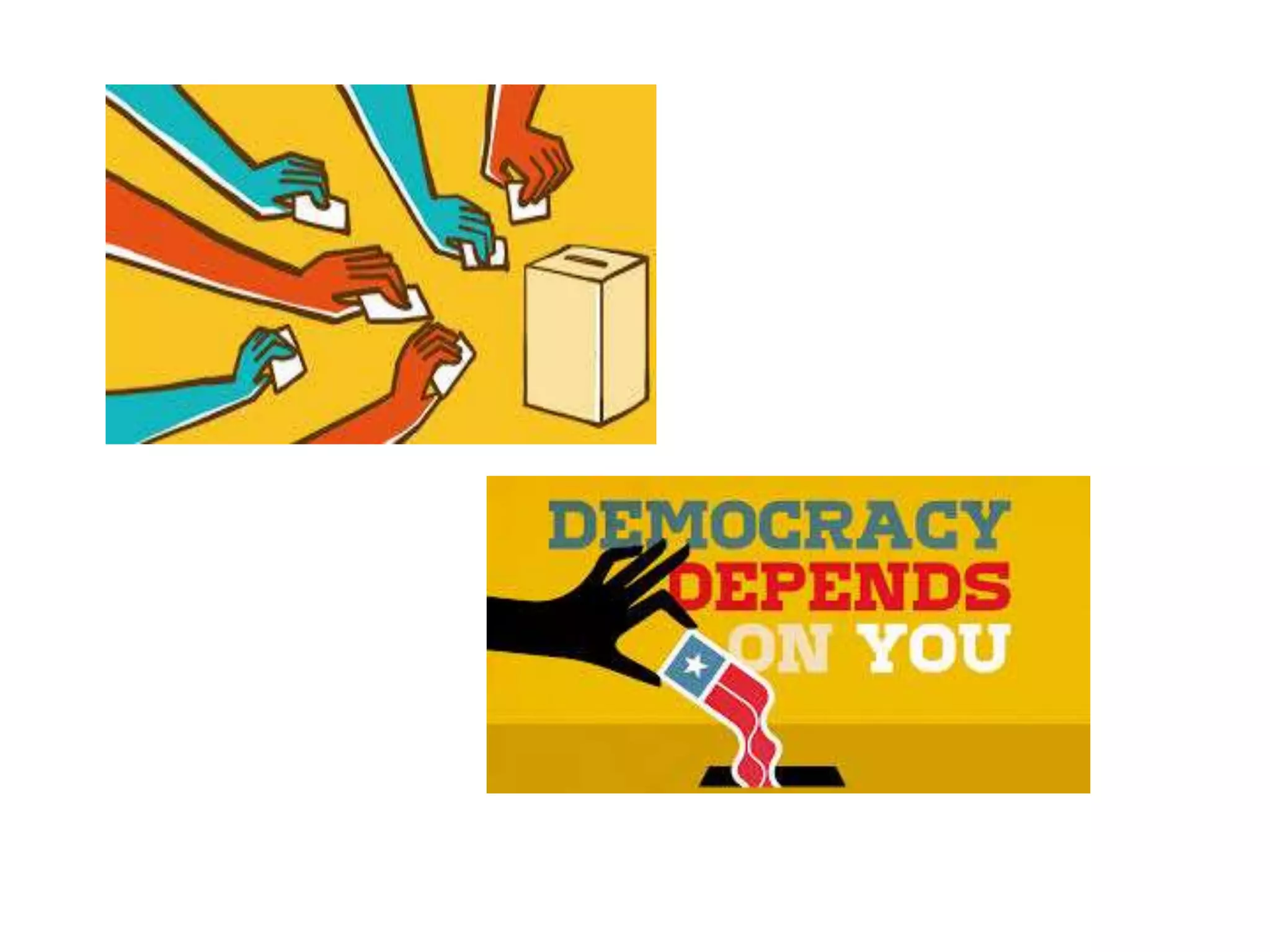
Democracy is a form of government in which:
• Rulers elected by the people take
all the major decisions;
• Elections offer a choice and fair
opportunity to the people to
change the current rulers;
• This choice and opportunity is
available to all the people on an
equal basis;
• The exercise of this choice leads
to a government limited by basic
rules of the constitution and
citizens’ rights.
Why Democracy?
What are the arguments put forward against
democracy?
• Leaders keep changing in a
democracy. This leads to instability.
• Democracy is all about political
competition and power play. There is
no scope for morality.
• So many people have to be consulted
in a democracy that it leads to
delays.
• Elected leaders do not know the best
interest of the people. It leads to bad
decisions.
• Democracy leads to corruption
for it is based on electoral
competition.
• Ordinary people don’t know what
is good for them; they should not
decide anything.
• What are the arguments put forward for
democracy?
1. A democratic government is a better
government because it is a more accountable
form of government.
2. Democracy improves the quality of decision
making by consulting various people and
institutions.
• Democracy provides a method to
deal with differences and
conflicts. In any society where
people belong to different
regions, speak different
languages, practice different
religions and have different
castes.
• Democracy enhances the dignity
of citizens by providing equality,
fundamental rights and
freedoms.
• Democracy is better than other
forms of government because it
allows us to correct its own
mistakes.
BROADER MEANING OF DEMOCRACY
Two types of Democracy
• Direct democracy– In which all
the citizens of the country
assemble in a place and directly
take part in decision making.
• Indirect democracy or
Representative Democracy-In
which people elect their
representatives and those elected
representatives make major
decision. The majority of people
rule through their elected
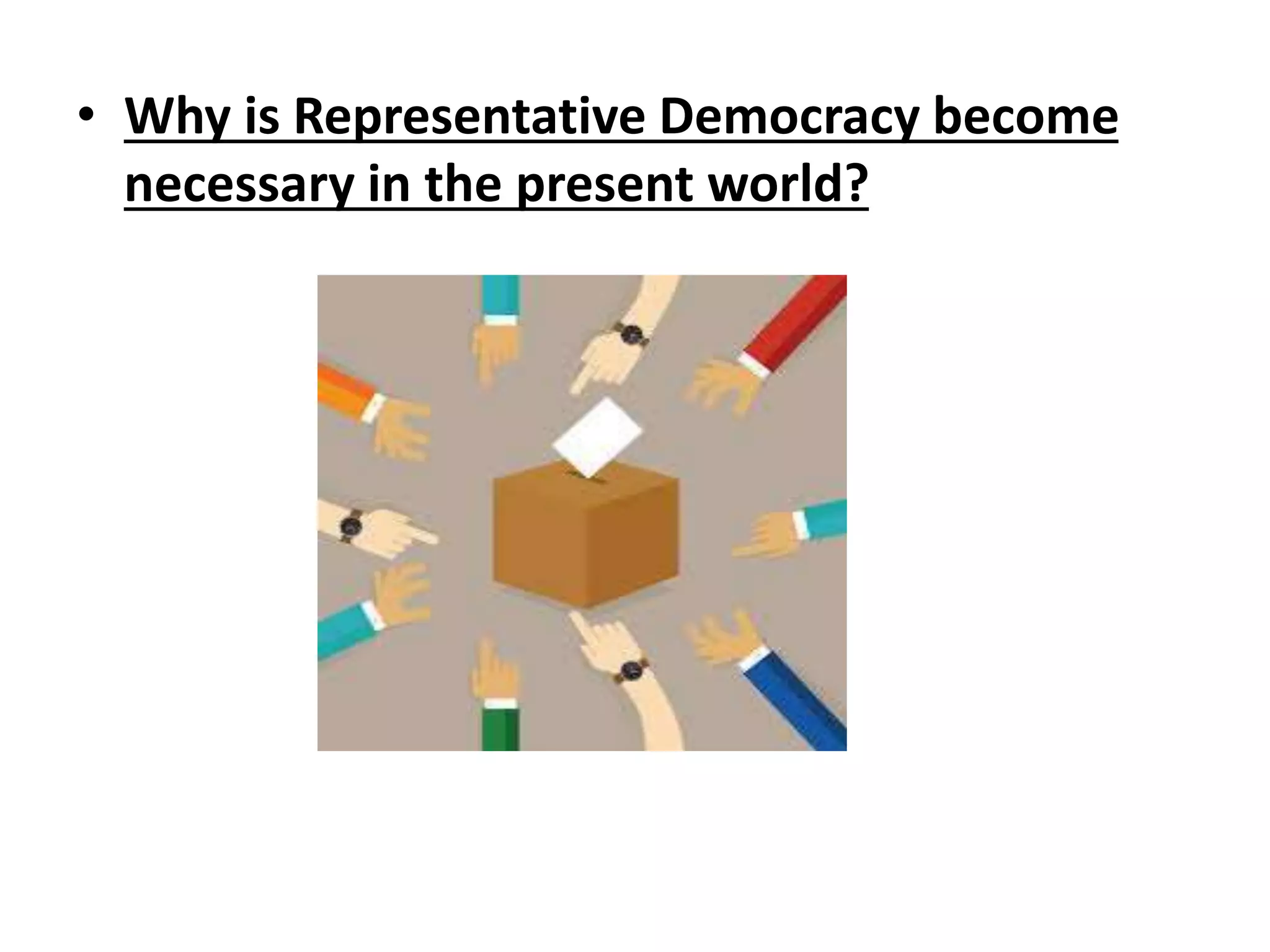
• Why is Representative Democracy become
necessary in the present world?
• Modern democracies involve such a
large number of people that it is
physically impossible for them to sit
together and take a collective
decision.
• Even if they could, the citizen does
not have the time, the desire or the
skills to take part in all the decisions.
What is an ideal standard
democracy?
• True democracy will come to a
country only when no one
goes hungry to bed.
• In a true democracy every citizen
must be able to play equal role in
decision making with equal right to
vote, equal information, basic
education, equal resources and a lot
of commitment.
Presented by
Nazima Hussain K
Mcom.,Mphil.,B.Ed.,GNIIT.,PGDCA.,
MA(Eng).,MA(His).,BA(Hin)

Democracy- class 9 - CBSE

  • 1.
    Democracy? NAZIMA MAZHAR HUSSAIN. K HOD : Dept of Social Science VELAMMAL BODHI CAMPUS POSTED – 6/6/19
  • 2.
    • A simpledefinition of Democracy • Pakistan under General Musharraf • Elections held in various places : China Mexico Syria
  • 3.
    • Elections heldin various places : Saudi Arabia Estonia Fiji Zimbabwe • Features of Democracy • Summary on Democracy
  • 4.
    • Why Democracy? •Arguments put forward against democracy • Arguments put forward for democracy • Two types of Democracy
  • 5.
    Introduction In this presentationwe shall see about : - - What is Democracy? - Why is Democracy needed?
  • 6.
    A simple definitionof Democracy Democracy is a form of government in which the rulers are elected by the people.
  • 7.
  • 8.
    Why Pakistan underGeneral Musharraf should not be called a democracy?.
  • 9.
    • In Pakistan,General Pervez Musharraf led a military coup and overthrew a democratically elected government and declared himself the ‘Chief Executive’ of the country. • Later he conducted a referendum which was based on malpractices and fraud. He changed his designation as President in 2002.
  • 10.
    • In August2002 he issued a ‘Legal Framework Order’ that amended the constitution of Pakistan. According to this Order, the President can dismiss the national or provincial assemblies. • The work of the civilian cabinet is supervised by a National Security Council which is dominated by military officers.
  • 11.
    • After passingthis law, elected representatives have some powers but the final power rests with military officers and General Musharraf himself. Because of these reasons Pakistan under General Musharraf should not be called a democracy.
  • 12.
    • Should weconsider the elections held in China are democratic elections
  • 13.
    • Parliament ofChina - Quanguo Renmin Daibiao Dahui (National Peoples Congress) • It has 3000 members elected from China.
  • 14.
    • In China,single party system is practiced. • Before contesting elections, a candidate needs the approval of the Chinese Communist Party. • Only those who are members of the Chinese Communist Party or eight smaller parties allied to it were allowed to contest elections. • The government is always formed by the Communist Party of China.
  • 15.
    • Should weconsider the elections held in Mexico are democratic elections
  • 16.
    • Since itsindependence in 1930, every election was won by a PRI (Institutional Revolutionary Party). Opposition parties did contest elections, but the PRI uses many dirty tricks to win elections.
  • 17.
    • All thosewho were employed in government offices had to attend its party meetings. • Teachers of government schools used to force parents to vote for the PRI. Media largely ignored the activities of opposition political parties except to criticise them.
  • 18.
    • Sometimes thepolling booths were shifted from one place to another in the last minute, which made it difficult for people to cast their votes. The PRI spent a large sum of money in the campaign for its candidates.
  • 19.
  • 21.
    • Syria isa small west Asian country. • The ruling Ba’ath Party and some of its small allies are the only parties allowed in that country.
  • 22.
    Which are thecountries deny equal right to vote? How? Until 2015, in Saudi Arabia women do not have the right to vote.
  • 24.
    • Estonia hasmade its citizenship rules in such a way that people belonging to Russian minority find it difficult to get the right to vote.
  • 26.
    • In Fiji,the electoral system is such that the vote of an indigenous Fiji has more value than that of an Indian-Fijian.
  • 27.
    • How isZimbabwe government undemocratic and autocratic
  • 28.
    • Zimbabwe hasbeen ruled by ZANU-PF, the party that led the freedom struggle. Its leader, Robert Mugabe, is popular but also uses unfair practices in elections.
  • 29.
    • Zimbabwe hasbeen ruled by ZANU-PF, the party that led the freedom struggle. Its leader, Robert Mugabe, is popular but also uses unfair practices in elections.
  • 30.
    • Over theyears his government has changed the constitution several times to increase the powers of the President and make him less accountable. • Opposition party workers are harassed and their meeting disrupted. Public protests and demonstrations against the government are declared illegal. There is a law that limits the right to criticise the President.
  • 31.
    • Television andradio are controlled by the government and give only the ruling party’s version. The government has ignored some court judgments that went against it and has pressurised judges.
  • 32.
    • Features ofDemocracy • In a democracy the final decision making power must rest with those elected by the people • A democracy must be based on a free and fair election where those currently in power have a fair chance of losing.
  • 33.
    • In ademocracy, each adult citizen must have one vote and each vote must have one value. • A democratic government rules within limits set by constitutional law and citizens’ rights.
  • 35.
    Summary on Democracy •Simple definition - Democracy is a form of government in which the rulers are elected by the people.
  • 36.
    Democracy is aform of government in which: • Rulers elected by the people take all the major decisions; • Elections offer a choice and fair opportunity to the people to change the current rulers;
  • 37.
    • This choiceand opportunity is available to all the people on an equal basis; • The exercise of this choice leads to a government limited by basic rules of the constitution and citizens’ rights.
  • 39.
    Why Democracy? What arethe arguments put forward against democracy? • Leaders keep changing in a democracy. This leads to instability. • Democracy is all about political competition and power play. There is no scope for morality.
  • 40.
    • So manypeople have to be consulted in a democracy that it leads to delays. • Elected leaders do not know the best interest of the people. It leads to bad decisions.
  • 41.
    • Democracy leadsto corruption for it is based on electoral competition. • Ordinary people don’t know what is good for them; they should not decide anything.
  • 42.
    • What arethe arguments put forward for democracy? 1. A democratic government is a better government because it is a more accountable form of government. 2. Democracy improves the quality of decision making by consulting various people and institutions.
  • 43.
    • Democracy providesa method to deal with differences and conflicts. In any society where people belong to different regions, speak different languages, practice different religions and have different castes.
  • 44.
    • Democracy enhancesthe dignity of citizens by providing equality, fundamental rights and freedoms. • Democracy is better than other forms of government because it allows us to correct its own mistakes.
  • 45.
    BROADER MEANING OFDEMOCRACY Two types of Democracy • Direct democracy– In which all the citizens of the country assemble in a place and directly take part in decision making.
  • 46.
    • Indirect democracyor Representative Democracy-In which people elect their representatives and those elected representatives make major decision. The majority of people rule through their elected
  • 47.
    • Why isRepresentative Democracy become necessary in the present world?
  • 48.
    • Modern democraciesinvolve such a large number of people that it is physically impossible for them to sit together and take a collective decision. • Even if they could, the citizen does not have the time, the desire or the skills to take part in all the decisions.
  • 49.
    What is anideal standard democracy? • True democracy will come to a country only when no one goes hungry to bed.
  • 50.
    • In atrue democracy every citizen must be able to play equal role in decision making with equal right to vote, equal information, basic education, equal resources and a lot of commitment.
  • 51.
    Presented by Nazima HussainK Mcom.,Mphil.,B.Ed.,GNIIT.,PGDCA., MA(Eng).,MA(His).,BA(Hin)