Chapter 8:
Autobiographical Memory
Lawrence Heller, Psy.D.
 Superior Autobiographical Memory
Everyday Memory
 How well do we remember our lives?
 Do we have photographic memory for
emotional events?
 In what ways can our memories be wrong?
 What can help us remember things we are
supposed to do?
 What kinds of events from their lives are
people most likely to remember?
Autobiographical Memory
(AM)
 These are the memories that comprise a
person’s life story
 Researchers tend to avoid this area of study
because
 1) events happen how and when they happen so
they are out of the control of the experimenter
 2) accuracy of AM can be difficult to assess
Autobiographical Memory (AM)
Memory over the life span
 Recollected events that belong to a person’s past
 Episodic memory for events from our life plus
personal semantic memories of facts about our
lives
Multidimensional
 Spatial, emotional, and sensory components
 Visual experience often plays a significant role in
forming and retrieving AM
What Is Autobiographical
Memory ?
 According to Conway (1990) there are two
major components of long-term memory that in
combination, form out AM system.
 Autobiographical Episodes
 Autobiographical Knowledge
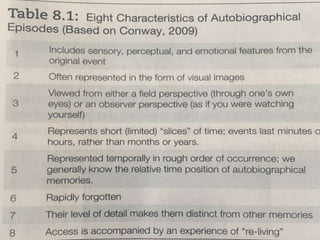
Autobiographical Episodes
 Autobiographical Episodes- same as
episodic memory proposed by Tulving in
1972-
 Mental representations of past events that include
elements of the original context, including a sense
of reliving or mental time-travel.
Autobiographical Knowledge
 A network of concepts that individuals have
about their own lives.
 For example, Greg and Bridget went to
Maryville University in Missouri which is where
Bridget grew up. Our knowledge of Maryville
and Missouri serve to provide background
within out personal recollections. We build on
this autobiographical network through
repeated encounters with events, people,
places, and objects.
DEVELOPMENTAL ASPECTS
OF AUTOBOGRAPHICAL
MEMORY
 Classic study by Rubin, Wetzler, and Nebes
(9186) used the cue word technique to
investigate how peoplerecall events from
different parts of the lifespan.
 Procedure-single words are presented as cues
(e.g., banana) and participants must recall an
Autobiographical Episode Component (AEC) in
response to each
AM retrieved throughout the
Lifespan
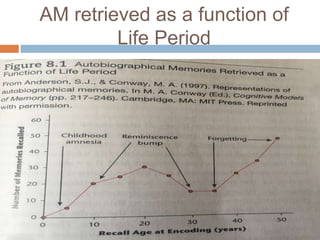
 Follow a predictable pattern called the
autobiographical retention function
 First-Childhood amnesia
 Second-Reminiscence
 Third-Forgetting
AM retrieved as a function of
Life Period
Childhood Amnesia
 Limited to episodic memories-relived events
that are high in personal relevance (i.e., AM)
 Few to no memories prior to age 3
 According to Bauer (2015) childhood amnesia
falls into two categories
 1) Those that place emphasis on problems at
encoding
 2) Those that place emphasis on problems that
occur at retrieval
Category 1
 Reasons for childhood amnesia
1) Brain physiology-immaturity of the developing
infant brain
2) Lack of sophisticated language ability
3) Development of sense of self-knowledge that
one is a person with unique and recognizable
characteristics, and that one thinks and knows
things about the world and can serve as a causal
agent.
Category 1 Cont’d
 4) Development of consciousness about the
past- temporal sense that they have a past to
connect to their present
 5) Inability to bind together the components of
an experienced event into a meaningful whole.
 These five appear to account for the
prevention of AM to develop
Category 2
 1) Underdevelopment of language
 2) Sense of self-the knowledge that one exists
as a separate entity with their own thoughts
and feelings.
Autobiographical Memory
Conway (1996)
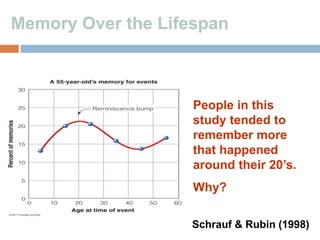
Reminiscence Bump
 When people recall a greater number of
memories that occur during for adolescence
and young adulthood (around ages 10-30)
Smell and the Reminiscence
Bump
 Proust Phenomenon
 Smells can cue distinct memories and show a
‘bump’ in the first decade of life
 For example, the smell of cookies may bring back
baking with Grandma
People in this
study tended to
remember more
that happened
around their 20’s.
Why?
Memory Over the Lifespan
Schrauf & Rubin (1998)
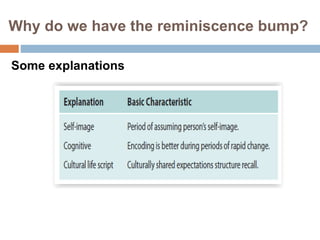
Why do we have the reminiscence bump?
Some explanations
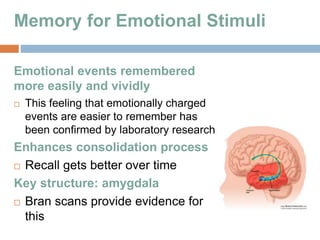
Memory for Emotional Stimuli
Emotional events remembered
more easily and vividly
 This feeling that emotionally charged
events are easier to remember has
been confirmed by laboratory research
Enhances consolidation process
 Recall gets better over time
Key structure: amygdala
 Bran scans provide evidence for
this
FORGETTING
 After the reminiscence bump there is a
standard forgetting curve beginning with
Ebbinghaus
 Most likely cause of forgetting is lack of
rehearsal (events not thought about or
discussed)
 Interference
Culture and Forgetting
 Wang (2009) suggests that cultural differences
produce a variation in the specificity of Ams
 For example, Asian cultures tend to forget the
individualized episode information (collectivist
culture)
 Whereas Euro-American culture might retain
individualized memores better.
Social Factors
 One of the important functions of
Autobiographical memory is that it allows us to
connect with others, as we share our daily
experiences and personal histories.
Video
 Autobiographical memory
CH 8 Autobiographical Memory for class.ppt

CH 8 Autobiographical Memory for class.ppt

  • 1.
  • 2.
  • 3.
    Everyday Memory  Howwell do we remember our lives?  Do we have photographic memory for emotional events?  In what ways can our memories be wrong?  What can help us remember things we are supposed to do?  What kinds of events from their lives are people most likely to remember?
  • 4.
    Autobiographical Memory (AM)  Theseare the memories that comprise a person’s life story  Researchers tend to avoid this area of study because  1) events happen how and when they happen so they are out of the control of the experimenter  2) accuracy of AM can be difficult to assess
  • 5.
    Autobiographical Memory (AM) Memoryover the life span  Recollected events that belong to a person’s past  Episodic memory for events from our life plus personal semantic memories of facts about our lives Multidimensional  Spatial, emotional, and sensory components  Visual experience often plays a significant role in forming and retrieving AM
  • 6.
    What Is Autobiographical Memory?  According to Conway (1990) there are two major components of long-term memory that in combination, form out AM system.  Autobiographical Episodes  Autobiographical Knowledge
  • 7.
    Autobiographical Episodes  AutobiographicalEpisodes- same as episodic memory proposed by Tulving in 1972-  Mental representations of past events that include elements of the original context, including a sense of reliving or mental time-travel.
  • 8.
    Autobiographical Knowledge  Anetwork of concepts that individuals have about their own lives.  For example, Greg and Bridget went to Maryville University in Missouri which is where Bridget grew up. Our knowledge of Maryville and Missouri serve to provide background within out personal recollections. We build on this autobiographical network through repeated encounters with events, people, places, and objects.
  • 10.
    DEVELOPMENTAL ASPECTS OF AUTOBOGRAPHICAL MEMORY Classic study by Rubin, Wetzler, and Nebes (9186) used the cue word technique to investigate how peoplerecall events from different parts of the lifespan.  Procedure-single words are presented as cues (e.g., banana) and participants must recall an Autobiographical Episode Component (AEC) in response to each
  • 11.
    AM retrieved throughoutthe Lifespan  Follow a predictable pattern called the autobiographical retention function  First-Childhood amnesia  Second-Reminiscence  Third-Forgetting
  • 12.
    AM retrieved asa function of Life Period
  • 13.
    Childhood Amnesia  Limitedto episodic memories-relived events that are high in personal relevance (i.e., AM)  Few to no memories prior to age 3  According to Bauer (2015) childhood amnesia falls into two categories  1) Those that place emphasis on problems at encoding  2) Those that place emphasis on problems that occur at retrieval
  • 14.
    Category 1  Reasonsfor childhood amnesia 1) Brain physiology-immaturity of the developing infant brain 2) Lack of sophisticated language ability 3) Development of sense of self-knowledge that one is a person with unique and recognizable characteristics, and that one thinks and knows things about the world and can serve as a causal agent.
  • 15.
    Category 1 Cont’d 4) Development of consciousness about the past- temporal sense that they have a past to connect to their present  5) Inability to bind together the components of an experienced event into a meaningful whole.  These five appear to account for the prevention of AM to develop
  • 16.
    Category 2  1)Underdevelopment of language  2) Sense of self-the knowledge that one exists as a separate entity with their own thoughts and feelings.
  • 17.
    Autobiographical Memory Conway (1996) ReminiscenceBump  When people recall a greater number of memories that occur during for adolescence and young adulthood (around ages 10-30)
  • 18.
    Smell and theReminiscence Bump  Proust Phenomenon  Smells can cue distinct memories and show a ‘bump’ in the first decade of life  For example, the smell of cookies may bring back baking with Grandma
  • 19.
    People in this studytended to remember more that happened around their 20’s. Why? Memory Over the Lifespan Schrauf & Rubin (1998)
  • 20.
    Why do wehave the reminiscence bump? Some explanations
  • 21.
    Memory for EmotionalStimuli Emotional events remembered more easily and vividly  This feeling that emotionally charged events are easier to remember has been confirmed by laboratory research Enhances consolidation process  Recall gets better over time Key structure: amygdala  Bran scans provide evidence for this
  • 22.
    FORGETTING  After thereminiscence bump there is a standard forgetting curve beginning with Ebbinghaus  Most likely cause of forgetting is lack of rehearsal (events not thought about or discussed)  Interference
  • 23.
    Culture and Forgetting Wang (2009) suggests that cultural differences produce a variation in the specificity of Ams  For example, Asian cultures tend to forget the individualized episode information (collectivist culture)  Whereas Euro-American culture might retain individualized memores better.
  • 24.
    Social Factors  Oneof the important functions of Autobiographical memory is that it allows us to connect with others, as we share our daily experiences and personal histories.
  • 25.