Chapter 24 Congestion Control and Quality of Service Copyright © The McGraw-Hill Companies, Inc. Permission required for reproduction or display.
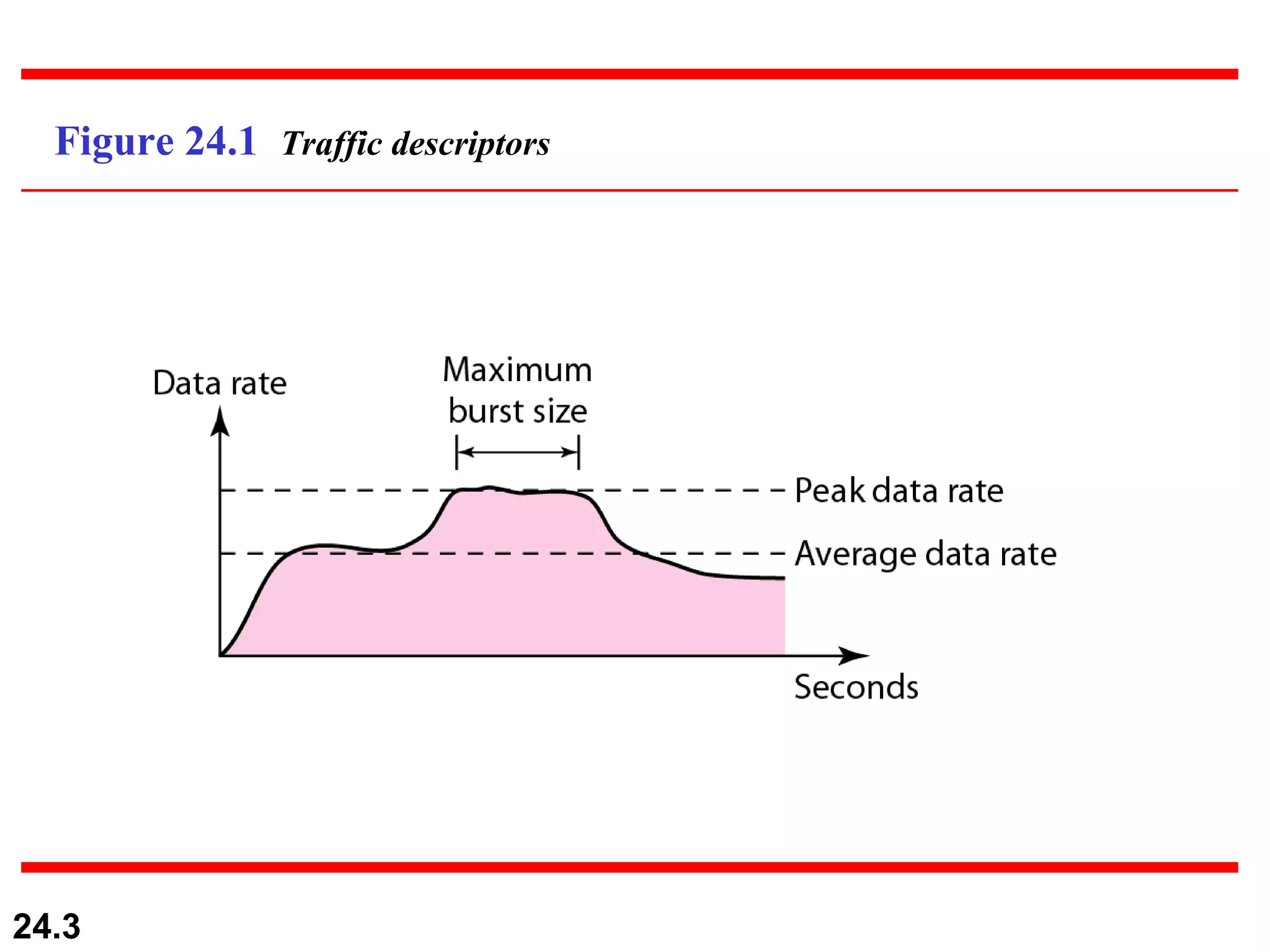
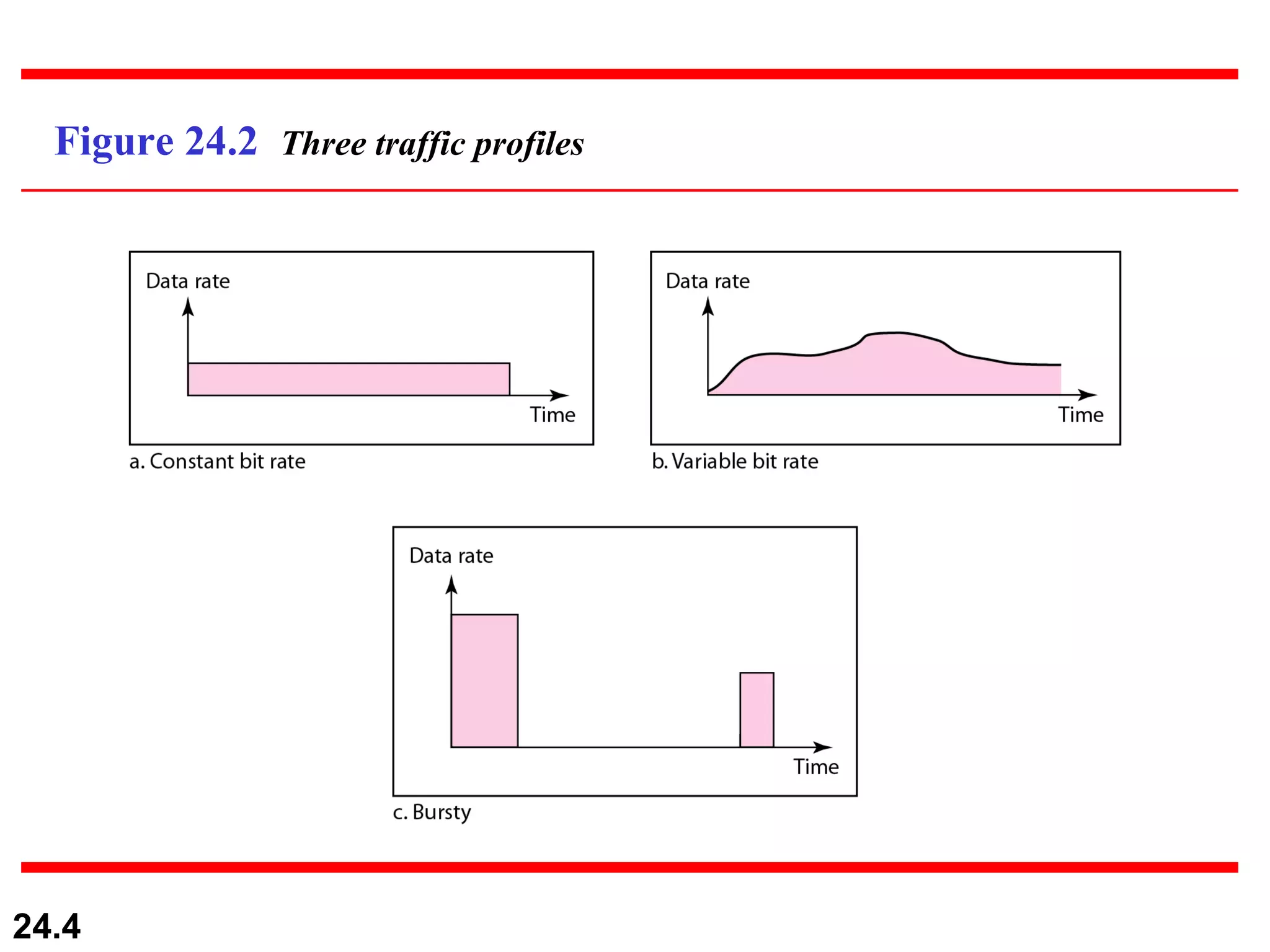
24-1  DATA TRAFFIC The main focus of congestion control and quality of service is  data traffic . In congestion control we try to avoid traffic congestion. In quality of service, we try to create an appropriate environment for the traffic. So, before talking about congestion control and quality of service, we discuss the data traffic itself. Traffic Descriptor Traffic Profiles Topics discussed in this section:
Figure 24.1  Traffic descriptors
Figure 24.2  Three traffic profiles
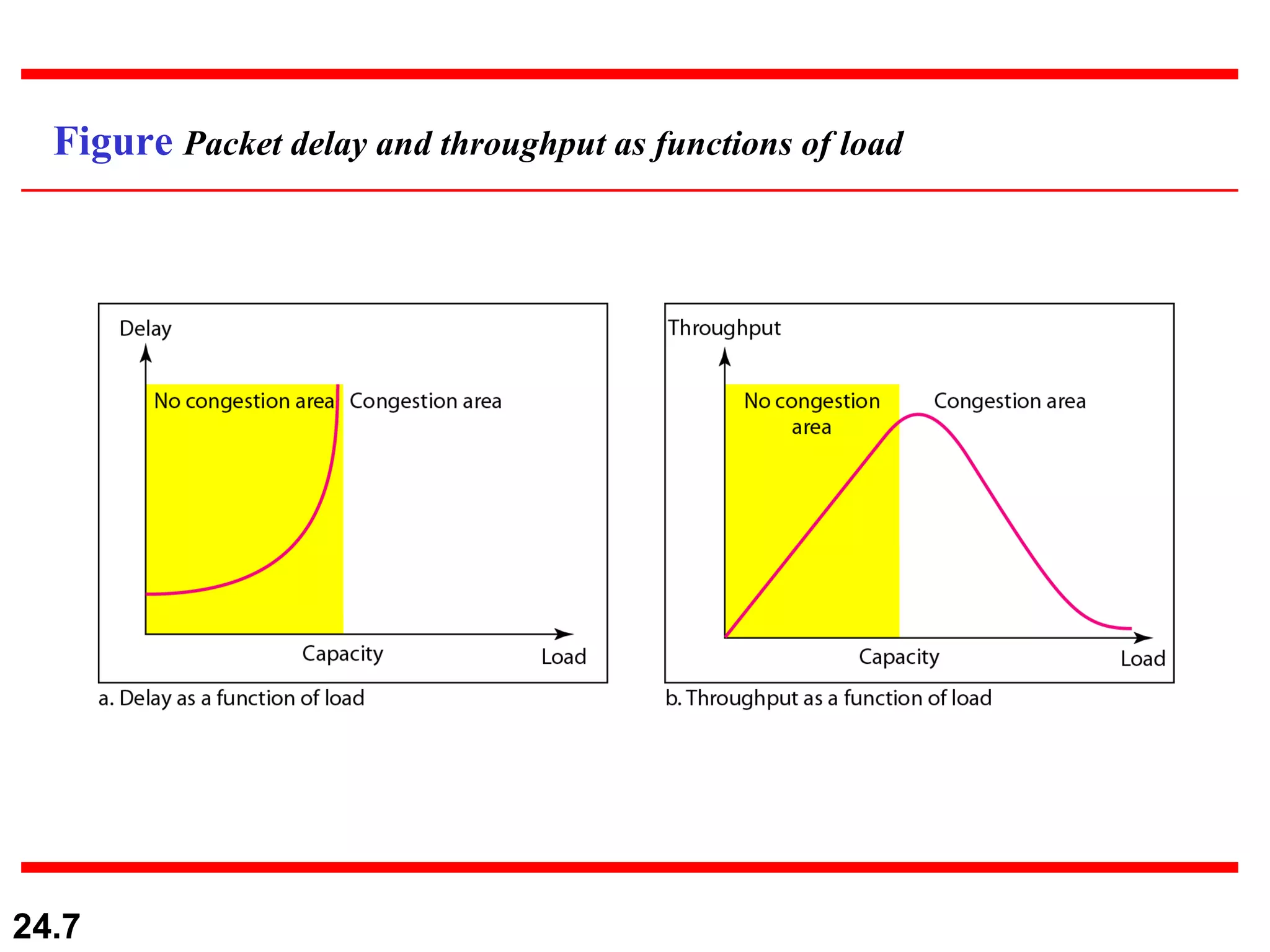
24-2  CONGESTION Congestion in a network may occur if the load on the network—the number of packets sent to the network—is greater than the capacity of the network—the number of packets a network can handle. Congestion control refers to the mechanisms and techniques to control the congestion and keep the load below the capacity. Network Performance Topics discussed in this section:
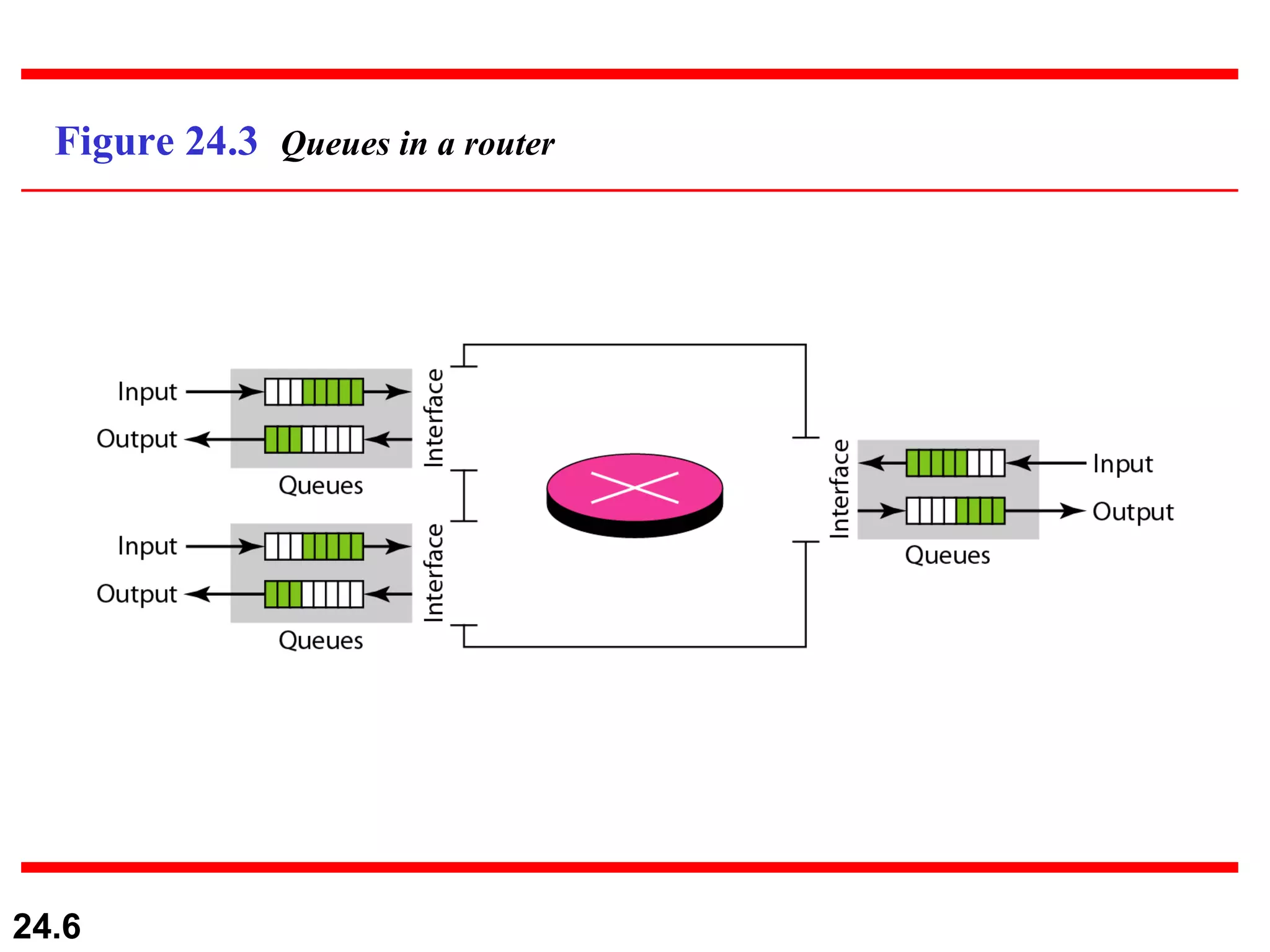
Figure 24.3  Queues in a router
Figure  Packet delay and throughput as functions of load
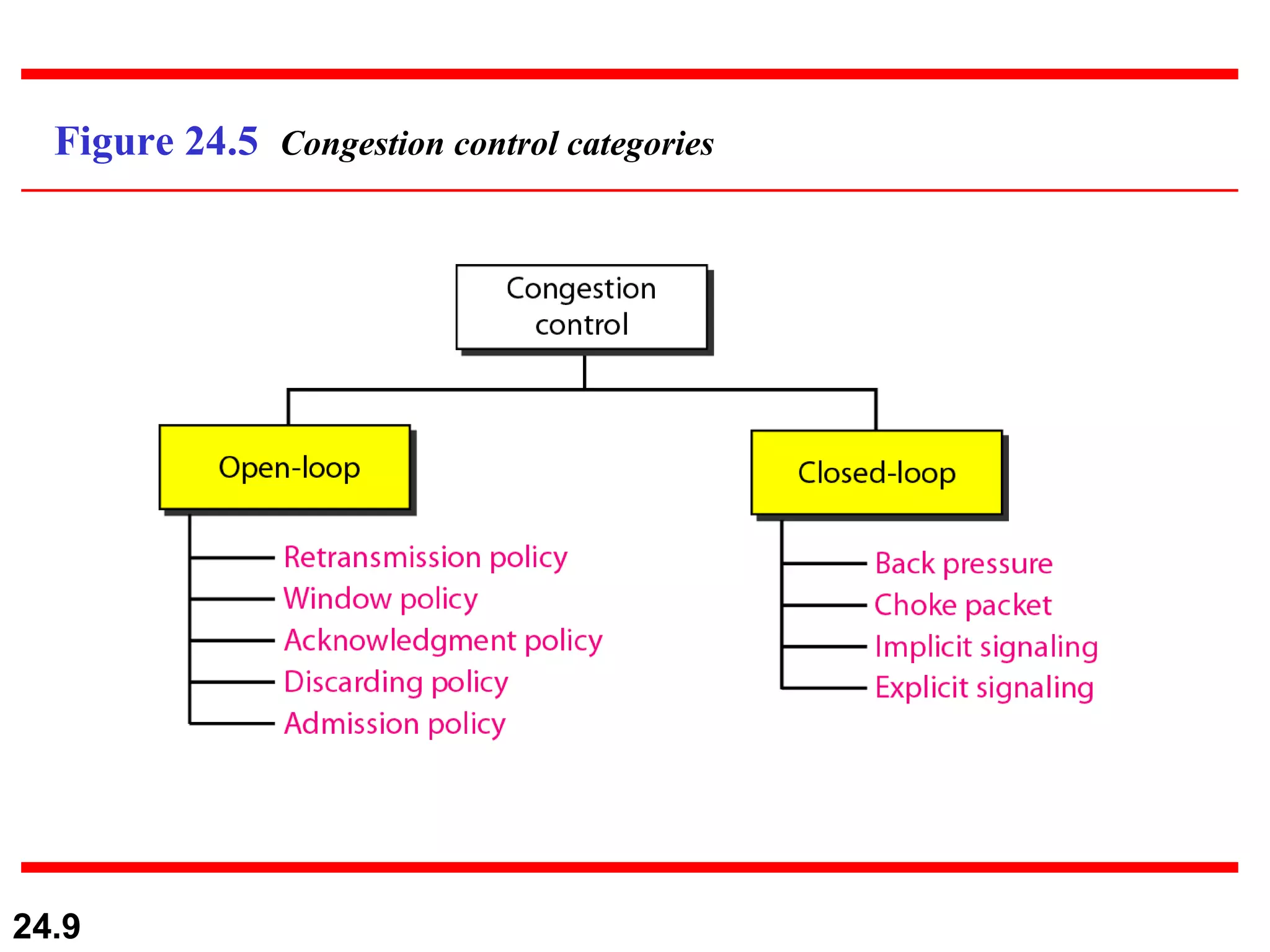
24-3  CONGESTION CONTROL Congestion control refers to techniques and mechanisms that can either prevent congestion, before it happens, or remove congestion, after it has happened. In general, we can divide congestion control mechanisms into two broad categories: open-loop congestion control (prevention) and closed-loop congestion control (removal). Open-Loop Congestion Control Closed-Loop Congestion Control Topics discussed in this section:
Figure 24.5  Congestion control categories
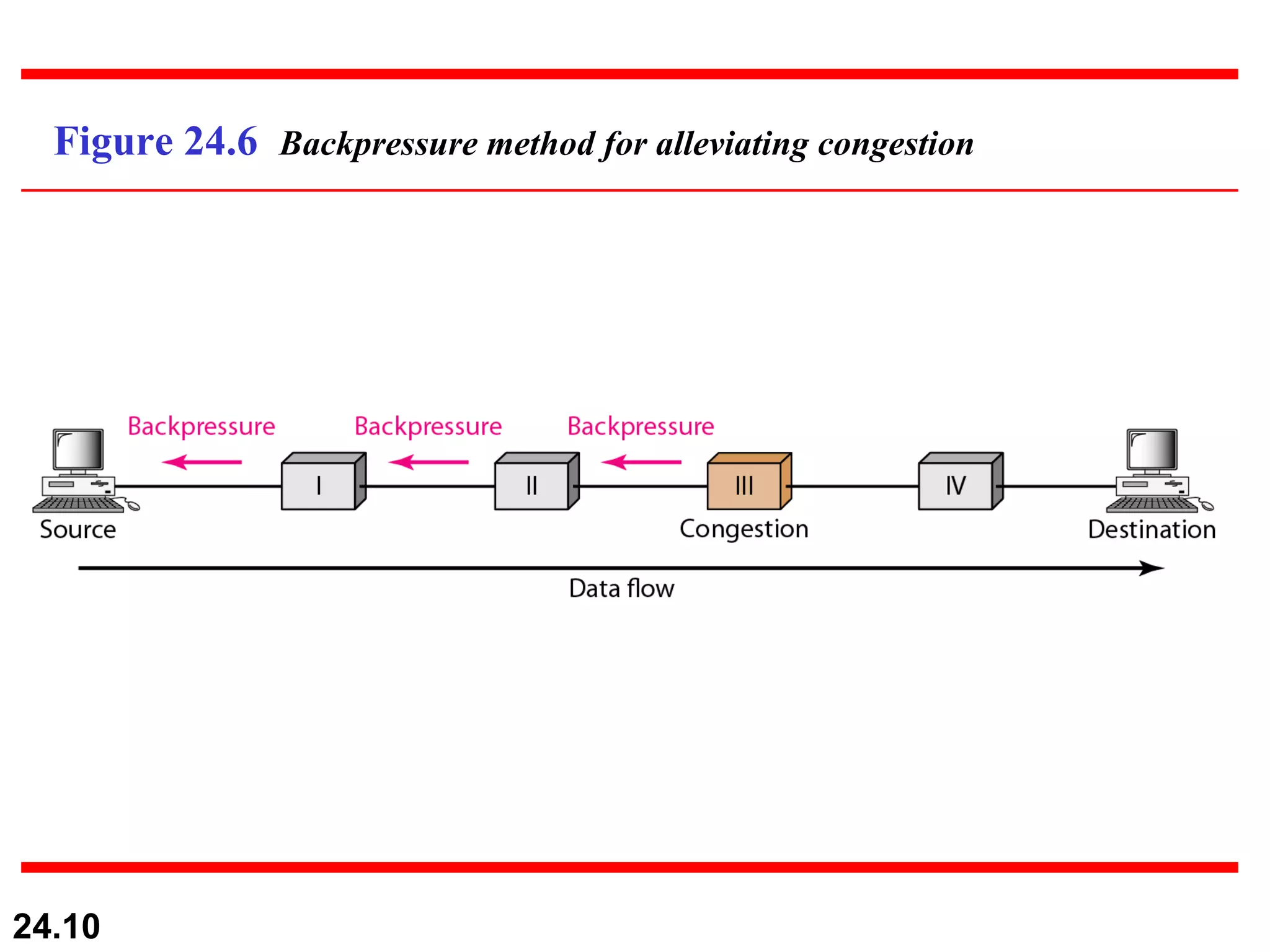
Figure 24.6  Backpressure method for alleviating congestion
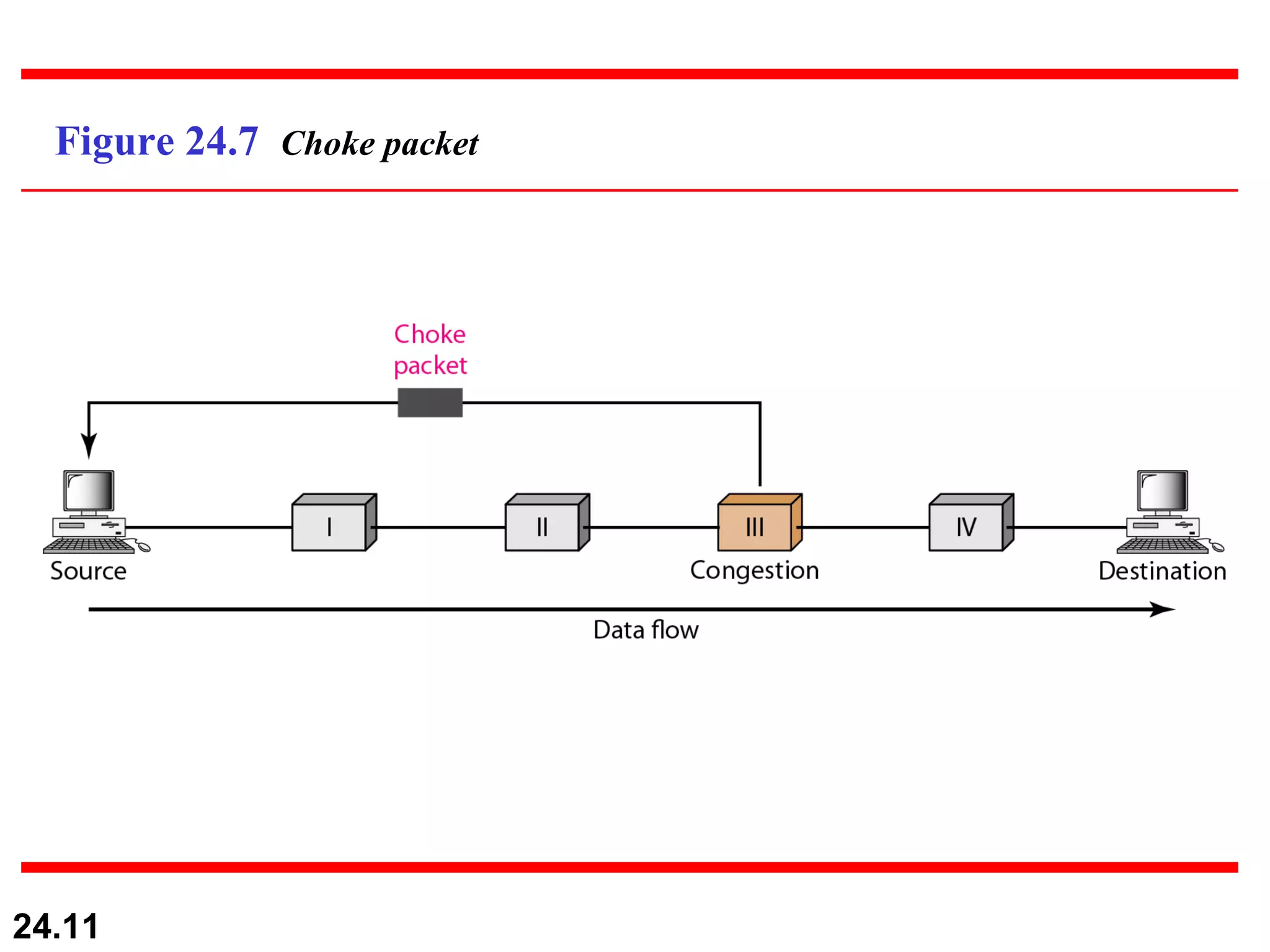
Figure 24.7  Choke packet
24-4  TWO EXAMPLES To better understand the concept of congestion control, let us give two examples: one in TCP and the other in Frame Relay. Congestion Control in TCP Congestion Control in Frame Relay Topics discussed in this section:
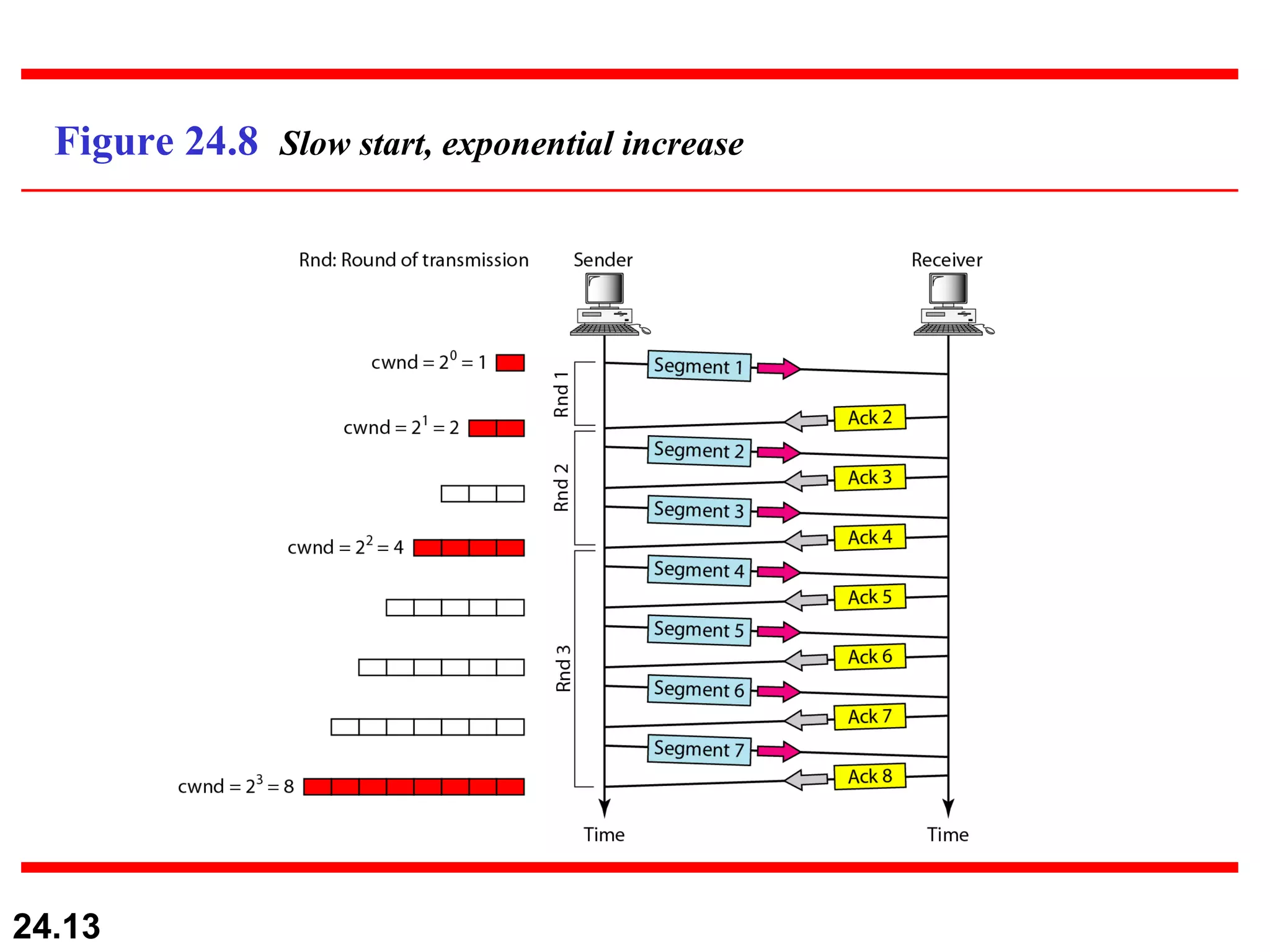
Figure 24.8  Slow start, exponential increase
In the slow-start algorithm, the size of the congestion window increases exponentially until it reaches a threshold. Note
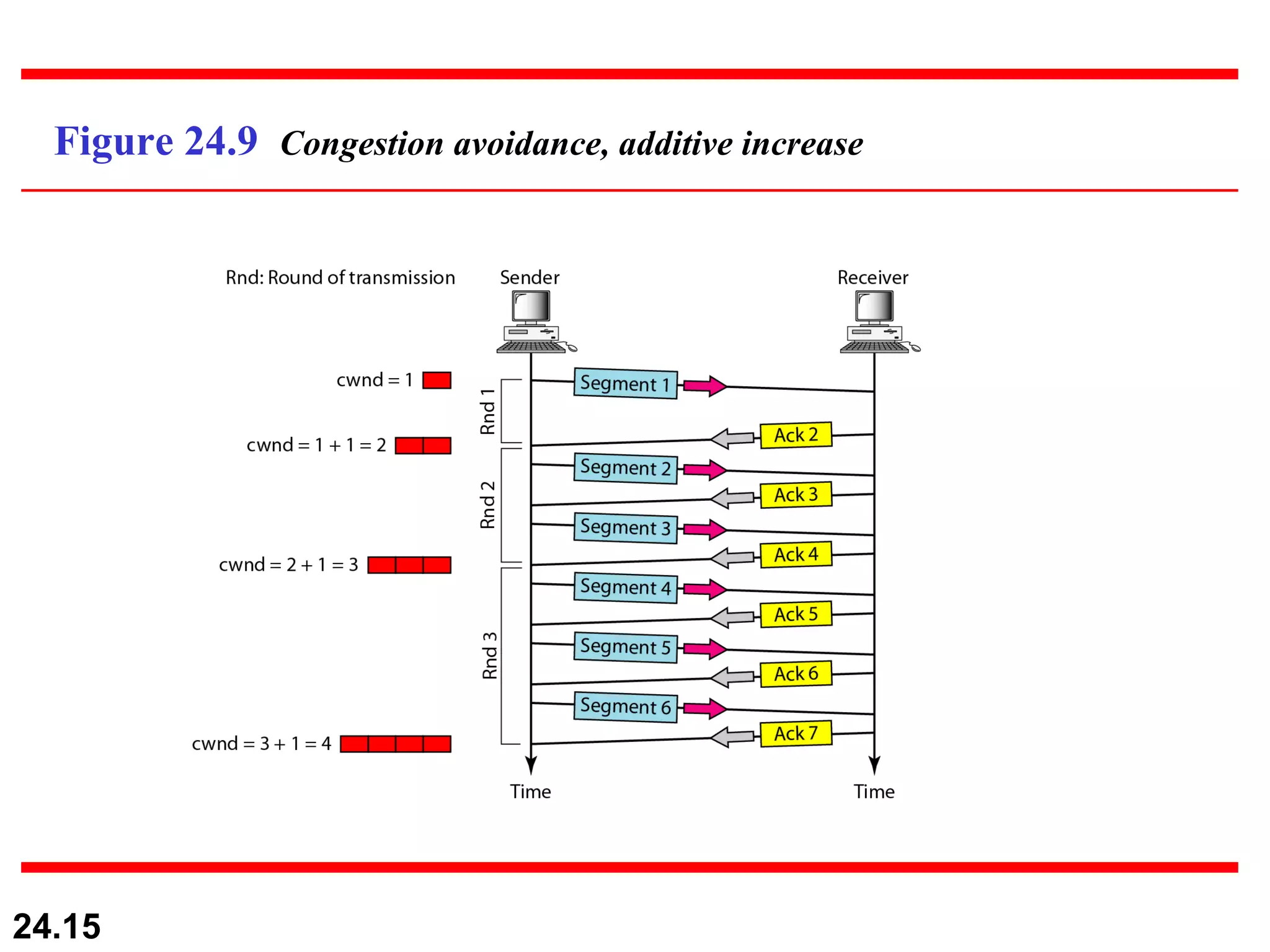
Figure 24.9  Congestion avoidance, additive increase
In the congestion avoidance algorithm, the size of the congestion window increases additively until  congestion is detected. Note
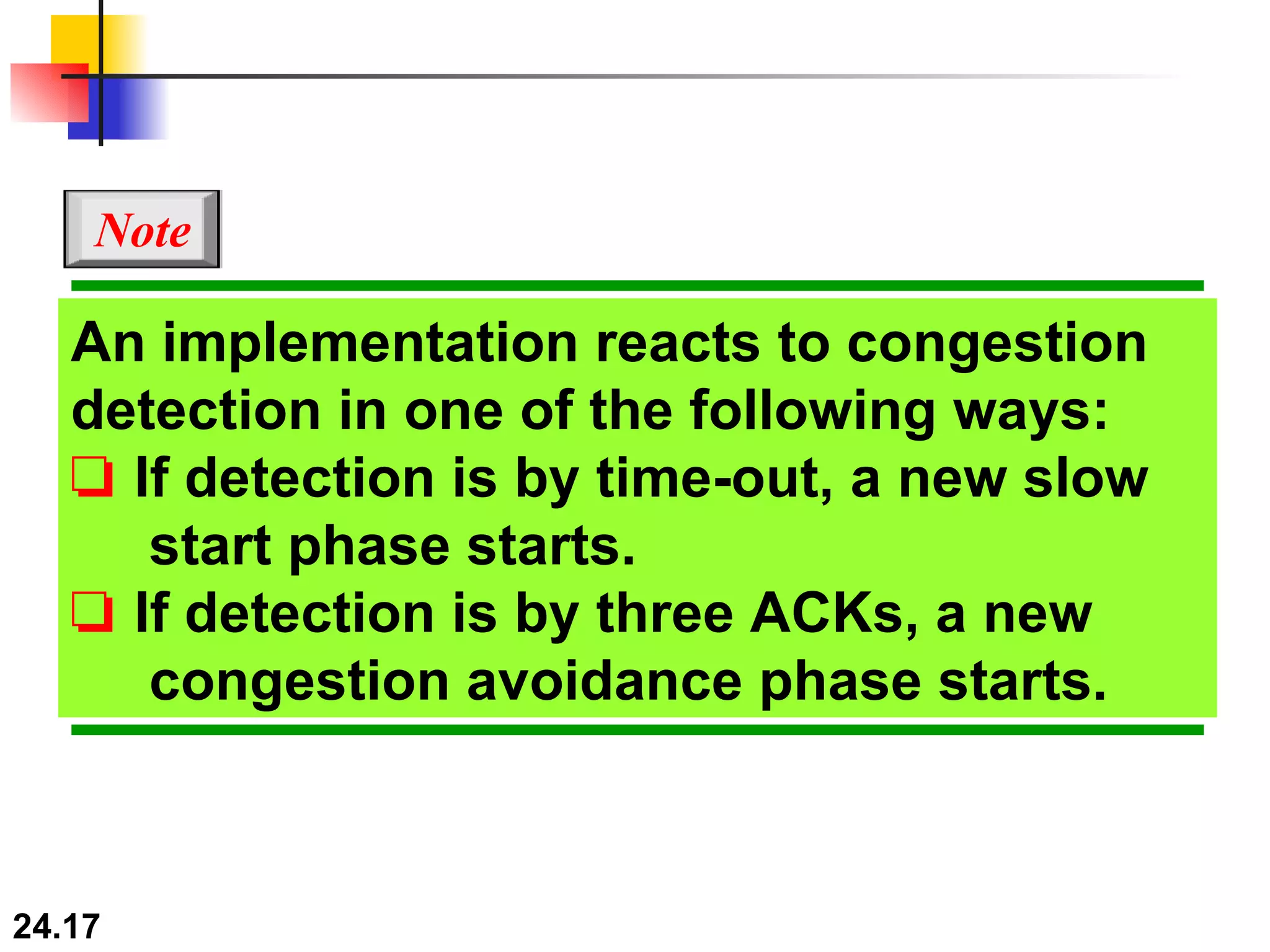
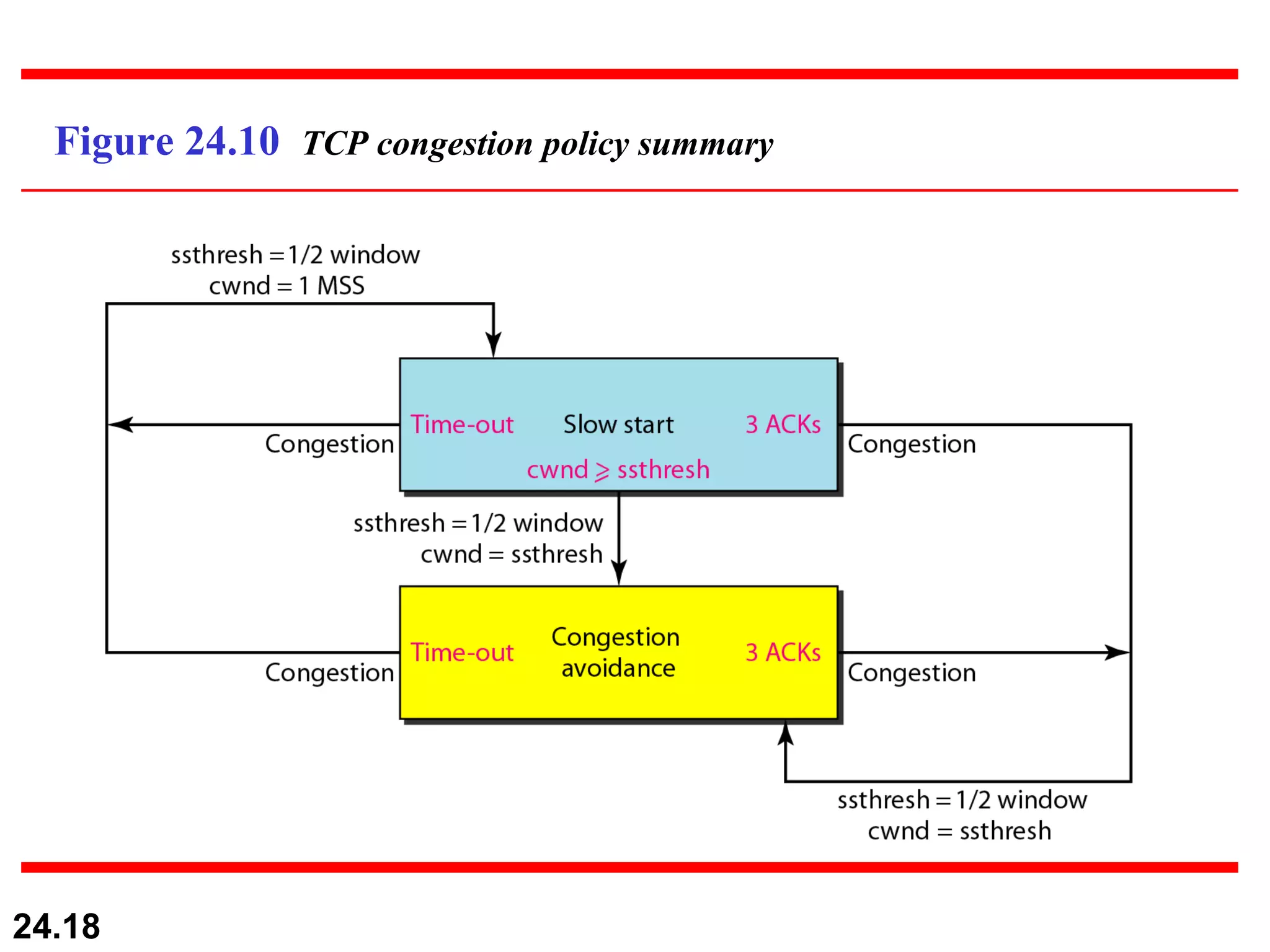
An implementation reacts to congestion detection in one of the following ways: ❏   If detection is by time-out, a new slow   start phase starts. ❏   If detection is by three ACKs, a new   congestion avoidance phase starts. Note
Figure 24.10  TCP congestion policy summary
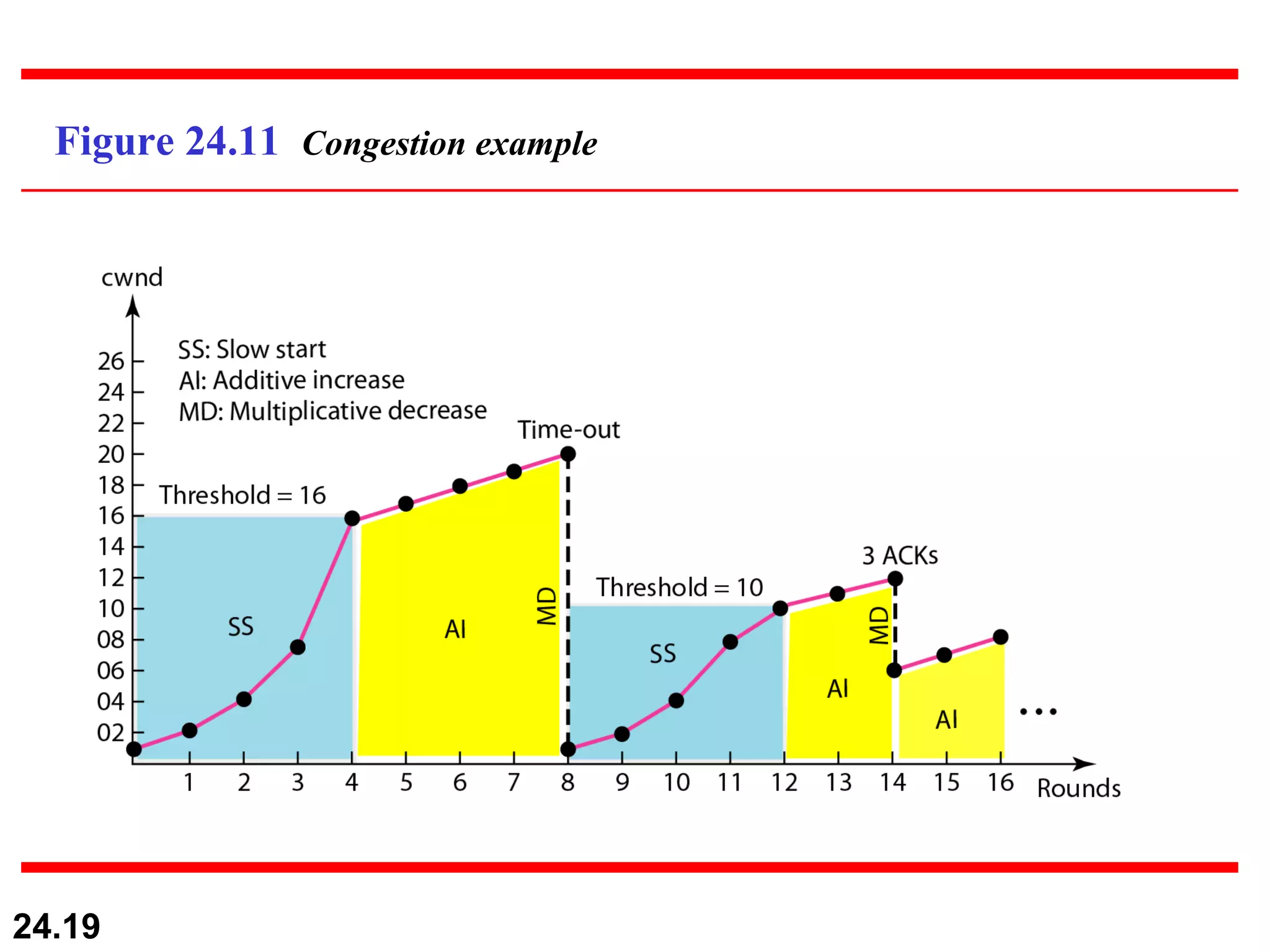
Figure 24.11  Congestion example
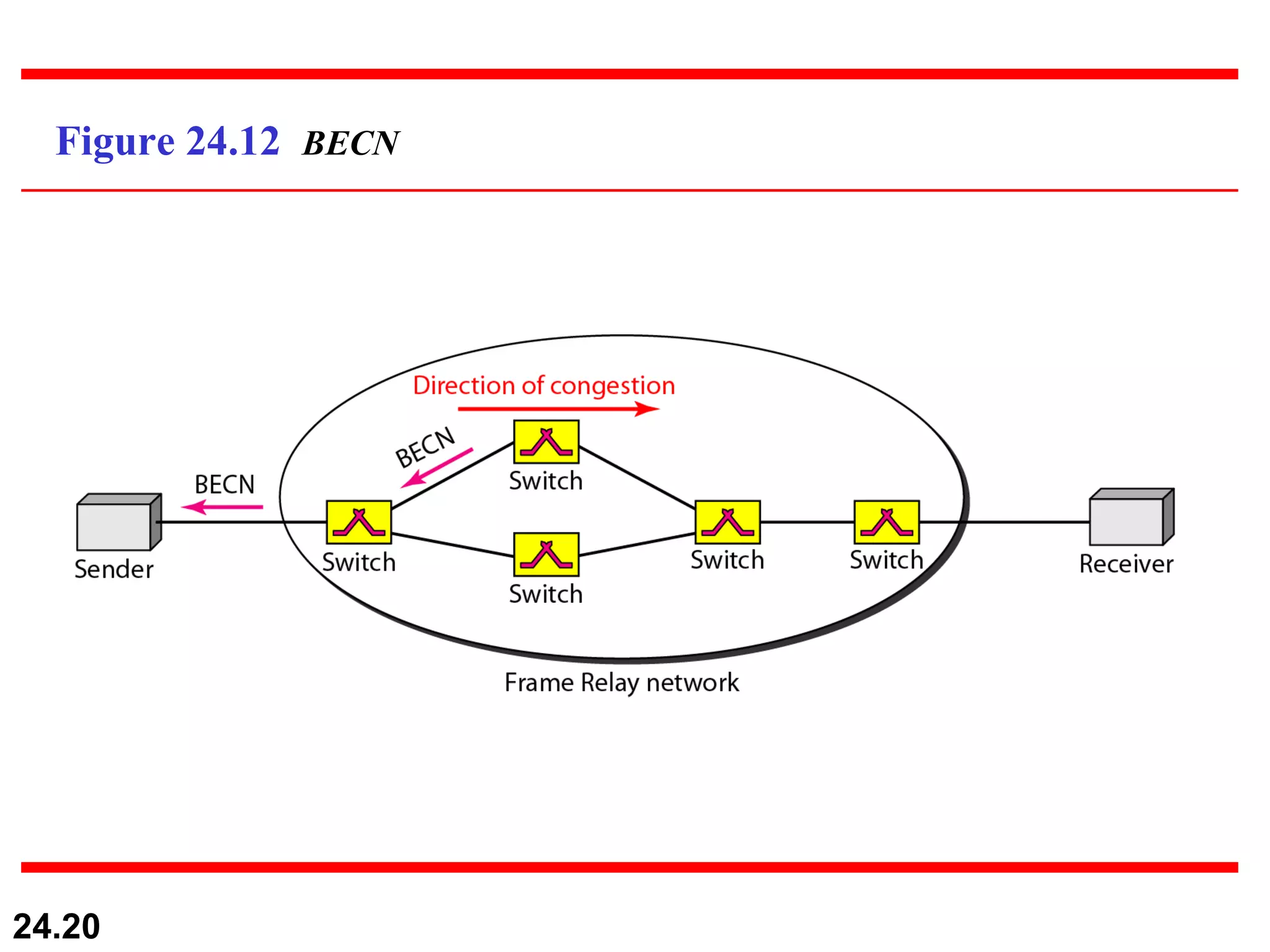
Figure 24.12  BECN
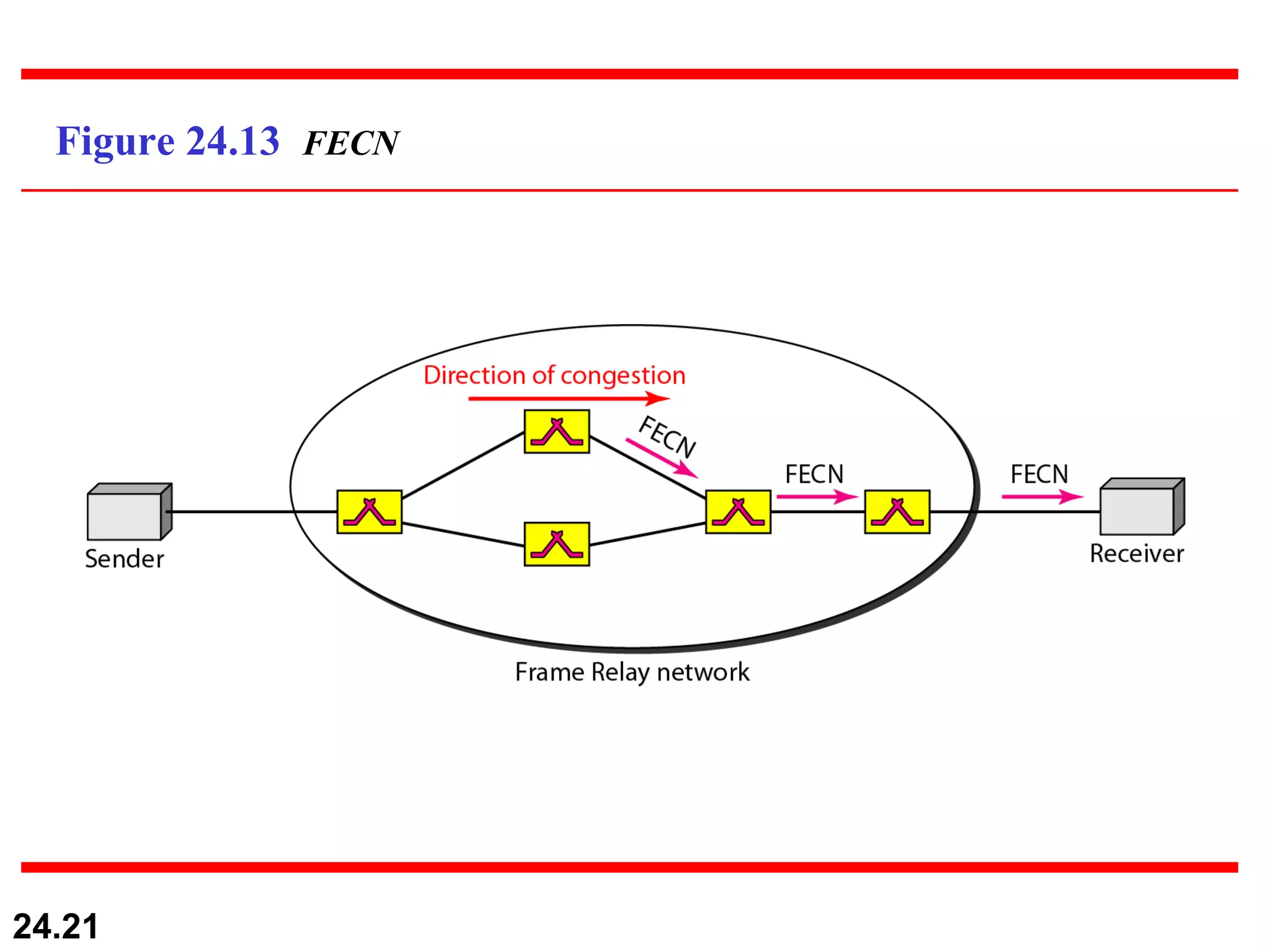
Figure 24.13  FECN
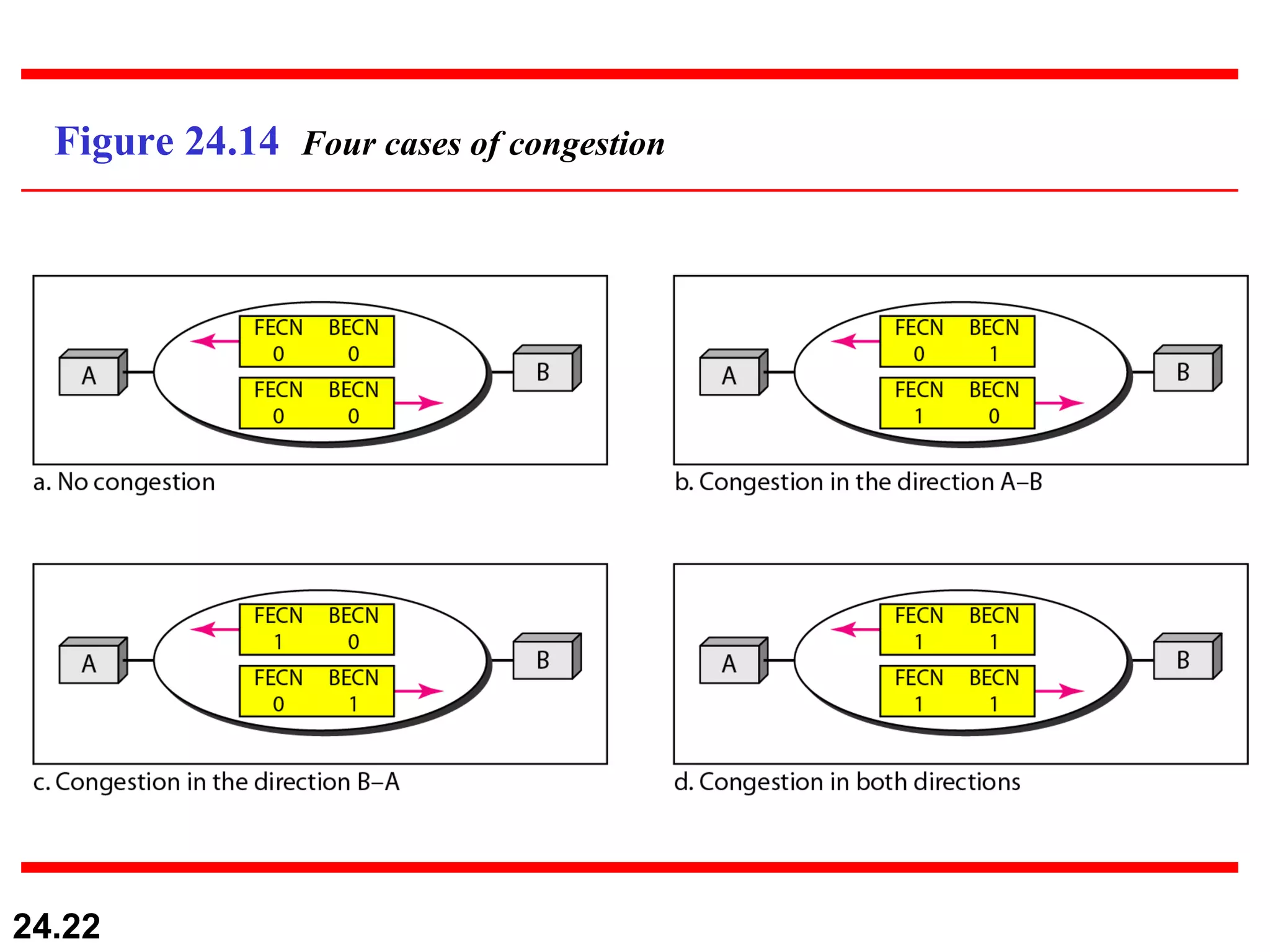
Figure 24.14  Four cases of congestion
24-5  QUALITY OF SERVICE Quality of service (QoS) is an internetworking issue that has been discussed more than defined. We can informally define quality of service as something a flow seeks to attain. Flow Characteristics Flow Classes Topics discussed in this section:
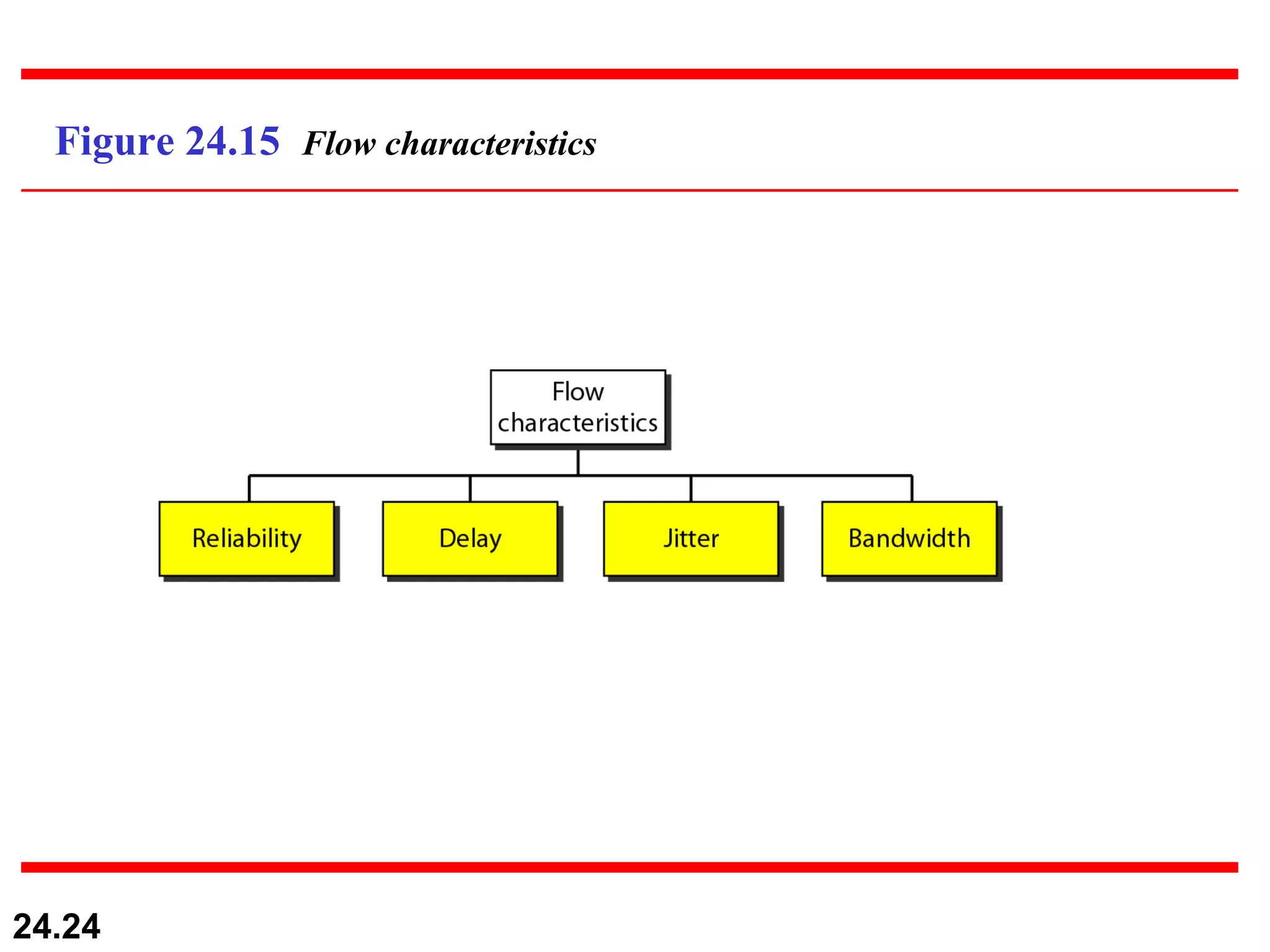
Figure 24.15  Flow characteristics
24-6  TECHNIQUES TO IMPROVE QoS In Section 24.5 we tried to define QoS in terms of its characteristics. In this section, we discuss some techniques that can be used to improve the quality of service. We briefly discuss four common methods: scheduling, traffic shaping, admission control, and resource reservation. Scheduling Traffic Shaping Resource Reservation Admission Control Topics discussed in this section:
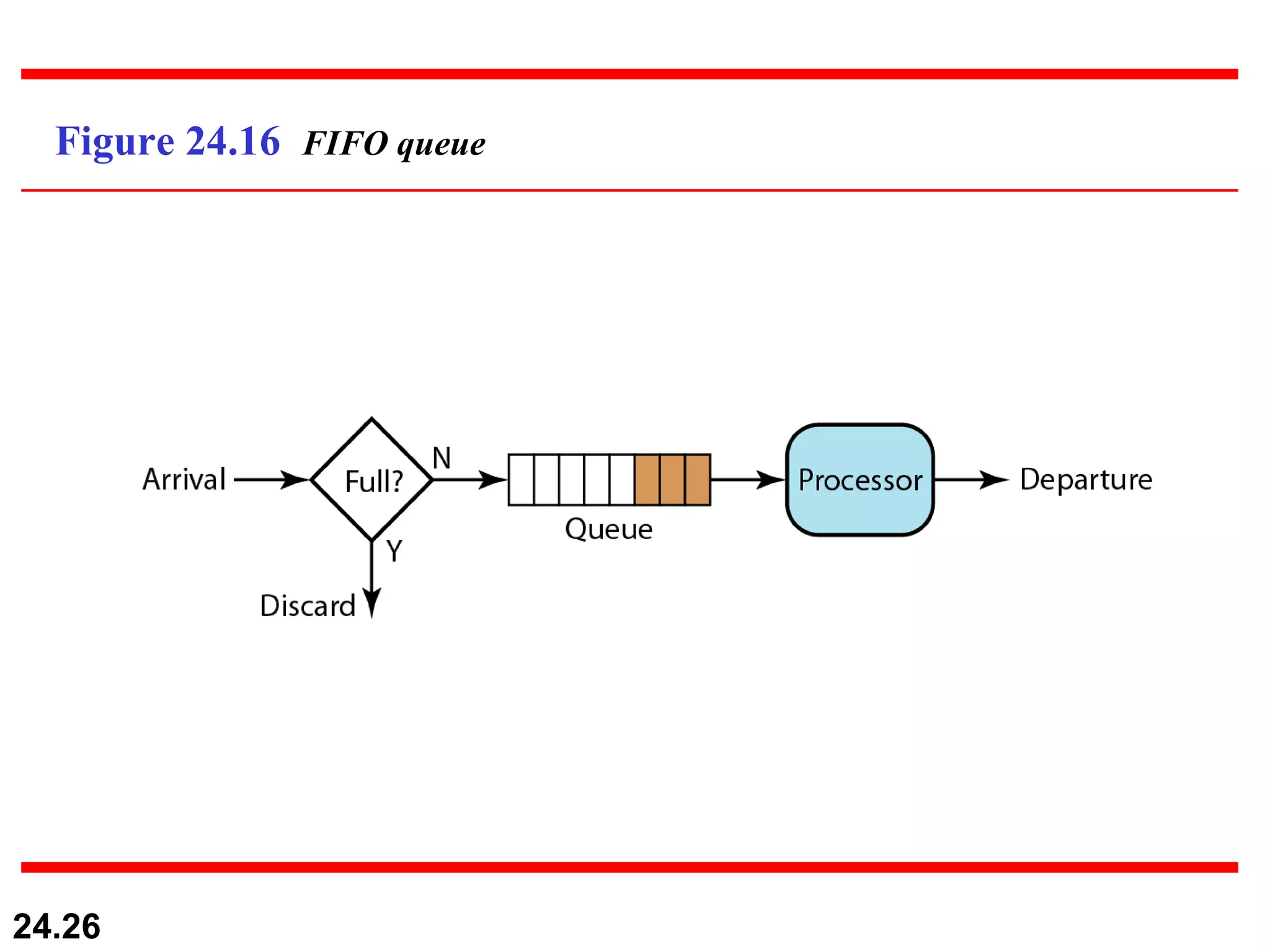
Figure 24.16  FIFO queue
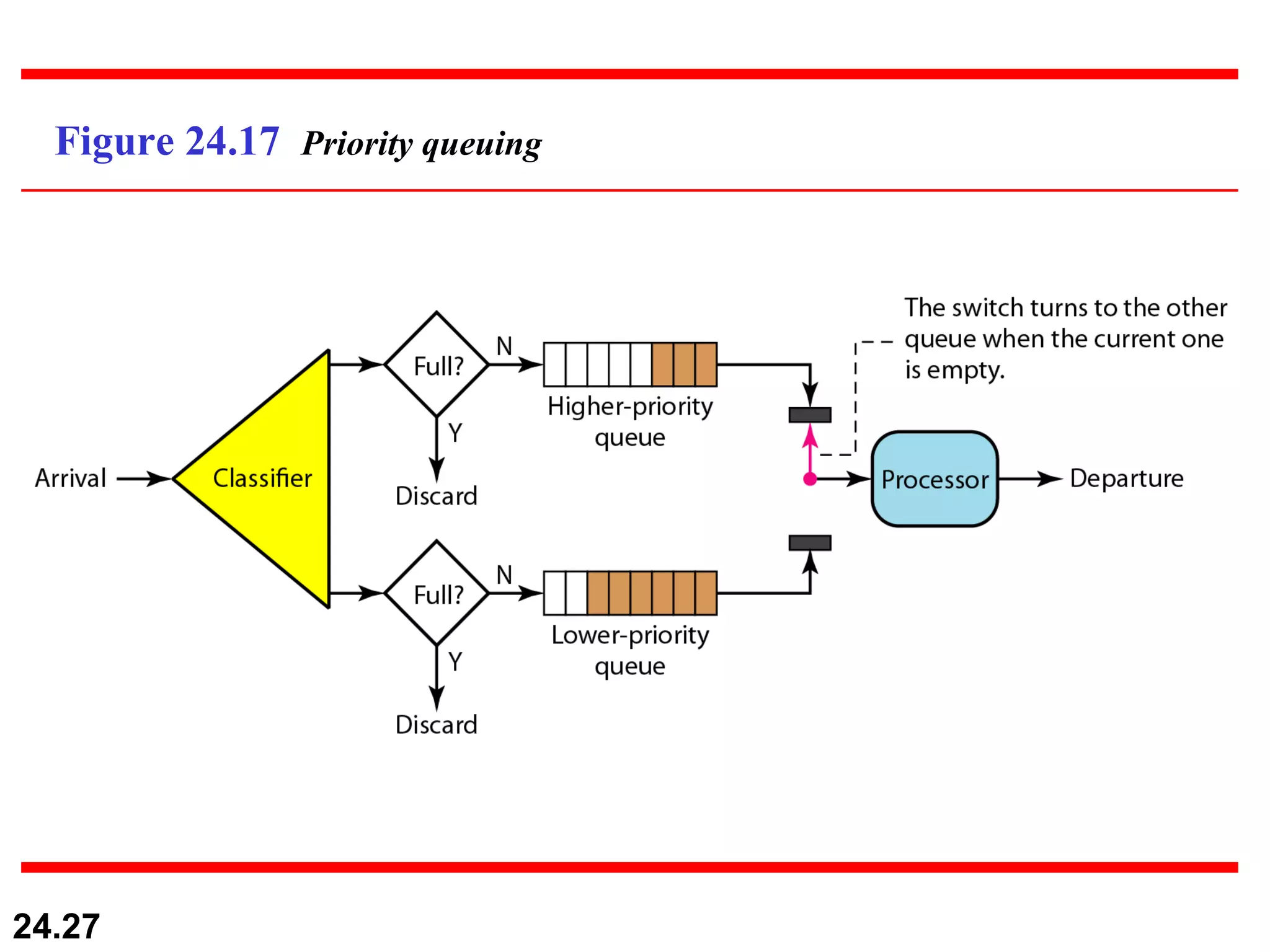
Figure 24.17  Priority queuing
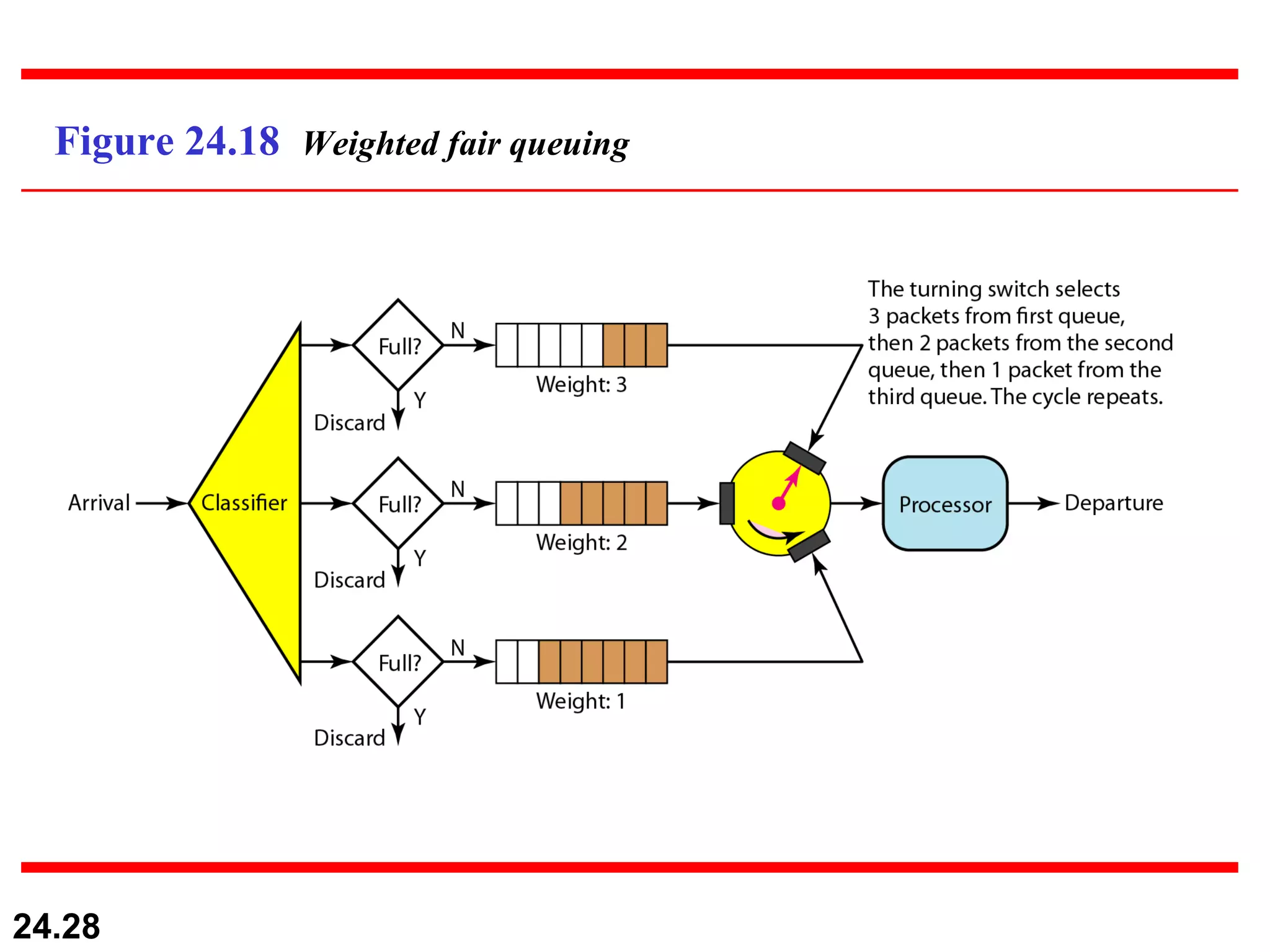
Figure 24.18  Weighted fair queuing
Figure 24.19  Leaky bucket
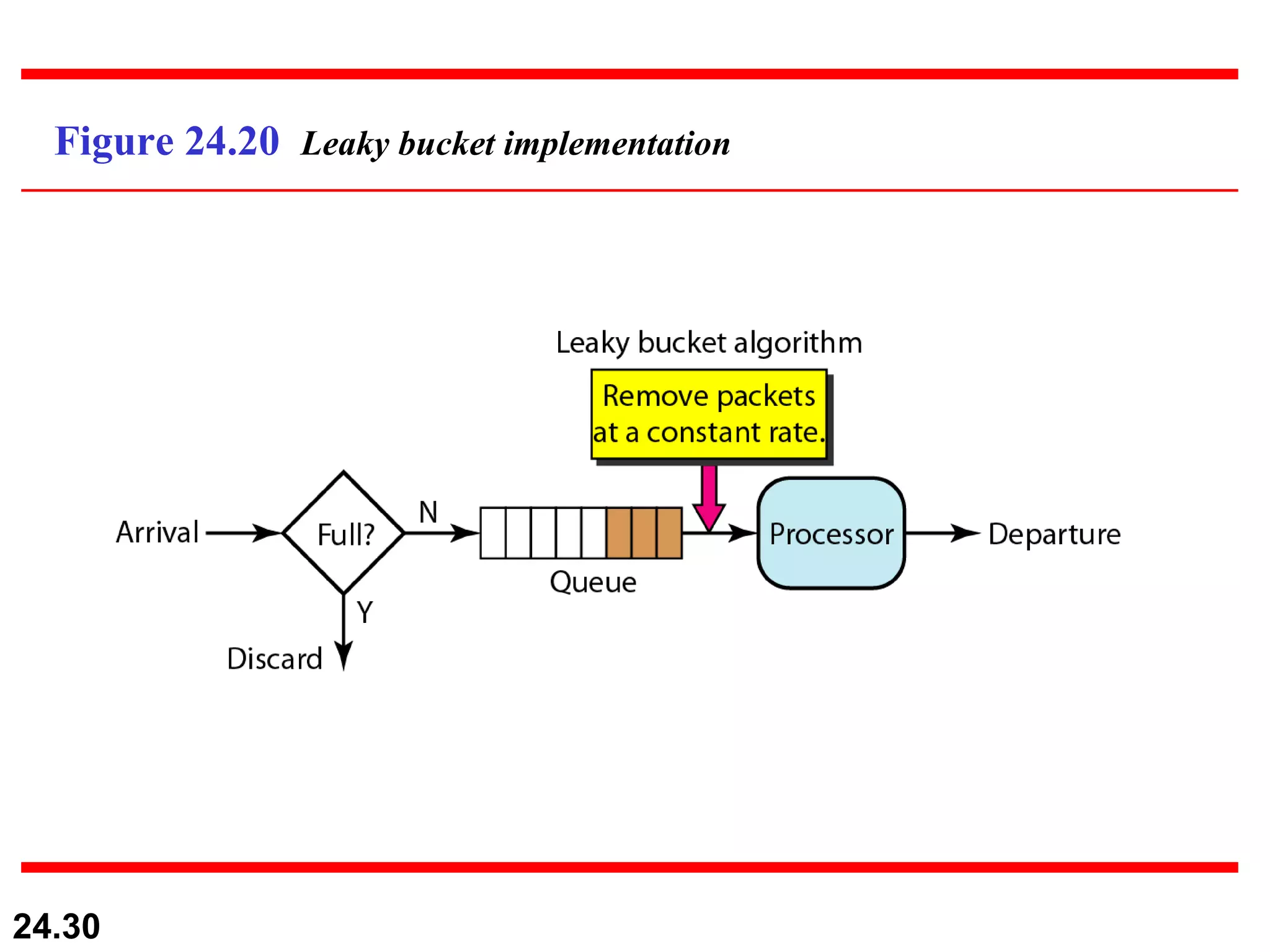
Figure 24.20  Leaky bucket implementation
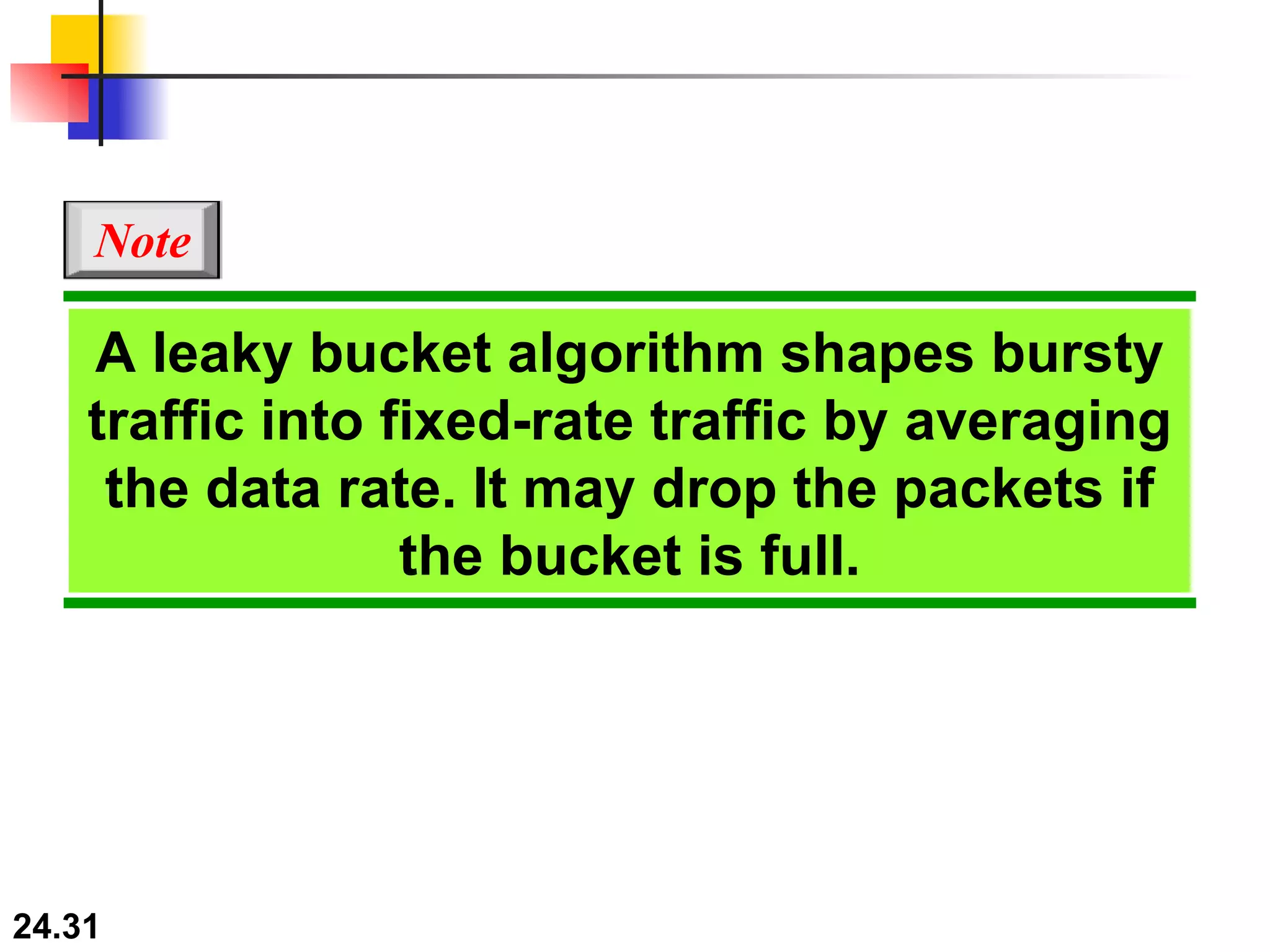
A leaky bucket algorithm shapes bursty traffic into fixed-rate traffic by averaging the data rate. It may drop the packets if the bucket is full. Note
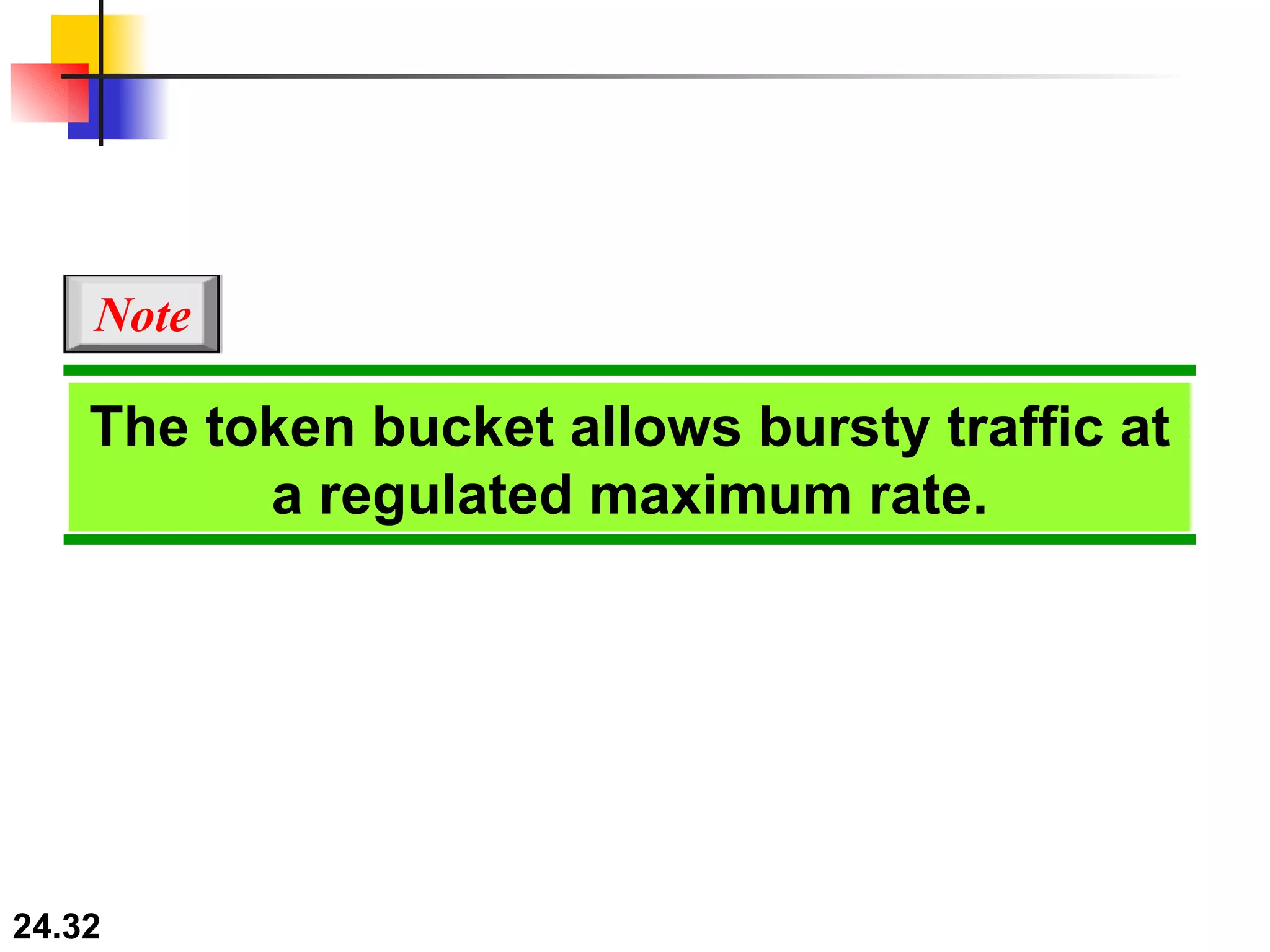
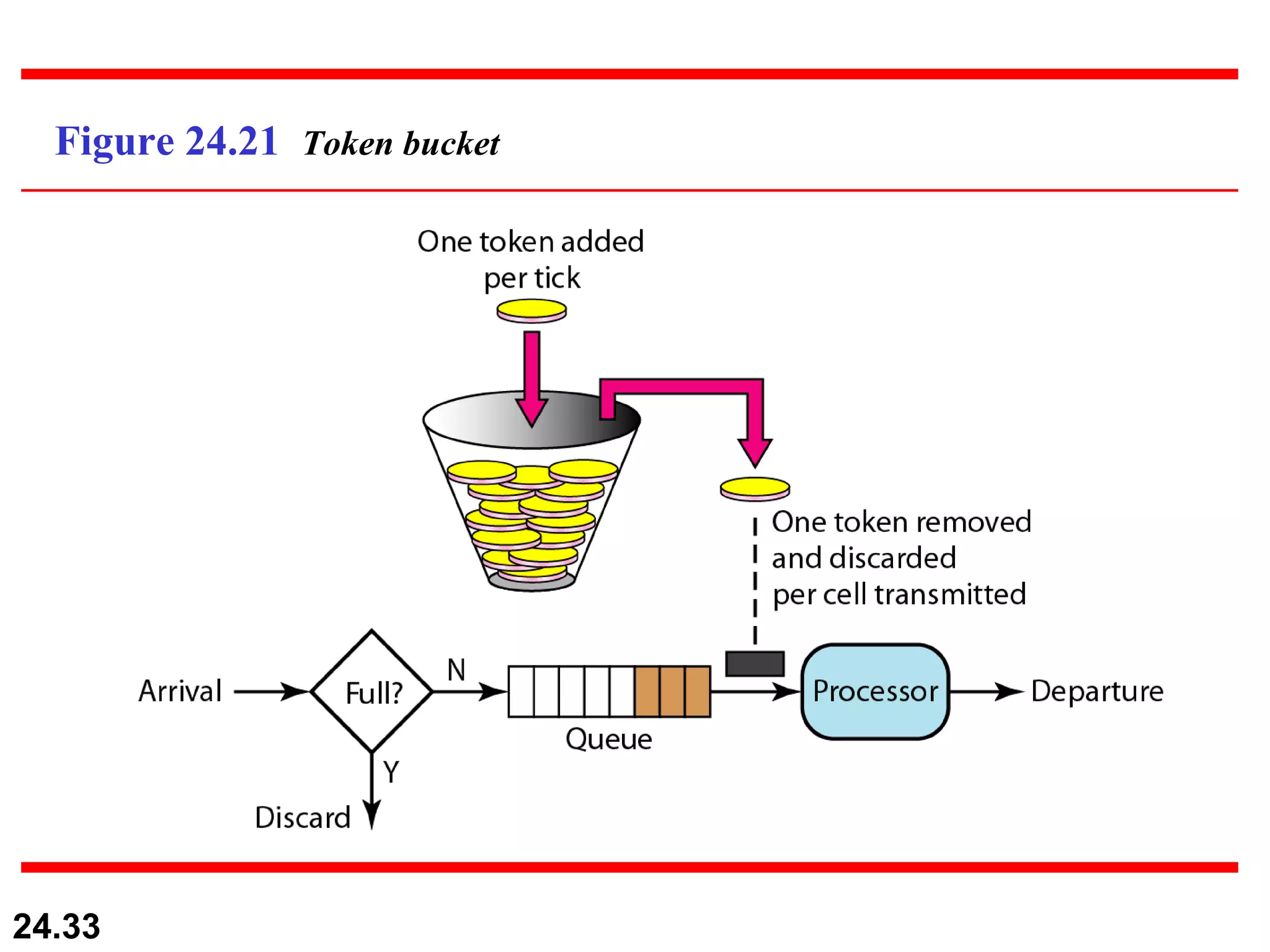
The token bucket allows bursty traffic at a regulated maximum rate. Note
Figure 24.21  Token bucket
24-7  INTEGRATED SERVICES Two models have been designed to provide quality of service in the Internet: Integrated Services and Differentiated Services. We discuss the first model here.  Signaling Flow Specification Admission Service Classes RSVP Problems with Integrated Services Topics discussed in this section:
Integrated Services is a flow-based QoS model designed for IP. Note
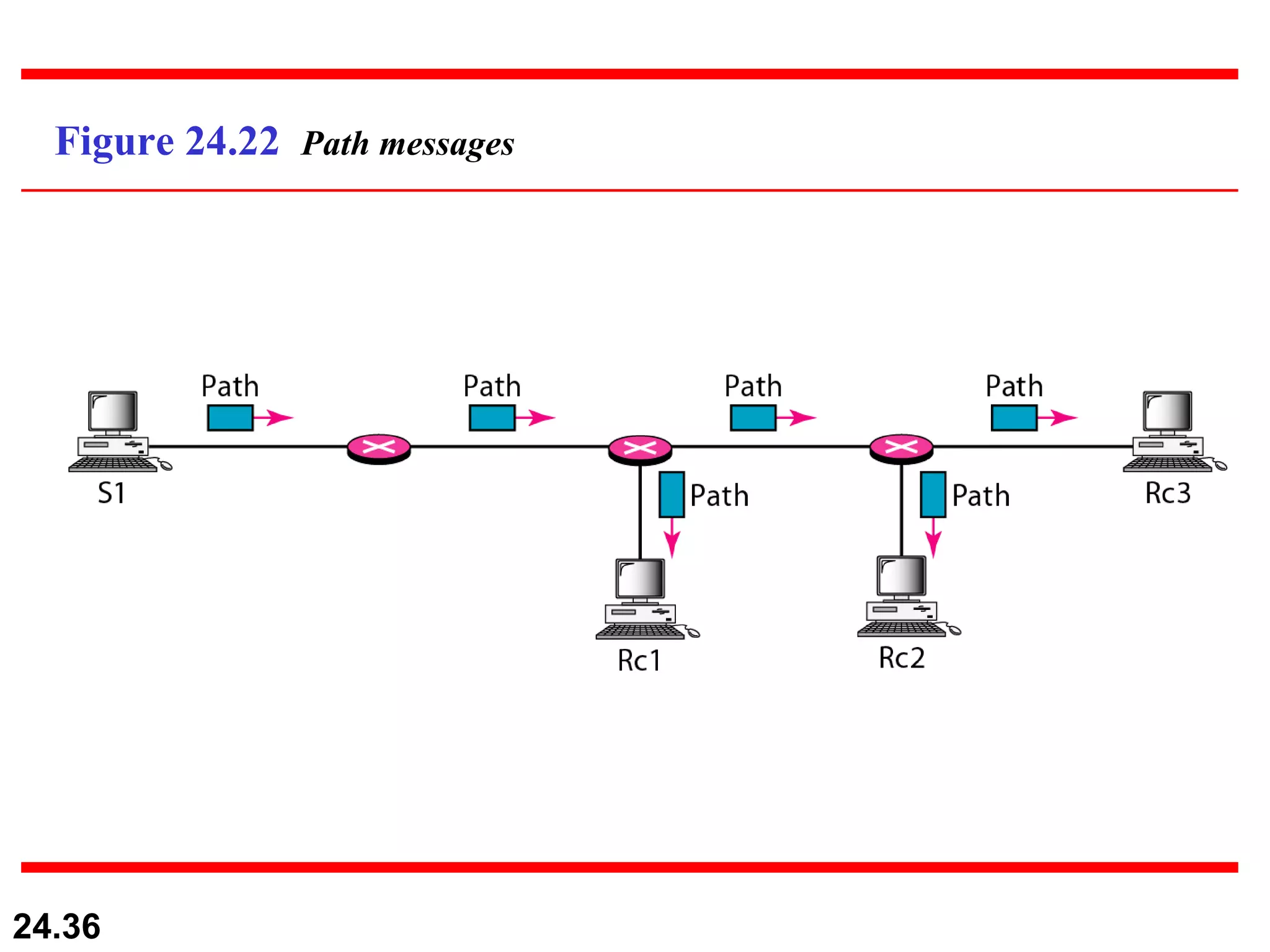
Figure 24.22  Path messages
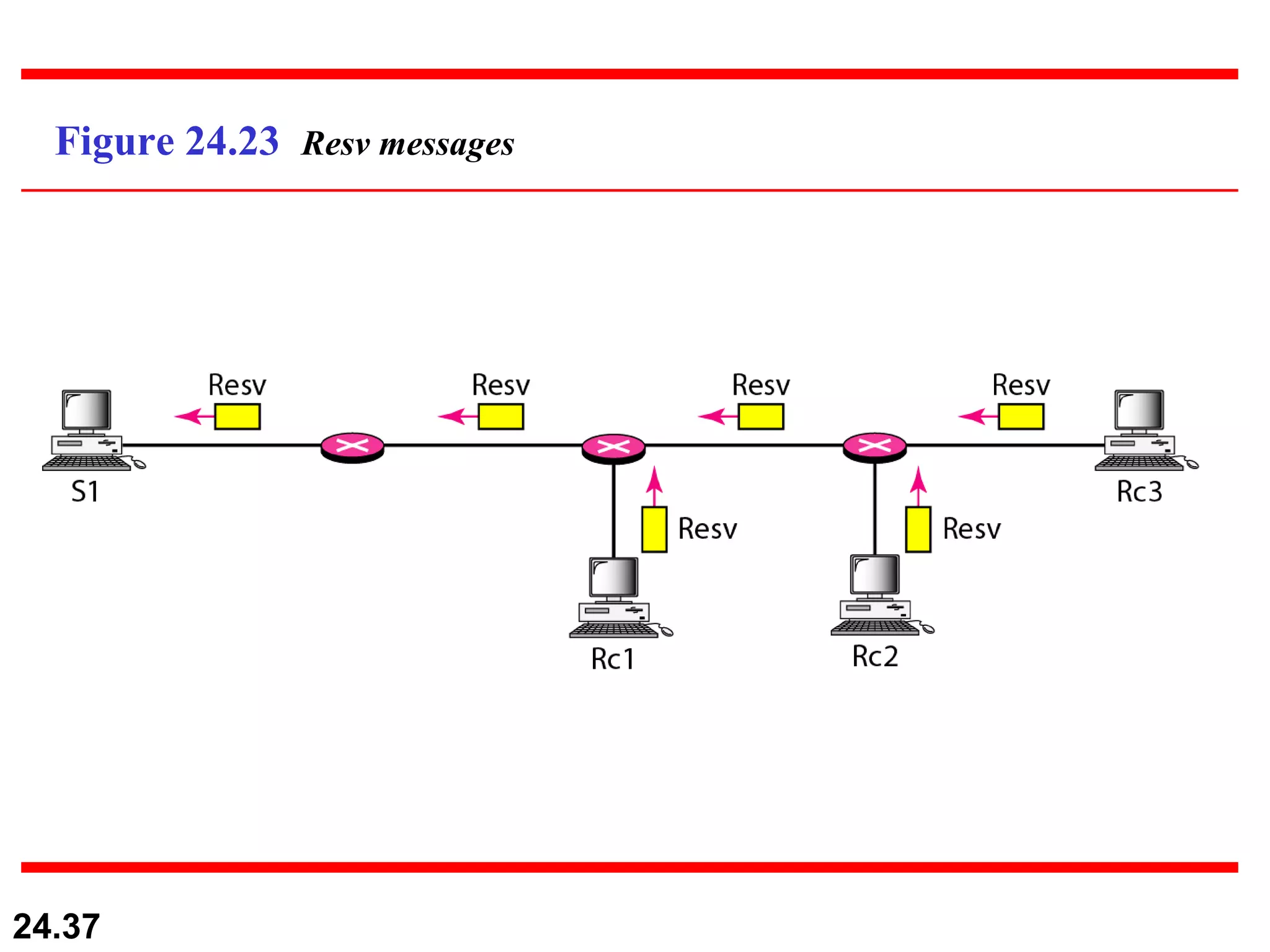
Figure 24.23  Resv messages
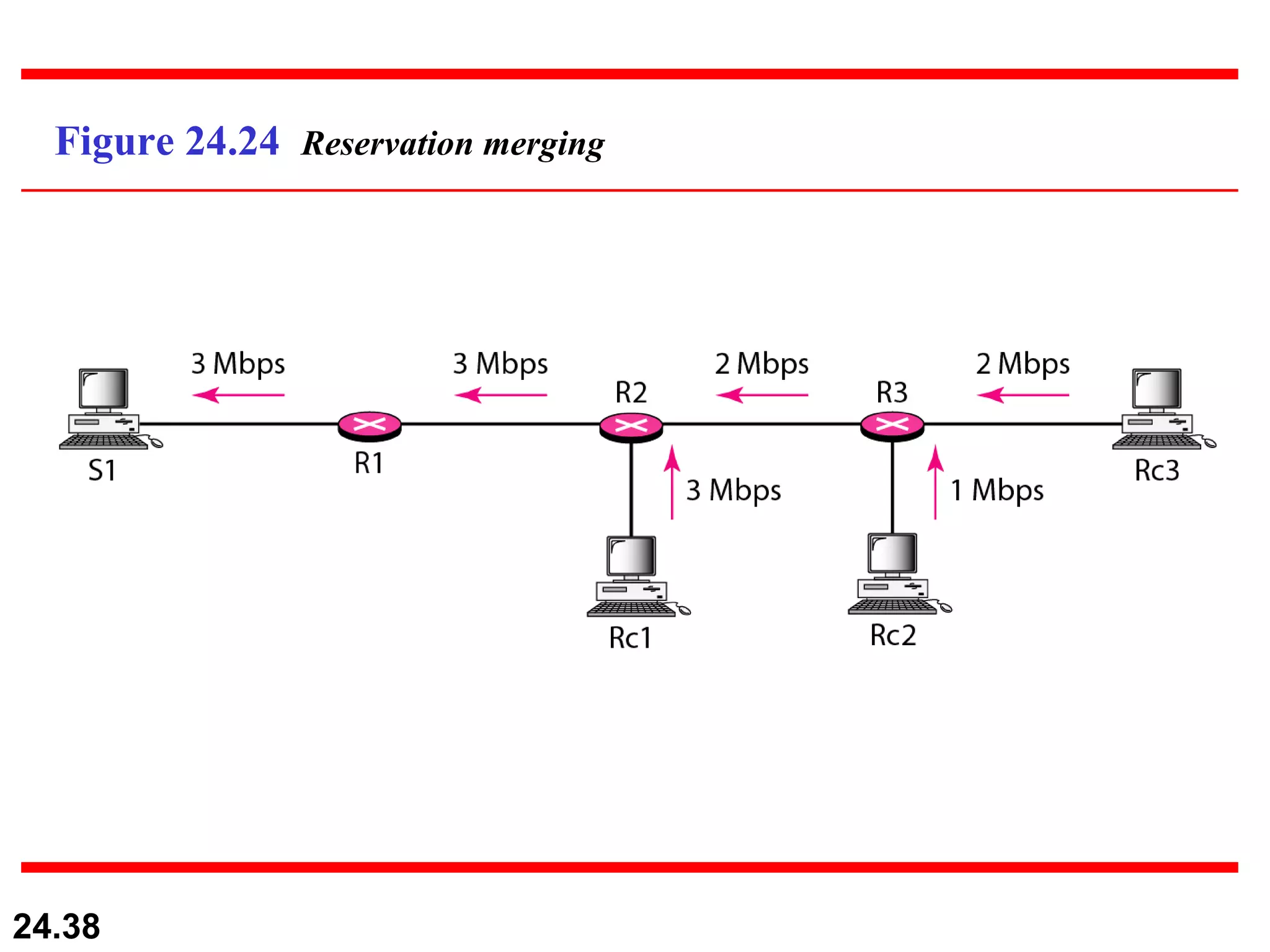
Figure 24.24  Reservation merging
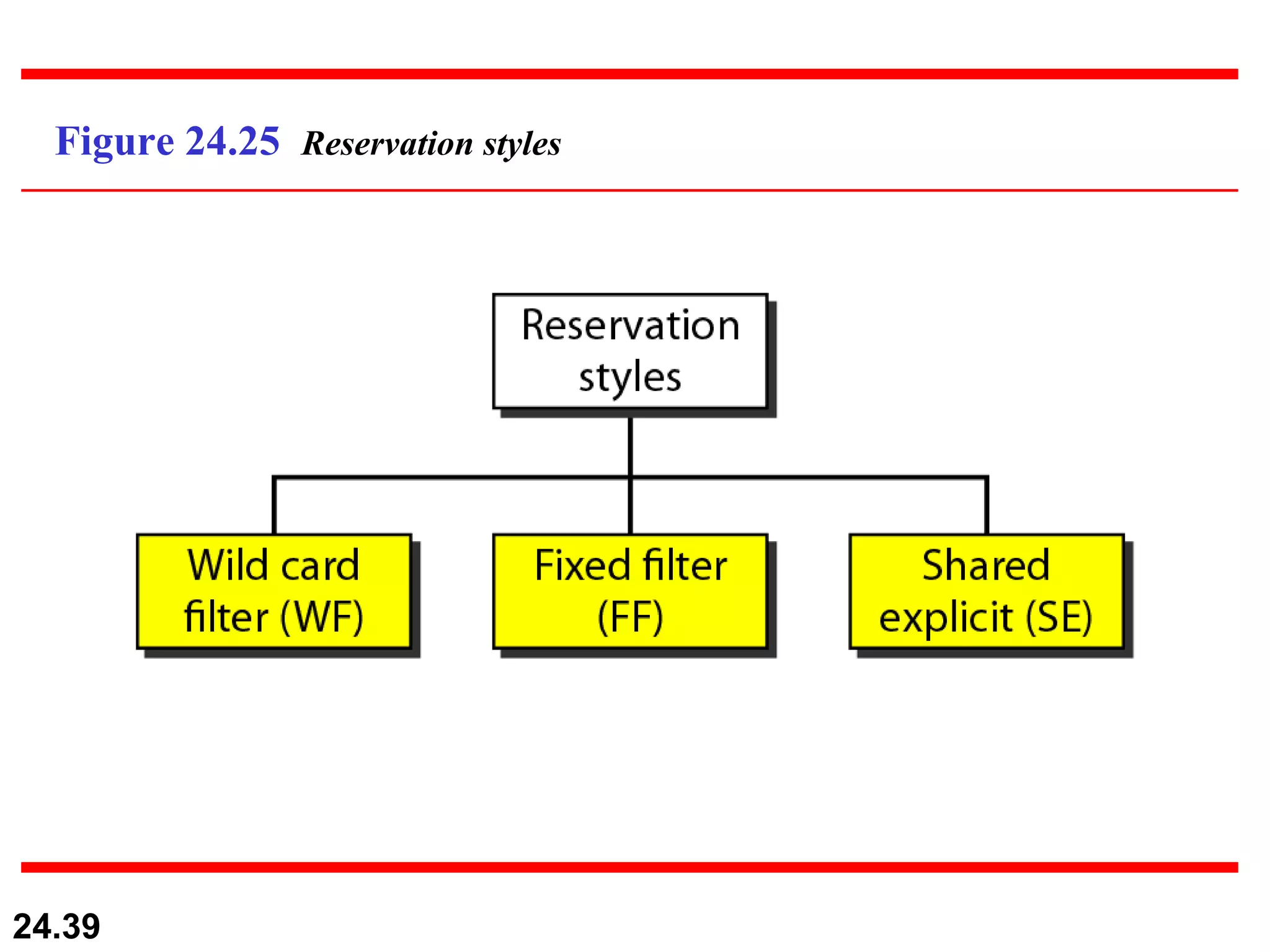
Figure 24.25  Reservation styles
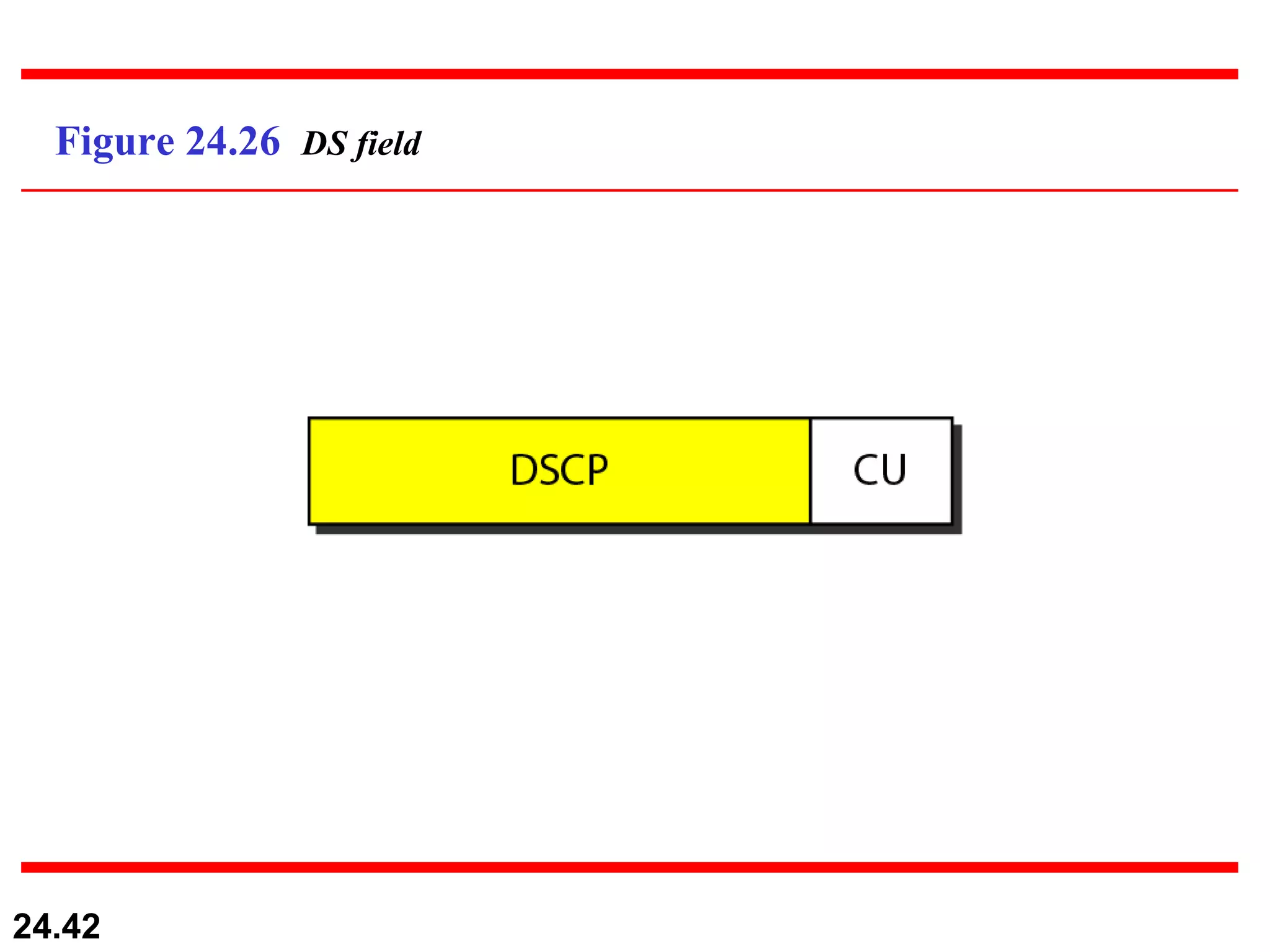
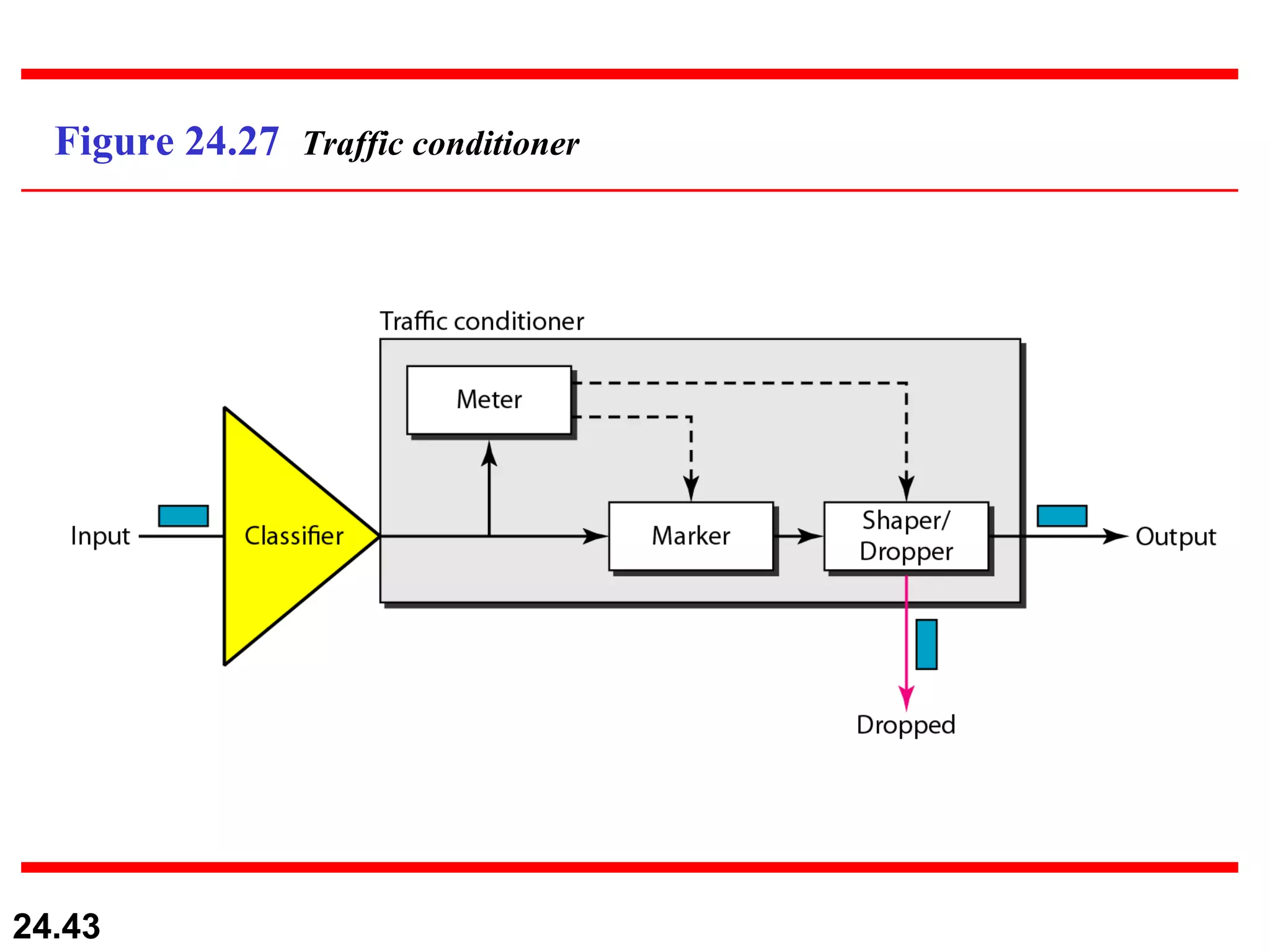
24-8  DIFFERENTIATED SERVICES Differentiated Services (DS or Diffserv) was introduced by the IETF (Internet Engineering Task Force) to handle the shortcomings of Integrated Services.  DS Field Topics discussed in this section:
Differentiated Services is a class-based QoS model designed for IP. Note
Figure 24.26  DS field
Figure 24.27  Traffic conditioner
24-9  QoS IN SWITCHED NETWORKS Let us now discuss QoS as used in two switched networks: Frame Relay and ATM. These two networks are virtual-circuit networks that need a signaling protocol such as RSVP. QoS in Frame Relay QoS in ATM Topics discussed in this section:
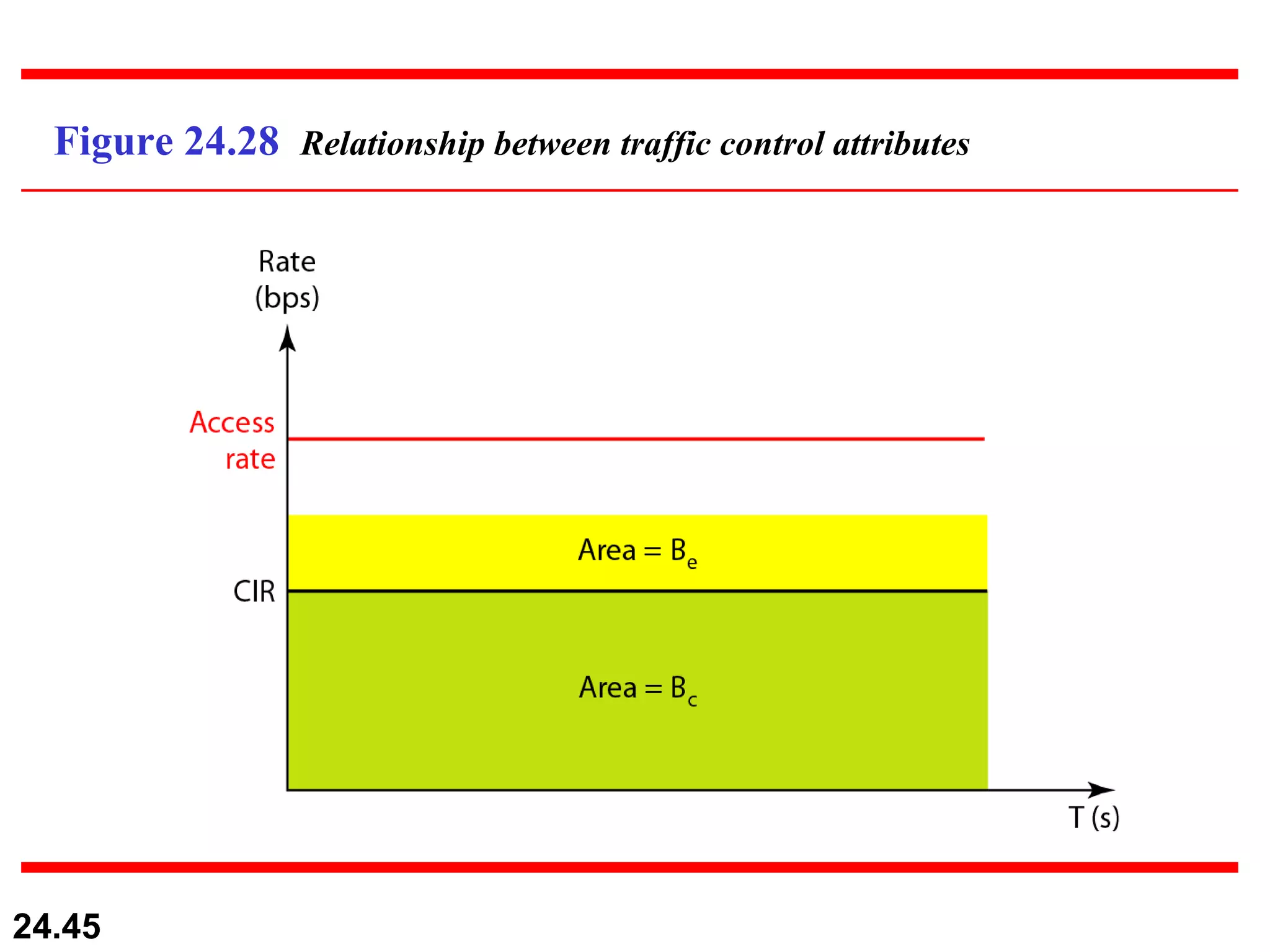
Figure 24.28  Relationship between traffic control attributes
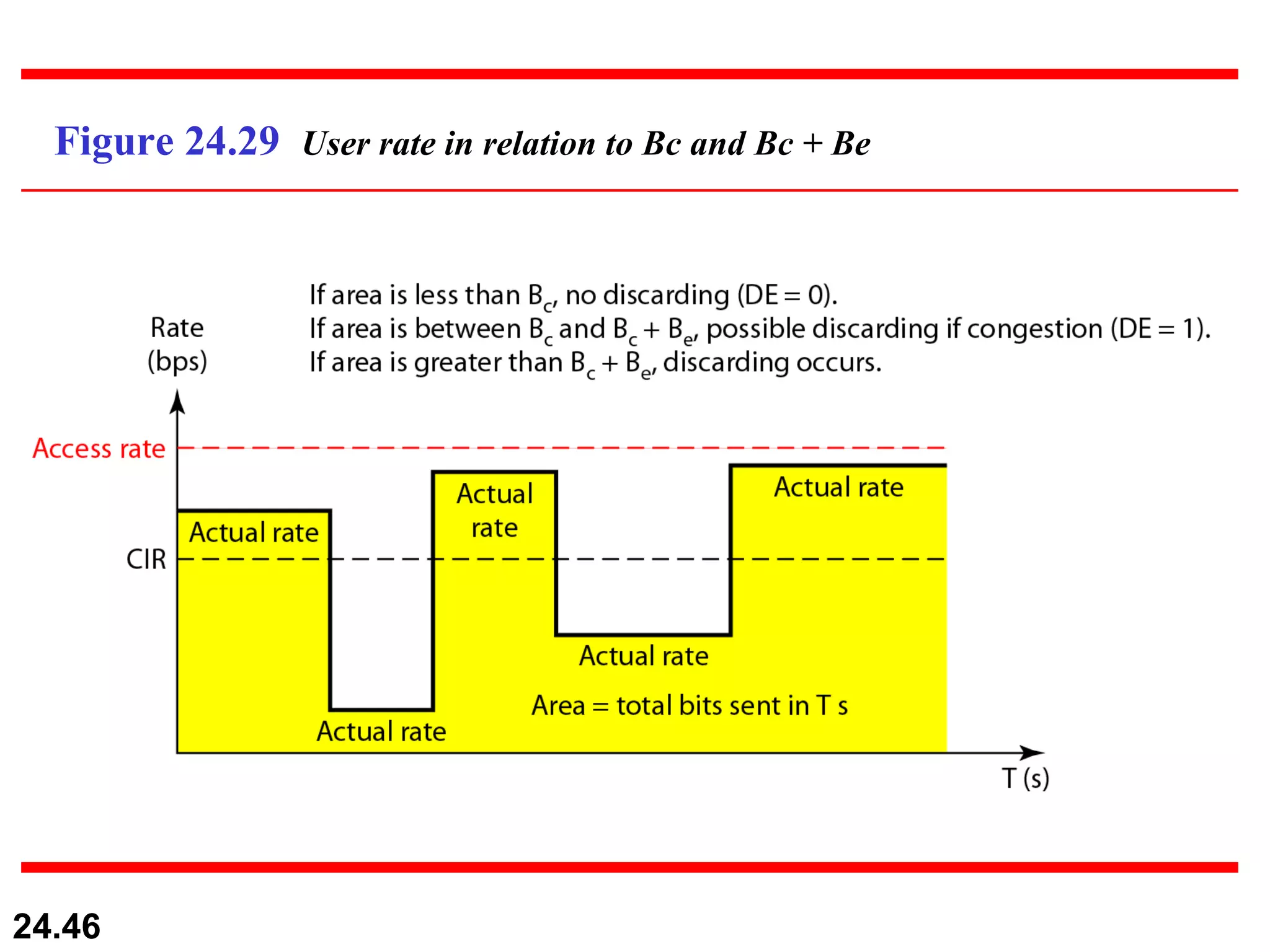
Figure 24.29  User rate in relation to Bc and Bc + Be
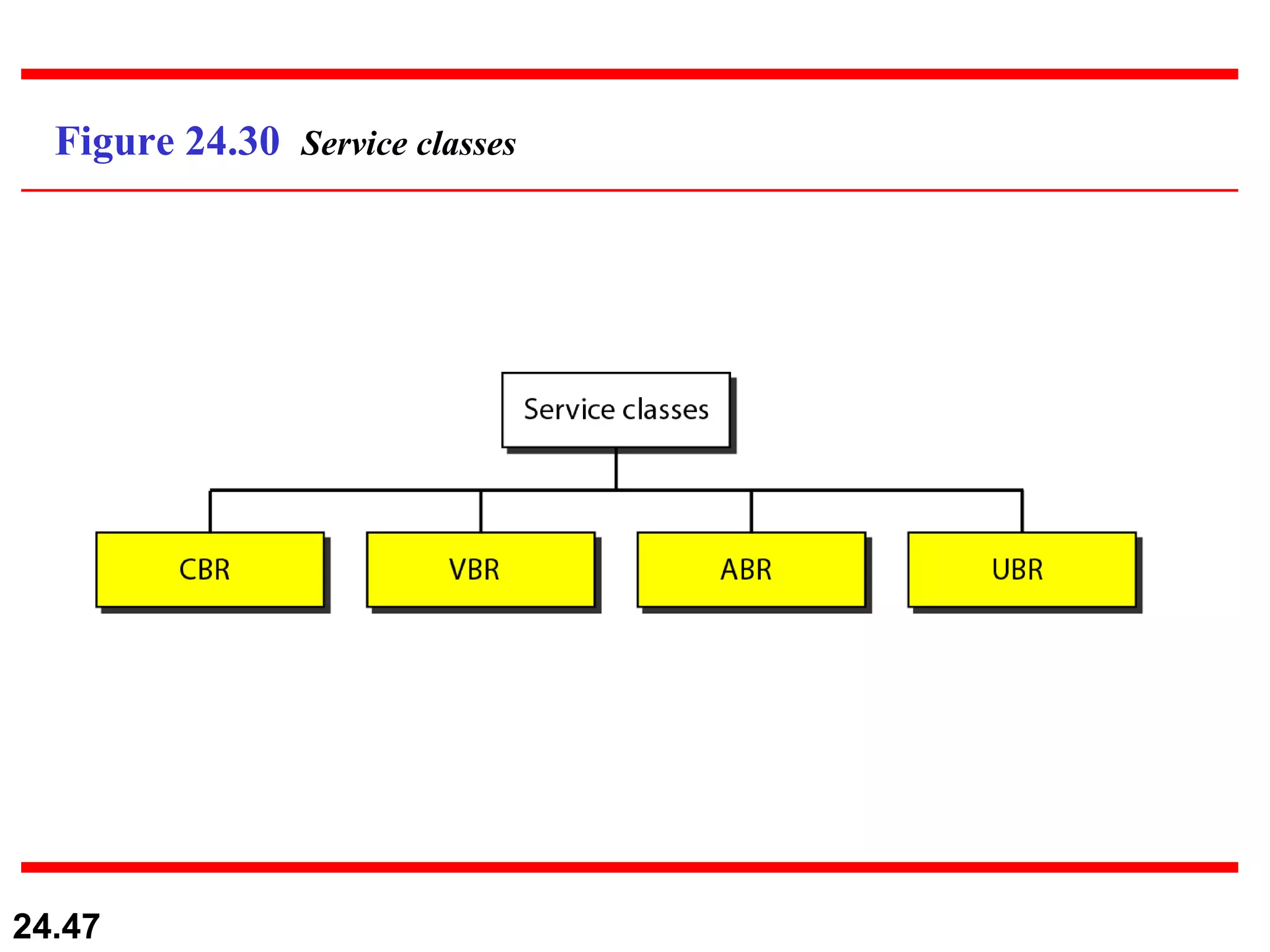
Figure 24.30  Service classes
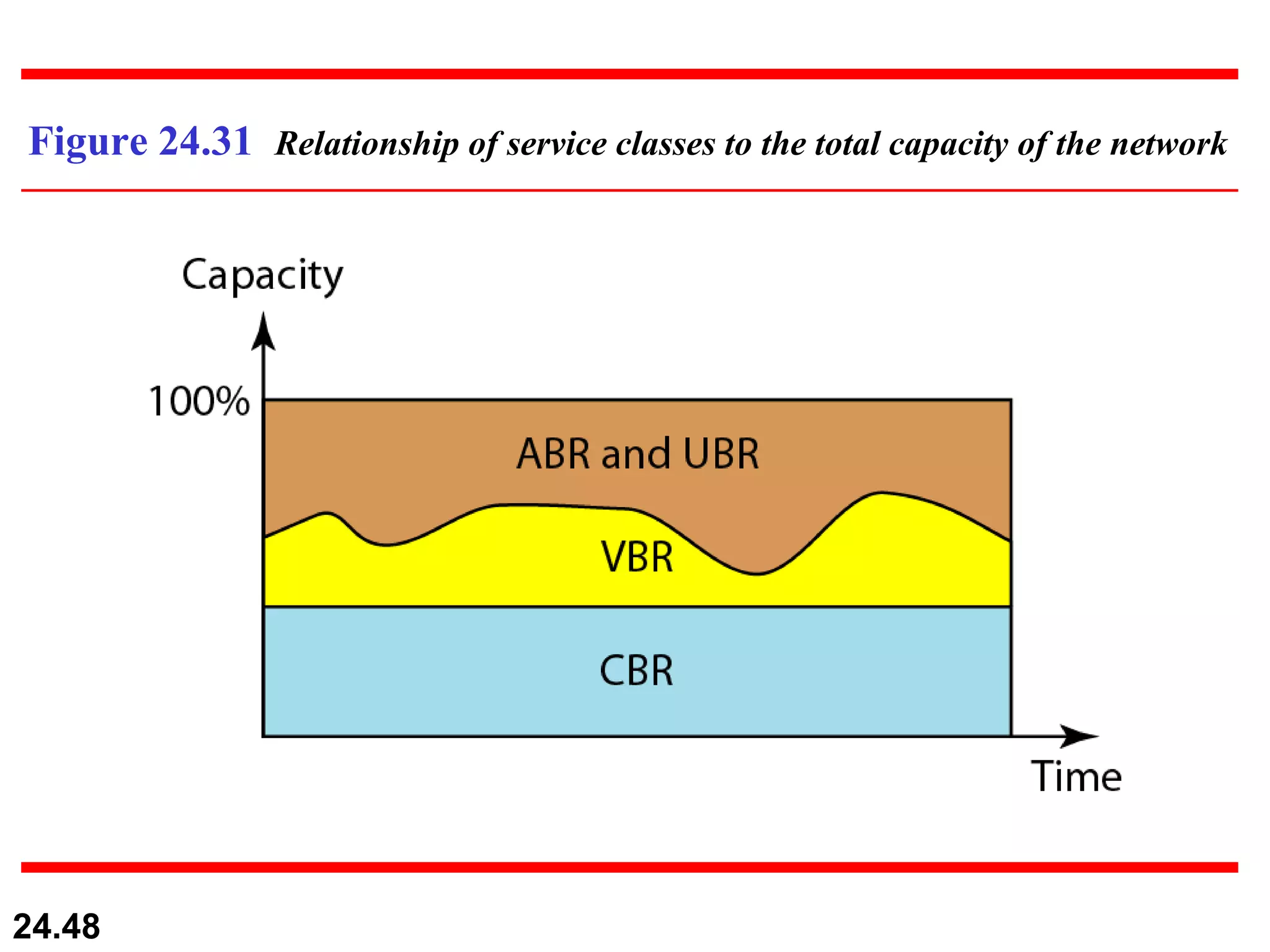
Figure 24.31  Relationship of service classes to the total capacity of the network

Chapter 24

  • 1.
    Chapter 24 CongestionControl and Quality of Service Copyright © The McGraw-Hill Companies, Inc. Permission required for reproduction or display.
  • 2.
    24-1 DATATRAFFIC The main focus of congestion control and quality of service is data traffic . In congestion control we try to avoid traffic congestion. In quality of service, we try to create an appropriate environment for the traffic. So, before talking about congestion control and quality of service, we discuss the data traffic itself. Traffic Descriptor Traffic Profiles Topics discussed in this section:
  • 3.
    Figure 24.1 Traffic descriptors
  • 4.
    Figure 24.2 Three traffic profiles
  • 5.
    24-2 CONGESTIONCongestion in a network may occur if the load on the network—the number of packets sent to the network—is greater than the capacity of the network—the number of packets a network can handle. Congestion control refers to the mechanisms and techniques to control the congestion and keep the load below the capacity. Network Performance Topics discussed in this section:
  • 6.
    Figure 24.3 Queues in a router
  • 7.
    Figure Packetdelay and throughput as functions of load
  • 8.
    24-3 CONGESTIONCONTROL Congestion control refers to techniques and mechanisms that can either prevent congestion, before it happens, or remove congestion, after it has happened. In general, we can divide congestion control mechanisms into two broad categories: open-loop congestion control (prevention) and closed-loop congestion control (removal). Open-Loop Congestion Control Closed-Loop Congestion Control Topics discussed in this section:
  • 9.
    Figure 24.5 Congestion control categories
  • 10.
    Figure 24.6 Backpressure method for alleviating congestion
  • 11.
    Figure 24.7 Choke packet
  • 12.
    24-4 TWOEXAMPLES To better understand the concept of congestion control, let us give two examples: one in TCP and the other in Frame Relay. Congestion Control in TCP Congestion Control in Frame Relay Topics discussed in this section:
  • 13.
    Figure 24.8 Slow start, exponential increase
  • 14.
    In the slow-startalgorithm, the size of the congestion window increases exponentially until it reaches a threshold. Note
  • 15.
    Figure 24.9 Congestion avoidance, additive increase
  • 16.
    In the congestionavoidance algorithm, the size of the congestion window increases additively until congestion is detected. Note
  • 17.
    An implementation reactsto congestion detection in one of the following ways: ❏ If detection is by time-out, a new slow start phase starts. ❏ If detection is by three ACKs, a new congestion avoidance phase starts. Note
  • 18.
    Figure 24.10 TCP congestion policy summary
  • 19.
    Figure 24.11 Congestion example
  • 20.
  • 21.
  • 22.
    Figure 24.14 Four cases of congestion
  • 23.
    24-5 QUALITYOF SERVICE Quality of service (QoS) is an internetworking issue that has been discussed more than defined. We can informally define quality of service as something a flow seeks to attain. Flow Characteristics Flow Classes Topics discussed in this section:
  • 24.
    Figure 24.15 Flow characteristics
  • 25.
    24-6 TECHNIQUESTO IMPROVE QoS In Section 24.5 we tried to define QoS in terms of its characteristics. In this section, we discuss some techniques that can be used to improve the quality of service. We briefly discuss four common methods: scheduling, traffic shaping, admission control, and resource reservation. Scheduling Traffic Shaping Resource Reservation Admission Control Topics discussed in this section:
  • 26.
    Figure 24.16 FIFO queue
  • 27.
    Figure 24.17 Priority queuing
  • 28.
    Figure 24.18 Weighted fair queuing
  • 29.
    Figure 24.19 Leaky bucket
  • 30.
    Figure 24.20 Leaky bucket implementation
  • 31.
    A leaky bucketalgorithm shapes bursty traffic into fixed-rate traffic by averaging the data rate. It may drop the packets if the bucket is full. Note
  • 32.
    The token bucketallows bursty traffic at a regulated maximum rate. Note
  • 33.
    Figure 24.21 Token bucket
  • 34.
    24-7 INTEGRATEDSERVICES Two models have been designed to provide quality of service in the Internet: Integrated Services and Differentiated Services. We discuss the first model here. Signaling Flow Specification Admission Service Classes RSVP Problems with Integrated Services Topics discussed in this section:
  • 35.
    Integrated Services isa flow-based QoS model designed for IP. Note
  • 36.
    Figure 24.22 Path messages
  • 37.
    Figure 24.23 Resv messages
  • 38.
    Figure 24.24 Reservation merging
  • 39.
    Figure 24.25 Reservation styles
  • 40.
    24-8 DIFFERENTIATEDSERVICES Differentiated Services (DS or Diffserv) was introduced by the IETF (Internet Engineering Task Force) to handle the shortcomings of Integrated Services. DS Field Topics discussed in this section:
  • 41.
    Differentiated Services isa class-based QoS model designed for IP. Note
  • 42.
    Figure 24.26 DS field
  • 43.
    Figure 24.27 Traffic conditioner
  • 44.
    24-9 QoSIN SWITCHED NETWORKS Let us now discuss QoS as used in two switched networks: Frame Relay and ATM. These two networks are virtual-circuit networks that need a signaling protocol such as RSVP. QoS in Frame Relay QoS in ATM Topics discussed in this section:
  • 45.
    Figure 24.28 Relationship between traffic control attributes
  • 46.
    Figure 24.29 User rate in relation to Bc and Bc + Be
  • 47.
    Figure 24.30 Service classes
  • 48.
    Figure 24.31 Relationship of service classes to the total capacity of the network