Chapter 30 Message Security, User Authentication, and Key Management
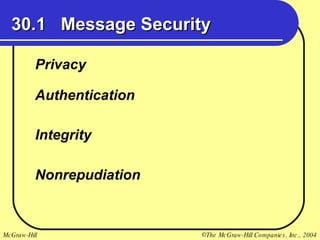
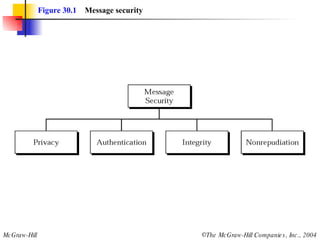
30.1  Message Security Privacy Authentication Integrity Nonrepudiation
Figure 30.1   Message security
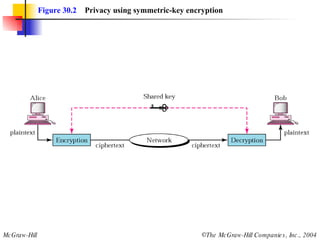
Figure 30.2   Privacy using symmetric-key encryption
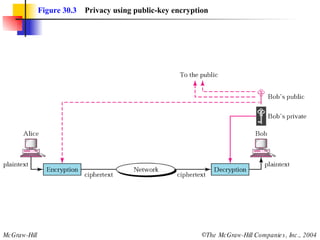
Figure 30.3   Privacy using public-key encryption
30.2  Digital Signature Signing the Whole Document Signing the Digest
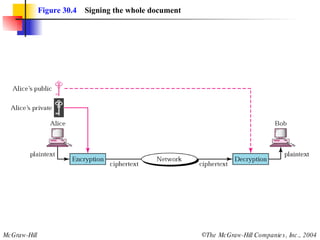
Figure 30.4   Signing the whole document
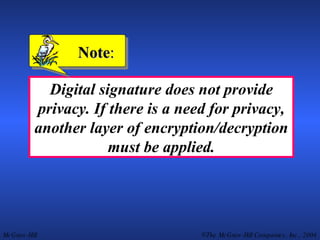
Digital signature does not provide privacy. If there is a need for privacy, another layer of encryption/decryption must be applied. Note :
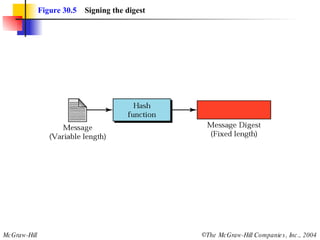
Figure 30.5   Signing the digest
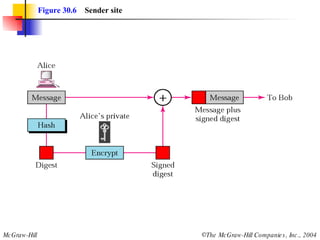
Figure 30.6   Sender site
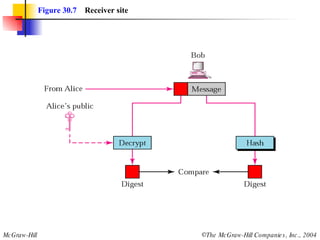
Figure 30.7   Receiver site
30.3  User Authentication With Symmetric Key  With Public Key
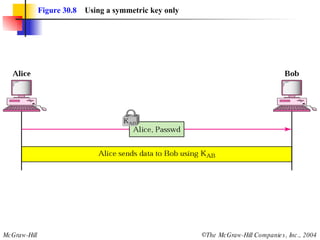
Figure 30.8   Using a symmetric key only
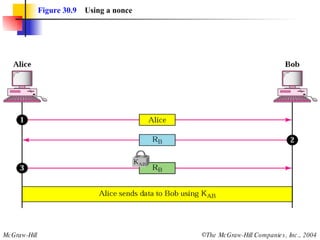
Figure 30.9   Using a nonce
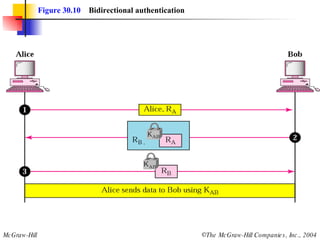
Figure 30.10   Bidirectional authentication
30.4  Key Management Symmetric-Key Distribution Public-Key Certification
A symmetric key between two parties is useful if it is used only once; it must be created for one session and destroyed when the session is over.  Note :
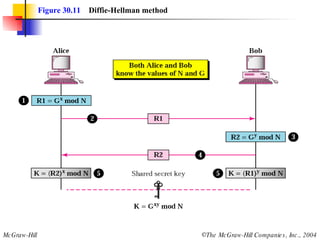
Figure 30.11   Diffie-Hellman method
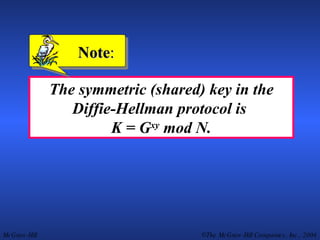
The symmetric (shared) key in the Diffie-Hellman protocol is  K = G xy  mod N. Note :
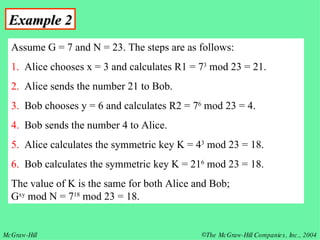
Example 2 Assume G = 7 and N = 23. The steps are as follows: 1.   Alice chooses x = 3 and calculates R1 = 7 3  mod 23 = 21. 2.   Alice sends the number 21 to Bob.  3.   Bob chooses y = 6 and calculates R2 = 7 6  mod 23 = 4. 4.   Bob sends the number 4 to Alice. 5.   Alice calculates the symmetric key K = 4 3  mod 23 = 18. 6.   Bob calculates the symmetric key K = 21 6  mod 23 = 18.  The value of K is the same for both Alice and Bob;  G xy  mod N = 7 18  mod 23 = 18.
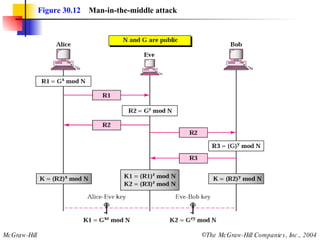
Figure 30.12   Man-in-the-middle attack
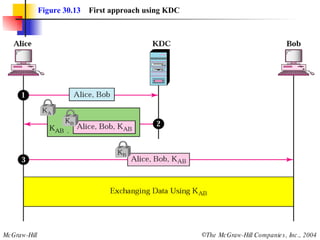
Figure 30.13   First approach using KDC
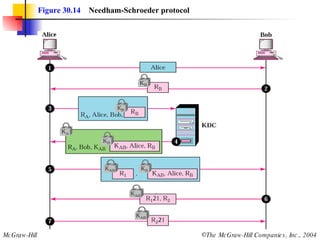
Figure 30.14   Needham-Schroeder protocol
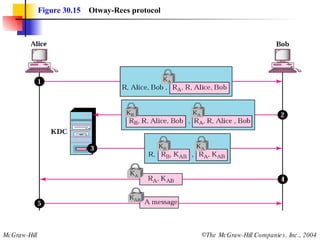
Figure 30.15   Otway-Rees protocol
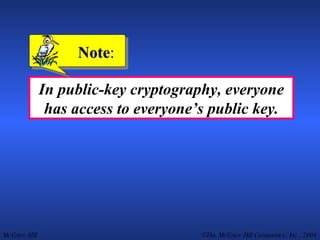
In public-key cryptography, everyone has access to everyone’s public key. Note :
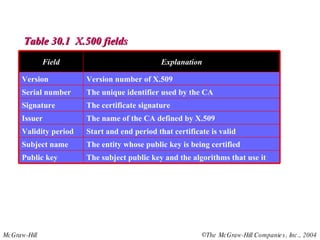
Table 30.1  X.500 fields The subject public key and the algorithms that use it Public key The entity whose public key is being certified Subject name Start and end period that certificate is valid Validity period The name of the CA defined by X.509 Issuer The certificate signature Signature The unique identifier used by the CA Serial number Version number of X.509 Explanation Version Field
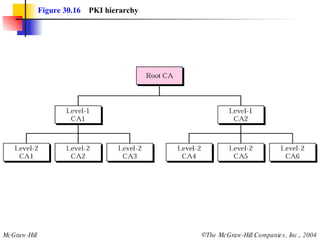
Figure 30.16   PKI hierarchy
30.5  Kerberos Servers Operation Using Different Servers Realms Version 5
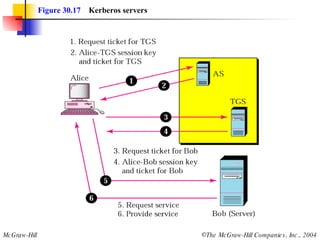
Figure 30.17   Kerberos servers
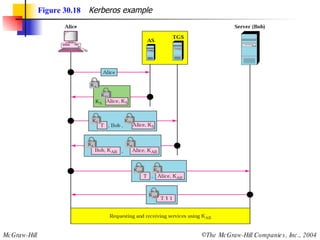
Figure 30.18   Kerberos example

Ch 30

  • 1.
    Chapter 30 MessageSecurity, User Authentication, and Key Management
  • 2.
    30.1 MessageSecurity Privacy Authentication Integrity Nonrepudiation
  • 3.
    Figure 30.1 Message security
  • 4.
    Figure 30.2 Privacy using symmetric-key encryption
  • 5.
    Figure 30.3 Privacy using public-key encryption
  • 6.
    30.2 DigitalSignature Signing the Whole Document Signing the Digest
  • 7.
    Figure 30.4 Signing the whole document
  • 8.
    Digital signature doesnot provide privacy. If there is a need for privacy, another layer of encryption/decryption must be applied. Note :
  • 9.
    Figure 30.5 Signing the digest
  • 10.
    Figure 30.6 Sender site
  • 11.
    Figure 30.7 Receiver site
  • 12.
    30.3 UserAuthentication With Symmetric Key With Public Key
  • 13.
    Figure 30.8 Using a symmetric key only
  • 14.
    Figure 30.9 Using a nonce
  • 15.
    Figure 30.10 Bidirectional authentication
  • 16.
    30.4 KeyManagement Symmetric-Key Distribution Public-Key Certification
  • 17.
    A symmetric keybetween two parties is useful if it is used only once; it must be created for one session and destroyed when the session is over. Note :
  • 18.
    Figure 30.11 Diffie-Hellman method
  • 19.
    The symmetric (shared)key in the Diffie-Hellman protocol is K = G xy mod N. Note :
  • 20.
    Example 2 AssumeG = 7 and N = 23. The steps are as follows: 1. Alice chooses x = 3 and calculates R1 = 7 3 mod 23 = 21. 2. Alice sends the number 21 to Bob. 3. Bob chooses y = 6 and calculates R2 = 7 6 mod 23 = 4. 4. Bob sends the number 4 to Alice. 5. Alice calculates the symmetric key K = 4 3 mod 23 = 18. 6. Bob calculates the symmetric key K = 21 6 mod 23 = 18. The value of K is the same for both Alice and Bob; G xy mod N = 7 18 mod 23 = 18.
  • 21.
    Figure 30.12 Man-in-the-middle attack
  • 22.
    Figure 30.13 First approach using KDC
  • 23.
    Figure 30.14 Needham-Schroeder protocol
  • 24.
    Figure 30.15 Otway-Rees protocol
  • 25.
    In public-key cryptography,everyone has access to everyone’s public key. Note :
  • 26.
    Table 30.1 X.500 fields The subject public key and the algorithms that use it Public key The entity whose public key is being certified Subject name Start and end period that certificate is valid Validity period The name of the CA defined by X.509 Issuer The certificate signature Signature The unique identifier used by the CA Serial number Version number of X.509 Explanation Version Field
  • 27.
    Figure 30.16 PKI hierarchy
  • 28.
    30.5 KerberosServers Operation Using Different Servers Realms Version 5
  • 29.
    Figure 30.17 Kerberos servers
  • 30.
    Figure 30.18 Kerberos example