Security PART VII
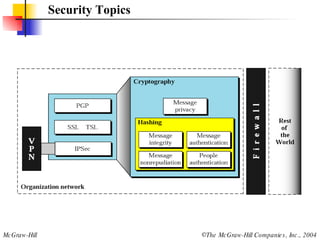
Security Topics
Chapters Chapter 29   Cryptography Chapter 30   Message Authentication, User    Authentication, and Key   Management Chapter 31   Security Protocols in The Internet
Chapter 29 Cryptography
29.1  Introduction Introduction  to  Cryptography
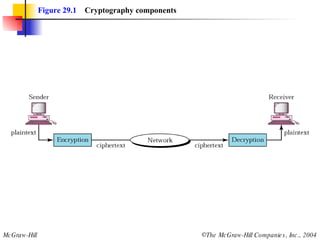
Figure 29.1   Cryptography components
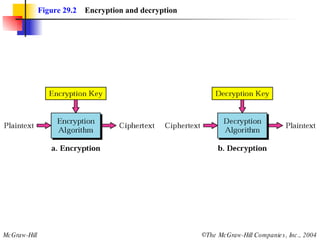
Figure 29.2   Encryption and decryption
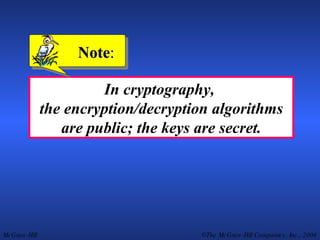
In cryptography,  the encryption/decryption algorithms are public; the keys are secret. Note :
29.2  Symmetric-Key Cryptography Traditional Cipher Block Cipher Operation Modes
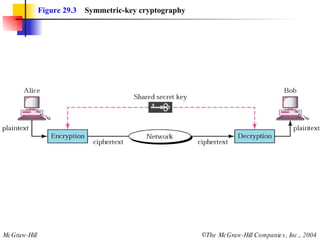
Figure 29.3   Symmetric-key cryptography
In symmetric-key cryptography, the same key is used by the sender (for encryption) and the receiver (for decryption). The key is shared.  Note :
In symmetric-key cryptography, the same key is used in both directions. Note :
Symmetric-key cryptography is often used for long messages. Note :
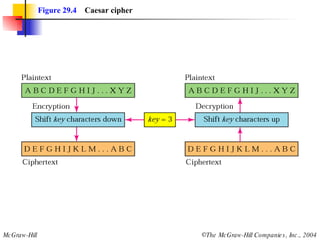
Figure 29.4   Caesar cipher
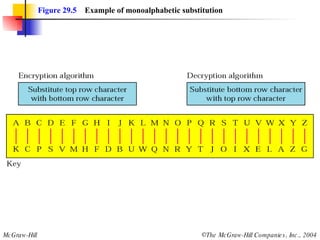
Figure 29.5   Example of monoalphabetic substitution
In monoalphabetic substitution, the relationship between a character in the plaintext to the character in the ciphertext is always one-to-one. Note :
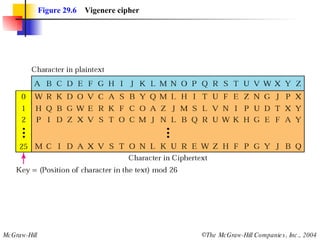
Figure 29.6   Vigenere cipher
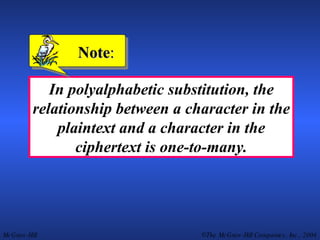
In polyalphabetic substitution, the relationship between a character in the plaintext and a character in the ciphertext is one-to-many. Note :
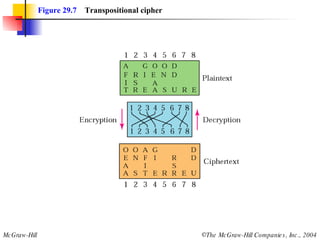
Figure 29.7   Transpositional cipher
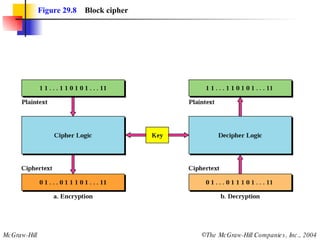
Figure 29.8   Block cipher
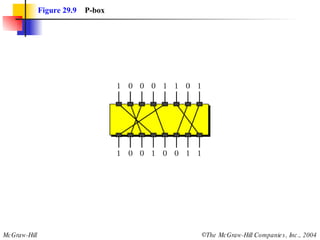
Figure 29.9   P-box
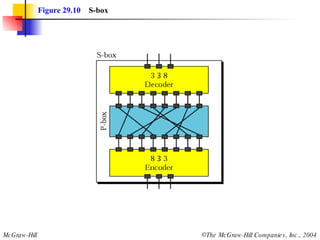
Figure 29.10   S-box
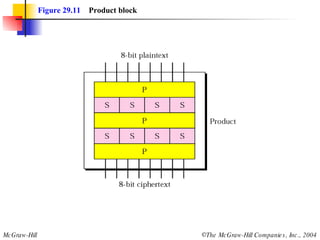
Figure 29.11   Product block
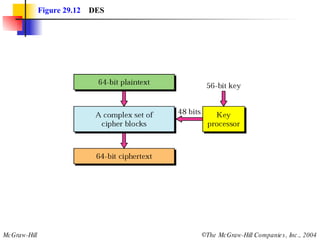
Figure 29.12   DES
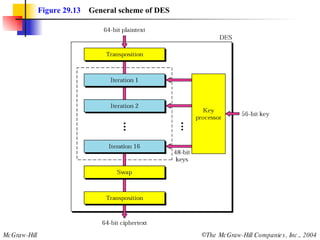
Figure 29.13   General scheme of DES
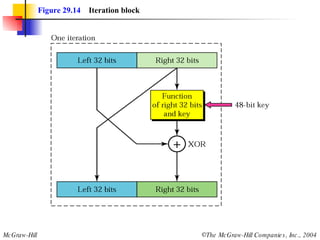
Figure 29.14   Iteration block
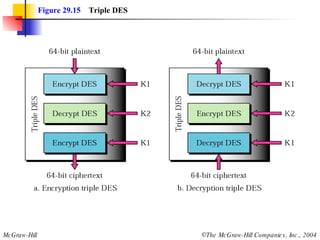
Figure 29.15   Triple DES
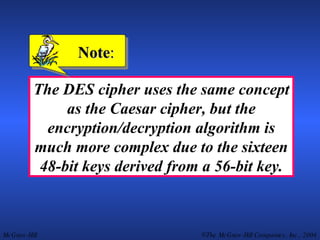
The DES cipher uses the same concept as the Caesar cipher, but the encryption/decryption algorithm is much more complex due to the sixteen 48-bit keys derived from a 56-bit key. Note :
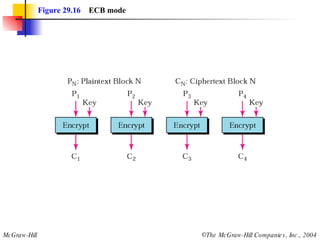
Figure 29.16   ECB mode
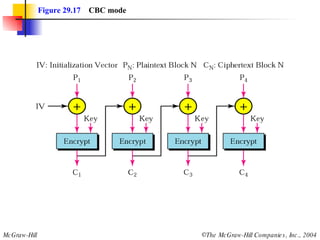
Figure 29.17   CBC mode
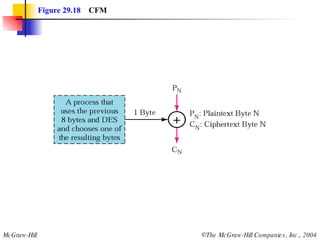
Figure 29.18   CFM
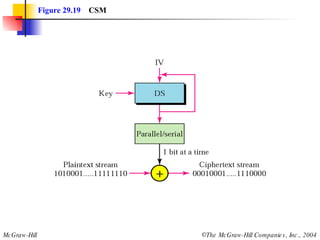
Figure 29.19   CSM
29.3  Public-Key Cryptography RSA Choosing Public and Private Keys
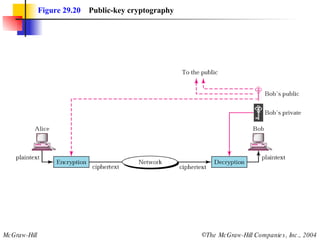
Figure 29.20   Public-key cryptography
Public-key algorithms are more efficient for short messages. Note :
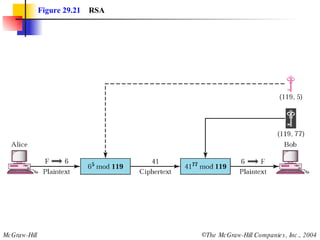
Figure 29.21   RSA

Ch 29