Information Technology and E-
Business
Chapter20
Copyright © 2005 by South-Western, a division of Thomson Learning. All rights reserved.
2
Technology and E-Business
 The strategic use of information
technology is one of the defining aspects
of organizational success in today’s world
 Many companies in industries from
manufacturing to entertainment use IT to
Get closer to customers
Enter new markets
Streamline business processes
Manager’s Challenge: Bountiful Mazda
Copyright © 2005 by South-Western, a division of Thomson Learning. All rights reserved.
3
Technology and
E-Business
 Management of information technology and e-
business
 Basic information technology & information
systems frequently used in organizations
 Fundamental strategies
 Management implications
 Recent information technology trends
Topics
Chapter 20
Copyright © 2005 by South-Western, a division of Thomson Learning. All rights reserved.
4
Information Technology
 The hardware, software,
telecommunications, database
management, and other technologies
used to store, process, and distribute
information
Copyright © 2005 by South-Western, a division of Thomson Learning. All rights reserved.
5
Data versus Information
Data- Raw, non-
summarized , and
unanalyzed facts
and figures
Information- Data that
have been converted
into a meaningful and
useful context for the
receiver
Copyright © 2005 by South-Western, a division of Thomson Learning. All rights reserved.
6
Information and Management Challenge
 Increasing Challenge for Managers
1. Effectively identify needed information
2. Access useful information
 Magnitude of transforming data into
useful information = introduction of
chief information officer (CIO) position
Copyright © 2005 by South-Western, a division of Thomson Learning. All rights reserved.
7
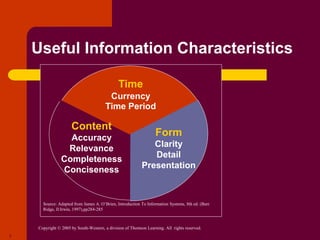
Useful Information Characteristics
Time
Currency
Time Period
Content
Accuracy
Relevance
Completeness
Conciseness
Form
Clarity
Detail
Presentation
Source: Adapted from James A. O’Brien, Introduction To Information Systems, 8th ed. (Burr
Ridge, Il:Irwin, 1997),pp284-285
Copyright © 2005 by South-Western, a division of Thomson Learning. All rights reserved.
8
Types of Information Systems
Operations Information Systems
 Transaction-processing systems
 Process control systems
 Office automation systems
Management Information Systems
Copyright © 2005 by South-Western, a division of Thomson Learning. All rights reserved.
9
Types of Information Systems
Management Information Systems
 Information-reporting systems
 Decision support systems
 Groupware
 Executive information systems
Experiential Exercise: What is Your MIS Style?
Copyright © 2005 by South-Western, a division of Thomson Learning. All rights reserved.
10
Basic Elements of
Management
Information Systems
Management
Information
Systems
Reporting
Systems
Decision
Support
Systems
Executive
Information
Systems
Group
Decision
Support
System
Corporate
and
External
Databases
Source: Adapted from Ralph M. Stair and George W. Reynolds,
Principles of Information Systems: A Managerial Approach, 4th
ed. (Cambridge, Mass.: Course Technology, 1999), 391.
Operations
Information
Systems
Copyright © 2005 by South-Western, a division of Thomson Learning. All rights reserved.
11
Internet and E-Business
 Internet = global collection of
computer networks linked together
 World Wide Web = (WWW) a
collection of central servers for
accessing information on the internet
Copyright © 2005 by South-Western, a division of Thomson Learning. All rights reserved.
12
Internet and E-Business
 E-business = any business that takes
place by digital processes over a
computer network rather than in
physical space
 E-commerce = business exchanges
that occur electronically
Copyright © 2005 by South-Western, a division of Thomson Learning. All rights reserved.
13
Internet Communication Systems
 Intranet = an internal communications
system that uses the technology and
standards of the Internet but is accessible
only to people within the organization
 Extranet = external communicati0ns system
that uses the Internet and is shared by two or
more organizations
Copyright © 2005 by South-Western, a division of Thomson Learning. All rights reserved.
14
E-Business Strategies
 Strategy = Market Expansion
● Internet division allows a company to
establish direct links to customers and
expand into new markets
● Organization can provide access around
the clock to a worldwide market and reach
new customers
Ethical Dilemma: Manipulative or Not?
Copyright © 2005 by South-Western, a division of Thomson Learning. All rights reserved.
15
E-Business Strategies
In-House Internet Division
Spin-Off
Strategic Partnerships
Strategy = Productivity and Efficiency
Copyright © 2005 by South-Western, a division of Thomson Learning. All rights reserved.
16
Strategies for Engaging
Clicks with Bricks
Competitive Business
Environment
E-Business
Strategy
Market expansion
and revenue growth
Increased productivity
and cost efficiency
Benefits
•Add new markets
•Integrate bricks and
clicks
•Increase market size
•Immediate short-term effects
•Measurable productivity impact
•Driven by internal processes
Implementation
In-house division or
partnership
In-house division or
partnership
Copyright © 2005 by South-Western, a division of Thomson Learning. All rights reserved.
17
E-Marketplaces
 Biggest boom in e-commerce is in business-
to-business (B2B) transactions
– $2.4 trillion and growing in 2004
– B2B marketplaces = intermediary sets up an
electronic marketplace where buyers and sellers
meet, acting as a hub for B2B commerce – online
portal
– Ebay has become a B2B portal
Copyright © 2005 by South-Western, a division of Thomson Learning. All rights reserved.
18
B2B Marketplace Model
Online portal or
“hub” for B2B
marketplace
Sellers
Buyers
Many
sellers offer
products
and
services
through an
intermediary
to many
buyers
Copyright © 2005 by South-Western, a division of Thomson Learning. All rights reserved.
19
E-Business Information
Management
ERP, integrate and optimize all the
various business processes across the
entire firm
Enterprise Resource Planning Systems
•Top ERP vendors today host the applications
themselves and offer their products through
Internet portals
•Customers access the applications with
standard browsers
Copyright © 2005 by South-Western, a division of Thomson Learning. All rights reserved.
20
Customer Relationship Management
 Systems that help companies track
customers’ interactions with the firm
and allow employees to call up
information on past transactions
Copyright © 2005 by South-Western, a division of Thomson Learning. All rights reserved.
21
Knowledge Management
 Process of systematically gathering
knowledge, making it widely available
throughout the organization, and
fostering a culture of learning
Copyright © 2005 by South-Western, a division of Thomson Learning. All rights reserved.
22
Knowledge Management
 Three Keys
 Data warehousing
 Business intelligence
 Knowledge management portals
Copyright © 2005 by South-Western, a division of Thomson Learning. All rights reserved.
23
Management Implications of
Information Technology
Improved employee effectiveness
Information overload
Enhanced collaboration
Empowered employees
Increased efficiency
Copyright © 2005 by South-Western, a division of Thomson Learning. All rights reserved.
24
IT Trends
 Wireless Internet
 Peer-to-Peer File Sharing
 Blogs and Wikis
 Going International
Copyright © 2005 by South-Western, a division of Thomson Learning. All rights reserved.
25
Information Systems Today
Information technology and e-business
are changing the way people and
organizations work
Customer, partners, and suppliers are
brought into the information network

Chapter 20 Information Technology and E-Business

  • 1.
    Information Technology andE- Business Chapter20
  • 2.
    Copyright © 2005by South-Western, a division of Thomson Learning. All rights reserved. 2 Technology and E-Business  The strategic use of information technology is one of the defining aspects of organizational success in today’s world  Many companies in industries from manufacturing to entertainment use IT to Get closer to customers Enter new markets Streamline business processes Manager’s Challenge: Bountiful Mazda
  • 3.
    Copyright © 2005by South-Western, a division of Thomson Learning. All rights reserved. 3 Technology and E-Business  Management of information technology and e- business  Basic information technology & information systems frequently used in organizations  Fundamental strategies  Management implications  Recent information technology trends Topics Chapter 20
  • 4.
    Copyright © 2005by South-Western, a division of Thomson Learning. All rights reserved. 4 Information Technology  The hardware, software, telecommunications, database management, and other technologies used to store, process, and distribute information
  • 5.
    Copyright © 2005by South-Western, a division of Thomson Learning. All rights reserved. 5 Data versus Information Data- Raw, non- summarized , and unanalyzed facts and figures Information- Data that have been converted into a meaningful and useful context for the receiver
  • 6.
    Copyright © 2005by South-Western, a division of Thomson Learning. All rights reserved. 6 Information and Management Challenge  Increasing Challenge for Managers 1. Effectively identify needed information 2. Access useful information  Magnitude of transforming data into useful information = introduction of chief information officer (CIO) position
  • 7.
    Copyright © 2005by South-Western, a division of Thomson Learning. All rights reserved. 7 Useful Information Characteristics Time Currency Time Period Content Accuracy Relevance Completeness Conciseness Form Clarity Detail Presentation Source: Adapted from James A. O’Brien, Introduction To Information Systems, 8th ed. (Burr Ridge, Il:Irwin, 1997),pp284-285
  • 8.
    Copyright © 2005by South-Western, a division of Thomson Learning. All rights reserved. 8 Types of Information Systems Operations Information Systems  Transaction-processing systems  Process control systems  Office automation systems Management Information Systems
  • 9.
    Copyright © 2005by South-Western, a division of Thomson Learning. All rights reserved. 9 Types of Information Systems Management Information Systems  Information-reporting systems  Decision support systems  Groupware  Executive information systems Experiential Exercise: What is Your MIS Style?
  • 10.
    Copyright © 2005by South-Western, a division of Thomson Learning. All rights reserved. 10 Basic Elements of Management Information Systems Management Information Systems Reporting Systems Decision Support Systems Executive Information Systems Group Decision Support System Corporate and External Databases Source: Adapted from Ralph M. Stair and George W. Reynolds, Principles of Information Systems: A Managerial Approach, 4th ed. (Cambridge, Mass.: Course Technology, 1999), 391. Operations Information Systems
  • 11.
    Copyright © 2005by South-Western, a division of Thomson Learning. All rights reserved. 11 Internet and E-Business  Internet = global collection of computer networks linked together  World Wide Web = (WWW) a collection of central servers for accessing information on the internet
  • 12.
    Copyright © 2005by South-Western, a division of Thomson Learning. All rights reserved. 12 Internet and E-Business  E-business = any business that takes place by digital processes over a computer network rather than in physical space  E-commerce = business exchanges that occur electronically
  • 13.
    Copyright © 2005by South-Western, a division of Thomson Learning. All rights reserved. 13 Internet Communication Systems  Intranet = an internal communications system that uses the technology and standards of the Internet but is accessible only to people within the organization  Extranet = external communicati0ns system that uses the Internet and is shared by two or more organizations
  • 14.
    Copyright © 2005by South-Western, a division of Thomson Learning. All rights reserved. 14 E-Business Strategies  Strategy = Market Expansion ● Internet division allows a company to establish direct links to customers and expand into new markets ● Organization can provide access around the clock to a worldwide market and reach new customers Ethical Dilemma: Manipulative or Not?
  • 15.
    Copyright © 2005by South-Western, a division of Thomson Learning. All rights reserved. 15 E-Business Strategies In-House Internet Division Spin-Off Strategic Partnerships Strategy = Productivity and Efficiency
  • 16.
    Copyright © 2005by South-Western, a division of Thomson Learning. All rights reserved. 16 Strategies for Engaging Clicks with Bricks Competitive Business Environment E-Business Strategy Market expansion and revenue growth Increased productivity and cost efficiency Benefits •Add new markets •Integrate bricks and clicks •Increase market size •Immediate short-term effects •Measurable productivity impact •Driven by internal processes Implementation In-house division or partnership In-house division or partnership
  • 17.
    Copyright © 2005by South-Western, a division of Thomson Learning. All rights reserved. 17 E-Marketplaces  Biggest boom in e-commerce is in business- to-business (B2B) transactions – $2.4 trillion and growing in 2004 – B2B marketplaces = intermediary sets up an electronic marketplace where buyers and sellers meet, acting as a hub for B2B commerce – online portal – Ebay has become a B2B portal
  • 18.
    Copyright © 2005by South-Western, a division of Thomson Learning. All rights reserved. 18 B2B Marketplace Model Online portal or “hub” for B2B marketplace Sellers Buyers Many sellers offer products and services through an intermediary to many buyers
  • 19.
    Copyright © 2005by South-Western, a division of Thomson Learning. All rights reserved. 19 E-Business Information Management ERP, integrate and optimize all the various business processes across the entire firm Enterprise Resource Planning Systems •Top ERP vendors today host the applications themselves and offer their products through Internet portals •Customers access the applications with standard browsers
  • 20.
    Copyright © 2005by South-Western, a division of Thomson Learning. All rights reserved. 20 Customer Relationship Management  Systems that help companies track customers’ interactions with the firm and allow employees to call up information on past transactions
  • 21.
    Copyright © 2005by South-Western, a division of Thomson Learning. All rights reserved. 21 Knowledge Management  Process of systematically gathering knowledge, making it widely available throughout the organization, and fostering a culture of learning
  • 22.
    Copyright © 2005by South-Western, a division of Thomson Learning. All rights reserved. 22 Knowledge Management  Three Keys  Data warehousing  Business intelligence  Knowledge management portals
  • 23.
    Copyright © 2005by South-Western, a division of Thomson Learning. All rights reserved. 23 Management Implications of Information Technology Improved employee effectiveness Information overload Enhanced collaboration Empowered employees Increased efficiency
  • 24.
    Copyright © 2005by South-Western, a division of Thomson Learning. All rights reserved. 24 IT Trends  Wireless Internet  Peer-to-Peer File Sharing  Blogs and Wikis  Going International
  • 25.
    Copyright © 2005by South-Western, a division of Thomson Learning. All rights reserved. 25 Information Systems Today Information technology and e-business are changing the way people and organizations work Customer, partners, and suppliers are brought into the information network