SEGMENTATION STRATEGIES FOR BUSINESS
MARKETS
PRESENTED BY
GLADY CHOURASIA
WHAT DO YOU UNDERSTAND BY ‘MACRO’ AND
‘MICRO’ BASES OF MARKET SEGMENTATION? HOW
IS THIS APPROACH DIFFERENT?
AND
WHAT IS THE ‘NESTED’ APPROACH AND HOW IS IT
DIFFERENT FROM WIND AND CARDAZO’S MODEL
OF A ‘TWO LEVEL’ SEGMENTED APPROACH?
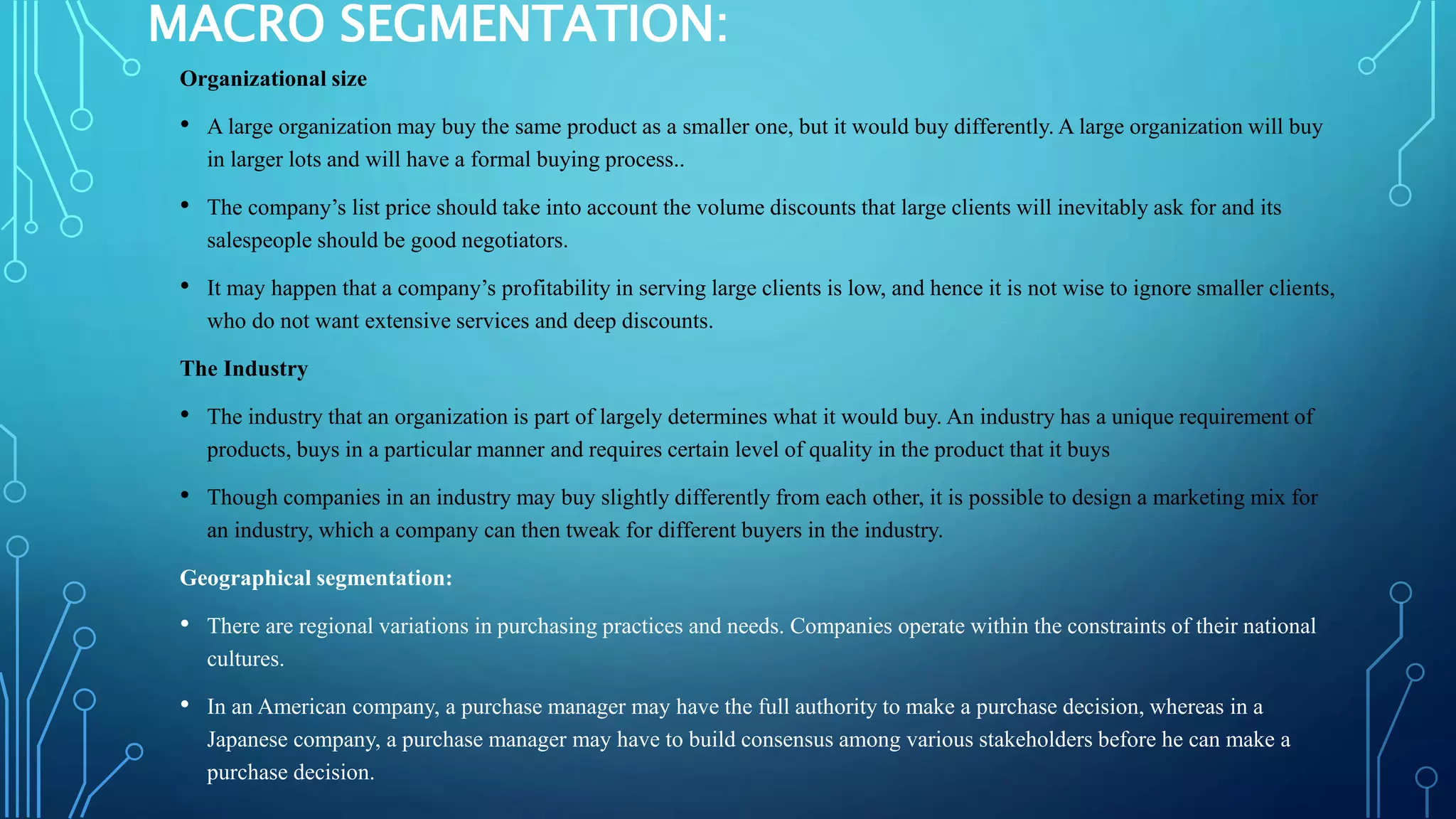
8.) MACRO AND MICRO APPROACH TO
SEGMENTATION OF ORGANIZATIONAL MARKETS
• Organizational markets can be
segmented on the basis of various
factors that can be broadly
classified into macro segmentation
and micro segmentation
MACRO SEGMENTATION:
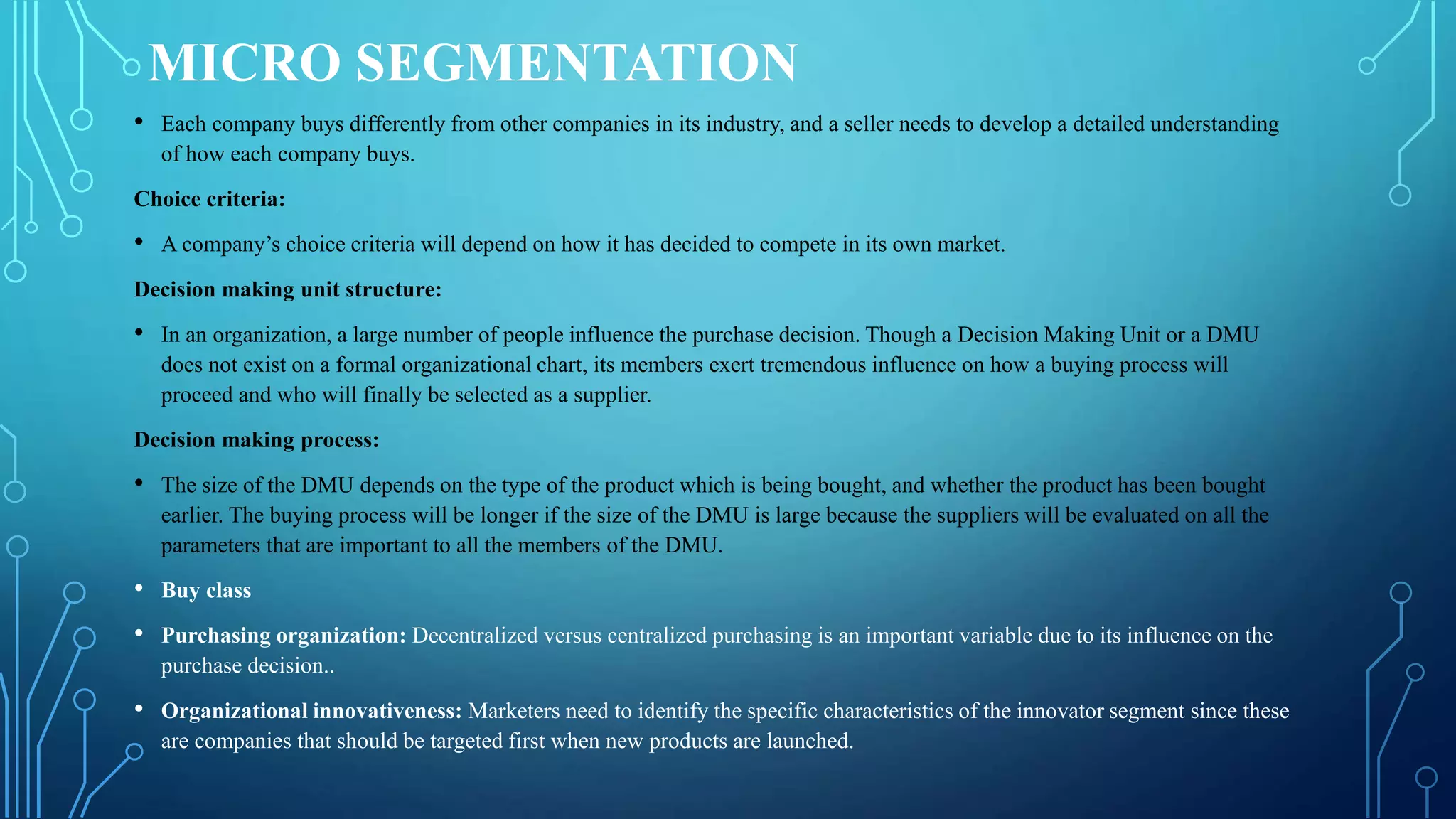
Organizational size
• A large organization may buy the same product as a smaller one, but it would buy differently. A large organization will buy
in larger lots and will have a formal buying process..
• The company’s list price should take into account the volume discounts that large clients will inevitably ask for and its
salespeople should be good negotiators.
• It may happen that a company’s profitability in serving large clients is low, and hence it is not wise to ignore smaller clients,
who do not want extensive services and deep discounts.
The Industry
• The industry that an organization is part of largely determines what it would buy. An industry has a unique requirement of
products, buys in a particular manner and requires certain level of quality in the product that it buys
• Though companies in an industry may buy slightly differently from each other, it is possible to design a marketing mix for
an industry, which a company can then tweak for different buyers in the industry.
Geographical segmentation:
• There are regional variations in purchasing practices and needs. Companies operate within the constraints of their national
cultures.
• In an American company, a purchase manager may have the full authority to make a purchase decision, whereas in a
Japanese company, a purchase manager may have to build consensus among various stakeholders before he can make a
purchase decision.
MICRO SEGMENTATION
• Each company buys differently from other companies in its industry, and a seller needs to develop a detailed understanding
of how each company buys.
Choice criteria:
• A company’s choice criteria will depend on how it has decided to compete in its own market.
Decision making unit structure:
• In an organization, a large number of people influence the purchase decision. Though a Decision Making Unit or a DMU
does not exist on a formal organizational chart, its members exert tremendous influence on how a buying process will
proceed and who will finally be selected as a supplier.
Decision making process:
• The size of the DMU depends on the type of the product which is being bought, and whether the product has been bought
earlier. The buying process will be longer if the size of the DMU is large because the suppliers will be evaluated on all the
parameters that are important to all the members of the DMU.
• Buy class
• Purchasing organization: Decentralized versus centralized purchasing is an important variable due to its influence on the
purchase decision..
• Organizational innovativeness: Marketers need to identify the specific characteristics of the innovator segment since these
are companies that should be targeted first when new products are launched.
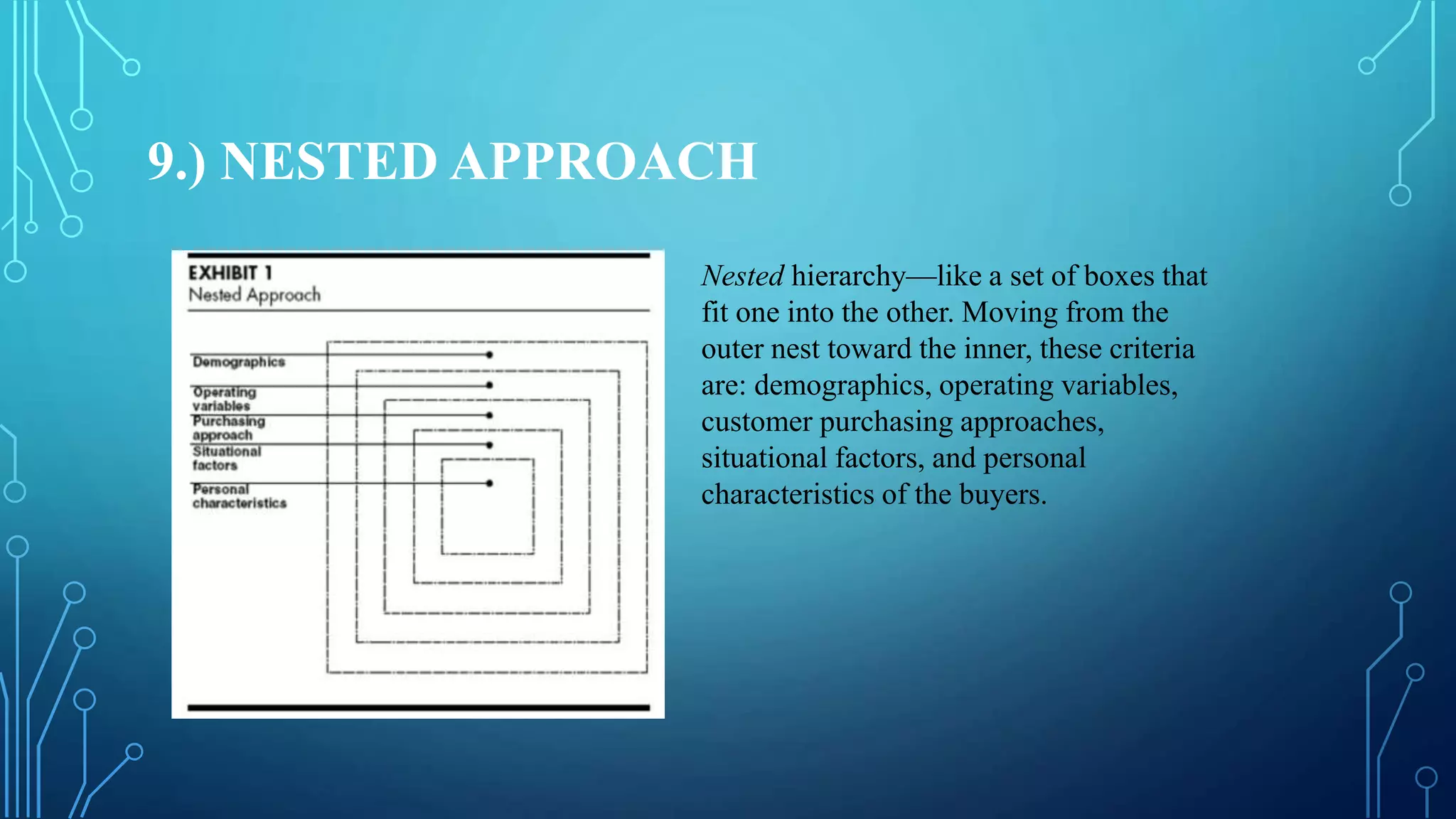
9.) NESTED APPROACH
Nested hierarchy—like a set of boxes that
fit one into the other. Moving from the
outer nest toward the inner, these criteria
are: demographics, operating variables,
customer purchasing approaches,
situational factors, and personal
characteristics of the buyers.
NESTED APPROACH CONTD..
DEMOGRAPHICS
• These variables give abroad description of the company and relate to general customer needs
and usage patterns. They can be determined without visiting the customer and include
industry, company size, and customer location.
The Industry.
• Knowledge of the industry affords a broad understanding of customer needs and perceptions
of purchase situations. Some companies, such as those selling paper, office equipment,
business-oriented computers, and financial services, market to a wide range of industries. For
these, industry is an important basis for market segmentation. Hospitals, for example, share
some computer needs and yet differ markedly as a customer group from retail stores.
• Marketers may wish to subdivide individual industries. For example, although financial
services are in a sense a single industry, commercial banks, insurance companies, stock
brokerage houses, and savings and loan associations all differ dramatically. Their differences
in terms of product and service needs, such as specialized peripherals and terminals, data
handling, and software requirements, make a more detailed segmentation scheme necessary
to sell computers to the financial services market.
DEMOGRAPHICS CONTD..
Company Size.
• The fact that large companies justify and require specialized programs affects market
segmentation. It may be, for example, that a smaller supplier of industrial chemicals, after
segmenting its prospective customers on the basis of company size, will choose not to approach
large companies whose volume requirements exceed its own production capacity.
Customer Location.
• The third demographic factor, location, is an important variable in decisions related to deployment
and organization of sales staff. A manufacturer of heavy-duty pumps for the petrochemical
industry, for example, would want to provide good coverage in the Gulf Coast, where customers
are concentrated, while putting little effort into New England. Customer location is especially
important when proximity is a requirement for doing business, as in marketing products of low
value-per-unit-weight or volume (such as corrugated boxes or prestressed concrete), or in
situations where personal service is essential (as in job shop printing).
OPERATING VARIABLES
• Operating variables are generally stable and include technology, user/nonuser status (by product and brand), and customer
capabilities (operating, technical, and financial).
Company Technology.
• A company’s technology, involving either its manufacturing process or its product, goes a long way toward determining its
buying needs. Soda ash, for example, can be produced by two methods that require different capital equipment and supplies.
The production of Japanese color televisions is highly automated and uses a few large, integrated circuits. In the United
States, on the other hand, color TV production once involved many discrete components, manual assembly, and fine tuning.
In Europe, production techniques made use of a hybrid of integrated circuits and discrete components. The technology used
affects companies’ requirements for test gear, tooling, and components and, thus, helps determine a marketer’s most
appropriate marketing approach.
Customer Capabilities.
• Marketers might find companies with known operating, technical, or financial strengths and weaknesses to be an attractive
market. For example, accompany operating with tight materials inventories would greatly appreciate a supplier with are
liable delivery record. And customers unable to perform quality-control tests on incoming materials might be willing to pay
for supplier quality checks. Some raw materials suppliers might choose to develop a thriving business among less
sophisticated companies, for which lower-than-usual average discounts well compensate added services.
• Technical strength can also differentiate customers. Digital Equipment Corporation for many years specialized in selling its
minicomputers to customers able to develop their own software, and Prime Computer sold computer systems to business
users who did not need the intensive support and “hand holding” offered by IBM and other manufacturers. Both companies
used segmentation for market selection.
PURCHASING APPROACHES
• One of the most neglected but valuable methods of segmenting an industrial market involves
consumers’ purchasing approaches and company philosophy.
Purchasing Function Organization.
• The organization of the purchasing function to some extent determines the size and operation of a
company’s purchasing unit.
Power Structures.
• These also vary widely among customers. The impact of influential organizational units varies and
often affects purchasing approaches.
Buyer-Seller Relationships.
• A supplier probably has stronger ties with some customers than with others. The link may be clearly
stated.
General Purchasing Policies.
• A financially strong company that offers a lease program might want to identify prospective customers
who prefer to lease capital equipment or who have meticulous asset management.
• Purchasing Criteria
SITUATIONAL FACTORS
• Situational factors resemble operating variables but are temporary and require a more detailed knowledge of
the customer. They include the urgency of order fulfillment, product application, and the size of order.
Urgency of Order Fulfillment.
• It is worthwhile to differentiate between products to be used in routine replacement or for building a new
plant and those for emergency replacement of existing parts. Some companies have found a degree of
urgency useful for market selection and for developing a focused marketing-manufacturing approach leading
to a “hot-order shop”—a factory that can supply small, urgent orders quickly.
Product Application.
• Product application can have a major impact on the purchase process and purchase criteria and thus on the
choice of vendor.
Size of Order.
• Market selection can begin with the individual line entries on the order form. Marketers can differentiate
individual orders in terms of product uses as well as users. The distinction is important; users may seek
different suppliers for the same product under different circumstances.
• Situational factors can greatly affect purchasing approaches. General Motors, for example, makes a
distinction between product purchases—that is, raw materials or components for a product being produced—
and nonproduct purchases. Urgency of order fulfillment is so powerful that it can change both the purchase
process and the criteria used. An urgent replacement is generally purchased on the basis of availability, not
price.
BUYERS’ PERSONAL CHARACTERISTICS
• People, not companies, make purchase decisions, although the organizational framework in which they work and
company policies and needs may constrain their choices. Marketers for industrial goods, like those for consumer
products, can segment markets according to the individuals involved in a purchase in terms of buyer-seller
similarity, buyer motivation, individual perceptions, and risk-management strategies.
• Some buyers are risk averse, others risk receptive. The level of risk a buyer is willing to assume is related to other
personality variables such as personal style, intolerance for ambiguity, and self-confidence.
• The amount of attention a purchasing agent will pay to cost factors depends not only on the degree of uncertainty
about the consequences of the decision but also on whether creditor blame for these will accrue to him or her.
• Buyers who are risk averse are not good prospects for new products and concepts. Risk-averse buyers also tend to
avoid untested vendors. Some buyers are meticulous in their approach to buying—they shop around, look at a
number of vendors, and then split their order to assure delivery.
• Others rely on old friends and past relationships and seldom make vendor comparisons.2 Companies can segment a
market in terms of these preferences.
• Data on personal characteristics are expensive and difficult to gather. It is often worthwhile to develop good, formal
sales information systems to ensure that sales people transmit the data they gather to the marketing department for
use in developing segmented marketing strategies
WIND AND CARDAZO TWO STEPAPPROACH
• In the two-stage market segmentation model proposed by Wind & Cardozo (1974) markets are being
segmented into two stages. The first stage consists of macro-segments that are based on characteristics of the
buying organisation, while the second stage involves breaking up these macro- segments into micro-segments
that are based on characteristics of the decision-making-units. Examples of characteristics of the buying
organisation in the first stage are: company size, geographical location, SIC-code (standard industry
classification) and purchasing situation. When looking at these characteristics, one may notice that these are
all easy to observe characteristics. On the other hand, characteristics of decision-making units in the second
stage are more difficult to observe. Examples of this are: buying decision criteria, purchasing strategy,
structure, perceived importance of the product and the attitude towards the supplier (Wind & Cardozo, 1974).
• Once an organisation makes use of this model, certain output that can be used in practice will be expected.
According to Wind & Cardozo (1974), proper output of applying this model would consist of two parts. The
first part is a key variable in order to segment the market the organisation is operating in. The second part of
the output would be a set of independent variables which are ideally being used to either tell where the key
variable is lying or to tell where this key variable can even create an even greater insight into the
characteristics of the segment.
• While this model is one of the most widely used models in current literature
Segmentation approach

Segmentation approach

  • 1.
    SEGMENTATION STRATEGIES FORBUSINESS MARKETS PRESENTED BY GLADY CHOURASIA
  • 2.
    WHAT DO YOUUNDERSTAND BY ‘MACRO’ AND ‘MICRO’ BASES OF MARKET SEGMENTATION? HOW IS THIS APPROACH DIFFERENT? AND WHAT IS THE ‘NESTED’ APPROACH AND HOW IS IT DIFFERENT FROM WIND AND CARDAZO’S MODEL OF A ‘TWO LEVEL’ SEGMENTED APPROACH?
  • 3.
    8.) MACRO ANDMICRO APPROACH TO SEGMENTATION OF ORGANIZATIONAL MARKETS • Organizational markets can be segmented on the basis of various factors that can be broadly classified into macro segmentation and micro segmentation
  • 4.
    MACRO SEGMENTATION: Organizational size •A large organization may buy the same product as a smaller one, but it would buy differently. A large organization will buy in larger lots and will have a formal buying process.. • The company’s list price should take into account the volume discounts that large clients will inevitably ask for and its salespeople should be good negotiators. • It may happen that a company’s profitability in serving large clients is low, and hence it is not wise to ignore smaller clients, who do not want extensive services and deep discounts. The Industry • The industry that an organization is part of largely determines what it would buy. An industry has a unique requirement of products, buys in a particular manner and requires certain level of quality in the product that it buys • Though companies in an industry may buy slightly differently from each other, it is possible to design a marketing mix for an industry, which a company can then tweak for different buyers in the industry. Geographical segmentation: • There are regional variations in purchasing practices and needs. Companies operate within the constraints of their national cultures. • In an American company, a purchase manager may have the full authority to make a purchase decision, whereas in a Japanese company, a purchase manager may have to build consensus among various stakeholders before he can make a purchase decision.
  • 5.
    MICRO SEGMENTATION • Eachcompany buys differently from other companies in its industry, and a seller needs to develop a detailed understanding of how each company buys. Choice criteria: • A company’s choice criteria will depend on how it has decided to compete in its own market. Decision making unit structure: • In an organization, a large number of people influence the purchase decision. Though a Decision Making Unit or a DMU does not exist on a formal organizational chart, its members exert tremendous influence on how a buying process will proceed and who will finally be selected as a supplier. Decision making process: • The size of the DMU depends on the type of the product which is being bought, and whether the product has been bought earlier. The buying process will be longer if the size of the DMU is large because the suppliers will be evaluated on all the parameters that are important to all the members of the DMU. • Buy class • Purchasing organization: Decentralized versus centralized purchasing is an important variable due to its influence on the purchase decision.. • Organizational innovativeness: Marketers need to identify the specific characteristics of the innovator segment since these are companies that should be targeted first when new products are launched.
  • 6.
    9.) NESTED APPROACH Nestedhierarchy—like a set of boxes that fit one into the other. Moving from the outer nest toward the inner, these criteria are: demographics, operating variables, customer purchasing approaches, situational factors, and personal characteristics of the buyers.
  • 7.
    NESTED APPROACH CONTD.. DEMOGRAPHICS •These variables give abroad description of the company and relate to general customer needs and usage patterns. They can be determined without visiting the customer and include industry, company size, and customer location. The Industry. • Knowledge of the industry affords a broad understanding of customer needs and perceptions of purchase situations. Some companies, such as those selling paper, office equipment, business-oriented computers, and financial services, market to a wide range of industries. For these, industry is an important basis for market segmentation. Hospitals, for example, share some computer needs and yet differ markedly as a customer group from retail stores. • Marketers may wish to subdivide individual industries. For example, although financial services are in a sense a single industry, commercial banks, insurance companies, stock brokerage houses, and savings and loan associations all differ dramatically. Their differences in terms of product and service needs, such as specialized peripherals and terminals, data handling, and software requirements, make a more detailed segmentation scheme necessary to sell computers to the financial services market.
  • 8.
    DEMOGRAPHICS CONTD.. Company Size. •The fact that large companies justify and require specialized programs affects market segmentation. It may be, for example, that a smaller supplier of industrial chemicals, after segmenting its prospective customers on the basis of company size, will choose not to approach large companies whose volume requirements exceed its own production capacity. Customer Location. • The third demographic factor, location, is an important variable in decisions related to deployment and organization of sales staff. A manufacturer of heavy-duty pumps for the petrochemical industry, for example, would want to provide good coverage in the Gulf Coast, where customers are concentrated, while putting little effort into New England. Customer location is especially important when proximity is a requirement for doing business, as in marketing products of low value-per-unit-weight or volume (such as corrugated boxes or prestressed concrete), or in situations where personal service is essential (as in job shop printing).
  • 9.
    OPERATING VARIABLES • Operatingvariables are generally stable and include technology, user/nonuser status (by product and brand), and customer capabilities (operating, technical, and financial). Company Technology. • A company’s technology, involving either its manufacturing process or its product, goes a long way toward determining its buying needs. Soda ash, for example, can be produced by two methods that require different capital equipment and supplies. The production of Japanese color televisions is highly automated and uses a few large, integrated circuits. In the United States, on the other hand, color TV production once involved many discrete components, manual assembly, and fine tuning. In Europe, production techniques made use of a hybrid of integrated circuits and discrete components. The technology used affects companies’ requirements for test gear, tooling, and components and, thus, helps determine a marketer’s most appropriate marketing approach. Customer Capabilities. • Marketers might find companies with known operating, technical, or financial strengths and weaknesses to be an attractive market. For example, accompany operating with tight materials inventories would greatly appreciate a supplier with are liable delivery record. And customers unable to perform quality-control tests on incoming materials might be willing to pay for supplier quality checks. Some raw materials suppliers might choose to develop a thriving business among less sophisticated companies, for which lower-than-usual average discounts well compensate added services. • Technical strength can also differentiate customers. Digital Equipment Corporation for many years specialized in selling its minicomputers to customers able to develop their own software, and Prime Computer sold computer systems to business users who did not need the intensive support and “hand holding” offered by IBM and other manufacturers. Both companies used segmentation for market selection.
  • 10.
    PURCHASING APPROACHES • Oneof the most neglected but valuable methods of segmenting an industrial market involves consumers’ purchasing approaches and company philosophy. Purchasing Function Organization. • The organization of the purchasing function to some extent determines the size and operation of a company’s purchasing unit. Power Structures. • These also vary widely among customers. The impact of influential organizational units varies and often affects purchasing approaches. Buyer-Seller Relationships. • A supplier probably has stronger ties with some customers than with others. The link may be clearly stated. General Purchasing Policies. • A financially strong company that offers a lease program might want to identify prospective customers who prefer to lease capital equipment or who have meticulous asset management. • Purchasing Criteria
  • 11.
    SITUATIONAL FACTORS • Situationalfactors resemble operating variables but are temporary and require a more detailed knowledge of the customer. They include the urgency of order fulfillment, product application, and the size of order. Urgency of Order Fulfillment. • It is worthwhile to differentiate between products to be used in routine replacement or for building a new plant and those for emergency replacement of existing parts. Some companies have found a degree of urgency useful for market selection and for developing a focused marketing-manufacturing approach leading to a “hot-order shop”—a factory that can supply small, urgent orders quickly. Product Application. • Product application can have a major impact on the purchase process and purchase criteria and thus on the choice of vendor. Size of Order. • Market selection can begin with the individual line entries on the order form. Marketers can differentiate individual orders in terms of product uses as well as users. The distinction is important; users may seek different suppliers for the same product under different circumstances. • Situational factors can greatly affect purchasing approaches. General Motors, for example, makes a distinction between product purchases—that is, raw materials or components for a product being produced— and nonproduct purchases. Urgency of order fulfillment is so powerful that it can change both the purchase process and the criteria used. An urgent replacement is generally purchased on the basis of availability, not price.
  • 12.
    BUYERS’ PERSONAL CHARACTERISTICS •People, not companies, make purchase decisions, although the organizational framework in which they work and company policies and needs may constrain their choices. Marketers for industrial goods, like those for consumer products, can segment markets according to the individuals involved in a purchase in terms of buyer-seller similarity, buyer motivation, individual perceptions, and risk-management strategies. • Some buyers are risk averse, others risk receptive. The level of risk a buyer is willing to assume is related to other personality variables such as personal style, intolerance for ambiguity, and self-confidence. • The amount of attention a purchasing agent will pay to cost factors depends not only on the degree of uncertainty about the consequences of the decision but also on whether creditor blame for these will accrue to him or her. • Buyers who are risk averse are not good prospects for new products and concepts. Risk-averse buyers also tend to avoid untested vendors. Some buyers are meticulous in their approach to buying—they shop around, look at a number of vendors, and then split their order to assure delivery. • Others rely on old friends and past relationships and seldom make vendor comparisons.2 Companies can segment a market in terms of these preferences. • Data on personal characteristics are expensive and difficult to gather. It is often worthwhile to develop good, formal sales information systems to ensure that sales people transmit the data they gather to the marketing department for use in developing segmented marketing strategies
  • 13.
    WIND AND CARDAZOTWO STEPAPPROACH • In the two-stage market segmentation model proposed by Wind & Cardozo (1974) markets are being segmented into two stages. The first stage consists of macro-segments that are based on characteristics of the buying organisation, while the second stage involves breaking up these macro- segments into micro-segments that are based on characteristics of the decision-making-units. Examples of characteristics of the buying organisation in the first stage are: company size, geographical location, SIC-code (standard industry classification) and purchasing situation. When looking at these characteristics, one may notice that these are all easy to observe characteristics. On the other hand, characteristics of decision-making units in the second stage are more difficult to observe. Examples of this are: buying decision criteria, purchasing strategy, structure, perceived importance of the product and the attitude towards the supplier (Wind & Cardozo, 1974). • Once an organisation makes use of this model, certain output that can be used in practice will be expected. According to Wind & Cardozo (1974), proper output of applying this model would consist of two parts. The first part is a key variable in order to segment the market the organisation is operating in. The second part of the output would be a set of independent variables which are ideally being used to either tell where the key variable is lying or to tell where this key variable can even create an even greater insight into the characteristics of the segment. • While this model is one of the most widely used models in current literature