Chapter 6:
MANAGING SMALL BUSINESS
START-UPS
Bernardo G. Bringas, Jr. MD
OUTLINE
Entrepreneurship Definition
Small business
Impact of Entreprenuerial Companies
Who are Entrepreneurs?
Diversity of Entrepreneurs
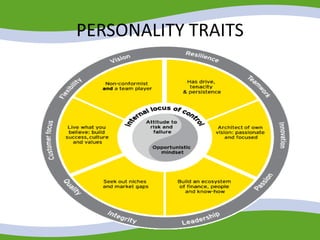
Personality Traits
Social Entreprenuership
OUTLINE
Launching an Entrepreneurial Start-Up
Starting an Idea
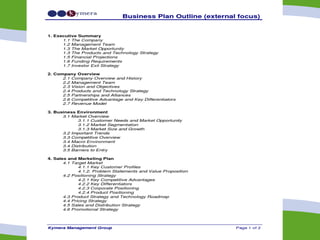
Writing a business plan
Choosing a legal structure
Arranging financing
Tactics for Becoming a Business owner
Starting an Online Business
OUTLINE
Managing a Growing Business
Stages of Growth
Planning
Organizing
Leading
Controlling
ENTREPRENEURSHIP
• ENTREPRENEURSHIP is the process of:
– Initiating a business venture
– Organizing the necessary resources
– Assuming the associated risks and rewards
ENTREPRENEUR
someone who engages in
entrepreneurship
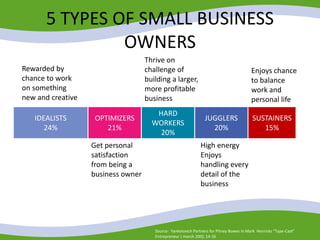
5 TYPES OF SMALL BUSINESS
OWNERS
IDEALISTS
24%
JUGGLERS
20%
HARD
WORKERS
20%
OPTIMIZERS
21%
SUSTAINERS
15%
Rewarded by
chance to work
on something
new and creative
Get personal
satisfaction
from being a
business owner
Thrive on
challenge of
building a larger,
more profitable
business
High energy
Enjoys
handling every
detail of the
business
Enjoys chance
to balance
work and
personal life
Source: Yankelovich Partners for Pitney Bowes in Mark Henricks “Type-Cast”
Entrepreneur ( march 200); 14-16
ENTREPRENEURSHIP TODAY
• Entrepreneurship and small business are:
– Vital, dynamic increasing important parts of US
economy
– Booming in other countries
• In the US:
– Small business represents 99.7% of all firms
– Generated 64% of new jobs annually for the past
15 years
SMALL BUSINESS
• US SBA (Small Business Administration)
defines small business as :
– Independently owned and operated,
– organized for profit
– not dominant in its field of operation
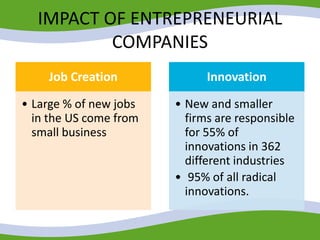
IMPACT OF ENTREPRENEURIAL
COMPANIES
Job Creation
• Large % of new jobs
in the US come from
small business
Innovation
• New and smaller
firms are responsible
for 55% of
innovations in 362
different industries
• 95% of all radical
innovations.
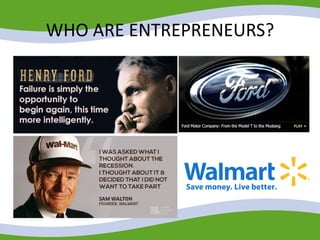
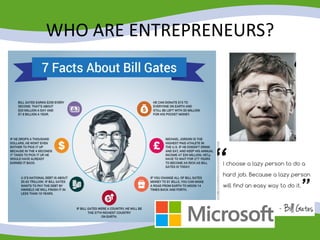
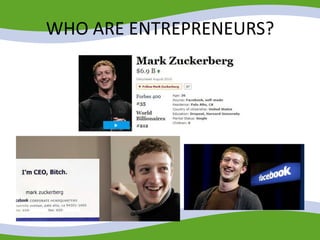
WHO ARE ENTREPRENEURS?
http://www.slideshare.net/gonzagacv1/the-john-gokongwei-story
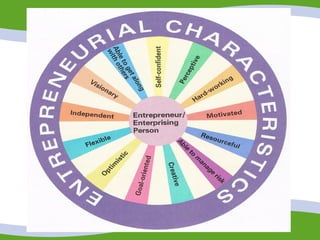
PERSONALITY TRAITS
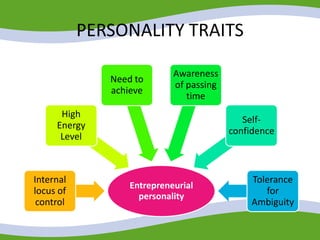
PERSONALITY TRAITS
Entrepreneurial
personality
Internal
locus of
control
High
Energy
Level
Need to
achieve
Awareness
of passing
time
Self-
confidence
Tolerance
for
Ambiguity
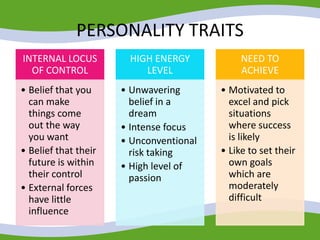
PERSONALITY TRAITS
INTERNAL LOCUS
OF CONTROL
• Belief that you
can make
things come
out the way
you want
• Belief that their
future is within
their control
• External forces
have little
influence
HIGH ENERGY
LEVEL
• Unwavering
belief in a
dream
• Intense focus
• Unconventional
risk taking
• High level of
passion
NEED TO
ACHIEVE
• Motivated to
excel and pick
situations
where success
is likely
• Like to set their
own goals
which are
moderately
difficult
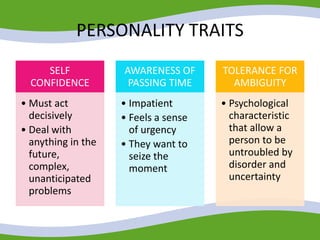
PERSONALITY TRAITS
SELF
CONFIDENCE
• Must act
decisively
• Deal with
anything in the
future,
complex,
unanticipated
problems
AWARENESS OF
PASSING TIME
• Impatient
• Feels a sense
of urgency
• They want to
seize the
moment
TOLERANCE FOR
AMBIGUITY
• Psychological
characteristic
that allow a
person to be
untroubled by
disorder and
uncertainty
PERSONALITY TRAITS
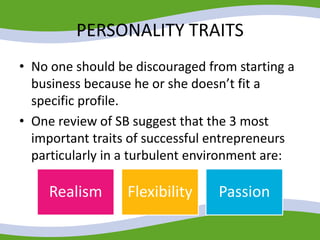
• No one should be discouraged from starting a
business because he or she doesn’t fit a
specific profile.
• One review of SB suggest that the 3 most
important traits of successful entrepreneurs
particularly in a turbulent environment are:
Realism Flexibility Passion
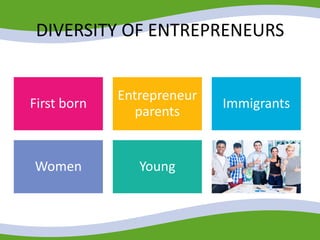
DIVERSITY OF ENTREPRENEURS
First born
Entrepreneur
parents
Immigrants
Women Young
SOCIAL ENTREPRENEURSHIP
• Committed to good business and social
change.
• Combines creativity, business smarts, passion,
hard work + mission to change the world for
the better
• Creates new business models that meet
– Critical human needs
– Resolve important problems unsolved by current
economic and social institutions
Social businesses for a better Philippines
PILIPINAS: NOW IS OUR TIME By Joey Concepcion (The Philippine Star) |
Updated September 30, 2013 - 12:00am
It is amazing to see the idealistic and passionate youth of
today engrossed in this growing phenomenon called social
entrepreneurship. For the past eight years, as Go Negosyo
pursues its passion of building a country of enterprising
Filipinos, we have adopted along the way the beauty of
social entrepreneurship, since we see that it is not only an
enterprise for profit, but an enterprise that also helps solve
a social issue, or benefits a particular underprivileged
sector or community. In a way, we have treated Go Negosyo
as a social enterprise that provides competency-building
and mindset change for those who want to beat poverty or
become successful.
Water Lily
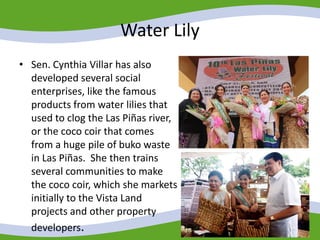
• Sen. Cynthia Villar has also
developed several social
enterprises, like the famous
products from water lilies that
used to clog the Las Piñas river,
or the coco coir that comes
from a huge pile of buko waste
in Las Piñas. She then trains
several communities to make
the coco coir, which she markets
initially to the Vista Land
projects and other property
developers.
HUMAN NATURE
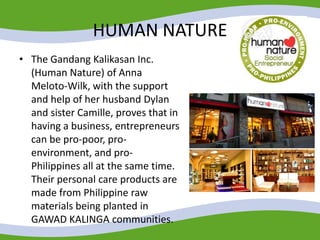
• The Gandang Kalikasan Inc.
(Human Nature) of Anna
Meloto-Wilk, with the support
and help of her husband Dylan
and sister Camille, proves that in
having a business, entrepreneurs
can be pro-poor, pro-
environment, and pro-
Philippines all at the same time.
Their personal care products are
made from Philippine raw
materials being planted in
GAWAD KALINGA communities.
RAGS2RICHES
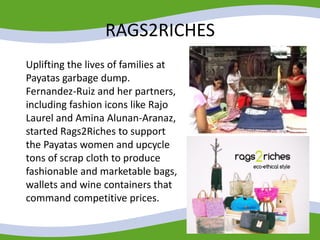
Uplifting the lives of families at
Payatas garbage dump.
Fernandez-Ruiz and her partners,
including fashion icons like Rajo
Laurel and Amina Alunan-Aranaz,
started Rags2Riches to support
the Payatas women and upcycle
tons of scrap cloth to produce
fashionable and marketable bags,
wallets and wine containers that
command competitive prices.
LAUNCHING AN
ENTREPRENEURIAL START-UP
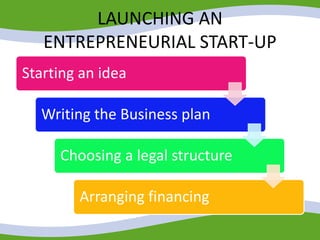
Starting an idea
Writing the Business plan
Choosing a legal structure
Arranging financing
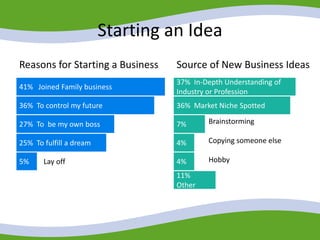
Starting an Idea
Reasons for Starting a Business
Lay off
41% Joined Family business
36% To control my future
27% To be my own boss
25% To fulfill a dream
5%
Source of New Business Ideas
Brainstorming
Copying someone else
Hobby
37% In-Depth Understanding of
Industry or Profession
36% Market Niche Spotted
7%
4%
4%
11%
Other
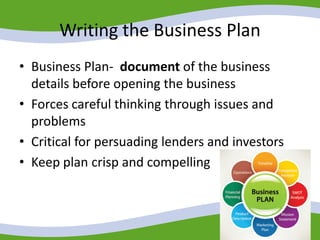
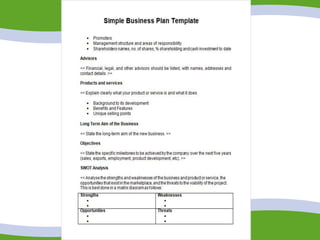
Writing the Business Plan
• Business Plan- document of the business
details before opening the business
• Forces careful thinking through issues and
problems
• Critical for persuading lenders and investors
• Keep plan crisp and compelling
BUSINESS PLAN DETAILS
• Clear, compelling vision that creates an air of
excitement
• Clear and realistic financial projection
• Profile potential customers and target market
• Detailed info about the industry and competitors
• Good formatting and clear writing
• Short- no more than 50 pages
• Spells out the sources and uses of start-up funds and
operating funds
• Killer summary
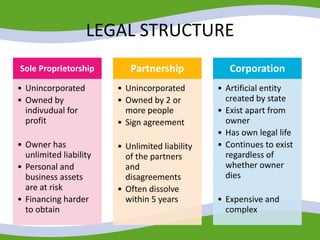
LEGAL STRUCTURE
Sole Proprietorship
• Unincorporated
• Owned by
indivudual for
profit
• Owner has
unlimited liability
• Personal and
business assets
are at risk
• Financing harder
to obtain
Partnership
• Unincorporated
• Owned by 2 or
more people
• Sign agreement
• Unlimited liability
of the partners
and
disagreements
• Often dissolve
within 5 years
Corporation
• Artificial entity
created by state
• Exist apart from
owner
• Has own legal life
• Continues to exist
regardless of
whether owner
dies
• Expensive and
complex
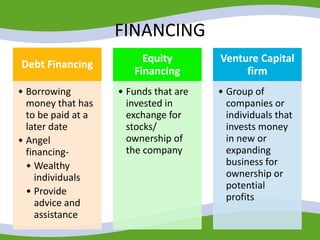
FINANCING
Debt Financing
• Borrowing
money that has
to be paid at a
later date
• Angel
financing-
• Wealthy
individuals
• Provide
advice and
assistance
Equity
Financing
• Funds that are
invested in
exchange for
stocks/
ownership of
the company
Venture Capital
firm
• Group of
companies or
individuals that
invests money
in new or
expanding
business for
ownership or
potential
profits
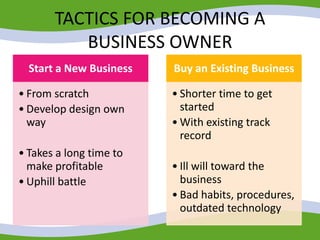
TACTICS FOR BECOMING A
BUSINESS OWNER
Start a New Business
• From scratch
• Develop design own
way
• Takes a long time to
make profitable
• Uphill battle
Buy an Existing Business
• Shorter time to get
started
• With existing track
record
• Ill will toward the
business
• Bad habits, procedures,
outdated technology
TACTICS FOR BECOMING A
BUSINESS OWNER
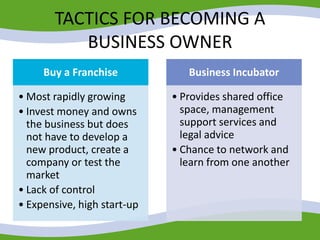
Buy a Franchise
• Most rapidly growing
• Invest money and owns
the business but does
not have to develop a
new product, create a
company or test the
market
• Lack of control
• Expensive, high start-up
Business Incubator
• Provides shared office
space, management
support services and
legal advice
• Chance to network and
learn from one another
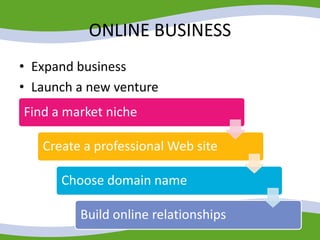
ONLINE BUSINESS
• Expand business
• Launch a new venture
Find a market niche
Create a professional Web site
Choose domain name
Build online relationships
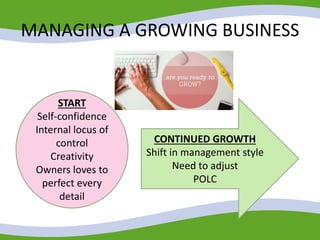
MANAGING A GROWING BUSINESS
START
Self-confidence
Internal locus of
control
Creativity
Owners loves to
perfect every
detail
CONTINUED GROWTH
Shift in management style
Need to adjust
POLC
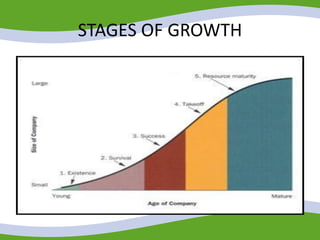
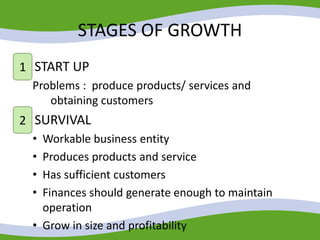
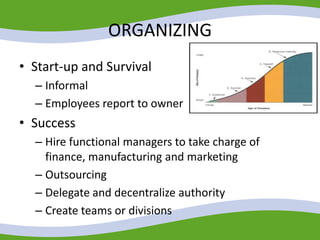
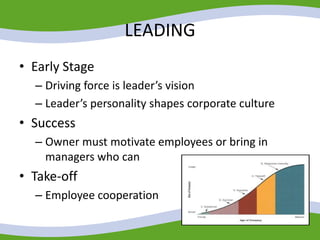
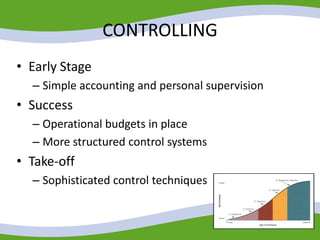
STAGES OF GROWTH
1. START UP
Problems : produce products/ services and
obtaining customers
2. SURVIVAL
• Workable business entity
• Produces products and service
• Has sufficient customers
• Finances should generate enough to maintain
operation
• Grow in size and profitability
STAGES OF GROWTH
2
1
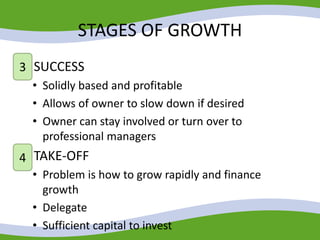
3. SUCCESS
• Solidly based and profitable
• Allows of owner to slow down if desired
• Owner can stay involved or turn over to
professional managers
4. TAKE-OFF
• Problem is how to grow rapidly and finance
growth
• Delegate
• Sufficient capital to invest
STAGES OF GROWTH
3
4
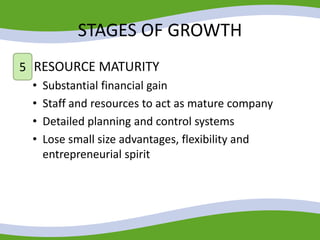
5. RESOURCE MATURITY
• Substantial financial gain
• Staff and resources to act as mature company
• Detailed planning and control systems
• Lose small size advantages, flexibility and
entrepreneurial spirit
STAGES OF GROWTH
5
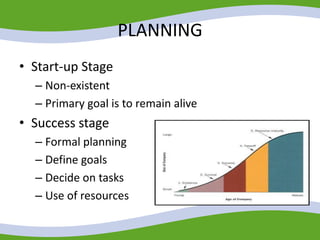
PLANNING
• Start-up Stage
– Non-existent
– Primary goal is to remain alive
• Success stage
– Formal planning
– Define goals
– Decide on tasks
– Use of resources
ORGANIZING
• Start-up and Survival
– Informal
– Employees report to owner
• Success
– Hire functional managers to take charge of
finance, manufacturing and marketing
– Outsourcing
– Delegate and decentralize authority
– Create teams or divisions
LEADING
• Early Stage
– Driving force is leader’s vision
– Leader’s personality shapes corporate culture
• Success
– Owner must motivate employees or bring in
managers who can
• Take-off
– Employee cooperation
CONTROLLING
• Early Stage
– Simple accounting and personal supervision
• Success
– Operational budgets in place
– More structured control systems
• Take-off
– Sophisticated control techniques
THANK YOU FOR LISTENING...

Chap 6 Management by Richard Draft

  • 1.
    Chapter 6: MANAGING SMALLBUSINESS START-UPS Bernardo G. Bringas, Jr. MD
  • 2.
    OUTLINE Entrepreneurship Definition Small business Impactof Entreprenuerial Companies Who are Entrepreneurs? Diversity of Entrepreneurs Personality Traits Social Entreprenuership
  • 3.
    OUTLINE Launching an EntrepreneurialStart-Up Starting an Idea Writing a business plan Choosing a legal structure Arranging financing Tactics for Becoming a Business owner Starting an Online Business
  • 4.
    OUTLINE Managing a GrowingBusiness Stages of Growth Planning Organizing Leading Controlling
  • 5.
    ENTREPRENEURSHIP • ENTREPRENEURSHIP isthe process of: – Initiating a business venture – Organizing the necessary resources – Assuming the associated risks and rewards ENTREPRENEUR someone who engages in entrepreneurship
  • 6.
    5 TYPES OFSMALL BUSINESS OWNERS IDEALISTS 24% JUGGLERS 20% HARD WORKERS 20% OPTIMIZERS 21% SUSTAINERS 15% Rewarded by chance to work on something new and creative Get personal satisfaction from being a business owner Thrive on challenge of building a larger, more profitable business High energy Enjoys handling every detail of the business Enjoys chance to balance work and personal life Source: Yankelovich Partners for Pitney Bowes in Mark Henricks “Type-Cast” Entrepreneur ( march 200); 14-16
  • 7.
    ENTREPRENEURSHIP TODAY • Entrepreneurshipand small business are: – Vital, dynamic increasing important parts of US economy – Booming in other countries • In the US: – Small business represents 99.7% of all firms – Generated 64% of new jobs annually for the past 15 years
  • 8.
    SMALL BUSINESS • USSBA (Small Business Administration) defines small business as : – Independently owned and operated, – organized for profit – not dominant in its field of operation
  • 9.
    IMPACT OF ENTREPRENEURIAL COMPANIES JobCreation • Large % of new jobs in the US come from small business Innovation • New and smaller firms are responsible for 55% of innovations in 362 different industries • 95% of all radical innovations.
  • 10.
  • 11.
  • 12.
  • 13.
  • 14.
  • 15.
  • 16.
  • 17.
  • 18.
  • 19.
  • 20.
  • 22.
  • 23.
    PERSONALITY TRAITS Entrepreneurial personality Internal locus of control High Energy Level Needto achieve Awareness of passing time Self- confidence Tolerance for Ambiguity
  • 24.
    PERSONALITY TRAITS INTERNAL LOCUS OFCONTROL • Belief that you can make things come out the way you want • Belief that their future is within their control • External forces have little influence HIGH ENERGY LEVEL • Unwavering belief in a dream • Intense focus • Unconventional risk taking • High level of passion NEED TO ACHIEVE • Motivated to excel and pick situations where success is likely • Like to set their own goals which are moderately difficult
  • 25.
    PERSONALITY TRAITS SELF CONFIDENCE • Mustact decisively • Deal with anything in the future, complex, unanticipated problems AWARENESS OF PASSING TIME • Impatient • Feels a sense of urgency • They want to seize the moment TOLERANCE FOR AMBIGUITY • Psychological characteristic that allow a person to be untroubled by disorder and uncertainty
  • 26.
    PERSONALITY TRAITS • Noone should be discouraged from starting a business because he or she doesn’t fit a specific profile. • One review of SB suggest that the 3 most important traits of successful entrepreneurs particularly in a turbulent environment are: Realism Flexibility Passion
  • 27.
    DIVERSITY OF ENTREPRENEURS Firstborn Entrepreneur parents Immigrants Women Young
  • 28.
    SOCIAL ENTREPRENEURSHIP • Committedto good business and social change. • Combines creativity, business smarts, passion, hard work + mission to change the world for the better • Creates new business models that meet – Critical human needs – Resolve important problems unsolved by current economic and social institutions
  • 29.
    Social businesses fora better Philippines PILIPINAS: NOW IS OUR TIME By Joey Concepcion (The Philippine Star) | Updated September 30, 2013 - 12:00am It is amazing to see the idealistic and passionate youth of today engrossed in this growing phenomenon called social entrepreneurship. For the past eight years, as Go Negosyo pursues its passion of building a country of enterprising Filipinos, we have adopted along the way the beauty of social entrepreneurship, since we see that it is not only an enterprise for profit, but an enterprise that also helps solve a social issue, or benefits a particular underprivileged sector or community. In a way, we have treated Go Negosyo as a social enterprise that provides competency-building and mindset change for those who want to beat poverty or become successful.
  • 30.
    Water Lily • Sen.Cynthia Villar has also developed several social enterprises, like the famous products from water lilies that used to clog the Las Piñas river, or the coco coir that comes from a huge pile of buko waste in Las Piñas. She then trains several communities to make the coco coir, which she markets initially to the Vista Land projects and other property developers.
  • 31.
    HUMAN NATURE • TheGandang Kalikasan Inc. (Human Nature) of Anna Meloto-Wilk, with the support and help of her husband Dylan and sister Camille, proves that in having a business, entrepreneurs can be pro-poor, pro- environment, and pro- Philippines all at the same time. Their personal care products are made from Philippine raw materials being planted in GAWAD KALINGA communities.
  • 32.
    RAGS2RICHES Uplifting the livesof families at Payatas garbage dump. Fernandez-Ruiz and her partners, including fashion icons like Rajo Laurel and Amina Alunan-Aranaz, started Rags2Riches to support the Payatas women and upcycle tons of scrap cloth to produce fashionable and marketable bags, wallets and wine containers that command competitive prices.
  • 33.
    LAUNCHING AN ENTREPRENEURIAL START-UP Startingan idea Writing the Business plan Choosing a legal structure Arranging financing
  • 34.
    Starting an Idea Reasonsfor Starting a Business Lay off 41% Joined Family business 36% To control my future 27% To be my own boss 25% To fulfill a dream 5% Source of New Business Ideas Brainstorming Copying someone else Hobby 37% In-Depth Understanding of Industry or Profession 36% Market Niche Spotted 7% 4% 4% 11% Other
  • 35.
    Writing the BusinessPlan • Business Plan- document of the business details before opening the business • Forces careful thinking through issues and problems • Critical for persuading lenders and investors • Keep plan crisp and compelling
  • 36.
    BUSINESS PLAN DETAILS •Clear, compelling vision that creates an air of excitement • Clear and realistic financial projection • Profile potential customers and target market • Detailed info about the industry and competitors • Good formatting and clear writing • Short- no more than 50 pages • Spells out the sources and uses of start-up funds and operating funds • Killer summary
  • 40.
    LEGAL STRUCTURE Sole Proprietorship •Unincorporated • Owned by indivudual for profit • Owner has unlimited liability • Personal and business assets are at risk • Financing harder to obtain Partnership • Unincorporated • Owned by 2 or more people • Sign agreement • Unlimited liability of the partners and disagreements • Often dissolve within 5 years Corporation • Artificial entity created by state • Exist apart from owner • Has own legal life • Continues to exist regardless of whether owner dies • Expensive and complex
  • 41.
    FINANCING Debt Financing • Borrowing moneythat has to be paid at a later date • Angel financing- • Wealthy individuals • Provide advice and assistance Equity Financing • Funds that are invested in exchange for stocks/ ownership of the company Venture Capital firm • Group of companies or individuals that invests money in new or expanding business for ownership or potential profits
  • 42.
    TACTICS FOR BECOMINGA BUSINESS OWNER Start a New Business • From scratch • Develop design own way • Takes a long time to make profitable • Uphill battle Buy an Existing Business • Shorter time to get started • With existing track record • Ill will toward the business • Bad habits, procedures, outdated technology
  • 43.
    TACTICS FOR BECOMINGA BUSINESS OWNER Buy a Franchise • Most rapidly growing • Invest money and owns the business but does not have to develop a new product, create a company or test the market • Lack of control • Expensive, high start-up Business Incubator • Provides shared office space, management support services and legal advice • Chance to network and learn from one another
  • 44.
    ONLINE BUSINESS • Expandbusiness • Launch a new venture Find a market niche Create a professional Web site Choose domain name Build online relationships
  • 45.
    MANAGING A GROWINGBUSINESS START Self-confidence Internal locus of control Creativity Owners loves to perfect every detail CONTINUED GROWTH Shift in management style Need to adjust POLC
  • 46.
  • 47.
    1. START UP Problems: produce products/ services and obtaining customers 2. SURVIVAL • Workable business entity • Produces products and service • Has sufficient customers • Finances should generate enough to maintain operation • Grow in size and profitability STAGES OF GROWTH 2 1
  • 48.
    3. SUCCESS • Solidlybased and profitable • Allows of owner to slow down if desired • Owner can stay involved or turn over to professional managers 4. TAKE-OFF • Problem is how to grow rapidly and finance growth • Delegate • Sufficient capital to invest STAGES OF GROWTH 3 4
  • 49.
    5. RESOURCE MATURITY •Substantial financial gain • Staff and resources to act as mature company • Detailed planning and control systems • Lose small size advantages, flexibility and entrepreneurial spirit STAGES OF GROWTH 5
  • 50.
    PLANNING • Start-up Stage –Non-existent – Primary goal is to remain alive • Success stage – Formal planning – Define goals – Decide on tasks – Use of resources
  • 51.
    ORGANIZING • Start-up andSurvival – Informal – Employees report to owner • Success – Hire functional managers to take charge of finance, manufacturing and marketing – Outsourcing – Delegate and decentralize authority – Create teams or divisions
  • 52.
    LEADING • Early Stage –Driving force is leader’s vision – Leader’s personality shapes corporate culture • Success – Owner must motivate employees or bring in managers who can • Take-off – Employee cooperation
  • 53.
    CONTROLLING • Early Stage –Simple accounting and personal supervision • Success – Operational budgets in place – More structured control systems • Take-off – Sophisticated control techniques
  • 54.
    THANK YOU FORLISTENING...