Motivation
Chapter16
Copyright © 2005 by South-Western, a division of Thomson Learning. All rights reserved.
2
Motivation
 One secret for success in
organizations is motivated and
enthusiastic employees
 With such a diverse workforce, it is
a challenge for managers to
motivate employees toward
common organizational goals
Manager’s Challenge: Pfizer
Copyright © 2005 by South-Western, a division of Thomson Learning. All rights reserved.
3
Motivation
 Employee motivation theories and
models
–Needs –processes
–Reinforcement
 How job design can affect employee
satisfaction & productivity
 Empowerment
Topics
Chapter 16
Copyright © 2005 by South-Western, a division of Thomson Learning. All rights reserved.
4
Motivation
 Arousal, direction, and persistence of
behavior
 Employee motivation affects productivity
 Part of a manager’s job is to channel
motivation toward the accomplishment of
organizational goals
Copyright © 2005 by South-Western, a division of Thomson Learning. All rights reserved.
5
Two Types of Rewards
 Intrinsic rewards--satisfactions a person
receives in the process of performing a
particular action.
 Extrinsic rewards--given by another person.
Copyright © 2005 by South-Western, a division of Thomson Learning. All rights reserved.
6
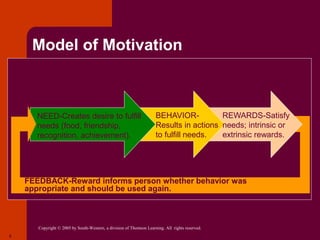
Model of Motivation
NEED-Creates desire to fulfill
needs (food, friendship,
recognition, achievement).
BEHAVIOR-
Results in actions
to fulfill needs.
REWARDS-Satisfy
needs; intrinsic or
extrinsic rewards.
FEEDBACK-Reward informs person whether behavior was
appropriate and should be used again.
Copyright © 2005 by South-Western, a division of Thomson Learning. All rights reserved.
7
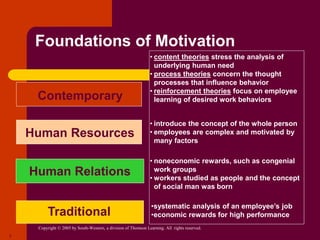
Foundations of Motivation
Traditional
Human Relations
Human Resources
Contemporary
•systematic analysis of an employee’s job
•economic rewards for high performance
• noneconomic rewards, such as congenial
work groups
• workers studied as people and the concept
of social man was born
• introduce the concept of the whole person
• employees are complex and motivated by
many factors
• content theories stress the analysis of
underlying human need
• process theories concern the thought
processes that influence behavior
• reinforcement theories focus on employee
learning of desired work behaviors
Copyright © 2005 by South-Western, a division of Thomson Learning. All rights reserved.
8
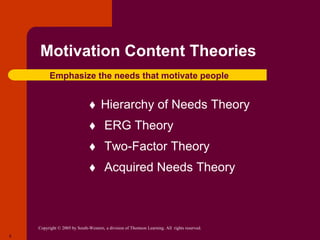
Motivation Content Theories
 Hierarchy of Needs Theory
 ERG Theory
 Two-Factor Theory
 Acquired Needs Theory
Emphasize the needs that motivate people
Copyright © 2005 by South-Western, a division of Thomson Learning. All rights reserved.
9
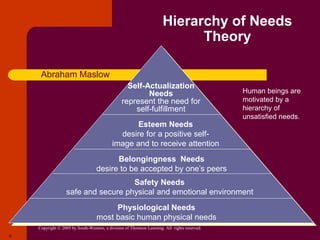
Hierarchy of Needs
Theory
Physiological Needs
most basic human physical needs
Safety Needs
safe and secure physical and emotional environment
Belongingness Needs
desire to be accepted by one’s peers
Esteem Needs
desire for a positive self-
image and to receive attention
Self-Actualization
Needs
represent the need for
self-fulfillment
Human beings are
motivated by a
hierarchy of
unsatisfied needs.
Abraham Maslow
Copyright © 2005 by South-Western, a division of Thomson Learning. All rights reserved.
10
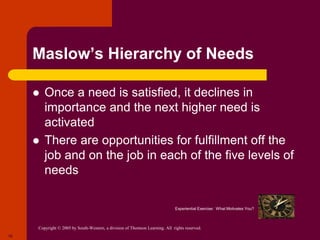
Maslow’s Hierarchy of Needs
 Once a need is satisfied, it declines in
importance and the next higher need is
activated
 There are opportunities for fulfillment off the
job and on the job in each of the five levels of
needs
Experiential Exercise: What Motivates You?
Copyright © 2005 by South-Western, a division of Thomson Learning. All rights reserved.
11
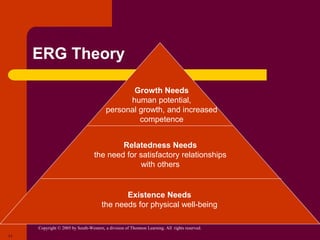
ERG Theory
Existence Needs
the needs for physical well-being
Relatedness Needs
the need for satisfactory relationships
with others
Growth Needs
human potential,
personal growth, and increased
competence
Copyright © 2005 by South-Western, a division of Thomson Learning. All rights reserved.
12
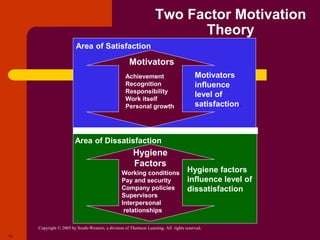
Two Factor Motivation
Theory
Area of Satisfaction
Area of Dissatisfaction
Motivators
influence
level of
satisfaction.
Hygiene factors
influence level of
dissatisfaction
Motivators
Hygiene
Factors
Achievement
Recognition
Responsibility
Work itself
Personal growth
Working conditions
Pay and security
Company policies
Supervisors
Interpersonal
relationships
Copyright © 2005 by South-Western, a division of Thomson Learning. All rights reserved.
13
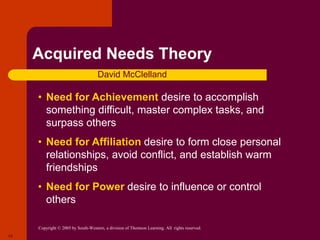
Acquired Needs Theory
• Need for Achievement desire to accomplish
something difficult, master complex tasks, and
surpass others
• Need for Affiliation desire to form close personal
relationships, avoid conflict, and establish warm
friendships
• Need for Power desire to influence or control
others
David McClelland
Copyright © 2005 by South-Western, a division of Thomson Learning. All rights reserved.
14
Motivation Process Theories
Equity Theory
 focuses on individuals’ perceptions of how fairly
they are treated compared with others
 motivated to seek social equity in the rewards
they expect for performance
Copyright © 2005 by South-Western, a division of Thomson Learning. All rights reserved.
15
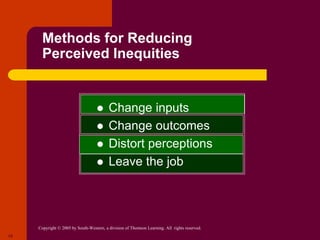
Methods for Reducing
Perceived Inequities
 Change inputs
 Change outcomes
 Distort perceptions
 Leave the job
Copyright © 2005 by South-Western, a division of Thomson Learning. All rights reserved.
16
Motivation Process Theories
Expectancy Theory
 motivation depends on individuals’ expectations
about their ability to perform tasks and receive
desired rewards
 concerned not with identifying types of needs but
with the thinking process that individuals use to
achieve rewards
 based on the effort, performance, and desirability of
outcomes
Copyright © 2005 by South-Western, a division of Thomson Learning. All rights reserved.
17
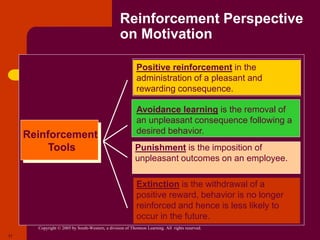
Reinforcement Perspective
on Motivation
Reinforcement
Tools
Positive reinforcement in the
administration of a pleasant and
rewarding consequence.
Avoidance learning is the removal of
an unpleasant consequence following a
desired behavior.
Punishment is the imposition of
unpleasant outcomes on an employee.
Extinction is the withdrawal of a
positive reward, behavior is no longer
reinforced and hence is less likely to
occur in the future.
Copyright © 2005 by South-Western, a division of Thomson Learning. All rights reserved.
18
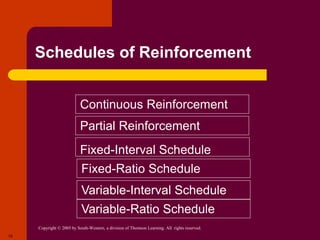
Schedules of Reinforcement
Continuous Reinforcement
Partial Reinforcement
Fixed-Interval Schedule
Fixed-Ratio Schedule
Variable-Interval Schedule
Variable-Ratio Schedule
Copyright © 2005 by South-Western, a division of Thomson Learning. All rights reserved.
19
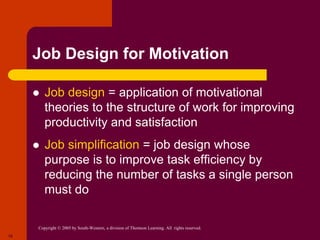
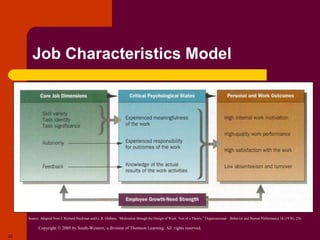
Job Design for Motivation
 Job design = application of motivational
theories to the structure of work for improving
productivity and satisfaction
 Job simplification = job design whose
purpose is to improve task efficiency by
reducing the number of tasks a single person
must do
Copyright © 2005 by South-Western, a division of Thomson Learning. All rights reserved.
20
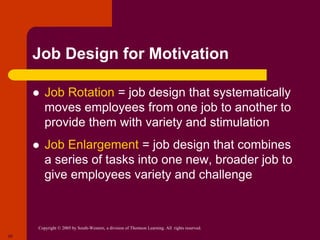
Job Design for Motivation
 Job Rotation = job design that systematically
moves employees from one job to another to
provide them with variety and stimulation
 Job Enlargement = job design that combines
a series of tasks into one new, broader job to
give employees variety and challenge
Copyright © 2005 by South-Western, a division of Thomson Learning. All rights reserved.
21
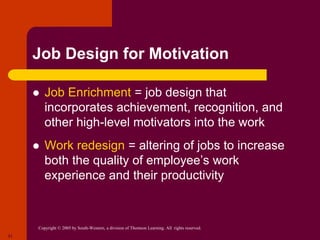
Job Design for Motivation
 Job Enrichment = job design that
incorporates achievement, recognition, and
other high-level motivators into the work
 Work redesign = altering of jobs to increase
both the quality of employee’s work
experience and their productivity
Copyright © 2005 by South-Western, a division of Thomson Learning. All rights reserved.
22
Job Characteristics Model
Source: Adapted from J. Richard Hackman and G. R. Oldham, “Motivation through the Design of Work: Test of a Theory,” Organizational Behavior and Human Performance 16 (1976), 256.
Copyright © 2005 by South-Western, a division of Thomson Learning. All rights reserved.
23
Motivational Ideas for Turbulent Times
 Organizations are increasingly using various
types of incentive compensation as a way to
motivate employees to higher levels of
performance
 Variable compensation and forms of at risk
pay are key motivational tools
Ethical Dilemma: Compensation Showdown
Copyright © 2005 by South-Western, a division of Thomson Learning. All rights reserved.
24
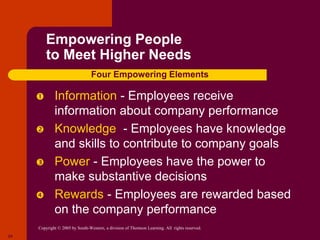
Empowering People
to Meet Higher Needs
 Information - Employees receive
information about company performance
 Knowledge - Employees have knowledge
and skills to contribute to company goals
 Power - Employees have the power to
make substantive decisions
 Rewards - Employees are rewarded based
on the company performance
Four Empowering Elements
Copyright © 2005 by South-Western, a division of Thomson Learning. All rights reserved.
25
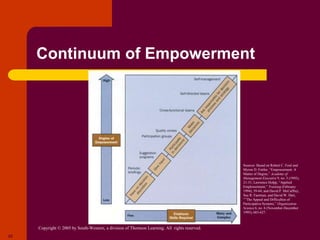
Continuum of Empowerment
Sources: Based on Robert C. Ford and
Myron D. Fottler, “Empowerment: A
Matter of Degree,” Academy of
Management Executive 9, no. 3 (1995),
21-31; Lawrence Holpp, “Applied
Emplowerment,” Training (February
1994), 39-44; and David P. McCaffrey,
Sue R. Faerman, and David W. Hart,
“”The Appeal and Difficulties of
Participative Systems,” Organization
Science 6, no. 6 (November-December
1995), 603-627.
Copyright © 2005 by South-Western, a division of Thomson Learning. All rights reserved.
26
Giving Meaning to Work
 To meet higher-level motivational needs and
help people get intrinsic rewards from their
work is to instill a sense of importance and
meaningfulness
Copyright © 2005 by South-Western, a division of Thomson Learning. All rights reserved.
27
Motivational Ideas for Turbulent Times
 Role of today’s manager is not to control
others but to organize the workplace in such
a way that each person
 Can learn
 Contribute
 Grow

Chapter 16 Motivation

  • 1.
  • 2.
    Copyright © 2005by South-Western, a division of Thomson Learning. All rights reserved. 2 Motivation  One secret for success in organizations is motivated and enthusiastic employees  With such a diverse workforce, it is a challenge for managers to motivate employees toward common organizational goals Manager’s Challenge: Pfizer
  • 3.
    Copyright © 2005by South-Western, a division of Thomson Learning. All rights reserved. 3 Motivation  Employee motivation theories and models –Needs –processes –Reinforcement  How job design can affect employee satisfaction & productivity  Empowerment Topics Chapter 16
  • 4.
    Copyright © 2005by South-Western, a division of Thomson Learning. All rights reserved. 4 Motivation  Arousal, direction, and persistence of behavior  Employee motivation affects productivity  Part of a manager’s job is to channel motivation toward the accomplishment of organizational goals
  • 5.
    Copyright © 2005by South-Western, a division of Thomson Learning. All rights reserved. 5 Two Types of Rewards  Intrinsic rewards--satisfactions a person receives in the process of performing a particular action.  Extrinsic rewards--given by another person.
  • 6.
    Copyright © 2005by South-Western, a division of Thomson Learning. All rights reserved. 6 Model of Motivation NEED-Creates desire to fulfill needs (food, friendship, recognition, achievement). BEHAVIOR- Results in actions to fulfill needs. REWARDS-Satisfy needs; intrinsic or extrinsic rewards. FEEDBACK-Reward informs person whether behavior was appropriate and should be used again.
  • 7.
    Copyright © 2005by South-Western, a division of Thomson Learning. All rights reserved. 7 Foundations of Motivation Traditional Human Relations Human Resources Contemporary •systematic analysis of an employee’s job •economic rewards for high performance • noneconomic rewards, such as congenial work groups • workers studied as people and the concept of social man was born • introduce the concept of the whole person • employees are complex and motivated by many factors • content theories stress the analysis of underlying human need • process theories concern the thought processes that influence behavior • reinforcement theories focus on employee learning of desired work behaviors
  • 8.
    Copyright © 2005by South-Western, a division of Thomson Learning. All rights reserved. 8 Motivation Content Theories  Hierarchy of Needs Theory  ERG Theory  Two-Factor Theory  Acquired Needs Theory Emphasize the needs that motivate people
  • 9.
    Copyright © 2005by South-Western, a division of Thomson Learning. All rights reserved. 9 Hierarchy of Needs Theory Physiological Needs most basic human physical needs Safety Needs safe and secure physical and emotional environment Belongingness Needs desire to be accepted by one’s peers Esteem Needs desire for a positive self- image and to receive attention Self-Actualization Needs represent the need for self-fulfillment Human beings are motivated by a hierarchy of unsatisfied needs. Abraham Maslow
  • 10.
    Copyright © 2005by South-Western, a division of Thomson Learning. All rights reserved. 10 Maslow’s Hierarchy of Needs  Once a need is satisfied, it declines in importance and the next higher need is activated  There are opportunities for fulfillment off the job and on the job in each of the five levels of needs Experiential Exercise: What Motivates You?
  • 11.
    Copyright © 2005by South-Western, a division of Thomson Learning. All rights reserved. 11 ERG Theory Existence Needs the needs for physical well-being Relatedness Needs the need for satisfactory relationships with others Growth Needs human potential, personal growth, and increased competence
  • 12.
    Copyright © 2005by South-Western, a division of Thomson Learning. All rights reserved. 12 Two Factor Motivation Theory Area of Satisfaction Area of Dissatisfaction Motivators influence level of satisfaction. Hygiene factors influence level of dissatisfaction Motivators Hygiene Factors Achievement Recognition Responsibility Work itself Personal growth Working conditions Pay and security Company policies Supervisors Interpersonal relationships
  • 13.
    Copyright © 2005by South-Western, a division of Thomson Learning. All rights reserved. 13 Acquired Needs Theory • Need for Achievement desire to accomplish something difficult, master complex tasks, and surpass others • Need for Affiliation desire to form close personal relationships, avoid conflict, and establish warm friendships • Need for Power desire to influence or control others David McClelland
  • 14.
    Copyright © 2005by South-Western, a division of Thomson Learning. All rights reserved. 14 Motivation Process Theories Equity Theory  focuses on individuals’ perceptions of how fairly they are treated compared with others  motivated to seek social equity in the rewards they expect for performance
  • 15.
    Copyright © 2005by South-Western, a division of Thomson Learning. All rights reserved. 15 Methods for Reducing Perceived Inequities  Change inputs  Change outcomes  Distort perceptions  Leave the job
  • 16.
    Copyright © 2005by South-Western, a division of Thomson Learning. All rights reserved. 16 Motivation Process Theories Expectancy Theory  motivation depends on individuals’ expectations about their ability to perform tasks and receive desired rewards  concerned not with identifying types of needs but with the thinking process that individuals use to achieve rewards  based on the effort, performance, and desirability of outcomes
  • 17.
    Copyright © 2005by South-Western, a division of Thomson Learning. All rights reserved. 17 Reinforcement Perspective on Motivation Reinforcement Tools Positive reinforcement in the administration of a pleasant and rewarding consequence. Avoidance learning is the removal of an unpleasant consequence following a desired behavior. Punishment is the imposition of unpleasant outcomes on an employee. Extinction is the withdrawal of a positive reward, behavior is no longer reinforced and hence is less likely to occur in the future.
  • 18.
    Copyright © 2005by South-Western, a division of Thomson Learning. All rights reserved. 18 Schedules of Reinforcement Continuous Reinforcement Partial Reinforcement Fixed-Interval Schedule Fixed-Ratio Schedule Variable-Interval Schedule Variable-Ratio Schedule
  • 19.
    Copyright © 2005by South-Western, a division of Thomson Learning. All rights reserved. 19 Job Design for Motivation  Job design = application of motivational theories to the structure of work for improving productivity and satisfaction  Job simplification = job design whose purpose is to improve task efficiency by reducing the number of tasks a single person must do
  • 20.
    Copyright © 2005by South-Western, a division of Thomson Learning. All rights reserved. 20 Job Design for Motivation  Job Rotation = job design that systematically moves employees from one job to another to provide them with variety and stimulation  Job Enlargement = job design that combines a series of tasks into one new, broader job to give employees variety and challenge
  • 21.
    Copyright © 2005by South-Western, a division of Thomson Learning. All rights reserved. 21 Job Design for Motivation  Job Enrichment = job design that incorporates achievement, recognition, and other high-level motivators into the work  Work redesign = altering of jobs to increase both the quality of employee’s work experience and their productivity
  • 22.
    Copyright © 2005by South-Western, a division of Thomson Learning. All rights reserved. 22 Job Characteristics Model Source: Adapted from J. Richard Hackman and G. R. Oldham, “Motivation through the Design of Work: Test of a Theory,” Organizational Behavior and Human Performance 16 (1976), 256.
  • 23.
    Copyright © 2005by South-Western, a division of Thomson Learning. All rights reserved. 23 Motivational Ideas for Turbulent Times  Organizations are increasingly using various types of incentive compensation as a way to motivate employees to higher levels of performance  Variable compensation and forms of at risk pay are key motivational tools Ethical Dilemma: Compensation Showdown
  • 24.
    Copyright © 2005by South-Western, a division of Thomson Learning. All rights reserved. 24 Empowering People to Meet Higher Needs  Information - Employees receive information about company performance  Knowledge - Employees have knowledge and skills to contribute to company goals  Power - Employees have the power to make substantive decisions  Rewards - Employees are rewarded based on the company performance Four Empowering Elements
  • 25.
    Copyright © 2005by South-Western, a division of Thomson Learning. All rights reserved. 25 Continuum of Empowerment Sources: Based on Robert C. Ford and Myron D. Fottler, “Empowerment: A Matter of Degree,” Academy of Management Executive 9, no. 3 (1995), 21-31; Lawrence Holpp, “Applied Emplowerment,” Training (February 1994), 39-44; and David P. McCaffrey, Sue R. Faerman, and David W. Hart, “”The Appeal and Difficulties of Participative Systems,” Organization Science 6, no. 6 (November-December 1995), 603-627.
  • 26.
    Copyright © 2005by South-Western, a division of Thomson Learning. All rights reserved. 26 Giving Meaning to Work  To meet higher-level motivational needs and help people get intrinsic rewards from their work is to instill a sense of importance and meaningfulness
  • 27.
    Copyright © 2005by South-Western, a division of Thomson Learning. All rights reserved. 27 Motivational Ideas for Turbulent Times  Role of today’s manager is not to control others but to organize the workplace in such a way that each person  Can learn  Contribute  Grow