Business Research Methods
(BRM )
Chapter # 2
Scientific investigation
Lecturer: Noorullah Nabizai
Chapter Outline:
• The Hallmarks of Scientific Research
• Purposiveness
• Rigor
• Testability
• Replicability (doing something again in the same way)
• Precision and confidence
• Objectivity
• Generalizability
• Parsimony
• The Hypothetical–deductive method
• Observation
• Preliminary information gathering
• Theory formulation
• Hypothesis
• Further scientific data collection
• Data analysis
• Deduction
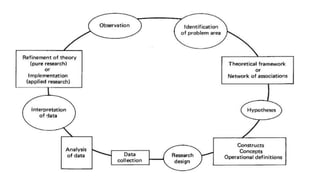
• The Building Blocks of Science
• Observation
• Problem Identification
• Theoretical framework
• Hypothesis
• Operationally defined process
• Research design
• Data collection
• Analysis of data
• Interpretation
• Deduction
The Hallmarks of Scientific Research
• The hallmarks or main distinguishing characteristics of scientific research
may be listed as follows:
• Purposiveness
• Rigor
• Testability
• Replicability (doing something again in the same way)
• Precision and confidence
• Objectivity
• Generalizability
• Parsimony
Purposiveness:
It has to start with a definite aim or purpose.
E.g.
THE FOCUS IS ON INCREASING EMPLOYEE COMMITMENT.
oIncrease employee commitment will translate into less turnover, less
absenteeism and increased performance levels.
oThus it has a purposive focus.
Rigor:
●RIGOR ADDS CAREFULNESS,) AND THE DEGREE OF
EXACTITUDE (ACCURACY) IN RESEARCH.
●A GOOD THEORETICAL BASE AND SOUND
METHODOLOGICAL DESIGN WOULD ADD RIGOR TO THE
PURPOSIVE STUDY.
Testability:
•This is a hypothesis which can be tested when
the data are collected and we can use certain
statistical tools for checking the correctness
of hypothesis.
Replicability (repeat,):
• IT MEANS THAT IT CAN BE USED AGAIN IF SIMILAR
CIRCUMSTANCES PREVAILS.
• when the same type of research is repeated in the other similar
circumstances.
Precision (accuracy) and confidence:
•Precision refers to the closeness of the findings
to “reality” based on a sample.
Confidence
• Refers to the probability (possibility) that our estimations are correct.
• That is, it is not merely enough to be precise, but it is also important
that we can confidently claim that 95% of the time our results would
be true and there is only a 5% chance of being wrong. This is also
known as confidence level.
Objectivity:
• The conclusion drawn through the interpretation (explanation) of
results of the data analysis should be objective, that is, they should
be based on the facts of the findings derived from actual data, and
not on our own subjective or emotional values.
Generalizability:
• Generalizability refers to the scope of applicability of the research
findings in one organizational setting to other settings.
• Obviously, the wider the range of applicability of the solutions
generated by research, the more useful the research is to the users.
• The more generalizable the research, the greater its usefulness and
value.
Parsimony:
• Simplicity in explaining the phenomena or problems
that occur, and in generating solutions for the
problems, is always preferred to complex research
frameworks that consider an unmanageable number
of factors.
Observation:
• A sales manager might observe that customers are
perhaps not as satisfied as they used to be.
• The manager may not be sure that this is really the
case but may experience anxiety or some nervousness
that customer satisfaction is on the decline.
Problem identification
• This problem identification will call for some preliminary
data gathering. They might talk casually to a few customers
to find out how they feel about the products and customers
service.
• During the course of these conversations the anger (feeling
sad) might find that the customers like the products but are
upset because many- of the items they need are frequently
out of stock, and they perceive the salespersons as not being
helpful.
Theoretical framework:
• Theoretical framework of all the factors contributing the problem. In
this case, there is a network of connections among the following
factors:
• delays by the factory in delivering the goods, the notification of later
delivery dates that are not kept, the promises of salespersons to the
customers (in hope of retaining them) that cannot be fulfilled, all of
which contribute to the customer dissatisfaction.
• From the theoretical framework, which is a meaningful integration of
all the information gathered, several hypothesis.
• Hypothesis:
• It can be can be generated and tested to determine if the data
support them.
• Operationally defined:
• Concepts are then operationally defined so that they can be
measured.
• Research design:
• It is set up to decide on, among other issues.
• Data collection:
• It is the collection of further data about the problem.
Analysis of data:
• Analyze the collected data remove
the excessive and unnecessary data.
• Interpret:
• Interpret the collected data, and
finally, to provide an answer to
the problem.
• The process of drawing from logical
analysis an inference (conclusion)
that purport (meaning) to be
conclusive.
• Deduction:
• The last stage is the arrival at
conclusion.
The Hypothetic–deductive method
• The seven steps involved in the Hypothetic-deductive method of research
stem from the buildings blocks discussed above, and are listed and
discussed below.
• Observation
• Preliminary information gathering
• Theory formulation
• Hypothesis
• Further scientific data collection
• Data analysis
• Deduction
Observation:
• It is the first stage, in which one senses that certain
changes are occurring, or that some new behaviors,
attitudes, and feelings are surfacing in one’s
environment (i.e. the workplace).
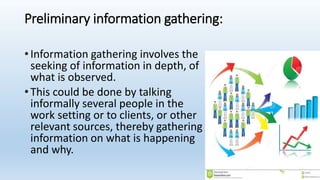
Preliminary information gathering:
• Information gathering involves the
seeking of information in depth, of
what is observed.
• This could be done by talking
informally several people in the
work setting or to clients, or other
relevant sources, thereby gathering
information on what is happening
and why.
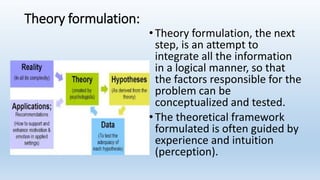
Theory formulation:
•Theory formulation, the next
step, is an attempt to
integrate all the information
in a logical manner, so that
the factors responsible for the
problem can be
conceptualized and tested.
•The theoretical framework
formulated is often guided by
experience and intuition
(perception).
Hypothesizing:
• It is the next logical step after theory formulation.
From the theorized network of association among the
variables, certain testable hypotheses or educated
conjectures (estimations) can be generated.
Further scientific data collection:
• After the development of the hypothesis, data with
respect to each variable in the hypothesis need to be
obtained.
• In other words, further scientific data collection is
needed to test the hypothesis that are generated in
the study.
Data analysis:
• In the data analysis step, the data gathered are
statistically analyzed to see if the hypotheses that
were generated have been supported
Deduction(conclusion):
• Deduction is the process of arriving at conclusions by interpreting the
meaning of the results of the data analysis
• .e.g. based on the results, the manager deduces or concludes that
managers do not use MIS owing to certain factors.
Group work
Each group should work and design a research plan
http://shodhganga.inflibnet.ac.in/

Ch # 2 brm

  • 1.
    Business Research Methods (BRM) Chapter # 2 Scientific investigation Lecturer: Noorullah Nabizai
  • 2.
    Chapter Outline: • TheHallmarks of Scientific Research • Purposiveness • Rigor • Testability • Replicability (doing something again in the same way) • Precision and confidence • Objectivity • Generalizability • Parsimony • The Hypothetical–deductive method • Observation • Preliminary information gathering • Theory formulation • Hypothesis • Further scientific data collection • Data analysis • Deduction • The Building Blocks of Science • Observation • Problem Identification • Theoretical framework • Hypothesis • Operationally defined process • Research design • Data collection • Analysis of data • Interpretation • Deduction
  • 3.
    The Hallmarks ofScientific Research • The hallmarks or main distinguishing characteristics of scientific research may be listed as follows: • Purposiveness • Rigor • Testability • Replicability (doing something again in the same way) • Precision and confidence • Objectivity • Generalizability • Parsimony
  • 4.
    Purposiveness: It has tostart with a definite aim or purpose. E.g. THE FOCUS IS ON INCREASING EMPLOYEE COMMITMENT. oIncrease employee commitment will translate into less turnover, less absenteeism and increased performance levels. oThus it has a purposive focus.
  • 5.
    Rigor: ●RIGOR ADDS CAREFULNESS,)AND THE DEGREE OF EXACTITUDE (ACCURACY) IN RESEARCH. ●A GOOD THEORETICAL BASE AND SOUND METHODOLOGICAL DESIGN WOULD ADD RIGOR TO THE PURPOSIVE STUDY.
  • 6.
    Testability: •This is ahypothesis which can be tested when the data are collected and we can use certain statistical tools for checking the correctness of hypothesis.
  • 7.
    Replicability (repeat,): • ITMEANS THAT IT CAN BE USED AGAIN IF SIMILAR CIRCUMSTANCES PREVAILS. • when the same type of research is repeated in the other similar circumstances.
  • 8.
    Precision (accuracy) andconfidence: •Precision refers to the closeness of the findings to “reality” based on a sample.
  • 9.
    Confidence • Refers tothe probability (possibility) that our estimations are correct. • That is, it is not merely enough to be precise, but it is also important that we can confidently claim that 95% of the time our results would be true and there is only a 5% chance of being wrong. This is also known as confidence level.
  • 10.
    Objectivity: • The conclusiondrawn through the interpretation (explanation) of results of the data analysis should be objective, that is, they should be based on the facts of the findings derived from actual data, and not on our own subjective or emotional values.
  • 11.
    Generalizability: • Generalizability refersto the scope of applicability of the research findings in one organizational setting to other settings. • Obviously, the wider the range of applicability of the solutions generated by research, the more useful the research is to the users. • The more generalizable the research, the greater its usefulness and value.
  • 12.
    Parsimony: • Simplicity inexplaining the phenomena or problems that occur, and in generating solutions for the problems, is always preferred to complex research frameworks that consider an unmanageable number of factors.
  • 14.
    Observation: • A salesmanager might observe that customers are perhaps not as satisfied as they used to be. • The manager may not be sure that this is really the case but may experience anxiety or some nervousness that customer satisfaction is on the decline.
  • 15.
    Problem identification • Thisproblem identification will call for some preliminary data gathering. They might talk casually to a few customers to find out how they feel about the products and customers service. • During the course of these conversations the anger (feeling sad) might find that the customers like the products but are upset because many- of the items they need are frequently out of stock, and they perceive the salespersons as not being helpful.
  • 16.
    Theoretical framework: • Theoreticalframework of all the factors contributing the problem. In this case, there is a network of connections among the following factors: • delays by the factory in delivering the goods, the notification of later delivery dates that are not kept, the promises of salespersons to the customers (in hope of retaining them) that cannot be fulfilled, all of which contribute to the customer dissatisfaction. • From the theoretical framework, which is a meaningful integration of all the information gathered, several hypothesis.
  • 17.
    • Hypothesis: • Itcan be can be generated and tested to determine if the data support them. • Operationally defined: • Concepts are then operationally defined so that they can be measured. • Research design: • It is set up to decide on, among other issues. • Data collection: • It is the collection of further data about the problem.
  • 18.
    Analysis of data: •Analyze the collected data remove the excessive and unnecessary data. • Interpret: • Interpret the collected data, and finally, to provide an answer to the problem. • The process of drawing from logical analysis an inference (conclusion) that purport (meaning) to be conclusive. • Deduction: • The last stage is the arrival at conclusion.
  • 19.
    The Hypothetic–deductive method •The seven steps involved in the Hypothetic-deductive method of research stem from the buildings blocks discussed above, and are listed and discussed below. • Observation • Preliminary information gathering • Theory formulation • Hypothesis • Further scientific data collection • Data analysis • Deduction
  • 20.
    Observation: • It isthe first stage, in which one senses that certain changes are occurring, or that some new behaviors, attitudes, and feelings are surfacing in one’s environment (i.e. the workplace).
  • 21.
    Preliminary information gathering: •Information gathering involves the seeking of information in depth, of what is observed. • This could be done by talking informally several people in the work setting or to clients, or other relevant sources, thereby gathering information on what is happening and why.
  • 22.
    Theory formulation: •Theory formulation,the next step, is an attempt to integrate all the information in a logical manner, so that the factors responsible for the problem can be conceptualized and tested. •The theoretical framework formulated is often guided by experience and intuition (perception).
  • 23.
    Hypothesizing: • It isthe next logical step after theory formulation. From the theorized network of association among the variables, certain testable hypotheses or educated conjectures (estimations) can be generated.
  • 24.
    Further scientific datacollection: • After the development of the hypothesis, data with respect to each variable in the hypothesis need to be obtained. • In other words, further scientific data collection is needed to test the hypothesis that are generated in the study.
  • 25.
    Data analysis: • Inthe data analysis step, the data gathered are statistically analyzed to see if the hypotheses that were generated have been supported
  • 26.
    Deduction(conclusion): • Deduction isthe process of arriving at conclusions by interpreting the meaning of the results of the data analysis • .e.g. based on the results, the manager deduces or concludes that managers do not use MIS owing to certain factors.
  • 27.
    Group work Each groupshould work and design a research plan http://shodhganga.inflibnet.ac.in/