Cost of capital
Concept of cost of capital
 A firm needs funds for various capital budgeting proposals. These funds can
be procured from different types of investors i.e. equity shareholders, preference
shareholders, debt holders, depositors etc.
 These investors while providing the funds to the firm will have an expectation of
receiving a minimum return from the firm.
 Obviously, this return payable to investors would be earned out of the
revenues generated by the proposal wherein the funds are being used. So, the
proposal must earn at least that much which is sufficient to pay to the investors
of the firm.
 So, cost of capital is the minimum return which the firm must earn on the
proposals in order to break even.
Importance and significance
 The importance and significance of the concept of cost of capital can be stated
in terms of the contribution it makes towards the achievement of the objective
of maximization of the wealth of the shareholders.
 If a firm’s actual rate of return exceeds its cost of capital and if this return is
earned without of course, increasing the risk characteristics of the firm, then the
wealth maximization goal will be achieved.
 Similarly, the firm’s value is reduced when the rate of return on the
proposal falls below the cost of capital.
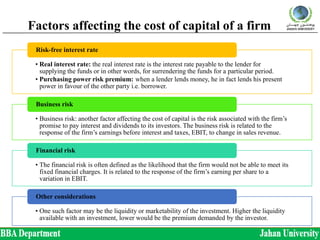
Factors affecting the cost of capital of a firm
• Real interest rate: the real interest rate is the interest rate payable to the lender for
supplying the funds or in other words, for surrendering the funds for a particular period.
• Purchasing power risk premium: when a lender lends money, he in fact lends his present
power in favour of the other party i.e. borrower.
Risk-free interest rate
• Business risk: another factor affecting the cost of capital is the risk associated with the firm’s
promise to pay interest and dividends to its investors. The business risk is related to the
response of the firm’s earnings before interest and taxes, EBIT, to change in sales revenue.
Business risk
• The financial risk is often defined as the likelihood that the firm would not be able to meet its
fixed financial charges. It is related to the response of the firm’s earning per share to a
variation in EBIT.
Financial risk
• One such factor may be the liquidity or marketability of the investment. Higher the liquidity
available with an investment, lower would be the premium demanded by the investor.
Other considerations
Components of cost of capital
 The overall cost of capital of a firm consists of the costs of various segments of
the total funds, which may be identified as follows:
1. Cost of debt capital i.e. debentures & loans from various institutions
2. Cost of preference capital
3. Cost of equity capital
4. Cost of retained earnings
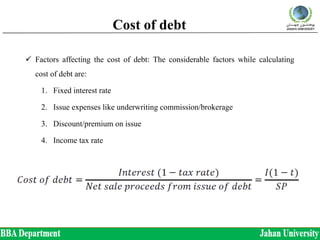
Cost of debt
 Factors affecting the cost of debt: The considerable factors while calculating
cost of debt are:
1. Fixed interest rate
2. Issue expenses like underwriting commission/brokerage
3. Discount/premium on issue
4. Income tax rate
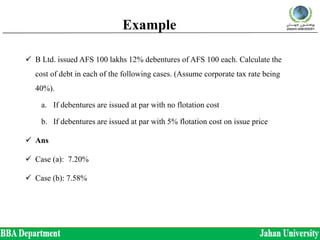
Example
 B Ltd. issued AFS 100 lakhs 12% debentures of AFS 100 each. Calculate the
cost of debt in each of the following cases. (Assume corporate tax rate being
40%).
a. If debentures are issued at par with no flotation cost
b. If debentures are issued at par with 5% flotation cost on issue price
 Ans
 Case (a): 7.20%
 Case (b): 7.58%
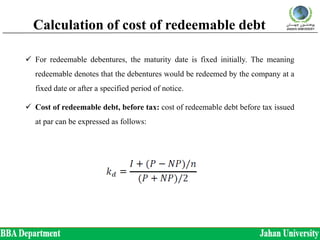
Calculation of cost of redeemable debt
 For redeemable debentures, the maturity date is fixed initially. The meaning
redeemable denotes that the debentures would be redeemed by the company at a
fixed date or after a specified period of notice.
 Cost of redeemable debt, before tax: cost of redeemable debt before tax issued
at par can be expressed as follows:
Example
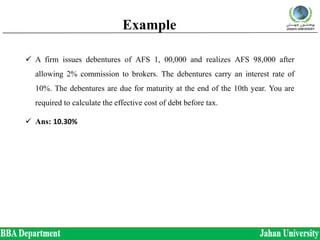
 A firm issues debentures of AFS 1, 00,000 and realizes AFS 98,000 after
allowing 2% commission to brokers. The debentures carry an interest rate of
10%. The debentures are due for maturity at the end of the 10th year. You are
required to calculate the effective cost of debt before tax.
 Ans: 10.30%
Calculation of cost of redeemable debt
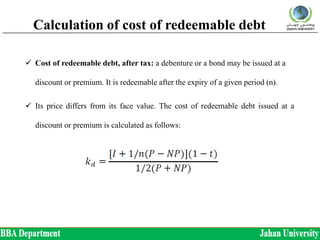
 Cost of redeemable debt, after tax: a debenture or a bond may be issued at a
discount or premium. It is redeemable after the expiry of a given period (n).
 Its price differs from its face value. The cost of redeemable debt issued at a
discount or premium is calculated as follows:
Example
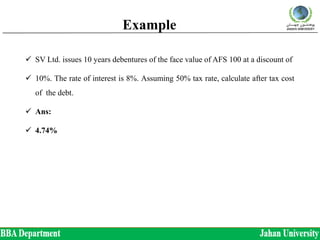
 SV Ltd. issues 10 years debentures of the face value of AFS 100 at a discount of
 10%. The rate of interest is 8%. Assuming 50% tax rate, calculate after tax cost
of the debt.
 Ans:
 4.74%
Cost of preference share
 On preference share a fixed rate of dividend is paid. Though as far as dividend
is concerned, there is no legal binding on the board of directors to pay dividend
but if any dividend is paid, then it is to be paid to the preference shareholders
first.
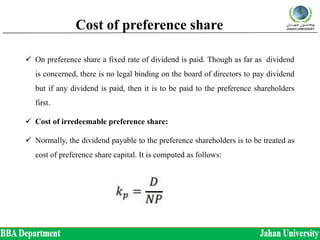
 Cost of irredeemable preference share:
 Normally, the dividend payable to the preference shareholders is to be treated as
cost of preference share capital. It is computed as follows:
Example
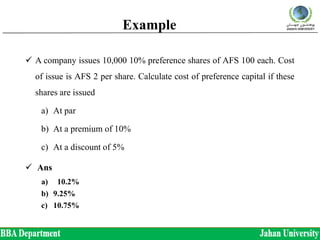
 A company issues 10,000 10% preference shares of AFS 100 each. Cost
of issue is AFS 2 per share. Calculate cost of preference capital if these
shares are issued
a) At par
b) At a premium of 10%
c) At a discount of 5%
 Ans
a) 10.2%
b) 9.25%
c) 10.75%
Cost of redeemable preference share
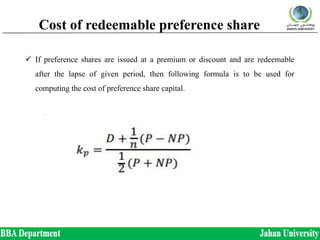
 If preference shares are issued at a premium or discount and are redeemable
after the lapse of given period, then following formula is to be used for
computing the cost of preference share capital.
Example
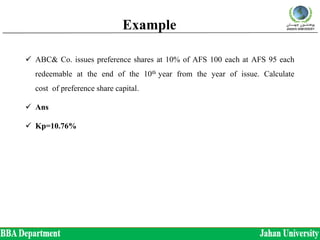
 ABC& Co. issues preference shares at 10% of AFS 100 each at AFS 95 each
redeemable at the end of the 10th year from the year of issue. Calculate
cost of preference share capital.
 Ans
 Kp=10.76%
Cost of equity shares
 The cost of equity is the minimum rate of return that the company must earn on equity
financed portion of the investment in order to leave unchanged the market price of its
stock.
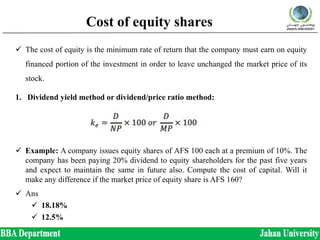
1. Dividend yield method or dividend/price ratio method:
 Example: A company issues equity shares of AFS 100 each at a premium of 10%. The
company has been paying 20% dividend to equity shareholders for the past five years
and expect to maintain the same in future also. Compute the cost of capital. Will it
make any difference if the market price of equity share is AFS 160?
 Ans
 18.18%
 12.5%
Cost of equity shares
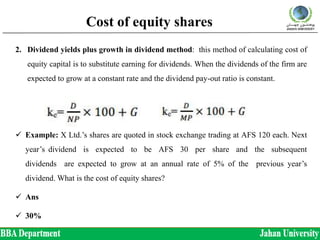
2. Dividend yields plus growth in dividend method: this method of calculating cost of
equity capital is to substitute earning for dividends. When the dividends of the firm are
expected to grow at a constant rate and the dividend pay-out ratio is constant.
 Example: X Ltd.’s shares are quoted in stock exchange trading at AFS 120 each. Next
year’s dividend is expected to be AFS 30 per share and the subsequent
dividends are expected to grow at an annual rate of 5% of the previous year’s
dividend. What is the cost of equity shares?
 Ans
 30%
Cost of equity shares
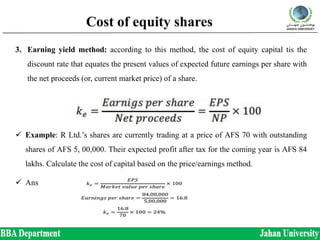
3. Earning yield method: according to this method, the cost of equity capital tis the
discount rate that equates the present values of expected future earnings per share with
the net proceeds (or, current market price) of a share.
 Example: R Ltd.’s shares are currently trading at a price of AFS 70 with outstanding
shares of AFS 5, 00,000. Their expected profit after tax for the coming year is AFS 84
lakhs. Calculate the cost of capital based on the price/earnings method.
 Ans
Cost of equity shares
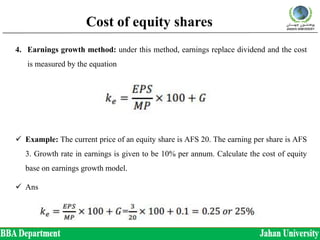
4. Earnings growth method: under this method, earnings replace dividend and the cost
is measured by the equation
 Example: The current price of an equity share is AFS 20. The earning per share is AFS
3. Growth rate in earnings is given to be 10% per annum. Calculate the cost of equity
base on earnings growth model.
 Ans
Cost of equity shares
5. Capital asset pricing model (CAPM): it describes the relationship between the
required rate of return and the cost of equity capital and non -diversifiable or relevant
risk of the firm as reflected in its index of non-diversifiable risk beta.
Ke= Rf +b (Rm-Rf)
 Example: Calculate the return on investment from the following information:
• Risk free return = 10%
• Market return = 12.5%
• β = 1.5
 Ans 13.75%
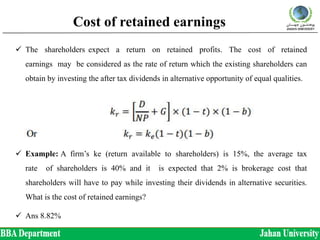
Cost of retained earnings
 The shareholders expect a return on retained profits. The cost of retained
earnings may be considered as the rate of return which the existing shareholders can
obtain by investing the after tax dividends in alternative opportunity of equal qualities.
 Example: A firm’s ke (return available to shareholders) is 15%, the average tax
rate of shareholders is 40% and it is expected that 2% is brokerage cost that
shareholders will have to pay while investing their dividends in alternative securities.
What is the cost of retained earnings?
 Ans 8.82%
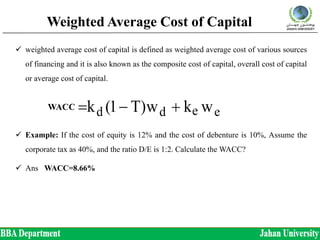
Weighted Average Cost of Capital
 weighted average cost of capital is defined as weighted average cost of various sources
of financing and it is also known as the composite cost of capital, overall cost of capital
or average cost of capital.
 Example: If the cost of equity is 12% and the cost of debenture is 10%, Assume the
corporate tax as 40%, and the ratio D/E is 1:2. Calculate the WACC?
 Ans WACC=8.66%
ED
E
k
ED
D
)T1(kk
wkw)T1(kk
edo
edddo




WACC
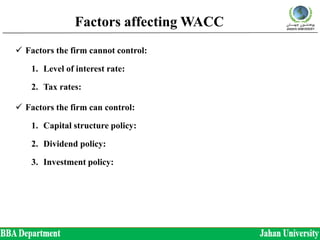
Factors affecting WACC
 Factors the firm cannot control:
1. Level of interest rate:
2. Tax rates:
 Factors the firm can control:
1. Capital structure policy:
2. Dividend policy:
3. Investment policy:

Bf chapter 4

  • 1.
  • 2.
    Concept of costof capital  A firm needs funds for various capital budgeting proposals. These funds can be procured from different types of investors i.e. equity shareholders, preference shareholders, debt holders, depositors etc.  These investors while providing the funds to the firm will have an expectation of receiving a minimum return from the firm.  Obviously, this return payable to investors would be earned out of the revenues generated by the proposal wherein the funds are being used. So, the proposal must earn at least that much which is sufficient to pay to the investors of the firm.  So, cost of capital is the minimum return which the firm must earn on the proposals in order to break even.
  • 3.
    Importance and significance The importance and significance of the concept of cost of capital can be stated in terms of the contribution it makes towards the achievement of the objective of maximization of the wealth of the shareholders.  If a firm’s actual rate of return exceeds its cost of capital and if this return is earned without of course, increasing the risk characteristics of the firm, then the wealth maximization goal will be achieved.  Similarly, the firm’s value is reduced when the rate of return on the proposal falls below the cost of capital.
  • 4.
    Factors affecting thecost of capital of a firm • Real interest rate: the real interest rate is the interest rate payable to the lender for supplying the funds or in other words, for surrendering the funds for a particular period. • Purchasing power risk premium: when a lender lends money, he in fact lends his present power in favour of the other party i.e. borrower. Risk-free interest rate • Business risk: another factor affecting the cost of capital is the risk associated with the firm’s promise to pay interest and dividends to its investors. The business risk is related to the response of the firm’s earnings before interest and taxes, EBIT, to change in sales revenue. Business risk • The financial risk is often defined as the likelihood that the firm would not be able to meet its fixed financial charges. It is related to the response of the firm’s earning per share to a variation in EBIT. Financial risk • One such factor may be the liquidity or marketability of the investment. Higher the liquidity available with an investment, lower would be the premium demanded by the investor. Other considerations
  • 5.
    Components of costof capital  The overall cost of capital of a firm consists of the costs of various segments of the total funds, which may be identified as follows: 1. Cost of debt capital i.e. debentures & loans from various institutions 2. Cost of preference capital 3. Cost of equity capital 4. Cost of retained earnings
  • 6.
    Cost of debt Factors affecting the cost of debt: The considerable factors while calculating cost of debt are: 1. Fixed interest rate 2. Issue expenses like underwriting commission/brokerage 3. Discount/premium on issue 4. Income tax rate
  • 7.
    Example  B Ltd.issued AFS 100 lakhs 12% debentures of AFS 100 each. Calculate the cost of debt in each of the following cases. (Assume corporate tax rate being 40%). a. If debentures are issued at par with no flotation cost b. If debentures are issued at par with 5% flotation cost on issue price  Ans  Case (a): 7.20%  Case (b): 7.58%
  • 8.
    Calculation of costof redeemable debt  For redeemable debentures, the maturity date is fixed initially. The meaning redeemable denotes that the debentures would be redeemed by the company at a fixed date or after a specified period of notice.  Cost of redeemable debt, before tax: cost of redeemable debt before tax issued at par can be expressed as follows:
  • 9.
    Example  A firmissues debentures of AFS 1, 00,000 and realizes AFS 98,000 after allowing 2% commission to brokers. The debentures carry an interest rate of 10%. The debentures are due for maturity at the end of the 10th year. You are required to calculate the effective cost of debt before tax.  Ans: 10.30%
  • 10.
    Calculation of costof redeemable debt  Cost of redeemable debt, after tax: a debenture or a bond may be issued at a discount or premium. It is redeemable after the expiry of a given period (n).  Its price differs from its face value. The cost of redeemable debt issued at a discount or premium is calculated as follows:
  • 11.
    Example  SV Ltd.issues 10 years debentures of the face value of AFS 100 at a discount of  10%. The rate of interest is 8%. Assuming 50% tax rate, calculate after tax cost of the debt.  Ans:  4.74%
  • 12.
    Cost of preferenceshare  On preference share a fixed rate of dividend is paid. Though as far as dividend is concerned, there is no legal binding on the board of directors to pay dividend but if any dividend is paid, then it is to be paid to the preference shareholders first.  Cost of irredeemable preference share:  Normally, the dividend payable to the preference shareholders is to be treated as cost of preference share capital. It is computed as follows:
  • 13.
    Example  A companyissues 10,000 10% preference shares of AFS 100 each. Cost of issue is AFS 2 per share. Calculate cost of preference capital if these shares are issued a) At par b) At a premium of 10% c) At a discount of 5%  Ans a) 10.2% b) 9.25% c) 10.75%
  • 14.
    Cost of redeemablepreference share  If preference shares are issued at a premium or discount and are redeemable after the lapse of given period, then following formula is to be used for computing the cost of preference share capital.
  • 15.
    Example  ABC& Co.issues preference shares at 10% of AFS 100 each at AFS 95 each redeemable at the end of the 10th year from the year of issue. Calculate cost of preference share capital.  Ans  Kp=10.76%
  • 16.
    Cost of equityshares  The cost of equity is the minimum rate of return that the company must earn on equity financed portion of the investment in order to leave unchanged the market price of its stock. 1. Dividend yield method or dividend/price ratio method:  Example: A company issues equity shares of AFS 100 each at a premium of 10%. The company has been paying 20% dividend to equity shareholders for the past five years and expect to maintain the same in future also. Compute the cost of capital. Will it make any difference if the market price of equity share is AFS 160?  Ans  18.18%  12.5%
  • 17.
    Cost of equityshares 2. Dividend yields plus growth in dividend method: this method of calculating cost of equity capital is to substitute earning for dividends. When the dividends of the firm are expected to grow at a constant rate and the dividend pay-out ratio is constant.  Example: X Ltd.’s shares are quoted in stock exchange trading at AFS 120 each. Next year’s dividend is expected to be AFS 30 per share and the subsequent dividends are expected to grow at an annual rate of 5% of the previous year’s dividend. What is the cost of equity shares?  Ans  30%
  • 18.
    Cost of equityshares 3. Earning yield method: according to this method, the cost of equity capital tis the discount rate that equates the present values of expected future earnings per share with the net proceeds (or, current market price) of a share.  Example: R Ltd.’s shares are currently trading at a price of AFS 70 with outstanding shares of AFS 5, 00,000. Their expected profit after tax for the coming year is AFS 84 lakhs. Calculate the cost of capital based on the price/earnings method.  Ans
  • 19.
    Cost of equityshares 4. Earnings growth method: under this method, earnings replace dividend and the cost is measured by the equation  Example: The current price of an equity share is AFS 20. The earning per share is AFS 3. Growth rate in earnings is given to be 10% per annum. Calculate the cost of equity base on earnings growth model.  Ans
  • 20.
    Cost of equityshares 5. Capital asset pricing model (CAPM): it describes the relationship between the required rate of return and the cost of equity capital and non -diversifiable or relevant risk of the firm as reflected in its index of non-diversifiable risk beta. Ke= Rf +b (Rm-Rf)  Example: Calculate the return on investment from the following information: • Risk free return = 10% • Market return = 12.5% • β = 1.5  Ans 13.75%
  • 21.
    Cost of retainedearnings  The shareholders expect a return on retained profits. The cost of retained earnings may be considered as the rate of return which the existing shareholders can obtain by investing the after tax dividends in alternative opportunity of equal qualities.  Example: A firm’s ke (return available to shareholders) is 15%, the average tax rate of shareholders is 40% and it is expected that 2% is brokerage cost that shareholders will have to pay while investing their dividends in alternative securities. What is the cost of retained earnings?  Ans 8.82%
  • 22.
    Weighted Average Costof Capital  weighted average cost of capital is defined as weighted average cost of various sources of financing and it is also known as the composite cost of capital, overall cost of capital or average cost of capital.  Example: If the cost of equity is 12% and the cost of debenture is 10%, Assume the corporate tax as 40%, and the ratio D/E is 1:2. Calculate the WACC?  Ans WACC=8.66% ED E k ED D )T1(kk wkw)T1(kk edo edddo     WACC
  • 23.
    Factors affecting WACC Factors the firm cannot control: 1. Level of interest rate: 2. Tax rates:  Factors the firm can control: 1. Capital structure policy: 2. Dividend policy: 3. Investment policy: