Significance
and role of
Environment on
ED
 Entrepreneurs are not born…….they are
made right from the childhood
ď‚› The environment around the entrepreneur
makes an entrepreneur
Environmental factors
ď‚› Parents
ď‚› Friends
ď‚› Teachers
ď‚› School atmosphere
ď‚› Neighbourhood
ď‚› Society around him
ď‚› Entrepreneurship is the result of the
interaction and assimilation of different
social and environmental factors
Entrepreneurial Environment
ď‚› Entrepreneurial Environment is a combination
of factors that play a role in the development
of entrepreneurship.
ď‚› First, it refers to the overall economic, socio-
cultural, and political factors that influence
people’s willingness and ability to undertake
entrepreneurial activities.
ď‚› Second, it refers to the availability of
assistance and support services that facilitate
the start-up process.
ď‚› The available literature on entrepreneurial
environments can be grouped into three
broad streams:
ď‚› general environmental conditions for
entrepreneurship;
ď‚› environmental conditions of a particular
country or region; and
ď‚› the role of public policy in shaping the
entrepreneurial environments.
General Environmental
Conditions
ď‚› General environmental conditions that may
influence entrepreneurship include:
ď‚› legal and institutional frameworks for efficient
functioning of private enterprises
ď‚› presence of experienced entrepreneurs and
skilled labor force
ď‚› accessibility of suppliers and customers or new
markets
ď‚› high degree of competition among firms
ď‚› favorable government policies
ď‚› provision of training and support services
ď‚› supportive infrastructure
ď‚› In addition, the literature suggests that the
characteristics of people, their skills,
experience, and motivation, play
important roles in new venture creation
Country/Region Specific
Environmental Conditions
ď‚› Countries that keep rules and regulations at a
minimum, offer tax and other incentives, and
provide training and counselling services to
start-up entrepreneurs increase the likelihood
of new venture start-ups.
ď‚› Furthermore, factors such as availability of
financial resources, large size urban areas,
and presence of universities for training and
research are found to be very important to
increase the rate of new venture creation
ď‚› Studies also show that entrepreneurs face
several obstacles, such as lack of financial
assistance, lack of information on various
aspects of business, excessive taxation,
and high rate of inflation.
Role of Public Policy
ď‚› Scholars that focused on the role of public policy
suggest several policy options for developing
entrepreneurship.
ď‚› These policy options include provision of
ď‚› venture capital funds
ď‚› tax-based incentives, and government procurement
programs
ď‚› protection of proprietary ideas and innovations
ď‚› investment in education and research
ď‚› explicit recognition of, and support for, entrepreneurship by
government agencies
ď‚› fostering of entrepreneurship by educational institutions
ď‚› and minimization of entry barriers.
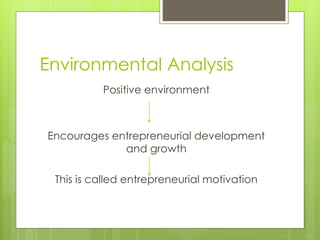
Environmental Analysis
Positive environment
Encourages entrepreneurial development
and growth
This is called entrepreneurial motivation
Greatest Motivation……
Money
But………
It is not alone that inspire an entrepreneur
Other motivating factors are:
ď‚› Internal
ď‚› External
Internal factors
ď‚› Family background
ď‚› Education background
ď‚› Training and work experience
ď‚› Desire for achievement
ď‚› Desire to head a unit
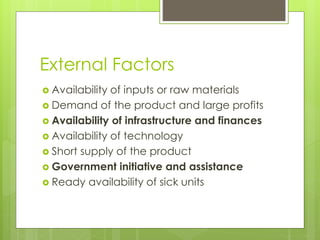
External Factors
ď‚› Availability of inputs or raw materials
ď‚› Demand of the product and large profits
ď‚› Availability of infrastructure and finances
ď‚› Availability of technology
ď‚› Short supply of the product
ď‚› Government initiative and assistance
ď‚› Ready availability of sick units
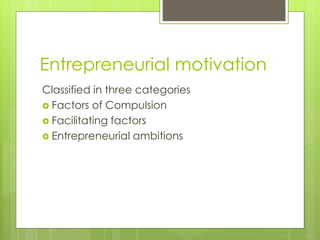
Entrepreneurial motivation
Classified in three categories
ď‚› Factors of Compulsion
ď‚› Facilitating factors
ď‚› Entrepreneurial ambitions
Role of Infrastructural Network
ď‚› The basic infrastructure at the place of
the project help in
ď‚› speedy implementation of the project
ď‚› Reduce costs
ď‚› Increase profitability
ď‚› Better or rapidly improving infrastructure in
a particular area may attract more
entrepreneurs and see enhanced
entrepreneurial activities
Basic infrastructure requirements
Certain infrastructural elements seem to make
substantial impact on the entrepreneurial
environment.
ď‚› modern transport and communication facilities
that provide easy access to suppliers and
customers
ď‚› Road Network
ď‚› Connected to Rail
ď‚› Ports
ď‚› Airport
ď‚› location decisions of based on the
community’s ability to supply trained and
capable workers and on the proximity to
research and development institutions
ď‚› existence of universities and research and
development programs
ď‚› a well-educated and technically skilled
labor force, and
ď‚› Supporting industries
ď‚› Climatic conditions
ď‚› Logistic support
ď‚› Electricity
ď‚› water
Role of Infrastructural Network
ď‚› Most commercial operations such as venture
capital firms and commercial banks tend to
exhibit greater interest in concentrated,
urban areas that usually have a well-
developed infrastructure and concentrated
demand for funds
ď‚› They also favour areas where businesses are
easier to supervise and monitor and the cost
of supervising and monitoring loans is
relatively low

Entrepreneurial environment & infrastructure

  • 1.
  • 2.
     Entrepreneurs arenot born…….they are made right from the childhood  The environment around the entrepreneur makes an entrepreneur
  • 3.
    Environmental factors ď‚› Parents ď‚›Friends ď‚› Teachers ď‚› School atmosphere ď‚› Neighbourhood ď‚› Society around him
  • 4.
    ď‚› Entrepreneurship isthe result of the interaction and assimilation of different social and environmental factors
  • 5.
    Entrepreneurial Environment  EntrepreneurialEnvironment is a combination of factors that play a role in the development of entrepreneurship.  First, it refers to the overall economic, socio- cultural, and political factors that influence people’s willingness and ability to undertake entrepreneurial activities.  Second, it refers to the availability of assistance and support services that facilitate the start-up process.
  • 6.
    ď‚› The availableliterature on entrepreneurial environments can be grouped into three broad streams: ď‚› general environmental conditions for entrepreneurship; ď‚› environmental conditions of a particular country or region; and ď‚› the role of public policy in shaping the entrepreneurial environments.
  • 7.
    General Environmental Conditions ď‚› Generalenvironmental conditions that may influence entrepreneurship include: ď‚› legal and institutional frameworks for efficient functioning of private enterprises ď‚› presence of experienced entrepreneurs and skilled labor force ď‚› accessibility of suppliers and customers or new markets ď‚› high degree of competition among firms ď‚› favorable government policies ď‚› provision of training and support services ď‚› supportive infrastructure
  • 8.
    ď‚› In addition,the literature suggests that the characteristics of people, their skills, experience, and motivation, play important roles in new venture creation
  • 9.
    Country/Region Specific Environmental Conditions ď‚›Countries that keep rules and regulations at a minimum, offer tax and other incentives, and provide training and counselling services to start-up entrepreneurs increase the likelihood of new venture start-ups. ď‚› Furthermore, factors such as availability of financial resources, large size urban areas, and presence of universities for training and research are found to be very important to increase the rate of new venture creation
  • 10.
    ď‚› Studies alsoshow that entrepreneurs face several obstacles, such as lack of financial assistance, lack of information on various aspects of business, excessive taxation, and high rate of inflation.
  • 11.
    Role of PublicPolicy ď‚› Scholars that focused on the role of public policy suggest several policy options for developing entrepreneurship. ď‚› These policy options include provision of ď‚› venture capital funds ď‚› tax-based incentives, and government procurement programs ď‚› protection of proprietary ideas and innovations ď‚› investment in education and research ď‚› explicit recognition of, and support for, entrepreneurship by government agencies ď‚› fostering of entrepreneurship by educational institutions ď‚› and minimization of entry barriers.
  • 12.
    Environmental Analysis Positive environment Encouragesentrepreneurial development and growth This is called entrepreneurial motivation
  • 13.
  • 14.
    Other motivating factorsare: ď‚› Internal ď‚› External
  • 15.
    Internal factors ď‚› Familybackground ď‚› Education background ď‚› Training and work experience ď‚› Desire for achievement ď‚› Desire to head a unit
  • 16.
    External Factors ď‚› Availabilityof inputs or raw materials ď‚› Demand of the product and large profits ď‚› Availability of infrastructure and finances ď‚› Availability of technology ď‚› Short supply of the product ď‚› Government initiative and assistance ď‚› Ready availability of sick units
  • 17.
    Entrepreneurial motivation Classified inthree categories ď‚› Factors of Compulsion ď‚› Facilitating factors ď‚› Entrepreneurial ambitions
  • 18.
  • 19.
    ď‚› The basicinfrastructure at the place of the project help in ď‚› speedy implementation of the project ď‚› Reduce costs ď‚› Increase profitability
  • 20.
    ď‚› Better orrapidly improving infrastructure in a particular area may attract more entrepreneurs and see enhanced entrepreneurial activities
  • 21.
    Basic infrastructure requirements Certaininfrastructural elements seem to make substantial impact on the entrepreneurial environment. ď‚› modern transport and communication facilities that provide easy access to suppliers and customers ď‚› Road Network ď‚› Connected to Rail ď‚› Ports ď‚› Airport
  • 22.
     location decisionsof based on the community’s ability to supply trained and capable workers and on the proximity to research and development institutions
  • 23.
    ď‚› existence ofuniversities and research and development programs ď‚› a well-educated and technically skilled labor force, and
  • 24.
    ď‚› Supporting industries ď‚›Climatic conditions ď‚› Logistic support ď‚› Electricity ď‚› water
  • 25.
    Role of InfrastructuralNetwork ď‚› Most commercial operations such as venture capital firms and commercial banks tend to exhibit greater interest in concentrated, urban areas that usually have a well- developed infrastructure and concentrated demand for funds ď‚› They also favour areas where businesses are easier to supervise and monitor and the cost of supervising and monitoring loans is relatively low