Chapter 16 Lesson 3: Absolute Age Dating – p582–589 – page 1
Vocabulary
 Absolute age (583) – the numerical age, in years, of a rock or object
 Isotope (584) – atoms of the same element that have different numbers of neutrons
 Radioactive decay (584) – the process by which an unstable element naturally changes into
another element that is stable
 Half-life (585) – the time required for half of the parent isotopes to decay into daughter
isotopes
Absolute Age of Rocks
 Absolute age means the ______________________ age, in years, of a rock or object.
o What is your absolute age?
o How is absolute age different from relative age?
 Scientists have been able to determine the absolute ages of rocks and other objects only
since the beginning of the ___________________________ century.
o Once ______________________________ had been discovered.
o Radioactivity is the release of _________________________ from unstable atoms.
Atoms
 You are all familiar with atoms.
o What are the parts of an atom?
o What determines the element of an atom?
o What is in the nucleus of an atom?
o What surrounds the nucleus?
Review of Isotopes
 All atoms of a given element have the same number of _______________________.
o How many protons does a hydrogen atom have?
 However, an element’s atoms can have different numbers of_____________________.
 Atoms of the same element that have different numbers of neutrons are called isotopes.
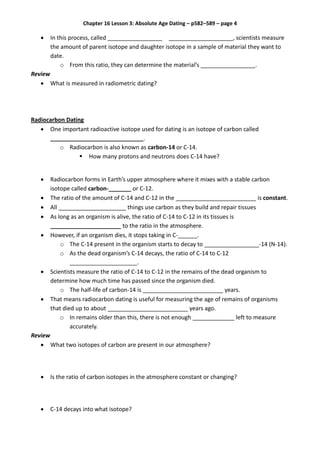
o We name isotopes with the element name and the number of particles
(protons+neutrons) in its nucleus.
Chapter 16 Lesson 3: Absolute Age Dating – p582–589 – page 2
Radioactive Decay
 Most isotopes are________________________________.
o Stable isotopes do not change under normal conditions
 Unstable isotopes are called _______________________________ isotopes.
o Radioactive isotopes _______________________, or change, over time.
o As they decay, they release energy and form _______________, stable atoms.
 Radioactive decay is the process by which an unstable element naturally changes into
another element that is ________________________.
 The unstable isotope that decays is called the ______________________ isotope.
 The new element that forms is called the ____________________________ isotope.
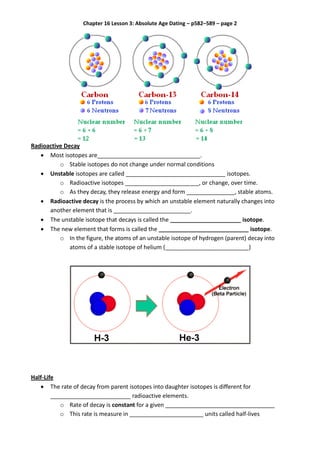
o In the figure, the atoms of an unstable isotope of hydrogen (parent) decay into
atoms of a stable isotope of helium (__________________________)
Half-Life
 The rate of decay from parent isotopes into daughter isotopes is different for
_________________________ radioactive elements.
o Rate of decay is constant for a given __________________________________
o This rate is measure in _______________________ units called half-lives
Chapter 16 Lesson 3: Absolute Age Dating – p582–589 – page 3
 An isotope’s half-life is the time required for ____________________
of the parent isotopes to decay into daughter isotopes.
o Half-lives of radioactive isotopes range from a few
microseconds to _______________________ of years.
 As time passes, more and more unstable parent isotopes decay and
form _______________________ daughter isotopes.
 The means the ratio of parent and daughter isotopes is always
________________________.
 When ______________________ the parent isotopes have decayed
into daughter isotopes, the isotope has reached one half-life.
Half-lives Time
Percentageofremaining
parentatoms
0 1 2 3 4
100
50
25
12.5
6.25
 After one half-life, _________% of the isotopes are parents and _________% of the
isotopes are daughters
 After two half-lives, 50% of the remaining parent isotopes have decayed so that only
___________% of the original parent isotopes remain.
 This process continues until nearly all parent isotopes have decayed into daughter
isotopes.
Radiometric Ages
 Because radioactive isotopes decay at a constant rate, they can be used like
_____________________ to measure the age of the material that contains them.
Chapter 16 Lesson 3: Absolute Age Dating – p582–589 – page 4
 In this process, called _________________ ____________________, scientists measure
the amount of parent isotope and daughter isotope in a sample of material they want to
date.
o From this ratio, they can determine the material’s _________________.
Review
 What is measured in radiometric dating?
Radiocarbon Dating
 One important radioactive isotope used for dating is an isotope of carbon called
_____________________________.
o Radiocarbon is also known as carbon-14 or C-14.
 How many protons and neutrons does C-14 have?
 Radiocarbon forms in Earth’s upper atmosphere where it mixes with a stable carbon
isotope called carbon-_______ or C-12.
 The ratio of the amount of C-14 and C-12 in the _________________________ is constant.
 All _____________________ things use carbon as they build and repair tissues
 As long as an organism is alive, the ratio of C-14 to C-12 in its tissues is
______________________ to the ratio in the atmosphere.
 However, if an organism dies, it stops taking in C-______.
o The C-14 present in the organism starts to decay to _________________-14 (N-14).
o As the dead organism’s C-14 decays, the ratio of C-14 to C-12
_____________________.
 Scientists measure the ratio of C-14 to C-12 in the remains of the dead organism to
determine how much time has passed since the organism died.
o The half-life of carbon-14 is _________________________ years.
 That means radiocarbon dating is useful for measuring the age of remains of organisms
that died up to about _________________________ years ago.
o In remains older than this, there is not enough _____________ left to measure
accurately.
Review
 What two isotopes of carbon are present in our atmosphere?
 Is the ratio of carbon isotopes in the atmosphere constant or changing?
 C-14 decays into what isotope?
Chapter 16 Lesson 3: Absolute Age Dating – p582–589 – page 5
 Should we expect more C-14 or N-14 in an organism that has been dead for 40,000 years?
Dating Rocks
 Radiocarbon dating is useful only for dating
_____________________ material – material from
once-living organisms.
o This material includes bones, _________________,
parchment, and charcoal.
 Most rocks do not contain __________________________
material.
 Even most ________________________ are no longer
organic.
o Their living tissue has been replaced by rock-forming
_______________________.
 So, for dating rocks, geologists use different kinds of
radioactive isotopes.
Dating Igneous Rock
 One of the most common isotopes used in radiometric dating is
___________________________ or U-235.
 U-235 is often trapped in the minerals of ____________________ rocks that crystallize
from hot, molten magma.
 As soon as it is trapped in a mineral, U-235 decays into ____________________ or Pb-207.
o What ratio would scientists use to determine how much time has passed since the
mineral was formed?
o Which isotope should there be more of it the rock is older than one half-life?
Chapter 16 Lesson 3: Absolute Age Dating – p582–589 – page 6
Draw a graph of U-235 decay.
 One half-life equals .704 billion years
Dating Sedimentary Rock
 How does sedimentary rock form?
 In order to be dated by radiometric means, that ___________________ that formed the
rock must contain U-235.
o The grains of sedimentary rocks come from a variety of weathered rocks from
different _________________________.
 However, by measuring U-235 would scientist be getting the date that the sedimentary
rock formed or the date that the grain of sediment formed?
 Radioactive isotopes within these grains generally record the ages of the
______________________ – not when the sediment was deposited.
 For this reason, sedimentary rock is not as __________________ to date as igneous rock
Chapter 16 Lesson 3: Absolute Age Dating – p582–589 – page 7
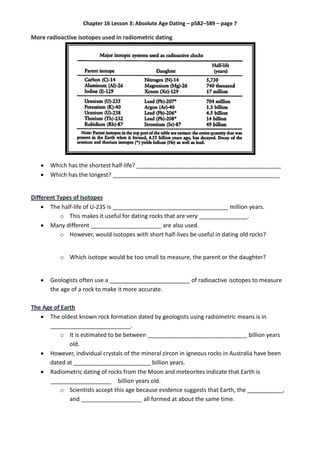
More radioactive isotopes used in radiometric dating
 Which has the shortest half-life? _____________________________________________
 Which has the longest? ____________________________________________________
Different Types of Isotopes
 The half-life of U-235 is ____________________________________ million years.
o This makes it useful for dating rocks that are very _______________.
 Many different ______________________ are also used.
o However, would isotopes with short half-lives be useful in dating old rocks?
o Which isotope would be too small to measure, the parent or the daughter?
 Geologists often use a _________________________ of radioactive isotopes to measure
the age of a rock to make it more accurate.
The Age of Earth
 The oldest known rock formation dated by geologists using radiometric means is in
_________________________.
o It is estimated to be between _______________________________ billion years
old.
 However, individual crystals of the mineral zircon in igneous rocks in Australia have been
dated at ________________________ billion years.
 Radiometric dating of rocks from the Moon and meteorites indicate that Earth is
___________________ billion years old.
o Scientists accept this age because evidence suggests that Earth, the ___________,
and ___________________ all formed at about the same time.
Chapter 16 Lesson 3: Absolute Age Dating – p582–589 – page 8
*** Extra Figures***
Chapter 16 Lesson 3: Absolute Age Dating – p582–589 – page 9

Outline: Chapter 16.3: Absolute Age Dating

  • 1.
    Chapter 16 Lesson3: Absolute Age Dating – p582–589 – page 1 Vocabulary  Absolute age (583) – the numerical age, in years, of a rock or object  Isotope (584) – atoms of the same element that have different numbers of neutrons  Radioactive decay (584) – the process by which an unstable element naturally changes into another element that is stable  Half-life (585) – the time required for half of the parent isotopes to decay into daughter isotopes Absolute Age of Rocks  Absolute age means the ______________________ age, in years, of a rock or object. o What is your absolute age? o How is absolute age different from relative age?  Scientists have been able to determine the absolute ages of rocks and other objects only since the beginning of the ___________________________ century. o Once ______________________________ had been discovered. o Radioactivity is the release of _________________________ from unstable atoms. Atoms  You are all familiar with atoms. o What are the parts of an atom? o What determines the element of an atom? o What is in the nucleus of an atom? o What surrounds the nucleus? Review of Isotopes  All atoms of a given element have the same number of _______________________. o How many protons does a hydrogen atom have?  However, an element’s atoms can have different numbers of_____________________.  Atoms of the same element that have different numbers of neutrons are called isotopes. o We name isotopes with the element name and the number of particles (protons+neutrons) in its nucleus.
  • 2.
    Chapter 16 Lesson3: Absolute Age Dating – p582–589 – page 2 Radioactive Decay  Most isotopes are________________________________. o Stable isotopes do not change under normal conditions  Unstable isotopes are called _______________________________ isotopes. o Radioactive isotopes _______________________, or change, over time. o As they decay, they release energy and form _______________, stable atoms.  Radioactive decay is the process by which an unstable element naturally changes into another element that is ________________________.  The unstable isotope that decays is called the ______________________ isotope.  The new element that forms is called the ____________________________ isotope. o In the figure, the atoms of an unstable isotope of hydrogen (parent) decay into atoms of a stable isotope of helium (__________________________) Half-Life  The rate of decay from parent isotopes into daughter isotopes is different for _________________________ radioactive elements. o Rate of decay is constant for a given __________________________________ o This rate is measure in _______________________ units called half-lives
  • 3.
    Chapter 16 Lesson3: Absolute Age Dating – p582–589 – page 3  An isotope’s half-life is the time required for ____________________ of the parent isotopes to decay into daughter isotopes. o Half-lives of radioactive isotopes range from a few microseconds to _______________________ of years.  As time passes, more and more unstable parent isotopes decay and form _______________________ daughter isotopes.  The means the ratio of parent and daughter isotopes is always ________________________.  When ______________________ the parent isotopes have decayed into daughter isotopes, the isotope has reached one half-life. Half-lives Time Percentageofremaining parentatoms 0 1 2 3 4 100 50 25 12.5 6.25  After one half-life, _________% of the isotopes are parents and _________% of the isotopes are daughters  After two half-lives, 50% of the remaining parent isotopes have decayed so that only ___________% of the original parent isotopes remain.  This process continues until nearly all parent isotopes have decayed into daughter isotopes. Radiometric Ages  Because radioactive isotopes decay at a constant rate, they can be used like _____________________ to measure the age of the material that contains them.
  • 4.
    Chapter 16 Lesson3: Absolute Age Dating – p582–589 – page 4  In this process, called _________________ ____________________, scientists measure the amount of parent isotope and daughter isotope in a sample of material they want to date. o From this ratio, they can determine the material’s _________________. Review  What is measured in radiometric dating? Radiocarbon Dating  One important radioactive isotope used for dating is an isotope of carbon called _____________________________. o Radiocarbon is also known as carbon-14 or C-14.  How many protons and neutrons does C-14 have?  Radiocarbon forms in Earth’s upper atmosphere where it mixes with a stable carbon isotope called carbon-_______ or C-12.  The ratio of the amount of C-14 and C-12 in the _________________________ is constant.  All _____________________ things use carbon as they build and repair tissues  As long as an organism is alive, the ratio of C-14 to C-12 in its tissues is ______________________ to the ratio in the atmosphere.  However, if an organism dies, it stops taking in C-______. o The C-14 present in the organism starts to decay to _________________-14 (N-14). o As the dead organism’s C-14 decays, the ratio of C-14 to C-12 _____________________.  Scientists measure the ratio of C-14 to C-12 in the remains of the dead organism to determine how much time has passed since the organism died. o The half-life of carbon-14 is _________________________ years.  That means radiocarbon dating is useful for measuring the age of remains of organisms that died up to about _________________________ years ago. o In remains older than this, there is not enough _____________ left to measure accurately. Review  What two isotopes of carbon are present in our atmosphere?  Is the ratio of carbon isotopes in the atmosphere constant or changing?  C-14 decays into what isotope?
  • 5.
    Chapter 16 Lesson3: Absolute Age Dating – p582–589 – page 5  Should we expect more C-14 or N-14 in an organism that has been dead for 40,000 years? Dating Rocks  Radiocarbon dating is useful only for dating _____________________ material – material from once-living organisms. o This material includes bones, _________________, parchment, and charcoal.  Most rocks do not contain __________________________ material.  Even most ________________________ are no longer organic. o Their living tissue has been replaced by rock-forming _______________________.  So, for dating rocks, geologists use different kinds of radioactive isotopes. Dating Igneous Rock  One of the most common isotopes used in radiometric dating is ___________________________ or U-235.  U-235 is often trapped in the minerals of ____________________ rocks that crystallize from hot, molten magma.  As soon as it is trapped in a mineral, U-235 decays into ____________________ or Pb-207. o What ratio would scientists use to determine how much time has passed since the mineral was formed? o Which isotope should there be more of it the rock is older than one half-life?
  • 6.
    Chapter 16 Lesson3: Absolute Age Dating – p582–589 – page 6 Draw a graph of U-235 decay.  One half-life equals .704 billion years Dating Sedimentary Rock  How does sedimentary rock form?  In order to be dated by radiometric means, that ___________________ that formed the rock must contain U-235. o The grains of sedimentary rocks come from a variety of weathered rocks from different _________________________.  However, by measuring U-235 would scientist be getting the date that the sedimentary rock formed or the date that the grain of sediment formed?  Radioactive isotopes within these grains generally record the ages of the ______________________ – not when the sediment was deposited.  For this reason, sedimentary rock is not as __________________ to date as igneous rock
  • 7.
    Chapter 16 Lesson3: Absolute Age Dating – p582–589 – page 7 More radioactive isotopes used in radiometric dating  Which has the shortest half-life? _____________________________________________  Which has the longest? ____________________________________________________ Different Types of Isotopes  The half-life of U-235 is ____________________________________ million years. o This makes it useful for dating rocks that are very _______________.  Many different ______________________ are also used. o However, would isotopes with short half-lives be useful in dating old rocks? o Which isotope would be too small to measure, the parent or the daughter?  Geologists often use a _________________________ of radioactive isotopes to measure the age of a rock to make it more accurate. The Age of Earth  The oldest known rock formation dated by geologists using radiometric means is in _________________________. o It is estimated to be between _______________________________ billion years old.  However, individual crystals of the mineral zircon in igneous rocks in Australia have been dated at ________________________ billion years.  Radiometric dating of rocks from the Moon and meteorites indicate that Earth is ___________________ billion years old. o Scientists accept this age because evidence suggests that Earth, the ___________, and ___________________ all formed at about the same time.
  • 8.
    Chapter 16 Lesson3: Absolute Age Dating – p582–589 – page 8 *** Extra Figures***
  • 9.
    Chapter 16 Lesson3: Absolute Age Dating – p582–589 – page 9