1. Introduction
2.History
3.Chemical properties
4.Nuclear properties
5.Importance of Rb-Sr dating
6.Methodology for dating
7.Source of Rb-Sr
8.Isochron equation
9.Sources of error/ limitations
10.Uses
11.Reference
   The rubidium-strontium dating method is a
    radiometric dating technique used by scientists to
    determine the age of rocks and minerals from the
    quantities they contain of specific isotopes of
    rubidium (87Rb) and strontium ( 87Sr, 86Sr).
   Development of this process was aided by
    German chemist Fritz Strassmann, who later went
    on to discover nuclear fission with German
    chemist Otto Hahn and Swedish physicist
    Lise Meitner.
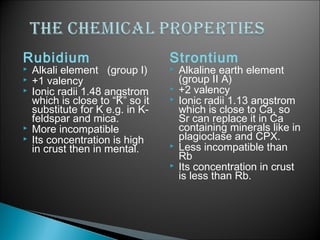
Rubidium                          Strontium
   Alkali element (group I)         Alkaline earth element
   +1 valency                        (group II A)
   Ionic radii 1.48 angstrom        +2 valency
    which is close to “K” so it      Ionic radii 1.13 angstrom
    substitute for K e.g. in K-       which is close to Ca, so
    feldspar and mica.                Sr can replace it in Ca
   More incompatible                 containing minerals like in
   Its concentration is high         plagioclase and CPX.
    in crust then in mental.         Less incompatible than
                                      Rb
                                     Its concentration in crust
                                      is less than Rb.
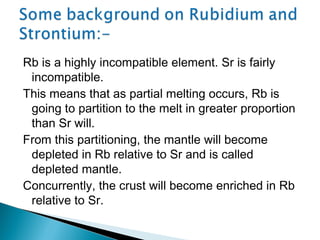
Rb is a highly incompatible element. Sr is fairly
 incompatible.
This means that as partial melting occurs, Rb is
 going to partition to the melt in greater proportion
 than Sr will.
From this partitioning, the mantle will become
 depleted in Rb relative to Sr and is called
 depleted mantle.
Concurrently, the crust will become enriched in Rb
 relative to Sr.
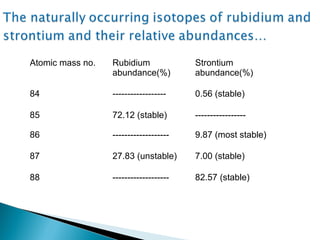
Atomic mass no.   Rubidium              Strontium
                  abundance(%)          abundance(%)

84                ------------------    0.56 (stable)

85                72.12 (stable)        -----------------

86                -------------------   9.87 (most stable)

87                27.83 (unstable)      7.00 (stable)

88                -------------------   82.57 (stable)
   The element rubidium consists of two isotopes
    having atomic mass numbers of 85 (72.16%) and
    87 (27.84%).

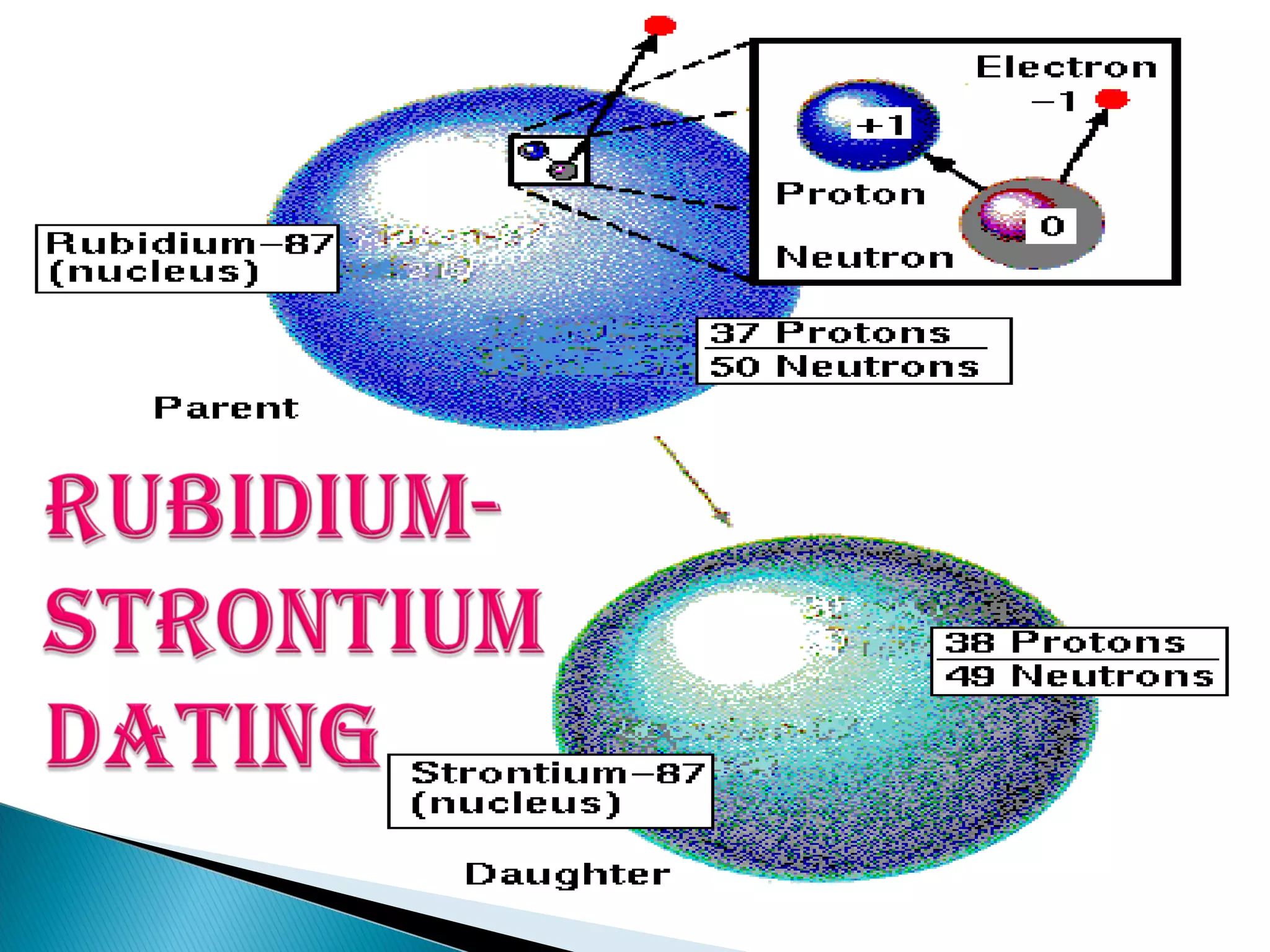
   Rb decays to 87Sr by a weak b- emission.  The
    decay constant is :- l = 1.42 x 10⁻¹¹ /yr.
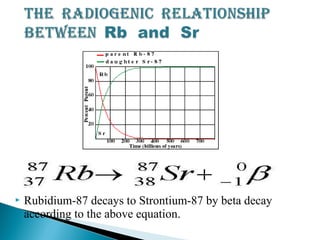
   Rubidium-87 decays to Strontium-87 by beta decay
    according to the above equation.
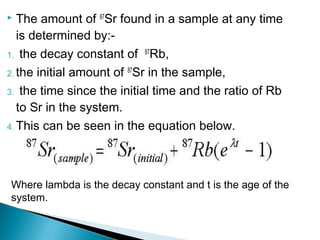
  The amount of 87Sr found in a sample at any time
   is determined by:-
1. the decay constant of  87Rb,

2. the initial amount of 87Sr in the sample,

3. the time since the initial time and the ratio of Rb
   to Sr in the system.
4. This can be seen in the equation below.


Where lambda is the decay constant and t is the age of the
system.
   The utility of the rubidium-strontium isotope
    system results from the fact that :-

•    87Rb (one of two naturally occurring isotopes of
    rubidium) decays to 87Sr with a half-life of 48.8 billion
    years.
•   Rb is a highly incompatible element that, during
    fractional crystallization of the mantle, stays in the
    magmatic melt rather than becoming part of mantle
    minerals.
•   The radiogenic daughter, 87Sr, is produced in this decay
    process and was produced in the original primordial
    nucleosynthesis of the universe.
  Different minerals gives different ratios of
   radiogenic strontium-87 to naturally occurring
   strontium-86 (87Sr/86Sr) through time; and their
   age can be calculated by:-
1. measuring the 87Sr/86Sr in a mass spectrometer,
2. knowing the amount of 87Sr present when the
   rock or mineral formed,
3. and calculating the amount of 87Rb from a
   measurement of the Rb present
4. and knowledge of the 85Rb/87Rb weight ratio.
 Ifthese minerals crystallized from the
  same silicic melt, each mineral had the
  same initial 87Sr/86Sr as the parent melt.
  However, because Rb substitutes for K in
  minerals and these minerals have different
  K/Ca ratios, the minerals will have had
  different Rb/Sr ratios.
   During fractional crystallization, Sr tends to become
    concentrated in plagioclase, leaving Rb in the liquid
    phase.

   Hence, the Rb/Sr ratio in residual magma may increase
    over time, resulting in rocks with increasing Rb/Sr ratios
    with increasing differentiation.

   Typically, Rb/Sr increases in the order:- plagioclase,
    hornblende, K-feldspar, biotite, muscovite.

   Therefore, given sufficient time for significant
    production (ingrowth) of radiogenic 87Sr, measured
    87
      Sr/86Sr values will be different in the minerals,
    increasing in the same order.
   Consider the case of an igneous rock such as a granite
    that contains several major Sr-bearing minerals
    including plagioclase feldspar, K-feldspar, hornblende,
    biotite, and muscovite.
   Each of these minerals has a different initial
    rubidium/strontium ratio dependent on their potassium
    content, the concentration of Rb and K in the melt and
    the temperature at which the minerals formed.
   Rubidium substitutes for potassium within the lattice of
    minerals at a rate proportional to its concentration within
    the melt.
   The ideal scenario according to Bowen's reaction series
    would see a granite melt begin crystallizing a cumulate
    assemblage of plagioclase and hornblende (i.e.; tonalite
    or diorite), which is low in K (and hence Rb) but high in
    Sr (as this substitutes for Ca), which proportionally
    enriches the melt in K and Rb.
   This then causes orthoclase and biotite, both K rich
    minerals into which Rb can substitute, to precipitate.
   The resulting Rb-Sr ratios and Rb and Sr abundances of
    both the whole rocks and their component minerals will
    be markedly different.
    This, thus, allows a different rate of radiogenic Sr to
    evolve in the separate rocks and their component
    minerals as time progresses.
   The age of a sample is determined by analyzing
    several minerals within the sample.

   The 87Sr/86Sr ratio for each sample is plotted against
    its 87Rb/86Sr ratio on a graph called an isochron .

   If these form a straight line then the samples are
    consistent, and the age probably reliable.

   The slope of the line dictates the age of the sample.
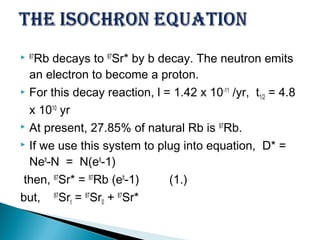
 87Rb decays to 87Sr* by b decay. The neutron emits
  an electron to become a proton.
 For this decay reaction, l = 1.42 x 10⁻¹¹ /yr,  t  = 4.8
                                                   1/2

  x 1010 yr
 At present, 27.85% of natural Rb is 87Rb.

 If we use this system to plug into equation, D* =

  Nelt-N  =  N(elt-1)
 then, 87Sr* = 87Rb (elt-1)         (1.)
but, 87Srt = 87Sr0 + 87Sr*
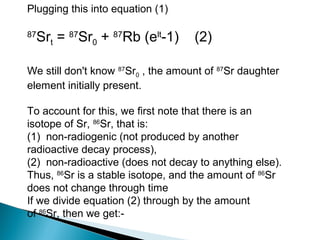
Plugging this into equation (1)

87
  Srt = 87Sr0 + 87Rb (elt-1)        (2)

We still don't know 87Sr0 , the amount of 87Sr daughter
element initially present.

To account for this, we first note that there is an
isotope of Sr, 86Sr, that is:
(1) non-radiogenic (not produced by another
radioactive decay process),
(2) non-radioactive (does not decay to anything else).
Thus, 86Sr is a stable isotope, and the amount of 86Sr
does not change through time
If we divide equation (2) through by the amount
of 86Sr, then we get:-
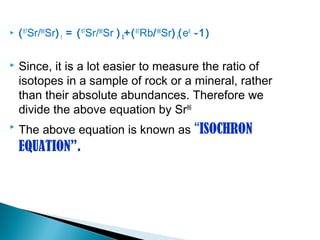
   ( 87Sr/86Sr) t = ( 87Sr/86Sr ) 0+( 87Rb/ 86Sr) t(elt -1)

   Since, it is a lot easier to measure the ratio of
    isotopes in a sample of rock or a mineral, rather
    than their absolute abundances. Therefore we
    divide the above equation by Sr86
   The above equation is known as “ISOCHRON
    EQUATION”.
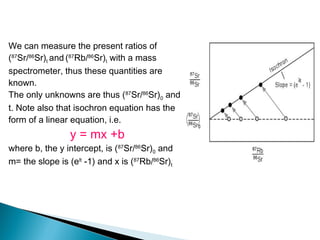
We can measure the present ratios of
(87Sr/86Sr)t and (87Rb/86Sr)t with a mass
spectrometer, thus these quantities are
known.
The only unknowns are thus (87Sr/86Sr)0 and
t. Note also that isochron equation has the
form of a linear equation, i.e.
                 y = mx +b
where b, the y intercept, is (87Sr/86Sr)0 and
m= the slope is (elt -1) and x is (87Rb/86Sr)t 
 
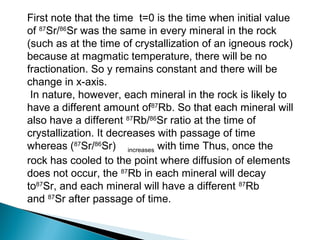
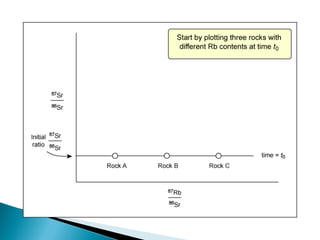
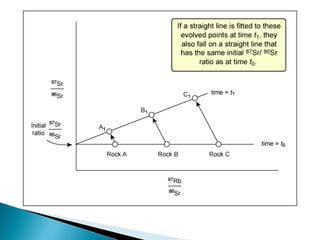
First note that the time t=0 is the time when initial value
of 87Sr/86Sr was the same in every mineral in the rock
(such as at the time of crystallization of an igneous rock)
because at magmatic temperature, there will be no
fractionation. So y remains constant and there will be
change in x-axis.
 In nature, however, each mineral in the rock is likely to
have a different amount of87Rb. So that each mineral will
also have a different 87Rb/86Sr ratio at the time of
crystallization. It decreases with passage of time
whereas (87Sr/86Sr) increases with time Thus, once the
rock has cooled to the point where diffusion of elements
does not occur, the 87Rb in each mineral will decay
to87Sr, and each mineral will have a different 87Rb
and 87Sr after passage of time.
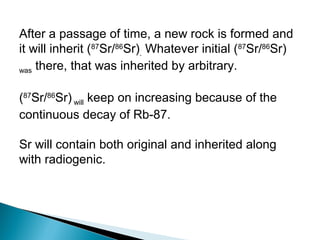
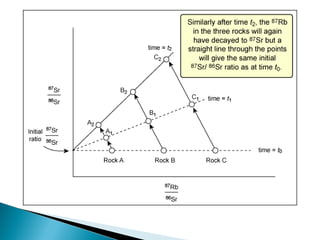
After a passage of time, a new rock is formed and
it will inherit (87Sr/86Sr). Whatever initial (87Sr/86Sr)
was there, that was inherited by arbitrary.


(87Sr/86Sr) will keep on increasing because of the
continuous decay of Rb-87.

Sr will contain both original and inherited along
with radiogenic.
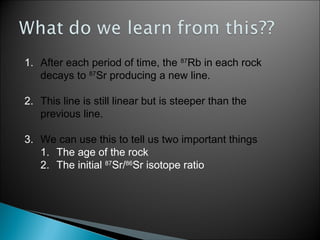
1. After each period of time, the 87Rb in each rock
   decays to 87Sr producing a new line.

2. This line is still linear but is steeper than the
   previous line.

3. We can use this to tell us two important things
   1. The age of the rock
   2. The initial 87Sr/86Sr isotope ratio
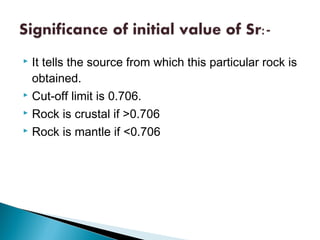
 It tells the source from which this particular rock is
  obtained.
 Cut-off limit is 0.706.

 Rock is crustal if >0.706

 Rock is mantle if <0.706
 If samples are clustered then we can’t get the
  value of isochron.
 There should be large variation between Rb

  isotope.
 There should be large spread in Rb/Sr ratio i.e

  high and low value.
 If initial ratio is not uniform then also we don’t get

  isochron. So, composition of daughter must be
  homogenous when a new rock is formed.
 Rb and Sr are mobile elements. Any rock which is
  slightly altered, these elements will leach out.
 In this case, we get younger age i.e wrong age

  than actual age.
 Since basaltic rock has more alteration as

  compare to granitic rock so they are not preferred.
 So mostly mantle derived rocks would not

  generate a good Rb-Sr isochron.
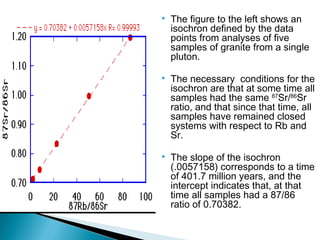
   The figure to the left shows an
    isochron defined by the data
    points from analyses of five
    samples of granite from a single
    pluton.

   The necessary  conditions for the
    isochron are that at some time all
    samples had the same 87Sr/86Sr
    ratio, and that since that time, all
    samples have remained closed
    systems with respect to Rb and
    Sr.

   The slope of the isochron
    (.0057158) corresponds to a time
    of 401.7 million years, and the
    intercept indicates that, at that
    time all samples had a 87/86
    ratio of 0.70382.
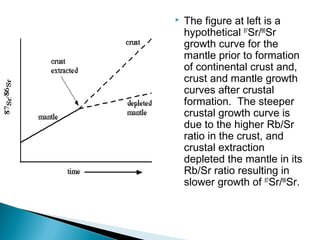
   The figure at left is a
    hypothetical 87Sr/86Sr
    growth curve for the
    mantle prior to formation
    of continental crust and,
    crust and mantle growth
    curves after crustal
    formation.  The steeper
    crustal growth curve is
    due to the higher Rb/Sr
    ratio in the crust, and
    crustal extraction
    depleted the mantle in its
    Rb/Sr ratio resulting in
    slower growth of 87Sr/86Sr.
   Rb-Sr dating relies on correctly measuring the Rb-Sr
    ratio of a mineral or whole rock sample, plus deriving an
    accurate 87Sr/86Sr ratio for the mineral or whole rock
    sample.
   Several preconditions must be satisfied before a Rb-Sr
    date can be considered as representing the time of
    emplacement or formation of a rock.
   The system must have remained closed to Rb and Sr
    diffusion from the time at which the rock formed or fell
    below the closure temperature i.e  the temperature at
    which a system has cooled so that there is no longer any
    significant diffusion of the daughter isotopes out of the
    system and into the external environment (generally
    considered to be 650 °C);
   The minerals which are taken from a rock to construct an
    isochron must have formed in chemical equilibrium with
    one another or in the case of sediments, be deposited at
    the same time;
   The rock must not have undergone any metasomatism
    (i.e. the chemical alteration of
    a rock by hydrothermal and other fluids) which could
    have disturbed the Rb-Sr system either thermally or
    chemically
   One of the major drawbacks of utilizing Rb and Sr to
    derive a radiometric date is their relative mobility,
    especially in hydrothermal fluids. Rb and Sr are relatively
    mobile alkaline elements and as such are relatively
    easily moved around by the hot hydrothermal fluids
    present during metamorphism.
   Conversely, these fluids may metasomatically alter a
    rock, introducing new Rb and Sr into the rock. Rb-Sr can
    then be used on the altered mineralogy to date the time
    of this alteration, but not the date at which the rock
    formed.
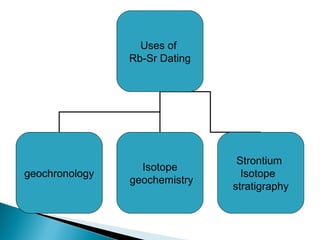
Uses of
                Rb-Sr Dating


                                Strontium
                  Isotope
geochronology                    Isotope
                geochemistry
                               stratigraphy
Geochronology
   If the initial amount of Sr is known or can be
    extrapolated, the age can be determined by
    measurement of the Rb and Sr concentrations and
    the 87Sr/86Sr ratio. The dates indicate the true age of
    the minerals only if the rocks have not been
    subsequently altered.

   The important concept in isotopic tracing is that Sr
    derived from any mineral through weathering
    reactions will have the same 87Sr/86Sr as the mineral.
   Initial 87Sr/86Sr ratios are a useful tool in archaeology,
    forensics and paleontology because the 87Sr/86Sr of a
    skeleton, sea shell or indeed a clay artifact is directly
    comparable to the source rocks upon which it was
    formed or upon which the organism lived. Thus, by
    measuring the current-day 87Sr/86Sr ratio, the
    geological fingerprint of an object or skeleton can be
    measured, allowing migration patterns to be
    determined.
   Strontium isotope stratigraphy relies on recognized
    variations in the 87Sr/86Sr ratio of seawater over time. The
    application of Sr isotope stratigraphy is generally limited to
    carbonate samples for which the Sr seawater curve is well
    defined. This is well known for the Cenozoic time-scale
    but, due to poorer preservation of carbonate sequences in
    the Mesozoic and earlier, it is not completely understood
    for older sequences.

   In older sequences diagenetic alteration combined with
    greater uncertainties in estimating absolute ages due to
    lack of overlap between other geochronometers (for
    example U-Th leads to greater uncertainties in the exact
    shape of the Sr isotope seawater curve.
   Jacobsen S.B., Wills J., Yin Q., 2000. Seawater isotope records, crustal
    evolution, tectonics and atmospheric evolution. Proceedings, Seventh Annual
    V.M. Goldschmidt Conference, 2000. PDF abstract

   USGS (2004) Resources on Isotopes:Strontium,
    http://wwwrcamnl.wr.usgs.gov/isoig/period/sr_iig.html.

   Attendorn, H. -G.; Bowen, Robert (1988). "Rubidium-Strontium Dating". Isotopes
    in the Earth Sciences. Springer. pp. 162–165. http://books.google.de/books?
    id=k90iAnFereYC&pg=PA162.

   Walther, John Victor (1988 2009). "Rubidium-Strontium Systematics". Essentials
    of geochemistry. Jones & Bartlett Learning. pp. 383–385.
    http://books.google.de/books?id=cYWNAZbPhMYC&pg=PA383

   ISOTOPE GEOLOGY by ‘CLAUDE.J.ALLEGRE’.. The Cambridge Publication
    UNITED KINGDOM.
THANK

The rubidium strontium dating

  • 2.
    1. Introduction 2.History 3.Chemical properties 4.Nuclearproperties 5.Importance of Rb-Sr dating 6.Methodology for dating 7.Source of Rb-Sr 8.Isochron equation 9.Sources of error/ limitations 10.Uses 11.Reference
  • 3.
    The rubidium-strontium dating method is a radiometric dating technique used by scientists to determine the age of rocks and minerals from the quantities they contain of specific isotopes of rubidium (87Rb) and strontium ( 87Sr, 86Sr).
  • 4.
    Development of this process was aided by German chemist Fritz Strassmann, who later went on to discover nuclear fission with German chemist Otto Hahn and Swedish physicist Lise Meitner.
  • 5.
    Rubidium Strontium  Alkali element (group I)  Alkaline earth element  +1 valency (group II A)  Ionic radii 1.48 angstrom  +2 valency which is close to “K” so it  Ionic radii 1.13 angstrom substitute for K e.g. in K- which is close to Ca, so feldspar and mica. Sr can replace it in Ca  More incompatible containing minerals like in  Its concentration is high plagioclase and CPX. in crust then in mental.  Less incompatible than Rb  Its concentration in crust is less than Rb.
  • 7.
    Rb is ahighly incompatible element. Sr is fairly incompatible. This means that as partial melting occurs, Rb is going to partition to the melt in greater proportion than Sr will. From this partitioning, the mantle will become depleted in Rb relative to Sr and is called depleted mantle. Concurrently, the crust will become enriched in Rb relative to Sr.
  • 8.
    Atomic mass no. Rubidium Strontium abundance(%) abundance(%) 84 ------------------ 0.56 (stable) 85 72.12 (stable) ----------------- 86 ------------------- 9.87 (most stable) 87 27.83 (unstable) 7.00 (stable) 88 ------------------- 82.57 (stable)
  • 9.
    The element rubidium consists of two isotopes having atomic mass numbers of 85 (72.16%) and 87 (27.84%).  Rb decays to 87Sr by a weak b- emission.  The decay constant is :- l = 1.42 x 10⁻¹¹ /yr.
  • 10.
    Rubidium-87 decays to Strontium-87 by beta decay according to the above equation.
  • 11.
     Theamount of 87Sr found in a sample at any time is determined by:- 1. the decay constant of  87Rb, 2. the initial amount of 87Sr in the sample, 3. the time since the initial time and the ratio of Rb to Sr in the system. 4. This can be seen in the equation below. Where lambda is the decay constant and t is the age of the system.
  • 12.
    The utility of the rubidium-strontium isotope system results from the fact that :- •  87Rb (one of two naturally occurring isotopes of rubidium) decays to 87Sr with a half-life of 48.8 billion years. • Rb is a highly incompatible element that, during fractional crystallization of the mantle, stays in the magmatic melt rather than becoming part of mantle minerals. • The radiogenic daughter, 87Sr, is produced in this decay process and was produced in the original primordial nucleosynthesis of the universe.
  • 13.
     Differentminerals gives different ratios of radiogenic strontium-87 to naturally occurring strontium-86 (87Sr/86Sr) through time; and their age can be calculated by:- 1. measuring the 87Sr/86Sr in a mass spectrometer, 2. knowing the amount of 87Sr present when the rock or mineral formed, 3. and calculating the amount of 87Rb from a measurement of the Rb present 4. and knowledge of the 85Rb/87Rb weight ratio.
  • 14.
     Ifthese mineralscrystallized from the same silicic melt, each mineral had the same initial 87Sr/86Sr as the parent melt. However, because Rb substitutes for K in minerals and these minerals have different K/Ca ratios, the minerals will have had different Rb/Sr ratios.
  • 15.
    During fractional crystallization, Sr tends to become concentrated in plagioclase, leaving Rb in the liquid phase.  Hence, the Rb/Sr ratio in residual magma may increase over time, resulting in rocks with increasing Rb/Sr ratios with increasing differentiation.  Typically, Rb/Sr increases in the order:- plagioclase, hornblende, K-feldspar, biotite, muscovite.  Therefore, given sufficient time for significant production (ingrowth) of radiogenic 87Sr, measured 87 Sr/86Sr values will be different in the minerals, increasing in the same order.
  • 16.
    Consider the case of an igneous rock such as a granite that contains several major Sr-bearing minerals including plagioclase feldspar, K-feldspar, hornblende, biotite, and muscovite.  Each of these minerals has a different initial rubidium/strontium ratio dependent on their potassium content, the concentration of Rb and K in the melt and the temperature at which the minerals formed.  Rubidium substitutes for potassium within the lattice of minerals at a rate proportional to its concentration within the melt.
  • 17.
    The ideal scenario according to Bowen's reaction series would see a granite melt begin crystallizing a cumulate assemblage of plagioclase and hornblende (i.e.; tonalite or diorite), which is low in K (and hence Rb) but high in Sr (as this substitutes for Ca), which proportionally enriches the melt in K and Rb.  This then causes orthoclase and biotite, both K rich minerals into which Rb can substitute, to precipitate.  The resulting Rb-Sr ratios and Rb and Sr abundances of both the whole rocks and their component minerals will be markedly different.  This, thus, allows a different rate of radiogenic Sr to evolve in the separate rocks and their component minerals as time progresses.
  • 18.
    The age of a sample is determined by analyzing several minerals within the sample.  The 87Sr/86Sr ratio for each sample is plotted against its 87Rb/86Sr ratio on a graph called an isochron .  If these form a straight line then the samples are consistent, and the age probably reliable.  The slope of the line dictates the age of the sample.
  • 19.
     87Rb decaysto 87Sr* by b decay. The neutron emits an electron to become a proton.  For this decay reaction, l = 1.42 x 10⁻¹¹ /yr,  t  = 4.8 1/2 x 1010 yr  At present, 27.85% of natural Rb is 87Rb.  If we use this system to plug into equation, D* = Nelt-N  =  N(elt-1) then, 87Sr* = 87Rb (elt-1)         (1.) but, 87Srt = 87Sr0 + 87Sr*
  • 20.
    Plugging this intoequation (1) 87 Srt = 87Sr0 + 87Rb (elt-1) (2) We still don't know 87Sr0 , the amount of 87Sr daughter element initially present. To account for this, we first note that there is an isotope of Sr, 86Sr, that is: (1) non-radiogenic (not produced by another radioactive decay process), (2) non-radioactive (does not decay to anything else). Thus, 86Sr is a stable isotope, and the amount of 86Sr does not change through time If we divide equation (2) through by the amount of 86Sr, then we get:-
  • 21.
    ( 87Sr/86Sr) t = ( 87Sr/86Sr ) 0+( 87Rb/ 86Sr) t(elt -1)  Since, it is a lot easier to measure the ratio of isotopes in a sample of rock or a mineral, rather than their absolute abundances. Therefore we divide the above equation by Sr86  The above equation is known as “ISOCHRON EQUATION”.
  • 22.
    We can measurethe present ratios of (87Sr/86Sr)t and (87Rb/86Sr)t with a mass spectrometer, thus these quantities are known. The only unknowns are thus (87Sr/86Sr)0 and t. Note also that isochron equation has the form of a linear equation, i.e. y = mx +b where b, the y intercept, is (87Sr/86Sr)0 and m= the slope is (elt -1) and x is (87Rb/86Sr)t   
  • 23.
    First note thatthe time t=0 is the time when initial value of 87Sr/86Sr was the same in every mineral in the rock (such as at the time of crystallization of an igneous rock) because at magmatic temperature, there will be no fractionation. So y remains constant and there will be change in x-axis. In nature, however, each mineral in the rock is likely to have a different amount of87Rb. So that each mineral will also have a different 87Rb/86Sr ratio at the time of crystallization. It decreases with passage of time whereas (87Sr/86Sr) increases with time Thus, once the rock has cooled to the point where diffusion of elements does not occur, the 87Rb in each mineral will decay to87Sr, and each mineral will have a different 87Rb and 87Sr after passage of time.
  • 25.
    After a passageof time, a new rock is formed and it will inherit (87Sr/86Sr). Whatever initial (87Sr/86Sr) was there, that was inherited by arbitrary. (87Sr/86Sr) will keep on increasing because of the continuous decay of Rb-87. Sr will contain both original and inherited along with radiogenic.
  • 28.
    1. After eachperiod of time, the 87Rb in each rock decays to 87Sr producing a new line. 2. This line is still linear but is steeper than the previous line. 3. We can use this to tell us two important things 1. The age of the rock 2. The initial 87Sr/86Sr isotope ratio
  • 29.
     It tellsthe source from which this particular rock is obtained.  Cut-off limit is 0.706.  Rock is crustal if >0.706  Rock is mantle if <0.706
  • 30.
     If samplesare clustered then we can’t get the value of isochron.  There should be large variation between Rb isotope.  There should be large spread in Rb/Sr ratio i.e high and low value.  If initial ratio is not uniform then also we don’t get isochron. So, composition of daughter must be homogenous when a new rock is formed.
  • 31.
     Rb andSr are mobile elements. Any rock which is slightly altered, these elements will leach out.  In this case, we get younger age i.e wrong age than actual age.  Since basaltic rock has more alteration as compare to granitic rock so they are not preferred.  So mostly mantle derived rocks would not generate a good Rb-Sr isochron.
  • 32.
    The figure to the left shows an isochron defined by the data points from analyses of five samples of granite from a single pluton.  The necessary  conditions for the isochron are that at some time all samples had the same 87Sr/86Sr ratio, and that since that time, all samples have remained closed systems with respect to Rb and Sr.  The slope of the isochron (.0057158) corresponds to a time of 401.7 million years, and the intercept indicates that, at that time all samples had a 87/86 ratio of 0.70382.
  • 33.
    The figure at left is a hypothetical 87Sr/86Sr growth curve for the mantle prior to formation of continental crust and, crust and mantle growth curves after crustal formation.  The steeper crustal growth curve is due to the higher Rb/Sr ratio in the crust, and crustal extraction depleted the mantle in its Rb/Sr ratio resulting in slower growth of 87Sr/86Sr.
  • 34.
    Rb-Sr dating relies on correctly measuring the Rb-Sr ratio of a mineral or whole rock sample, plus deriving an accurate 87Sr/86Sr ratio for the mineral or whole rock sample.  Several preconditions must be satisfied before a Rb-Sr date can be considered as representing the time of emplacement or formation of a rock.  The system must have remained closed to Rb and Sr diffusion from the time at which the rock formed or fell below the closure temperature i.e  the temperature at which a system has cooled so that there is no longer any significant diffusion of the daughter isotopes out of the system and into the external environment (generally considered to be 650 °C);  The minerals which are taken from a rock to construct an isochron must have formed in chemical equilibrium with one another or in the case of sediments, be deposited at the same time;
  • 35.
    The rock must not have undergone any metasomatism (i.e. the chemical alteration of a rock by hydrothermal and other fluids) which could have disturbed the Rb-Sr system either thermally or chemically  One of the major drawbacks of utilizing Rb and Sr to derive a radiometric date is their relative mobility, especially in hydrothermal fluids. Rb and Sr are relatively mobile alkaline elements and as such are relatively easily moved around by the hot hydrothermal fluids present during metamorphism.  Conversely, these fluids may metasomatically alter a rock, introducing new Rb and Sr into the rock. Rb-Sr can then be used on the altered mineralogy to date the time of this alteration, but not the date at which the rock formed.
  • 36.
    Uses of Rb-Sr Dating Strontium Isotope geochronology Isotope geochemistry stratigraphy
  • 37.
    Geochronology  If the initial amount of Sr is known or can be extrapolated, the age can be determined by measurement of the Rb and Sr concentrations and the 87Sr/86Sr ratio. The dates indicate the true age of the minerals only if the rocks have not been subsequently altered.  The important concept in isotopic tracing is that Sr derived from any mineral through weathering reactions will have the same 87Sr/86Sr as the mineral.
  • 38.
    Initial 87Sr/86Sr ratios are a useful tool in archaeology, forensics and paleontology because the 87Sr/86Sr of a skeleton, sea shell or indeed a clay artifact is directly comparable to the source rocks upon which it was formed or upon which the organism lived. Thus, by measuring the current-day 87Sr/86Sr ratio, the geological fingerprint of an object or skeleton can be measured, allowing migration patterns to be determined.
  • 39.
    Strontium isotope stratigraphy relies on recognized variations in the 87Sr/86Sr ratio of seawater over time. The application of Sr isotope stratigraphy is generally limited to carbonate samples for which the Sr seawater curve is well defined. This is well known for the Cenozoic time-scale but, due to poorer preservation of carbonate sequences in the Mesozoic and earlier, it is not completely understood for older sequences.  In older sequences diagenetic alteration combined with greater uncertainties in estimating absolute ages due to lack of overlap between other geochronometers (for example U-Th leads to greater uncertainties in the exact shape of the Sr isotope seawater curve.
  • 40.
    Jacobsen S.B., Wills J., Yin Q., 2000. Seawater isotope records, crustal evolution, tectonics and atmospheric evolution. Proceedings, Seventh Annual V.M. Goldschmidt Conference, 2000. PDF abstract  USGS (2004) Resources on Isotopes:Strontium, http://wwwrcamnl.wr.usgs.gov/isoig/period/sr_iig.html.  Attendorn, H. -G.; Bowen, Robert (1988). "Rubidium-Strontium Dating". Isotopes in the Earth Sciences. Springer. pp. 162–165. http://books.google.de/books? id=k90iAnFereYC&pg=PA162.  Walther, John Victor (1988 2009). "Rubidium-Strontium Systematics". Essentials of geochemistry. Jones & Bartlett Learning. pp. 383–385. http://books.google.de/books?id=cYWNAZbPhMYC&pg=PA383  ISOTOPE GEOLOGY by ‘CLAUDE.J.ALLEGRE’.. The Cambridge Publication UNITED KINGDOM.
  • 41.