





Chapter:  Clues to Earth’s Past Table of Contents Section 3:  Absolute Ages of Rocks Section 1:  Fossils Section 2:  Relative Ages of Rocks
Absolute Ages Absolute age  is the age, in years, of a rock or other object.  Geologists determine absolute ages by using properties of the atoms that make up materials.  Absolute Ages of Rocks 3
Radioactive Decay Some isotopes are unstable and break down into other isotopes and particles. Sometimes a lot of energy is given off during this process. Absolute Ages of Rocks 3 The process of breaking down is called  radioactive decay .
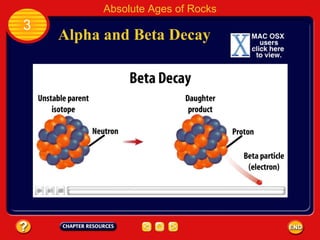
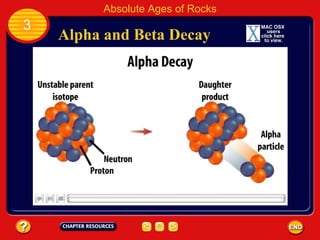
Alpha and Beta Decay In some isotopes, a neutron breaks down into a proton and an electron. This type of radioactive decay is called beta decay. Absolute Ages of Rocks 3 Other isotopes give off two protons and two neutrons in the form of an alpha particle.
Alpha and Beta Decay Absolute Ages of Rocks 3
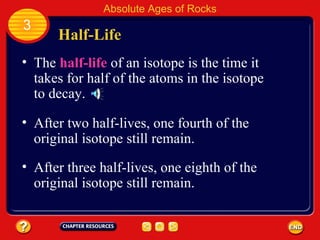
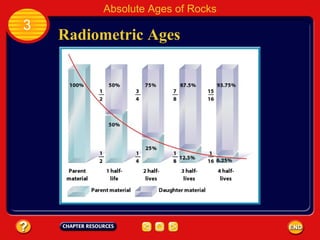
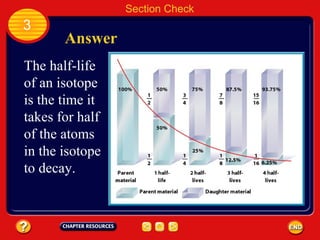
Half-Life The  half-life  of an isotope is the time it takes for half of the atoms in the isotope to decay. After two half-lives, one fourth of the original isotope still remain. Absolute Ages of Rocks 3 After three half-lives, one eighth of the original isotope still remain.
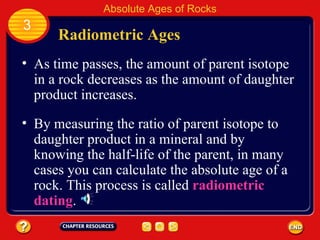
Radiometric Ages As time passes, the amount of parent isotope in a rock decreases as the amount of daughter product increases. By measuring the ratio of parent isotope to daughter product in a mineral and by knowing the half-life of the parent, in many cases you can calculate the absolute age of a rock. This process is called  radiometric dating . Absolute Ages of Rocks 3
Radiometric Ages Absolute Ages of Rocks 3
By determining the amounts of the isotopes in a sample, scientists can evaluate how much the isotope ratio in the sample differs from that in the environment. Radiometric Dating Carbon-14 is useful for dating bones, wood, and charcoal up to 75,000 years old. Absolute Ages of Rocks 3 Living things take in carbon from the environment to build their bodies. After the organism dies, the carbon-14 slowly decays.
This is because many sedimentary rocks are made up of particles eroded from older rocks. Age Determination Aside from carbon-14 dating, rocks that can be radiometrically dated are mostly igneous and metamorphic rocks. Absolute Ages of Rocks 3 Most sedimentary rocks cannot be dated by this method.
By dating meteorites and using other evidence, scientists have estimated the age of to be about 4.5 billion years. The Oldest Known Rocks Radiometric dating has been used to date the oldest rocks on Earth. Absolute Ages of Rocks 3 These rocks are about 3.96 billion years old.
Uniformitarianism Before the discovery of radiometric dating, many people estimated that Earth is only a few thousand years old. Absolute Ages of Rocks 3 But in the 1700’s, Scottish scientist James Hutton estimated that Earth is much older.
He used the principle of  uniformitariansm . This principle states that Earth processes occurring today are similar to those that occurred in the past. Uniformitarianism Absolute Ages of Rocks 3 Hutton’s principle is often paraphrased as “the present is the key to the past.”
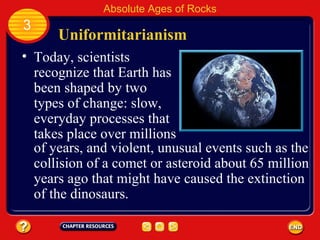
Uniformitarianism Absolute Ages of Rocks 3 Today, scientists recognize that Earth has been shaped by two types of change: slow, everyday processes that takes place over millions  of years, and violent, unusual events such as the collision of a comet or asteroid about 65 million years ago that might have caused the extinction of the dinosaurs.
Section Check 3 Question 1 __________ age is the age in years of an object. A. Absolute B. Calculated C. Derived D. Relative NC: 5.01
Section Check 3 Answer The answer is A. Geologists use properties of atoms in specific materials to determine absolute age. NC: 5.01
Section Check 3 Question 2 What is meant by the term “half-life” of an isotope?
Section Check 3 Answer The half-life of an isotope is the time it takes for half of the atoms in the isotope to decay.
Section Check 3 Question 3 What information must you have in order to conduct radiometric dating? Answer You must have an isotope with an appropriately short or long half-life. You must also know the isotope’s half-life and be able to measure the ratio of parent isotope to daughter product.

Chapter 3:3 Absolute Ages of Rocks

  • 1.
  • 2.
    Chapter: Cluesto Earth’s Past Table of Contents Section 3: Absolute Ages of Rocks Section 1: Fossils Section 2: Relative Ages of Rocks
  • 3.
    Absolute Ages Absoluteage is the age, in years, of a rock or other object. Geologists determine absolute ages by using properties of the atoms that make up materials. Absolute Ages of Rocks 3
  • 4.
    Radioactive Decay Someisotopes are unstable and break down into other isotopes and particles. Sometimes a lot of energy is given off during this process. Absolute Ages of Rocks 3 The process of breaking down is called radioactive decay .
  • 5.
    Alpha and BetaDecay In some isotopes, a neutron breaks down into a proton and an electron. This type of radioactive decay is called beta decay. Absolute Ages of Rocks 3 Other isotopes give off two protons and two neutrons in the form of an alpha particle.
  • 6.
    Alpha and BetaDecay Absolute Ages of Rocks 3
  • 7.
    Alpha and BetaDecay Absolute Ages of Rocks 3
  • 8.
    Half-Life The half-life of an isotope is the time it takes for half of the atoms in the isotope to decay. After two half-lives, one fourth of the original isotope still remain. Absolute Ages of Rocks 3 After three half-lives, one eighth of the original isotope still remain.
  • 9.
    Radiometric Ages Astime passes, the amount of parent isotope in a rock decreases as the amount of daughter product increases. By measuring the ratio of parent isotope to daughter product in a mineral and by knowing the half-life of the parent, in many cases you can calculate the absolute age of a rock. This process is called radiometric dating . Absolute Ages of Rocks 3
  • 10.
  • 11.
    By determining theamounts of the isotopes in a sample, scientists can evaluate how much the isotope ratio in the sample differs from that in the environment. Radiometric Dating Carbon-14 is useful for dating bones, wood, and charcoal up to 75,000 years old. Absolute Ages of Rocks 3 Living things take in carbon from the environment to build their bodies. After the organism dies, the carbon-14 slowly decays.
  • 12.
    This is becausemany sedimentary rocks are made up of particles eroded from older rocks. Age Determination Aside from carbon-14 dating, rocks that can be radiometrically dated are mostly igneous and metamorphic rocks. Absolute Ages of Rocks 3 Most sedimentary rocks cannot be dated by this method.
  • 13.
    By dating meteoritesand using other evidence, scientists have estimated the age of to be about 4.5 billion years. The Oldest Known Rocks Radiometric dating has been used to date the oldest rocks on Earth. Absolute Ages of Rocks 3 These rocks are about 3.96 billion years old.
  • 14.
    Uniformitarianism Before thediscovery of radiometric dating, many people estimated that Earth is only a few thousand years old. Absolute Ages of Rocks 3 But in the 1700’s, Scottish scientist James Hutton estimated that Earth is much older.
  • 15.
    He used theprinciple of uniformitariansm . This principle states that Earth processes occurring today are similar to those that occurred in the past. Uniformitarianism Absolute Ages of Rocks 3 Hutton’s principle is often paraphrased as “the present is the key to the past.”
  • 16.
    Uniformitarianism Absolute Agesof Rocks 3 Today, scientists recognize that Earth has been shaped by two types of change: slow, everyday processes that takes place over millions of years, and violent, unusual events such as the collision of a comet or asteroid about 65 million years ago that might have caused the extinction of the dinosaurs.
  • 17.
    Section Check 3Question 1 __________ age is the age in years of an object. A. Absolute B. Calculated C. Derived D. Relative NC: 5.01
  • 18.
    Section Check 3Answer The answer is A. Geologists use properties of atoms in specific materials to determine absolute age. NC: 5.01
  • 19.
    Section Check 3Question 2 What is meant by the term “half-life” of an isotope?
  • 20.
    Section Check 3Answer The half-life of an isotope is the time it takes for half of the atoms in the isotope to decay.
  • 21.
    Section Check 3Question 3 What information must you have in order to conduct radiometric dating? Answer You must have an isotope with an appropriately short or long half-life. You must also know the isotope’s half-life and be able to measure the ratio of parent isotope to daughter product.