Radiocarbon Dating:
theoretical concepts & practical
          applications

  (all you ever wanted to know about
        14C but were afraid to ask)

            Robert M Chapple
Rule No. 1
• Many things about 14C dating are complex, but
  the basics are simple!
• Analogy: your car
  – you don’t need to know everything about how it
    works to drive it around
• Analogy: your car
  – BUT you should have a mastery of the basics
• Analogy: your car
  – Adherence to basic principles prevent …
• Analogy: your car
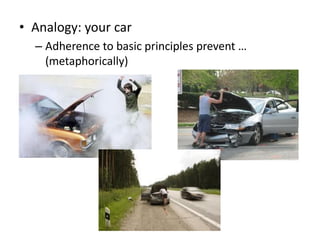
  – Adherence to basic principles prevent …
    (metaphorically)
• Basics:
  – Here comes the science bit …
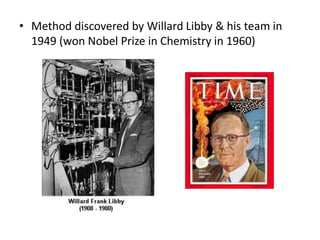
• Method discovered by Willard Libby & his team in
  1949 (won Nobel Prize in Chemistry in 1960)
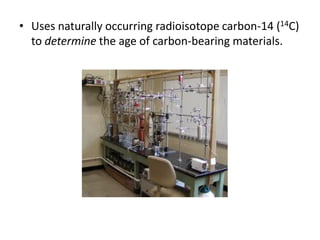
• Uses naturally occurring radioisotope carbon-14 (14C)
  to determine the age of carbon-bearing materials.
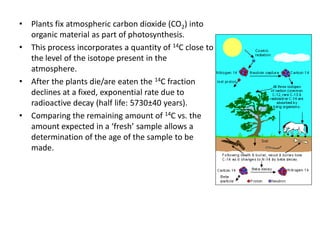
•   Plants fix atmospheric carbon dioxide (CO2) into
    organic material as part of photosynthesis.
•   This process incorporates a quantity of 14C close to
    the level of the isotope present in the
    atmosphere.
•   After the plants die/are eaten the 14C fraction
    declines at a fixed, exponential rate due to
    radioactive decay (half life: 5730±40 years).
•   Comparing the remaining amount of 14C vs. the
    amount expected in a ‘fresh’ sample allows a
    determination of the age of the sample to be
    made.
•   ‘Raw’ results are presented as years BP (Before
    Present - 1950) eg 3476±45BP

•   Determinations are supplied with a ‘±’ (standard
    deviation). This describes a level of uncertainty
    with the date. Traditionally: statistical counting
    uncertainty, but some labs also include an ‘error
    multiplier’ to account for other forms of
    uncertainty.

•   Limits: 58,000 to 62,000 years
•   Calibration: change determinations into calendar
    dates.
•   Necessary: 14C varies in the atmosphere over time
    & locality.
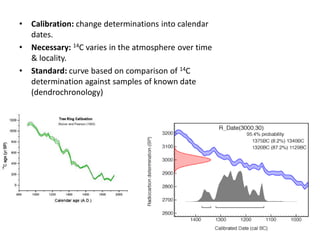
•   Standard: curve based on comparison of 14C
    determination against samples of known date
    (dendrochronology)
Reporting dates in publications/reports: some fundamentals

The radiocarbon determination: record the actual determination: 3727±49 BP
eg “this feature dated to 2286-1987 cal BC” fine in the text, but of limited use in
    assessing/reusing that date

Lab Code: unique identifier for that date

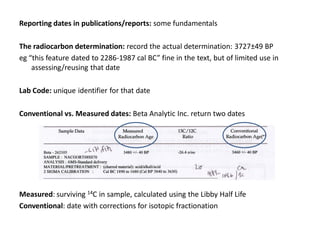
Conventional vs. Measured dates: Beta Analytic Inc. return two dates


Measured: surviving 14C in sample, calculated using the Libby Half Life
Conventional: date with corrections for isotopic fractionation
Reporting dates in publications/reports: some fundamentals

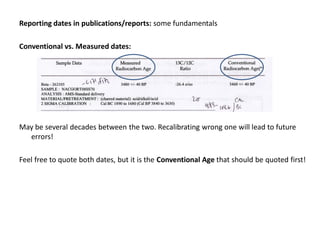
Conventional vs. Measured dates:


May be several decades between the two. Recalibrating wrong one will lead to future
  errors!

Feel free to quote both dates, but it is the Conventional Age that should be quoted first!
Reporting dates in publications/reports: some fundamentals

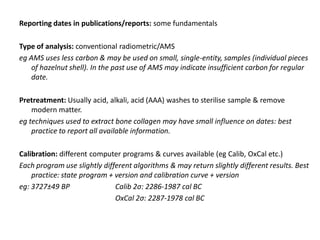
Type of analysis: conventional radiometric/AMS
eg AMS uses less carbon & may be used on small, single-entity, samples (individual pieces
    of hazelnut shell). In the past use of AMS may indicate insufficient carbon for regular
    date.

Pretreatment: Usually acid, alkali, acid (AAA) washes to sterilise sample & remove
    modern matter.
eg techniques used to extract bone collagen may have small influence on dates: best
    practice to report all available information.

Calibration: different computer programs & curves available (eg Calib, OxCal etc.)
Each program use slightly different algorithms & may return slightly different results. Best
    practice: state program + version and calibration curve + version
eg: 3727±49 BP                Calib 2σ: 2286-1987 cal BC
                              OxCal 2σ: 2287-1978 cal BC
Reporting dates in publications/reports: some fundamentals
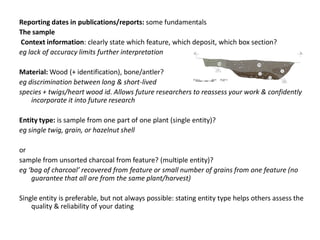
The sample
Context information: clearly state which feature, which deposit, which box section?
eg lack of accuracy limits further interpretation

Material: Wood (+ identification), bone/antler?
eg discrimination between long & short-lived
species + twigs/heart wood id. Allows future researchers to reassess your work & confidently
    incorporate it into future research

Entity type: is sample from one part of one plant (single entity)?
eg single twig, grain, or hazelnut shell

or
sample from unsorted charcoal from feature? (multiple entity)?
eg ‘bag of charcoal’ recovered from feature or small number of grains from one feature (no
    guarantee that all are from the same plant/harvest)

Single entity is preferable, but not always possible: stating entity type helps others assess the
    quality & reliability of your dating
Reporting dates in publications/reports: some fundamentals

Fundamental: include the ‘raw’ date with its standard deviation!

General rules      : Include as much information as possible in publication

                   : If in doubt, include it!
Reporting dates in publications/reports: some fundamentals

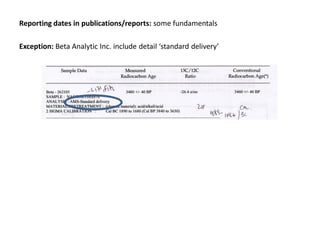
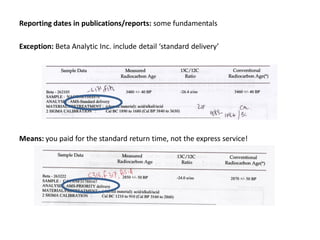
Exception: Beta Analytic Inc. include detail ‘standard delivery’
Reporting dates in publications/reports: some fundamentals

Exception: Beta Analytic Inc. include detail ‘standard delivery’


Means: you paid for the standard return time, not the express service!
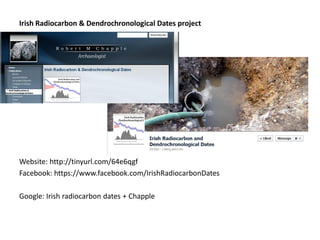
Irish Radiocarbon & Dendrochronological Dates project


Website: http://tinyurl.com/64e6qgf
Facebook: https://www.facebook.com/IrishRadiocarbonDates

Google: Irish radiocarbon dates + Chapple
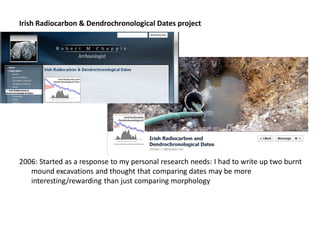
Irish Radiocarbon & Dendrochronological Dates project


2006: Started as a response to my personal research needs: I had to write up two burnt
   mound excavations and thought that comparing dates may be more
   interesting/rewarding than just comparing morphology
Irish Radiocarbon & Dendrochronological Dates project

Problem: dates are scattered across a vast array of books, journals & reports
Irish Radiocarbon & Dendrochronological Dates project

Problem: dates are scattered across a vast array of books, journals & reports

Solution: start with my own library & go from there!
Irish Radiocarbon & Dendrochronological Dates project

Originally: just for my own use & interest

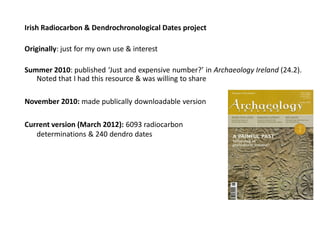
Summer 2010: published ‘Just and expensive number?’ in Archaeology Ireland (24.2).
   Noted that I had this resource & was willing to share

November 2010: made publically downloadable version

Current version (March 2012): 6093 radiocarbon
   determinations & 240 dendro dates
Irish Radiocarbon & Dendrochronological Dates project

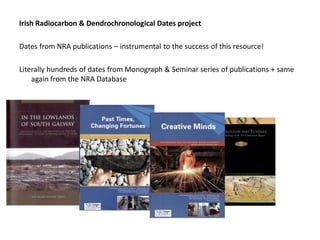
Dates from NRA publications – instrumental to the success of this resource!

Literally hundreds of dates from Monograph & Seminar series of publications + same
    again from the NRA Database
Irish Radiocarbon & Dendrochronological Dates project

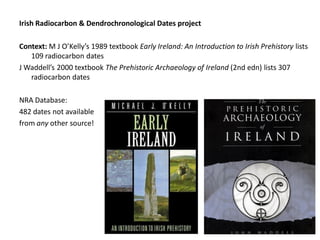
Context: M J O’Kelly’s 1989 textbook Early Ireland: An Introduction to Irish Prehistory lists
   109 radiocarbon dates
J Waddell’s 2000 textbook The Prehistoric Archaeology of Ireland (2nd edn) lists 307
   radiocarbon dates

NRA Database:
482 dates not available
from any other source!
Irish Radiocarbon & Dendrochronological Dates project

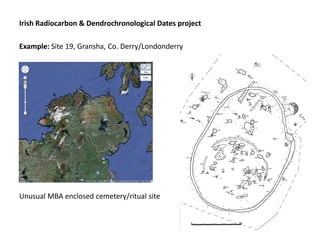
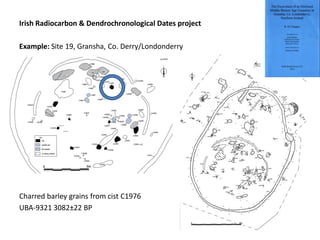
Example: Site 19, Gransha, Co. Derry/Londonderry


Unusual MBA enclosed cemetery/ritual site
Irish Radiocarbon & Dendrochronological Dates project

Example: Site 19, Gransha, Co. Derry/Londonderry


Charred barley grains from cist C1976
UBA-9321 3082±22 BP
Irish Radiocarbon & Dendrochronological Dates project

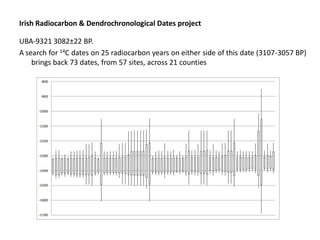
UBA-9321 3082±22 BP.
A search for 14C dates on 25 radiocarbon years on either side of this date (3107-3057 BP)
    brings back 73 dates, from 57 sites, across 21 counties
Irish Radiocarbon & Dendrochronological Dates project

UBA-9321 3082±22 BP.
Some detail:
Burials
• Cloncowan II, Co. Meath (possible ring ditch)
• Magheramenagh, Portrush, Co. Londonderry (ring ditch)
• Derrycraw, Co. Down (token burial/possible cremation in cairn & ring ditch (2 dates))
• Island, Co. Cork (wedge tomb)
• Ballybannon, Co. Carlow (cremated Remains)
• Killoran 10, Co. Tipperary (cremation cemetery)
• Rathcannon, Co. Limerick (cremation cemetery)
• Cooradarrigan, Co. Cork (boulder burial)
• Ballybar Lower, Co. Carlow (flat Cemetery)*
• Priestsnewtown 6b, Co. Wicklow (cremation pit)*
• Templenoe, site 163.1, Co. Tipperary (Bronze Age grave)*
• Edenagarry, Co. Down (Burial Cairn)                              * = NRA Scheme site
Irish Radiocarbon & Dendrochronological Dates project

UBA-9321 3082±22 BP.
Some detail:
Houses/structures
• Corrstown, Co. Londonderry, (Structures 4 (2 dates), 17, 30, 37, 45, 47 & 68)
• Knockgraffon, site 137.1, Co. Tipperary*
• Toome (Brecart Td.), , Co. Antrim
• Grace Dieu West 8, Co. Waterford*
• Carrigillihy, Co. Cork
• Ballydrehid, site 185.5, Co. Tipperary*
• Cloghabreedy, site 125.1, Co. Tipperary*
• Ballyvergan West 1 AR 26, Co. Cork*
• Knockdomny, Co. Westmeath
• Mitchelstown 1, Cork (3 dates)*
• Cloghabreedy, site 125.4, Co. Tipperary*
• Chancellorsland, Site A, Co. Tipperary (2 dates)                  * = NRA Scheme site
Irish Radiocarbon & Dendrochronological Dates project

UBA-9321 3082±22 BP.
Some detail:
Burnt mounds
• Sranagalloon 1, Co. Clare*
• Cahircalla Beg (AR126) , Co. Clare*
• Dromnea, Co. Cork
• Doughiska, Co. Galway
• Cahiracon, Co. Clare
• Newtown 3, Co. Westmeath*
• Ballyglass West, Co. Galway*
• Sonnagh II, Co. Mayo*
• Demesne or Mearsparkfarm 6.1-6.5, Co. Westmeath*
• Monreagh 2, Co. Clare*
• Sonnagh V, Co. Mayo*
• Carrigane, site C. 3.1, Co. Cork*                     * = NRA Scheme site
Irish Radiocarbon & Dendrochronological Dates project

UBA-9321 3082±22 BP.
Some detail:
Trackways
• Timahoe, Co. Kildare
• Creggan, Track B, Co. Roscommon
• Killoran 230, Co. Tipperary
• Killoran 305, Co. Tipperary
• Lissanure, Co. Longford
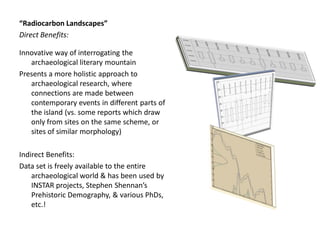
“Radiocarbon Landscapes”
Direct Benefits:

Innovative way of interrogating the
   archaeological literary mountain
Presents a more holistic approach to
   archaeological research, where
   connections are made between
   contemporary events in different parts of
   the island (vs. some reports which draw
   only from sites on the same scheme, or
   sites of similar morphology)

Indirect Benefits:
Data set is freely available to the entire
    archaeological world & has been used by
    INSTAR projects, Stephen Shennan’s
    Prehistoric Demography, & various PhDs,
    etc.!
“Radiocarbon Landscapes”
Downsides:

Not a research ‘silver bullet’ – for use as one
   of a number of complimentary research
   tools

Inconsistencies, repetitions & lack of robust
    error checking: stems from being a
    personal research project

‘One man band’ project – reliant on my own
   book-buying power/donations &
   occasional grant funding
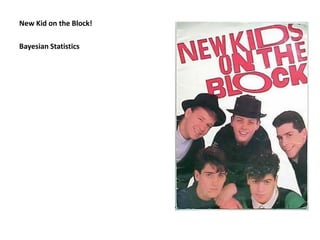
New Kid on the Block!

Bayesian Statistics
New Kid on the Block!

Bayesian Statistics
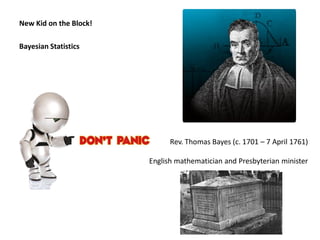
New Kid on the Block!

Bayesian Statistics


                              Rev. Thomas Bayes (c. 1701 – 7 April 1761)

                        English mathematician and Presbyterian minister
New Kid on the Block!

Bayesian Statistics
New Kid on the Block!

Bayesian Statistics


Statistical means for modifying
beliefs in the light of new
information.
Ideas about the likelihood of A are
modified by observing B
Two kinds of Bayesian models

Type 1: Strong reasons for assigning
   chronological order to a series of events
   (eg Stratigraphy). This information will
   strongly influence the model. Known as:
   'informative prior belief'

Type 2: No stratigraphic information, only
   assumptions about the mathematical
   distribution of dates in a single phase of
   activity. Known as: 'uninformative prior
   belief'
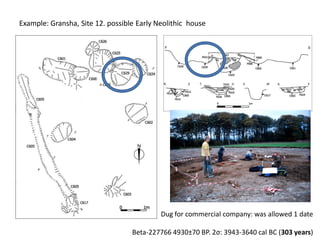
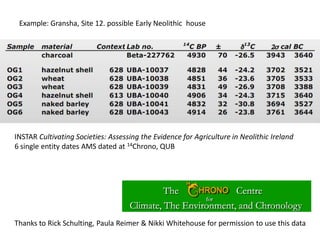
Example: Gransha, Site 12. possible Early Neolithic house


                                           Dug for commercial company: was allowed 1 date

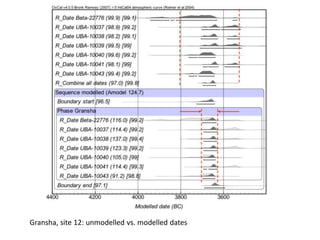
                                  Beta-227766 4930±70 BP. 2σ: 3943-3640 cal BC (303 years)
Example: Gransha, Site 12. possible Early Neolithic house


INSTAR Cultivating Societies: Assessing the Evidence for Agriculture in Neolithic Ireland
6 single entity dates AMS dated at 14Chrono, QUB


Thanks to Rick Schulting, Paula Reimer & Nikki Whitehouse for permission to use this data
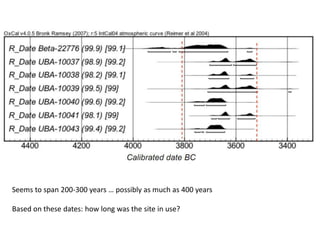
Seems to span 200-300 years … possibly as much as 400 years

Based on these dates: how long was the site in use?
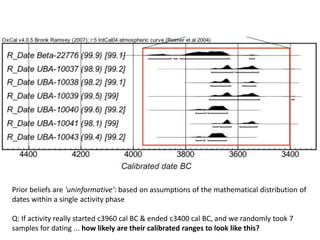
Prior beliefs are 'uninformative': based on assumptions of the mathematical distribution of
dates within a single activity phase

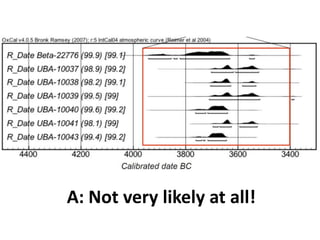
Q: If activity really started c3960 cal BC & ended c3400 cal BC, and we randomly took 7
samples for dating ... how likely are their calibrated ranges to look like this?
A: Not very likely at all!
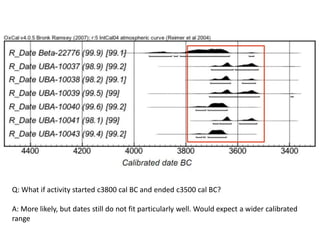
Q: What if activity started c3800 cal BC and ended c3500 cal BC?

A: More likely, but dates still do not fit particularly well. Would expect a wider calibrated
range
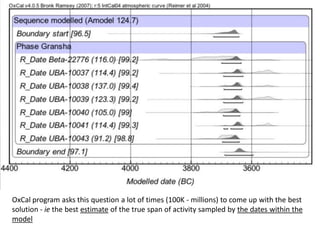
OxCal program asks this question a lot of times (100K - millions) to come up with the best
solution - ie the best estimate of the true span of activity sampled by the dates within the
model
Gransha, site 12: unmodelled vs. modelled dates
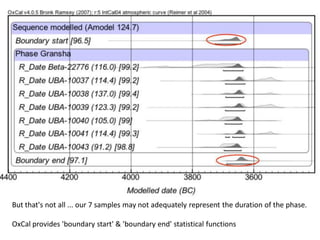
But that's not all ... our 7 samples may not adequately represent the duration of the phase.

OxCal provides 'boundary start' & 'boundary end' statistical functions
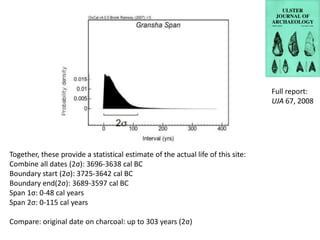
Full report:
                                                                                  UJA 67, 2008


Together, these provide a statistical estimate of the actual life of this site:
Combine all dates (2σ): 3696-3638 cal BC
Boundary start (2σ): 3725-3642 cal BC
Boundary end(2σ): 3689-3597 cal BC
Span 1σ: 0-48 cal years
Span 2σ: 0-115 cal years

Compare: original date on charcoal: up to 303 years (2σ)
Problems with Bayesian modelling?

Has recently come to prominence in archaeology & is somewhat being accepted
uncritically

Problem: it is a statistical model!
"All models are wrong, some models are useful“ (Box 1979 cited in Bayliss et al. 2007)

Model is only as good as our baseline assumptions & the data we put into it!


Bayliss, A., Bronk Ramsey, C., van der Plicht, J. & Whittle, A. 2007 'Bradshaw and Bayes:
towards a timetable for the Neolithic' Cambridge Archaeological Journal 17, 1-28.
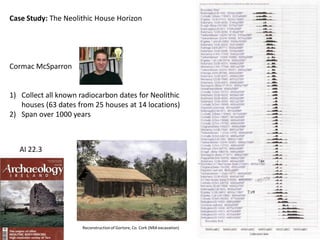
Case Study: The Neolithic House Horizon


Cormac McSparron


1) Collect all known radiocarbon dates for Neolithic
   houses (63 dates from 25 houses at 14 locations)
2) Span over 1000 years


   AI 22.3


                      Reconstruction of Gortore, Co. Cork (NRA excavation)
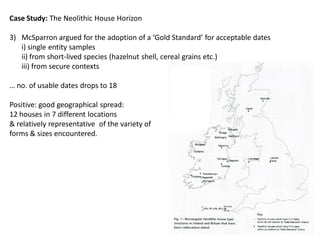
Case Study: The Neolithic House Horizon

3) McSparron argued for the adoption of a ‘Gold Standard’ for acceptable dates
   i) single entity samples
   ii) from short-lived species (hazelnut shell, cereal grains etc.)
   iii) from secure contexts

… no. of usable dates drops to 18

Positive: good geographical spread:
12 houses in 7 different locations
& relatively representative of the variety of
forms & sizes encountered.
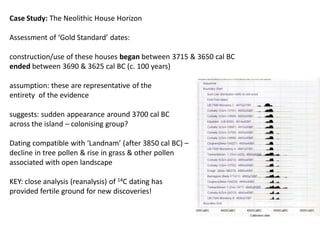
Case Study: The Neolithic House Horizon

Assessment of ‘Gold Standard’ dates:

construction/use of these houses began between 3715 & 3650 cal BC
ended between 3690 & 3625 cal BC (c. 100 years)

assumption: these are representative of the
entirety of the evidence

suggests: sudden appearance around 3700 cal BC
across the island – colonising group?

Dating compatible with ‘Landnam’ (after 3850 cal BC) –
decline in tree pollen & rise in grass & other pollen
associated with open landscape

KEY: close analysis (reanalysis) of 14C dating has
provided fertile ground for new discoveries!
Thank You for Listening!
rmchapple@hotmail.com

@RMChapple

rmchapple.blogspot.com

Irish Radiocarbon &
Dendrochronological Dates

https://sites.google.com/site/chapplearchaeology/

Dingbat19and17

Radiocarbon dating theoretical concepts & practical applications

  • 1.
    Radiocarbon Dating: theoretical concepts& practical applications (all you ever wanted to know about 14C but were afraid to ask) Robert M Chapple
  • 2.
  • 3.
    • Many thingsabout 14C dating are complex, but the basics are simple!
  • 4.
    • Analogy: yourcar – you don’t need to know everything about how it works to drive it around
  • 5.
    • Analogy: yourcar – BUT you should have a mastery of the basics
  • 6.
    • Analogy: yourcar – Adherence to basic principles prevent …
  • 7.
    • Analogy: yourcar – Adherence to basic principles prevent … (metaphorically)
  • 8.
    • Basics: – Here comes the science bit …
  • 9.
    • Method discoveredby Willard Libby & his team in 1949 (won Nobel Prize in Chemistry in 1960)
  • 10.
    • Uses naturallyoccurring radioisotope carbon-14 (14C) to determine the age of carbon-bearing materials.
  • 11.
    Plants fix atmospheric carbon dioxide (CO2) into organic material as part of photosynthesis. • This process incorporates a quantity of 14C close to the level of the isotope present in the atmosphere. • After the plants die/are eaten the 14C fraction declines at a fixed, exponential rate due to radioactive decay (half life: 5730±40 years). • Comparing the remaining amount of 14C vs. the amount expected in a ‘fresh’ sample allows a determination of the age of the sample to be made.
  • 12.
    ‘Raw’ results are presented as years BP (Before Present - 1950) eg 3476±45BP • Determinations are supplied with a ‘±’ (standard deviation). This describes a level of uncertainty with the date. Traditionally: statistical counting uncertainty, but some labs also include an ‘error multiplier’ to account for other forms of uncertainty. • Limits: 58,000 to 62,000 years
  • 13.
    Calibration: change determinations into calendar dates. • Necessary: 14C varies in the atmosphere over time & locality. • Standard: curve based on comparison of 14C determination against samples of known date (dendrochronology)
  • 14.
    Reporting dates inpublications/reports: some fundamentals The radiocarbon determination: record the actual determination: 3727±49 BP eg “this feature dated to 2286-1987 cal BC” fine in the text, but of limited use in assessing/reusing that date Lab Code: unique identifier for that date Conventional vs. Measured dates: Beta Analytic Inc. return two dates Measured: surviving 14C in sample, calculated using the Libby Half Life Conventional: date with corrections for isotopic fractionation
  • 15.
    Reporting dates inpublications/reports: some fundamentals Conventional vs. Measured dates: May be several decades between the two. Recalibrating wrong one will lead to future errors! Feel free to quote both dates, but it is the Conventional Age that should be quoted first!
  • 16.
    Reporting dates inpublications/reports: some fundamentals Type of analysis: conventional radiometric/AMS eg AMS uses less carbon & may be used on small, single-entity, samples (individual pieces of hazelnut shell). In the past use of AMS may indicate insufficient carbon for regular date. Pretreatment: Usually acid, alkali, acid (AAA) washes to sterilise sample & remove modern matter. eg techniques used to extract bone collagen may have small influence on dates: best practice to report all available information. Calibration: different computer programs & curves available (eg Calib, OxCal etc.) Each program use slightly different algorithms & may return slightly different results. Best practice: state program + version and calibration curve + version eg: 3727±49 BP Calib 2σ: 2286-1987 cal BC OxCal 2σ: 2287-1978 cal BC
  • 17.
    Reporting dates inpublications/reports: some fundamentals The sample Context information: clearly state which feature, which deposit, which box section? eg lack of accuracy limits further interpretation Material: Wood (+ identification), bone/antler? eg discrimination between long & short-lived species + twigs/heart wood id. Allows future researchers to reassess your work & confidently incorporate it into future research Entity type: is sample from one part of one plant (single entity)? eg single twig, grain, or hazelnut shell or sample from unsorted charcoal from feature? (multiple entity)? eg ‘bag of charcoal’ recovered from feature or small number of grains from one feature (no guarantee that all are from the same plant/harvest) Single entity is preferable, but not always possible: stating entity type helps others assess the quality & reliability of your dating
  • 18.
    Reporting dates inpublications/reports: some fundamentals Fundamental: include the ‘raw’ date with its standard deviation! General rules : Include as much information as possible in publication : If in doubt, include it!
  • 19.
    Reporting dates inpublications/reports: some fundamentals Exception: Beta Analytic Inc. include detail ‘standard delivery’
  • 20.
    Reporting dates inpublications/reports: some fundamentals Exception: Beta Analytic Inc. include detail ‘standard delivery’ Means: you paid for the standard return time, not the express service!
  • 21.
    Irish Radiocarbon &Dendrochronological Dates project Website: http://tinyurl.com/64e6qgf Facebook: https://www.facebook.com/IrishRadiocarbonDates Google: Irish radiocarbon dates + Chapple
  • 22.
    Irish Radiocarbon &Dendrochronological Dates project 2006: Started as a response to my personal research needs: I had to write up two burnt mound excavations and thought that comparing dates may be more interesting/rewarding than just comparing morphology
  • 23.
    Irish Radiocarbon &Dendrochronological Dates project Problem: dates are scattered across a vast array of books, journals & reports
  • 24.
    Irish Radiocarbon &Dendrochronological Dates project Problem: dates are scattered across a vast array of books, journals & reports Solution: start with my own library & go from there!
  • 25.
    Irish Radiocarbon &Dendrochronological Dates project Originally: just for my own use & interest Summer 2010: published ‘Just and expensive number?’ in Archaeology Ireland (24.2). Noted that I had this resource & was willing to share November 2010: made publically downloadable version Current version (March 2012): 6093 radiocarbon determinations & 240 dendro dates
  • 26.
    Irish Radiocarbon &Dendrochronological Dates project Dates from NRA publications – instrumental to the success of this resource! Literally hundreds of dates from Monograph & Seminar series of publications + same again from the NRA Database
  • 27.
    Irish Radiocarbon &Dendrochronological Dates project Context: M J O’Kelly’s 1989 textbook Early Ireland: An Introduction to Irish Prehistory lists 109 radiocarbon dates J Waddell’s 2000 textbook The Prehistoric Archaeology of Ireland (2nd edn) lists 307 radiocarbon dates NRA Database: 482 dates not available from any other source!
  • 28.
    Irish Radiocarbon &Dendrochronological Dates project Example: Site 19, Gransha, Co. Derry/Londonderry Unusual MBA enclosed cemetery/ritual site
  • 29.
    Irish Radiocarbon &Dendrochronological Dates project Example: Site 19, Gransha, Co. Derry/Londonderry Charred barley grains from cist C1976 UBA-9321 3082±22 BP
  • 30.
    Irish Radiocarbon &Dendrochronological Dates project UBA-9321 3082±22 BP. A search for 14C dates on 25 radiocarbon years on either side of this date (3107-3057 BP) brings back 73 dates, from 57 sites, across 21 counties
  • 31.
    Irish Radiocarbon &Dendrochronological Dates project UBA-9321 3082±22 BP. Some detail: Burials • Cloncowan II, Co. Meath (possible ring ditch) • Magheramenagh, Portrush, Co. Londonderry (ring ditch) • Derrycraw, Co. Down (token burial/possible cremation in cairn & ring ditch (2 dates)) • Island, Co. Cork (wedge tomb) • Ballybannon, Co. Carlow (cremated Remains) • Killoran 10, Co. Tipperary (cremation cemetery) • Rathcannon, Co. Limerick (cremation cemetery) • Cooradarrigan, Co. Cork (boulder burial) • Ballybar Lower, Co. Carlow (flat Cemetery)* • Priestsnewtown 6b, Co. Wicklow (cremation pit)* • Templenoe, site 163.1, Co. Tipperary (Bronze Age grave)* • Edenagarry, Co. Down (Burial Cairn) * = NRA Scheme site
  • 32.
    Irish Radiocarbon &Dendrochronological Dates project UBA-9321 3082±22 BP. Some detail: Houses/structures • Corrstown, Co. Londonderry, (Structures 4 (2 dates), 17, 30, 37, 45, 47 & 68) • Knockgraffon, site 137.1, Co. Tipperary* • Toome (Brecart Td.), , Co. Antrim • Grace Dieu West 8, Co. Waterford* • Carrigillihy, Co. Cork • Ballydrehid, site 185.5, Co. Tipperary* • Cloghabreedy, site 125.1, Co. Tipperary* • Ballyvergan West 1 AR 26, Co. Cork* • Knockdomny, Co. Westmeath • Mitchelstown 1, Cork (3 dates)* • Cloghabreedy, site 125.4, Co. Tipperary* • Chancellorsland, Site A, Co. Tipperary (2 dates) * = NRA Scheme site
  • 33.
    Irish Radiocarbon &Dendrochronological Dates project UBA-9321 3082±22 BP. Some detail: Burnt mounds • Sranagalloon 1, Co. Clare* • Cahircalla Beg (AR126) , Co. Clare* • Dromnea, Co. Cork • Doughiska, Co. Galway • Cahiracon, Co. Clare • Newtown 3, Co. Westmeath* • Ballyglass West, Co. Galway* • Sonnagh II, Co. Mayo* • Demesne or Mearsparkfarm 6.1-6.5, Co. Westmeath* • Monreagh 2, Co. Clare* • Sonnagh V, Co. Mayo* • Carrigane, site C. 3.1, Co. Cork* * = NRA Scheme site
  • 34.
    Irish Radiocarbon &Dendrochronological Dates project UBA-9321 3082±22 BP. Some detail: Trackways • Timahoe, Co. Kildare • Creggan, Track B, Co. Roscommon • Killoran 230, Co. Tipperary • Killoran 305, Co. Tipperary • Lissanure, Co. Longford
  • 35.
    “Radiocarbon Landscapes” Direct Benefits: Innovativeway of interrogating the archaeological literary mountain Presents a more holistic approach to archaeological research, where connections are made between contemporary events in different parts of the island (vs. some reports which draw only from sites on the same scheme, or sites of similar morphology) Indirect Benefits: Data set is freely available to the entire archaeological world & has been used by INSTAR projects, Stephen Shennan’s Prehistoric Demography, & various PhDs, etc.!
  • 36.
    “Radiocarbon Landscapes” Downsides: Not aresearch ‘silver bullet’ – for use as one of a number of complimentary research tools Inconsistencies, repetitions & lack of robust error checking: stems from being a personal research project ‘One man band’ project – reliant on my own book-buying power/donations & occasional grant funding
  • 37.
    New Kid onthe Block!
  • 38.
    New Kid onthe Block! Bayesian Statistics
  • 39.
    New Kid onthe Block! Bayesian Statistics
  • 40.
    New Kid onthe Block! Bayesian Statistics Rev. Thomas Bayes (c. 1701 – 7 April 1761) English mathematician and Presbyterian minister
  • 41.
    New Kid onthe Block! Bayesian Statistics
  • 42.
    New Kid onthe Block! Bayesian Statistics Statistical means for modifying beliefs in the light of new information. Ideas about the likelihood of A are modified by observing B
  • 43.
    Two kinds ofBayesian models Type 1: Strong reasons for assigning chronological order to a series of events (eg Stratigraphy). This information will strongly influence the model. Known as: 'informative prior belief' Type 2: No stratigraphic information, only assumptions about the mathematical distribution of dates in a single phase of activity. Known as: 'uninformative prior belief'
  • 44.
    Example: Gransha, Site12. possible Early Neolithic house Dug for commercial company: was allowed 1 date Beta-227766 4930±70 BP. 2σ: 3943-3640 cal BC (303 years)
  • 45.
    Example: Gransha, Site12. possible Early Neolithic house INSTAR Cultivating Societies: Assessing the Evidence for Agriculture in Neolithic Ireland 6 single entity dates AMS dated at 14Chrono, QUB Thanks to Rick Schulting, Paula Reimer & Nikki Whitehouse for permission to use this data
  • 46.
    Seems to span200-300 years … possibly as much as 400 years Based on these dates: how long was the site in use?
  • 47.
    Prior beliefs are'uninformative': based on assumptions of the mathematical distribution of dates within a single activity phase Q: If activity really started c3960 cal BC & ended c3400 cal BC, and we randomly took 7 samples for dating ... how likely are their calibrated ranges to look like this?
  • 48.
    A: Not verylikely at all!
  • 49.
    Q: What ifactivity started c3800 cal BC and ended c3500 cal BC? A: More likely, but dates still do not fit particularly well. Would expect a wider calibrated range
  • 50.
    OxCal program asksthis question a lot of times (100K - millions) to come up with the best solution - ie the best estimate of the true span of activity sampled by the dates within the model

  • 51.
    Gransha, site 12:unmodelled vs. modelled dates
  • 52.
    But that's notall ... our 7 samples may not adequately represent the duration of the phase. OxCal provides 'boundary start' & 'boundary end' statistical functions
  • 53.
    Full report: UJA 67, 2008 Together, these provide a statistical estimate of the actual life of this site: Combine all dates (2σ): 3696-3638 cal BC Boundary start (2σ): 3725-3642 cal BC Boundary end(2σ): 3689-3597 cal BC Span 1σ: 0-48 cal years Span 2σ: 0-115 cal years Compare: original date on charcoal: up to 303 years (2σ)
  • 54.
    Problems with Bayesianmodelling? Has recently come to prominence in archaeology & is somewhat being accepted uncritically Problem: it is a statistical model! "All models are wrong, some models are useful“ (Box 1979 cited in Bayliss et al. 2007) Model is only as good as our baseline assumptions & the data we put into it! Bayliss, A., Bronk Ramsey, C., van der Plicht, J. & Whittle, A. 2007 'Bradshaw and Bayes: towards a timetable for the Neolithic' Cambridge Archaeological Journal 17, 1-28.
  • 55.
    Case Study: TheNeolithic House Horizon Cormac McSparron 1) Collect all known radiocarbon dates for Neolithic houses (63 dates from 25 houses at 14 locations) 2) Span over 1000 years AI 22.3 Reconstruction of Gortore, Co. Cork (NRA excavation)
  • 56.
    Case Study: TheNeolithic House Horizon 3) McSparron argued for the adoption of a ‘Gold Standard’ for acceptable dates i) single entity samples ii) from short-lived species (hazelnut shell, cereal grains etc.) iii) from secure contexts … no. of usable dates drops to 18 Positive: good geographical spread: 12 houses in 7 different locations & relatively representative of the variety of forms & sizes encountered.
  • 57.
    Case Study: TheNeolithic House Horizon Assessment of ‘Gold Standard’ dates: construction/use of these houses began between 3715 & 3650 cal BC ended between 3690 & 3625 cal BC (c. 100 years) assumption: these are representative of the entirety of the evidence suggests: sudden appearance around 3700 cal BC across the island – colonising group? Dating compatible with ‘Landnam’ (after 3850 cal BC) – decline in tree pollen & rise in grass & other pollen associated with open landscape KEY: close analysis (reanalysis) of 14C dating has provided fertile ground for new discoveries!
  • 58.
    Thank You forListening! rmchapple@hotmail.com @RMChapple rmchapple.blogspot.com Irish Radiocarbon & Dendrochronological Dates https://sites.google.com/site/chapplearchaeology/ Dingbat19and17