Objectives:
1. Describe howradioactive decay
occurs.
2. Explain how radioactive decay relates
to radiometric dating.
3. Identify four types of radiometric
dating.
4. Determine the best type of
radiometric dating to use to date an
object.
3.
Radioactive Decay
• Absolutedating
any method of measuring the age of an event or object in years.
• To determine the absolute ages of fossils and
rocks,
scientists analyze isotopes of radioactive elements.
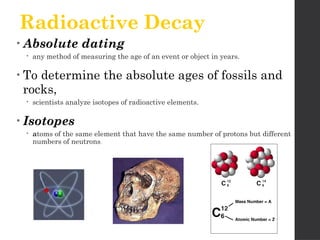
• Isotopes
atoms of the same element that have the same number of protons but different
numbers of neutrons.
4.
• Most isotopesare stable, meaning that they
stay in their original form.
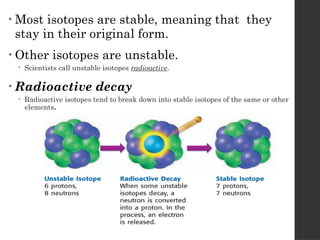
• Other isotopes are unstable.
Scientists call unstable isotopes radioactive.
• Radioactive decay
Radioactive isotopes tend to break down into stable isotopes of the same or other
elements.
5.
• Because radioactivedecay occurs at a
steady rate,
Scientists can use the relative amounts of stable and unstable
isotopes present in an object to determine the object’s age.
• Dating Rocks — How Does It
Work?
In radioactive decay, an unstable radioactive isotope of one
element breaks down into a stable isotope.
The stable isotope may be of the same element or of a different
element.
• Parent isotope
The unstable radioactive isotope.
• Daughter isotope
The stable isotope produced by the radioactive decay of the
parent isotope.
6.
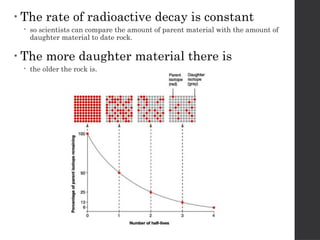
• The rateof radioactive decay is constant
so scientists can compare the amount of parent material with the amount of
daughter material to date rock.
• The more daughter material there is
the older the rock is.
7.
Radiometric Dating
• Radiometricdating
Determining the absolute age of a sample, based on the ratio of parent material to
daughter material.
• If you know the rate of decay for a radioactive
element in a rock
you can figure out the absolute age of the rock.
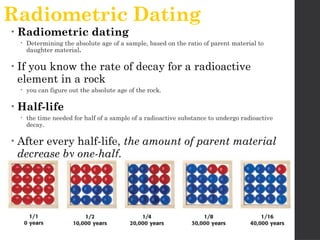
• Half-life
the time needed for half of a sample of a radioactive substance to undergo radioactive
decay.
• After every half-life, the amount of parent material
decrease by one-half.
8.
Types of RadiometricDating
Scientists use different radiometric-dating methods based on the
estimated age of an object.
• There are four radiometric-dating
techniques.
1. Potassium-Argon Method
Potassium-40 has a half-life of 1.3 billion years, and it decays
leaving a daughter material of argon.
This method is used mainly to date rocks older than 100,000
years.
2. Uranium-Lead Method
Uranium-238 is a radioactive isotope with a half-life of 4.5 billion
years. Uranium-238 decays in a series of steps to lead-206.
The uranium-lead method can be used to date rocks more than
10 million years old.
9.
3. Rubidium-Strontium Method
The unstable parent isotope rubidium-87 forms a stable daughter
isotope strontium-87.
The half-life of rubidium-87 is 49 billion years
This method is used for rocks older than 10 million years.
4. Carbon-14 Method
Carbon is normally found in three forms, the
stable isotopes carbon-12 and carbon-13, and the
radioactive isotope carbon-14.
Living plants and animals contain a constant ratio
of carbon-14 to carbon-12.
Once a plant or animal dies, no new carbon is taken in.
The amount of carbon-14 begins to decrease as the plant
or animal decays.
The half-life of carbon-14 is 5,730 years.
The carbon-14 method of radiometric dating is used
mainly for dating things that lived within the last 50,000
years.