COMPUTERS
HISTORY
PRESENTED BY:
 Name:- KHALID RIAZ
 Subject:- Computer Application
 Semester:- 1st
 Teacher:- Sir Yousuf Qasim
INTRODUCTION
The History of Computer development is
often referred to in reference to the different
generations of computing devices. Each
generation of computer is characterized by a
major technological development that
fundamentally changed the way computers
operate, resulting in increasingly smaller,
cheaper, more powerful and more efficient
and reliable devices.
FIRST COMPUTER
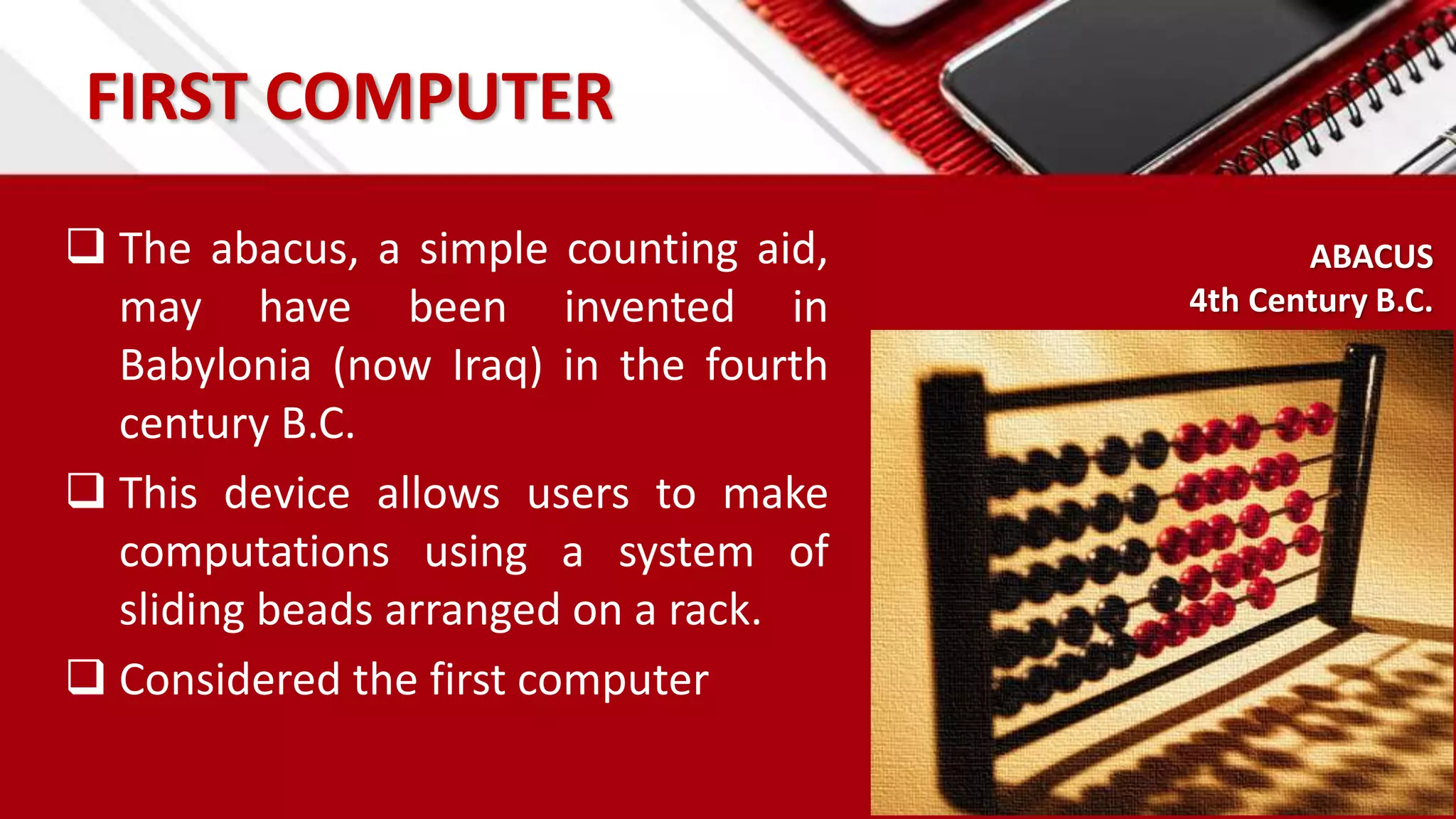
 The abacus, a simple counting aid,
may have been invented in
Babylonia (now Iraq) in the fourth
century B.C.
 This device allows users to make
computations using a system of
sliding beads arranged on a rack.
 Considered the first computer
ABACUS
4th Century B.C.
BLAISE PASCAL
(1623 - 1662)
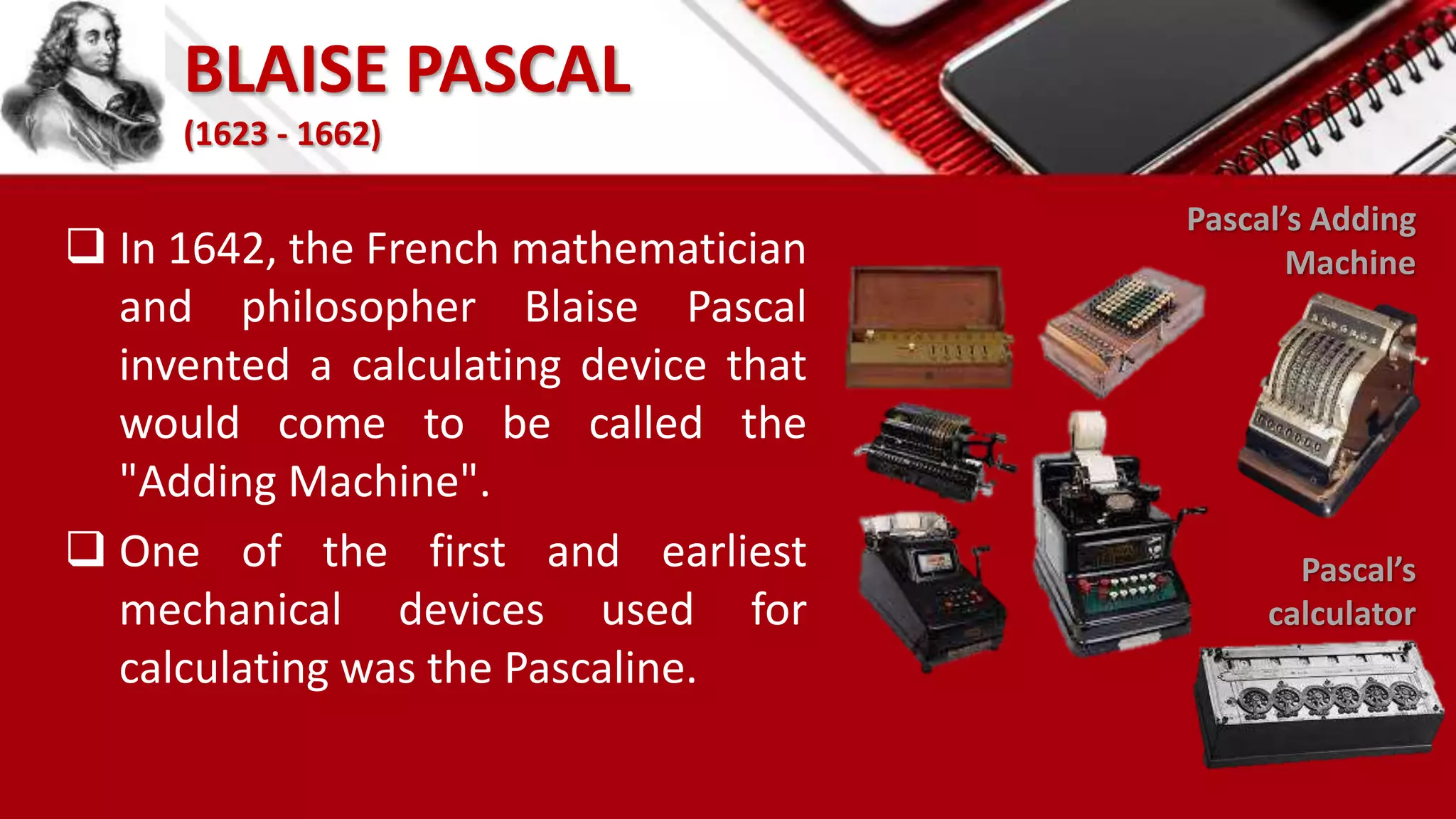
 In 1642, the French mathematician
and philosopher Blaise Pascal
invented a calculating device that
would come to be called the
"Adding Machine".
 One of the first and earliest
mechanical devices used for
calculating was the Pascaline.
Pascal’s
calculator
Pascal’s Adding
Machine
CHARLES BABBAGE
(1791 - 1871)
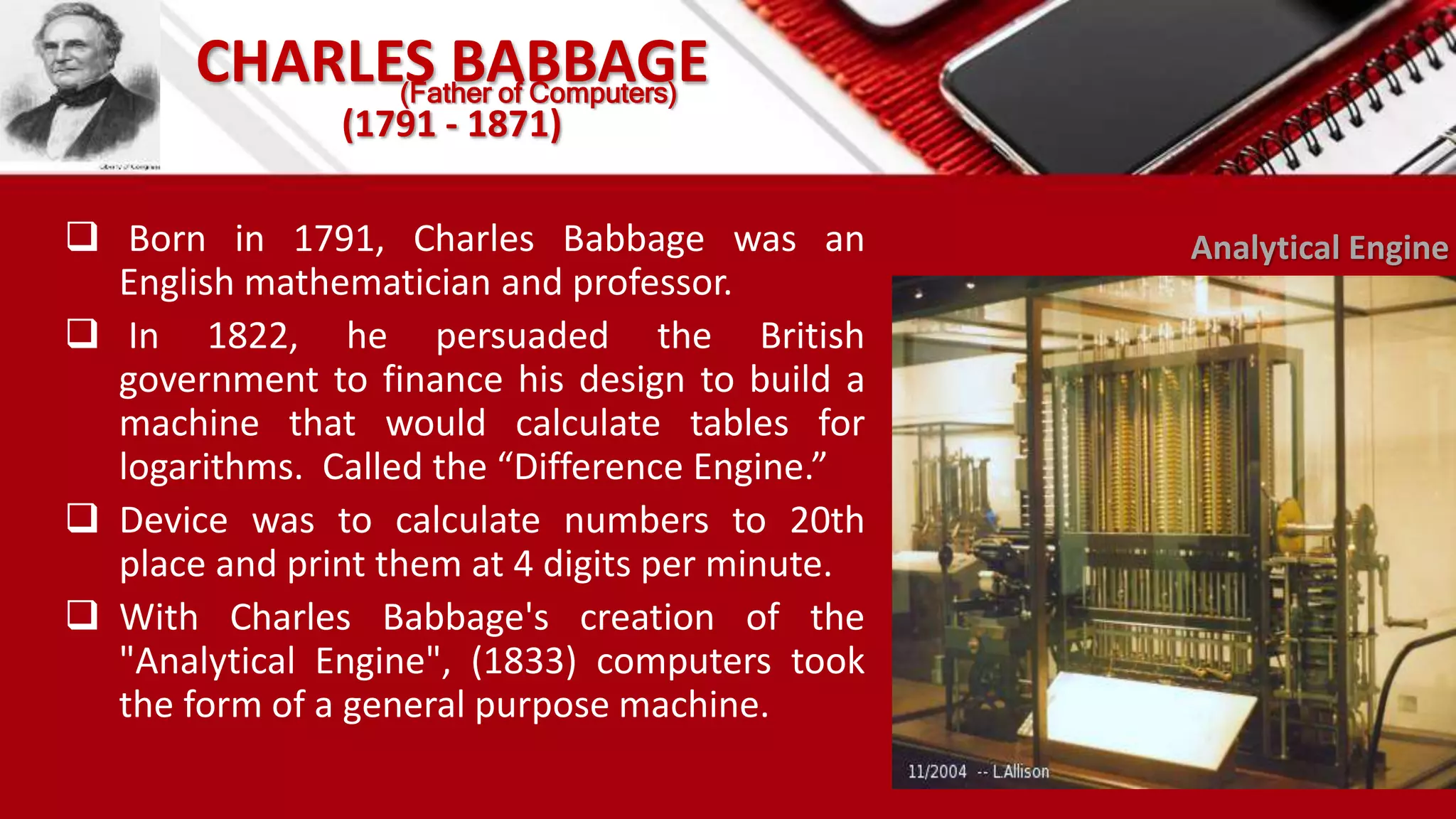
 Born in 1791, Charles Babbage was an
English mathematician and professor.
 In 1822, he persuaded the British
government to finance his design to build a
machine that would calculate tables for
logarithms. Called the “Difference Engine.”
 Device was to calculate numbers to 20th
place and print them at 4 digits per minute.
 With Charles Babbage's creation of the
"Analytical Engine", (1833) computers took
the form of a general purpose machine.
Analytical Engine
(Father of Computers)
COMPUTER
GENERATIONS
GENERATIONS OF COMPUTER
 FIRST GENERATION COMPUTERS
 SECOND GENERATION COMPUTERS
 THIRD GENERATION COMPUTERS
 FOURTH GENERATION COMPUTERS
 FIFTH GENERATION COMPUTERS
FIRST GENERATION
Vacuum Tubes
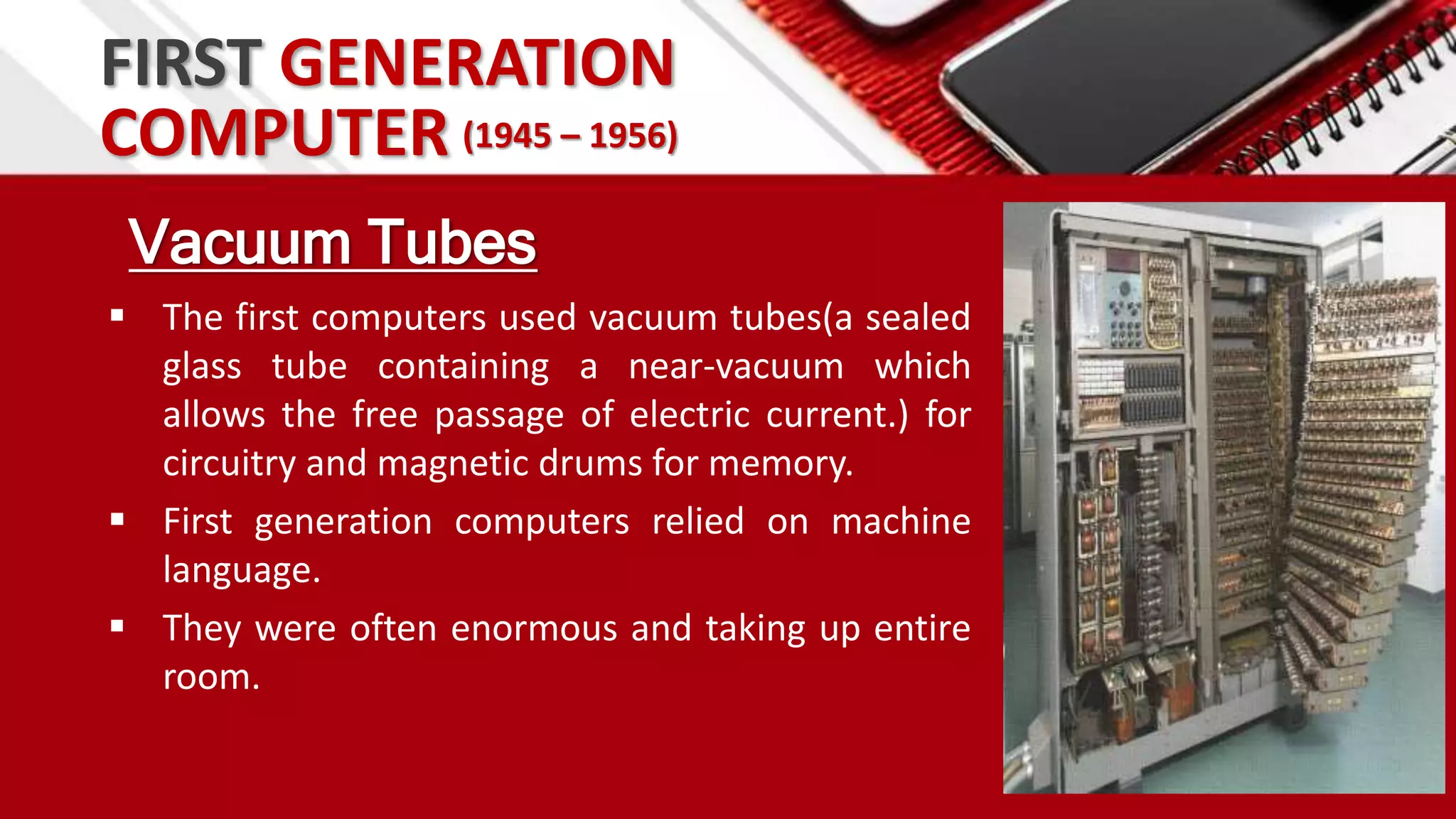
 The first computers used vacuum tubes(a sealed
glass tube containing a near-vacuum which
allows the free passage of electric current.) for
circuitry and magnetic drums for memory.
 First generation computers relied on machine
language.
 They were often enormous and taking up entire
room.
COMPUTER (1945 – 1956)
FIRST GENERATION
MAIN FEATURES OF FIRST
GENERATION
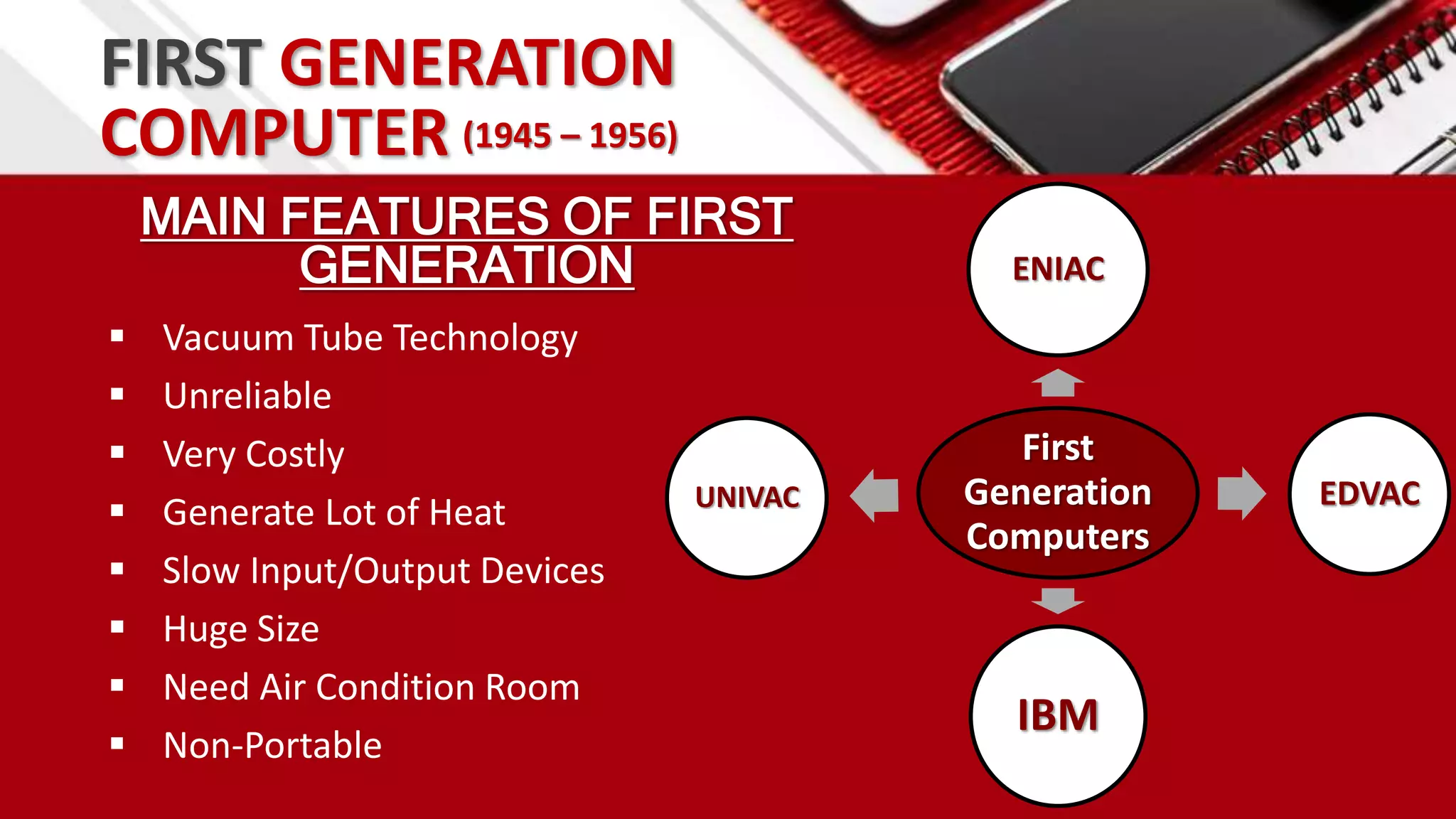
 Vacuum Tube Technology
 Unreliable
 Very Costly
 Generate Lot of Heat
 Slow Input/Output Devices
 Huge Size
 Need Air Condition Room
 Non-Portable
COMPUTER (1945 – 1956)
First
Generation
Computers
ENIAC
EDVAC
IBM
UNIVAC
SECOND GENERATION
TRANSISTORS
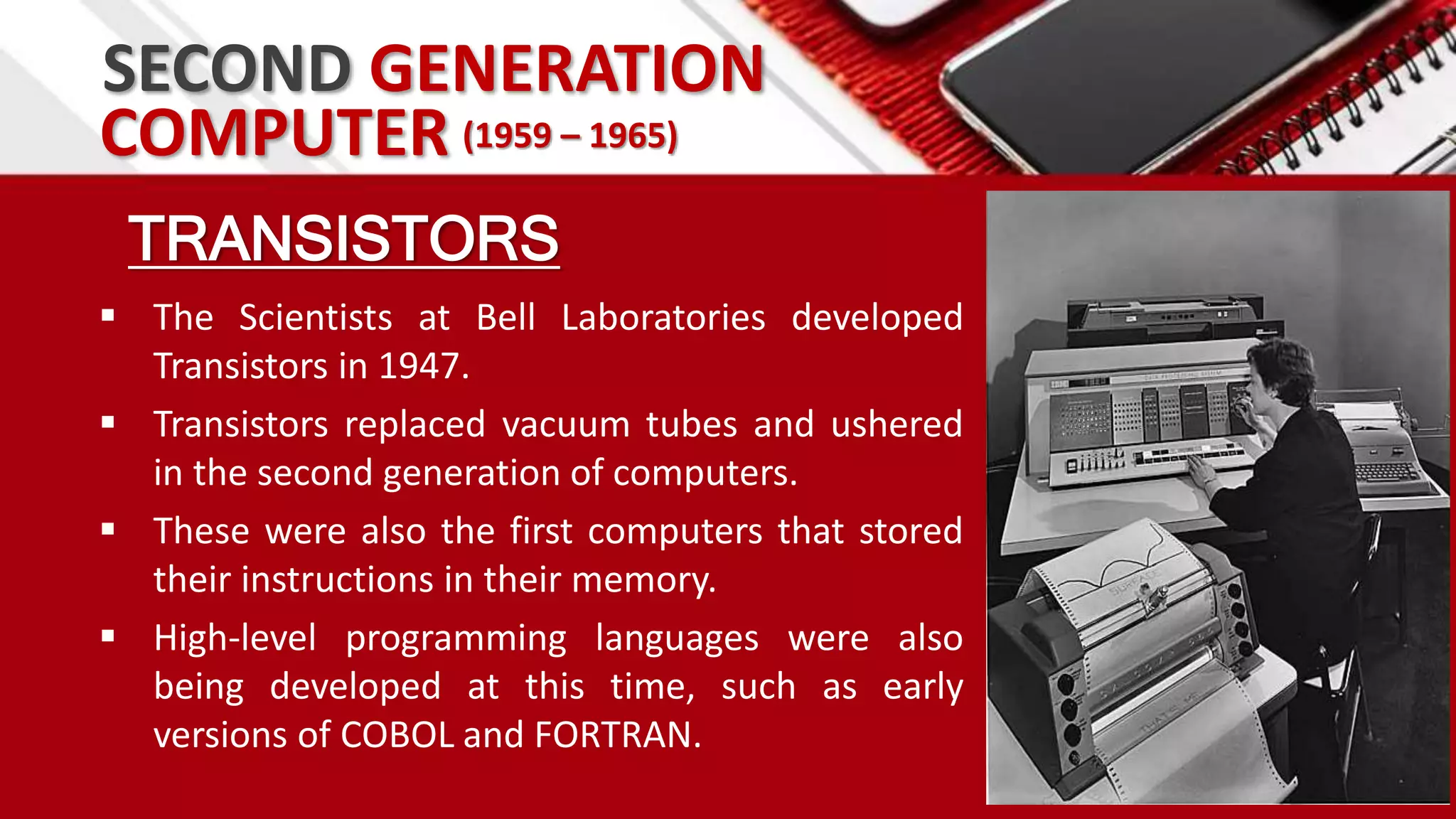
 The Scientists at Bell Laboratories developed
Transistors in 1947.
 Transistors replaced vacuum tubes and ushered
in the second generation of computers.
 These were also the first computers that stored
their instructions in their memory.
 High-level programming languages were also
being developed at this time, such as early
versions of COBOL and FORTRAN.
COMPUTER (1959 – 1965)
SECOND GENERATION
MAIN FEATURES OF SECOND
GENERATION
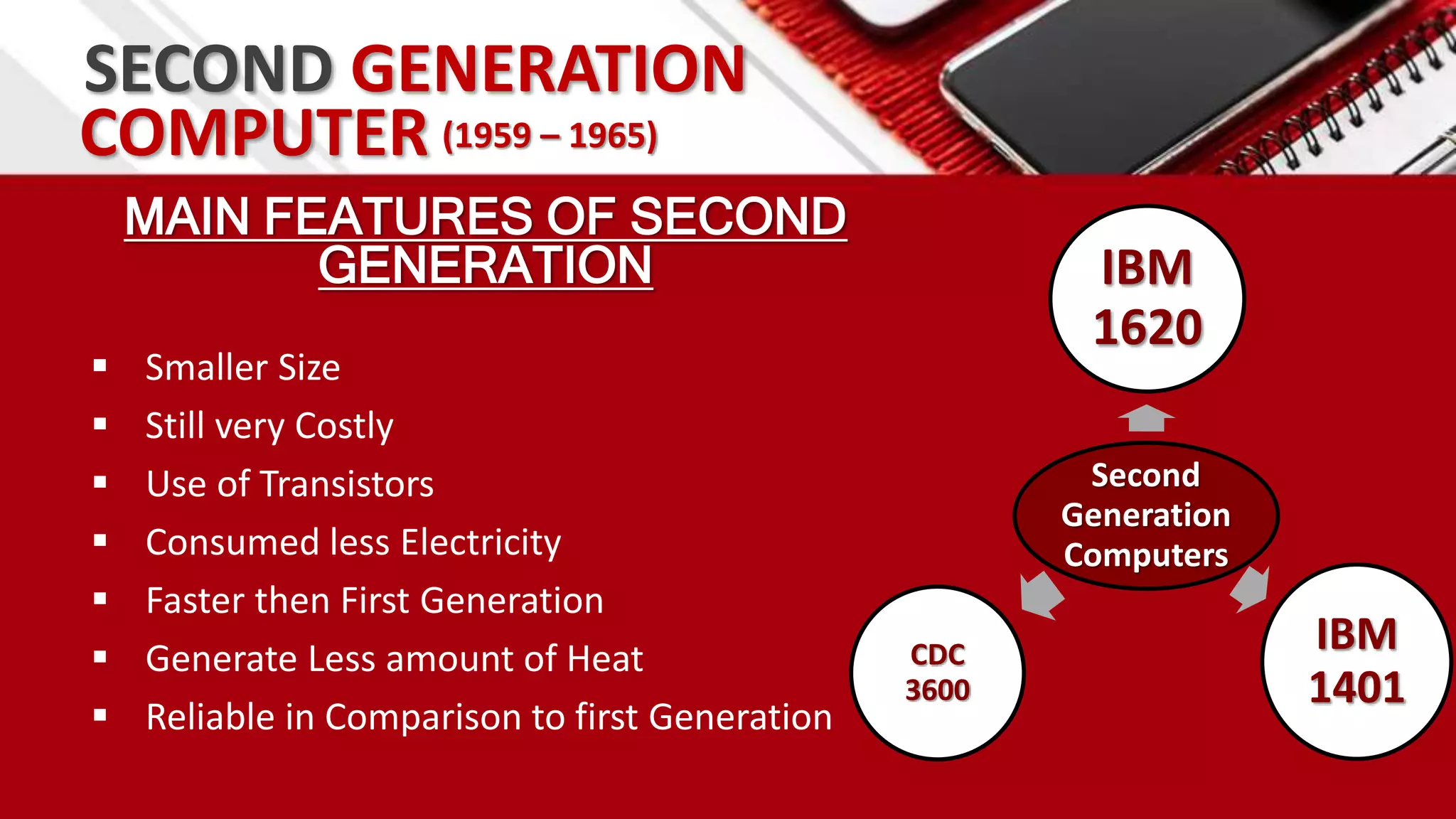
 Smaller Size
 Still very Costly
 Use of Transistors
 Consumed less Electricity
 Faster then First Generation
 Generate Less amount of Heat
 Reliable in Comparison to first Generation
COMPUTER (1959 – 1965)
Second
Generation
Computers
IBM
1620
IBM
1401
CDC
3600
THIRD GENERATION
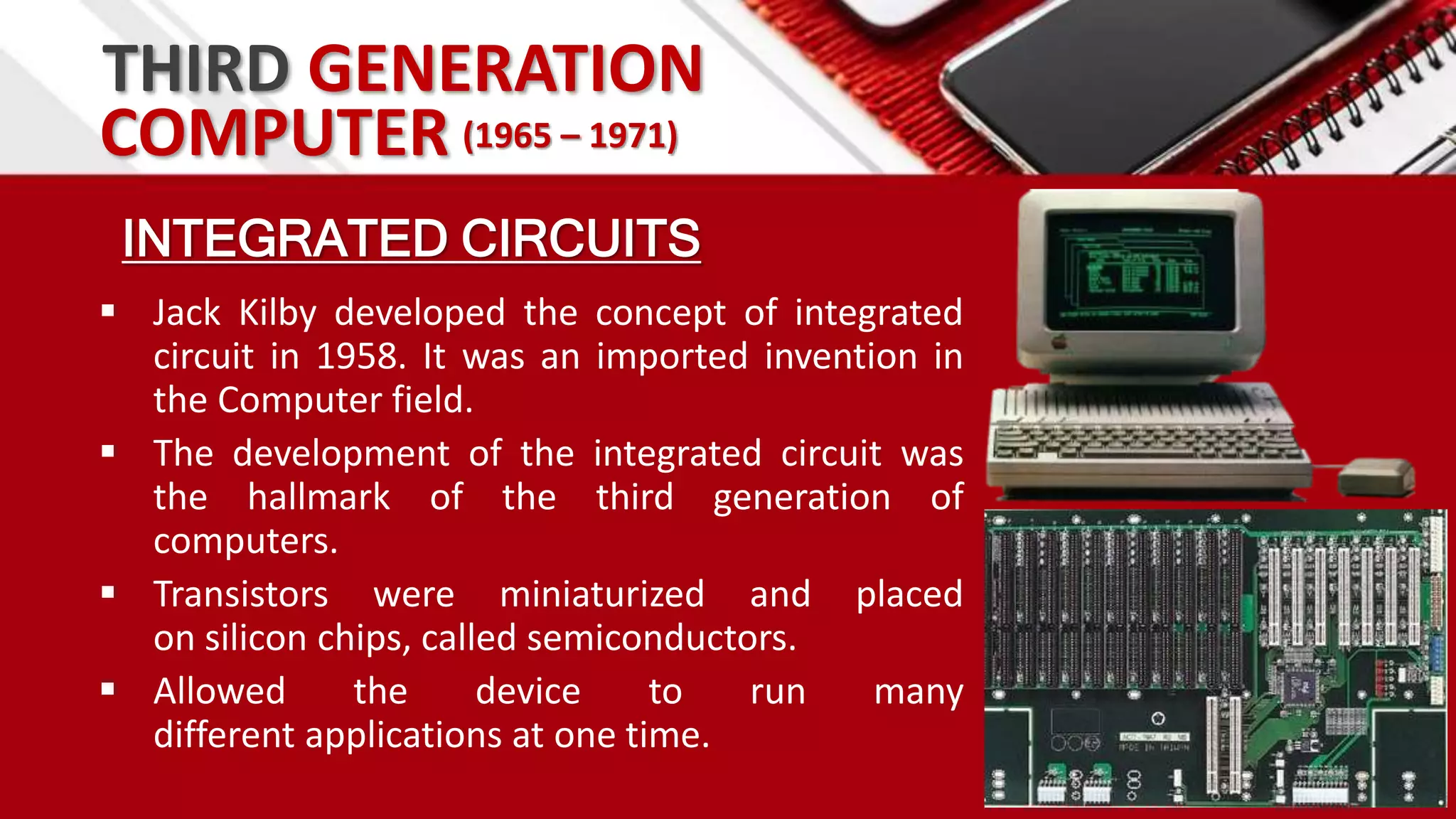
INTEGRATED CIRCUITS
 Jack Kilby developed the concept of integrated
circuit in 1958. It was an imported invention in
the Computer field.
 The development of the integrated circuit was
the hallmark of the third generation of
computers.
 Transistors were miniaturized and placed
on silicon chips, called semiconductors.
 Allowed the device to run many
different applications at one time.
COMPUTER (1965 – 1971)
THIRD GENERATION
MAIN FEATURES OF THIRD
GENERATION
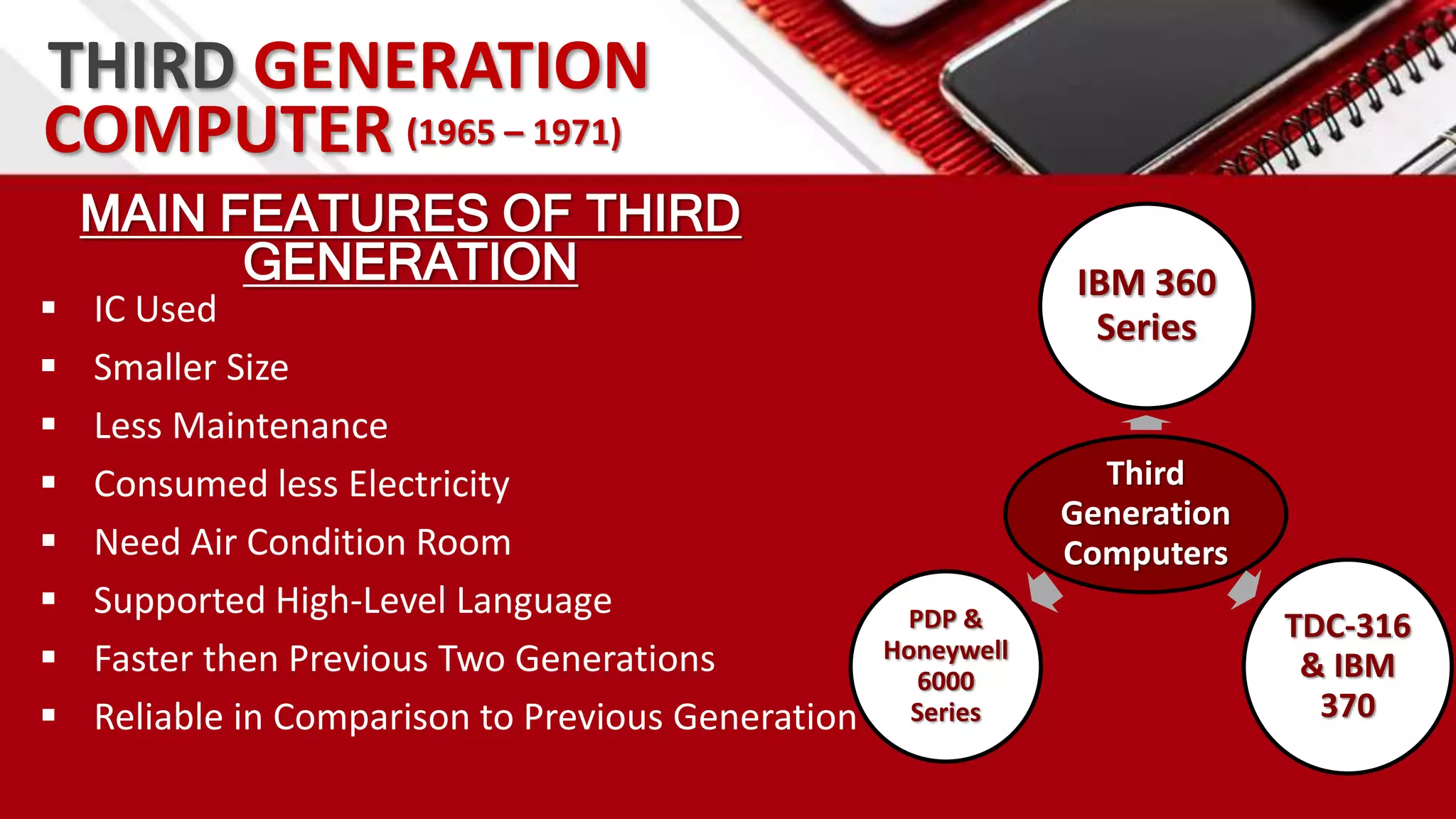
 IC Used
 Smaller Size
 Less Maintenance
 Consumed less Electricity
 Need Air Condition Room
 Supported High-Level Language
 Faster then Previous Two Generations
 Reliable in Comparison to Previous Generation
COMPUTER (1965 – 1971)
Third
Generation
Computers
IBM 360
Series
TDC-316
& IBM
370
PDP &
Honeywell
6000
Series
FOURTH GENERATION
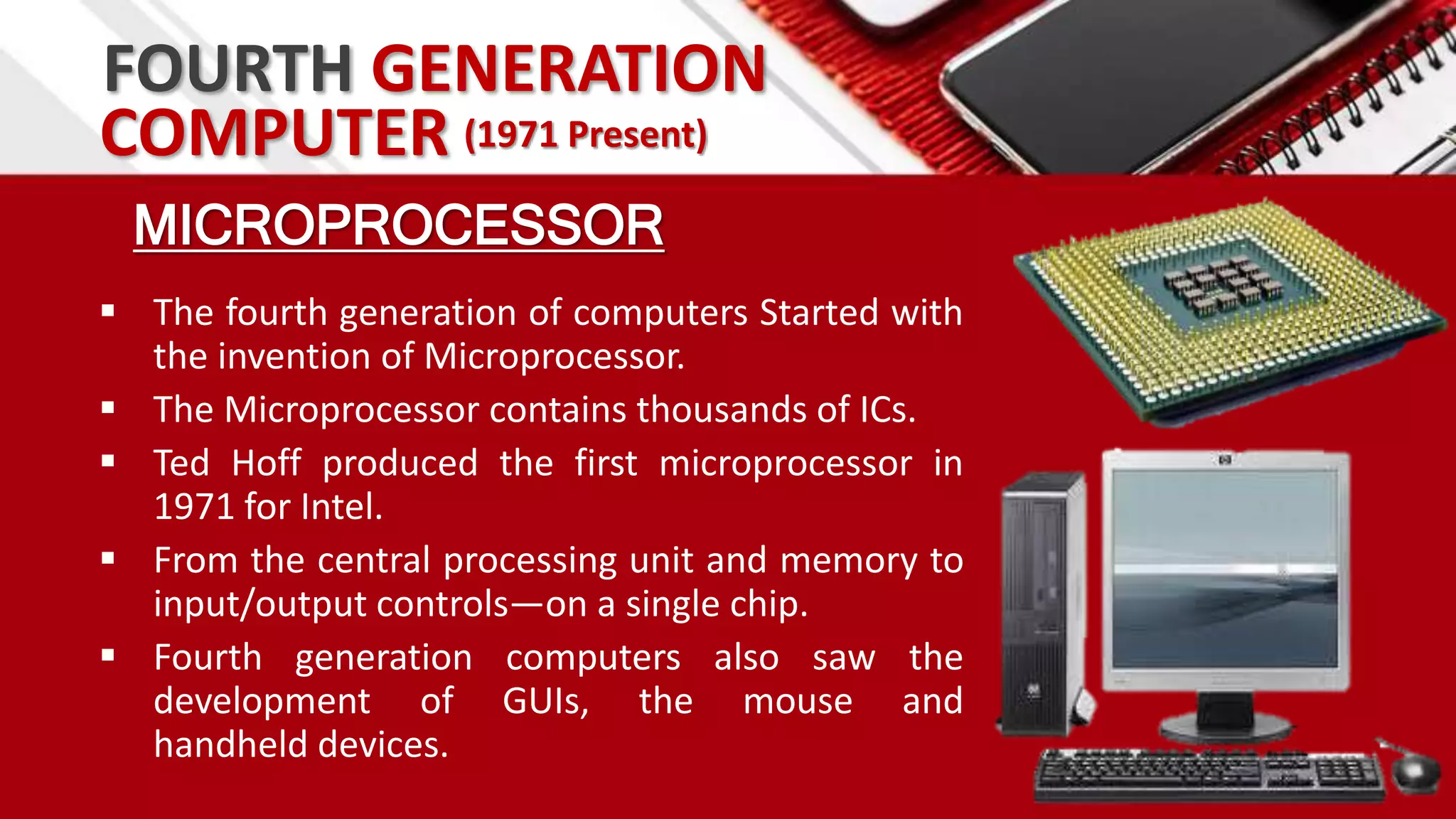
MICROPROCESSOR
 The fourth generation of computers Started with
the invention of Microprocessor.
 The Microprocessor contains thousands of ICs.
 Ted Hoff produced the first microprocessor in
1971 for Intel.
 From the central processing unit and memory to
input/output controls—on a single chip.
 Fourth generation computers also saw the
development of GUIs, the mouse and
handheld devices.
COMPUTER (1971 Present)
FOURTH GENERATION
MAIN FEATURES OF FOURTH
GENERATION
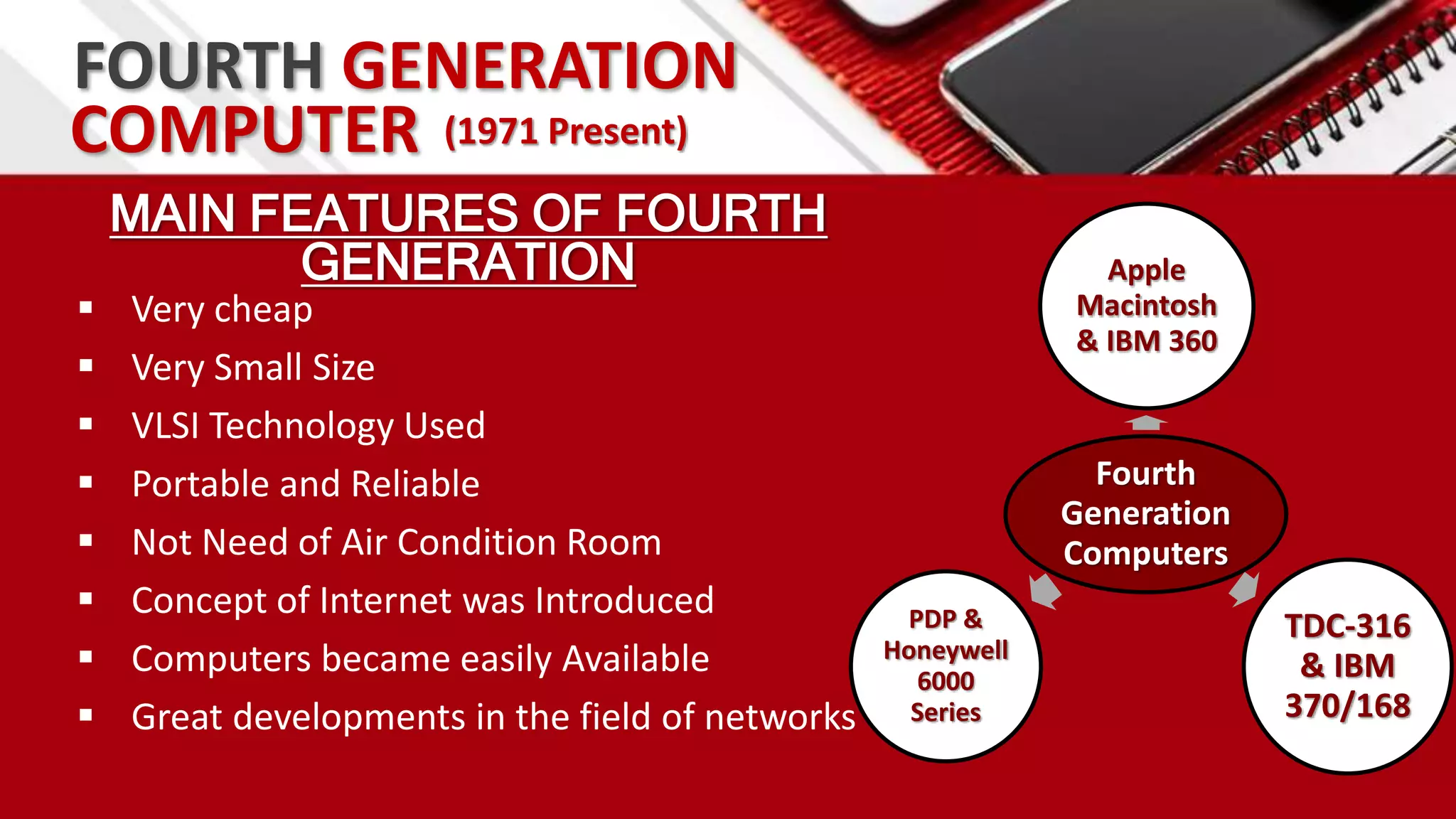
 Very cheap
 Very Small Size
 VLSI Technology Used
 Portable and Reliable
 Not Need of Air Condition Room
 Concept of Internet was Introduced
 Computers became easily Available
 Great developments in the field of networks
COMPUTER (1971 Present)
Fourth
Generation
Computers
Apple
Macintosh
& IBM 360
TDC-316
& IBM
370/168
PDP &
Honeywell
6000
Series
FIFTH GENERATION
Artificial intelligence
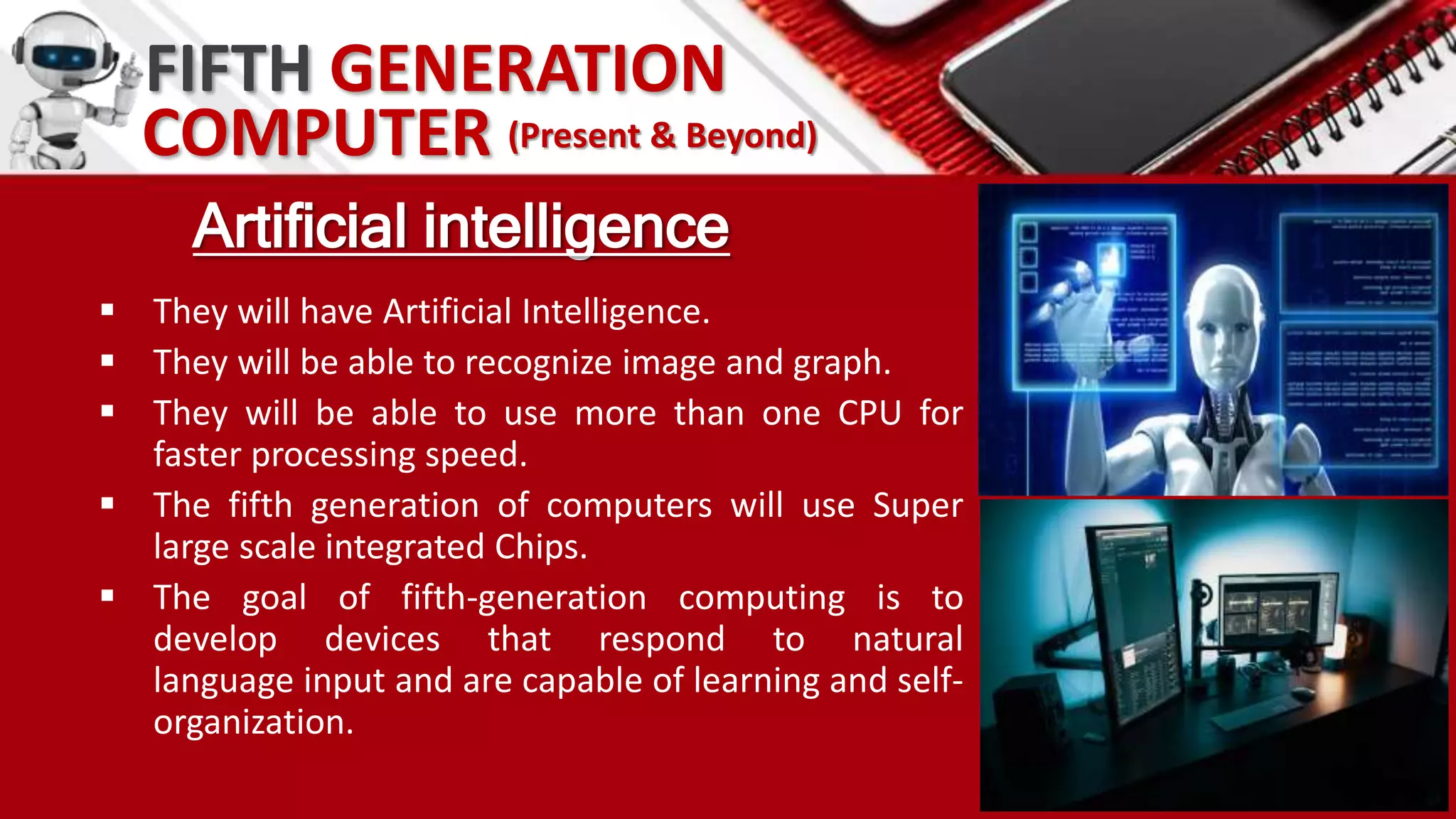
 They will have Artificial Intelligence.
 They will be able to recognize image and graph.
 They will be able to use more than one CPU for
faster processing speed.
 The fifth generation of computers will use Super
large scale integrated Chips.
 The goal of fifth-generation computing is to
develop devices that respond to natural
language input and are capable of learning and self-
organization.
COMPUTER (Present & Beyond)
MAIN FEATURES OF FIFTH
GENERATION
 USLI Technology
 Advancement in parallel processing
 Development of true artificial intelligence
 Development of Natural Language processing
 Advancement in Super-Conductor technology
 More User Friendly interfaces with
multimedia features.
 Availability of very powerful & Compact
Computers at cheap rates.
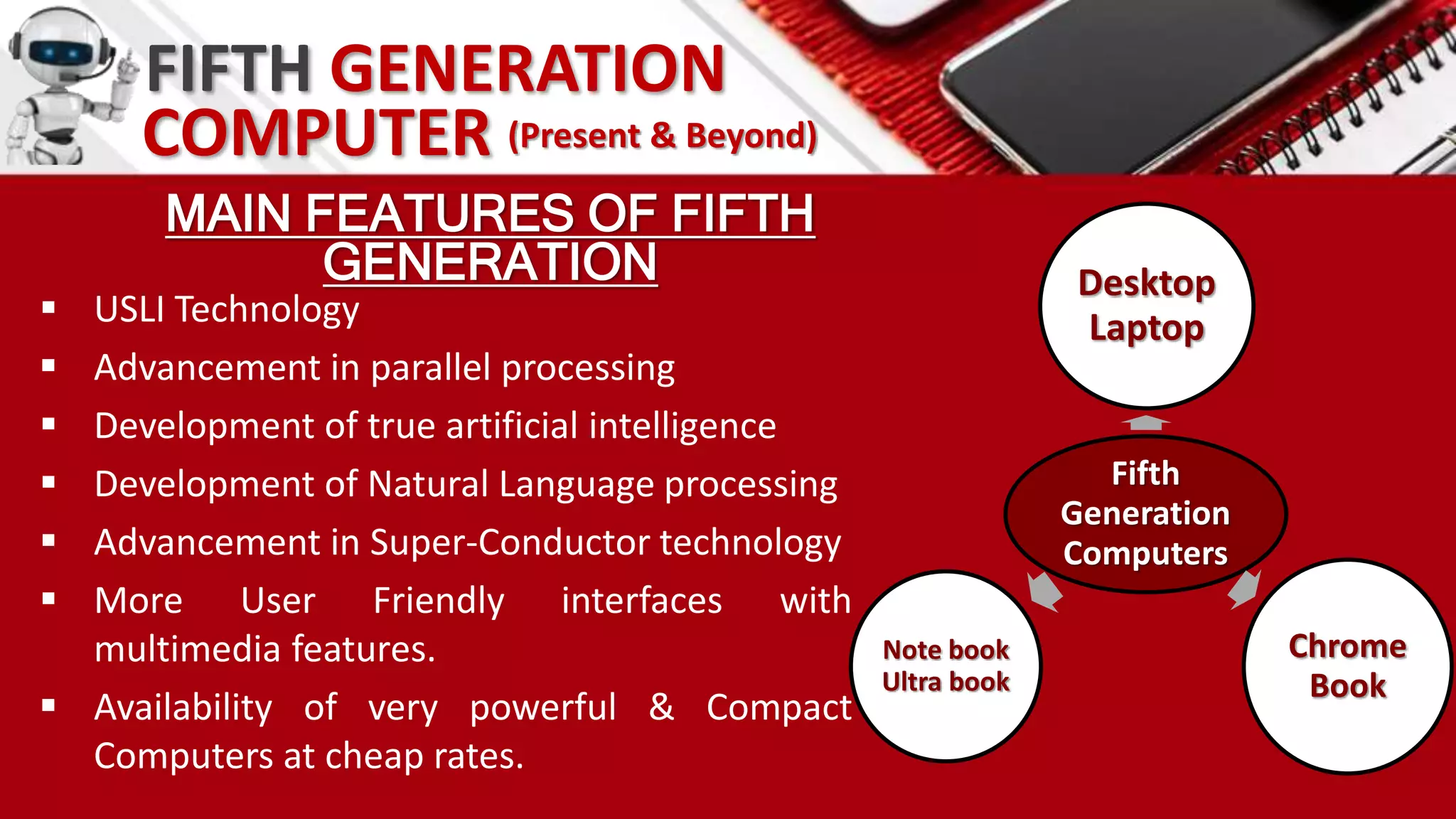
Fifth
Generation
Computers
Desktop
Laptop
Chrome
Book
Note book
Ultra book
FIFTH GENERATION
COMPUTER (Present & Beyond)
THANKS 

Computers presentation lab task by khalid riaz bsc civil

  • 1.
  • 2.
    PRESENTED BY:  Name:-KHALID RIAZ  Subject:- Computer Application  Semester:- 1st  Teacher:- Sir Yousuf Qasim
  • 3.
    INTRODUCTION The History ofComputer development is often referred to in reference to the different generations of computing devices. Each generation of computer is characterized by a major technological development that fundamentally changed the way computers operate, resulting in increasingly smaller, cheaper, more powerful and more efficient and reliable devices.
  • 4.
    FIRST COMPUTER  Theabacus, a simple counting aid, may have been invented in Babylonia (now Iraq) in the fourth century B.C.  This device allows users to make computations using a system of sliding beads arranged on a rack.  Considered the first computer ABACUS 4th Century B.C.
  • 5.
    BLAISE PASCAL (1623 -1662)  In 1642, the French mathematician and philosopher Blaise Pascal invented a calculating device that would come to be called the "Adding Machine".  One of the first and earliest mechanical devices used for calculating was the Pascaline. Pascal’s calculator Pascal’s Adding Machine
  • 6.
    CHARLES BABBAGE (1791 -1871)  Born in 1791, Charles Babbage was an English mathematician and professor.  In 1822, he persuaded the British government to finance his design to build a machine that would calculate tables for logarithms. Called the “Difference Engine.”  Device was to calculate numbers to 20th place and print them at 4 digits per minute.  With Charles Babbage's creation of the "Analytical Engine", (1833) computers took the form of a general purpose machine. Analytical Engine (Father of Computers)
  • 7.
  • 8.
    GENERATIONS OF COMPUTER FIRST GENERATION COMPUTERS  SECOND GENERATION COMPUTERS  THIRD GENERATION COMPUTERS  FOURTH GENERATION COMPUTERS  FIFTH GENERATION COMPUTERS
  • 9.
    FIRST GENERATION Vacuum Tubes The first computers used vacuum tubes(a sealed glass tube containing a near-vacuum which allows the free passage of electric current.) for circuitry and magnetic drums for memory.  First generation computers relied on machine language.  They were often enormous and taking up entire room. COMPUTER (1945 – 1956)
  • 10.
    FIRST GENERATION MAIN FEATURESOF FIRST GENERATION  Vacuum Tube Technology  Unreliable  Very Costly  Generate Lot of Heat  Slow Input/Output Devices  Huge Size  Need Air Condition Room  Non-Portable COMPUTER (1945 – 1956) First Generation Computers ENIAC EDVAC IBM UNIVAC
  • 11.
    SECOND GENERATION TRANSISTORS  TheScientists at Bell Laboratories developed Transistors in 1947.  Transistors replaced vacuum tubes and ushered in the second generation of computers.  These were also the first computers that stored their instructions in their memory.  High-level programming languages were also being developed at this time, such as early versions of COBOL and FORTRAN. COMPUTER (1959 – 1965)
  • 12.
    SECOND GENERATION MAIN FEATURESOF SECOND GENERATION  Smaller Size  Still very Costly  Use of Transistors  Consumed less Electricity  Faster then First Generation  Generate Less amount of Heat  Reliable in Comparison to first Generation COMPUTER (1959 – 1965) Second Generation Computers IBM 1620 IBM 1401 CDC 3600
  • 13.
    THIRD GENERATION INTEGRATED CIRCUITS Jack Kilby developed the concept of integrated circuit in 1958. It was an imported invention in the Computer field.  The development of the integrated circuit was the hallmark of the third generation of computers.  Transistors were miniaturized and placed on silicon chips, called semiconductors.  Allowed the device to run many different applications at one time. COMPUTER (1965 – 1971)
  • 14.
    THIRD GENERATION MAIN FEATURESOF THIRD GENERATION  IC Used  Smaller Size  Less Maintenance  Consumed less Electricity  Need Air Condition Room  Supported High-Level Language  Faster then Previous Two Generations  Reliable in Comparison to Previous Generation COMPUTER (1965 – 1971) Third Generation Computers IBM 360 Series TDC-316 & IBM 370 PDP & Honeywell 6000 Series
  • 15.
    FOURTH GENERATION MICROPROCESSOR  Thefourth generation of computers Started with the invention of Microprocessor.  The Microprocessor contains thousands of ICs.  Ted Hoff produced the first microprocessor in 1971 for Intel.  From the central processing unit and memory to input/output controls—on a single chip.  Fourth generation computers also saw the development of GUIs, the mouse and handheld devices. COMPUTER (1971 Present)
  • 16.
    FOURTH GENERATION MAIN FEATURESOF FOURTH GENERATION  Very cheap  Very Small Size  VLSI Technology Used  Portable and Reliable  Not Need of Air Condition Room  Concept of Internet was Introduced  Computers became easily Available  Great developments in the field of networks COMPUTER (1971 Present) Fourth Generation Computers Apple Macintosh & IBM 360 TDC-316 & IBM 370/168 PDP & Honeywell 6000 Series
  • 17.
    FIFTH GENERATION Artificial intelligence They will have Artificial Intelligence.  They will be able to recognize image and graph.  They will be able to use more than one CPU for faster processing speed.  The fifth generation of computers will use Super large scale integrated Chips.  The goal of fifth-generation computing is to develop devices that respond to natural language input and are capable of learning and self- organization. COMPUTER (Present & Beyond)
  • 18.
    MAIN FEATURES OFFIFTH GENERATION  USLI Technology  Advancement in parallel processing  Development of true artificial intelligence  Development of Natural Language processing  Advancement in Super-Conductor technology  More User Friendly interfaces with multimedia features.  Availability of very powerful & Compact Computers at cheap rates. Fifth Generation Computers Desktop Laptop Chrome Book Note book Ultra book FIFTH GENERATION COMPUTER (Present & Beyond)
  • 19.