GMP and Quality Assurance
B Pharm VI Sem (BP 606 T)
By
Dr. Abhishek Pandey
Assistant Professor
School of Studies in Pharmaceutical Sciences, Jiwaji
University, Gwalior
Contents
2
Introduction to GMP
Objectives of GMP
Quality assurance
WHO GMP guidelines
General GMP
guidelines
Conclusion
3
According to FDA a drug is defined as adulterated if the
methods used in its manufacture or processing Testing
Packaging Storing
Did not conform to the GMPs
As a result of this, GMPs were first established in June
1963 The concept was born in U.S.A
Drugs being a very important component of health
care system need special attention in regard to their
Quality
Safety
efficacy
4
Final testing of the product cannot ensure the
quality, safety, efficacy of a product
Therefore the concept of QC evolved
The development of QC resulted in GMPs
5
Many Indian drug manufacturers export
pharmaceutical preparations to other member
countries of WHO
Indian drug manufacturers as well as their technical
personnel should be aware of the GMP guidelines
prepared by WHO
These are referred to WHO GMPs
6
What is GMP ?
7
GMP is that part of Quality assurance which
ensures that the products are consistently
manufactured and controlled to the Quality
standards appropriate to their intended use
"GMP" - A set of principles and procedures which,
when followed by manufacturers for therapeutic
goods, helps ensure that the products manufactured
will have the required quality.
The Govt of India amended the drugs & cosmetics
rules, 1945 on 24th june 1988 and prescribed GMPs
under Schedule M
Schedule M has 2 parts, part 1 and part 2
GMP guidelines come under part1
The Schedule M has been revised and brought
more less to the level of WHO GMP text
8
WHO GMP ensures the following:
9
Avoidance of Cross- Contamination
Prevention of Mix-ups
Provide Traceability
Accountability of actions
Responsibility
Product Performance Guarantee
India is the world’s second largest producer of APIs,
not only in quantity but also in the variety of
molecules.
Indian API manufacturers have traditionally
complied with US GMP regulations since the
majority of the material produced is for export.
10
11
The current trend in pharmaceutical companies in India
is that they adopt ICH structured guidelines, GMP
regulations, audit topics and legal requirements as per
target country and gear up for the audit.
But necessarily the manufacturer may not follow
Schedule M for facing international audits. The
difference between the GMP standards of the drug
supplying countries and the receiving countries may
therefore result in ambiguities and difficulties relating to
its compliance.
Objectives of GMP
12
To produce products conforming to the pre-
determined specifications
To produce products of consistent quality
To minimize contamination
To eliminate errors
Good Manufacturing Practices
13
A basic tenet of GMP is that quality cannot be tested
into a batch of product but must be built into each
batch of product during all stages of the
manufacturing process.
It is designed to minimize the risks involved in any
pharmaceutical production that cannot be eliminated
through testing the final product.
14
diminishing the risks inherent in pharmaceutical
production, which may broadly be categorized into
1. unexpected contamination of products
2. incorrect labels on containers
3. insufficient or too much active ingredient
Above all, manufacturers must not place patients
at risk due to inadequate safety, quality or efficacy;
for this reason, risk assessment has come to play
an important role in WHO quality assurance
guidelines.
Aim of GMP
Quality assurance
15
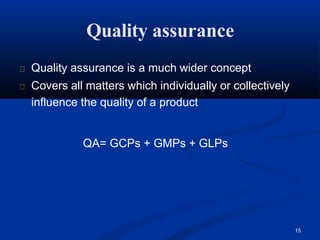
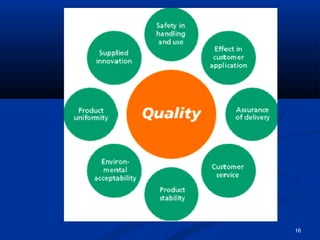
Quality assurance is a much wider concept
Covers all matters which individually or collectively
influence the quality of a product
QA= GCPs + GMPs + GLPs
16
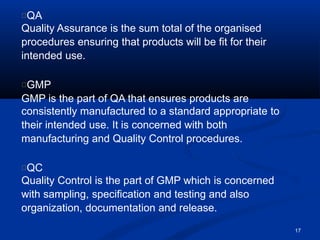
QA
Quality Assurance is the sum total of the organised
procedures ensuring that products will be fit for their
intended use.
GMP
GMP is the part of QA that ensures products are
consistently manufactured to a standard appropriate to
their intended use. It is concerned with both
manufacturing and Quality Control procedures.
QC
Quality Control is the part of GMP which is concerned
with sampling, specification and testing and also
organization, documentation and release.
17
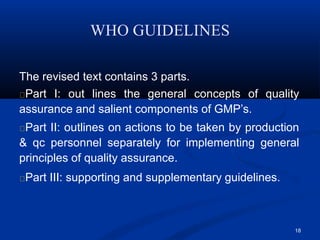
WHO GUIDELINES
18
The revised text contains 3 parts.
Part I: out lines the general concepts of quality
assurance and salient components of GMP’s.
Part II: outlines on actions to be taken by production
& qc personnel separately for implementing general
principles of quality assurance.
Part III: supporting and supplementary guidelines.
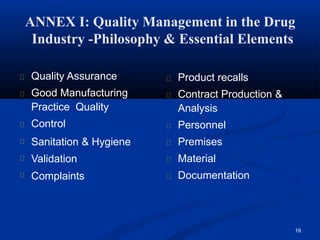
ANNEX I: Quality Management in the Drug
Industry -Philosophy & Essential Elements
19
Quality Assurance
Good Manufacturing
Practice Quality
Control
Sanitation & Hygiene
Validation
Complaints
Product recalls
Contract Production &
Analysis
Personnel
Premises
Material
Documentation
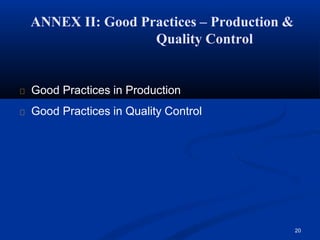
ANNEX II: Good Practices – Production &
Quality Control
20
Good Practices in Production
Good Practices in Quality Control
ANNEX III: Supporting and
Supplementary Guidelines
21
Sterile pharmaceutical Products
Good Manufacturing Practice for Active
Pharmaceutical Ingredients
What is done under GMP can
be summarized as follows
22
1. all processes are clearly defined systematically
2. All necessary resources are provided by
Adequately qualified and trained personnel
Adequate premises and equipment
Adequate services
Appropriate materials, containers and labels
Approved procedures and instruments
Suitable storage and transport
Adequate qc facilities
3. Qualification and validation work is performed
4. Procedures and instructions are written in clear
unambiguous language
5. Operators are trained
6. Manufacturing procedures are recorded
7. All production and distribution records are
retained
8. Proper storage and distribution of products
9. Recall of any product batch
10. Complaints about product quality are investigated
23
Premises
Personnel
Equipment
Sanitation
Starting material
Manufacturing operations
Validation
Qc systems
Documentation etc
24
General GMP guidelines include
important aspects like
Premises
25
Location
Structure
Basic design and layout
Size, scale, and complexity of manufacturing
operations
Production area
Storage area
QC area
Ancillary area
Organization & Personnel
26
1. Responsibilities of quality control unit.
2. Personnel qualifications.
3. Personnel responsibilities.
4. Consultants.
Equipment
27
1. Equipment design, size, and location.
2. Equipment construction.
3. Equipment cleaning and maintenance.
4. Automatic, mechanical, and electronic equipment.
5. Filters.
Utilities and facilities
28
Design and construction features. Lighting.
Ventilation, air filtration, air heating and cooling.
Plumbing. .
Washing and toilet facilities.
Sanitation.
Maintenance.
Water (of various grades)
Steam
Compressed air
29
Various other gases
Vacuum
Electricity Cooling
systems
Dust control and collection systems
Effluent and waste disposal systems and drainage
Bulk solvent and other bulk liquid supply systems
Lubrication services
Sanitation
30
premises shall be cleaned
free from accumulated waste, dust, debris
A validated cleaning procedure shall be maintained.
routine sanitation program and which shall indicate--
(a)Specific areas to be cleaned and cleaning intervals
(b)Cleaning procedure to be followed, including
equipment and materials to be used for cleaning
(c)Personnel assigned for the cleaning operation.
Raw materials
31
inventory
maintain records as per Schedule U.
quarantined immediately after receipt
stored under appropriate conditions
batch segregation and stock rotation.
purchased from approved sources .
labeled with the following information:
(a)name of the product
(b)Manufacturers name, address, batch number;
(c)status of the contents (e.g. quarantine, under test,
released, approved, rejected)
(d)manufacturing date, expiry date, re-test date.
Only QC passed materials should be released
32
Manufacturing operations
33
carried out under the supervision of technical staff
Critical steps shall be performed by trained personnel
under the direct personal supervision of approved
technical staff.
The contents of all vessels and containers shall be
conspicuously labeled
Precautions against mix-up and cross-contamination-
SOPs shall be maintained.
All equipment shall be labeled with their current status.
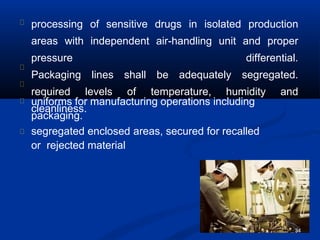
processing of sensitive drugs in isolated production
areas with independent air-handling unit and proper
pressure differential.
Packaging lines shall be adequately segregated.
required levels of temperature, humidity and
cleanliness.
uniforms for manufacturing operations including
packaging.
segregated enclosed areas, secured for recalled
or rejected material
34
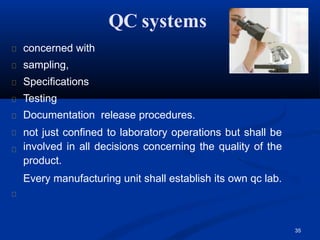
QC systems
concerned with
sampling,
Specifications
Testing
Documentation release procedures.
not just confined to laboratory operations but shall be
involved in all decisions concerning the quality of the
product.
Every manufacturing unit shall establish its own qc lab.
35
area of qc lab may be divided into
Chemical
36
Instrumentation
Microbiological
Biological testing.
storage conditions shall be provided for
keeping reference samples.
SOPs for sampling, inspecting and testing of
raw materials,
intermediate
bulk finished products packing materials.
Documentation
37
Its aim is to
define the specifications for all materials,
method of manufacture,
to provide an audit trail
designed, prepared, reviewed and controlled, wherever
applicable,
approved, signed and dated by appropriate and
authorized persons.
specify the title, nature and purpose.
laid out in an orderly fashion and be easy to
check. clear and legible.
38
regularly reviewed and kept up to date.
alteration made shall be signed and dated. Records and
SOPs shall be retained
Data may be recorded by electronic data processing
systems or other reliable means, but Master Formulae
shall also be available in a hard copy
GMP
39
Good Manufacturing Practice
Good Management Practice
Get More Profit
Give More Production
Conclusion
40
The Quality of a drug depends on the Quality of those
producing it
The problem cannot be solved by tighter regulations alone.
Continuous and professional auditing is essential to
overcome the challenge of meeting stringent requirements
of GMP.
GMP is doing the right thing when nobody is watching but it
will reflect in the final product being right.
In matter of GMP, swim with the current and in
matter of Quality stand like a rock!
41
Thank you

GMP and Quality assurance PDF.pdf

  • 1.
    GMP and QualityAssurance B Pharm VI Sem (BP 606 T) By Dr. Abhishek Pandey Assistant Professor School of Studies in Pharmaceutical Sciences, Jiwaji University, Gwalior
  • 2.
    Contents 2 Introduction to GMP Objectivesof GMP Quality assurance WHO GMP guidelines General GMP guidelines Conclusion
  • 3.
    3 According to FDAa drug is defined as adulterated if the methods used in its manufacture or processing Testing Packaging Storing Did not conform to the GMPs As a result of this, GMPs were first established in June 1963 The concept was born in U.S.A
  • 4.
    Drugs being avery important component of health care system need special attention in regard to their Quality Safety efficacy 4
  • 5.
    Final testing ofthe product cannot ensure the quality, safety, efficacy of a product Therefore the concept of QC evolved The development of QC resulted in GMPs 5
  • 6.
    Many Indian drugmanufacturers export pharmaceutical preparations to other member countries of WHO Indian drug manufacturers as well as their technical personnel should be aware of the GMP guidelines prepared by WHO These are referred to WHO GMPs 6
  • 7.
    What is GMP? 7 GMP is that part of Quality assurance which ensures that the products are consistently manufactured and controlled to the Quality standards appropriate to their intended use "GMP" - A set of principles and procedures which, when followed by manufacturers for therapeutic goods, helps ensure that the products manufactured will have the required quality.
  • 8.
    The Govt ofIndia amended the drugs & cosmetics rules, 1945 on 24th june 1988 and prescribed GMPs under Schedule M Schedule M has 2 parts, part 1 and part 2 GMP guidelines come under part1 The Schedule M has been revised and brought more less to the level of WHO GMP text 8
  • 9.
    WHO GMP ensuresthe following: 9 Avoidance of Cross- Contamination Prevention of Mix-ups Provide Traceability Accountability of actions Responsibility Product Performance Guarantee
  • 10.
    India is theworld’s second largest producer of APIs, not only in quantity but also in the variety of molecules. Indian API manufacturers have traditionally complied with US GMP regulations since the majority of the material produced is for export. 10
  • 11.
    11 The current trendin pharmaceutical companies in India is that they adopt ICH structured guidelines, GMP regulations, audit topics and legal requirements as per target country and gear up for the audit. But necessarily the manufacturer may not follow Schedule M for facing international audits. The difference between the GMP standards of the drug supplying countries and the receiving countries may therefore result in ambiguities and difficulties relating to its compliance.
  • 12.
    Objectives of GMP 12 Toproduce products conforming to the pre- determined specifications To produce products of consistent quality To minimize contamination To eliminate errors
  • 13.
    Good Manufacturing Practices 13 Abasic tenet of GMP is that quality cannot be tested into a batch of product but must be built into each batch of product during all stages of the manufacturing process. It is designed to minimize the risks involved in any pharmaceutical production that cannot be eliminated through testing the final product.
  • 14.
    14 diminishing the risksinherent in pharmaceutical production, which may broadly be categorized into 1. unexpected contamination of products 2. incorrect labels on containers 3. insufficient or too much active ingredient Above all, manufacturers must not place patients at risk due to inadequate safety, quality or efficacy; for this reason, risk assessment has come to play an important role in WHO quality assurance guidelines. Aim of GMP
  • 15.
    Quality assurance 15 Quality assuranceis a much wider concept Covers all matters which individually or collectively influence the quality of a product QA= GCPs + GMPs + GLPs
  • 16.
  • 17.
    QA Quality Assurance isthe sum total of the organised procedures ensuring that products will be fit for their intended use. GMP GMP is the part of QA that ensures products are consistently manufactured to a standard appropriate to their intended use. It is concerned with both manufacturing and Quality Control procedures. QC Quality Control is the part of GMP which is concerned with sampling, specification and testing and also organization, documentation and release. 17
  • 18.
    WHO GUIDELINES 18 The revisedtext contains 3 parts. Part I: out lines the general concepts of quality assurance and salient components of GMP’s. Part II: outlines on actions to be taken by production & qc personnel separately for implementing general principles of quality assurance. Part III: supporting and supplementary guidelines.
  • 19.
    ANNEX I: QualityManagement in the Drug Industry -Philosophy & Essential Elements 19 Quality Assurance Good Manufacturing Practice Quality Control Sanitation & Hygiene Validation Complaints Product recalls Contract Production & Analysis Personnel Premises Material Documentation
  • 20.
    ANNEX II: GoodPractices – Production & Quality Control 20 Good Practices in Production Good Practices in Quality Control
  • 21.
    ANNEX III: Supportingand Supplementary Guidelines 21 Sterile pharmaceutical Products Good Manufacturing Practice for Active Pharmaceutical Ingredients
  • 22.
    What is doneunder GMP can be summarized as follows 22 1. all processes are clearly defined systematically 2. All necessary resources are provided by Adequately qualified and trained personnel Adequate premises and equipment Adequate services Appropriate materials, containers and labels Approved procedures and instruments Suitable storage and transport Adequate qc facilities
  • 23.
    3. Qualification andvalidation work is performed 4. Procedures and instructions are written in clear unambiguous language 5. Operators are trained 6. Manufacturing procedures are recorded 7. All production and distribution records are retained 8. Proper storage and distribution of products 9. Recall of any product batch 10. Complaints about product quality are investigated 23
  • 24.
    Premises Personnel Equipment Sanitation Starting material Manufacturing operations Validation Qcsystems Documentation etc 24 General GMP guidelines include important aspects like
  • 25.
    Premises 25 Location Structure Basic design andlayout Size, scale, and complexity of manufacturing operations Production area Storage area QC area Ancillary area
  • 26.
    Organization & Personnel 26 1.Responsibilities of quality control unit. 2. Personnel qualifications. 3. Personnel responsibilities. 4. Consultants.
  • 27.
    Equipment 27 1. Equipment design,size, and location. 2. Equipment construction. 3. Equipment cleaning and maintenance. 4. Automatic, mechanical, and electronic equipment. 5. Filters.
  • 28.
    Utilities and facilities 28 Designand construction features. Lighting. Ventilation, air filtration, air heating and cooling. Plumbing. . Washing and toilet facilities. Sanitation. Maintenance. Water (of various grades) Steam Compressed air
  • 29.
    29 Various other gases Vacuum ElectricityCooling systems Dust control and collection systems Effluent and waste disposal systems and drainage Bulk solvent and other bulk liquid supply systems Lubrication services
  • 30.
    Sanitation 30 premises shall becleaned free from accumulated waste, dust, debris A validated cleaning procedure shall be maintained. routine sanitation program and which shall indicate-- (a)Specific areas to be cleaned and cleaning intervals (b)Cleaning procedure to be followed, including equipment and materials to be used for cleaning (c)Personnel assigned for the cleaning operation.
  • 31.
    Raw materials 31 inventory maintain recordsas per Schedule U. quarantined immediately after receipt stored under appropriate conditions batch segregation and stock rotation. purchased from approved sources .
  • 32.
    labeled with thefollowing information: (a)name of the product (b)Manufacturers name, address, batch number; (c)status of the contents (e.g. quarantine, under test, released, approved, rejected) (d)manufacturing date, expiry date, re-test date. Only QC passed materials should be released 32
  • 33.
    Manufacturing operations 33 carried outunder the supervision of technical staff Critical steps shall be performed by trained personnel under the direct personal supervision of approved technical staff. The contents of all vessels and containers shall be conspicuously labeled Precautions against mix-up and cross-contamination- SOPs shall be maintained. All equipment shall be labeled with their current status.
  • 34.
    processing of sensitivedrugs in isolated production areas with independent air-handling unit and proper pressure differential. Packaging lines shall be adequately segregated. required levels of temperature, humidity and cleanliness. uniforms for manufacturing operations including packaging. segregated enclosed areas, secured for recalled or rejected material 34
  • 35.
    QC systems concerned with sampling, Specifications Testing Documentationrelease procedures. not just confined to laboratory operations but shall be involved in all decisions concerning the quality of the product. Every manufacturing unit shall establish its own qc lab. 35
  • 36.
    area of qclab may be divided into Chemical 36 Instrumentation Microbiological Biological testing. storage conditions shall be provided for keeping reference samples. SOPs for sampling, inspecting and testing of raw materials, intermediate bulk finished products packing materials.
  • 37.
    Documentation 37 Its aim isto define the specifications for all materials, method of manufacture, to provide an audit trail designed, prepared, reviewed and controlled, wherever applicable, approved, signed and dated by appropriate and authorized persons. specify the title, nature and purpose.
  • 38.
    laid out inan orderly fashion and be easy to check. clear and legible. 38 regularly reviewed and kept up to date. alteration made shall be signed and dated. Records and SOPs shall be retained Data may be recorded by electronic data processing systems or other reliable means, but Master Formulae shall also be available in a hard copy
  • 39.
    GMP 39 Good Manufacturing Practice GoodManagement Practice Get More Profit Give More Production
  • 40.
    Conclusion 40 The Quality ofa drug depends on the Quality of those producing it The problem cannot be solved by tighter regulations alone. Continuous and professional auditing is essential to overcome the challenge of meeting stringent requirements of GMP. GMP is doing the right thing when nobody is watching but it will reflect in the final product being right. In matter of GMP, swim with the current and in matter of Quality stand like a rock!
  • 41.