CURRENRT GOOD
MANUFACTURING
PRACTICES (cGMP)
Presented by: Mr. Sandip M. Honmane
(M.Pharm, Pharmaceutics)
Asst. Prof. ADCBP, Ashta
Previous Working: Quality Assurance Dept. Cipla
Ltd. Goa.
MEDICINE ARE FIT TO ITS PURPOSE WHEN
 It is the right product
 Right strength
 Free from contamination
 Correctly labeled
 Properly sealed in its containers/ final packaging
material for protection, contamination & damage.
Why GMP
• MEDICINES are different from other products
OTHER PRODUCTS:
• We can check quality before we buy.
• If faulty then they can be returned back.
MEDICINES:
• Patient have little chances to detect if anything is
wrong.
• If something goes wrong it can be very dangerous.
• They trust the DOCTORS who prescribe and
Manufacturing company who mfg it.
Skills Required
• Technical competency
• Language skill
• Flexibility
• Productive (Authorative)
• Willing to learn
• Interaction with other Dept.
• Time bounding work
• IT/Software knowledge
GMP
 GMP is that part of QA which ensures that products are
consistently produced and controlled to quality standards
appropriate to their intended use and as required by the
marketing authorization or product specification.
 GMP is concerned with both production and quality
control.
cGMP
 C- means current/ updated/ up to date
 The manufacturer of a pharmaceuticals must be by
current methods with current control as a requirement
that which is current or generally, accepted in the industry
as appropriate equipment's, methodology, control and
records.
 But that they also be ‘’Good’’
Basic Elements of cGMP
1. Quality management- interrelated Concept to QA, GMP &
QC
2. Buildings and facilities
3. Equipment
4. Organisation and personnel
5. Control of components and drug product containers and
closures-materials
6. Production and process controls
7. Packaging and labelling control
8. Holding and distribution (warehouse)
9. Laboratory controls (QC)
10.Records and Reports (Documentation)
11.Returned and Salvaging
12.Validation and Qualification
13.Contamination
Departments:
 Quality Assurance
 Quality control
 IPQC
 Production
 Packing
 Supply chain management
 R&D
 Pharma writing
 Quality Unit
GMP
 GMP is that part of QA which ensures that products are
consistently produced and controlled to quality standards
appropriate to their intended use and as required by the
marketing authorization or product specification.
 GMP is concerned with both production and quality
control.
cGMP
 C- means current/ updated/ up to date
 The manufacturer of a pharmaceuticals must be by
current methods with current control as a requirement
that which is current or generally, accepted in the industry
as appropriate equipment's, methodology, control and
records.
 But that they also be ‘’Good’’
Quality Assurance
 QA is a wide concept which covers all the matter which
individually or collectively influence quality of the
product.
 Systematic pattern of action that constantly ensure the
Quality of product in context of need of
consumer/regulatory.
Quality control
 QC is part of GMP which is concerned with sampling,
specification, testing and with the organisation,
documentation and release procedure which ensure that
necessary tests are actually carried out
 that material are not released for use, nor product
released for sale or supply, until their quality has been
judged to be satisfactory.
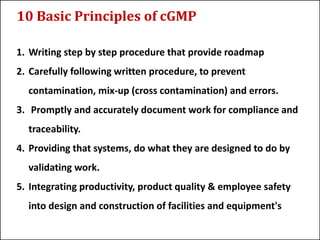
10 Basic Principles of cGMP
1. Writing step by step procedure that provide roadmap
2. Carefully following written procedure, to prevent
contamination, mix-up (cross contamination) and errors.
3. Promptly and accurately document work for compliance and
traceability.
4. Providing that systems, do what they are designed to do by
validating work.
5. Integrating productivity, product quality & employee safety
into design and construction of facilities and equipment's.
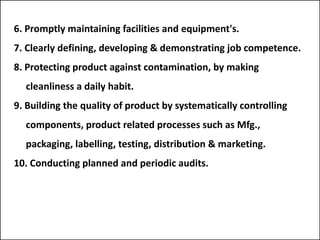
6. Promptly maintaining facilities and equipment's.
7. Clearly defining, developing & demonstrating job competence.
8. Protecting product against contamination, by making
cleanliness a daily habit.
9. Building the quality of product by systematically controlling
components, product related processes such as Mfg.,
packaging, labelling, testing, distribution & marketing.
10. Conducting planned and periodic audits.
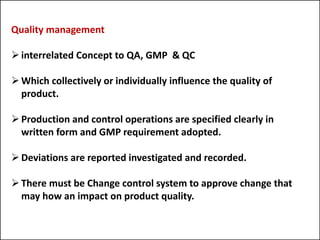
Quality management
interrelated Concept to QA, GMP & QC
Which collectively or individually influence the quality of
product.
Production and control operations are specified clearly in
written form and GMP requirement adopted.
Deviations are reported investigated and recorded.
There must be Change control system to approve change that
may how an impact on product quality.
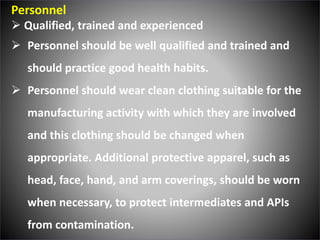
Personnel
 Qualified, trained and experienced
 Personnel should be well qualified and trained and
should practice good health habits.
 Personnel should wear clean clothing suitable for the
manufacturing activity with which they are involved
and this clothing should be changed when
appropriate. Additional protective apparel, such as
head, face, hand, and arm coverings, should be worn
when necessary, to protect intermediates and APIs
from contamination.
 Personnel should avoid direct contact with
intermediates or APIs.
 Smoking, eating, drinking, chewing and the storage of
food should be restricted to certain designated areas
separate from the manufacturing areas.
 Personnel suffering from an infectious disease or
having open lesions on the exposed surface of the body
should not engage in activities that could result in
compromising the quality of APIs.
 Equipment Cleaning
 Equipment and utensils should be cleaned, stored, and, where
appropriate, sanitized or sterilized to prevent contamination or
carry-over of a material that would alter the quality of the
intermediate or API beyond the official or other established
specifications.
 Where equipment is assigned to continuous production or
campaign production of successive batches of the same
intermediate or API, equipment should be cleaned at
appropriate intervals to prevent build-up and carry-over of
contaminants (e.g. degradants or objectionable levels of micro-
organisms).
QUERIES ???
Thank you ...!

C GMP

  • 1.
    CURRENRT GOOD MANUFACTURING PRACTICES (cGMP) Presentedby: Mr. Sandip M. Honmane (M.Pharm, Pharmaceutics) Asst. Prof. ADCBP, Ashta Previous Working: Quality Assurance Dept. Cipla Ltd. Goa.
  • 2.
    MEDICINE ARE FITTO ITS PURPOSE WHEN  It is the right product  Right strength  Free from contamination  Correctly labeled  Properly sealed in its containers/ final packaging material for protection, contamination & damage.
  • 3.
    Why GMP • MEDICINESare different from other products OTHER PRODUCTS: • We can check quality before we buy. • If faulty then they can be returned back. MEDICINES: • Patient have little chances to detect if anything is wrong. • If something goes wrong it can be very dangerous. • They trust the DOCTORS who prescribe and Manufacturing company who mfg it.
  • 4.
    Skills Required • Technicalcompetency • Language skill • Flexibility • Productive (Authorative) • Willing to learn • Interaction with other Dept. • Time bounding work • IT/Software knowledge
  • 5.
    GMP  GMP isthat part of QA which ensures that products are consistently produced and controlled to quality standards appropriate to their intended use and as required by the marketing authorization or product specification.  GMP is concerned with both production and quality control. cGMP  C- means current/ updated/ up to date  The manufacturer of a pharmaceuticals must be by current methods with current control as a requirement that which is current or generally, accepted in the industry as appropriate equipment's, methodology, control and records.  But that they also be ‘’Good’’
  • 6.
    Basic Elements ofcGMP 1. Quality management- interrelated Concept to QA, GMP & QC 2. Buildings and facilities 3. Equipment 4. Organisation and personnel 5. Control of components and drug product containers and closures-materials 6. Production and process controls 7. Packaging and labelling control 8. Holding and distribution (warehouse) 9. Laboratory controls (QC) 10.Records and Reports (Documentation) 11.Returned and Salvaging 12.Validation and Qualification 13.Contamination
  • 7.
    Departments:  Quality Assurance Quality control  IPQC  Production  Packing  Supply chain management  R&D  Pharma writing  Quality Unit
  • 8.
    GMP  GMP isthat part of QA which ensures that products are consistently produced and controlled to quality standards appropriate to their intended use and as required by the marketing authorization or product specification.  GMP is concerned with both production and quality control. cGMP  C- means current/ updated/ up to date  The manufacturer of a pharmaceuticals must be by current methods with current control as a requirement that which is current or generally, accepted in the industry as appropriate equipment's, methodology, control and records.  But that they also be ‘’Good’’ Quality Assurance  QA is a wide concept which covers all the matter which individually or collectively influence quality of the product.  Systematic pattern of action that constantly ensure the Quality of product in context of need of consumer/regulatory. Quality control  QC is part of GMP which is concerned with sampling, specification, testing and with the organisation, documentation and release procedure which ensure that necessary tests are actually carried out  that material are not released for use, nor product released for sale or supply, until their quality has been judged to be satisfactory.
  • 9.
    10 Basic Principlesof cGMP 1. Writing step by step procedure that provide roadmap 2. Carefully following written procedure, to prevent contamination, mix-up (cross contamination) and errors. 3. Promptly and accurately document work for compliance and traceability. 4. Providing that systems, do what they are designed to do by validating work. 5. Integrating productivity, product quality & employee safety into design and construction of facilities and equipment's.
  • 10.
    6. Promptly maintainingfacilities and equipment's. 7. Clearly defining, developing & demonstrating job competence. 8. Protecting product against contamination, by making cleanliness a daily habit. 9. Building the quality of product by systematically controlling components, product related processes such as Mfg., packaging, labelling, testing, distribution & marketing. 10. Conducting planned and periodic audits.
  • 11.
    Quality management interrelated Conceptto QA, GMP & QC Which collectively or individually influence the quality of product. Production and control operations are specified clearly in written form and GMP requirement adopted. Deviations are reported investigated and recorded. There must be Change control system to approve change that may how an impact on product quality.
  • 12.
    Personnel  Qualified, trainedand experienced  Personnel should be well qualified and trained and should practice good health habits.  Personnel should wear clean clothing suitable for the manufacturing activity with which they are involved and this clothing should be changed when appropriate. Additional protective apparel, such as head, face, hand, and arm coverings, should be worn when necessary, to protect intermediates and APIs from contamination.
  • 13.
     Personnel shouldavoid direct contact with intermediates or APIs.  Smoking, eating, drinking, chewing and the storage of food should be restricted to certain designated areas separate from the manufacturing areas.  Personnel suffering from an infectious disease or having open lesions on the exposed surface of the body should not engage in activities that could result in compromising the quality of APIs.
  • 14.
     Equipment Cleaning Equipment and utensils should be cleaned, stored, and, where appropriate, sanitized or sterilized to prevent contamination or carry-over of a material that would alter the quality of the intermediate or API beyond the official or other established specifications.  Where equipment is assigned to continuous production or campaign production of successive batches of the same intermediate or API, equipment should be cleaned at appropriate intervals to prevent build-up and carry-over of contaminants (e.g. degradants or objectionable levels of micro- organisms).
  • 16.