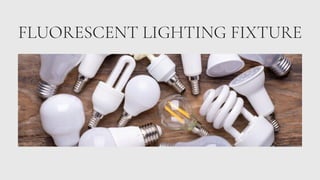
FLUORESCENT LIGHTING FIXTURE
LEARNING OBJECTIVE
At the end of the lesson, the students are expected
to:
A. Explain how fluorescent lamps work ,
B. Value the importance of the fluorescent lamps
nowadays,
C. Hands-on activity, assembling a fluorescent
lamp.
TYPES OF ELECTRIC DISCHARGE
PRE-HEAT STARTING, HOT-CATHODE
This requires starter glow or glow switch and is pre-heated
during starting
COLD- CATHODE
This requires high voltage in its operation. This electrodes
made of thimble-type iron.
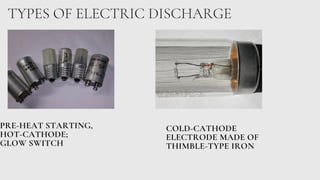
TYPES OF ELECTRIC DISCHARGE
PRE-HEAT STARTING,
HOT-CATHODE;
GLOW SWITCH
COLD-CATHODE
ELECTRODE MADE OF
THIMBLE-TYPE IRON
TYPES OF ELECTRIC DISCHARGE
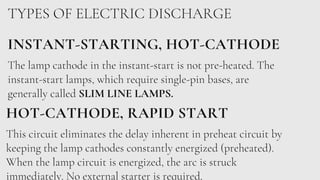
INSTANT-STARTING, HOT-CATHODE
The lamp cathode in the instant-start is not pre-heated. The
instant-start lamps, which require single-pin bases, are
generally called SLIM LINE LAMPS.
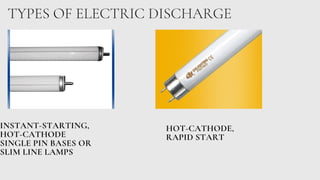
HOT-CATHODE, RAPID START
This circuit eliminates the delay inherent in preheat circuit by
keeping the lamp cathodes constantly energized (preheated).
When the lamp circuit is energized, the arc is struck
immediately. No external starter is required.
TYPES OF ELECTRIC DISCHARGE
INSTANT-STARTING,
HOT-CATHODE
SINGLE PIN BASES OR
SLIM LINE LAMPS
HOT-CATHODE,
RAPID START
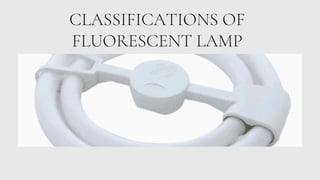
CLASSIFICATIONS OF
FLUORESCENT LAMP
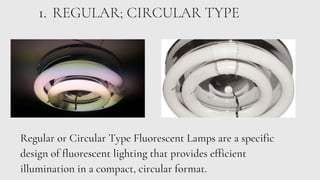
REGULAR; CIRCULAR TYPE
1.
Regular or Circular Type Fluorescent Lamps are a specific
design of fluorescent lighting that provides efficient
illumination in a compact, circular format.
REGULAR; OPEN-TYPE
1.
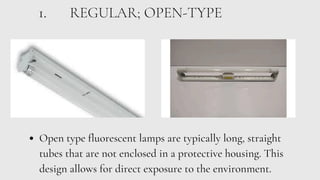
Open type fluorescent lamps are typically long, straight
tubes that are not enclosed in a protective housing. This
design allows for direct exposure to the environment.
REGULAR; BOX-TYPE
1.
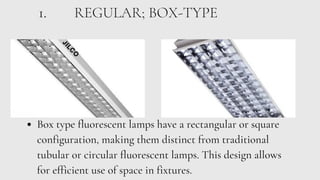
Box type fluorescent lamps have a rectangular or square
configuration, making them distinct from traditional
tubular or circular fluorescent lamps. This design allows
for efficient use of space in fixtures.
2. COMPACT FLUORESCENT
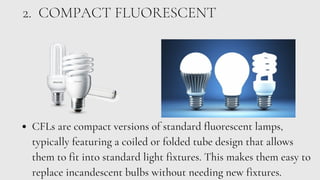
CFLs are compact versions of standard fluorescent lamps,
typically featuring a coiled or folded tube design that allows
them to fit into standard light fixtures. This makes them easy to
replace incandescent bulbs without needing new fixtures.
PARTS AND FUNCTIONS OF
FLUORESCENT LAMPS
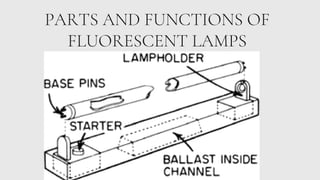
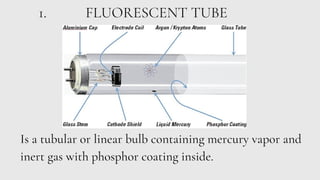
FLUORESCENT TUBE
1.
Is a tubular or linear bulb containing mercury vapor and
inert gas with phosphor coating inside.
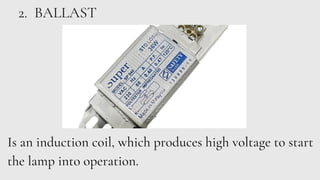
2. BALLAST
Is an induction coil, which produces high voltage to start
the lamp into operation.
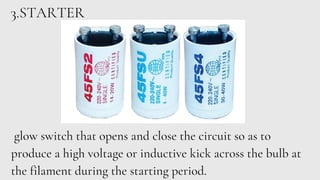
3.STARTER
glow switch that opens and close the circuit so as to
produce a high voltage or inductive kick across the bulb at
the filament during the starting period.
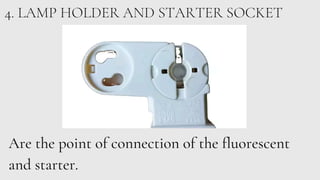
4. LAMP HOLDER AND STARTER SOCKET
Are the point of connection of the fluorescent
and starter.
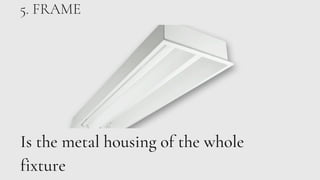
5. FRAME
Is the metal housing of the whole
fixture

TLE GRADE 9 FLUORESCENT LIGHTING FIXTURE

  • 1.
  • 2.
    LEARNING OBJECTIVE At theend of the lesson, the students are expected to: A. Explain how fluorescent lamps work , B. Value the importance of the fluorescent lamps nowadays, C. Hands-on activity, assembling a fluorescent lamp.
  • 3.
    TYPES OF ELECTRICDISCHARGE PRE-HEAT STARTING, HOT-CATHODE This requires starter glow or glow switch and is pre-heated during starting COLD- CATHODE This requires high voltage in its operation. This electrodes made of thimble-type iron.
  • 4.
    TYPES OF ELECTRICDISCHARGE PRE-HEAT STARTING, HOT-CATHODE; GLOW SWITCH COLD-CATHODE ELECTRODE MADE OF THIMBLE-TYPE IRON
  • 5.
    TYPES OF ELECTRICDISCHARGE INSTANT-STARTING, HOT-CATHODE The lamp cathode in the instant-start is not pre-heated. The instant-start lamps, which require single-pin bases, are generally called SLIM LINE LAMPS. HOT-CATHODE, RAPID START This circuit eliminates the delay inherent in preheat circuit by keeping the lamp cathodes constantly energized (preheated). When the lamp circuit is energized, the arc is struck immediately. No external starter is required.
  • 6.
    TYPES OF ELECTRICDISCHARGE INSTANT-STARTING, HOT-CATHODE SINGLE PIN BASES OR SLIM LINE LAMPS HOT-CATHODE, RAPID START
  • 7.
  • 8.
    REGULAR; CIRCULAR TYPE 1. Regularor Circular Type Fluorescent Lamps are a specific design of fluorescent lighting that provides efficient illumination in a compact, circular format.
  • 9.
    REGULAR; OPEN-TYPE 1. Open typefluorescent lamps are typically long, straight tubes that are not enclosed in a protective housing. This design allows for direct exposure to the environment.
  • 10.
    REGULAR; BOX-TYPE 1. Box typefluorescent lamps have a rectangular or square configuration, making them distinct from traditional tubular or circular fluorescent lamps. This design allows for efficient use of space in fixtures.
  • 11.
    2. COMPACT FLUORESCENT CFLsare compact versions of standard fluorescent lamps, typically featuring a coiled or folded tube design that allows them to fit into standard light fixtures. This makes them easy to replace incandescent bulbs without needing new fixtures.
  • 12.
    PARTS AND FUNCTIONSOF FLUORESCENT LAMPS
  • 13.
    FLUORESCENT TUBE 1. Is atubular or linear bulb containing mercury vapor and inert gas with phosphor coating inside.
  • 14.
    2. BALLAST Is aninduction coil, which produces high voltage to start the lamp into operation.
  • 15.
    3.STARTER glow switch thatopens and close the circuit so as to produce a high voltage or inductive kick across the bulb at the filament during the starting period.
  • 16.
    4. LAMP HOLDERAND STARTER SOCKET Are the point of connection of the fluorescent and starter.
  • 17.
    5. FRAME Is themetal housing of the whole fixture