PPT
ON
TYPES OF LAMPS
Construction, working and Applications of
Following Lamps:
- Incandescent Lamps.
- Fluorescent Tube
- Compact Fluorescent Lamps (C.F.L.)
- LED Lamps.
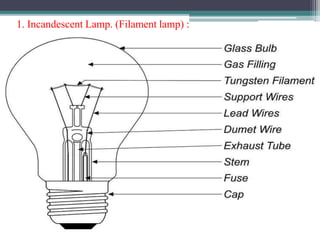
1. Incandescent Lamp. (Filament lamp) :
.
Filament lamps must have,
1. It should have high melting point (3500º C).
2. It should have high resistivity.
3. It should have low temperature co-efficient.
4. It should have low vapor pressure.
5. Mechanically Strong, ductile.
Material used for filament is Carbon, Osmium tantalum and
Tungsten.
Gas used inside the lamp ( Nitrogen orArgon )
Life: 1000 Hrs working hrs. Lamp efficiency: 10 - 30 lumens/watt
Working:
Lamp work on the principal of Incandescence
( i.e. when a hot body is heated, radiant energy is emitted in waveform).
□ An incandescent bulb generates light through heat.(95% Heat,5% Light)
□ When electrical current passes through the tungsten filament, it
heats to the point where it glows and gives off a yellow-red light.
□ To keep the filament from burning up immediately, it's housed in a
vacuum. Even so, the intense heat of the filament ensures a
comparatively short and expensive life span.(Working avi)
Applications: Domestic, Commercial and Industrial. Etc…
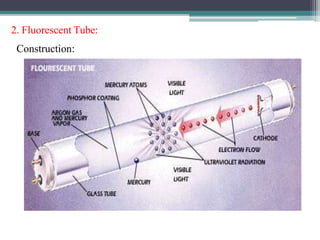
2. Fluorescent Tube:
Construction:
A fluorescent lamp tube is filled with a gas containing low
pressure mercury vapor and argon, xenon, neon, or krypton.
The pressure inside the lamp is around 0.3% of atmospheric
pressure.
The inner surface of the lamp is coated with a fluorescent (and
often slightly phosphorescent) coating made of varying blends of
metallic and rare-earth phosphor salts.
The lamp's electrodes are typically made of coiled tungsten and
usually referred to as cathodes because of their prime function of
emitting electrons. For this, they are coated with a mixture of
barium, strontium and calcium oxides chosen to have a low
thermionic emission temperature.
Working:
Working:
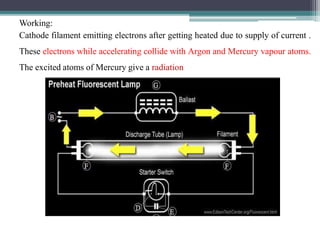
Cathode filament emitting electrons after getting heated due to supply of current .
These electrons while accelerating collide with Argon and Mercury vapour atoms.
The excited atoms of Mercury give a radiation
Applications:
1.In US residences, fluorescent lamps are mostly found in kitchens,
basements, and garages.
2. In countries, like India…
i) Residential.
ii) Commercial.
iii) Small scale industries ….Etc.
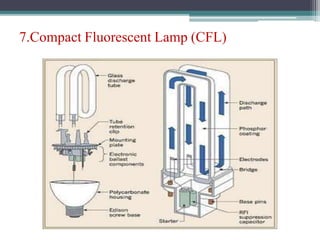
7.Compact Fluorescent Lamp (CFL)
COMPARISION WITH INCANDESCENT LAMPS:
Incandescent CFL
1) Life Span: 1000 Hrs 6000-15,000 Hrs
2) Energy consumption: More Less
3) Cost : Less More
4) Starting time: Immediately Take time to give
full illumination.
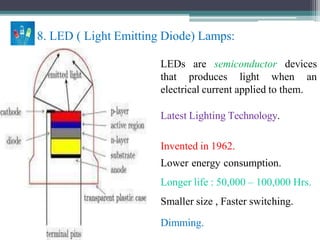
8. LED ( Light Emitting Diode) Lamps:
LEDs are semiconductor devices
that produces light when an
electrical current applied to them.
Latest Lighting Technology.
Invented in 1962.
Lower energy consumption.
Longer life : 50,000 – 100,000 Hrs.
Smaller size , Faster switching.
Dimming.
Efficiency: 130 lumens/watt.
RGB-Method mixing the proper
amount of light from red, green,
blue
LED yield white light.
Working of LED avi.
Application:
1) Signs and Traffic signals.
2) Displays.
3) Exit signs.
4) Indicators and Flash lights.
5) Under counters. Etc.
THANK YOU
Mr.KantoliS.B. BMP

light source.pptx

  • 1.
  • 2.
    Construction, working andApplications of Following Lamps: - Incandescent Lamps. - Fluorescent Tube - Compact Fluorescent Lamps (C.F.L.) - LED Lamps.
  • 3.
    1. Incandescent Lamp.(Filament lamp) :
  • 4.
    . Filament lamps musthave, 1. It should have high melting point (3500º C). 2. It should have high resistivity. 3. It should have low temperature co-efficient. 4. It should have low vapor pressure. 5. Mechanically Strong, ductile. Material used for filament is Carbon, Osmium tantalum and Tungsten. Gas used inside the lamp ( Nitrogen orArgon ) Life: 1000 Hrs working hrs. Lamp efficiency: 10 - 30 lumens/watt
  • 5.
    Working: Lamp work onthe principal of Incandescence ( i.e. when a hot body is heated, radiant energy is emitted in waveform). □ An incandescent bulb generates light through heat.(95% Heat,5% Light) □ When electrical current passes through the tungsten filament, it heats to the point where it glows and gives off a yellow-red light. □ To keep the filament from burning up immediately, it's housed in a vacuum. Even so, the intense heat of the filament ensures a comparatively short and expensive life span.(Working avi) Applications: Domestic, Commercial and Industrial. Etc…
  • 6.
  • 7.
    A fluorescent lamptube is filled with a gas containing low pressure mercury vapor and argon, xenon, neon, or krypton. The pressure inside the lamp is around 0.3% of atmospheric pressure. The inner surface of the lamp is coated with a fluorescent (and often slightly phosphorescent) coating made of varying blends of metallic and rare-earth phosphor salts. The lamp's electrodes are typically made of coiled tungsten and usually referred to as cathodes because of their prime function of emitting electrons. For this, they are coated with a mixture of barium, strontium and calcium oxides chosen to have a low thermionic emission temperature.
  • 8.
  • 9.
    Working: Cathode filament emittingelectrons after getting heated due to supply of current . These electrons while accelerating collide with Argon and Mercury vapour atoms. The excited atoms of Mercury give a radiation
  • 10.
    Applications: 1.In US residences,fluorescent lamps are mostly found in kitchens, basements, and garages. 2. In countries, like India… i) Residential. ii) Commercial. iii) Small scale industries ….Etc.
  • 11.
  • 12.
    COMPARISION WITH INCANDESCENTLAMPS: Incandescent CFL 1) Life Span: 1000 Hrs 6000-15,000 Hrs 2) Energy consumption: More Less 3) Cost : Less More 4) Starting time: Immediately Take time to give full illumination.
  • 13.
    8. LED (Light Emitting Diode) Lamps: LEDs are semiconductor devices that produces light when an electrical current applied to them. Latest Lighting Technology. Invented in 1962. Lower energy consumption. Longer life : 50,000 – 100,000 Hrs. Smaller size , Faster switching. Dimming.
  • 14.
    Efficiency: 130 lumens/watt. RGB-Methodmixing the proper amount of light from red, green, blue LED yield white light. Working of LED avi.
  • 15.
    Application: 1) Signs andTraffic signals. 2) Displays. 3) Exit signs. 4) Indicators and Flash lights. 5) Under counters. Etc.
  • 17.