 By;
 Jayamalie, Prashadhi, Dicra, Shanya, Vikum
 ya, Shenal , Ashik, Hashan & Roshen
THEORETIC HISTORY- “ARGUE”

    Basic Principle How Incandescent Lamps
    Work.
   In 1802, Humphry Davy demonstrated that by running
    electricity through a thin strip of metal, that strip could
    be heated to temperatures high enough so they would
    give off light. The strip of metal, called a filament, is
    resistance to the electricity flowing through it (the
    thinner the metal, the higher resistance). The
    resistance turns the electrical energy into heat, and
    when the filament becomes white-hot, it gives off light.
    It incandesces because of the heat.
PRACTICAL HISTORY- “COMBAT”
   In the decades of Davy's demonstration, other scientists
    and inventors tried to develop workable incandescent
    lamps. But these lamps were delicate, unreliable, short
    lived, and expensive to operate. The lifetime was short
    because the filaments used would burn up in air. To
    combat the short lifetime, early developers used thick, low
    resistance filaments, but heating them to incandescence
    required large electrical currents and generating current
    was costly.

   These problems arose in improving the technologies of
    the incandescent lamp.
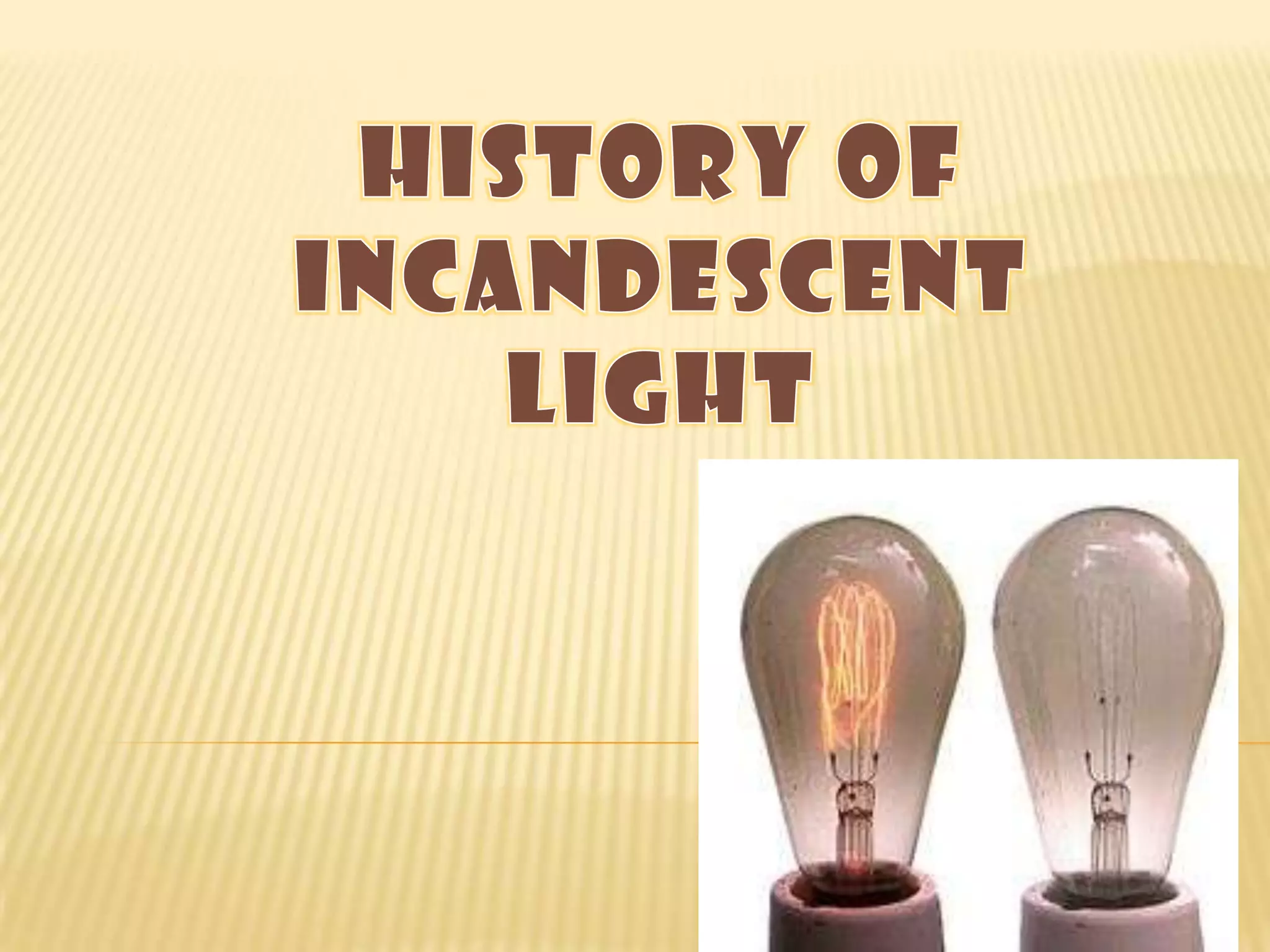
   1802- Humphry Davy, had the most
    powerful battery and he created the first
    incandescent light bulb by passing
    current through a platinum strip.

   By 1964, improvements in production of
    incandescent lamps increased since
    Edison’s lighting system.
 The Incandescent light bulb produces light by
  heating a metal filament wire to a high
  temperature until it glows.
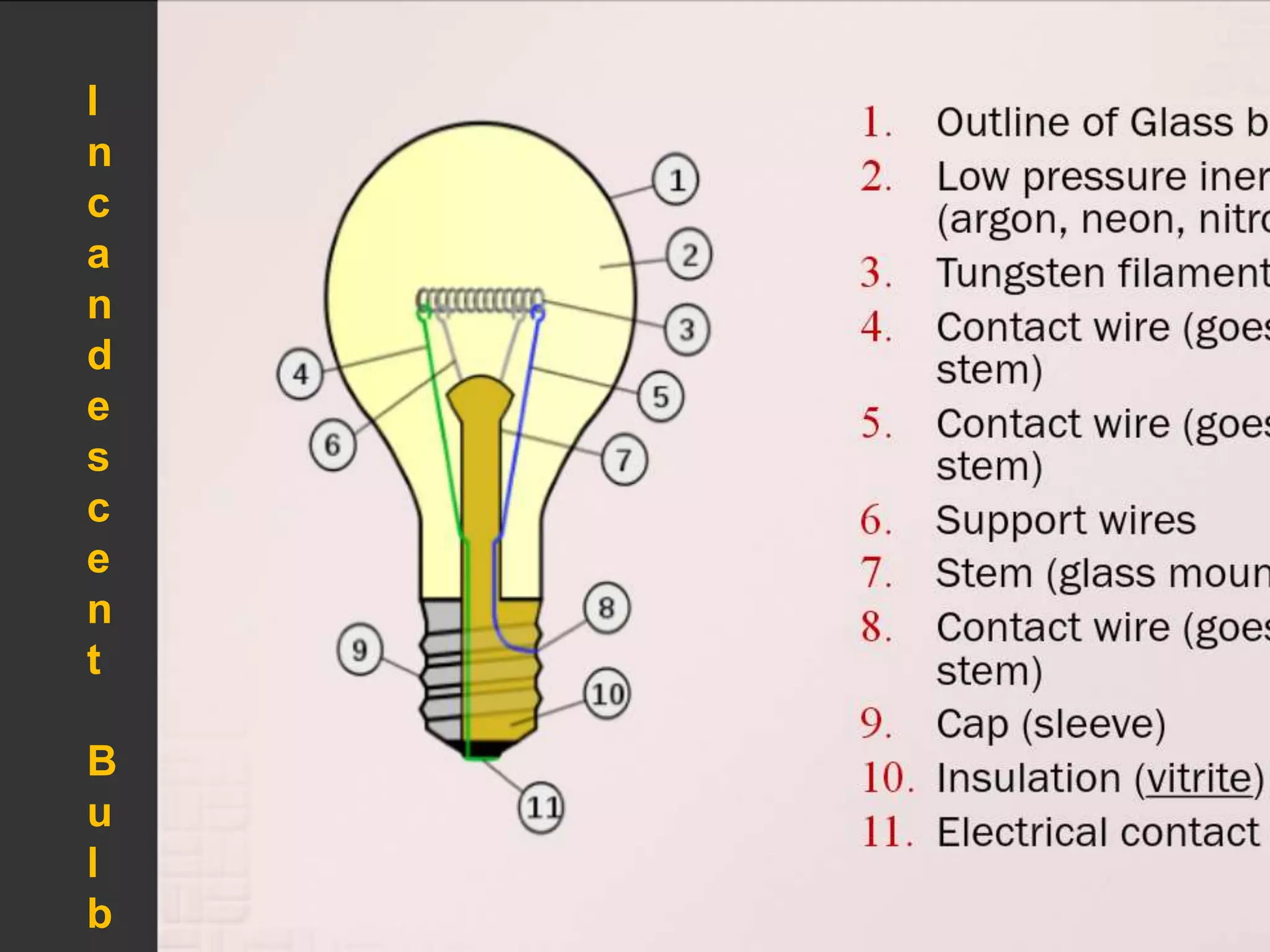
 the hot filament is protected from oxidation in
  the air with a glass enclose that is filled with
  inert gas or evacuated.
 In a halogen lamp, filament evaporation is
  prevented by a chemical process that redeposit
  metal vapor into the filament, extending its life.
 the light bulb is supplied with electrical current
  by feed-through terminals or wires embedded in
  the glass.
 Most bulbs are used in a socket which provides
  mechanical support and electrical connection.
I
n
c
a
n
d
e
s
c
e
n
t

B
u
l
b
Availability of incandescent
   lights
 Incandescent bulbs are available in a wide range of
  sizes, light output, and voltage ratings, from 1.5
  volts to about 300 volts. They require no external
  regulating equipment, have low manufacturing
  costs, and work equally well on either alternating
  current or direct current. As a result, the
  incandescent lamp is used often in household and
  commercial lighting, especially for portable lighting
  such as table lamps, car headlamps, flashlights , and
  for decorative and advertising lighting.
Incandescent lights are available
in various forms, sizes and
shapes. Few categories including
these can be listed as follows
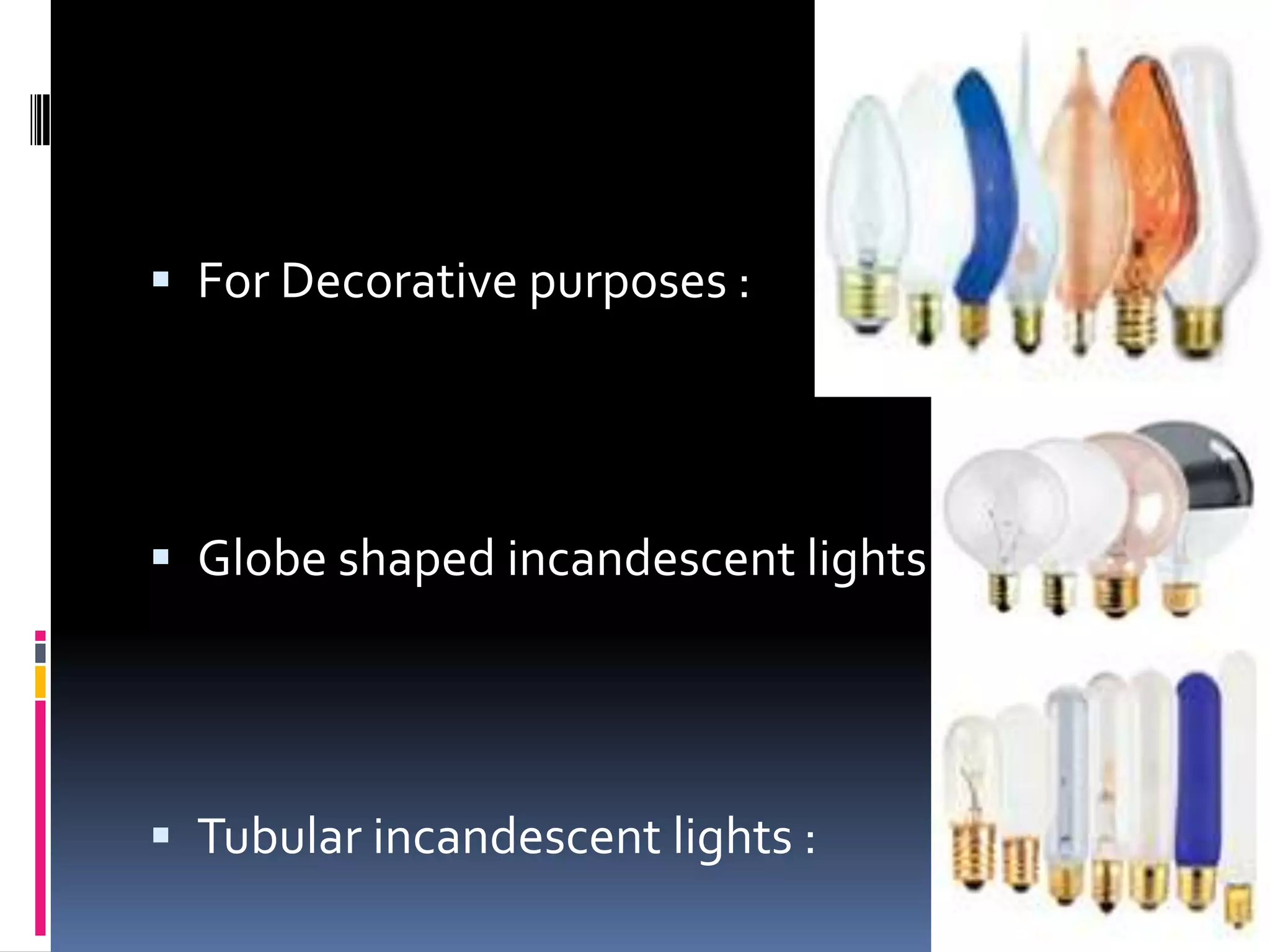
 For Decorative purposes :


 Globe shaped incandescent lights :


 Tubular incandescent lights :
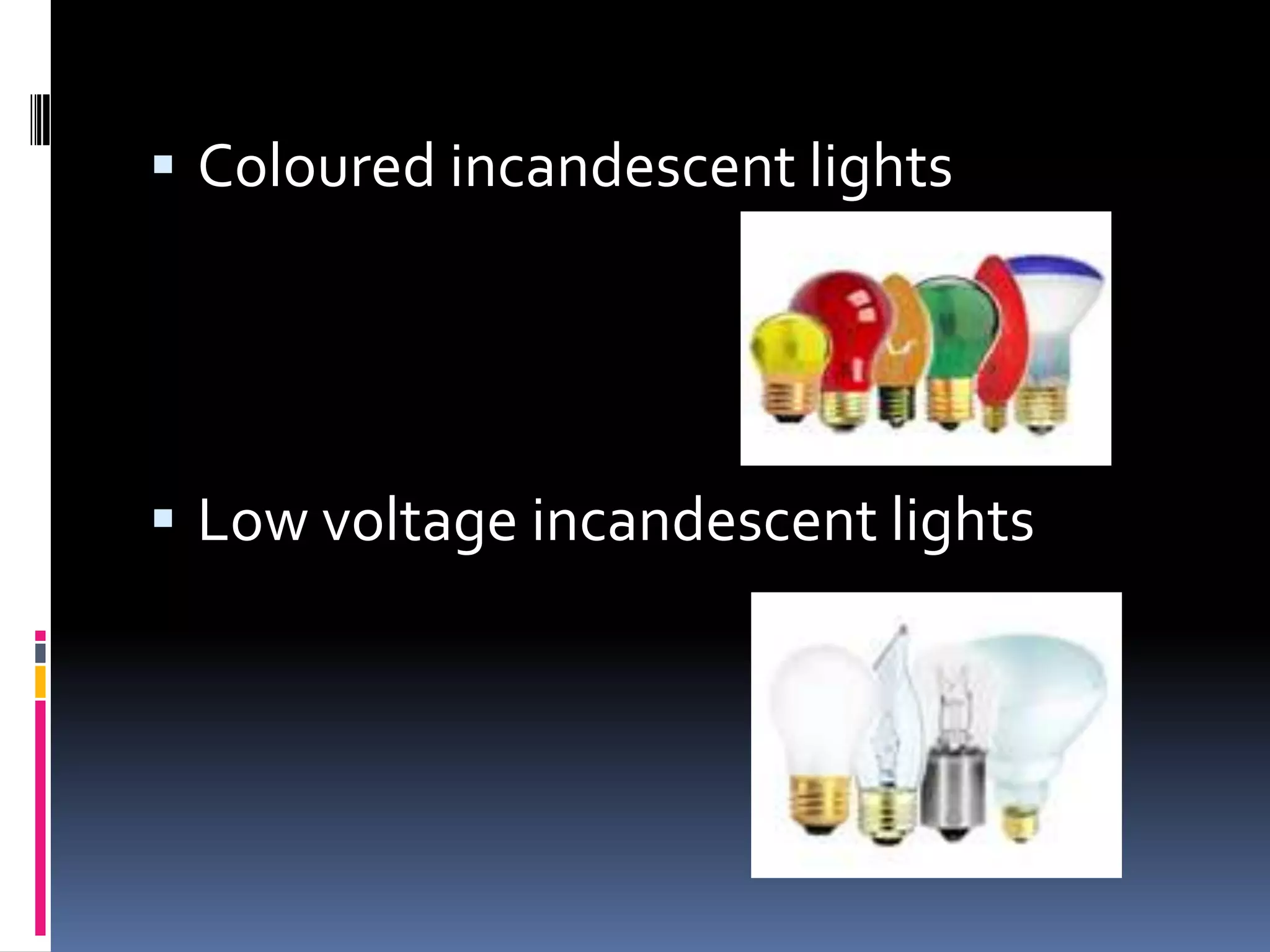
 Coloured incandescent lights


 Low voltage incandescent lights
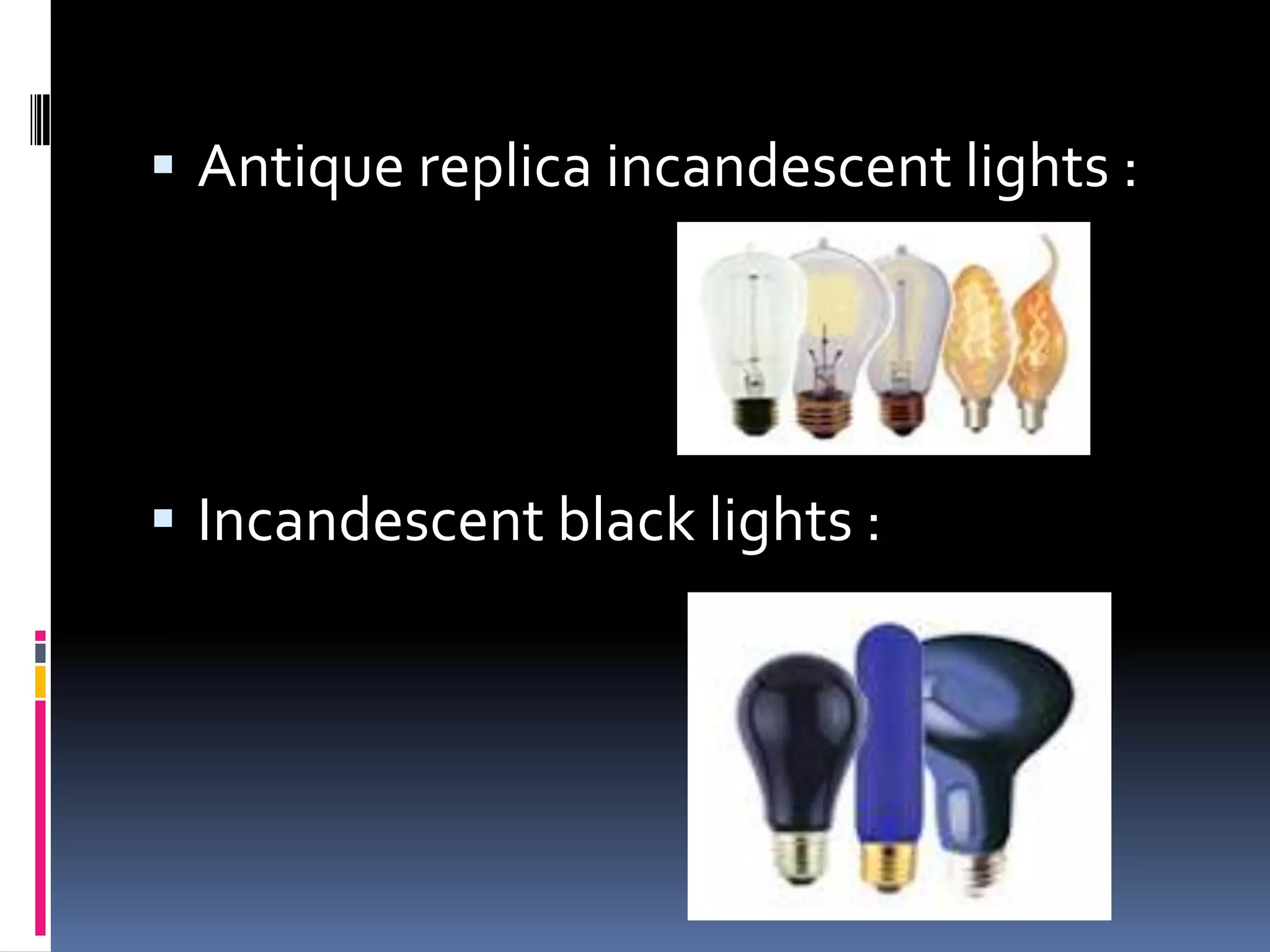
 Antique replica incandescent lights :


 Incandescent black lights :
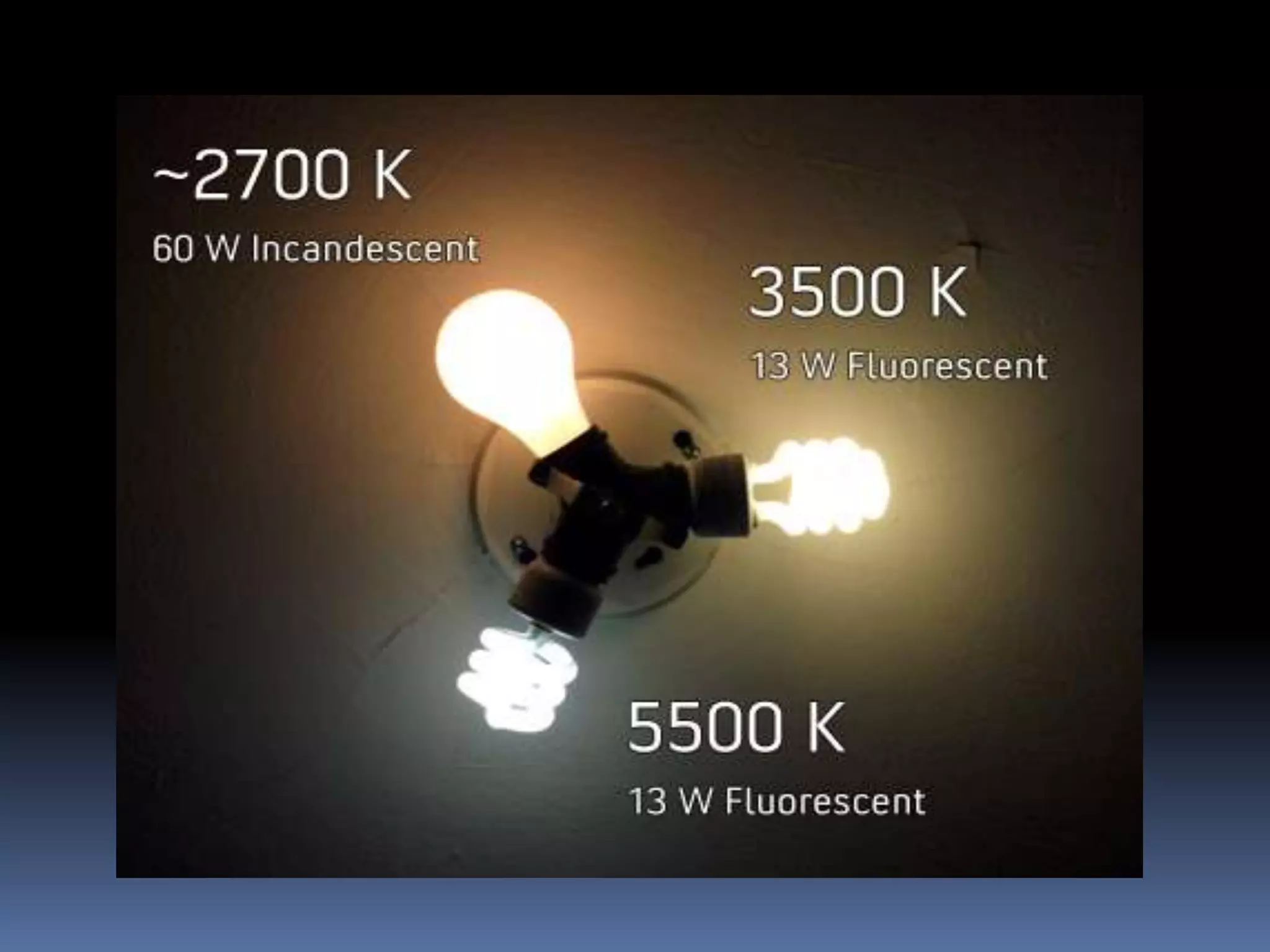
What color is electric light?

A glowing filament is white, and we describe
its incandescent light as white. However, the
actual wavelength components of different
electric light sources vary, so that we
perceive white with a bluish cast as "cool"
and white with a pinkish cast as "warm". As
these labels are vague, tools such as the
color rendering index (CRI) and color
temperature have been developed.
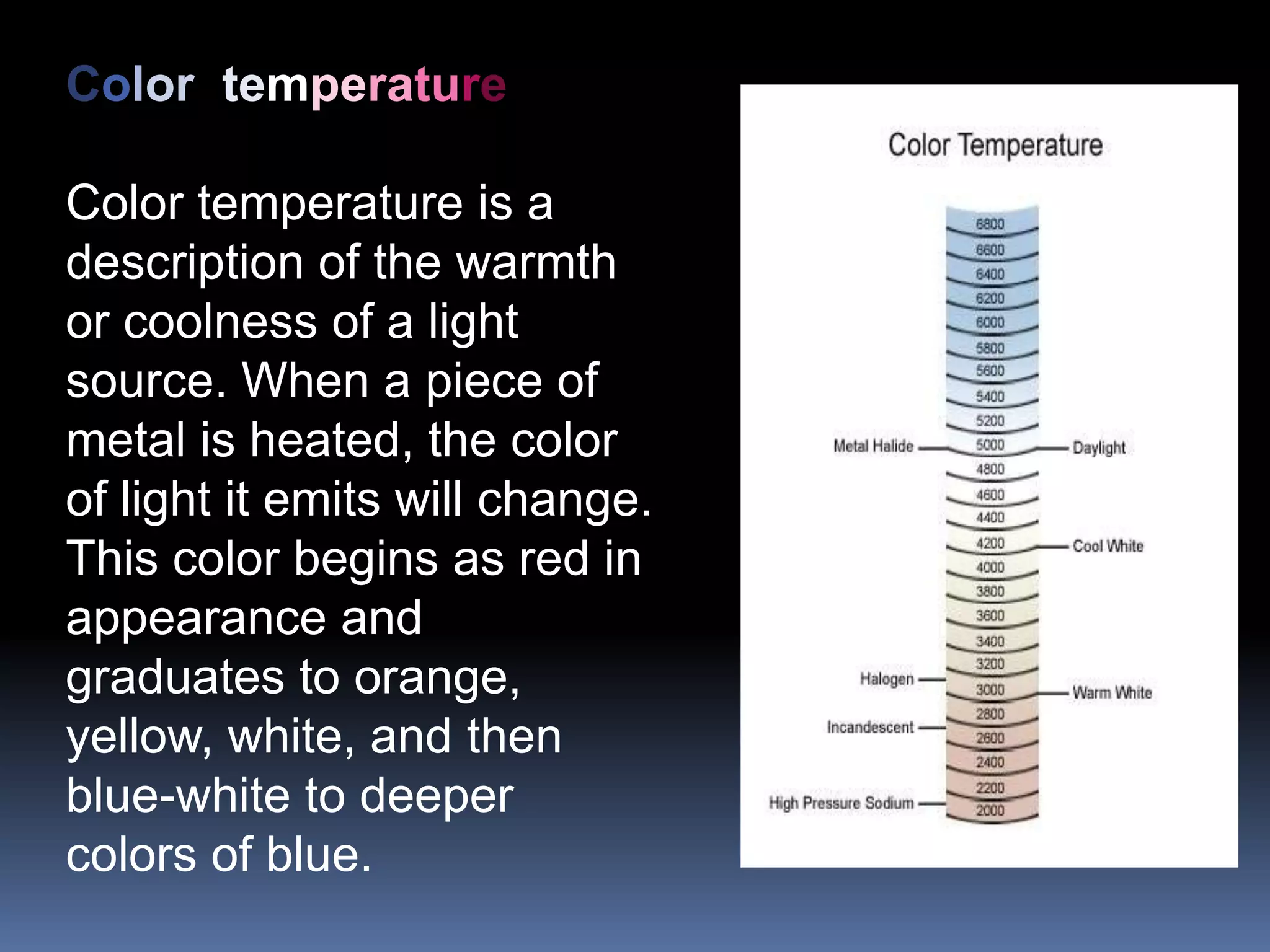
Color temperature

Color temperature is a
description of the warmth
or coolness of a light
source. When a piece of
metal is heated, the color
of light it emits will change.
This color begins as red in
appearance and
graduates to orange,
yellow, white, and then
blue-white to deeper
colors of blue.
THE USABILITY OF INCANDESCENT
BULBS

The uses of Incandescent bulbs can be
 categorized into two different ways.

1. The uses of incandescent bulbs as a mode
  of light

2. The uses of heat generated by the filament
  of the Incandescent bulbs
THE INCANDESCENT BULBS ARE WIDELY USED IN

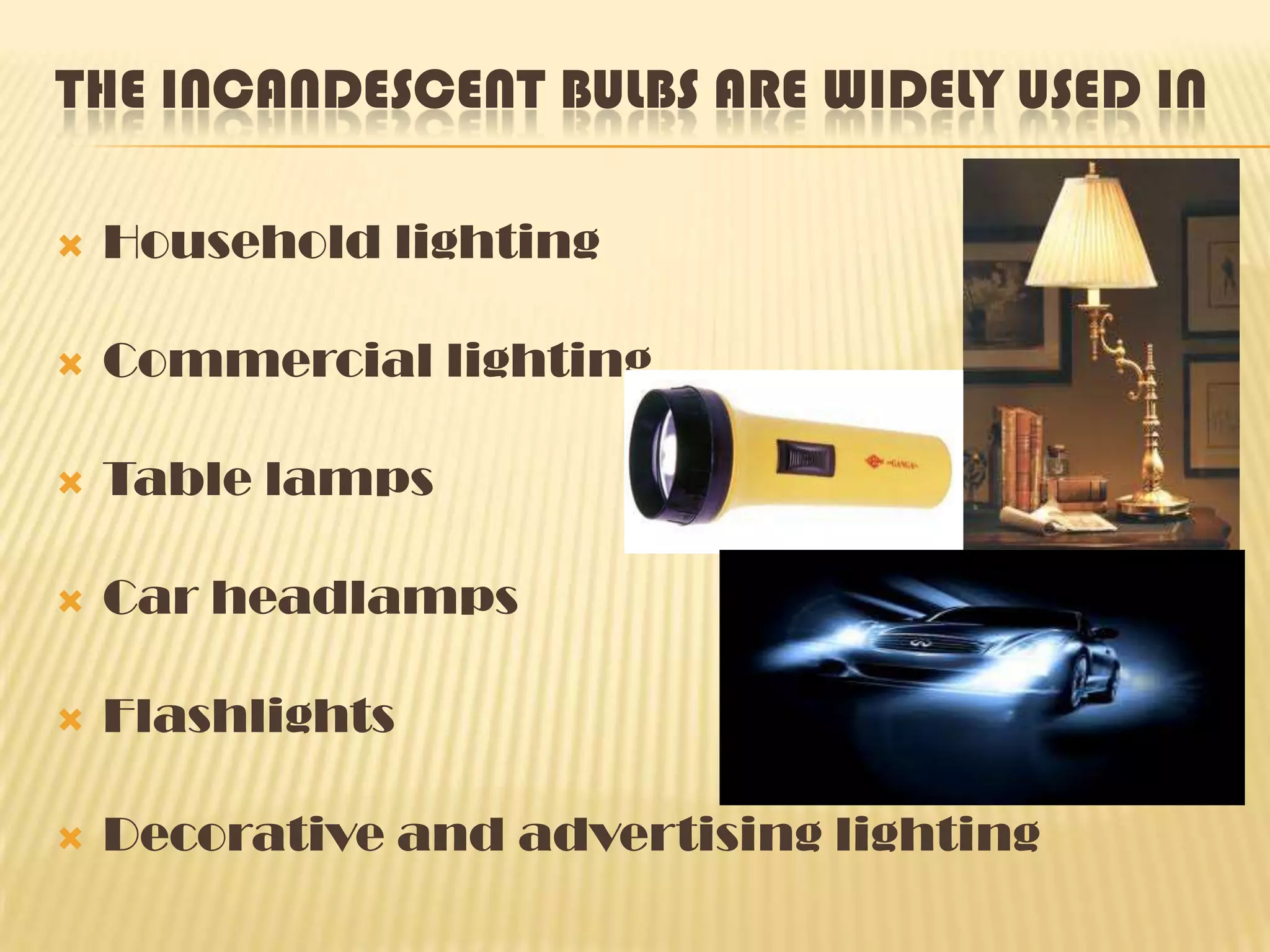
   Household lighting

   Commercial lighting

   Table lamps

   Car headlamps

   Flashlights

   Decorative and advertising lighting
 Incandescent  bulbs are less
 efficient than several other
 modern types of light bulbs.

 Most incandescent bulbs convert
 less than 5% of the energy they
 use into visible light with the
 remaining energy being
 converted into heat.
Screw Type
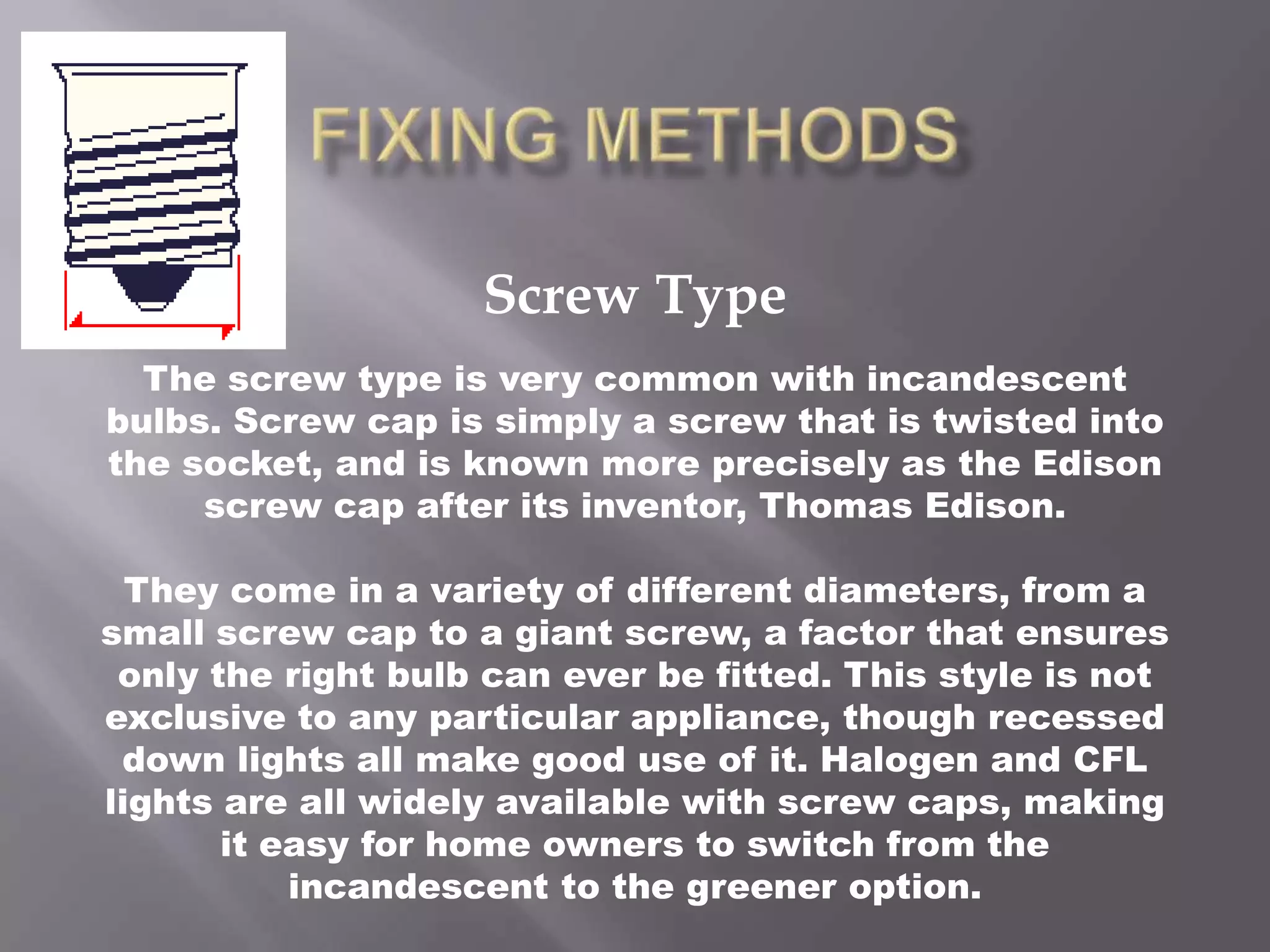
  The screw type is very common with incandescent
bulbs. Screw cap is simply a screw that is twisted into
the socket, and is known more precisely as the Edison
     screw cap after its inventor, Thomas Edison.

  They come in a variety of different diameters, from a
small screw cap to a giant screw, a factor that ensures
 only the right bulb can ever be fitted. This style is not
exclusive to any particular appliance, though recessed
 down lights all make good use of it. Halogen and CFL
lights are all widely available with screw caps, making
       it easy for home owners to switch from the
           incandescent to the greener option.
Pin Type
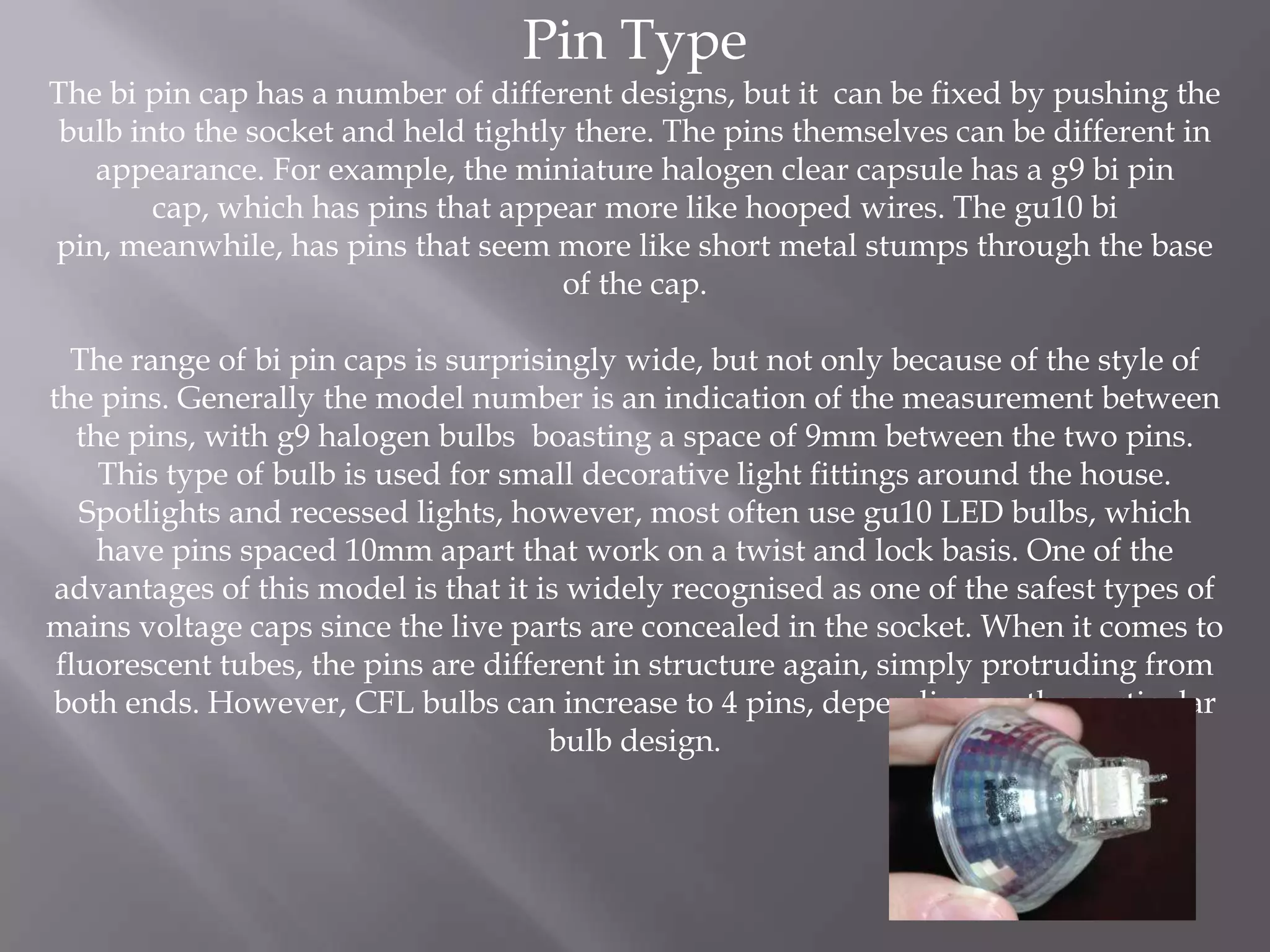
The bi pin cap has a number of different designs, but it can be fixed by pushing the
 bulb into the socket and held tightly there. The pins themselves can be different in
   appearance. For example, the miniature halogen clear capsule has a g9 bi pin
        cap, which has pins that appear more like hooped wires. The gu10 bi
pin, meanwhile, has pins that seem more like short metal stumps through the base
                                      of the cap.

  The range of bi pin caps is surprisingly wide, but not only because of the style of
the pins. Generally the model number is an indication of the measurement between
   the pins, with g9 halogen bulbs boasting a space of 9mm between the two pins.
     This type of bulb is used for small decorative light fittings around the house.
   Spotlights and recessed lights, however, most often use gu10 LED bulbs, which
     have pins spaced 10mm apart that work on a twist and lock basis. One of the
advantages of this model is that it is widely recognised as one of the safest types of
mains voltage caps since the live parts are concealed in the socket. When it comes to
 fluorescent tubes, the pins are different in structure again, simply protruding from
both ends. However, CFL bulbs can increase to 4 pins, depending on the particular
                                      bulb design.
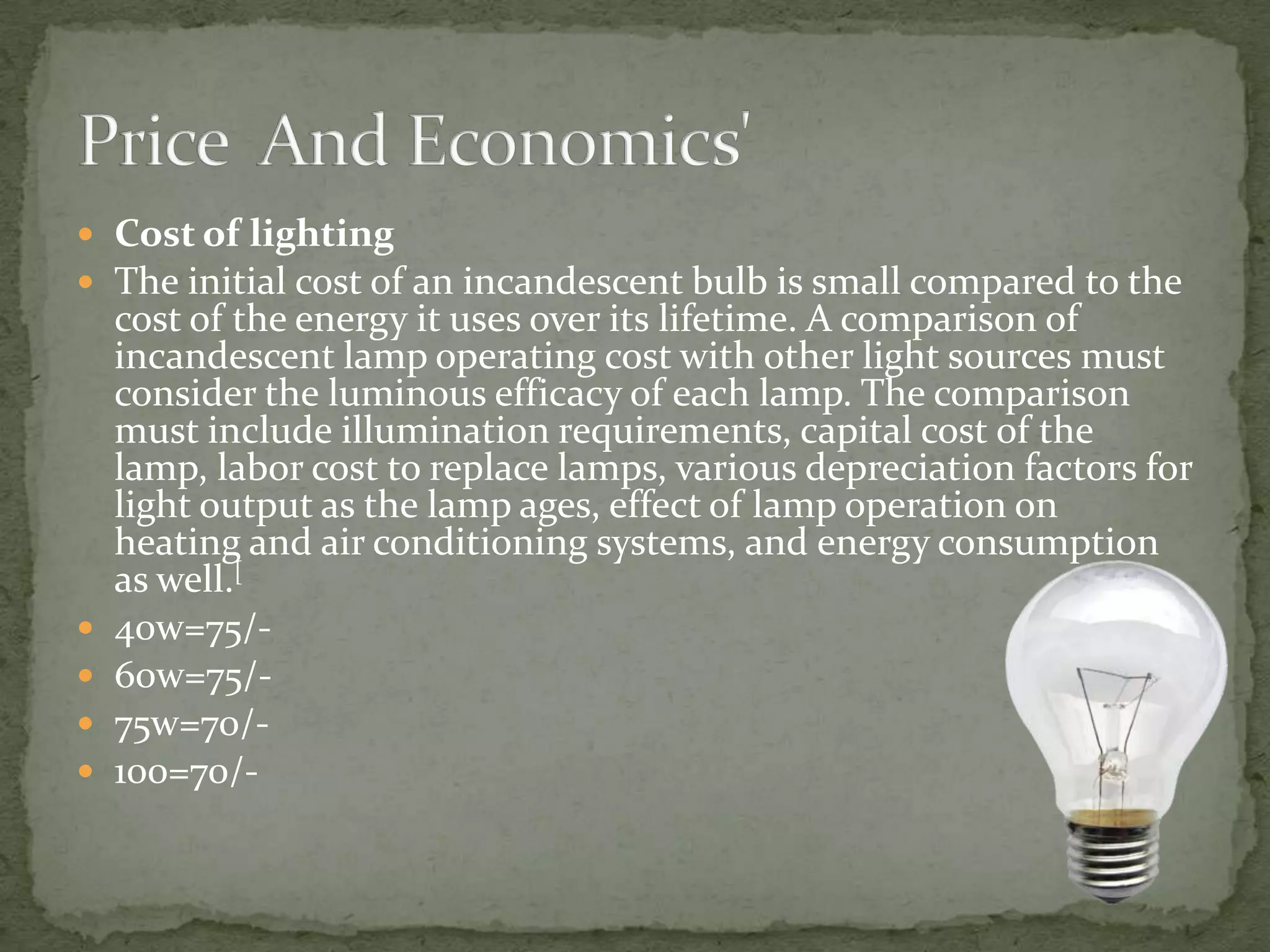
 Cost of lighting
 The initial cost of an incandescent bulb is small compared to the
    cost of the energy it uses over its lifetime. A comparison of
    incandescent lamp operating cost with other light sources must
    consider the luminous efficacy of each lamp. The comparison
    must include illumination requirements, capital cost of the
    lamp, labor cost to replace lamps, various depreciation factors for
    light output as the lamp ages, effect of lamp operation on
    heating and air conditioning systems, and energy consumption
    as well.[
   40w=75/-
   60w=75/-
   75w=70/-
   100=70/-
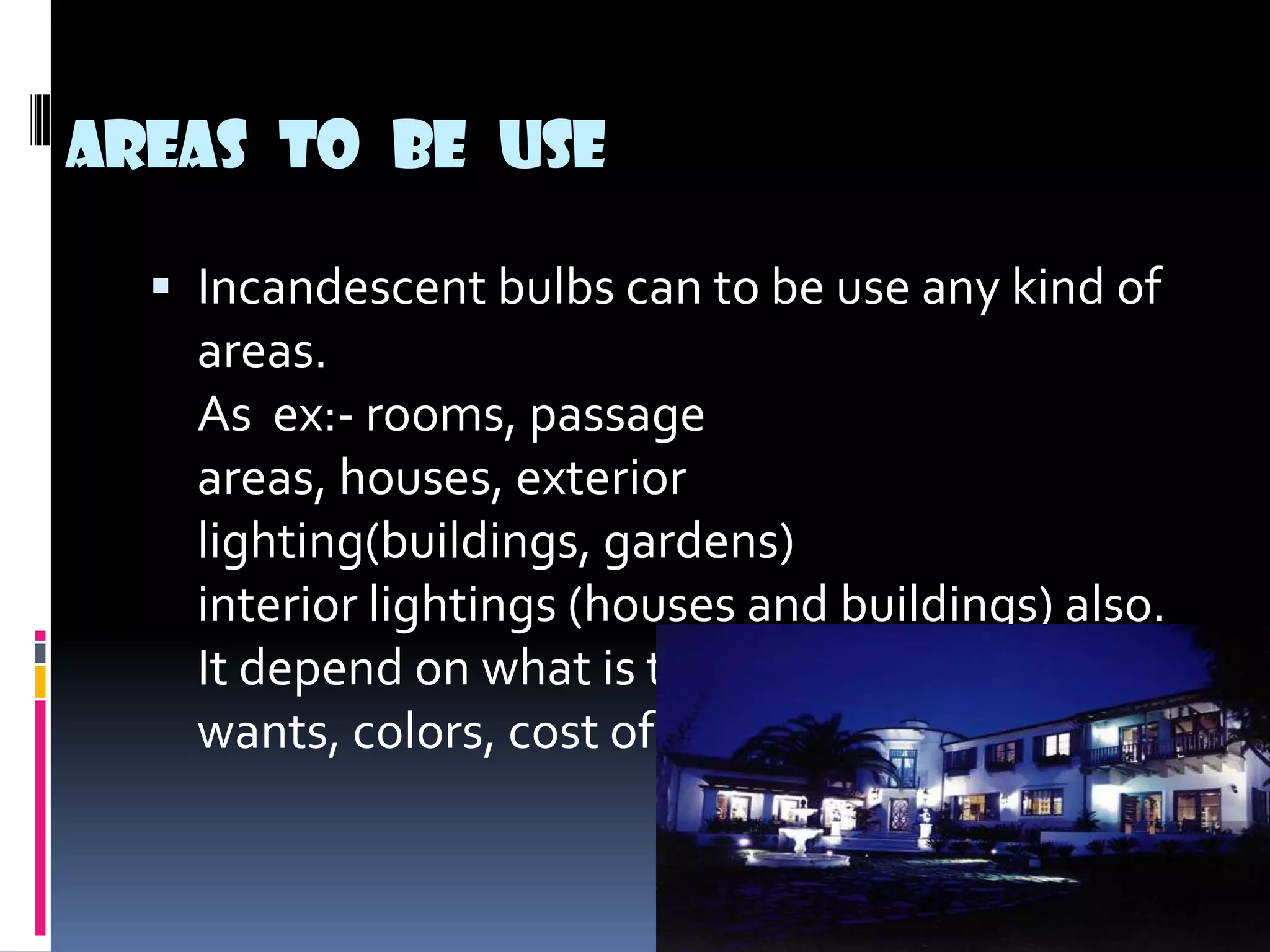
Areas to be use

   Incandescent bulbs can to be use any kind of
    areas.
    As ex:- rooms, passage
    areas, houses, exterior
    lighting(buildings, gardens)
    interior lightings (houses and buildings) also.
    It depend on what is the client
    wants, colors, cost of lights.
Incandescent lamp

Incandescent lamp

  • 1.
     By; Jayamalie,Prashadhi, Dicra, Shanya, Vikum ya, Shenal , Ashik, Hashan & Roshen
  • 3.
    THEORETIC HISTORY- “ARGUE” Basic Principle How Incandescent Lamps Work.  In 1802, Humphry Davy demonstrated that by running electricity through a thin strip of metal, that strip could be heated to temperatures high enough so they would give off light. The strip of metal, called a filament, is resistance to the electricity flowing through it (the thinner the metal, the higher resistance). The resistance turns the electrical energy into heat, and when the filament becomes white-hot, it gives off light. It incandesces because of the heat.
  • 4.
    PRACTICAL HISTORY- “COMBAT”  In the decades of Davy's demonstration, other scientists and inventors tried to develop workable incandescent lamps. But these lamps were delicate, unreliable, short lived, and expensive to operate. The lifetime was short because the filaments used would burn up in air. To combat the short lifetime, early developers used thick, low resistance filaments, but heating them to incandescence required large electrical currents and generating current was costly.  These problems arose in improving the technologies of the incandescent lamp.
  • 5.
    1802- Humphry Davy, had the most powerful battery and he created the first incandescent light bulb by passing current through a platinum strip.  By 1964, improvements in production of incandescent lamps increased since Edison’s lighting system.
  • 6.
     The Incandescentlight bulb produces light by heating a metal filament wire to a high temperature until it glows.  the hot filament is protected from oxidation in the air with a glass enclose that is filled with inert gas or evacuated.  In a halogen lamp, filament evaporation is prevented by a chemical process that redeposit metal vapor into the filament, extending its life.  the light bulb is supplied with electrical current by feed-through terminals or wires embedded in the glass.  Most bulbs are used in a socket which provides mechanical support and electrical connection.
  • 7.
  • 8.
    Availability of incandescent lights  Incandescent bulbs are available in a wide range of sizes, light output, and voltage ratings, from 1.5 volts to about 300 volts. They require no external regulating equipment, have low manufacturing costs, and work equally well on either alternating current or direct current. As a result, the incandescent lamp is used often in household and commercial lighting, especially for portable lighting such as table lamps, car headlamps, flashlights , and for decorative and advertising lighting.
  • 9.
    Incandescent lights areavailable in various forms, sizes and shapes. Few categories including these can be listed as follows
  • 10.
     For Decorativepurposes :  Globe shaped incandescent lights :  Tubular incandescent lights :
  • 11.
     Coloured incandescentlights  Low voltage incandescent lights
  • 12.
     Antique replicaincandescent lights :  Incandescent black lights :
  • 13.
    What color iselectric light? A glowing filament is white, and we describe its incandescent light as white. However, the actual wavelength components of different electric light sources vary, so that we perceive white with a bluish cast as "cool" and white with a pinkish cast as "warm". As these labels are vague, tools such as the color rendering index (CRI) and color temperature have been developed.
  • 14.
    Color temperature Color temperatureis a description of the warmth or coolness of a light source. When a piece of metal is heated, the color of light it emits will change. This color begins as red in appearance and graduates to orange, yellow, white, and then blue-white to deeper colors of blue.
  • 16.
    THE USABILITY OFINCANDESCENT BULBS The uses of Incandescent bulbs can be categorized into two different ways. 1. The uses of incandescent bulbs as a mode of light 2. The uses of heat generated by the filament of the Incandescent bulbs
  • 17.
    THE INCANDESCENT BULBSARE WIDELY USED IN  Household lighting  Commercial lighting  Table lamps  Car headlamps  Flashlights  Decorative and advertising lighting
  • 18.
     Incandescent bulbs are less efficient than several other modern types of light bulbs.  Most incandescent bulbs convert less than 5% of the energy they use into visible light with the remaining energy being converted into heat.
  • 19.
    Screw Type The screw type is very common with incandescent bulbs. Screw cap is simply a screw that is twisted into the socket, and is known more precisely as the Edison screw cap after its inventor, Thomas Edison. They come in a variety of different diameters, from a small screw cap to a giant screw, a factor that ensures only the right bulb can ever be fitted. This style is not exclusive to any particular appliance, though recessed down lights all make good use of it. Halogen and CFL lights are all widely available with screw caps, making it easy for home owners to switch from the incandescent to the greener option.
  • 20.
    Pin Type The bipin cap has a number of different designs, but it can be fixed by pushing the bulb into the socket and held tightly there. The pins themselves can be different in appearance. For example, the miniature halogen clear capsule has a g9 bi pin cap, which has pins that appear more like hooped wires. The gu10 bi pin, meanwhile, has pins that seem more like short metal stumps through the base of the cap. The range of bi pin caps is surprisingly wide, but not only because of the style of the pins. Generally the model number is an indication of the measurement between the pins, with g9 halogen bulbs boasting a space of 9mm between the two pins. This type of bulb is used for small decorative light fittings around the house. Spotlights and recessed lights, however, most often use gu10 LED bulbs, which have pins spaced 10mm apart that work on a twist and lock basis. One of the advantages of this model is that it is widely recognised as one of the safest types of mains voltage caps since the live parts are concealed in the socket. When it comes to fluorescent tubes, the pins are different in structure again, simply protruding from both ends. However, CFL bulbs can increase to 4 pins, depending on the particular bulb design.
  • 21.
     Cost oflighting  The initial cost of an incandescent bulb is small compared to the cost of the energy it uses over its lifetime. A comparison of incandescent lamp operating cost with other light sources must consider the luminous efficacy of each lamp. The comparison must include illumination requirements, capital cost of the lamp, labor cost to replace lamps, various depreciation factors for light output as the lamp ages, effect of lamp operation on heating and air conditioning systems, and energy consumption as well.[  40w=75/-  60w=75/-  75w=70/-  100=70/-
  • 22.
    Areas to beuse  Incandescent bulbs can to be use any kind of areas. As ex:- rooms, passage areas, houses, exterior lighting(buildings, gardens) interior lightings (houses and buildings) also. It depend on what is the client wants, colors, cost of lights.