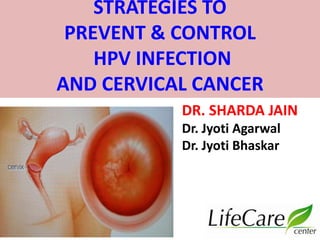
STRATEGIES TO
PREVENT & CONTROL
HPV INFECTION
AND CERVICAL CANCER
DR. SHARDA JAIN
Dr. Jyoti Agarwal
Dr. Jyoti Bhaskar
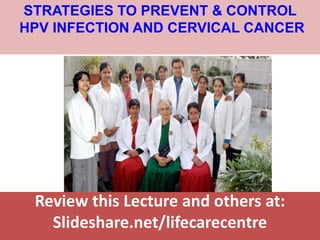
Review this Lecture and others at:
Slideshare.net/lifecarecentre
STRATEGIES TO PREVENT & CONTROL
HPV INFECTION AND CERVICAL CANCER
3
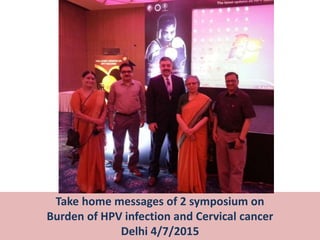
Take home messages of 2 symposium on
Burden of HPV infection and Cervical cancer
Delhi 4/7/2015
Presentation Outlines
•Facts on cancer cervix
•Strategy to prevent and control HPV
infection and cervical cancer
•Need of HPV vaccination
An Airbus-320 full of WOMEN crashing every day in India
Deaths Due to CaCx
JUST THINK!!!
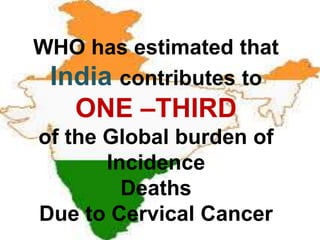
WHO has estimated that
India contributes to
ONE –THIRD
of the Global burden of
Incidence
Deaths
Due to Cervical Cancer
Women with
• multiple sexual partners are at a higher risk of
cervical cancer
• Women who being sexual activity before 16 years
of age
• Who are sexually active within year of the onset
of menses.
Who are at risk of Cervical Cancer ?
SEXUAL ACTIVITY
1
• STDs such as HIV are associated with an
increased incidence of human papilloma virus
(HPV) infections
• Persistent HPV and cervical dysplasia
substantiate their role in carcinoma of the
cervix.
Who are at risk of Cervical Cancer ?
STD
2
Women of the lower socioeconomic status
may not be aware of the illness they are
suffering from and also may not be able to
afford healthcare services , thereby
facilitating the progression of cervical
precursor lesions.
Who are at risk of Cervical Cancer ?
LOWER SOCIOECONOMIC STATUS
3
Some studies have indicated that
smokingcan be considered as a risk
factor owing to the direct or indirect systemic
effects on the immune system and local
effects of the certain carcinogens in tobacco.
4
Who are at risk of Cervical Cancer ?
SMOKING 4
Certain other studies have recorded an
increase in the occurrence of cervical
carcinoma in people whose immune system
has been suppressed either due to some
disorder or following organ transplants.
Who are at risk of Cervical Cancer ?
COMPROMISED IMMUNE SYSTEM 5
While most women tend to remain asymptomatic
for many months to years,
abnormal discharge and postcoital bleeding
may be observed in majority of women with
precancerous lesions.
HPV Infection &
Precancerous Lesions
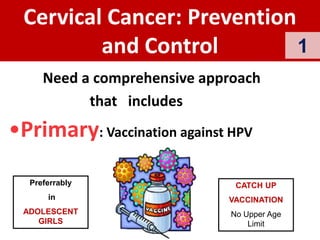
•Primary: Vaccination against HPV
Cervical Cancer: Prevention
and Control
Need a comprehensive approach
that includes
CATCH UP
VACCINATION
No Upper Age
Limit
Preferrably
in
ADOLESCENT
GIRLS
1
Cervical Cancer: Prevention
and Control
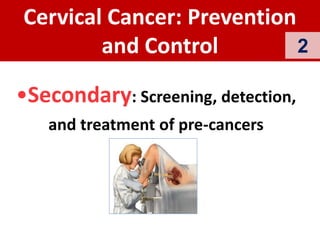
•Secondary: Screening, detection,
and treatment of pre-cancers
2
Cervical Cancer: Prevention
and Control
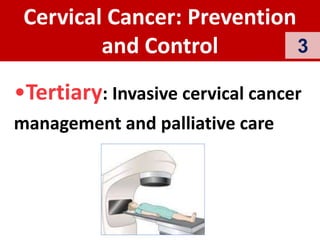
•Tertiary: Invasive cervical cancer
management and palliative care
3
Impact of Vaccination
& Screening for
Precancerous lesions
In countries without existing
screening programmes
Like India
Modelling studies suggest that vaccination is
likely to be the most effective option to
reduce the incidence of cervical cancer2,4
2. Goldie SJ, et al. J Natl Cancer Inst 2004; 96:604–615; 4. Goldie SJ, et al. Int J Cancer
2003; 106:896–904;
screening programmes for cervical cancer
•Vaccination +screening are more
effective and cost-effective than
screening alone for the prevention of
cervical cancer and cervical pre-
cancer1,2, 3
1. Garnett GP et al. Vaccine 2006; 24:S178–S186; 2. Goldie SJ, et al. J Natl Cancer Inst 2004; 96:604–
615; 3. Elbasha EH, et al. Emerg Infect Dis 2007; 13:28–41
In countries with established screening
programmes
•Screening should continue in order to
detect disease related to non-vaccine
HPV types
•Screening intervals are likely to
increase once widespread vaccination
occurs
1. Garnett GP et al. Vaccine 2006; 24:S178–S186; 2. Goldie SJ, et al. J Natl Cancer Inst 2004; 96:604–
615; 3. Elbasha EH, et al. Emerg Infect Dis 2007; 13:28–41
Screening programmes for cervical Cancer
TAKE HOME MESSAGE
Vaccination& Screening
BOTH are Complementary
to each other,
NOT Substitutes !
CONVENTIONAL
CERVICAL CANCER
SCREENNG
KINDLY SEE 2013 GUIDELINES OF SIX
INSTITUTIONS AND FOLLOW STRICTLY
SCR
The decreased incidence of cervical
cancers in developed countries can be
attributed to early and consistent
cancer screening programme In these
counties.
WHO
Screening programmes for cervical Cancer
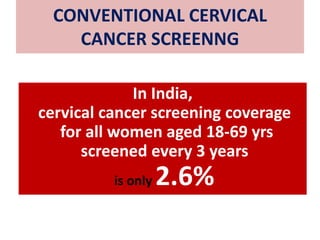
CONVENTIONAL CERVICAL
CANCER SCREENNG
In India,
cervical cancer screening coverage
for all women aged 18-69 yrs
screened every 3 years
is only 2.6%
This finding necessitates the importance
of start of cancer cervix screening in
India to avoid the huge morbidity and
mortality associated with cervical cancer.
CONVENTIONAL CERVICAL CANCER
SCREENNG
1.Stanley M. Vaccine 2006; 24: S106-13, 2.Tindle RW. Nat Rev Cancer 2002;2: 59-65, 3.Stanley M. Vaccine
2006; 24: S16-22, 4. Stanley M. HPV Today 2007; 11: 1-16
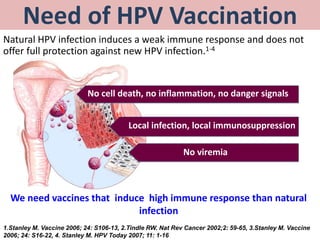
No viremia
Local infection, local immunosuppression
No cell death, no inflammation, no danger signals
Natural HPV infection induces a weak immune response and does not
offer full protection against new HPV infection.1-4
Need of HPV Vaccination
We need vaccines that induce high immune response than natural
infection
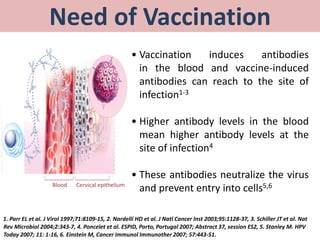
Blood Cervical epithelium
1. Parr EL et al. J Virol 1997;71:8109-15, 2. Nardelli HD et al. J Natl Cancer Inst 2003;95:1128-37, 3. Schiller JT et al. Nat
Rev Microbiol 2004;2:343-7, 4. Poncelet et al. ESPID, Porto, Portugal 2007; Abstract 37, session ES2, 5. Stanley M. HPV
Today 2007; 11: 1-16, 6. Einstein M, Cancer Immunol Immunother 2007; 57:443-51.
• Vaccination induces antibodies
in the blood and vaccine-induced
antibodies can reach to the site of
infection1-3
• Higher antibody levels in the blood
mean higher antibody levels at the
site of infection4
• These antibodies neutralize the virus
and prevent entry into cells5,6
Need of Vaccination
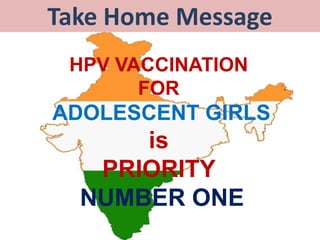
Take Home Message
HPV VACCINATION
FOR
ADOLESCENT GIRLS
is
PRIORITY
NUMBER ONE
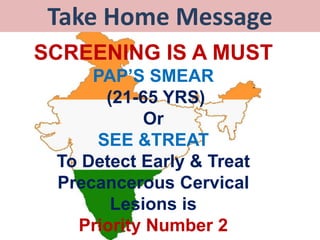
Take Home Message
SCREENING IS A MUST
PAP’S SMEAR
(21-65 YRS)
Or
SEE &TREAT
To Detect Early & Treat
Precancerous Cervical
Lesions is
Priority Number 2
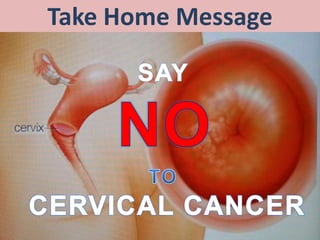
Take Home Message
30
THANK
YOU
SYMPOPSIUM
DELHI
4/7/2015
DR. SHARDA JAIN DR. SHYAM KUKREJA
ADDRESS
11 Gagan Vihar, Near Karkari Morh Flyover,
Delhi - 51
CONTACT US
9650511339, 9811011690
011-22414049,22058865
WEBSITE :
www.globalstemgenn.com
www. Stemgenn.com
www.lifecarecentre.in
E-MAIL ID
Contact@globalstemgenn.com
Contact @stemgenn.com
A UNIT
OF ISO 14001:2004 (EMS)
…..Caring hearts, healing
hands
ISO 9001:2008
ISO 9001:2008

STRATEGIES TO PREVENT & CONTROL HPV INFECTION AND CERVICAL CANCER. Dr. Sharda Jain

  • 1.
    STRATEGIES TO PREVENT &CONTROL HPV INFECTION AND CERVICAL CANCER DR. SHARDA JAIN Dr. Jyoti Agarwal Dr. Jyoti Bhaskar
  • 2.
    Review this Lectureand others at: Slideshare.net/lifecarecentre STRATEGIES TO PREVENT & CONTROL HPV INFECTION AND CERVICAL CANCER
  • 3.
    3 Take home messagesof 2 symposium on Burden of HPV infection and Cervical cancer Delhi 4/7/2015
  • 4.
    Presentation Outlines •Facts oncancer cervix •Strategy to prevent and control HPV infection and cervical cancer •Need of HPV vaccination
  • 5.
    An Airbus-320 fullof WOMEN crashing every day in India Deaths Due to CaCx JUST THINK!!!
  • 6.
    WHO has estimatedthat India contributes to ONE –THIRD of the Global burden of Incidence Deaths Due to Cervical Cancer
  • 7.
    Women with • multiplesexual partners are at a higher risk of cervical cancer • Women who being sexual activity before 16 years of age • Who are sexually active within year of the onset of menses. Who are at risk of Cervical Cancer ? SEXUAL ACTIVITY 1
  • 8.
    • STDs suchas HIV are associated with an increased incidence of human papilloma virus (HPV) infections • Persistent HPV and cervical dysplasia substantiate their role in carcinoma of the cervix. Who are at risk of Cervical Cancer ? STD 2
  • 9.
    Women of thelower socioeconomic status may not be aware of the illness they are suffering from and also may not be able to afford healthcare services , thereby facilitating the progression of cervical precursor lesions. Who are at risk of Cervical Cancer ? LOWER SOCIOECONOMIC STATUS 3
  • 10.
    Some studies haveindicated that smokingcan be considered as a risk factor owing to the direct or indirect systemic effects on the immune system and local effects of the certain carcinogens in tobacco. 4 Who are at risk of Cervical Cancer ? SMOKING 4
  • 11.
    Certain other studieshave recorded an increase in the occurrence of cervical carcinoma in people whose immune system has been suppressed either due to some disorder or following organ transplants. Who are at risk of Cervical Cancer ? COMPROMISED IMMUNE SYSTEM 5
  • 12.
    While most womentend to remain asymptomatic for many months to years, abnormal discharge and postcoital bleeding may be observed in majority of women with precancerous lesions. HPV Infection & Precancerous Lesions
  • 13.
    •Primary: Vaccination againstHPV Cervical Cancer: Prevention and Control Need a comprehensive approach that includes CATCH UP VACCINATION No Upper Age Limit Preferrably in ADOLESCENT GIRLS 1
  • 14.
    Cervical Cancer: Prevention andControl •Secondary: Screening, detection, and treatment of pre-cancers 2
  • 15.
    Cervical Cancer: Prevention andControl •Tertiary: Invasive cervical cancer management and palliative care 3
  • 16.
    Impact of Vaccination &Screening for Precancerous lesions
  • 17.
    In countries withoutexisting screening programmes Like India Modelling studies suggest that vaccination is likely to be the most effective option to reduce the incidence of cervical cancer2,4 2. Goldie SJ, et al. J Natl Cancer Inst 2004; 96:604–615; 4. Goldie SJ, et al. Int J Cancer 2003; 106:896–904;
  • 18.
    screening programmes forcervical cancer •Vaccination +screening are more effective and cost-effective than screening alone for the prevention of cervical cancer and cervical pre- cancer1,2, 3 1. Garnett GP et al. Vaccine 2006; 24:S178–S186; 2. Goldie SJ, et al. J Natl Cancer Inst 2004; 96:604– 615; 3. Elbasha EH, et al. Emerg Infect Dis 2007; 13:28–41 In countries with established screening programmes
  • 19.
    •Screening should continuein order to detect disease related to non-vaccine HPV types •Screening intervals are likely to increase once widespread vaccination occurs 1. Garnett GP et al. Vaccine 2006; 24:S178–S186; 2. Goldie SJ, et al. J Natl Cancer Inst 2004; 96:604– 615; 3. Elbasha EH, et al. Emerg Infect Dis 2007; 13:28–41 Screening programmes for cervical Cancer
  • 20.
    TAKE HOME MESSAGE Vaccination&Screening BOTH are Complementary to each other, NOT Substitutes !
  • 21.
    CONVENTIONAL CERVICAL CANCER SCREENNG KINDLY SEE2013 GUIDELINES OF SIX INSTITUTIONS AND FOLLOW STRICTLY
  • 22.
    SCR The decreased incidenceof cervical cancers in developed countries can be attributed to early and consistent cancer screening programme In these counties. WHO Screening programmes for cervical Cancer
  • 23.
    CONVENTIONAL CERVICAL CANCER SCREENNG InIndia, cervical cancer screening coverage for all women aged 18-69 yrs screened every 3 years is only 2.6%
  • 24.
    This finding necessitatesthe importance of start of cancer cervix screening in India to avoid the huge morbidity and mortality associated with cervical cancer. CONVENTIONAL CERVICAL CANCER SCREENNG
  • 25.
    1.Stanley M. Vaccine2006; 24: S106-13, 2.Tindle RW. Nat Rev Cancer 2002;2: 59-65, 3.Stanley M. Vaccine 2006; 24: S16-22, 4. Stanley M. HPV Today 2007; 11: 1-16 No viremia Local infection, local immunosuppression No cell death, no inflammation, no danger signals Natural HPV infection induces a weak immune response and does not offer full protection against new HPV infection.1-4 Need of HPV Vaccination We need vaccines that induce high immune response than natural infection
  • 26.
    Blood Cervical epithelium 1.Parr EL et al. J Virol 1997;71:8109-15, 2. Nardelli HD et al. J Natl Cancer Inst 2003;95:1128-37, 3. Schiller JT et al. Nat Rev Microbiol 2004;2:343-7, 4. Poncelet et al. ESPID, Porto, Portugal 2007; Abstract 37, session ES2, 5. Stanley M. HPV Today 2007; 11: 1-16, 6. Einstein M, Cancer Immunol Immunother 2007; 57:443-51. • Vaccination induces antibodies in the blood and vaccine-induced antibodies can reach to the site of infection1-3 • Higher antibody levels in the blood mean higher antibody levels at the site of infection4 • These antibodies neutralize the virus and prevent entry into cells5,6 Need of Vaccination
  • 27.
    Take Home Message HPVVACCINATION FOR ADOLESCENT GIRLS is PRIORITY NUMBER ONE
  • 28.
    Take Home Message SCREENINGIS A MUST PAP’S SMEAR (21-65 YRS) Or SEE &TREAT To Detect Early & Treat Precancerous Cervical Lesions is Priority Number 2
  • 29.
  • 30.
  • 31.
    ADDRESS 11 Gagan Vihar,Near Karkari Morh Flyover, Delhi - 51 CONTACT US 9650511339, 9811011690 011-22414049,22058865 WEBSITE : www.globalstemgenn.com www. Stemgenn.com www.lifecarecentre.in E-MAIL ID Contact@globalstemgenn.com Contact @stemgenn.com A UNIT OF ISO 14001:2004 (EMS) …..Caring hearts, healing hands ISO 9001:2008 ISO 9001:2008