American Society for Colposcopy and Cervical Pathology
!"#$%&'(#)*$+&,$-&.#,$/#0()1-$
),1')$2(%&,2#,%$%(0'#$34567$
Updated Consensus Guidelines for
Managing Abnormal Cervical Cancer
Screening Tests and Cancer Precursors
!"#$%&'(#)%"
Cytology
Since the publication of the 2006 consensus guidelines, new
cervical cancer screening guidelines have been published
and new information has become available which includes
key cervical cancer screening and follow up, and cervical
precancer management data over a nine year period among
more than 1 million women cared for at Kaiser Permanente
Northern California. Moreover, women under age 21 are no
longer receiving cervical cancer screening and cotesting
with high-risk HPV type assays, and cervical cytology is being
used to screen women 30 years of age and older.
Therefore, in 2012 the American Society for Colposcopy and
Cervical Pathology (ASCCP), together with its 24 partner
professional societies, Federal agencies, and international
organizations, began the process of revising the 2006
management guidelines. This culminated in the consensus
conference held at the National Institutes of Health in
September 2012. This report provides updated recommenda-
tions for managing women with cytological abnormalities.
A more comprehensive discussion of these recommendations
and their supporting evidence was published in the Journal
of Lower Genital Tract Disease and Obstetrics and Gynecology
and is made available on the ASCCP website at www.asccp.org.
Histopathology
Appropriate management of women with histo-pathologically
diagnosed cervical precancer is an important component of
cervical cancer prevention programs. Although the precise
number of women diagnosed with cervical precancer each
year in the U.S. is not known, it appears to be a relatively
common occurence. In 2001 and 2006, the American Society
for Colposcopy and Cervical Pathology and 28 partner
professional societies, federal agencies, and international
organizations, convened processes to develop and update
consensus guidelines for the management of women with
cervical precancer. Since then, considerable new informa-
tion has emerged about management of young women, and
the impact of treatment for precursor disease on pregnancy
outcomes. Progress has also been made in our understanding
of the management of women with adenocarcinoma in-situ,
also a human papillomavirus (HPV)—associated precursor
lesion to invasive cervical adenocarcinoma. Therefore, in
2012 the ASCCP, together with its partner organizations,
reconvened the consensus process of revising the guide-
lines. This culminated in the September 2012 Consensus
Conference held at the National Institutes of Health. This re-
port provides the recommendations developed for managing
women with cervical precancer. A summary of the guidelines
themselves–including the recommendations for manag-
ing women with cervical cytological abnormalities — are
published in JLGTD and Obstetrics & Gynecology.
© Copyright, 2002, 2006, 2013 American Society for Colposcopy and Cervical Pathology. All rights reserved
Although the guidelines are based on evidence whenever
possible, for certain clinical situations limited high-quality
evidence exists. In these situations the guidelines are
based on consensus expert opinion. Guidelines should never
be a substitute for clinical judgment. Clinical judgment should
always be used when applying a guideline to an individual
patient since guidelines may not apply to all patient-related
situations. Finally, both clinicians and patients need to
recognize that while most cases of cervical cancer can be
prevented through a program of screening and management
of cervical precancer, no screening or treatment modality is
100% effective and invasive cervical cancer can develop in
women participating in such programs.
The 2001 Bethesda System terminology is used for cytological
classification. This terminology utilizes the terms low-grade
squamous intraepithelial lesion (LSIL) and high-grade
squamous intraepithelial lesion (HSIL) to refer to low-grade
lesions and high-grade cervical cancer precursors respec-
tively. For managing cervical precancer, the histopathological
classification is two-tiered applying the terms cervical
intraepithelial neoplasia grade 1 (CIN 1) to low-grade lesions
and CIN2,3 to high-grade lesions. If using the 2012 Lower
Anogenital Squamous Terminology (LAST), CIN1 is equivalent
to histopathological LSIL and CIN2,3 is equivalent to histo-
pathological HSIL. Please note that cytological LSIL is not
equivalent to histopathological CIN 1 and cytological HSIL
is not equivalent to histopathological CIN2,3. The current
guidelines expand clinical indications for HPV testing based
on studies using FDA-approved, validated HPV assays.
Management decisions based on results using HPV tests
not similarly validated may not result in outcomes intended
by these guidelines. HPV testing should be restricted to
high-risk (oncogenic) HPV types. Testing for low-risk (non-
oncogenic) HPV types has no role in evaluating women with
abnormal cervical cytological results. Therefore, whenever
“HPV testing” is mentioned in the guidelines, it refers to
testing for high-risk (oncogenic) HPV types only.
!"#"$%&'()**"#+,
© Copyright, 2002, 2006, 2013 American Society for Colposcopy and Cervical Pathology. All rights reserved
Comments
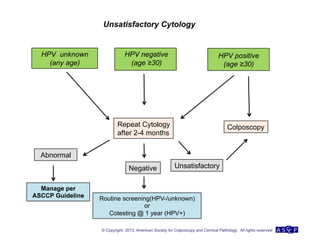
Unsatisfactory Cytology
HPV negative
(age !30)
HPV unknown
(any age)
ColposcopyRepeat Cytology
after 2-4 months
Manage per
ASCCP Guideline
Abnormal
Negative Unsatisfactory
Routine screening(HPV-/unknown)
or
Cotesting @ 1 year (HPV+)
© Copyright, 2013, American Society for Colposcopy and Cervical Pathology. All rights reserved.
HPV positive
(age !30)
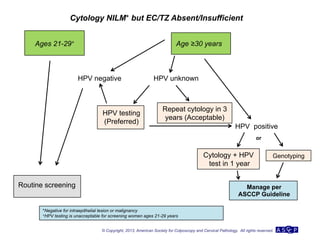
Cytology NILM* but EC/TZ Absent/Insufficient
Ages 21-29+
HPV negative
HPV positive
HPV testing
(Preferred)
Routine screening
HPV unknown
Manage per
ASCCP Guideline
Cytology + HPV
test in 1 year
Genotyping
Repeat cytology in 3
years (Acceptable)
or
Age !30 years
© Copyright, 2013, American Society for Colposcopy and Cervical Pathology. All rights reserved.
*Negative for intraepithelial lesion or malignancy
+HPV testing is unacceptable for screening women ages 21-29 years
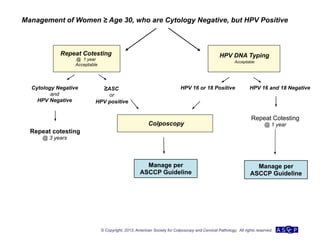
Management of Women ! Age 30, who are Cytology Negative, but HPV Positive
Cytology Negative
and
HPV Negative
!ASC
or
HPV positive
Repeat Cotesting
@ 1 year
Acceptable
Repeat cotesting
@ 3 years
HPV DNA Typing
HPV 16 or 18 Positive
Colposcopy
Acceptable!
Repeat Cotesting
@ 1 year
HPV 16 and 18 Negative
© Copyright, 2013, American Society for Colposcopy and Cervical Pathology. All rights reserved.
Manage per
ASCCP Guideline
Manage per
ASCCP Guideline
Management of Women with Atypical Squamous Cells of
Undetermined Significance (ASC-US) on Cytology*
Negative > ASC
Repeat Cytology
@ 1 year
Acceptable
HPV Testing
HPV Positive
(managed the same as
women with LSIL)
Colposcopy
Endocervical sampling preferred in women
with no lesions, and those with inadequate
colposcopy; it is acceptable for others
Preferred!
Repeat Cotesting
@ 3 years
HPV Negative
Manage per
ASCCP Guideline
© Copyright, 2013, American Society for Colposcopy and Cervical Pathology. All rights reserved.
*Management options may vary if the
woman is pregnant or ages 21-24
+Cytology at 3 year intervals
Routine
Screening+
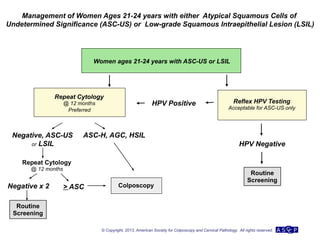
Management of Women Ages 21-24 years with either Atypical Squamous Cells of
Undetermined Significance (ASC-US) or Low-grade Squamous Intraepithelial Lesion (LSIL)
Negative, ASC-US
or LSIL
ASC-H, AGC, HSIL
Reflex HPV Testing
Acceptable for ASC-US only
Negative x 2 > ASC
Routine
Screening
Repeat Cytology
@ 12 months
Women ages 21-24 years with ASC-US or LSIL
Colposcopy
Repeat Cytology
@ 12 months
Preferred
HPV Positive
Routine
Screening
HPV Negative
© Copyright, 2013, American Society for Colposcopy and Cervical Pathology. All rights reserved.
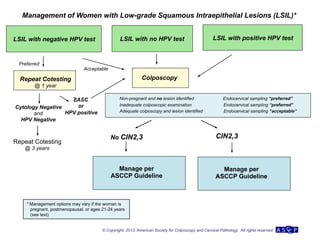
Management of Women with Low-grade Squamous Intraepithelial Lesions (LSIL)*
Non-pregnant and no lesion identified Endocervical sampling “preferred”
Inadequate colposcopic examination Endocervical sampling “preferred"
Adequate colposcopy and lesion identified Endocervical sampling “acceptable”
Colposcopy
CIN2,3No CIN2,3
Repeat Cotesting
@ 3 years
* Management options may vary if the woman is
pregnant, postmenopausal, or ages 21-24 years
(see text)
Manage per
ASCCP Guideline
LSIL with no HPV test LSIL with positive HPV testLSIL with negative HPV test
Repeat Cotesting
@ 1 year
Preferred
Acceptable
!ASC
or
HPV positive
Cytology Negative
and
HPV Negative
© Copyright, 2013, American Society for Colposcopy and Cervical Pathology. All rights reserved.
Manage per
ASCCP Guideline
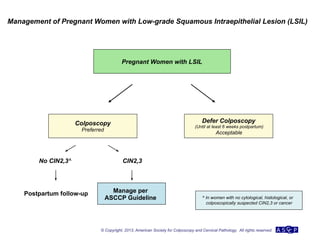
Management of Pregnant Women with Low-grade Squamous Intraepithelial Lesion (LSIL)
CIN2,3
Colposcopy
Preferred
Pregnant Women with LSIL
Defer Colposcopy
(Until at least 6 weeks postpartum)
Acceptable
^ In women with no cytological, histological, or
colposcopically suspected CIN2,3 or cancer
No CIN2,3^
Postpartum follow-up
© Copyright, 2013, American Society for Colposcopy and Cervical Pathology. All rights reserved.
Manage per
ASCCP Guideline
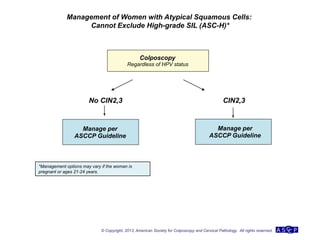
Colposcopy
Regardless of HPV status
CIN2,3
Management of Women with Atypical Squamous Cells:
Cannot Exclude High-grade SIL (ASC-H)*
Manage per
ASCCP Guideline
No CIN2,3
Manage per
ASCCP Guideline
© Copyright, 2013, American Society for Colposcopy and Cervical Pathology. All rights reserved.
*Management options may vary if the woman is
pregnant or ages 21-24 years.
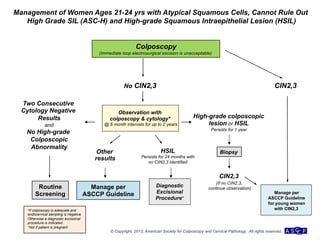
Management of Women Ages 21-24 yrs with Atypical Squamous Cells, Cannot Rule Out
High Grade SIL (ASC-H) and High-grade Squamous Intraepithelial Lesion (HSIL)
No CIN2,3 CIN2,3
Two Consecutive
Cytology Negative
Results
and
No High-grade
Colposcopic
Abnormality
High-grade colposcopic
lesion or HSIL
Persists for 1 year
Routine
Screening
Observation with
colposcopy & cytology*
@ 6 month intervals for up to 2 years
Manage per
ASCCP Guideline
for young women
with CIN2,3
Colposcopy
(Immediate loop electrosurgical excision is unacceptable)
Biopsy
CIN2,3
(If no CIN2,3,
continue observation)
HSIL
Persists for 24 months with
no CIN2,3 identified
Diagnostic
Excisional
Procedure+
Other
results
© Copyright, 2013, American Society for Colposcopy and Cervical Pathology. All rights reserved.
Manage per
ASCCP Guideline
*If colposcopy is adequate and
endocervical sampling is negative.
Otherwise a diagnostic excisional
procedure is indicated.
+Not if patient is pregnant
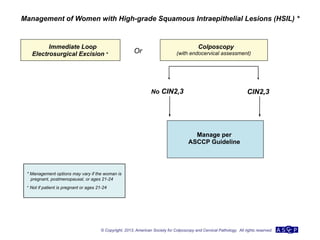
Colposcopy
(with endocervical assessment)
* Management options may vary if the woman is
pregnant, postmenopausal, or ages 21-24
+ Not if patient is pregnant or ages 21-24
CIN2,3No CIN2,3
Management of Women with High-grade Squamous Intraepithelial Lesions (HSIL) *
Immediate Loop
Electrosurgical Excision + Or
Manage per
ASCCP Guideline
© Copyright, 2013, American Society for Colposcopy and Cervical Pathology. All rights reserved.
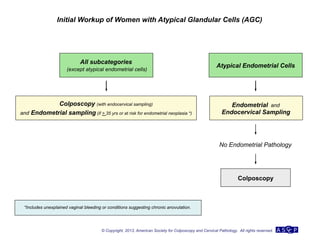
Initial Workup of Women with Atypical Glandular Cells (AGC)
No Endometrial Pathology
All subcategories
(except atypical endometrial cells)
Atypical Endometrial Cells
Colposcopy (with endocervical sampling)
and Endometrial sampling (if > 35 yrs or at risk for endometrial neoplasia *)
Endometrial and
Endocervical Sampling
Colposcopy
*Includes unexplained vaginal bleeding or conditions suggesting chronic anovulation.
© Copyright, 2013, American Society for Colposcopy and Cervical Pathology. All rights reserved.
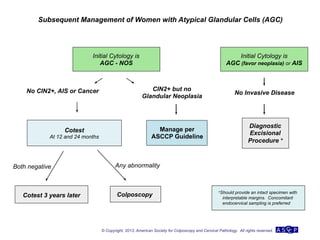
Subsequent Management of Women with Atypical Glandular Cells (AGC)
No CIN2+, AIS or Cancer
Initial Cytology is
AGC - NOS
Manage per
ASCCP Guideline
Cotest
At 12 and 24 months
Any abnormality
Colposcopy
CIN2+ but no
Glandular Neoplasia
Initial Cytology is
AGC (favor neoplasia) or AIS
No Invasive Disease
Diagnostic
Excisional
Procedure +
!"Should provide an intact specimen with
interpretable margins. Concomitant
endocervical sampling is preferred
Both negative
Cotest 3 years later
© Copyright, 2013, American Society for Colposcopy and Cervical Pathology. All rights reserved.
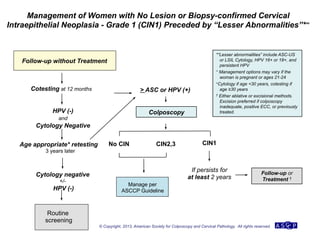
*“Lesser abnormalities” include ASC-US
or LSIL Cytology, HPV 16+ or 18+, and
persistent HPV
" Management options may vary if the
woman is pregnant or ages 21-24
+Cytology if age <30 years, cotesting if
age !30 years
† Either ablative or excisional methods.
Excision preferred if colposcopy
inadequate, positive ECC, or previously
treated.
Management of Women with No Lesion or Biopsy-confirmed Cervical
Intraepithelial Neoplasia - Grade 1 (CIN1) Preceded by “Lesser Abnormalities”*"
Manage per
ASCCP Guideline
Follow-up without Treatment
Cotesting at 12 months > ASC or HPV (+)
HPV (-)
and
Cytology Negative
Colposcopy
Age appropriate* retesting
3 years later
No CIN CIN2,3 CIN1
If persists for
at least 2 years
© Copyright, 2013, American Society for Colposcopy and Cervical Pathology. All rights reserved.
Follow-up or
Treatment †
Cytology negative
+/-
HPV (-)
Routine
screening
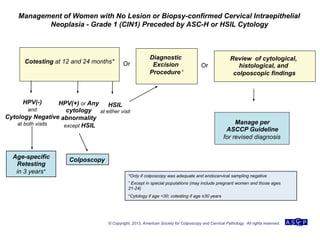
Management of Women with No Lesion or Biopsy-confirmed Cervical Intraepithelial
Neoplasia - Grade 1 (CIN1) Preceded by ASC-H or HSIL Cytology
Cotesting at 12 and 24 months*
Age-specific
Retesting
in 3 years+
Colposcopy
HPV(+) or Any
cytology
abnormality
except HSIL
*Only if colposcopy was adequate and endocervical sampling negative
^ Except in special populations (may include pregnant women and those ages
21-24)
+Cytology if age <30; cotesting if age !30 years
© Copyright, 2013, American Society for Colposcopy and Cervical Pathology. All rights reserved.
HPV(-)
and
Cytology Negative
at both visits
HSIL
at either visit
Diagnostic
Excision
Procedure ^
Or
Review of cytological,
histological, and
colposcopic findings
Or
Manage per
ASCCP Guideline
for revised diagnosis
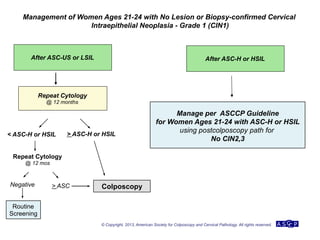
Management of Women Ages 21-24 with No Lesion or Biopsy-confirmed Cervical
Intraepithelial Neoplasia - Grade 1 (CIN1)
< ASC-H or HSIL > ASC-H or HSIL
Repeat Cytology
@ 12 months
Negative > ASC
Routine
Screening
Repeat Cytology
@ 12 mos
After ASC-US or LSIL After ASC-H or HSIL
© Copyright, 2013, American Society for Colposcopy and Cervical Pathology. All rights reserved.
Colposcopy
Manage per ASCCP Guideline
for Women Ages 21-24 with ASC-H or HSIL
using postcolposcopy path for
No CIN2,3
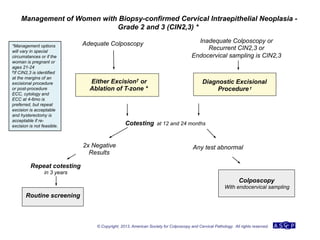
Management of Women with Biopsy-confirmed Cervical Intraepithelial Neoplasia -
Grade 2 and 3 (CIN2,3) *
Either Excision† or
Ablation of T-zone *
Cotesting at 12 and 24 months
2x Negative
Results
Any test abnormal
Diagnostic Excisional
Procedure †
Adequate Colposcopy Inadequate Colposcopy or
Recurrent CIN2,3 or
Endocervical sampling is CIN2,3
Colposcopy
With endocervical sampling
*Management options
will vary in special
circumstances or if the
woman is pregnant or
ages 21-24
†If CIN2,3 is identified
at the margins of an
excisional procedure
or post-procedure
ECC, cytology and
ECC at 4-6mo is
preferred, but repeat
excision is acceptable
and hysterectomy is
acceptable if re-
excision is not feasible.
Repeat cotesting
in 3 years
© Copyright, 2013, American Society for Colposcopy and Cervical Pathology. All rights reserved.
Routine screening
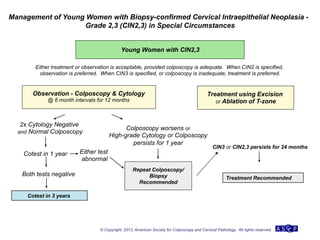
Management of Young Women with Biopsy-confirmed Cervical Intraepithelial Neoplasia -
Grade 2,3 (CIN2,3) in Special Circumstances
Young Women with CIN2,3
Colposcopy worsens or
High-grade Cytology or Colposcopy
persists for 1 year
2x Cytology Negative
and Normal Colposcopy
Repeat Colposcopy/
Biopsy
Recommended
Observation - Colposcopy & Cytology
@ 6 month intervals for 12 months
Treatment using Excision
or Ablation of T-zone
© Copyright, 2013, American Society for Colposcopy and Cervical Pathology. All rights reserved.
CIN3 or CIN2,3 persists for 24 months
Treatment Recommended
Either treatment or observation is acceptable, provided colposcopy is adequate. When CIN2 is specified,
observation is preferred. When CIN3 is specified, or colposcopy is inadequate, treatment is preferred.
Cotest in 1 year
Cotest in 3 years
Both tests negative
Either test
abnormal
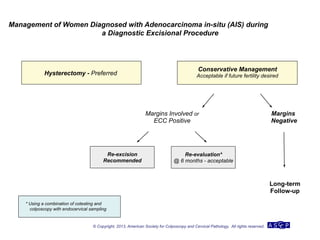
Management of Women Diagnosed with Adenocarcinoma in-situ (AIS) during
a Diagnostic Excisional Procedure
Margins Involved or
ECC Positive
Re-excision
Recommended
Hysterectomy - Preferred
Long-term
Follow-up
Conservative Management
Acceptable if future fertility desired
© Copyright, 2013, American Society for Colposcopy and Cervical Pathology. All rights reserved.
Margins
Negative
* Using a combination of cotesting and
colposcopy with endocervical sampling
Re-evaluation*
@ 6 months - acceptable
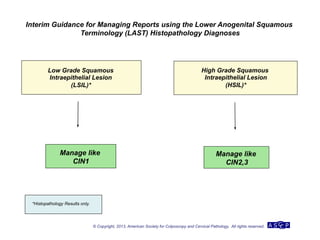
Interim Guidance for Managing Reports using the Lower Anogenital Squamous
Terminology (LAST) Histopathology Diagnoses
Manage like
CIN1
Low Grade Squamous
Intraepithelial Lesion
(LSIL)*
© Copyright, 2013, American Society for Colposcopy and Cervical Pathology. All rights reserved.
*Histopathology Results only.
Manage like
CIN2,3
High Grade Squamous
Intraepithelial Lesion
(HSIL)*
!"#$%$&$'%(
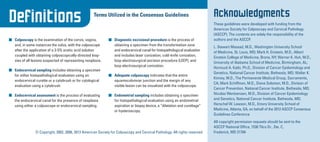
Colposcopy is the examination of the cervix, vagina,
and, in some instances the vulva, with the colposcope
after the application of a 3-5% acetic acid solution
coupled with obtaining colposcopically-directed biop-
sies of all lesions suspected of representing neoplasia.
Endocervical sampling includes obtaining a specimen
for either histopathological evaluation using an
endocervical curette or a cytobrush or for cytological
evaluation using a cytobrush.
Endocervical assessment is the process of evaluating
the endocervical canal for the presence of neoplasia
using either a colposcope or endocervical sampling.
Diagnostic excisional procedure is the process of
obtaining a specimen from the transformation zone
and endocervical canal for histopathological evaluation
and includes laser conization, cold-knife conization,
loop electrosurgical excision procedure (LEEP), and
loop electrosurgical conization.
Adequate colposcopy indicates that the entire
squamocolumnar junction and the margin of any
visible lesion can be visualized with the colposcope.
Endometrial sampling includes obtaining a specimen
for histopathological evaluation using an endometrial
aspiration or biopsy device, a “dilatation and curettage”
or hysteroscopy.
Terms Utilized in the Consensus Guidelines
© Copyright, 2002, 2006, 2013 American Society for Colposcopy and Cervical Pathology. All rights reserved
)*+%',-"./0"%&(
These guidelines were developed with funding from the
American Society for Colposcopy and Cervical Pathology
(ASCCP). The contents are solely the responsibility of the
authors and the ASCCP.
L. Stewart Massad, M.D., Washington University School
of Medicine, St. Louis, MO; Mark H. Einstein, M.D., Albert
Einstein College of Medicine, Bronx, NY; Warner K. Huh, M.D.,
University of Alabama School of Medicine, Birmingham, AL;
Hormuzd A. Katki, Ph.D., Division of Cancer Epidemiology and
Genetics, National Cancer Institute, Bethesda, MD; Walter K.
Kinney, M.D., The Permanente Medical Group, Sacramento,
CA; Mark Schiffman, M.D., Diane Solomon, M.D., Division of
Cancer Prevention, National Cancer Institute, Bethesda, MD;
Nicolas Wentzensen, M.D., Division of Cancer Epidemiology
and Genetics, National Cancer Institute, Bethesda, MD;
Herschel W. Lawson, M.D., Emory University School of
Medicine, Atlanta, GA, on behalf of the 2012 ASCCP Consensus
Guidelines Conference
All copyright permission requests should be sent to the
ASCCP National Office, 1530 Tilco Dr., Ste. C,
Frederick, MD 21704
!"#$%&'(#)*$+&,$-&.#,$/#0()1-$
),1')$2(%&,2#,%$%(0'#$34567$
www.asccp.org/Consensus2012
ASCCP
1530 Tilco Drive, Suite C
Frederick, MD 21704
(301) 733-3640 (telephone)
(800) 787-7227 (toll free)
(240) 575-9880 (fax)
For more information, or to order
additional copies, please email:
administrator@asccp.org

Updated 2012 asccp algorithms

  • 1.
    American Society forColposcopy and Cervical Pathology !"#$%&'(#)*$+&,$-&.#,$/#0()1-$ ),1')$2(%&,2#,%$%(0'#$34567$ Updated Consensus Guidelines for Managing Abnormal Cervical Cancer Screening Tests and Cancer Precursors
  • 2.
    !"#$%&'(#)%" Cytology Since the publicationof the 2006 consensus guidelines, new cervical cancer screening guidelines have been published and new information has become available which includes key cervical cancer screening and follow up, and cervical precancer management data over a nine year period among more than 1 million women cared for at Kaiser Permanente Northern California. Moreover, women under age 21 are no longer receiving cervical cancer screening and cotesting with high-risk HPV type assays, and cervical cytology is being used to screen women 30 years of age and older. Therefore, in 2012 the American Society for Colposcopy and Cervical Pathology (ASCCP), together with its 24 partner professional societies, Federal agencies, and international organizations, began the process of revising the 2006 management guidelines. This culminated in the consensus conference held at the National Institutes of Health in September 2012. This report provides updated recommenda- tions for managing women with cytological abnormalities. A more comprehensive discussion of these recommendations and their supporting evidence was published in the Journal of Lower Genital Tract Disease and Obstetrics and Gynecology and is made available on the ASCCP website at www.asccp.org. Histopathology Appropriate management of women with histo-pathologically diagnosed cervical precancer is an important component of cervical cancer prevention programs. Although the precise number of women diagnosed with cervical precancer each year in the U.S. is not known, it appears to be a relatively common occurence. In 2001 and 2006, the American Society for Colposcopy and Cervical Pathology and 28 partner professional societies, federal agencies, and international organizations, convened processes to develop and update consensus guidelines for the management of women with cervical precancer. Since then, considerable new informa- tion has emerged about management of young women, and the impact of treatment for precursor disease on pregnancy outcomes. Progress has also been made in our understanding of the management of women with adenocarcinoma in-situ, also a human papillomavirus (HPV)—associated precursor lesion to invasive cervical adenocarcinoma. Therefore, in 2012 the ASCCP, together with its partner organizations, reconvened the consensus process of revising the guide- lines. This culminated in the September 2012 Consensus Conference held at the National Institutes of Health. This re- port provides the recommendations developed for managing women with cervical precancer. A summary of the guidelines themselves–including the recommendations for manag- ing women with cervical cytological abnormalities — are published in JLGTD and Obstetrics & Gynecology. © Copyright, 2002, 2006, 2013 American Society for Colposcopy and Cervical Pathology. All rights reserved
  • 3.
    Although the guidelinesare based on evidence whenever possible, for certain clinical situations limited high-quality evidence exists. In these situations the guidelines are based on consensus expert opinion. Guidelines should never be a substitute for clinical judgment. Clinical judgment should always be used when applying a guideline to an individual patient since guidelines may not apply to all patient-related situations. Finally, both clinicians and patients need to recognize that while most cases of cervical cancer can be prevented through a program of screening and management of cervical precancer, no screening or treatment modality is 100% effective and invasive cervical cancer can develop in women participating in such programs. The 2001 Bethesda System terminology is used for cytological classification. This terminology utilizes the terms low-grade squamous intraepithelial lesion (LSIL) and high-grade squamous intraepithelial lesion (HSIL) to refer to low-grade lesions and high-grade cervical cancer precursors respec- tively. For managing cervical precancer, the histopathological classification is two-tiered applying the terms cervical intraepithelial neoplasia grade 1 (CIN 1) to low-grade lesions and CIN2,3 to high-grade lesions. If using the 2012 Lower Anogenital Squamous Terminology (LAST), CIN1 is equivalent to histopathological LSIL and CIN2,3 is equivalent to histo- pathological HSIL. Please note that cytological LSIL is not equivalent to histopathological CIN 1 and cytological HSIL is not equivalent to histopathological CIN2,3. The current guidelines expand clinical indications for HPV testing based on studies using FDA-approved, validated HPV assays. Management decisions based on results using HPV tests not similarly validated may not result in outcomes intended by these guidelines. HPV testing should be restricted to high-risk (oncogenic) HPV types. Testing for low-risk (non- oncogenic) HPV types has no role in evaluating women with abnormal cervical cytological results. Therefore, whenever “HPV testing” is mentioned in the guidelines, it refers to testing for high-risk (oncogenic) HPV types only. !"#"$%&'()**"#+, © Copyright, 2002, 2006, 2013 American Society for Colposcopy and Cervical Pathology. All rights reserved Comments
  • 4.
    Unsatisfactory Cytology HPV negative (age!30) HPV unknown (any age) ColposcopyRepeat Cytology after 2-4 months Manage per ASCCP Guideline Abnormal Negative Unsatisfactory Routine screening(HPV-/unknown) or Cotesting @ 1 year (HPV+) © Copyright, 2013, American Society for Colposcopy and Cervical Pathology. All rights reserved. HPV positive (age !30)
  • 5.
    Cytology NILM* butEC/TZ Absent/Insufficient Ages 21-29+ HPV negative HPV positive HPV testing (Preferred) Routine screening HPV unknown Manage per ASCCP Guideline Cytology + HPV test in 1 year Genotyping Repeat cytology in 3 years (Acceptable) or Age !30 years © Copyright, 2013, American Society for Colposcopy and Cervical Pathology. All rights reserved. *Negative for intraepithelial lesion or malignancy +HPV testing is unacceptable for screening women ages 21-29 years
  • 6.
    Management of Women! Age 30, who are Cytology Negative, but HPV Positive Cytology Negative and HPV Negative !ASC or HPV positive Repeat Cotesting @ 1 year Acceptable Repeat cotesting @ 3 years HPV DNA Typing HPV 16 or 18 Positive Colposcopy Acceptable! Repeat Cotesting @ 1 year HPV 16 and 18 Negative © Copyright, 2013, American Society for Colposcopy and Cervical Pathology. All rights reserved. Manage per ASCCP Guideline Manage per ASCCP Guideline
  • 7.
    Management of Womenwith Atypical Squamous Cells of Undetermined Significance (ASC-US) on Cytology* Negative > ASC Repeat Cytology @ 1 year Acceptable HPV Testing HPV Positive (managed the same as women with LSIL) Colposcopy Endocervical sampling preferred in women with no lesions, and those with inadequate colposcopy; it is acceptable for others Preferred! Repeat Cotesting @ 3 years HPV Negative Manage per ASCCP Guideline © Copyright, 2013, American Society for Colposcopy and Cervical Pathology. All rights reserved. *Management options may vary if the woman is pregnant or ages 21-24 +Cytology at 3 year intervals Routine Screening+
  • 8.
    Management of WomenAges 21-24 years with either Atypical Squamous Cells of Undetermined Significance (ASC-US) or Low-grade Squamous Intraepithelial Lesion (LSIL) Negative, ASC-US or LSIL ASC-H, AGC, HSIL Reflex HPV Testing Acceptable for ASC-US only Negative x 2 > ASC Routine Screening Repeat Cytology @ 12 months Women ages 21-24 years with ASC-US or LSIL Colposcopy Repeat Cytology @ 12 months Preferred HPV Positive Routine Screening HPV Negative © Copyright, 2013, American Society for Colposcopy and Cervical Pathology. All rights reserved.
  • 9.
    Management of Womenwith Low-grade Squamous Intraepithelial Lesions (LSIL)* Non-pregnant and no lesion identified Endocervical sampling “preferred” Inadequate colposcopic examination Endocervical sampling “preferred" Adequate colposcopy and lesion identified Endocervical sampling “acceptable” Colposcopy CIN2,3No CIN2,3 Repeat Cotesting @ 3 years * Management options may vary if the woman is pregnant, postmenopausal, or ages 21-24 years (see text) Manage per ASCCP Guideline LSIL with no HPV test LSIL with positive HPV testLSIL with negative HPV test Repeat Cotesting @ 1 year Preferred Acceptable !ASC or HPV positive Cytology Negative and HPV Negative © Copyright, 2013, American Society for Colposcopy and Cervical Pathology. All rights reserved. Manage per ASCCP Guideline
  • 10.
    Management of PregnantWomen with Low-grade Squamous Intraepithelial Lesion (LSIL) CIN2,3 Colposcopy Preferred Pregnant Women with LSIL Defer Colposcopy (Until at least 6 weeks postpartum) Acceptable ^ In women with no cytological, histological, or colposcopically suspected CIN2,3 or cancer No CIN2,3^ Postpartum follow-up © Copyright, 2013, American Society for Colposcopy and Cervical Pathology. All rights reserved. Manage per ASCCP Guideline
  • 11.
    Colposcopy Regardless of HPVstatus CIN2,3 Management of Women with Atypical Squamous Cells: Cannot Exclude High-grade SIL (ASC-H)* Manage per ASCCP Guideline No CIN2,3 Manage per ASCCP Guideline © Copyright, 2013, American Society for Colposcopy and Cervical Pathology. All rights reserved. *Management options may vary if the woman is pregnant or ages 21-24 years.
  • 12.
    Management of WomenAges 21-24 yrs with Atypical Squamous Cells, Cannot Rule Out High Grade SIL (ASC-H) and High-grade Squamous Intraepithelial Lesion (HSIL) No CIN2,3 CIN2,3 Two Consecutive Cytology Negative Results and No High-grade Colposcopic Abnormality High-grade colposcopic lesion or HSIL Persists for 1 year Routine Screening Observation with colposcopy & cytology* @ 6 month intervals for up to 2 years Manage per ASCCP Guideline for young women with CIN2,3 Colposcopy (Immediate loop electrosurgical excision is unacceptable) Biopsy CIN2,3 (If no CIN2,3, continue observation) HSIL Persists for 24 months with no CIN2,3 identified Diagnostic Excisional Procedure+ Other results © Copyright, 2013, American Society for Colposcopy and Cervical Pathology. All rights reserved. Manage per ASCCP Guideline *If colposcopy is adequate and endocervical sampling is negative. Otherwise a diagnostic excisional procedure is indicated. +Not if patient is pregnant
  • 13.
    Colposcopy (with endocervical assessment) *Management options may vary if the woman is pregnant, postmenopausal, or ages 21-24 + Not if patient is pregnant or ages 21-24 CIN2,3No CIN2,3 Management of Women with High-grade Squamous Intraepithelial Lesions (HSIL) * Immediate Loop Electrosurgical Excision + Or Manage per ASCCP Guideline © Copyright, 2013, American Society for Colposcopy and Cervical Pathology. All rights reserved.
  • 14.
    Initial Workup ofWomen with Atypical Glandular Cells (AGC) No Endometrial Pathology All subcategories (except atypical endometrial cells) Atypical Endometrial Cells Colposcopy (with endocervical sampling) and Endometrial sampling (if > 35 yrs or at risk for endometrial neoplasia *) Endometrial and Endocervical Sampling Colposcopy *Includes unexplained vaginal bleeding or conditions suggesting chronic anovulation. © Copyright, 2013, American Society for Colposcopy and Cervical Pathology. All rights reserved.
  • 15.
    Subsequent Management ofWomen with Atypical Glandular Cells (AGC) No CIN2+, AIS or Cancer Initial Cytology is AGC - NOS Manage per ASCCP Guideline Cotest At 12 and 24 months Any abnormality Colposcopy CIN2+ but no Glandular Neoplasia Initial Cytology is AGC (favor neoplasia) or AIS No Invasive Disease Diagnostic Excisional Procedure + !"Should provide an intact specimen with interpretable margins. Concomitant endocervical sampling is preferred Both negative Cotest 3 years later © Copyright, 2013, American Society for Colposcopy and Cervical Pathology. All rights reserved.
  • 16.
    *“Lesser abnormalities” includeASC-US or LSIL Cytology, HPV 16+ or 18+, and persistent HPV " Management options may vary if the woman is pregnant or ages 21-24 +Cytology if age <30 years, cotesting if age !30 years † Either ablative or excisional methods. Excision preferred if colposcopy inadequate, positive ECC, or previously treated. Management of Women with No Lesion or Biopsy-confirmed Cervical Intraepithelial Neoplasia - Grade 1 (CIN1) Preceded by “Lesser Abnormalities”*" Manage per ASCCP Guideline Follow-up without Treatment Cotesting at 12 months > ASC or HPV (+) HPV (-) and Cytology Negative Colposcopy Age appropriate* retesting 3 years later No CIN CIN2,3 CIN1 If persists for at least 2 years © Copyright, 2013, American Society for Colposcopy and Cervical Pathology. All rights reserved. Follow-up or Treatment † Cytology negative +/- HPV (-) Routine screening
  • 17.
    Management of Womenwith No Lesion or Biopsy-confirmed Cervical Intraepithelial Neoplasia - Grade 1 (CIN1) Preceded by ASC-H or HSIL Cytology Cotesting at 12 and 24 months* Age-specific Retesting in 3 years+ Colposcopy HPV(+) or Any cytology abnormality except HSIL *Only if colposcopy was adequate and endocervical sampling negative ^ Except in special populations (may include pregnant women and those ages 21-24) +Cytology if age <30; cotesting if age !30 years © Copyright, 2013, American Society for Colposcopy and Cervical Pathology. All rights reserved. HPV(-) and Cytology Negative at both visits HSIL at either visit Diagnostic Excision Procedure ^ Or Review of cytological, histological, and colposcopic findings Or Manage per ASCCP Guideline for revised diagnosis
  • 18.
    Management of WomenAges 21-24 with No Lesion or Biopsy-confirmed Cervical Intraepithelial Neoplasia - Grade 1 (CIN1) < ASC-H or HSIL > ASC-H or HSIL Repeat Cytology @ 12 months Negative > ASC Routine Screening Repeat Cytology @ 12 mos After ASC-US or LSIL After ASC-H or HSIL © Copyright, 2013, American Society for Colposcopy and Cervical Pathology. All rights reserved. Colposcopy Manage per ASCCP Guideline for Women Ages 21-24 with ASC-H or HSIL using postcolposcopy path for No CIN2,3
  • 19.
    Management of Womenwith Biopsy-confirmed Cervical Intraepithelial Neoplasia - Grade 2 and 3 (CIN2,3) * Either Excision† or Ablation of T-zone * Cotesting at 12 and 24 months 2x Negative Results Any test abnormal Diagnostic Excisional Procedure † Adequate Colposcopy Inadequate Colposcopy or Recurrent CIN2,3 or Endocervical sampling is CIN2,3 Colposcopy With endocervical sampling *Management options will vary in special circumstances or if the woman is pregnant or ages 21-24 †If CIN2,3 is identified at the margins of an excisional procedure or post-procedure ECC, cytology and ECC at 4-6mo is preferred, but repeat excision is acceptable and hysterectomy is acceptable if re- excision is not feasible. Repeat cotesting in 3 years © Copyright, 2013, American Society for Colposcopy and Cervical Pathology. All rights reserved. Routine screening
  • 20.
    Management of YoungWomen with Biopsy-confirmed Cervical Intraepithelial Neoplasia - Grade 2,3 (CIN2,3) in Special Circumstances Young Women with CIN2,3 Colposcopy worsens or High-grade Cytology or Colposcopy persists for 1 year 2x Cytology Negative and Normal Colposcopy Repeat Colposcopy/ Biopsy Recommended Observation - Colposcopy & Cytology @ 6 month intervals for 12 months Treatment using Excision or Ablation of T-zone © Copyright, 2013, American Society for Colposcopy and Cervical Pathology. All rights reserved. CIN3 or CIN2,3 persists for 24 months Treatment Recommended Either treatment or observation is acceptable, provided colposcopy is adequate. When CIN2 is specified, observation is preferred. When CIN3 is specified, or colposcopy is inadequate, treatment is preferred. Cotest in 1 year Cotest in 3 years Both tests negative Either test abnormal
  • 21.
    Management of WomenDiagnosed with Adenocarcinoma in-situ (AIS) during a Diagnostic Excisional Procedure Margins Involved or ECC Positive Re-excision Recommended Hysterectomy - Preferred Long-term Follow-up Conservative Management Acceptable if future fertility desired © Copyright, 2013, American Society for Colposcopy and Cervical Pathology. All rights reserved. Margins Negative * Using a combination of cotesting and colposcopy with endocervical sampling Re-evaluation* @ 6 months - acceptable
  • 22.
    Interim Guidance forManaging Reports using the Lower Anogenital Squamous Terminology (LAST) Histopathology Diagnoses Manage like CIN1 Low Grade Squamous Intraepithelial Lesion (LSIL)* © Copyright, 2013, American Society for Colposcopy and Cervical Pathology. All rights reserved. *Histopathology Results only. Manage like CIN2,3 High Grade Squamous Intraepithelial Lesion (HSIL)*
  • 23.
    !"#$%$&$'%( Colposcopy is theexamination of the cervix, vagina, and, in some instances the vulva, with the colposcope after the application of a 3-5% acetic acid solution coupled with obtaining colposcopically-directed biop- sies of all lesions suspected of representing neoplasia. Endocervical sampling includes obtaining a specimen for either histopathological evaluation using an endocervical curette or a cytobrush or for cytological evaluation using a cytobrush. Endocervical assessment is the process of evaluating the endocervical canal for the presence of neoplasia using either a colposcope or endocervical sampling. Diagnostic excisional procedure is the process of obtaining a specimen from the transformation zone and endocervical canal for histopathological evaluation and includes laser conization, cold-knife conization, loop electrosurgical excision procedure (LEEP), and loop electrosurgical conization. Adequate colposcopy indicates that the entire squamocolumnar junction and the margin of any visible lesion can be visualized with the colposcope. Endometrial sampling includes obtaining a specimen for histopathological evaluation using an endometrial aspiration or biopsy device, a “dilatation and curettage” or hysteroscopy. Terms Utilized in the Consensus Guidelines © Copyright, 2002, 2006, 2013 American Society for Colposcopy and Cervical Pathology. All rights reserved )*+%',-"./0"%&( These guidelines were developed with funding from the American Society for Colposcopy and Cervical Pathology (ASCCP). The contents are solely the responsibility of the authors and the ASCCP. L. Stewart Massad, M.D., Washington University School of Medicine, St. Louis, MO; Mark H. Einstein, M.D., Albert Einstein College of Medicine, Bronx, NY; Warner K. Huh, M.D., University of Alabama School of Medicine, Birmingham, AL; Hormuzd A. Katki, Ph.D., Division of Cancer Epidemiology and Genetics, National Cancer Institute, Bethesda, MD; Walter K. Kinney, M.D., The Permanente Medical Group, Sacramento, CA; Mark Schiffman, M.D., Diane Solomon, M.D., Division of Cancer Prevention, National Cancer Institute, Bethesda, MD; Nicolas Wentzensen, M.D., Division of Cancer Epidemiology and Genetics, National Cancer Institute, Bethesda, MD; Herschel W. Lawson, M.D., Emory University School of Medicine, Atlanta, GA, on behalf of the 2012 ASCCP Consensus Guidelines Conference All copyright permission requests should be sent to the ASCCP National Office, 1530 Tilco Dr., Ste. C, Frederick, MD 21704
  • 24.
    !"#$%&'(#)*$+&,$-&.#,$/#0()1-$ ),1')$2(%&,2#,%$%(0'#$34567$ www.asccp.org/Consensus2012 ASCCP 1530 Tilco Drive,Suite C Frederick, MD 21704 (301) 733-3640 (telephone) (800) 787-7227 (toll free) (240) 575-9880 (fax) For more information, or to order additional copies, please email: administrator@asccp.org