MALARIA – Pathophysiology,
Clinical features, Management &
Epidemiology
Rumala Morel
Department of Parasitology
University of Peradeniya
Y3S2
Objectives
• Name the parasites causing human malaria worldwide
indicating those present in Sri Lanka.
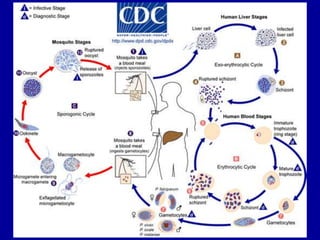
• Describe the life cycle - recapitulation
• Describe the pathological and clinical consequences of
the erythrocytic cycle including relapse & recrudescence
• Malaria diagnosis - recapitulation
• Name the anti malarial drugs in common use and
describe the mode of action of each – recapitulation
• Describe the current malaria situation in Sri Lanka
• Describe the preventive and control measures used by
Anti Malaria Campaign in Sri Lanka
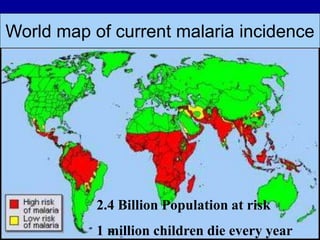
World map of current malaria incidence
2.4 Billion Population at risk
1 million children die every year
5 Plasmodium spp. causing HUMAN MALARIA
3. P.malariae
band form
1. P.falciparum
small rings
2. P.vivax
large rings & schizonts
4. P.ovale
red cell has oval shape
Found in SL Not in SL
Common
Species
worldwide
5. P.knowlesi
Monkey parasite.
Human disease
South-East Asia
5th Human Malaria Parasite
Plasmodium knowlesi
Rapidly multiply –
Quotidian 24h
Erythrocytic cycle
Early Trophozoites:
small rings similar to
P.falciparum
Late Trophozoites :
band-forms like
P.malariae
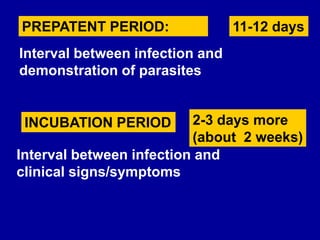
PREPATENT PERIOD:
Interval between infection and
demonstration of parasites
INCUBATION PERIOD
Interval between infection and
clinical signs/symptoms
11-12 days
2-3 days more
(about 2 weeks)
PATHOPHYSIOLOGY
Pathology is due to erythrocytic cycle
A). Destruction of RBCs – haemolysis anaemia
releases endotoxins, malaria pigment
B). Host reaction:
1. IMMUNOPATHOLOGY
Balance between
pro-inflammatory & anti-inflammatory cytokines
2. hyperplasia of RES system -
splenomegaly & hepatomegaly
Red Blood Cells
rupture
Release parasite endotoxins
Glycosyl Phosphatidyl Inositol (GPI)
Activate MACROPHAGE-MONOCYTE system
Pro inflammatory Cytokines:
TNF, interleukin-(IL-1), interferon-γ, IL-6, IL-8,
macrophage colony-stimulating factor , lymphotoxin,
superoxide and nitric oxide(NO)
Symptoms: FEVER, malaise, headache,
nausea and vomiting, diarrhea, anorexia, body aches,
thrombocytopenia, immunosuppression, coagulopathy, C
NS symptoms
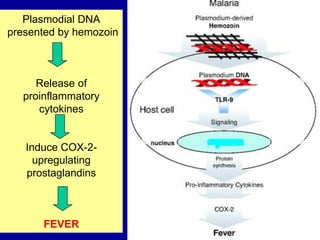
Plasmodial DNA
presented by hemozoin
Release of
proinflammatory
cytokines
Induce COX-2-
upregulating
prostaglandins
FEVER
after the infection gets established for about a week
MALARIA FEBRILE PAROXYSMS
CLASSIC THREE STAGES :–
1. Cold stage – chills (15 min – 1hour)
2. Hot stage – High fever 106 ºF (2 - 6 hours)
accompanied by
head aches, vomiting, delirium,
anxiety, restlessness
3. Sweating stage - profuse sweating and fever subsides
(2-4 hours)
.
FEVER with chills & rigors
Palpable
SPLEEN
ANAEMIA
Severe anaemia = leading cause
of death in children with
falciparum malaria.
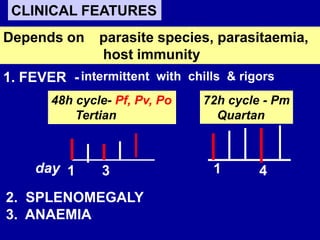
CLINICAL FEATURES
Depends on parasite species, parasitaemia,
host immunity
1. FEVER -intermittent with chills & rigors
48h cycle- Pf, Pv, Po
Tertian
72h cycle - Pm
Quartan
1 3day 1 4
2. SPLENOMEGALY
3. ANAEMIA
D 1 2 3 4 5 6 1 2 3 4 5 6 1 2 3 4 5 6 7 8
P falciparum P vivax , P ovale P malariae
Fever patterns in malaria
tertian periodicity uncommon
in primary attack of Pf
Tertian Quartan
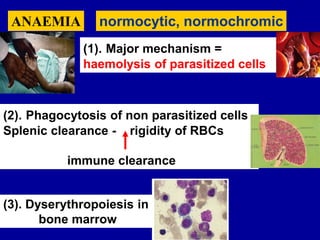
ANAEMIA normocytic, normochromic
(1). Major mechanism =
haemolysis of parasitized cells
(2). Phagocytosis of non parasitized cells
Splenic clearance - rigidity of RBCs
immune clearance
(3). Dyserythropoiesis in
bone marrow
Haemoglobin
utilization by
parasite
Haem + parasite protein
Malaria pigment
(haemozoin)
globin
Haemozoin induction of apoptosis in
erythroid cells in the bone marrow
DYSERYTHROPOIETIC ANAEMIA
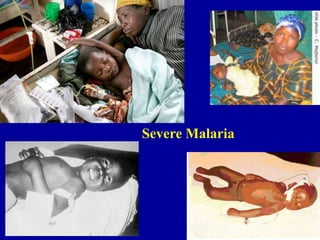
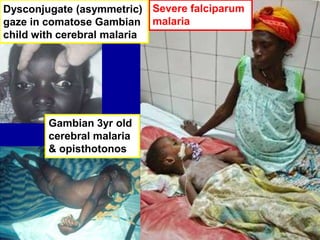
Severe falciparum
malaria
Gambian 3yr old
cerebral malaria
& opisthotonos
Dysconjugate (asymmetric)
gaze in comatose Gambian
child with cerebral malaria
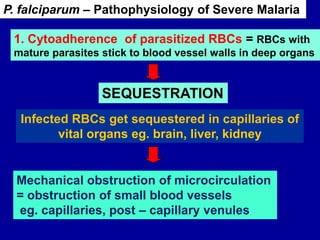
Infected RBCs get sequestered in capillaries of
vital organs eg. brain, liver, kidney
Mechanical obstruction of microcirculation
= obstruction of small blood vessels
eg. capillaries, post – capillary venules
P. falciparum – Pathophysiology of Severe Malaria
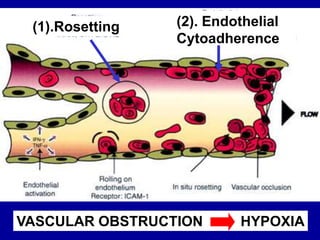
1. Cytoadherence of parasitized RBCs = RBCs with
mature parasites stick to blood vessel walls in deep organs
SEQUESTRATION
Interfere with microcirculation
1. Tissue hypoxia
2. Nitric oxide [NO] release
2. Rosetting = Parasitized RBCs stick to
uninfected RBCs
P. falciparum – Pathophysiology of Severe Malaria
3. Rigid parasitized RBCs get stuck in narrowed
capillary lumen
1. Cytoadherence (mainly)
2. Rosetting
3. Rigid parasitized RBCs
P. falciparum - Mechanisms
of
Microcirculatory Obstruction
(1).Rosetting (2). Endothelial
Cytoadherence
VASCULAR OBSTRUCTION HYPOXIA
Ischaemia &
Tissue hypoxia
Cytoadherence , Rosetting & Rigid RBCs
Block capillaries & post capillary venules
NO = Nitric Oxide release
Oxidative damage to tissue
Severe Malaria
• Impaired level of
consciousness, COMA
• Convulsions
• Generalized and
localized
neurological signs
Cerebral
Pathogenesis Clinical Features
Renal
• Acute tubular necrosis -
sluggish blood flow and hypotension.
•Intravascular haemolysis
•Oliguria
• Haemoglobinuria
• Acute Renal Failure [ARF]
Sluggish flow caused by
sticky knobs on parasitized
redcells leading to stagnant
hypoxia and vascular damage.
Severe Malaria: Common Clinical Manifestations 2
Pathogenesis Clinical Features
Increased pulmonary
capillary permeability
• Cough
• Pulmonary oedema
[ARDS]
•Bronchopneumonia
•Elevated serum enzyme levels
•Prolonged prothrombin time
Jaundice
(mainly haemolytic)
Bleeding
Respiratory
Hepatic
Severe Malaria: Common Clinical Manifestations 3
BLOOD Severe anaemia – Hb < 5g/dl
Hypoglycaemia
Acidaemia
Shock
Disseminated Intravascular Circulation [DIC]
Multiple Organ Dysfunction [MODS]
1. Impairment of consciousness
Glasgow Coma Scale [adults] & Blantyre Scale [children]
2. Prostration – inability to sit unassisted in a child.
In infant not old enough to sit, inability to feed
[on examination - not just told in history]
3. Hyperparasitaemia >4% in non-immune [SL]
SEVERE MALARIA – 2000 WHO
Treat any patient as SEVERE MALARIA
if physician is worried about Signs & Symptoms
BUT
Severe Malaria
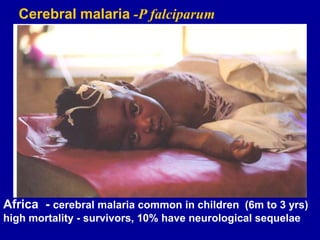
Cerebral malaria -P falciparum
Africa - cerebral malaria common in children (6m to 3 yrs)
high mortality - survivors, 10% have neurological sequelae
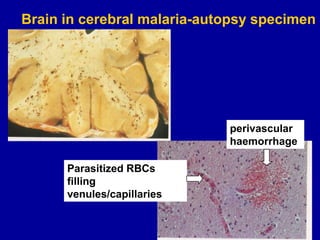
Brain in cerebral malaria-autopsy specimen
perivascular
haemorrhage
Parasitized RBCs
filling
venules/capillaries
Liver in chronic malaria:
dark colour is due to malarial
pigment in macrophages
ANAEMIA in recurrent malaria
• hypersplenism
• severe dyserythropoeisis - ineffective
erythropoeisis in bone marrow
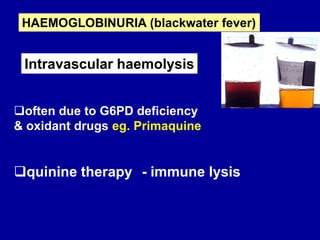
HAEMOGLOBINURIA (blackwater fever)
often due to G6PD deficiency
& oxidant drugs eg. Primaquine
quinine therapy - immune lysis
Intravascular haemolysis
Post-malaria
neurological syndromes
Following cerebral malaria
 <than in other encephalopathies – 3% in
adults & 10-20% in children
Hemiparesis, cortical blindness, tremor,
cranial N palsy
?subtle persistent cognitive/behavioural
effects
2-3 wks after P vivax uncomplicated malaria.
Self limiting – few wks
Cerebellar Ataxia in Sri Lanka
Hyperreactive malarial
splenomegaly syndrome
(Tropical splenomegaly
syndrome)
massive spleens
seen in endemic areas
Overproduction of
polyclonal IgM
immune response
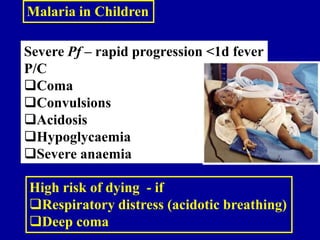
Malaria in Children
Severe Pf – rapid progression <1d fever
P/C
Coma
Convulsions
Acidosis
Hypoglycaemia
Severe anaemia
High risk of dying - if
Respiratory distress (acidotic breathing)
Deep coma
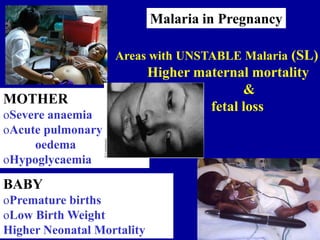
Malaria in Pregnancy
Areas with UNSTABLE Malaria (SL)
Higher maternal mortality
&
fetal loss
MOTHER
oSevere anaemia
oAcute pulmonary
oedema
oHypoglycaemia
BABY
oPremature births
oLow Birth Weight
Higher Neonatal Mortality
RELAPSE OR RECRUDESCENCE?
Reappearance of clinical symptoms
following a period of being well
Recrudescence: 2- 4 weeks „specially in Pf
Due to presence of asexual blood stages that are
not cleared - Inadequate treatment or drug
resistance
Relapse: 3- 6 weeks - Pv, Po
Due to hypnozoite activation merozoites
>% hypnozoites - relapses over longer term
Clinical symptoms
parasitiaemia
subpatent
Liver schizogony-hypnozoites
Recrudescence & Relapse
Fever threshold
Microscopic threshold
Recrudescence Relapse 3-6 wks later
1st attack
MALARIA ENDEMICITY
STABLE OR UNSTABLE TRANSMISSION
 Hyper/holo endemic
 High anopheline biting
frequency
 Severe malaria in
6 months -3 yrs age
 Older – asymptomatic
parasitaemic
[PREMUNITION]
 Pregnancy – severe
malaria
 Spleen rate .50% in
children 2-9yrs
UNSTABLE MALARIA
[Sri Lanka,Thailand, Cambodia]
Meso / hypoendemic
Severe malaria in all ages
Cerebral malaria > common
Spleen rate in children
<50%
STABLE MALARIA
[AFRICA]
Laboratory diagnosis
Diagnosis confirmed by finding parasites/products
in blood using microscopy/ Antigen detection RDTs
1. Microscopy - thin /thick blood film x3 (if –ve repeat 12-24h)
THICK FILM (3-5l) – Very Sensitive
Limit of detection 10-20 p/l =0.002% parasitaemia
THIN FILM (1l) - accurate species identification
2. Antigen detection - parasite derived products - proteins
enzymes
3. PCR – identify DNA (for research only)
In falciparum malaria- peripheral parasitaemia
could underestimate the total parasite burden
The parasites causing the clinical symptoms are
SEQUESTERED in the capillaries of deep organs
ie. microvascular circulation
In synchronous cycles, peripheral parasitaemia
could even be negative
Repeat blood films daily – 3 consecutive days
42
Microscopy – identify parasite
Thin & Thick film x3 Consecutive days
GOLD STANDARD
THICK FILM
(3-5 l)
Very Sensitive
Limit of detection 10-20 p/l
Can quantify against WBCs
THIN FILM
(1l)
Accurate species identification
43
Disadvantages
1. Need trained experienced personnel
2. Can’t do in field
Microscopy
Advantages
1. Less costly
2. High sensitivity
3. Can quantify
44
ANTIGEN DETECTION
RAPID DIAGNOSTIC TESTS [RDTs]
Dipstick/card methods
1. Most useful commercial tests detecting
BOTH Pf + Pv
Detects
parasite Lactate dehydrogenase ( pLDH)
depends on LIVE parasites
CAN USE TO TEST DRUG RESISTANCE
2. RDTs – sensitivity is low
(won’t detect below 100 – 200 parasites/μl)
45
ANTIGEN DETECTION
RAPID DIAGNOSTIC TESTS [RDTs]
WHO malaria RDT performance evaluation - Round 2
1. High cost
Disadvantages
Advantages
1. Easy to do in field
2. Don’t need trained persons
The leaves of Artemisia annua,
(China) are the source of artemisinin
Cinchona (Peru) –
Quinine
Anti - malarials
Malaria Treatment in Sri Lanka
Vivax malaria
1. Chloroquine –
blood schizonticide
2. Primaquine – Kills
hypnozoites &
gametocytes
Falciparum Malaria
Combination therapy to limit
Development of drug resisitance
CO-ARTEMETHER
[Artemether & Lumefantrine]
& Primaquine
Severe Pf – Quinine
Pregnant women in 1st trimester
Exclusively breastfeeding
Children weighing < 5 kg
„Coartem‟ is contraindicated for:-
Treatment = Quinine
ANTIMALARIAL RESISTANCE
DEFINITION
“Ability of a parasite strain to survive or multiply
in spite of administration of a drug at usual
or higher than usual dose.
( where drug failure due to defective intake
/absorption / metabolism has been excluded)”
P falciparum –
Multi Drug Resistance
(MDR) – combination
therapy
P vivax - resistance to
chloroquine in a few areas
RESISTANCE 3 grades :
R1 (low grade)
R ll (high)
R lll (no response)
P.falciparum – map of chloroquine resistance
Assessment of Therapeutic
Response to Anti-malarials
(1) Parasite Clearance Time (PCT)
Time between beginning the anti-malarial
treatment and the first –ve blood film
(2) Fever Clearance Time (FCT)
Time from beginning anti- malarial treatment
until the patient is apyrexial [no fever]
Prevention & Control of Malaria
Interrupt transmission @ different stages
1. MAN
3. PARASITE
2. VECTOR
A. Prevent Man-Vector Contact / Reduce Vector
Population
most useful strategies
 Insecticide impregnated bed nets
 Residual insecticide spraying of
houses
Prevention & Control of Malaria
B. Reduce Parasite Population
Treatment of patients –
Gametocytocides (Primaquine) also to prevent
transmission
Still experimental
Multistage, multi component -
anti sporozoite, liver stages, merozoite,
ring infected erythrocytes
Transmission blocking – anti gametocyte
Anti disease not anti parasitic –
So as not to prevent infection &
reduce natural immunity = Premunition
DNA vaccines
Vaccines
Prevention & Control of Malaria in SL
Ministry of Health – Anti Malaria Campaign
ELIMINATION of Malaria transmission in SL by 2015
56
200,000 cases in 2000
23 in 2012
(99.99% reduction)
2012 lowest number of
malaria cases since
1963
Dramatic reduction of microscopically confirmed case load
http://www.malariacampaign.gov.lk
57
Prevention & Control of Malaria in SL
http://www.malariacampaign.gov.lk
Most detected by
1. Activated Passive Case Detection (APCD) –
hospitals in endemic area
also
1. Active Case Detection (ACD) and Mobile malaria
clinics – home visits
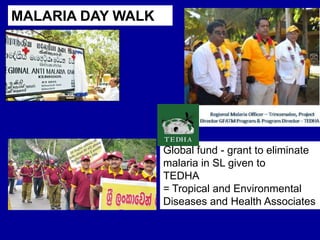
MALARIA DAY WALK
Global fund - grant to eliminate
malaria in SL given to
TEDHA
= Tropical and Environmental
Diseases and Health Associates
Clinical features of severe falciparum malaria
include
A. Severe anaemia
B. Acute pulmonary oedema
C. Hypoglycaemia
D. Coma
E. Convulsions
T=ABCDE
References
Look at these websites
• World health Organization: WHO - www.who.int/
• Centers for Disease Control and Prevention (cdc)
website : www.cdc.gov/
Books
1. Manson’s Tropical Diseases – 22nd Ed
2. Worms & Human Disease – Ralph Muller & Derek
Wakelin

Malaria clinical

  • 1.
    MALARIA – Pathophysiology, Clinicalfeatures, Management & Epidemiology Rumala Morel Department of Parasitology University of Peradeniya Y3S2
  • 2.
    Objectives • Name theparasites causing human malaria worldwide indicating those present in Sri Lanka. • Describe the life cycle - recapitulation • Describe the pathological and clinical consequences of the erythrocytic cycle including relapse & recrudescence • Malaria diagnosis - recapitulation • Name the anti malarial drugs in common use and describe the mode of action of each – recapitulation • Describe the current malaria situation in Sri Lanka • Describe the preventive and control measures used by Anti Malaria Campaign in Sri Lanka
  • 3.
    World map ofcurrent malaria incidence 2.4 Billion Population at risk 1 million children die every year
  • 5.
    5 Plasmodium spp.causing HUMAN MALARIA 3. P.malariae band form 1. P.falciparum small rings 2. P.vivax large rings & schizonts 4. P.ovale red cell has oval shape Found in SL Not in SL Common Species worldwide 5. P.knowlesi Monkey parasite. Human disease South-East Asia
  • 6.
    5th Human MalariaParasite Plasmodium knowlesi Rapidly multiply – Quotidian 24h Erythrocytic cycle Early Trophozoites: small rings similar to P.falciparum Late Trophozoites : band-forms like P.malariae
  • 8.
    PREPATENT PERIOD: Interval betweeninfection and demonstration of parasites INCUBATION PERIOD Interval between infection and clinical signs/symptoms 11-12 days 2-3 days more (about 2 weeks)
  • 9.
    PATHOPHYSIOLOGY Pathology is dueto erythrocytic cycle A). Destruction of RBCs – haemolysis anaemia releases endotoxins, malaria pigment B). Host reaction: 1. IMMUNOPATHOLOGY Balance between pro-inflammatory & anti-inflammatory cytokines 2. hyperplasia of RES system - splenomegaly & hepatomegaly
  • 10.
    Red Blood Cells rupture Releaseparasite endotoxins Glycosyl Phosphatidyl Inositol (GPI) Activate MACROPHAGE-MONOCYTE system Pro inflammatory Cytokines: TNF, interleukin-(IL-1), interferon-γ, IL-6, IL-8, macrophage colony-stimulating factor , lymphotoxin, superoxide and nitric oxide(NO) Symptoms: FEVER, malaise, headache, nausea and vomiting, diarrhea, anorexia, body aches, thrombocytopenia, immunosuppression, coagulopathy, C NS symptoms
  • 11.
    Plasmodial DNA presented byhemozoin Release of proinflammatory cytokines Induce COX-2- upregulating prostaglandins FEVER
  • 12.
    after the infectiongets established for about a week MALARIA FEBRILE PAROXYSMS CLASSIC THREE STAGES :– 1. Cold stage – chills (15 min – 1hour) 2. Hot stage – High fever 106 ºF (2 - 6 hours) accompanied by head aches, vomiting, delirium, anxiety, restlessness 3. Sweating stage - profuse sweating and fever subsides (2-4 hours) .
  • 13.
    FEVER with chills& rigors Palpable SPLEEN ANAEMIA Severe anaemia = leading cause of death in children with falciparum malaria.
  • 14.
    CLINICAL FEATURES Depends onparasite species, parasitaemia, host immunity 1. FEVER -intermittent with chills & rigors 48h cycle- Pf, Pv, Po Tertian 72h cycle - Pm Quartan 1 3day 1 4 2. SPLENOMEGALY 3. ANAEMIA
  • 15.
    D 1 23 4 5 6 1 2 3 4 5 6 1 2 3 4 5 6 7 8 P falciparum P vivax , P ovale P malariae Fever patterns in malaria tertian periodicity uncommon in primary attack of Pf Tertian Quartan
  • 16.
    ANAEMIA normocytic, normochromic (1).Major mechanism = haemolysis of parasitized cells (2). Phagocytosis of non parasitized cells Splenic clearance - rigidity of RBCs immune clearance (3). Dyserythropoiesis in bone marrow
  • 17.
    Haemoglobin utilization by parasite Haem +parasite protein Malaria pigment (haemozoin) globin Haemozoin induction of apoptosis in erythroid cells in the bone marrow DYSERYTHROPOIETIC ANAEMIA
  • 18.
    Severe falciparum malaria Gambian 3yrold cerebral malaria & opisthotonos Dysconjugate (asymmetric) gaze in comatose Gambian child with cerebral malaria
  • 19.
    Infected RBCs getsequestered in capillaries of vital organs eg. brain, liver, kidney Mechanical obstruction of microcirculation = obstruction of small blood vessels eg. capillaries, post – capillary venules P. falciparum – Pathophysiology of Severe Malaria 1. Cytoadherence of parasitized RBCs = RBCs with mature parasites stick to blood vessel walls in deep organs SEQUESTRATION
  • 20.
    Interfere with microcirculation 1.Tissue hypoxia 2. Nitric oxide [NO] release 2. Rosetting = Parasitized RBCs stick to uninfected RBCs P. falciparum – Pathophysiology of Severe Malaria 3. Rigid parasitized RBCs get stuck in narrowed capillary lumen
  • 21.
    1. Cytoadherence (mainly) 2.Rosetting 3. Rigid parasitized RBCs P. falciparum - Mechanisms of Microcirculatory Obstruction
  • 22.
  • 23.
    Ischaemia & Tissue hypoxia Cytoadherence, Rosetting & Rigid RBCs Block capillaries & post capillary venules NO = Nitric Oxide release Oxidative damage to tissue
  • 24.
    Severe Malaria • Impairedlevel of consciousness, COMA • Convulsions • Generalized and localized neurological signs Cerebral Pathogenesis Clinical Features Renal • Acute tubular necrosis - sluggish blood flow and hypotension. •Intravascular haemolysis •Oliguria • Haemoglobinuria • Acute Renal Failure [ARF] Sluggish flow caused by sticky knobs on parasitized redcells leading to stagnant hypoxia and vascular damage.
  • 25.
    Severe Malaria: CommonClinical Manifestations 2 Pathogenesis Clinical Features Increased pulmonary capillary permeability • Cough • Pulmonary oedema [ARDS] •Bronchopneumonia •Elevated serum enzyme levels •Prolonged prothrombin time Jaundice (mainly haemolytic) Bleeding Respiratory Hepatic
  • 26.
    Severe Malaria: CommonClinical Manifestations 3 BLOOD Severe anaemia – Hb < 5g/dl Hypoglycaemia Acidaemia Shock Disseminated Intravascular Circulation [DIC] Multiple Organ Dysfunction [MODS]
  • 27.
    1. Impairment ofconsciousness Glasgow Coma Scale [adults] & Blantyre Scale [children] 2. Prostration – inability to sit unassisted in a child. In infant not old enough to sit, inability to feed [on examination - not just told in history] 3. Hyperparasitaemia >4% in non-immune [SL] SEVERE MALARIA – 2000 WHO Treat any patient as SEVERE MALARIA if physician is worried about Signs & Symptoms BUT
  • 28.
  • 29.
    Cerebral malaria -Pfalciparum Africa - cerebral malaria common in children (6m to 3 yrs) high mortality - survivors, 10% have neurological sequelae
  • 30.
    Brain in cerebralmalaria-autopsy specimen perivascular haemorrhage Parasitized RBCs filling venules/capillaries
  • 31.
    Liver in chronicmalaria: dark colour is due to malarial pigment in macrophages ANAEMIA in recurrent malaria • hypersplenism • severe dyserythropoeisis - ineffective erythropoeisis in bone marrow
  • 32.
    HAEMOGLOBINURIA (blackwater fever) oftendue to G6PD deficiency & oxidant drugs eg. Primaquine quinine therapy - immune lysis Intravascular haemolysis
  • 33.
    Post-malaria neurological syndromes Following cerebralmalaria  <than in other encephalopathies – 3% in adults & 10-20% in children Hemiparesis, cortical blindness, tremor, cranial N palsy ?subtle persistent cognitive/behavioural effects 2-3 wks after P vivax uncomplicated malaria. Self limiting – few wks Cerebellar Ataxia in Sri Lanka
  • 34.
    Hyperreactive malarial splenomegaly syndrome (Tropicalsplenomegaly syndrome) massive spleens seen in endemic areas Overproduction of polyclonal IgM immune response
  • 35.
    Malaria in Children SeverePf – rapid progression <1d fever P/C Coma Convulsions Acidosis Hypoglycaemia Severe anaemia High risk of dying - if Respiratory distress (acidotic breathing) Deep coma
  • 36.
    Malaria in Pregnancy Areaswith UNSTABLE Malaria (SL) Higher maternal mortality & fetal loss MOTHER oSevere anaemia oAcute pulmonary oedema oHypoglycaemia BABY oPremature births oLow Birth Weight Higher Neonatal Mortality
  • 37.
    RELAPSE OR RECRUDESCENCE? Reappearanceof clinical symptoms following a period of being well Recrudescence: 2- 4 weeks „specially in Pf Due to presence of asexual blood stages that are not cleared - Inadequate treatment or drug resistance Relapse: 3- 6 weeks - Pv, Po Due to hypnozoite activation merozoites >% hypnozoites - relapses over longer term
  • 38.
    Clinical symptoms parasitiaemia subpatent Liver schizogony-hypnozoites Recrudescence& Relapse Fever threshold Microscopic threshold Recrudescence Relapse 3-6 wks later 1st attack
  • 39.
    MALARIA ENDEMICITY STABLE ORUNSTABLE TRANSMISSION  Hyper/holo endemic  High anopheline biting frequency  Severe malaria in 6 months -3 yrs age  Older – asymptomatic parasitaemic [PREMUNITION]  Pregnancy – severe malaria  Spleen rate .50% in children 2-9yrs UNSTABLE MALARIA [Sri Lanka,Thailand, Cambodia] Meso / hypoendemic Severe malaria in all ages Cerebral malaria > common Spleen rate in children <50% STABLE MALARIA [AFRICA]
  • 40.
    Laboratory diagnosis Diagnosis confirmedby finding parasites/products in blood using microscopy/ Antigen detection RDTs 1. Microscopy - thin /thick blood film x3 (if –ve repeat 12-24h) THICK FILM (3-5l) – Very Sensitive Limit of detection 10-20 p/l =0.002% parasitaemia THIN FILM (1l) - accurate species identification 2. Antigen detection - parasite derived products - proteins enzymes 3. PCR – identify DNA (for research only)
  • 41.
    In falciparum malaria-peripheral parasitaemia could underestimate the total parasite burden The parasites causing the clinical symptoms are SEQUESTERED in the capillaries of deep organs ie. microvascular circulation In synchronous cycles, peripheral parasitaemia could even be negative Repeat blood films daily – 3 consecutive days
  • 42.
    42 Microscopy – identifyparasite Thin & Thick film x3 Consecutive days GOLD STANDARD THICK FILM (3-5 l) Very Sensitive Limit of detection 10-20 p/l Can quantify against WBCs THIN FILM (1l) Accurate species identification
  • 43.
    43 Disadvantages 1. Need trainedexperienced personnel 2. Can’t do in field Microscopy Advantages 1. Less costly 2. High sensitivity 3. Can quantify
  • 44.
    44 ANTIGEN DETECTION RAPID DIAGNOSTICTESTS [RDTs] Dipstick/card methods 1. Most useful commercial tests detecting BOTH Pf + Pv Detects parasite Lactate dehydrogenase ( pLDH) depends on LIVE parasites CAN USE TO TEST DRUG RESISTANCE
  • 45.
    2. RDTs –sensitivity is low (won’t detect below 100 – 200 parasites/μl) 45 ANTIGEN DETECTION RAPID DIAGNOSTIC TESTS [RDTs] WHO malaria RDT performance evaluation - Round 2 1. High cost Disadvantages Advantages 1. Easy to do in field 2. Don’t need trained persons
  • 47.
    The leaves ofArtemisia annua, (China) are the source of artemisinin Cinchona (Peru) – Quinine Anti - malarials
  • 48.
    Malaria Treatment inSri Lanka Vivax malaria 1. Chloroquine – blood schizonticide 2. Primaquine – Kills hypnozoites & gametocytes Falciparum Malaria Combination therapy to limit Development of drug resisitance CO-ARTEMETHER [Artemether & Lumefantrine] & Primaquine Severe Pf – Quinine
  • 49.
    Pregnant women in1st trimester Exclusively breastfeeding Children weighing < 5 kg „Coartem‟ is contraindicated for:- Treatment = Quinine
  • 50.
    ANTIMALARIAL RESISTANCE DEFINITION “Ability ofa parasite strain to survive or multiply in spite of administration of a drug at usual or higher than usual dose. ( where drug failure due to defective intake /absorption / metabolism has been excluded)” P falciparum – Multi Drug Resistance (MDR) – combination therapy P vivax - resistance to chloroquine in a few areas RESISTANCE 3 grades : R1 (low grade) R ll (high) R lll (no response)
  • 51.
    P.falciparum – mapof chloroquine resistance
  • 52.
    Assessment of Therapeutic Responseto Anti-malarials (1) Parasite Clearance Time (PCT) Time between beginning the anti-malarial treatment and the first –ve blood film (2) Fever Clearance Time (FCT) Time from beginning anti- malarial treatment until the patient is apyrexial [no fever]
  • 53.
    Prevention & Controlof Malaria Interrupt transmission @ different stages 1. MAN 3. PARASITE 2. VECTOR
  • 54.
    A. Prevent Man-VectorContact / Reduce Vector Population most useful strategies  Insecticide impregnated bed nets  Residual insecticide spraying of houses Prevention & Control of Malaria B. Reduce Parasite Population Treatment of patients – Gametocytocides (Primaquine) also to prevent transmission
  • 55.
    Still experimental Multistage, multicomponent - anti sporozoite, liver stages, merozoite, ring infected erythrocytes Transmission blocking – anti gametocyte Anti disease not anti parasitic – So as not to prevent infection & reduce natural immunity = Premunition DNA vaccines Vaccines
  • 56.
    Prevention & Controlof Malaria in SL Ministry of Health – Anti Malaria Campaign ELIMINATION of Malaria transmission in SL by 2015 56 200,000 cases in 2000 23 in 2012 (99.99% reduction) 2012 lowest number of malaria cases since 1963 Dramatic reduction of microscopically confirmed case load http://www.malariacampaign.gov.lk
  • 57.
    57 Prevention & Controlof Malaria in SL http://www.malariacampaign.gov.lk Most detected by 1. Activated Passive Case Detection (APCD) – hospitals in endemic area also 1. Active Case Detection (ACD) and Mobile malaria clinics – home visits
  • 58.
    MALARIA DAY WALK Globalfund - grant to eliminate malaria in SL given to TEDHA = Tropical and Environmental Diseases and Health Associates
  • 60.
    Clinical features ofsevere falciparum malaria include A. Severe anaemia B. Acute pulmonary oedema C. Hypoglycaemia D. Coma E. Convulsions T=ABCDE
  • 61.
    References Look at thesewebsites • World health Organization: WHO - www.who.int/ • Centers for Disease Control and Prevention (cdc) website : www.cdc.gov/ Books 1. Manson’s Tropical Diseases – 22nd Ed 2. Worms & Human Disease – Ralph Muller & Derek Wakelin