CERAMIC AND MOSAIC TILES FOR FLOOR
PROJECT SUPERVISOR: PROF.DR.AFZAL JAVED
EXTERNAL EXAMINAR:
CERAMIC AND MOSAIC TILES FOR FLOOR
Submitted To: Dr. Muhammad Afzal Javed
Prepared By: Khalid Yousaf BSCE01113094
Inayat Sarwary BSCE01113233
Faramarz BSCE01113239
Sayed Ahmad BSCE01113240
Presentation flow
INTRODUCTION OF TILES
PHYSICAL PROPERTIES OF THE TILES
TYPES OF TILES
MOSAIC TILES
MANUFACTURING OF MOSAIC AND CERAMIC TILE
CERAMIC TILES
IMPORTANT TESTS REQUIRED ON TILES
SELECTION AND MAINTENANCE OF TILES
INTRODUCTION TO TILES
A tile is a manufactured piece of
hard-wearing material such as
ceramic, stone, metal, or even
glass, generally used for covering
roofs, floors, walls, showers, or
other objects such as tabletops
INTRODUCTION
 Tiles are often used to form wall and floor coverings, and can range
from simple square tiles to complex mosaics. Tiles are most often
made of ceramic, typically glazed for internal uses and unglazed for
roofing, but other materials are also commonly used, such as glass,
cork, concrete and other composite materials, and stone
TYPES OF TILES
 Quarry Tile
 Glazed Porcelain Tiles
 Metal Tiles
 Vitrified Tiles
 Digital Tiles
 Stone Tiles
 Ceramic Tiles
 Mosaic Tiles
QUARRY TILES PORCELAIN TILE
made by the extrusion process from
natural clay or shale’s. Quarry tile is
manufactured from clay in a manner
similar to bricks Usually coming in 13
to 19 mm
Porcelain tiles are ceramic tiles commonly
used to cover floors and walls, with a water
absorption rate of less than 0.5 percent.
They can either be glazed or unglazed.
 METAL TILE
Choice of leading and designers from
around the world.
 VITRIFIED TILE
Is a ceramic tile with very low porosity. It
is an alternative to marble and granite
flooring. Vitrified tiles are often used
outdoors due to their water and frost
resistance. Vitrified tile
Metal tile
 DIGITAL TILE
These tiles are created based on principles and
procedures similar to graphic art work and
offers photo-like high resolution impressions.
They give a unique look to the walls,
with unlimited designs possibilities, sharper
finishes and high resolution printing, digital
tiles is now becoming ceramic art for the walls.
 STONE TILE
Stone Art Tiles represents a wide range of tiles
resembling stones ranging from traditional to
contemporary designs, varied patterns with
light to dark colors and matching the
specification of urban and small town house
holds. These tiles are cost effective and easy to
maintain as compared to natural stones
PHYSICAL PROPERTIES OF THE TILES
PROPERTIES
• RESISTANCE TO ABRASION
• FREEZE-RESISTANCE
• THERMAL SHOCK RESISTANCE
• BENDING STRENGTH AND BREAKING FORCE
• CHEMICAL RESISTANCE
• STAIN RESISTANCE
• PROPERTIES RELATED TO SAFETY
 RESISTANCE TO ABRASION
• It specifies the resistance of the tile to mechanical damage
resulting from the impact of the abrasive factor
• The greater the hardness of the tile is, the lower its
susceptibility to scratching, wear and tear during walking and
abrasion
• It consists in the specification of the number of rotations of
the device that rubs the surface of the glazed tile after which
the permanent traces of abrasion become visible
 FREEZE-RESISTANCE
The ceramic tiles, which are to be laid out at places exposed to the impact
of negative temperatures
 THERMAL SHOCK RESISTANCE
The ceramic tiles which can be subjected to the local sudden temperature
change should have the declared thermal shock resistance confirmed by the
test according to PN-EN ISO 10545-9.
 BENDING STRENGTH AND BREAKING FORCE
 To put it simply, these parameters specify at which stress, the tile is
subject to breaking. It is a particularly important parameter in case of
the floor tiles
 are subjected to significant mechanical loads, and abrasive tiles laid out
in places, where stresses caused by the movements of building walls can
occur.
the test method specified in PN-EN ISO 10545-9.
 CHEMICAL RESISTANCE
 Specifies the resistance of the tile to the impact of testing solutions:
daily use agents, salts for swimming pools as well as acids and alkalis
 The tiles resistant to the chemical factors cannot be subject to changes
under the influence of these substances, e.g. a change in gloss or color.
The test method specified in PN-EN ISO 10545-13.
www.company.com
 PROPERTIES RELATED TO SAFETY
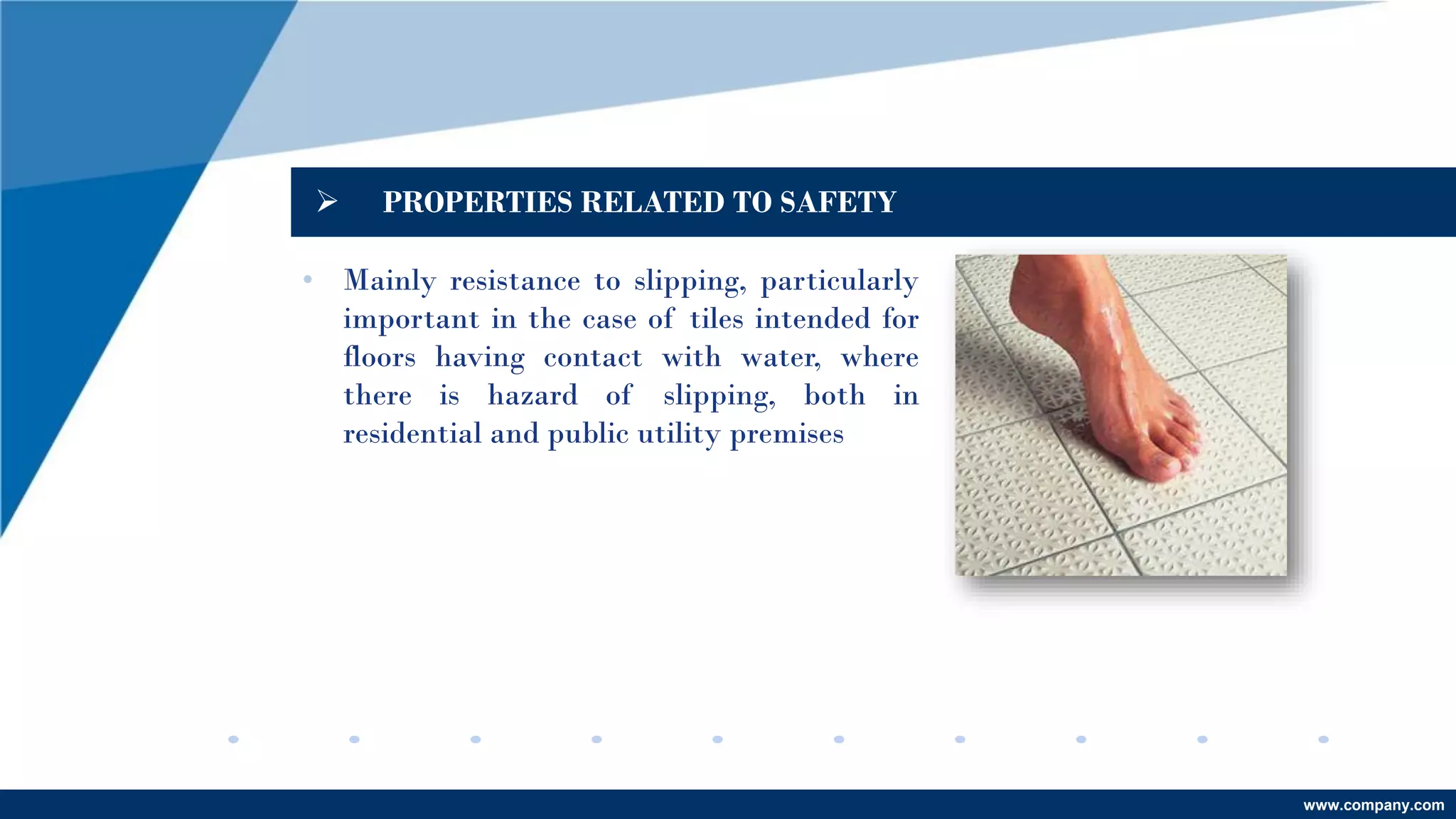
• Mainly resistance to slipping, particularly
important in the case of tiles intended for
floors having contact with water, where
there is hazard of slipping, both in
residential and public utility premises
MANUFACTURING OF CERAMIC
AND MOSAIC TILES
Background
• The production of tile dates back to ancient times and peoples, including
the Egyptians, the Babylonians, and the Assyrians. For instance, the Step
Pyramid for the Pharaoh Djoser, built in ancient Egypt around 2600 B.C
contained colorful glazed tile.
• Later, tile was manufactured in virtually every major European country
and in the United States. By the beginning of the twentieth century, tile
was manufactured on an industrial scale.
Background
• Europe, Latin America, and the Far East are the largest producers of tile,
with Italy the leader at 16.6 million ft.2/day as of 1989. Following Italy
(at 24.6 percent of the world market) are Spain (12.6 percent), Brazil and
Germany (both at 11.2 percent), and the United States (4.5 percent).
 SELECTION OF RAW MATERIALS
The raw materials used to form tile consist of
clay minerals mined from the earth's crust,
natural minerals such as feldspar that are used
to lower the firing temperature, and
chemical additives required for the shaping
process
The minerals are often refined or beneficiated
near the mine before shipment to the ceramic
plant
clay
www.company.com
 Batching
• For many ceramic products, including tile, the body composition is
determined by the amount and type of raw materials.
• The raw materials also determine the color of the tile body, which can
be red or white in color, depending on the amount of iron-containing
raw materials used.
• Therefore, it is important to mix the right amounts together to achieve
the desired properties
www.company.com
Mixing and grinding
• Once the ingredients are weighed, they are added together into a shell
mixer, ribbon mixer, or intensive mixer. A shell mixer consists of two
cylinders joined into a V
, which rotates to tumble and mix the
material.
• Sometimes it is necessary to add water to improve the mixing of a
multiple-ingredient batch as well as to achieve fine grinding This
process is called wet milling and is often performed using a ball mill
• The resulting water-filled mixture is called a slurry or slip
www.company.com
www.company.com
Spray drying
• If wet milling is first used, the excess water is usually removed via
spray drying. This involves pumping the slurry to an atomizer
consisting of a rapidly rotating disk or nozzle
• . Droplets of the slip are dried as they are heated by a rising hot air
column, forming small, free flowing granules that result in a powder
suitable for forming.
www.company.com
www.company.com
Forming
• Most tile is formed by dry pressing. In this method, the free flowing
powder—containing organic binder or a low percentage of moisture—
flows from a hopper into the forming die.
• The material is compressed in a steel cavity by steel plungers and is
then ejected by the bottom plunger. Automated presses are used with
operating pressures as high as 2,500 tons.
www.company.com
Auto hydraulic tile press machinery
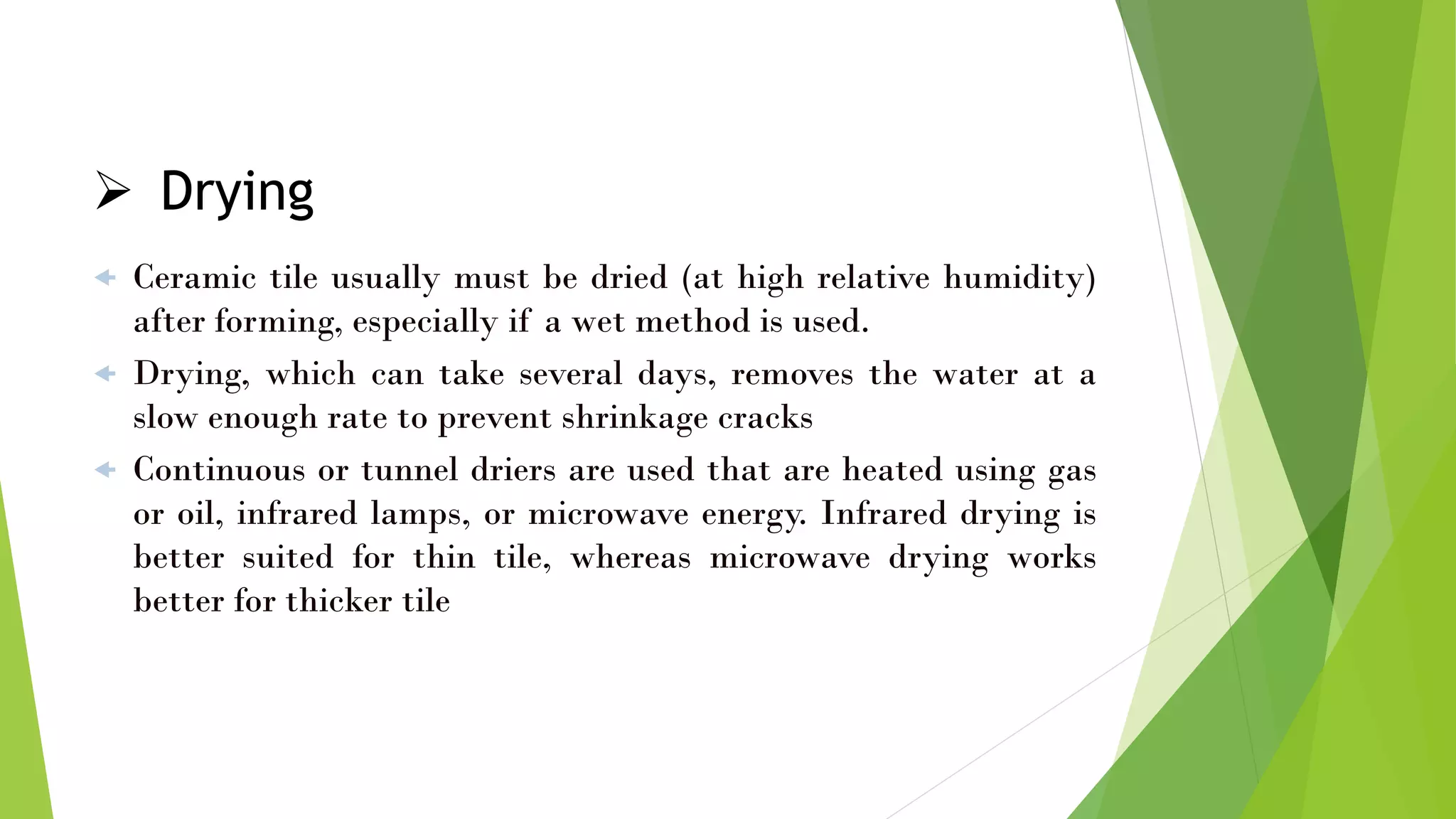
 Drying
 Ceramic tile usually must be dried (at high relative humidity)
after forming, especially if a wet method is used.
 Drying, which can take several days, removes the water at a
slow enough rate to prevent shrinkage cracks
 Continuous or tunnel driers are used that are heated using gas
or oil, infrared lamps, or microwave energy. Infrared drying is
better suited for thin tile, whereas microwave drying works
better for thicker tile
 Glazing
• The glaze coating is comprised of liquid colored glass and is
applied and baked to the surface of the bisque under very
high temperatures.
• The liquid glass coating is what creates the texture, design
and color of a glazed tile and protects the body of the tile
from staining. The colors in the glaze come from various
minerals, such as zinc, mercury, copper, gold, silver, etc.
 Firing
• After glazing, the tile must be heated
intensely to strengthen it and give it
the desired porosity.
Process flow
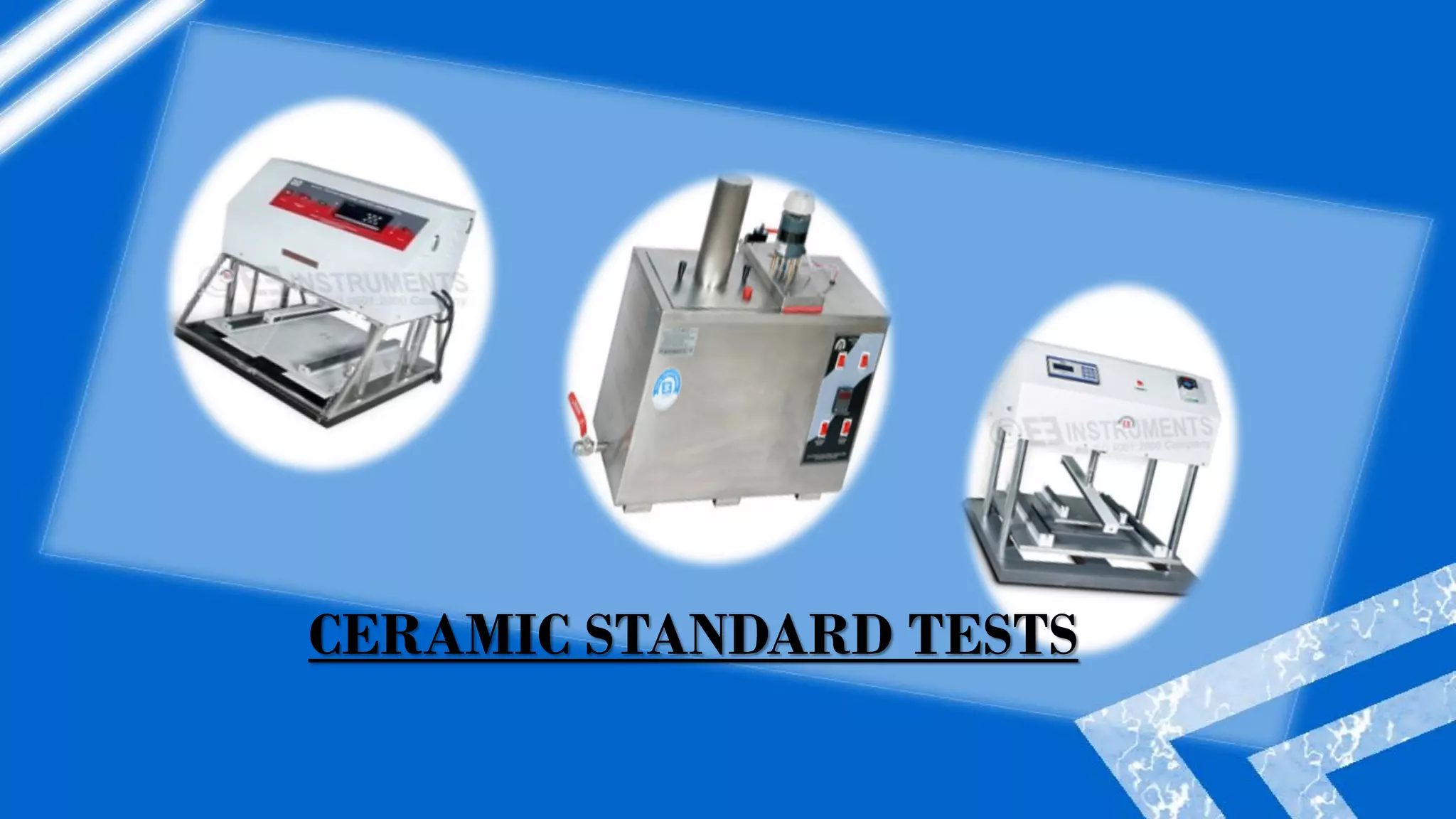
CERAMIC STANDARD TESTS
IMPORTANT TEST
BREAKING STRENGTH CERAMIC TILE, ASTM C648-04
FRICTION
WATER ABSORPTION
SCRATCH HARDNESS
CHEMICAL RESISTANCE, ASTM C650-04
ABRASION RESISTANCE, ASTM C1027-99
INDUSTRY STANDARDS
BREAKING STRENGTH CERAMIC TILE
ASTM C648-04
 Ceramic tiles used on floors and walls
must be able to withstand the
expected load bearing capacity of
various installations
 A force is applied to an unsupported
portion of the tile specimen until
breakage occurs. The ultimate
breaking strength is then recorded in
pounds
 Final selection of the tile should be
based upon the breaking strength
and the appropriate installation
method
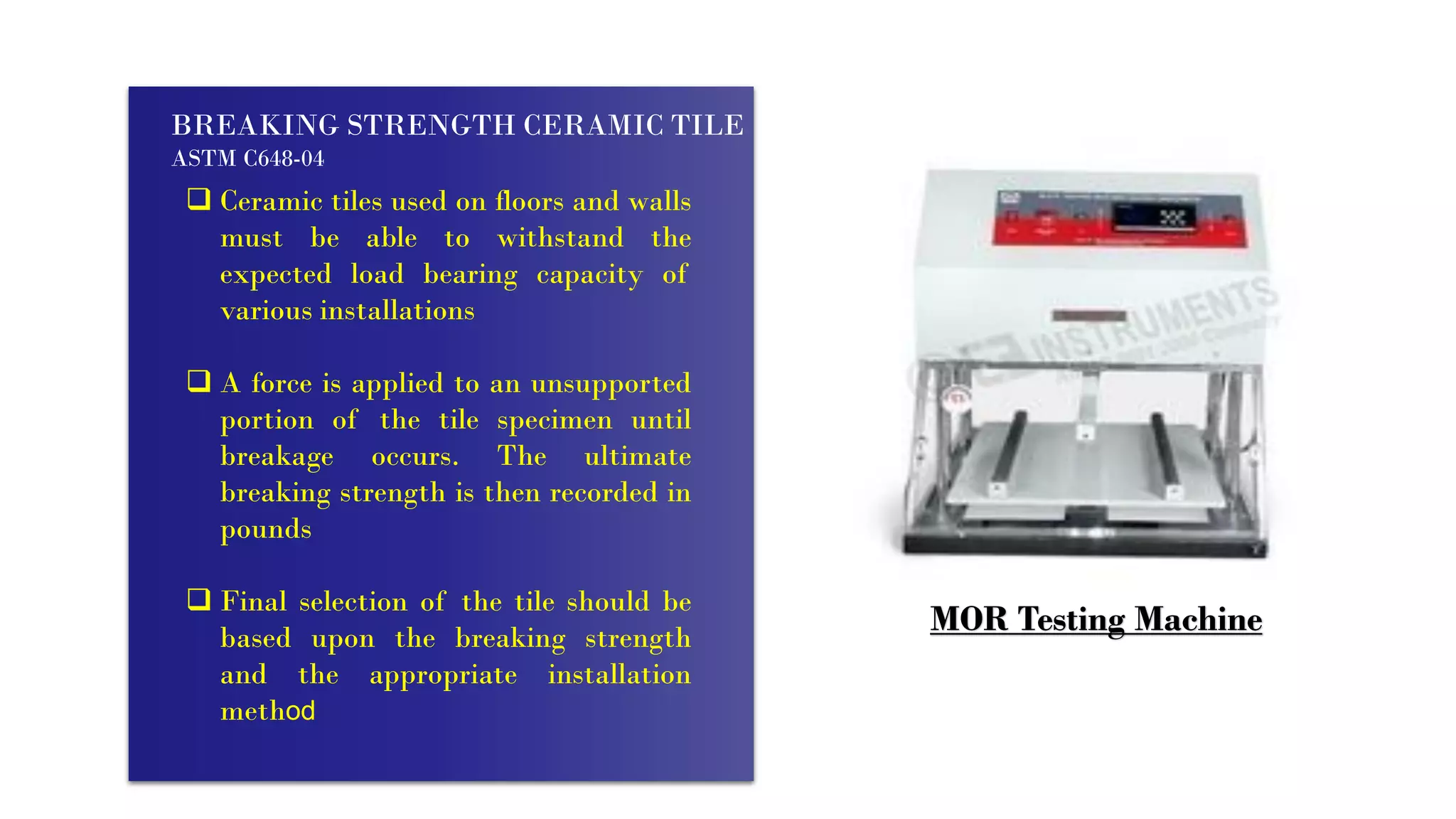
MOR Testing Machine
FRICTION
 is the force that resists the
sliding motion of one surface
against another
 There are two types of friction:
static (SCOF) and dynamic
(DCOF)
 SCOF is the ratio of forces
necessary to start two surfaces
sliding. This is what the former
ASTM C1028 static test
measured
 . DCOF is the ratio of forces
necessary to keep two surfaces
sliding.
MOR TESTING MACHINE
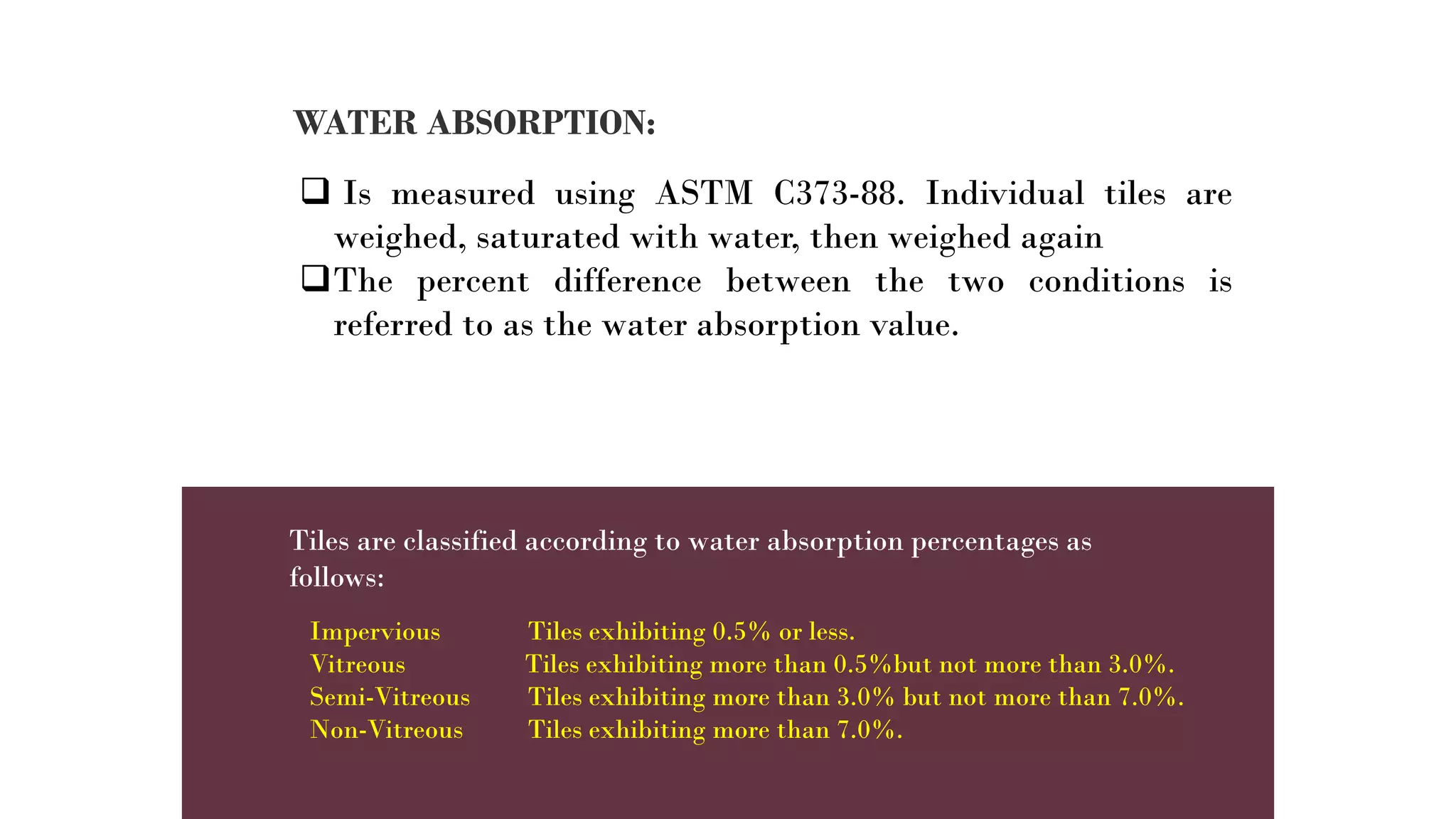
WATER ABSORPTION:
 Is measured using ASTM C373-88. Individual tiles are
weighed, saturated with water, then weighed again
The percent difference between the two conditions is
referred to as the water absorption value.
Tiles are classified according to water absorption percentages as
follows:
Impervious Tiles exhibiting 0.5% or less.
Vitreous Tiles exhibiting more than 0.5%but not more than 3.0%.
Semi-Vitreous Tiles exhibiting more than 3.0% but not more than 7.0%.
Non-Vitreous Tiles exhibiting more than 7.0%.
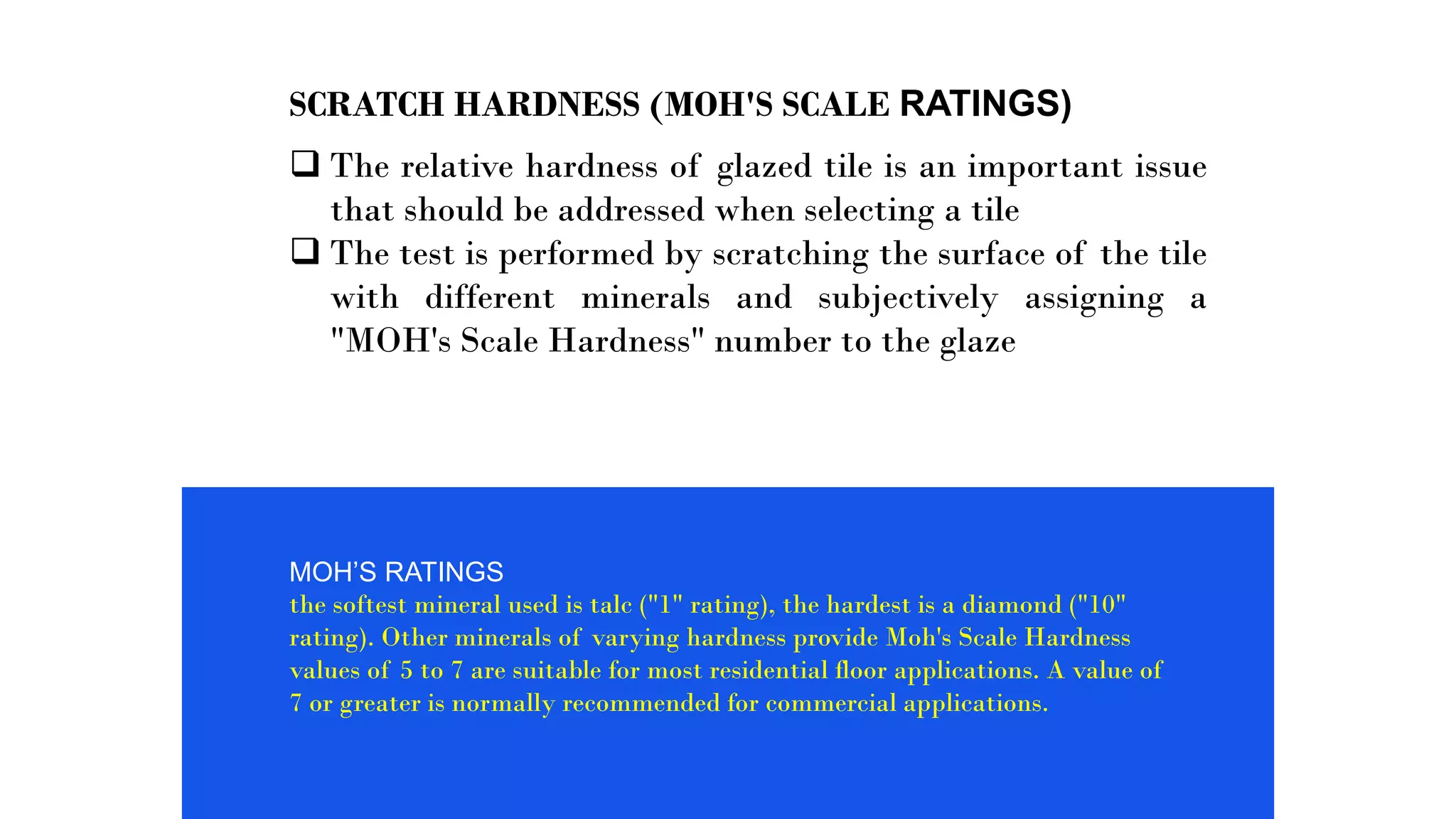
SCRATCH HARDNESS (MOH'S SCALE RATINGS)
 The relative hardness of glazed tile is an important issue
that should be addressed when selecting a tile
 The test is performed by scratching the surface of the tile
with different minerals and subjectively assigning a
"MOH's Scale Hardness" number to the glaze
MOH’S RATINGS
the softest mineral used is talc ("1" rating), the hardest is a diamond ("10"
rating). Other minerals of varying hardness provide Moh's Scale Hardness
values of 5 to 7 are suitable for most residential floor applications. A value of
7 or greater is normally recommended for commercial applications.
CHEMICAL RESISTANCE, ASTM C650-04
 Chemical resistance is measured using ASTM C650-04
 A tile sample is placed in continuous contact with a
variety of chemicals for 24 hours, rinsing the surface
and then examining the surface for visible variation.
SELECTION AND MAINTENANCE OF CERAMIC TILES
WHICH IS BEST !!!
What are the key factors to consider when specifying
/ buying ceramic tiles as a flooring option?
• When specifying tiles, it is imperative to consider
the area of use (floor or wall)
• condition of use (wet or dry, traffic condition,
exposure to hygrothermic stress: weather, sun, big
temperature change, prolonged contact with water,
etc.).
• For floor that is often exposed to water, for
instance the bathroom, and in contact with stain
and chemicals (e.g. bathroom and laboratories
involving chemicals), the tiles should be stain and
chemical resistant.
• For floor tiles subjected to high amount of traffic
such as public areas in shopping centers,
restaurants, meeting halls, hospitals, offices and
factories the tiles chosen must be hard, high in
mechanical strength, show high resistant to abrasion
and slip as well as resistant to stain and chemical
attack
• For public areas, heavy duty tiles such as porcelain
tiles are preferred to glazed tiles because they are
more compact and possess higher mechanical
strength.
CERAMIC IMPORTANT FEATURES
• SAFETY
• HYGIENE
• EASE OF CLEANING
• COST
• SIZE
• COLOUR
• AESTHETIC
• GOOD INSULATOR
SAFTY HYGIENE
fire-proof materials compared
to other flooring materials
They will not give off any toxic
gas or fume during a fire.
do not tend to accumulate
electrostatic charge
will not retain liquids or
absorb fumes, odors or
smoke
The surface of tiles is
resistant to biological
agents such as bacteria
or microbes
EASE OF CLEANING COST
Ceramic tiles do not retain dust
or residue as these particles will
not adhere to their surface.
Ceramic tiles are so easy to clean
and maintain
 It is obvious that cost is one of
the important factors in selecting
tiles
AESTHETIC
 Depending on a tile's design,
shape and surface texture, it
can produce a large variety
of effects
 simple, elegant, cool,
warm, modern, classic
MAINTENANCE
precautions have to be taken
 CLEANING PRODUCTS
 CLEANING METHODS
 ABRASIVE DIRT
 IMPACT
PRECAUTIONS HAVE TO BE TAKEN
CLEANING PRODUCTS
Use appropriate cleaning products, such as
standard commercial tile care products for
cleaning.
Avoid using acid based detergents that are
very harsh and corrosive
. Cleaning agents containing hydrofluoric or
fluoric compounds should be avoided
www.company.com
CLEANING METHODS
When cleaning, try to avoid the use of highly
abrasive materials like scouring pads or metal
pads
Clean all spills immediately. The longer the spills stand,
the greater the possibility of staining to the tile
surface.
ABRASIVE DIRT
 Sweep away any grit or sand from the tiled
surface as they can scratch the glaze
www.company.com
IMPACT
 Do not drag heavy objects such as furniture
or crates across the tiled floor
 Every effort should be made to prevent
heavy objects from dropping onto the tiles.
www.company.com
We are so pleased you could join us on our special day.

ceramic-tiles-for-floors.pdf

  • 1.
    CERAMIC AND MOSAICTILES FOR FLOOR PROJECT SUPERVISOR: PROF.DR.AFZAL JAVED EXTERNAL EXAMINAR:
  • 2.
    CERAMIC AND MOSAICTILES FOR FLOOR Submitted To: Dr. Muhammad Afzal Javed Prepared By: Khalid Yousaf BSCE01113094 Inayat Sarwary BSCE01113233 Faramarz BSCE01113239 Sayed Ahmad BSCE01113240
  • 3.
    Presentation flow INTRODUCTION OFTILES PHYSICAL PROPERTIES OF THE TILES TYPES OF TILES MOSAIC TILES MANUFACTURING OF MOSAIC AND CERAMIC TILE CERAMIC TILES IMPORTANT TESTS REQUIRED ON TILES SELECTION AND MAINTENANCE OF TILES
  • 4.
    INTRODUCTION TO TILES Atile is a manufactured piece of hard-wearing material such as ceramic, stone, metal, or even glass, generally used for covering roofs, floors, walls, showers, or other objects such as tabletops
  • 5.
    INTRODUCTION  Tiles areoften used to form wall and floor coverings, and can range from simple square tiles to complex mosaics. Tiles are most often made of ceramic, typically glazed for internal uses and unglazed for roofing, but other materials are also commonly used, such as glass, cork, concrete and other composite materials, and stone
  • 6.
    TYPES OF TILES Quarry Tile  Glazed Porcelain Tiles  Metal Tiles  Vitrified Tiles  Digital Tiles  Stone Tiles  Ceramic Tiles  Mosaic Tiles
  • 7.
    QUARRY TILES PORCELAINTILE made by the extrusion process from natural clay or shale’s. Quarry tile is manufactured from clay in a manner similar to bricks Usually coming in 13 to 19 mm Porcelain tiles are ceramic tiles commonly used to cover floors and walls, with a water absorption rate of less than 0.5 percent. They can either be glazed or unglazed.
  • 8.
     METAL TILE Choiceof leading and designers from around the world.  VITRIFIED TILE Is a ceramic tile with very low porosity. It is an alternative to marble and granite flooring. Vitrified tiles are often used outdoors due to their water and frost resistance. Vitrified tile Metal tile
  • 9.
     DIGITAL TILE Thesetiles are created based on principles and procedures similar to graphic art work and offers photo-like high resolution impressions. They give a unique look to the walls, with unlimited designs possibilities, sharper finishes and high resolution printing, digital tiles is now becoming ceramic art for the walls.
  • 10.
     STONE TILE StoneArt Tiles represents a wide range of tiles resembling stones ranging from traditional to contemporary designs, varied patterns with light to dark colors and matching the specification of urban and small town house holds. These tiles are cost effective and easy to maintain as compared to natural stones
  • 11.
  • 12.
    PROPERTIES • RESISTANCE TOABRASION • FREEZE-RESISTANCE • THERMAL SHOCK RESISTANCE • BENDING STRENGTH AND BREAKING FORCE • CHEMICAL RESISTANCE • STAIN RESISTANCE • PROPERTIES RELATED TO SAFETY
  • 13.
     RESISTANCE TOABRASION • It specifies the resistance of the tile to mechanical damage resulting from the impact of the abrasive factor • The greater the hardness of the tile is, the lower its susceptibility to scratching, wear and tear during walking and abrasion • It consists in the specification of the number of rotations of the device that rubs the surface of the glazed tile after which the permanent traces of abrasion become visible
  • 14.
     FREEZE-RESISTANCE The ceramictiles, which are to be laid out at places exposed to the impact of negative temperatures  THERMAL SHOCK RESISTANCE The ceramic tiles which can be subjected to the local sudden temperature change should have the declared thermal shock resistance confirmed by the test according to PN-EN ISO 10545-9.
  • 15.
     BENDING STRENGTHAND BREAKING FORCE  To put it simply, these parameters specify at which stress, the tile is subject to breaking. It is a particularly important parameter in case of the floor tiles  are subjected to significant mechanical loads, and abrasive tiles laid out in places, where stresses caused by the movements of building walls can occur. the test method specified in PN-EN ISO 10545-9.  CHEMICAL RESISTANCE  Specifies the resistance of the tile to the impact of testing solutions: daily use agents, salts for swimming pools as well as acids and alkalis  The tiles resistant to the chemical factors cannot be subject to changes under the influence of these substances, e.g. a change in gloss or color. The test method specified in PN-EN ISO 10545-13.
  • 16.
    www.company.com  PROPERTIES RELATEDTO SAFETY • Mainly resistance to slipping, particularly important in the case of tiles intended for floors having contact with water, where there is hazard of slipping, both in residential and public utility premises
  • 17.
  • 18.
    Background • The productionof tile dates back to ancient times and peoples, including the Egyptians, the Babylonians, and the Assyrians. For instance, the Step Pyramid for the Pharaoh Djoser, built in ancient Egypt around 2600 B.C contained colorful glazed tile. • Later, tile was manufactured in virtually every major European country and in the United States. By the beginning of the twentieth century, tile was manufactured on an industrial scale.
  • 19.
    Background • Europe, LatinAmerica, and the Far East are the largest producers of tile, with Italy the leader at 16.6 million ft.2/day as of 1989. Following Italy (at 24.6 percent of the world market) are Spain (12.6 percent), Brazil and Germany (both at 11.2 percent), and the United States (4.5 percent).
  • 21.
     SELECTION OFRAW MATERIALS The raw materials used to form tile consist of clay minerals mined from the earth's crust, natural minerals such as feldspar that are used to lower the firing temperature, and chemical additives required for the shaping process The minerals are often refined or beneficiated near the mine before shipment to the ceramic plant
  • 22.
  • 23.
    www.company.com  Batching • Formany ceramic products, including tile, the body composition is determined by the amount and type of raw materials. • The raw materials also determine the color of the tile body, which can be red or white in color, depending on the amount of iron-containing raw materials used. • Therefore, it is important to mix the right amounts together to achieve the desired properties
  • 24.
    www.company.com Mixing and grinding •Once the ingredients are weighed, they are added together into a shell mixer, ribbon mixer, or intensive mixer. A shell mixer consists of two cylinders joined into a V , which rotates to tumble and mix the material. • Sometimes it is necessary to add water to improve the mixing of a multiple-ingredient batch as well as to achieve fine grinding This process is called wet milling and is often performed using a ball mill • The resulting water-filled mixture is called a slurry or slip
  • 25.
  • 26.
    www.company.com Spray drying • Ifwet milling is first used, the excess water is usually removed via spray drying. This involves pumping the slurry to an atomizer consisting of a rapidly rotating disk or nozzle • . Droplets of the slip are dried as they are heated by a rising hot air column, forming small, free flowing granules that result in a powder suitable for forming.
  • 27.
  • 28.
    www.company.com Forming • Most tileis formed by dry pressing. In this method, the free flowing powder—containing organic binder or a low percentage of moisture— flows from a hopper into the forming die. • The material is compressed in a steel cavity by steel plungers and is then ejected by the bottom plunger. Automated presses are used with operating pressures as high as 2,500 tons.
  • 29.
  • 30.
     Drying  Ceramictile usually must be dried (at high relative humidity) after forming, especially if a wet method is used.  Drying, which can take several days, removes the water at a slow enough rate to prevent shrinkage cracks  Continuous or tunnel driers are used that are heated using gas or oil, infrared lamps, or microwave energy. Infrared drying is better suited for thin tile, whereas microwave drying works better for thicker tile
  • 32.
     Glazing • Theglaze coating is comprised of liquid colored glass and is applied and baked to the surface of the bisque under very high temperatures. • The liquid glass coating is what creates the texture, design and color of a glazed tile and protects the body of the tile from staining. The colors in the glaze come from various minerals, such as zinc, mercury, copper, gold, silver, etc.
  • 34.
     Firing • Afterglazing, the tile must be heated intensely to strengthen it and give it the desired porosity.
  • 35.
  • 36.
  • 37.
    IMPORTANT TEST BREAKING STRENGTHCERAMIC TILE, ASTM C648-04 FRICTION WATER ABSORPTION SCRATCH HARDNESS CHEMICAL RESISTANCE, ASTM C650-04 ABRASION RESISTANCE, ASTM C1027-99 INDUSTRY STANDARDS
  • 38.
    BREAKING STRENGTH CERAMICTILE ASTM C648-04  Ceramic tiles used on floors and walls must be able to withstand the expected load bearing capacity of various installations  A force is applied to an unsupported portion of the tile specimen until breakage occurs. The ultimate breaking strength is then recorded in pounds  Final selection of the tile should be based upon the breaking strength and the appropriate installation method MOR Testing Machine
  • 39.
    FRICTION  is theforce that resists the sliding motion of one surface against another  There are two types of friction: static (SCOF) and dynamic (DCOF)  SCOF is the ratio of forces necessary to start two surfaces sliding. This is what the former ASTM C1028 static test measured  . DCOF is the ratio of forces necessary to keep two surfaces sliding. MOR TESTING MACHINE
  • 40.
    WATER ABSORPTION:  Ismeasured using ASTM C373-88. Individual tiles are weighed, saturated with water, then weighed again The percent difference between the two conditions is referred to as the water absorption value. Tiles are classified according to water absorption percentages as follows: Impervious Tiles exhibiting 0.5% or less. Vitreous Tiles exhibiting more than 0.5%but not more than 3.0%. Semi-Vitreous Tiles exhibiting more than 3.0% but not more than 7.0%. Non-Vitreous Tiles exhibiting more than 7.0%.
  • 41.
    SCRATCH HARDNESS (MOH'SSCALE RATINGS)  The relative hardness of glazed tile is an important issue that should be addressed when selecting a tile  The test is performed by scratching the surface of the tile with different minerals and subjectively assigning a "MOH's Scale Hardness" number to the glaze MOH’S RATINGS the softest mineral used is talc ("1" rating), the hardest is a diamond ("10" rating). Other minerals of varying hardness provide Moh's Scale Hardness values of 5 to 7 are suitable for most residential floor applications. A value of 7 or greater is normally recommended for commercial applications.
  • 42.
    CHEMICAL RESISTANCE, ASTMC650-04  Chemical resistance is measured using ASTM C650-04  A tile sample is placed in continuous contact with a variety of chemicals for 24 hours, rinsing the surface and then examining the surface for visible variation.
  • 43.
    SELECTION AND MAINTENANCEOF CERAMIC TILES WHICH IS BEST !!!
  • 44.
    What are thekey factors to consider when specifying / buying ceramic tiles as a flooring option? • When specifying tiles, it is imperative to consider the area of use (floor or wall) • condition of use (wet or dry, traffic condition, exposure to hygrothermic stress: weather, sun, big temperature change, prolonged contact with water, etc.). • For floor that is often exposed to water, for instance the bathroom, and in contact with stain and chemicals (e.g. bathroom and laboratories involving chemicals), the tiles should be stain and chemical resistant.
  • 45.
    • For floortiles subjected to high amount of traffic such as public areas in shopping centers, restaurants, meeting halls, hospitals, offices and factories the tiles chosen must be hard, high in mechanical strength, show high resistant to abrasion and slip as well as resistant to stain and chemical attack • For public areas, heavy duty tiles such as porcelain tiles are preferred to glazed tiles because they are more compact and possess higher mechanical strength.
  • 46.
    CERAMIC IMPORTANT FEATURES •SAFETY • HYGIENE • EASE OF CLEANING • COST • SIZE • COLOUR • AESTHETIC • GOOD INSULATOR
  • 47.
    SAFTY HYGIENE fire-proof materialscompared to other flooring materials They will not give off any toxic gas or fume during a fire. do not tend to accumulate electrostatic charge will not retain liquids or absorb fumes, odors or smoke The surface of tiles is resistant to biological agents such as bacteria or microbes
  • 48.
    EASE OF CLEANINGCOST Ceramic tiles do not retain dust or residue as these particles will not adhere to their surface. Ceramic tiles are so easy to clean and maintain  It is obvious that cost is one of the important factors in selecting tiles
  • 49.
    AESTHETIC  Depending ona tile's design, shape and surface texture, it can produce a large variety of effects  simple, elegant, cool, warm, modern, classic
  • 50.
  • 51.
     CLEANING PRODUCTS CLEANING METHODS  ABRASIVE DIRT  IMPACT PRECAUTIONS HAVE TO BE TAKEN
  • 52.
    CLEANING PRODUCTS Use appropriatecleaning products, such as standard commercial tile care products for cleaning. Avoid using acid based detergents that are very harsh and corrosive . Cleaning agents containing hydrofluoric or fluoric compounds should be avoided
  • 53.
    www.company.com CLEANING METHODS When cleaning,try to avoid the use of highly abrasive materials like scouring pads or metal pads Clean all spills immediately. The longer the spills stand, the greater the possibility of staining to the tile surface. ABRASIVE DIRT  Sweep away any grit or sand from the tiled surface as they can scratch the glaze
  • 54.
    www.company.com IMPACT  Do notdrag heavy objects such as furniture or crates across the tiled floor  Every effort should be made to prevent heavy objects from dropping onto the tiles.
  • 55.
    www.company.com We are sopleased you could join us on our special day.