Installation Art Project
Intro Sculpture
Objective
Contemporary sculpture is no longer just a finished object, further the
value has been placed on the provisional, and on procedures, and
processes. In this project, students explore the potential of art
throughout examining the materials surrounding them considering the
elements of sculpture.
What is Sculpture?
This artwork entitled The Curved House by Louise Bourgeois. We may
have a preconceived idea of what a sculpture should look like. If so, is
this a sculpture? And if so, what is the sculptor telling us?
It appears to be a house, but it is far too small to be anything but a
miniature doll’s house. It is made of solid mass, marble, with no space
for rooms inside; ”the object” lost the function to be a “house”.
The whole form appears to be curved: was the stone malleable at one
time? Fabricated not from steel nor cast in bronze, it is hewn from
pink marble. Why this particular material?
The artist presents the viewer with a simple opposition. Pink evokes
soft flesh, but the stone has been carved into a sharp-edged
geometric architectural mass – a child’s drawing of a house hardened
into stone. There is much more to consider but with this question
towards understanding has already begun.
What follows provides the information we need to discover the wealth
of meaning contained within sculpture, introducing the elements of
sculpture.
Elements of Sculpture
• The elements of Sculpture from sculpture’s visual
language and an understanding of them reveals the
structure and vocabulary of sculptural expression. In
this project, we focus on the elements below:
1. Material
2. Place
1. Material
= The matter from which a thing is made.
• Material is first because everything is made from something.
Each material contains unique characteristics. The sculptor
must be aware of the numerous possibilities within a
particular material.
• Nothing the sculptor does to the material is neutral; every act
contains meaning.
1. Material
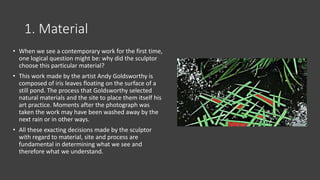
• When we see a contemporary work for the first time,
one logical question might be: why did the sculptor
choose this particular material?
• This work made by the artist Andy Goldsworthy is
composed of iris leaves floating on the surface of a
still pond. The process that Goldsworthy selected
natural materials and the site to place them itself his
art practice. Moments after the photograph was
taken the work may have been washed away by the
next rain or in other ways.
• All these exacting decisions made by the sculptor
with regard to material, site and process are
fundamental in determining what we see and
therefore what we understand.
1. Material
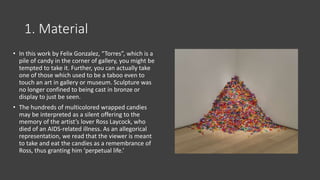
• In this work by Felix Gonzalez, “Torres”, which is a
pile of candy in the corner of gallery, you might be
tempted to take it. Further, you can actually take
one of those which used to be a taboo even to
touch an art in gallery or museum. Sculpture was
no longer confined to being cast in bronze or
display to just be seen.
• The hundreds of multicolored wrapped candies
may be interpreted as a silent offering to the
memory of the artist’s lover Ross Laycock, who
died of an AIDS-related illness. As an allegorical
representation, we read that the viewer is meant
to take and eat the candies as a remembrance of
Ross, thus granting him ‘perpetual life.’
2. Place
=The environment that surrounds the object.
• The environment in which a sculpture is situated is either active or passive.
• In the active sense the object’s immediate environment plays a significant role in
how we understand a particular sculpture. The two are so entwined that to
remove one from the other is impossible without destroying the meaning of the
total work. (‘site-specific’ work)
• A passive environment means that the place surrounding the object is secondary
to it, for instance, galleries and museums: the white box. But it does not mean
place can be separated entirely from meaning. The relationship between location,
object, and meaning is complex.
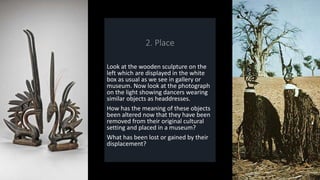
Look at the wooden sculpture on the
left which are displayed in the white
box as usual as we see in gallery or
museum. Now look at the photograph
on the light showing dancers wearing
similar objects as headdresses.
How has the meaning of these objects
been altered now that they have been
removed from their original cultural
setting and placed in a museum?
What has been lost or gained by their
displacement?
2. Place
• Robert Smithson’s Spiral Jetty is a large-scale site-
specific earthwork that actively engage with the
site, the Great Salt Lake in Utah. The work extends
about 500 feet from the shoreline and measures
approximately 300 feet across and is made with
Earth, rock and salt.
• In his writing, site and jetty are united; the one
cannot exist without the other. But nature is in a
continual state of transformation. Smithson
describe these changes using the word “entropy”.
• The natural alterations occur slowly over time,
while the basic stone and gravel structure of Spiral
Jetty remains intact.
Elements of Design
• Three-dimensional design consists of the strategies and tools an artist
or designer uses to execute an object in space. We will utilize the
Elements and Principles of Design to understand how to make
effective sculptural forms.
• In this project, we focus on the elements below:
1. Line
2. Color
3. Scale
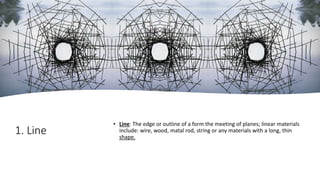
1. Line
• Line: The edge or outline of a form the meeting of planes; linear materials
include: wire, wood, matal rod, string or any materials with a long, thin
shape.
3. Color/Value
• Color may be applied to the surface of a sculpture or inherent to the
material it is made from. Hue, tint and shade are words that describe
the character of color.
• Value is light and shadows on the surface of forms; quality of light
actually reflected by an object’s surface. Value changes might be
affected by the addition of color to the surface of a work.
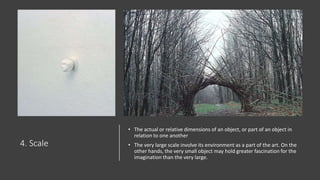
4. Scale
• The actual or relative dimensions of an object, or part of an object in
relation to one another
• The very large scale involve its environment as a part of the art. On the
other hands, the very small object may hold greater fascination for the
imagination than the very large.
Agenda
Aug 24 Reading Assignment “Introduction” DUE
Syllabus Test DUE
Safety Test DUE
Online – Workday
Day 1: Look around in your apt or house. What can be installation? Explore and
Photograph
WEBEX Meeting Group 1
Progress Report on the BB
Aug 26 Online – Workday
Day 2: Photograph ‘landscape’ which can be art, document them, and title
them.
WEBEX Meeting Group 2
Progress Report on the BB
Aug 31 Reading Assignment “Anti-Form” DUE
Online – Workday
Day 3: Body in Sculpture - create 3 uncanny sculptures using your own body.
WebEX Meeting Group 1
Progress Report on the BB
Sep 02 Online – Workday
Day 4: Natural Sculpture
WEBEX Meeting Group 2
Progress Report on the BB
Sep 07 Holiday
Sep 14 Critique Group 1:1:30-2:45pm Group 2: 12:00-1:15pm
Present your work for 3-4 min, process, examination, final work, and your
concept using PowerPoint.
Aug 24: Find/Collect/Organize (Day 1)
• Reading Assignment “Introduction” DUE
• Look around objects in your apt or house.
• What can be installation?
• Explore the potential of objects around you
• Consider “Unity” the principle of Design
• Organize the objects considering the elements of Design and Sculpture
• Document your practice. *See example next sildes
• Submit the images on blackboard
* WEBEX Meeting Group 1
How about bowls?
Color objects?
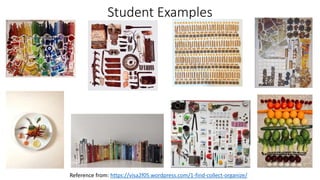
Student Examples
Reference from: https://visa2f05.wordpress.com/1-find-collect-organize/
Aug 26: Landscape as Sculpture (Day 2)
• Go out! Walk looking around landscape
• Photograph ‘landscape’ which can be art
• Title them.
• Consider the elements of Design and Sculpture
• Submit the images (at least 3 pictures) on blackboard
* WEBEX Meeting Group 2
Homework: Reading Assignment “Anti-Form” Due Aug 31
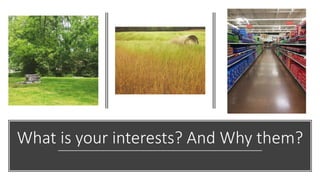
What is your interests? And Why them?
Title Your Pictures! The images change along with the title
“Theater Seat” “Red or Blue?” “Whale Watching”
Title give a viewer your idea; What a viewer should see in your picture, what is your connotation?
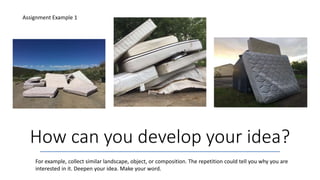
How can you develop your idea?
Assignment Example 1
For example, collect similar landscape, object, or composition. The repetition could tell you why you are
interested in it. Deepen your idea. Make your word.
Aug 31: Body in Sculpture (Day 3)
• Reading Assignment “Anti-Form” DUE
• Body in Sculpture - create uncanny sculptures using your own body.
• Choose Three high potential pictures
• Submit the images (At Least 3 pictures) *the submission can be a
video.
* WEBEX Meeting Group 1
Erwin Wurm
Erwin Wurm (b. 1954) is an Austrian artist
known for his humorous approach to
formalism. Since the late 1980s he has
been working on “One Minute Sculptues”
placing people in enexpected relationship
with everyday objects.
The quote:
"If you approach things with a sense of
humor, people immediately assume you're
not to be taken seriously. But I think truths
about society and human existence can be
approached in different ways. You don't
always have to be deadly serious. Sarcasm
and humor can help you see things in a
lighter vein.”
Wurm, E (2007). "Pretty Cool People Interviews: Erwin Wurm", SubmarineChannel.
Erwin Wurm
Video
If the video does not start, click the link: https://www.youtube.com/watch?v=yVwDB83E-ZE
One Minute
Sculpture by
by IBB
students
If the video does not start, click the link: https://www.youtube.com/watch?v=AFvehpjZmuI
Student Examples
*Reference from https://visa2f05.wordpress.com/seven-body-in-sculpture/
Sep 02: Natural Sculpture (Day 4)
• Create an installation using natural materials around you.
• Photograph the installation in the site that fits in your idea.
• Submit the images (MORE THAN 3 IMAGES) on blackboard *the
submission can be a video.
* WEBEX Meeting Group 2
Homework: Create a PowerPoint including the documentation from
Day1 to Day 4 (you will have a presentation with it on Sep 07)
Due Sep 07 at noon
Andy
Goldsworthy
Andy Goldsworthy (b. ) is a British
artist known as a sculptor who
produces site-specific sculpture and
land art situated in natural and urban
settings.
In his collaborations with nature, Andy
works with whatever comes to hand:
twigs, leaves, stones, snow and ice,
reeds and thorns, creating site specific
installations, exploring the very
essences of these materials.
Andy Goldsworthy Video
• https://www.youtube.com/watch?time_continue=118&v=f7sZv4_0Fx
g&feature=emb_logo
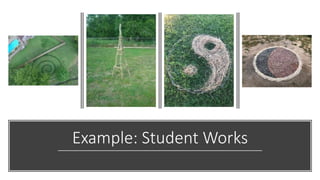
Example: Student Works
Sep 07: Critique @ Norman Hall room 113
Group 1: 1:30-2:45pm Group 2: 12:00-1:15pm
• Present your work for 3-4 min: the process, examination, final work,
and your concept using PowerPoint.
1. How did you develop your ideas?
2. How did you use Elements of Sculpture to integrate your concept and the
objects?
1. Material
2. Place
3. Why did you choose the composition, consider Elements of Design?
1. Line
2. Color
3. Scale
*The PowerPoint must be more than 8 slides
Reference
1. “Elements of Sculpture”
Herbert George
ISBN 10: 0714867411 / ISBN 13: 9780714867410
2. https://visa2f05.wordpress.com/seven-body-in-sculpture/

Intro sculpture installation

  • 1.
  • 2.
    Objective Contemporary sculpture isno longer just a finished object, further the value has been placed on the provisional, and on procedures, and processes. In this project, students explore the potential of art throughout examining the materials surrounding them considering the elements of sculpture.
  • 3.
    What is Sculpture? Thisartwork entitled The Curved House by Louise Bourgeois. We may have a preconceived idea of what a sculpture should look like. If so, is this a sculpture? And if so, what is the sculptor telling us? It appears to be a house, but it is far too small to be anything but a miniature doll’s house. It is made of solid mass, marble, with no space for rooms inside; ”the object” lost the function to be a “house”. The whole form appears to be curved: was the stone malleable at one time? Fabricated not from steel nor cast in bronze, it is hewn from pink marble. Why this particular material? The artist presents the viewer with a simple opposition. Pink evokes soft flesh, but the stone has been carved into a sharp-edged geometric architectural mass – a child’s drawing of a house hardened into stone. There is much more to consider but with this question towards understanding has already begun. What follows provides the information we need to discover the wealth of meaning contained within sculpture, introducing the elements of sculpture.
  • 4.
    Elements of Sculpture •The elements of Sculpture from sculpture’s visual language and an understanding of them reveals the structure and vocabulary of sculptural expression. In this project, we focus on the elements below: 1. Material 2. Place
  • 5.
    1. Material = Thematter from which a thing is made. • Material is first because everything is made from something. Each material contains unique characteristics. The sculptor must be aware of the numerous possibilities within a particular material. • Nothing the sculptor does to the material is neutral; every act contains meaning.
  • 6.
    1. Material • Whenwe see a contemporary work for the first time, one logical question might be: why did the sculptor choose this particular material? • This work made by the artist Andy Goldsworthy is composed of iris leaves floating on the surface of a still pond. The process that Goldsworthy selected natural materials and the site to place them itself his art practice. Moments after the photograph was taken the work may have been washed away by the next rain or in other ways. • All these exacting decisions made by the sculptor with regard to material, site and process are fundamental in determining what we see and therefore what we understand.
  • 7.
    1. Material • Inthis work by Felix Gonzalez, “Torres”, which is a pile of candy in the corner of gallery, you might be tempted to take it. Further, you can actually take one of those which used to be a taboo even to touch an art in gallery or museum. Sculpture was no longer confined to being cast in bronze or display to just be seen. • The hundreds of multicolored wrapped candies may be interpreted as a silent offering to the memory of the artist’s lover Ross Laycock, who died of an AIDS-related illness. As an allegorical representation, we read that the viewer is meant to take and eat the candies as a remembrance of Ross, thus granting him ‘perpetual life.’
  • 8.
    2. Place =The environmentthat surrounds the object. • The environment in which a sculpture is situated is either active or passive. • In the active sense the object’s immediate environment plays a significant role in how we understand a particular sculpture. The two are so entwined that to remove one from the other is impossible without destroying the meaning of the total work. (‘site-specific’ work) • A passive environment means that the place surrounding the object is secondary to it, for instance, galleries and museums: the white box. But it does not mean place can be separated entirely from meaning. The relationship between location, object, and meaning is complex.
  • 9.
    Look at thewooden sculpture on the left which are displayed in the white box as usual as we see in gallery or museum. Now look at the photograph on the light showing dancers wearing similar objects as headdresses. How has the meaning of these objects been altered now that they have been removed from their original cultural setting and placed in a museum? What has been lost or gained by their displacement?
  • 10.
    2. Place • RobertSmithson’s Spiral Jetty is a large-scale site- specific earthwork that actively engage with the site, the Great Salt Lake in Utah. The work extends about 500 feet from the shoreline and measures approximately 300 feet across and is made with Earth, rock and salt. • In his writing, site and jetty are united; the one cannot exist without the other. But nature is in a continual state of transformation. Smithson describe these changes using the word “entropy”. • The natural alterations occur slowly over time, while the basic stone and gravel structure of Spiral Jetty remains intact.
  • 11.
    Elements of Design •Three-dimensional design consists of the strategies and tools an artist or designer uses to execute an object in space. We will utilize the Elements and Principles of Design to understand how to make effective sculptural forms. • In this project, we focus on the elements below: 1. Line 2. Color 3. Scale
  • 12.
    1. Line • Line:The edge or outline of a form the meeting of planes; linear materials include: wire, wood, matal rod, string or any materials with a long, thin shape.
  • 13.
    3. Color/Value • Colormay be applied to the surface of a sculpture or inherent to the material it is made from. Hue, tint and shade are words that describe the character of color. • Value is light and shadows on the surface of forms; quality of light actually reflected by an object’s surface. Value changes might be affected by the addition of color to the surface of a work.
  • 14.
    4. Scale • Theactual or relative dimensions of an object, or part of an object in relation to one another • The very large scale involve its environment as a part of the art. On the other hands, the very small object may hold greater fascination for the imagination than the very large.
  • 15.
    Agenda Aug 24 ReadingAssignment “Introduction” DUE Syllabus Test DUE Safety Test DUE Online – Workday Day 1: Look around in your apt or house. What can be installation? Explore and Photograph WEBEX Meeting Group 1 Progress Report on the BB Aug 26 Online – Workday Day 2: Photograph ‘landscape’ which can be art, document them, and title them. WEBEX Meeting Group 2 Progress Report on the BB Aug 31 Reading Assignment “Anti-Form” DUE Online – Workday Day 3: Body in Sculpture - create 3 uncanny sculptures using your own body. WebEX Meeting Group 1 Progress Report on the BB Sep 02 Online – Workday Day 4: Natural Sculpture WEBEX Meeting Group 2 Progress Report on the BB Sep 07 Holiday Sep 14 Critique Group 1:1:30-2:45pm Group 2: 12:00-1:15pm Present your work for 3-4 min, process, examination, final work, and your concept using PowerPoint.
  • 16.
    Aug 24: Find/Collect/Organize(Day 1) • Reading Assignment “Introduction” DUE • Look around objects in your apt or house. • What can be installation? • Explore the potential of objects around you • Consider “Unity” the principle of Design • Organize the objects considering the elements of Design and Sculpture • Document your practice. *See example next sildes • Submit the images on blackboard * WEBEX Meeting Group 1
  • 17.
  • 18.
  • 19.
    Student Examples Reference from:https://visa2f05.wordpress.com/1-find-collect-organize/
  • 20.
    Aug 26: Landscapeas Sculpture (Day 2) • Go out! Walk looking around landscape • Photograph ‘landscape’ which can be art • Title them. • Consider the elements of Design and Sculpture • Submit the images (at least 3 pictures) on blackboard * WEBEX Meeting Group 2 Homework: Reading Assignment “Anti-Form” Due Aug 31
  • 21.
    What is yourinterests? And Why them?
  • 22.
    Title Your Pictures!The images change along with the title “Theater Seat” “Red or Blue?” “Whale Watching” Title give a viewer your idea; What a viewer should see in your picture, what is your connotation?
  • 23.
    How can youdevelop your idea? Assignment Example 1 For example, collect similar landscape, object, or composition. The repetition could tell you why you are interested in it. Deepen your idea. Make your word.
  • 24.
    Aug 31: Bodyin Sculpture (Day 3) • Reading Assignment “Anti-Form” DUE • Body in Sculpture - create uncanny sculptures using your own body. • Choose Three high potential pictures • Submit the images (At Least 3 pictures) *the submission can be a video. * WEBEX Meeting Group 1
  • 25.
    Erwin Wurm Erwin Wurm(b. 1954) is an Austrian artist known for his humorous approach to formalism. Since the late 1980s he has been working on “One Minute Sculptues” placing people in enexpected relationship with everyday objects. The quote: "If you approach things with a sense of humor, people immediately assume you're not to be taken seriously. But I think truths about society and human existence can be approached in different ways. You don't always have to be deadly serious. Sarcasm and humor can help you see things in a lighter vein.” Wurm, E (2007). "Pretty Cool People Interviews: Erwin Wurm", SubmarineChannel.
  • 26.
    Erwin Wurm Video If thevideo does not start, click the link: https://www.youtube.com/watch?v=yVwDB83E-ZE
  • 27.
    One Minute Sculpture by byIBB students If the video does not start, click the link: https://www.youtube.com/watch?v=AFvehpjZmuI
  • 28.
    Student Examples *Reference fromhttps://visa2f05.wordpress.com/seven-body-in-sculpture/
  • 29.
    Sep 02: NaturalSculpture (Day 4) • Create an installation using natural materials around you. • Photograph the installation in the site that fits in your idea. • Submit the images (MORE THAN 3 IMAGES) on blackboard *the submission can be a video. * WEBEX Meeting Group 2 Homework: Create a PowerPoint including the documentation from Day1 to Day 4 (you will have a presentation with it on Sep 07) Due Sep 07 at noon
  • 30.
    Andy Goldsworthy Andy Goldsworthy (b.) is a British artist known as a sculptor who produces site-specific sculpture and land art situated in natural and urban settings. In his collaborations with nature, Andy works with whatever comes to hand: twigs, leaves, stones, snow and ice, reeds and thorns, creating site specific installations, exploring the very essences of these materials.
  • 31.
    Andy Goldsworthy Video •https://www.youtube.com/watch?time_continue=118&v=f7sZv4_0Fx g&feature=emb_logo
  • 32.
  • 33.
    Sep 07: Critique@ Norman Hall room 113 Group 1: 1:30-2:45pm Group 2: 12:00-1:15pm • Present your work for 3-4 min: the process, examination, final work, and your concept using PowerPoint. 1. How did you develop your ideas? 2. How did you use Elements of Sculpture to integrate your concept and the objects? 1. Material 2. Place 3. Why did you choose the composition, consider Elements of Design? 1. Line 2. Color 3. Scale *The PowerPoint must be more than 8 slides
  • 34.
    Reference 1. “Elements ofSculpture” Herbert George ISBN 10: 0714867411 / ISBN 13: 9780714867410 2. https://visa2f05.wordpress.com/seven-body-in-sculpture/