CERAMICS
 It consist of a combination of non-metallic substances mostly
silicates and metal oxides.
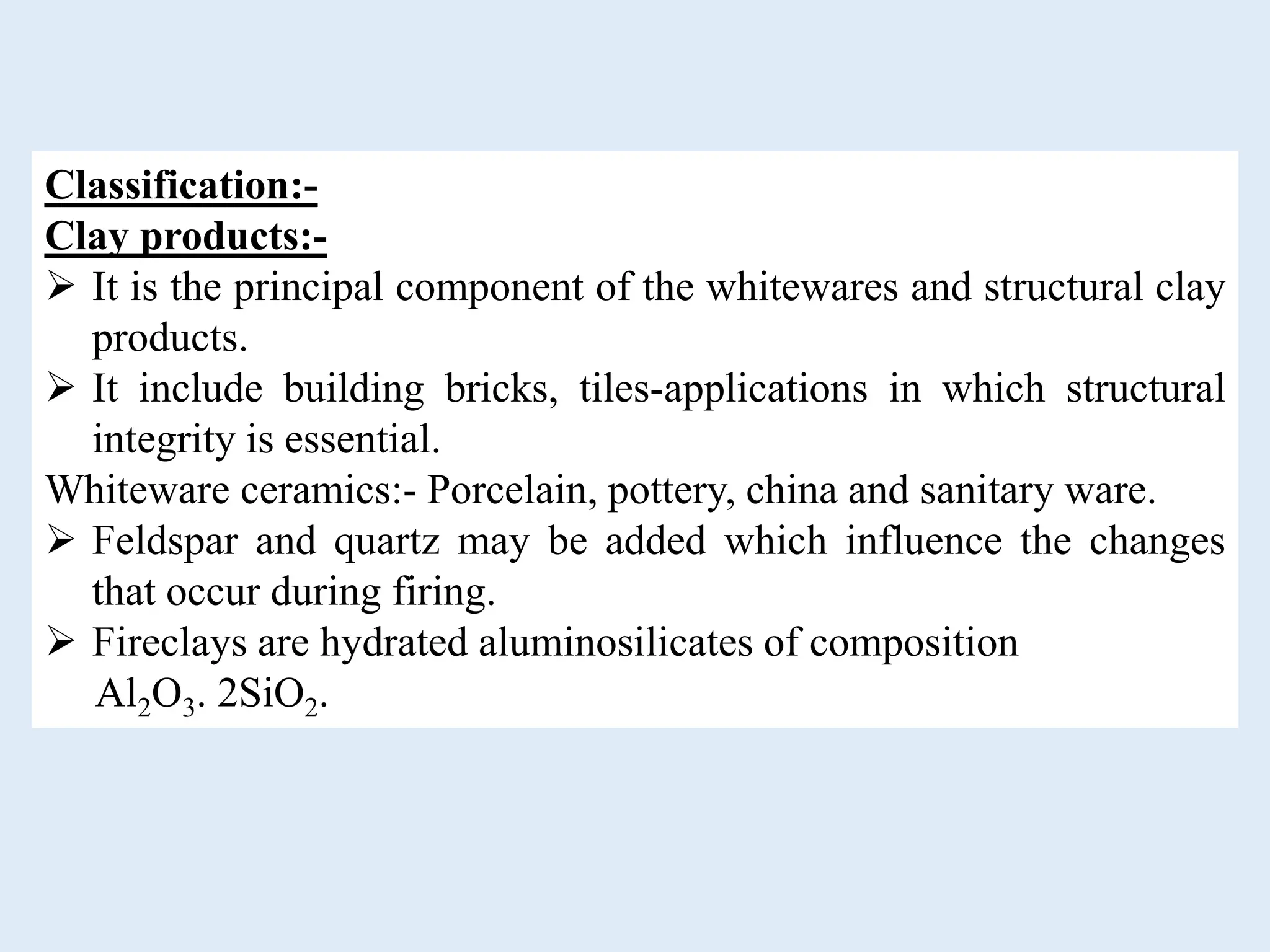
 It is used to indicate refractories, glass, enamels, porcelain, bricks
and abrasive materials.
 It include also aluminium oxide, SiO2, SiC, SiN and the traditional
ceramics are those composed of clay minerals as well as cement
and glass.
 They could withstand a temperature of 1500 to 2000o C.
 Its mechanical behaviour relatively stiff and strong, very hard,
brittle, highly susceptible to fracture, higher stability and higher
melting points.
 Its used as a structural materials where resistance to high
temperature in furnace for steel making and glass making.
 It may be transparent, translucent or opaque and some of the oxide
ceramics (e.g., Fe3O4) exhibit magnetic behaviour.
Classification:-
Glasses:-
 Products of fusion rapidly cooled to a rigid condition without
crystallization.
 They are noncrystalline silicates that contain other oxides.
 Its used for thermal shock materials (ovenware, tableware).
 It also serve as electrical insulators and as substrates for printed
circuit boards, heat exchangers and regenerators.
Classification:-
Clay products:-
 It is the principal component of the whitewares and structural clay
products.
 It include building bricks, tiles-applications in which structural
integrity is essential.
Whiteware ceramics:- Porcelain, pottery, china and sanitary ware.
 Feldspar and quartz may be added which influence the changes
that occur during firing.
 Fireclays are hydrated aluminosilicates of composition
Al2O3. 2SiO2.
Manufacture of Refractories:-
1. Crushing and grinding:- A good quality refractory materials cab
be obtained by crushing the big lumps of material into smaller
sizes.
2. Screening:- The materials so obtained are subjected to different
physical, chemical and magnetic methods and the material got is
free from unwanted impurities.
3. Mixing:- It is subjected to a process of mixing which results in
equal distribution of plastic materials throughout the mass so that
moulding may be easy.
4. Moulding:- It can be dome by two methods
 Hand moulding
 Mechanical moulding
Manufacture of Refractories:-
5. Drying:- The removal of water/moisture content of refractor
materials is executed through a process known as drying.
6. Firing and Sintering:- The very purpose of firing the refractor
material at elevated temperature is to achieve the desirable properties
such as vitrification, sintering and to obtain a stable mineral form.
Acid Refractories:-
 They consist of acidic materials like alumina (Al2O3) and silica
(SiO2 ).
 They are not attacked by acidic materials, but easily affected by
basic materials.
 They include substances such as silica, alumina, and fire clay
brick refractories.
 Fireclay bricks are used in furnace construction to confine hot
atmosphere and to insulate structures from excessive temperatures
thermally.
Neutral Refractories:-
 These are used in areas where slags and atmosphere are either
acidic or basic and are chemically stable.
 The principal raw materials belong to but are not confined to, the
M2O3 group.
 The typical examples of these materials are alumina (Al2O3),
chromia (Cr2O3) and carbon.
Basic Refractories:-
 The refractories that are rich in periclase, or magnesia (MgO) are
termed basic; they may also contain calcium, chromium, and iron
compounds.
 These are used in areas where slags and atmosphere are basic; they
are stable to alkaline materials but could react with acids.
 The steelmaking used artificial periclase as a lining material for
the furnace.
Abrasive Materials:-
 Its being hard and tough and are used to cut, grind and polish other
softer materials.
Example:- Diamond, SiC, Tungsten Carbide
 It may be employed in the form of loose grains, bonded to an
abrasive wheel or coated on paper.
 Its used for sharpening knives and polishing wooden surfaces.
Cement:-
 When mixed with water, inorganic cement forms a paste that is
capable of assuming just about any desired shape.
 The subsequent setting is a result of chemical reactions involving
the cement particles and occurs at the ambient temperature.
 The Portland cement is the most common called as hydraulic
cement, the chemical reaction is one of hydration.
 The produced mixture hardens into a solid mass on reacting with
water and provides the water-resistant product.
Advanced ceramics (Composite materials, Engine rotors):-
 Its used advanced ceramics because of their unique mechanical,
chemical, electrical, magnetic and optical properties.
Example:- ceramic ball bearings, piezoelectric ceramics.
Properties:-
 Glass-ceramic materials have relatively high mechanical strength;
low coefficient of thermal expansion and high-temperature
capabilities, excellent dielectric properties and good biological
compatibility, easy of fabrication.
 In refractories, porosity must be controlled. Strength, load bearing
capacity and resistance to attack by corrosive materials all increase
with porosity reduction. Any residual porosity will have a
deleterious influence on both elastic properties and strength.
Mechanical properties of ceramics:-
 Energy absorption is low. Strength and melting temperature vary
linearly.
 At low temperature, ceramics are brittle while close to its melting
temperature, non-crystalline ceramics becomes ductile.
 The processing method of ceramics decides the strength and are
usually strong in compression than in tension.
 Ceramics have limited energy absorption, load carrying capacity.
.
Brittle fracture
 When the tensile load is applied on crystalline or non-crystalline
ceramics, fracture takes place, before any deformation sets-in.
 Brittle ceramic strength is lower than expected. Compressive
strength is higher than tensile strength.
 Fracture toughness is the ability of the ceramics to resist the
fracture is directly proportional to applied stress and length of the
crack.
Stress-strain behavior
 As ceramics are brittle, they tend to fracture before it reaches
plastic deformation state.
 As materials under consideration have diverse shapes, their tensile
strength measurement is difficult. Instead, three-point bending
apparatus to measure stress-strain behavior.
 Flexural or fracture strength fs is the stress at fracture is directly
proportional to load at fracture and indirectly proportional to the
thickness of the material.
Elastic behavior:
 Elastic deformation is reversible deformation, while plastic
deformation is permanent deformation. In reversible deformation,
the material comes to its original configuration, (shape and size),
when load/force are released.
Elastic deformation can be due to tension / compression / shear
force.
 The elastic modulus, like fracture strength, is directly proportional
to load at fracture and indirectly proportional to the thickness of
the material.

Ceramics Student copy SKM engg chem.pptx

  • 1.
    CERAMICS  It consistof a combination of non-metallic substances mostly silicates and metal oxides.  It is used to indicate refractories, glass, enamels, porcelain, bricks and abrasive materials.  It include also aluminium oxide, SiO2, SiC, SiN and the traditional ceramics are those composed of clay minerals as well as cement and glass.  They could withstand a temperature of 1500 to 2000o C.
  • 2.
     Its mechanicalbehaviour relatively stiff and strong, very hard, brittle, highly susceptible to fracture, higher stability and higher melting points.  Its used as a structural materials where resistance to high temperature in furnace for steel making and glass making.  It may be transparent, translucent or opaque and some of the oxide ceramics (e.g., Fe3O4) exhibit magnetic behaviour.
  • 3.
    Classification:- Glasses:-  Products offusion rapidly cooled to a rigid condition without crystallization.  They are noncrystalline silicates that contain other oxides.  Its used for thermal shock materials (ovenware, tableware).  It also serve as electrical insulators and as substrates for printed circuit boards, heat exchangers and regenerators.
  • 4.
    Classification:- Clay products:-  Itis the principal component of the whitewares and structural clay products.  It include building bricks, tiles-applications in which structural integrity is essential. Whiteware ceramics:- Porcelain, pottery, china and sanitary ware.  Feldspar and quartz may be added which influence the changes that occur during firing.  Fireclays are hydrated aluminosilicates of composition Al2O3. 2SiO2.
  • 5.
    Manufacture of Refractories:- 1.Crushing and grinding:- A good quality refractory materials cab be obtained by crushing the big lumps of material into smaller sizes. 2. Screening:- The materials so obtained are subjected to different physical, chemical and magnetic methods and the material got is free from unwanted impurities. 3. Mixing:- It is subjected to a process of mixing which results in equal distribution of plastic materials throughout the mass so that moulding may be easy. 4. Moulding:- It can be dome by two methods  Hand moulding  Mechanical moulding
  • 6.
    Manufacture of Refractories:- 5.Drying:- The removal of water/moisture content of refractor materials is executed through a process known as drying. 6. Firing and Sintering:- The very purpose of firing the refractor material at elevated temperature is to achieve the desirable properties such as vitrification, sintering and to obtain a stable mineral form.
  • 7.
    Acid Refractories:-  Theyconsist of acidic materials like alumina (Al2O3) and silica (SiO2 ).  They are not attacked by acidic materials, but easily affected by basic materials.  They include substances such as silica, alumina, and fire clay brick refractories.  Fireclay bricks are used in furnace construction to confine hot atmosphere and to insulate structures from excessive temperatures thermally.
  • 8.
    Neutral Refractories:-  Theseare used in areas where slags and atmosphere are either acidic or basic and are chemically stable.  The principal raw materials belong to but are not confined to, the M2O3 group.  The typical examples of these materials are alumina (Al2O3), chromia (Cr2O3) and carbon.
  • 9.
    Basic Refractories:-  Therefractories that are rich in periclase, or magnesia (MgO) are termed basic; they may also contain calcium, chromium, and iron compounds.  These are used in areas where slags and atmosphere are basic; they are stable to alkaline materials but could react with acids.  The steelmaking used artificial periclase as a lining material for the furnace.
  • 10.
    Abrasive Materials:-  Itsbeing hard and tough and are used to cut, grind and polish other softer materials. Example:- Diamond, SiC, Tungsten Carbide  It may be employed in the form of loose grains, bonded to an abrasive wheel or coated on paper.  Its used for sharpening knives and polishing wooden surfaces.
  • 11.
    Cement:-  When mixedwith water, inorganic cement forms a paste that is capable of assuming just about any desired shape.  The subsequent setting is a result of chemical reactions involving the cement particles and occurs at the ambient temperature.  The Portland cement is the most common called as hydraulic cement, the chemical reaction is one of hydration.  The produced mixture hardens into a solid mass on reacting with water and provides the water-resistant product.
  • 12.
    Advanced ceramics (Compositematerials, Engine rotors):-  Its used advanced ceramics because of their unique mechanical, chemical, electrical, magnetic and optical properties. Example:- ceramic ball bearings, piezoelectric ceramics. Properties:-  Glass-ceramic materials have relatively high mechanical strength; low coefficient of thermal expansion and high-temperature capabilities, excellent dielectric properties and good biological compatibility, easy of fabrication.  In refractories, porosity must be controlled. Strength, load bearing capacity and resistance to attack by corrosive materials all increase with porosity reduction. Any residual porosity will have a deleterious influence on both elastic properties and strength.
  • 13.
    Mechanical properties ofceramics:-  Energy absorption is low. Strength and melting temperature vary linearly.  At low temperature, ceramics are brittle while close to its melting temperature, non-crystalline ceramics becomes ductile.  The processing method of ceramics decides the strength and are usually strong in compression than in tension.  Ceramics have limited energy absorption, load carrying capacity.
  • 14.
    . Brittle fracture  Whenthe tensile load is applied on crystalline or non-crystalline ceramics, fracture takes place, before any deformation sets-in.  Brittle ceramic strength is lower than expected. Compressive strength is higher than tensile strength.  Fracture toughness is the ability of the ceramics to resist the fracture is directly proportional to applied stress and length of the crack.
  • 15.
    Stress-strain behavior  Asceramics are brittle, they tend to fracture before it reaches plastic deformation state.  As materials under consideration have diverse shapes, their tensile strength measurement is difficult. Instead, three-point bending apparatus to measure stress-strain behavior.  Flexural or fracture strength fs is the stress at fracture is directly proportional to load at fracture and indirectly proportional to the thickness of the material.
  • 16.
    Elastic behavior:  Elasticdeformation is reversible deformation, while plastic deformation is permanent deformation. In reversible deformation, the material comes to its original configuration, (shape and size), when load/force are released. Elastic deformation can be due to tension / compression / shear force.  The elastic modulus, like fracture strength, is directly proportional to load at fracture and indirectly proportional to the thickness of the material.