























Country Education Project -
Rural Education Conference
“Improving Student Outcomes in Blended
Learning Environments”
Britt Gow
Moonee Valley Racecourse
18th and 19th July, 2013
@brittgow
How is it different?
• Very fast – almost instant – sharing of audio, text
and images.
• Much more data stored in smaller spaces.
• Visual data are more prominent.
• Global access – few restrictions to
communication across the world.
• 24/7 – not restricted to 9-to-5 on weekdays
‘school’ or ‘working’ hours.
• Anyone can publish – not just the ‘experts’.
• Many more opportunities to find people of
similar interests.
What does this mean for teaching
and learning?
• Teachers are no longer the “font of all
knowledge”.
• Students don’t need to memorize facts.
• Questions shouldn’t be easily ‘googled’.
• Instead of rote learning; analysis, evaluation
inquiry, problem-solving and creation should be
the focus.
• Students need to be taught to evaluate the
reliability of information.
• Opportunities for peer collaboration with like-
minds
Which of the following are
characteristics of 21st C learners?
A. Multi-taskers and digitally literate
B. Sociable, mobile and connected 24/7
C. Visual / spatial learners with fast
response times & short attention spans
D. All of the above
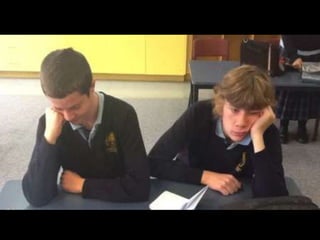
Which is the best reason for uptake of
technology in classrooms?
A. The power to engage students
B. Students use technology already
C. It's not going to go away...it will only
grow & employers want skilled workers
D. Professional development
Memory and retrieval
• Mnemonics – acronyms or rhymes
• Humour – cartoons and YouTube
• Famous quotes that resonate
• Chunking (5, 7 or 9 points)
• Movement and colour
• Mystery & surprise
• Use patterns
• Mix it up
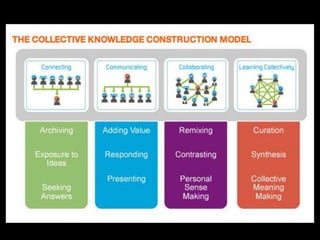
How
do we
CONNECT,
COMMUNICATE,
COLLABORATE and
LEARN COLLECTIVELY at
HAWKEDALE P12 COLLEGE?
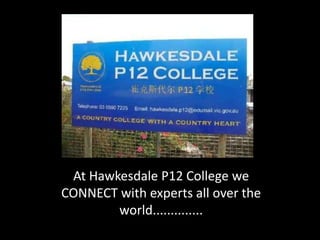
At Hawkesdale P12 College we
CONNECT with experts all over the
world..............
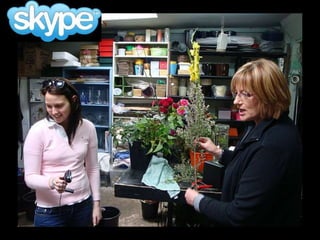
@genegeek
Catherine Anderson,
a geneticist from
Canada.
@ScienceMags
Magdeline Lum, a
Metallurgist, photographer
and science writer from
Perth
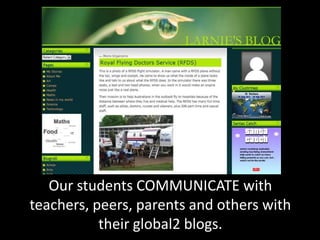
Our students COMMUNICATE with
teachers, peers, parents and others with
their global2 blogs.
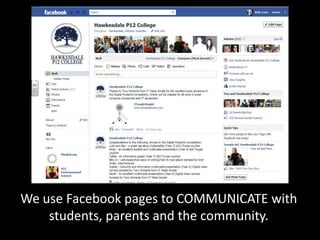
We use Facebook pages to COMMUNICATE with
students, parents and the community.
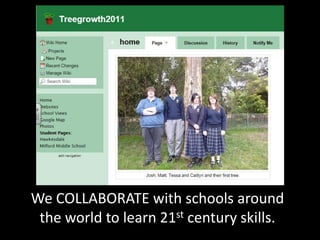
We COLLABORATE with schools around
the world to learn 21st century skills.
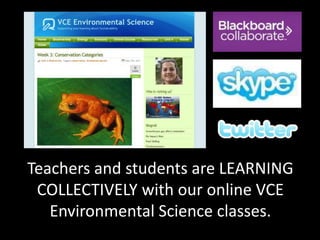
Teachers and students are LEARNING
COLLECTIVELY with our online VCE
Environmental Science classes.
1. Are some students more likely to complete
their studies and achieve good outcomes
by participating in an online learning
environment?
2. What characteristics of students are likely
indicators of success in an online learning
environment?
3. Is virtual, blended provision just a different
way of doing the same things?
4. What teaching strategies are more effective
in an online learning environment?
5. What aspects of virtual classrooms are
advantageous to student learning?
6. What can schools do to support new ways
of teaching and learning?
7. How can online learning environments
impact school organisation?
Practical considerations
• Technology does not replace experiments
• Does every student have access to devices?
• Does every student have internet access?
• Preferred learning styles?
• Concentration span – mix it up!
• Plan B and Plan C
• Best tool for the job of learning
Thank you!
Email - Brittgow@gmail.com
Twitter - @brittgow
Technoscience blog -
http://technoscience.global2.vic.gov.au
Digital toolbox –
http://digitaltoolbox.wikispaces.com

CEP Rural Education Conference - Effective Online Learning

  • 1.
    Country Education Project- Rural Education Conference “Improving Student Outcomes in Blended Learning Environments” Britt Gow Moonee Valley Racecourse 18th and 19th July, 2013
  • 2.
  • 25.
    How is itdifferent? • Very fast – almost instant – sharing of audio, text and images. • Much more data stored in smaller spaces. • Visual data are more prominent. • Global access – few restrictions to communication across the world. • 24/7 – not restricted to 9-to-5 on weekdays ‘school’ or ‘working’ hours. • Anyone can publish – not just the ‘experts’. • Many more opportunities to find people of similar interests.
  • 26.
    What does thismean for teaching and learning? • Teachers are no longer the “font of all knowledge”. • Students don’t need to memorize facts. • Questions shouldn’t be easily ‘googled’. • Instead of rote learning; analysis, evaluation inquiry, problem-solving and creation should be the focus. • Students need to be taught to evaluate the reliability of information. • Opportunities for peer collaboration with like- minds
  • 27.
    Which of thefollowing are characteristics of 21st C learners? A. Multi-taskers and digitally literate B. Sociable, mobile and connected 24/7 C. Visual / spatial learners with fast response times & short attention spans D. All of the above
  • 28.
    Which is thebest reason for uptake of technology in classrooms? A. The power to engage students B. Students use technology already C. It's not going to go away...it will only grow & employers want skilled workers D. Professional development
  • 31.
    Memory and retrieval •Mnemonics – acronyms or rhymes • Humour – cartoons and YouTube • Famous quotes that resonate • Chunking (5, 7 or 9 points) • Movement and colour • Mystery & surprise • Use patterns • Mix it up
  • 34.
    How do we CONNECT, COMMUNICATE, COLLABORATE and LEARNCOLLECTIVELY at HAWKEDALE P12 COLLEGE?
  • 35.
    At Hawkesdale P12College we CONNECT with experts all over the world..............
  • 37.
  • 38.
    @ScienceMags Magdeline Lum, a Metallurgist,photographer and science writer from Perth
  • 39.
    Our students COMMUNICATEwith teachers, peers, parents and others with their global2 blogs.
  • 40.
    We use Facebookpages to COMMUNICATE with students, parents and the community.
  • 44.
    We COLLABORATE withschools around the world to learn 21st century skills.
  • 45.
    Teachers and studentsare LEARNING COLLECTIVELY with our online VCE Environmental Science classes.
  • 49.
    1. Are somestudents more likely to complete their studies and achieve good outcomes by participating in an online learning environment? 2. What characteristics of students are likely indicators of success in an online learning environment? 3. Is virtual, blended provision just a different way of doing the same things?
  • 50.
    4. What teachingstrategies are more effective in an online learning environment? 5. What aspects of virtual classrooms are advantageous to student learning? 6. What can schools do to support new ways of teaching and learning? 7. How can online learning environments impact school organisation?
  • 51.
    Practical considerations • Technologydoes not replace experiments • Does every student have access to devices? • Does every student have internet access? • Preferred learning styles? • Concentration span – mix it up! • Plan B and Plan C • Best tool for the job of learning
  • 52.
    Thank you! Email -Brittgow@gmail.com Twitter - @brittgow Technoscience blog - http://technoscience.global2.vic.gov.au Digital toolbox – http://digitaltoolbox.wikispaces.com

Editor's Notes

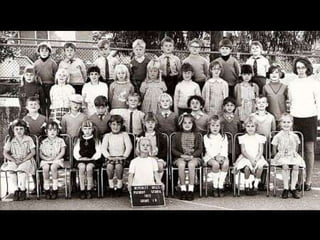
  • #16 Black and white photo album
  • #17 Colour photographs
  • #18 Digital cameras
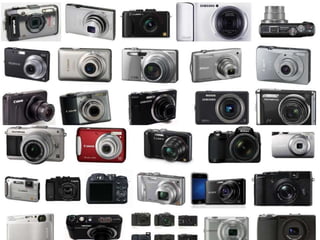
  • #19 Photos with cameras
  • #20 Photos shared online with Instagram, Twitter, Flickr and Facebook
  • #34 Richard Olsen’s IdeasLAB
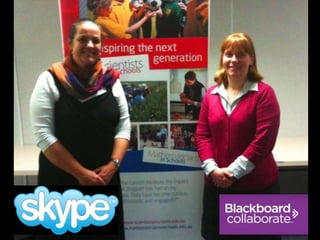
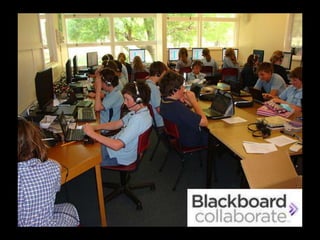
  • #44 We use Skype and Blackboard Collaborate to COMMUNICATE with our Scientists in Schools partner, Melissa Toifl, from CSIRO Land and Water Technologies.