Future-focused
learning in
21st Century
Schools
Mark Osborne
mark.osborne@core-ed.org
Drivers of
change
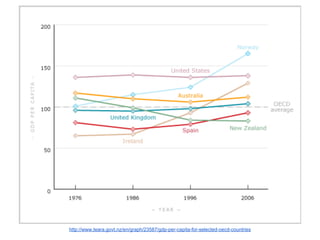
http://www.teara.govt.nz/en/graph/23587/gdp-per-capita-for-selected-oecd-countries
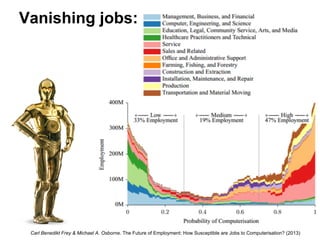
Carl Benedikt Frey & Michael A. Osborne. The Future of Employment: How Susceptible are Jobs to Computerisation? (2013)
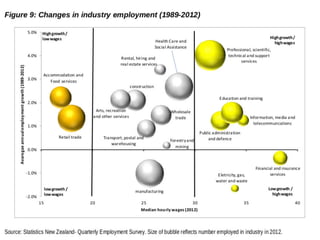
Vanishing jobs:
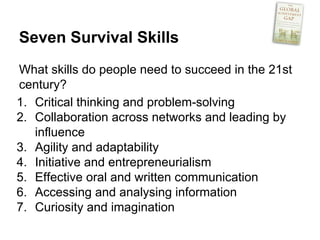
Seven Survival Skills
What skills do people need to succeed in the 21st
century?
1. Critical thinking and problem-solving
2. Collaboration across networks and leading by
influence
3. Agility and adaptability
4. Initiative and entrepreneurialism
5. Effective oral and written communication
6. Accessing and analysing information
7. Curiosity and imagination
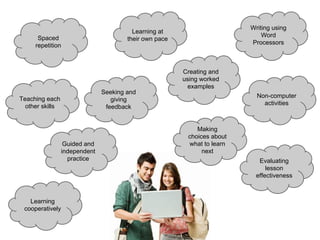
What activities might students
be engaged in if powerful learning
were taking place?
Teaching each
other skills
Writing using
Word
Processors
Non-computer
activities
Spaced
repetition
Learning at
their own pace
Seeking and
giving
feedback
Evaluating
lesson
effectiveness
Guided and
independent
practice
Creating and
using worked
examples
Making
choices about
what to learn
next
Learning
cooperatively
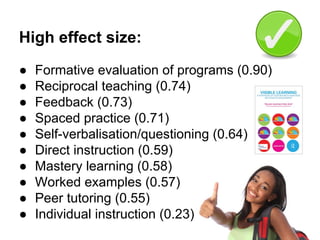
High effect size:
● Formative evaluation of programs (0.90)
● Reciprocal teaching (0.74)
● Feedback (0.73)
● Spaced practice (0.71)
● Self-verbalisation/questioning (0.64)
● Direct instruction (0.59)
● Mastery learning (0.58)
● Worked examples (0.57)
● Peer tutoring (0.55)
● Individual instruction (0.23)
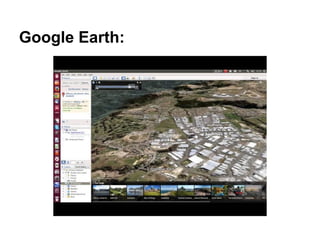
Google Earth:
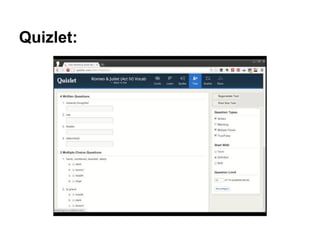
Quizlet:
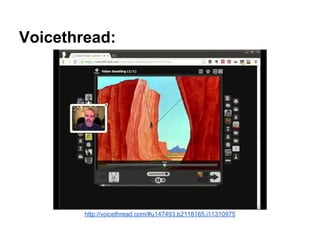
Voicethread:
http://voicethread.com/#u147493.b2118165.i11310975
Thinglink:
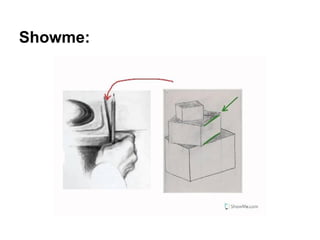
Showme:
Youtube Editor:
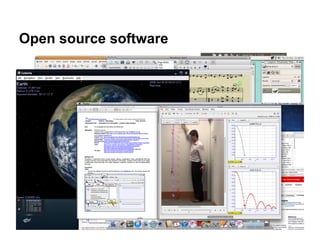
Open source software

2014 LoopRSP Mark Osborne | Modern Learning Practice