Lower Respiratory Tract
Disorder - Bronchial Asthma
Dr. SARITA SHARMA
ASSOCIATE PROFESSOR
DEPARTMENT OF PHARMACOLOGY
CONTENTS
1) INTRODUCTION
2) EPIDEMIOLOGY
3) ETIOLOGY & RISK FACTORS
4) SIGNS & SYMPTOMS
5) PATHOPHYSIOLOGY
6) DIAGNOSIS
7) TREATMENT
8) COMPLICATIONS
Anatomy of Respiratory System
Introduction:
 The National Asthma Education & Prevention Program
(NAEPP) define asthma as:
 It is a chronic illness of the lungs & respiratory
system.
 It is an inflammatory disorder of airways in which
many cells & cellular elements undergo inflammation.
 It is characterized by recurrent episodes of
Breathlessness, Coughing, Chest tightness and
Wheezing.
 These episodes usually associated with airflow
Narrowing of Bronchial
Lumen
Epidemiology:
 Bronchial asthma is common and prevalent
worldwide.
 In United States about 4% of population suffering
from asthma has been reported every year.
 It occurs at all age group people, but 50% of asthma
cases develop after the age of 10 years.
 In adults, both males & females are affected equally
but in children, occurrence rate of boys & girls is 2 :
1 ratio.
Etiology and Risk factors: Asthma Triggers include
 Irritants in the air: Smoke, chemical fumes, strong
odours.
 Indoor allergens: Pet dander and dust mites.
 Outdoor allergens: Pollen from grass, trees and weeds.
 Weather conditions: Cold air & extremely windy
weather.
 Upper respiratory infection: Cold, flu, sinusitis,
Pharyngitis.
 Certain drugs: Aspirin, Beta blockers, Ibuprofen,
Signs & Symptoms:
 Cough: It is chronic that occur during exercise and is
nocturnal in nature with the presence of phlegm
(sputum).
 Respiratory: Difficulty breathing, Breathing through
the mouth, Tachypnea, Dyspnea, Wheezing and
Frequent respiratory infections.
 Also common: Anxiety, Early awakening, Throat
irritation, Chest tightness & Tachycardia.
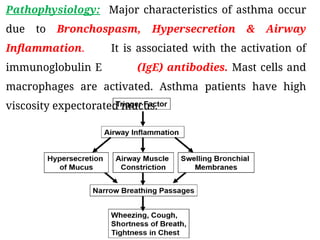
Pathophysiology: Major characteristics of asthma occur
due to Bronchospasm, Hypersecretion & Airway
Inflammation. It is associated with the activation of
immunoglobulin E (IgE) antibodies. Mast cells and
macrophages are activated. Asthma patients have high
viscosity expectorated mucus.
Diagnosis:
 Clinical manifestations, history, physical
examination & laboratory tests.
 Radiographic examination.
 Pulmonary function tests; it helps to evaluate the
severity of lung diseases.
 After the inhalation of β2 agonist drugs, If FEV1 /
FVC is less than 80%, Spirometry test confirms
presence of obstruction.
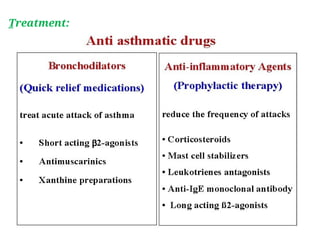
Treatment:
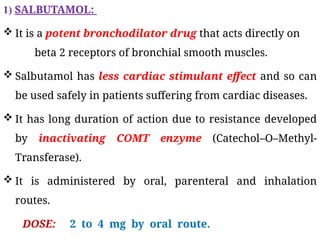
1) SALBUTAMOL:
 It is a potent bronchodilator drug that acts directly on
beta 2 receptors of bronchial smooth muscles.
 Salbutamol has less cardiac stimulant effect and so can
be used safely in patients suffering from cardiac diseases.
 It has long duration of action due to resistance developed
by inactivating COMT enzyme (Catechol–O–Methyl-
Transferase).
 It is administered by oral, parenteral and inhalation
routes.
DOSE: 2 to 4 mg by oral route.
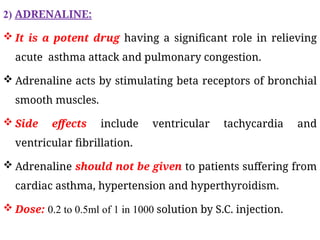
2) ADRENALINE:
 It is a potent drug having a significant role in relieving
acute asthma attack and pulmonary congestion.
 Adrenaline acts by stimulating beta receptors of bronchial
smooth muscles.
 Side effects include ventricular tachycardia and
ventricular fibrillation.
 Adrenaline should not be given to patients suffering from
cardiac asthma, hypertension and hyperthyroidism.
 Dose: 0.2 to 0.5ml of 1 in 1000 solution by S.C. injection.
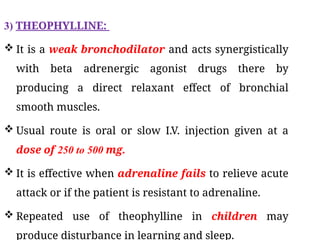
3) THEOPHYLLINE:
 It is a weak bronchodilator and acts synergistically
with beta adrenergic agonist drugs there by
producing a direct relaxant effect of bronchial
smooth muscles.
 Usual route is oral or slow I.V. injection given at a
dose of 250 to 500 mg.
 It is effective when adrenaline fails to relieve acute
attack or if the patient is resistant to adrenaline.
 Repeated use of theophylline in children may
produce disturbance in learning and sleep.
4) EPHEDRINE:
 It is a sympathomimetic drug which acts on both alpha
and beta adrenergic receptors. It is a week
bronchodilator.
 It causes insomnia. This can be prevented by
combining Ephedrine with Phenobarbitone.
5) KETOTIFEN:
 It acts by inhibiting airway inflammation that is induced
by Platelet Activating Factor (PAF).
 It has antihistaminic effect.
 Side effects include Drowsiness and Dry mouth.
6) DISODIUM CHROMOGLYCATE:
 It is a synthetic compound which acts by inhibiting the
phosphodiesterase enzyme thereby preventing mast
cell degranulation.
 It also prevents the release of spasmogenic
substances like histamine and serotonin, But it does
not have antihistaminic effects.
 It is poorly absorbed on oral administration and do
not produce any adverse effect except local irritation.
 Dose: 20 mg given by inhalation 3 to 4 times daily by
means of 'spinhaler'.
Complications:
Poorly-controlled asthma can have a negative
effect on quality of life. Complications include
Pneumothorax, Pneumopericardium, Pneumonia,
Pulmonary interstitial emphysema, Cardiac
arrhythmias, Myocardial infarction, Electrolyte
imbalances, Lactic acidosis, Hyperglycemia.
Bronchial Asthma.pptx Pharmacotherapeutics

Bronchial Asthma.pptx Pharmacotherapeutics

  • 1.
    Lower Respiratory Tract Disorder- Bronchial Asthma Dr. SARITA SHARMA ASSOCIATE PROFESSOR DEPARTMENT OF PHARMACOLOGY
  • 2.
    CONTENTS 1) INTRODUCTION 2) EPIDEMIOLOGY 3)ETIOLOGY & RISK FACTORS 4) SIGNS & SYMPTOMS 5) PATHOPHYSIOLOGY 6) DIAGNOSIS 7) TREATMENT 8) COMPLICATIONS
  • 3.
  • 4.
    Introduction:  The NationalAsthma Education & Prevention Program (NAEPP) define asthma as:  It is a chronic illness of the lungs & respiratory system.  It is an inflammatory disorder of airways in which many cells & cellular elements undergo inflammation.  It is characterized by recurrent episodes of Breathlessness, Coughing, Chest tightness and Wheezing.  These episodes usually associated with airflow
  • 5.
  • 6.
    Epidemiology:  Bronchial asthmais common and prevalent worldwide.  In United States about 4% of population suffering from asthma has been reported every year.  It occurs at all age group people, but 50% of asthma cases develop after the age of 10 years.  In adults, both males & females are affected equally but in children, occurrence rate of boys & girls is 2 : 1 ratio.
  • 7.
    Etiology and Riskfactors: Asthma Triggers include  Irritants in the air: Smoke, chemical fumes, strong odours.  Indoor allergens: Pet dander and dust mites.  Outdoor allergens: Pollen from grass, trees and weeds.  Weather conditions: Cold air & extremely windy weather.  Upper respiratory infection: Cold, flu, sinusitis, Pharyngitis.  Certain drugs: Aspirin, Beta blockers, Ibuprofen,
  • 8.
    Signs & Symptoms: Cough: It is chronic that occur during exercise and is nocturnal in nature with the presence of phlegm (sputum).  Respiratory: Difficulty breathing, Breathing through the mouth, Tachypnea, Dyspnea, Wheezing and Frequent respiratory infections.  Also common: Anxiety, Early awakening, Throat irritation, Chest tightness & Tachycardia.
  • 9.
    Pathophysiology: Major characteristicsof asthma occur due to Bronchospasm, Hypersecretion & Airway Inflammation. It is associated with the activation of immunoglobulin E (IgE) antibodies. Mast cells and macrophages are activated. Asthma patients have high viscosity expectorated mucus.
  • 10.
    Diagnosis:  Clinical manifestations,history, physical examination & laboratory tests.  Radiographic examination.  Pulmonary function tests; it helps to evaluate the severity of lung diseases.  After the inhalation of β2 agonist drugs, If FEV1 / FVC is less than 80%, Spirometry test confirms presence of obstruction.
  • 11.
  • 12.
    1) SALBUTAMOL:  Itis a potent bronchodilator drug that acts directly on beta 2 receptors of bronchial smooth muscles.  Salbutamol has less cardiac stimulant effect and so can be used safely in patients suffering from cardiac diseases.  It has long duration of action due to resistance developed by inactivating COMT enzyme (Catechol–O–Methyl- Transferase).  It is administered by oral, parenteral and inhalation routes. DOSE: 2 to 4 mg by oral route.
  • 13.
    2) ADRENALINE:  Itis a potent drug having a significant role in relieving acute asthma attack and pulmonary congestion.  Adrenaline acts by stimulating beta receptors of bronchial smooth muscles.  Side effects include ventricular tachycardia and ventricular fibrillation.  Adrenaline should not be given to patients suffering from cardiac asthma, hypertension and hyperthyroidism.  Dose: 0.2 to 0.5ml of 1 in 1000 solution by S.C. injection.
  • 14.
    3) THEOPHYLLINE:  Itis a weak bronchodilator and acts synergistically with beta adrenergic agonist drugs there by producing a direct relaxant effect of bronchial smooth muscles.  Usual route is oral or slow I.V. injection given at a dose of 250 to 500 mg.  It is effective when adrenaline fails to relieve acute attack or if the patient is resistant to adrenaline.  Repeated use of theophylline in children may produce disturbance in learning and sleep.
  • 15.
    4) EPHEDRINE:  Itis a sympathomimetic drug which acts on both alpha and beta adrenergic receptors. It is a week bronchodilator.  It causes insomnia. This can be prevented by combining Ephedrine with Phenobarbitone. 5) KETOTIFEN:  It acts by inhibiting airway inflammation that is induced by Platelet Activating Factor (PAF).  It has antihistaminic effect.  Side effects include Drowsiness and Dry mouth.
  • 16.
    6) DISODIUM CHROMOGLYCATE: It is a synthetic compound which acts by inhibiting the phosphodiesterase enzyme thereby preventing mast cell degranulation.  It also prevents the release of spasmogenic substances like histamine and serotonin, But it does not have antihistaminic effects.  It is poorly absorbed on oral administration and do not produce any adverse effect except local irritation.  Dose: 20 mg given by inhalation 3 to 4 times daily by means of 'spinhaler'.
  • 17.
    Complications: Poorly-controlled asthma canhave a negative effect on quality of life. Complications include Pneumothorax, Pneumopericardium, Pneumonia, Pulmonary interstitial emphysema, Cardiac arrhythmias, Myocardial infarction, Electrolyte imbalances, Lactic acidosis, Hyperglycemia.