 Spinal Cord
 Spinal Cord Tracts
 Cranial and Spinal Nerves
 Reflex
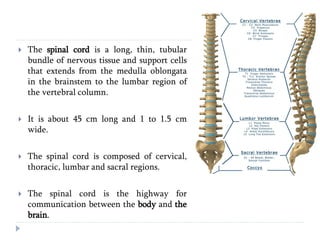
 The spinal cord is a long, thin, tubular
bundle of nervous tissue and support cells
that extends from the medulla oblongata
in the brainstem to the lumbar region of
the vertebral column.
 It is about 45 cm long and 1 to 1.5 cm
wide.
 The spinal cord is composed of cervical,
thoracic, lumbar and sacral regions.
 The spinal cord is the highway for
communication between the body and the
brain.
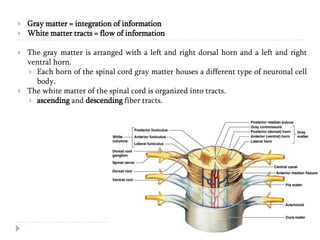
 Gray matter = integration of information
 White matter tracts = flow of information
 The gray matter is arranged with a left and right dorsal horn and a left and right
ventral horn.
 Each horn of the spinal cord gray matter houses a different type of neuronal cell
body.
 The white matter of the spinal cord is organized into tracts.
 ascending and descending fiber tracts.
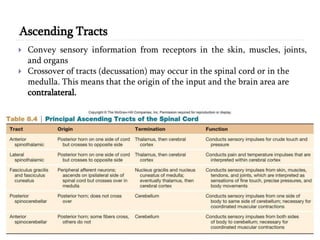
Ascending Tracts
 Convey sensory information from receptors in the skin, muscles, joints,
and organs
 Crossover of tracts (decussation) may occur in the spinal cord or in the
medulla. This means that the origin of the input and the brain area are
contralateral.
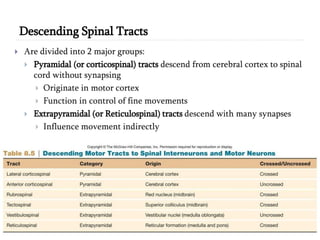
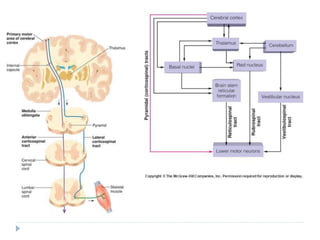
Descending Spinal Tracts
 Are divided into 2 major groups:
 Pyramidal (or corticospinal) tracts descend from cerebral cortex to spinal
cord without synapsing
 Originate in motor cortex
 Function in control of fine movements
 Extrapyramidal (or Reticulospinal) tracts descend with many synapses
 Influence movement indirectly
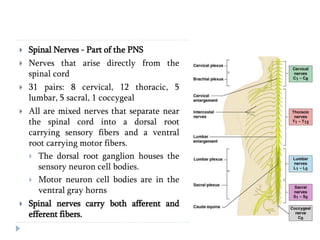
 Spinal Nerves - Part of the PNS
 Nerves that arise directly from the
spinal cord
 31 pairs: 8 cervical, 12 thoracic, 5
lumbar, 5 sacral, 1 coccygeal
 All are mixed nerves that separate near
the spinal cord into a dorsal root
carrying sensory fibers and a ventral
root carrying motor fibers.
 The dorsal root ganglion houses the
sensory neuron cell bodies.
 Motor neuron cell bodies are in the
ventral gray horns
 Spinal nerves carry both afferent and
efferent fibers.
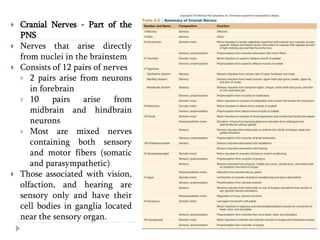
 Cranial Nerves - Part of the
PNS
 Nerves that arise directly
from nuclei in the brainstem
 Consists of 12 pairs of nerves
 2 pairs arise from neurons
in forebrain
 10 pairs arise from
midbrain and hindbrain
neurons
 Most are mixed nerves
containing both sensory
and motor fibers (somatic
and parasympathetic)
 Those associated with vision,
olfaction, and hearing are
sensory only and have their
cell bodies in ganglia located
near the sensory organ.
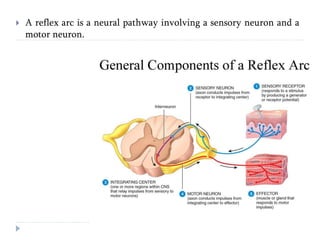
 A reflex arc is a neural pathway involving a sensory neuron and a
motor neuron.
1. Spinal or cranial reflexes, depending on the CNS level at which the
reflex is integrated.
2. Innate or conditioned reflexes, depending on whether the reflex is
inborn or learned.
3. Somatic or autonomic, depending on which efferent division of the
peripheral nervous system and which effector organs are involved.
4. Monosynaptic or polysynaptic, depending on how many synapses are in
the reflex arc.

Spinal cord - cns ppt, general physiology,

  • 1.
     Spinal Cord Spinal Cord Tracts  Cranial and Spinal Nerves  Reflex
  • 2.
     The spinalcord is a long, thin, tubular bundle of nervous tissue and support cells that extends from the medulla oblongata in the brainstem to the lumbar region of the vertebral column.  It is about 45 cm long and 1 to 1.5 cm wide.  The spinal cord is composed of cervical, thoracic, lumbar and sacral regions.  The spinal cord is the highway for communication between the body and the brain.
  • 3.
     Gray matter= integration of information  White matter tracts = flow of information  The gray matter is arranged with a left and right dorsal horn and a left and right ventral horn.  Each horn of the spinal cord gray matter houses a different type of neuronal cell body.  The white matter of the spinal cord is organized into tracts.  ascending and descending fiber tracts.
  • 4.
    Ascending Tracts  Conveysensory information from receptors in the skin, muscles, joints, and organs  Crossover of tracts (decussation) may occur in the spinal cord or in the medulla. This means that the origin of the input and the brain area are contralateral.
  • 5.
    Descending Spinal Tracts Are divided into 2 major groups:  Pyramidal (or corticospinal) tracts descend from cerebral cortex to spinal cord without synapsing  Originate in motor cortex  Function in control of fine movements  Extrapyramidal (or Reticulospinal) tracts descend with many synapses  Influence movement indirectly
  • 7.
     Spinal Nerves- Part of the PNS  Nerves that arise directly from the spinal cord  31 pairs: 8 cervical, 12 thoracic, 5 lumbar, 5 sacral, 1 coccygeal  All are mixed nerves that separate near the spinal cord into a dorsal root carrying sensory fibers and a ventral root carrying motor fibers.  The dorsal root ganglion houses the sensory neuron cell bodies.  Motor neuron cell bodies are in the ventral gray horns  Spinal nerves carry both afferent and efferent fibers.
  • 8.
     Cranial Nerves- Part of the PNS  Nerves that arise directly from nuclei in the brainstem  Consists of 12 pairs of nerves  2 pairs arise from neurons in forebrain  10 pairs arise from midbrain and hindbrain neurons  Most are mixed nerves containing both sensory and motor fibers (somatic and parasympathetic)  Those associated with vision, olfaction, and hearing are sensory only and have their cell bodies in ganglia located near the sensory organ.
  • 9.
     A reflexarc is a neural pathway involving a sensory neuron and a motor neuron.
  • 10.
    1. Spinal orcranial reflexes, depending on the CNS level at which the reflex is integrated. 2. Innate or conditioned reflexes, depending on whether the reflex is inborn or learned. 3. Somatic or autonomic, depending on which efferent division of the peripheral nervous system and which effector organs are involved. 4. Monosynaptic or polysynaptic, depending on how many synapses are in the reflex arc.