Dr SARITA SHARMA
ASSOCIATE PROFESSOR
MMCP, MMDU
Recombinant DNA technology
Essential vocabulary
 Biotechnology/ GE
 RDNA/ RDNA tech
 Restriction enzymes/endonucleases
 Cloning
 DNA ligase
 Vectors
 Plasmid
 Bacteriophages
 DNA library
Biotechnology
The manipulation of biological processes and/or
organisms for the benefit of mankind
.
RDNA
DNA that has been created artificially (not natural).
DNA from two or more sources is incorporated into a
single recombinant molecule
RDNA tech
 Procedures by which DNA from different species
can be isolated, cut and spliced together
 New "recombinant " molecules are then multiplied
in quantity in populations of rapidly dividing cells
(e.g. bacteria, yeast).
 Uses methods derived from biochemistry of
nucleic acids coupled with genetic techniques
originally used for the study of bacteria and viruses
RDNA tech process
 1. A gene is located on a chromosome map
(RFLP)
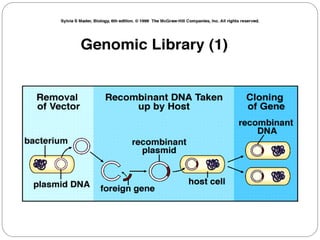
 2. A DNA library is constructed – plasmid are
obtained, cleavage occurs and RDNA prod.
 3. The gene of interest is isolated (cloned) from
the library via plasmid DNA isolation, restriction
digestion and electrophoresis.
 4. Multiple copies of gene interest are produced
for study.
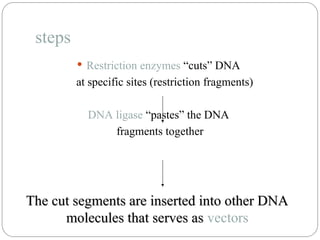
steps
 Restriction enzymes “cuts” DNA
at specific sites (restriction fragments)
DNA ligase “pastes” the DNA
fragments together
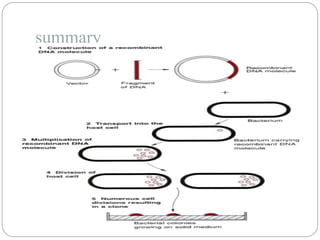
The cut segments are inserted into other DNA
molecules that serves as
molecules that serves as vectors
Vectors
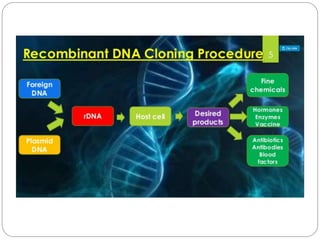
 Carrier DNA mol = transfers the RDNA into the host
cell.
 Within host cells, vectors can replicate producing
many DNA segments = identical copies (CLONES)
 Host cells pass the recombinant DNA mol on their
progeny = population of cells.
 Cloned DNA segments recovered from host cells for
purification and analysis
Plasmids
 Molecules of DNA that are found in bacteria
 Act as a system to transfer genetic material to other
bacteria, allowing those to express the transmitted
genes.
 small (a few thousand base pairs)
 usually carry only one or a few genes
 circular
 have a single origin of replication
Resctriction enzymes
 DNA cutting enzymes. Restriction endonucleases
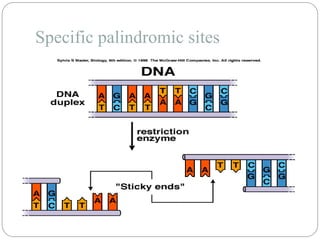
 cuts DNA at a specific site defined by a sequence
of bases in the DNA (recog.site) forming “sticky
ends” (
 Palindromic sites
 several hundred endonucleases have been
extracted from bacteria and many are used in
recombinant DNA research. eg EcoR1,Hind III,
HaeIII, TaqA1, Sau3A
Specific palindromic sites
Library construction
 Because each cloned DNA segemnt is relatively small,
many separate clones must be constructed .
 A set of cloned DNA segments derived from a single
individual represents a library
 Cloned libraries could be an entire genome, a singe
chromosome, or a set og genes compiled together in a
single cell type.
summary
Applications of recombinant DNA
technology
technology
Used widely in research and hospital laboratories.
Broad applications - medicine, agriculture,
??..
 1. The processes of inheritance and gene
expression.
 2. Process of various diseases
 3. Generation of economic benefits eg.
improved agricultural products.
Applications
 Molecular Biology/Research
 Diagnostics
 Genetic Counseling
 Criminology/Forensics
 Paternity testing
 Archeology
 Food testing
 Evolutionary studies
Medicine
 Medicine –production of industrial and commercial
compounds
 Insulin – Diabetes
 drugs (angiostation and endostatin) ,
 Factor VIII – Haemophilia A
 Factor IX – Haemophilia B
 EPO – Anaemia
 Interleukins and interferons
 Tissue plasminogen activator – dissolve blood clots
 Hormones = GH, parathyroid
 Oxytocin
 Adenosine deaminase –sev. Com. Imm (SCID)
,
 Diagnostic kits
Diagnostic kits – Hep, AIDS
 Antibiotics
Antibiotics
 genetic testing,–Mapping the chromosomal
location of genetic disorders. RFLP, DNA
fingerprinting – the HG project
 Gene therapy – manipulation of DNA to tx
diseases by altering individuals genes
 Forensic applications - All individuals are
genetically unique = a distinct "genetic
fingerprint“, all types of specs, old and new
 Animals = models of genetic diseases Eg mice

lecture-recombinant-DNA-technology....ppt

  • 1.
    Dr SARITA SHARMA ASSOCIATEPROFESSOR MMCP, MMDU Recombinant DNA technology
  • 2.
    Essential vocabulary  Biotechnology/GE  RDNA/ RDNA tech  Restriction enzymes/endonucleases  Cloning  DNA ligase  Vectors  Plasmid  Bacteriophages  DNA library
  • 3.
    Biotechnology The manipulation ofbiological processes and/or organisms for the benefit of mankind .
  • 4.
    RDNA DNA that hasbeen created artificially (not natural). DNA from two or more sources is incorporated into a single recombinant molecule
  • 5.
    RDNA tech  Proceduresby which DNA from different species can be isolated, cut and spliced together  New "recombinant " molecules are then multiplied in quantity in populations of rapidly dividing cells (e.g. bacteria, yeast).  Uses methods derived from biochemistry of nucleic acids coupled with genetic techniques originally used for the study of bacteria and viruses
  • 7.
    RDNA tech process 1. A gene is located on a chromosome map (RFLP)  2. A DNA library is constructed – plasmid are obtained, cleavage occurs and RDNA prod.  3. The gene of interest is isolated (cloned) from the library via plasmid DNA isolation, restriction digestion and electrophoresis.  4. Multiple copies of gene interest are produced for study.
  • 8.
    steps  Restriction enzymes“cuts” DNA at specific sites (restriction fragments) DNA ligase “pastes” the DNA fragments together The cut segments are inserted into other DNA The cut segments are inserted into other DNA molecules that serves as molecules that serves as vectors
  • 9.
    Vectors  Carrier DNAmol = transfers the RDNA into the host cell.  Within host cells, vectors can replicate producing many DNA segments = identical copies (CLONES)  Host cells pass the recombinant DNA mol on their progeny = population of cells.  Cloned DNA segments recovered from host cells for purification and analysis
  • 10.
    Plasmids  Molecules ofDNA that are found in bacteria  Act as a system to transfer genetic material to other bacteria, allowing those to express the transmitted genes.  small (a few thousand base pairs)  usually carry only one or a few genes  circular  have a single origin of replication
  • 11.
    Resctriction enzymes  DNAcutting enzymes. Restriction endonucleases  cuts DNA at a specific site defined by a sequence of bases in the DNA (recog.site) forming “sticky ends” (  Palindromic sites  several hundred endonucleases have been extracted from bacteria and many are used in recombinant DNA research. eg EcoR1,Hind III, HaeIII, TaqA1, Sau3A
  • 12.
  • 13.
    Library construction  Becauseeach cloned DNA segemnt is relatively small, many separate clones must be constructed .  A set of cloned DNA segments derived from a single individual represents a library  Cloned libraries could be an entire genome, a singe chromosome, or a set og genes compiled together in a single cell type.
  • 15.
  • 16.
    Applications of recombinantDNA Applications of recombinant DNA technology technology Used widely in research and hospital laboratories. Used widely in research and hospital laboratories. Broad applications - medicine, agriculture, Broad applications - medicine, agriculture,
  • 17.
    ??..  1. Theprocesses of inheritance and gene expression.  2. Process of various diseases  3. Generation of economic benefits eg. improved agricultural products.
  • 18.
    Applications  Molecular Biology/Research Diagnostics  Genetic Counseling  Criminology/Forensics  Paternity testing  Archeology  Food testing  Evolutionary studies
  • 20.
    Medicine  Medicine –productionof industrial and commercial compounds  Insulin – Diabetes  drugs (angiostation and endostatin) ,  Factor VIII – Haemophilia A  Factor IX – Haemophilia B  EPO – Anaemia  Interleukins and interferons  Tissue plasminogen activator – dissolve blood clots  Hormones = GH, parathyroid  Oxytocin  Adenosine deaminase –sev. Com. Imm (SCID) ,
  • 21.
     Diagnostic kits Diagnostickits – Hep, AIDS  Antibiotics Antibiotics  genetic testing,–Mapping the chromosomal location of genetic disorders. RFLP, DNA fingerprinting – the HG project  Gene therapy – manipulation of DNA to tx diseases by altering individuals genes  Forensic applications - All individuals are genetically unique = a distinct "genetic fingerprint“, all types of specs, old and new  Animals = models of genetic diseases Eg mice