
Secondary Biology,
Reproduction in Plants and
Animals
Cell division; Mitosis
By Mr. Kanyoro Peter
Introduction
 Reproduction is the process by which mature
living organisms produce young ones of their
kind/offspring.
 It’s of two types;
 Sexual reproduction – involves fusion of sex cells
(male and female gametes) in a process called
fertilization.
 Asexual reproduction – where parts of mature
organisms develop into new individuals in several
mechanisms.
Sexual (a) and Asexual (b)
reproduction
Importance of reproduction
 Leads to procreation hence
perpetuation/survival/sustenance of
species so that it dose not become
extinct
 Helps in improvement of quality of
species through exchange of genetic
material during crossing over hence
variation and adaptability.
 Helps to maintain all the
characteristics of the parent as in
asexual reproduction.
Cell division
 Organisms start as a single cell; spore or
zygote
 Cells of multicellular organisms divides into
two and the division continues in multiples of
two.
 Cells of unicellular organisms divide into
separate daughter cells which develop into
adult individuals.
 Cell division starts with division of nucleus
(karyogamy) – chromosomes and then
cytoplasm (cytogamy)
 There are two types of cell division; mitosis
and meiosis
Chromosomes
 Are long thread-like structures found in the nucleus
which become visible with microscope only during cell
division.
 Each somatic cell (body cell) has a fixed diploid (double
number) of chromosomes (also referred to as “2n”
constitution) e.g. 23 pairs for human, 4 pairs for
Drosophila, 20 pairs for mouse and 7 pairs for garden
pea.
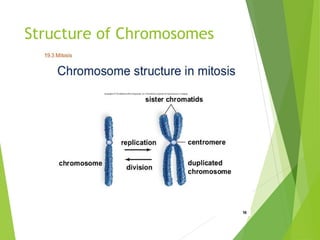
 Each chromosome is made of two parallel strands called
chromatids. Each chromatid pair is connected at a
point by centromere.
Structure of Chromosomes
Homologous chromosomes
 This is a pair of chromosomes with a
characteristic length i.e. have a similar
appearance though their genetic
composition may be different.
 Each parent gives one pair of such
chromosomes during sexual reproduction.
Homologous chromosomes
Genes
 Located along the length of chromosome.
 Are basic units of heredity that are transferred from a
parent to offspring.
 Are made of protein chemical substance called
Deoxyribonucleic acid (DNA), which contain coded
information determine the characteristics of the
offspring e.g. whether male or female.
Mitosis
 The type of reproduction in which a cell divides into
two daughter cells each with the same number of
chromosomes as the parent cell.
Importance of Mitosis
Functions of mitosis
 For simple organisms, it
is a means of asexual
reproduction. (For
example cells of fungus)
 In multicellular
organisms, it allows for
entire cell to grow by
forming new cells and
replacing older cells.
 In certain species,
mitosis is used to heal
wounds or regenerate
body parts.
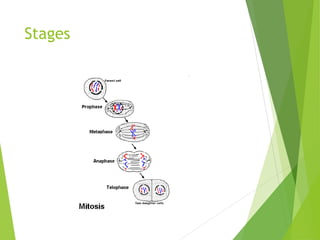
Phases of mitosis
 It is a continuous process, divided into four
phases;
1. Prophase
2. Metaphase
3. Anaphase
4. Telophase
 In order to remember the phases easily, we can
use the acronym P-MAT
 However, prior to cell division (P-MAT), the cell
spends a lot of time in INTERPHASE where it
undergoes intense activities in preparation to
division.
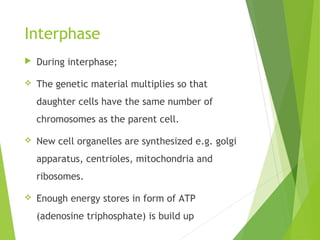
Interphase
 During interphase;
 The genetic material multiplies so that
daughter cells have the same number of
chromosomes as the parent cell.
 New cell organelles are synthesized e.g. golgi
apparatus, centrioles, mitochondria and
ribosomes.
 Enough energy stores in form of ATP
(adenosine triphosphate) is build up
Phases of the Cell Cycle
 Interphase- phase in
which cells spends
most time performing
functions that makes
it unique.
 Mitosis- phase of cell
during which cell
divides into two
daughter cells.
Stages
Prophase
 In animal cells, duplicated
microscopic bodies called
centrioles separate and move
to opposite sides of the cell.
These are not present in most
plant or fungal cells.
 Spindle fibres begin to form.
 Nuclear membrane begins to
break down and nucleolus
disappear.
 Chromosomes thicken and
shorten and become visible
through staining.
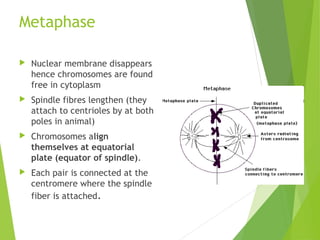
Metaphase
 Nuclear membrane disappears
hence chromosomes are found
free in cytoplasm
 Spindle fibres lengthen (they
attach to centrioles by at both
poles in animal)
 Chromosomes align
themselves at equatorial
plate (equator of spindle).
 Each pair is connected at the
centromere where the spindle
fiber is attached.
Anaphase
 Spindle fibres shorten,
chromatids move apart
(separate) from each
other and move to the
opposite poles.
 The spindle apparatus
begin to disappear.
 The cell membrane in
animal cells begins to
constrict towards the
end.
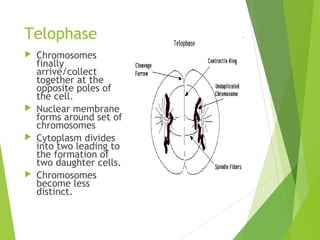
Telophase
 Chromosomes
finally
arrive/collect
together at the
opposite poles of
the cell.
 Nuclear membrane
forms around set of
chromosomes
 Cytoplasm divides
into two leading to
the formation of
two daughter cells.
 Chromosomes
become less
distinct.
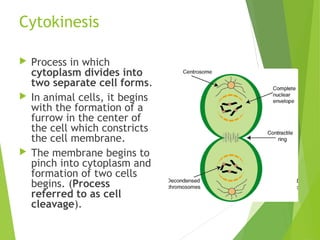
Cytokinesis
 Process in which
cytoplasm divides into
two separate cell forms.
 In animal cells, it begins
with the formation of a
furrow in the center of
the cell which constricts
the cell membrane.
 The membrane begins to
pinch into cytoplasm and
formation of two cells
begins. (Process
referred to as cell
cleavage).
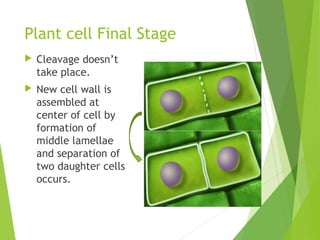
Plant cell Final Stage
 Cleavage doesn’t
take place.
 New cell wall is
assembled at
center of cell by
formation of
middle lamellae
and separation of
two daughter cells
occurs.
The End;
thanks for
walking with me.

Reproduction Ppt; New

  • 1.
    Secondary Biology, Reproduction inPlants and Animals Cell division; Mitosis By Mr. Kanyoro Peter
  • 2.
    Introduction  Reproduction isthe process by which mature living organisms produce young ones of their kind/offspring.  It’s of two types;  Sexual reproduction – involves fusion of sex cells (male and female gametes) in a process called fertilization.  Asexual reproduction – where parts of mature organisms develop into new individuals in several mechanisms.
  • 3.
    Sexual (a) andAsexual (b) reproduction
  • 4.
    Importance of reproduction Leads to procreation hence perpetuation/survival/sustenance of species so that it dose not become extinct  Helps in improvement of quality of species through exchange of genetic material during crossing over hence variation and adaptability.  Helps to maintain all the characteristics of the parent as in asexual reproduction.
  • 5.
    Cell division  Organismsstart as a single cell; spore or zygote  Cells of multicellular organisms divides into two and the division continues in multiples of two.  Cells of unicellular organisms divide into separate daughter cells which develop into adult individuals.  Cell division starts with division of nucleus (karyogamy) – chromosomes and then cytoplasm (cytogamy)  There are two types of cell division; mitosis and meiosis
  • 6.
    Chromosomes  Are longthread-like structures found in the nucleus which become visible with microscope only during cell division.  Each somatic cell (body cell) has a fixed diploid (double number) of chromosomes (also referred to as “2n” constitution) e.g. 23 pairs for human, 4 pairs for Drosophila, 20 pairs for mouse and 7 pairs for garden pea.  Each chromosome is made of two parallel strands called chromatids. Each chromatid pair is connected at a point by centromere.
  • 7.
  • 8.
    Homologous chromosomes  Thisis a pair of chromosomes with a characteristic length i.e. have a similar appearance though their genetic composition may be different.  Each parent gives one pair of such chromosomes during sexual reproduction.
  • 9.
  • 10.
    Genes  Located alongthe length of chromosome.  Are basic units of heredity that are transferred from a parent to offspring.  Are made of protein chemical substance called Deoxyribonucleic acid (DNA), which contain coded information determine the characteristics of the offspring e.g. whether male or female.
  • 11.
    Mitosis  The typeof reproduction in which a cell divides into two daughter cells each with the same number of chromosomes as the parent cell.
  • 12.
  • 13.
    Functions of mitosis For simple organisms, it is a means of asexual reproduction. (For example cells of fungus)  In multicellular organisms, it allows for entire cell to grow by forming new cells and replacing older cells.  In certain species, mitosis is used to heal wounds or regenerate body parts.
  • 14.
    Phases of mitosis It is a continuous process, divided into four phases; 1. Prophase 2. Metaphase 3. Anaphase 4. Telophase  In order to remember the phases easily, we can use the acronym P-MAT  However, prior to cell division (P-MAT), the cell spends a lot of time in INTERPHASE where it undergoes intense activities in preparation to division.
  • 15.
    Interphase  During interphase; The genetic material multiplies so that daughter cells have the same number of chromosomes as the parent cell.  New cell organelles are synthesized e.g. golgi apparatus, centrioles, mitochondria and ribosomes.  Enough energy stores in form of ATP (adenosine triphosphate) is build up
  • 16.
    Phases of theCell Cycle  Interphase- phase in which cells spends most time performing functions that makes it unique.  Mitosis- phase of cell during which cell divides into two daughter cells.
  • 17.
  • 18.
    Prophase  In animalcells, duplicated microscopic bodies called centrioles separate and move to opposite sides of the cell. These are not present in most plant or fungal cells.  Spindle fibres begin to form.  Nuclear membrane begins to break down and nucleolus disappear.  Chromosomes thicken and shorten and become visible through staining.
  • 19.
    Metaphase  Nuclear membranedisappears hence chromosomes are found free in cytoplasm  Spindle fibres lengthen (they attach to centrioles by at both poles in animal)  Chromosomes align themselves at equatorial plate (equator of spindle).  Each pair is connected at the centromere where the spindle fiber is attached.
  • 20.
    Anaphase  Spindle fibresshorten, chromatids move apart (separate) from each other and move to the opposite poles.  The spindle apparatus begin to disappear.  The cell membrane in animal cells begins to constrict towards the end.
  • 21.
    Telophase  Chromosomes finally arrive/collect together atthe opposite poles of the cell.  Nuclear membrane forms around set of chromosomes  Cytoplasm divides into two leading to the formation of two daughter cells.  Chromosomes become less distinct.
  • 22.
    Cytokinesis  Process inwhich cytoplasm divides into two separate cell forms.  In animal cells, it begins with the formation of a furrow in the center of the cell which constricts the cell membrane.  The membrane begins to pinch into cytoplasm and formation of two cells begins. (Process referred to as cell cleavage).
  • 23.
    Plant cell FinalStage  Cleavage doesn’t take place.  New cell wall is assembled at center of cell by formation of middle lamellae and separation of two daughter cells occurs.
  • 24.

Editor's Notes

  • #14 Starfish, also known as sea stars, (they are not fish) are capable of regenerating even one arm into a whole new body. This is only possible if the arm includes part of the central disc. If you cut off only the tip of an arm, that tip will not regenerate, but the animal will grow another arm. I have seen a single arm nearly 8 inches long with small 1/2 inch arms growing off of it, it will eventually become a whole new sea star. If you cut a sea star in quarters, right down the center, each piece will grow into a whole new sea star. I do not know how many pieces one can cut any one starfish into and still have each regenerate. As long as a piece has part of the central disk, it should regenerate into a whole organism. But if you cut a starfish in half, and then let it grow into an whole one before cutting it in half again, one should be able to do that indefinitely.