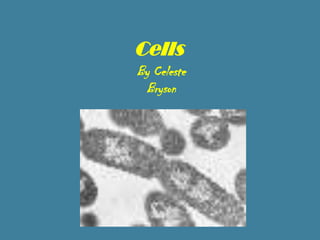
Cells
By Celeste
  Bryson
Cell Facts
 There are 2 types of primary cells, eukaryotic and
  prokaryotic.
 Cells are too small to be seen without magnification.
 Cells are 1 to 100 micrometers
 Scientists believe Single-celled organisms were the
  earliest forms of life on earth. Single celled organisms are
  called Prokaryotic.
 There are more bacterial cells in the body than human
  cells.
 Cells commit suicide. When they get infected or damaged,
  it will self destruct.
 Cells have varying life spans.
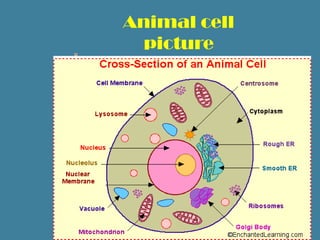
Animal Cell
   Parts
   Cell Membrane
   Cell Cytoplasm
   Nucleus
   Nucleolus
   Nuclear Membrane
   Nucleoplasm
   Mitochondria
   Ribosome
   Lysosome
   Centrosome
   Endoplasmic Reticulum
   Golgi Apparatus
   Vacuole
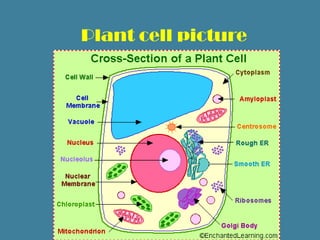
Plant Cell Parts
    Nucleus
    Plastids
    Ribosome
    Mitochondria
    Golgi Body
    Endoplasmic
     Reticulum
    Vacuoles
    Peroxisomes
    Cell wall
    Cell membrane
    Cytoplasm
    Amyloplast
    Nucleolus
    Nuclear membrane
    Chloroplast
Nucleus
• Nucleus is the brain of the plant cell and the most important of
  all plant cell parts.
Plastids
• Plastids are those plant cells which carry pigments.
Ribosome
• These are the parts that mainly contain RNA[ribonucleic acids].
  Ribosomes are those parts that are responsible for production of
  proteins in plants.
Mitochondria
• The mitochondria is responsible for breaking down carbohydrates
  and sugars.
Golgi Body
• The Golgi Body is used to transport material inside and outside
  the cell.
Endoplasmic Reticulum
• Endoplasmic Reticulum (ER) is a system of convulsed sacs,
  which are in turn interconnected.
Vacuoles
• Vacuoles are the storage area. They hold the water for the
  plant.
Peroxisomes
• Peroxisomes contain certain parts that are responsible for breaking
  such fatty acids into simpler forms. They help chloroplasts in the
  process of photosynthesis.
Cell wall
• The cell wall protects and supports the cell.
Cell membrane
• The cell membrane covers and gives the cell it’s shape. It
  allows materials to come in and out of the cell.
Cytoplasm
• Cytoplasm is the gel like liquid that holds in all the organisms.
Amyloplast
• They are responsible for the synthesis and storage of starch
  granules.
Centrosome
• An organelle near the nucleus of a cell that contains the
  centrioles.
Nucleolus
• A small structure in the nucleus of a cell.
Nuclear membrane
• Separates the nucleus from the cytoplasm of the cell. It is
  similar to the cell membrane.
Golgi Apparatus
• It is made up of folded membranes within the cytoplasm of most
  singled cells.
Lysosome
• An organelle in the cytoplasm of singled cells containing
  degradative(The reduction of a chemical compound to a less complex
  compound) enzymes (substance produced by a living organism)
  enclosed in a membrane.
Animal cell
  picture
Plant cell picture
Sources

 http://www.buzzle.com/articles/animal-cell
 http://www.buzzle.com/articles/plant-cell-parts
My Dad 
My Mom 
My Brother David [a scientist] 
Google images 
Enchantedlearning.com 
Dictionary.com 

Cells power point