Outline
• Phospholipid Bilayer
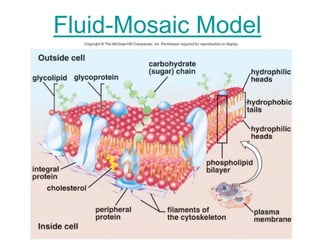
• Fluid Mosaic Model
• Membrane Proteins
• Diffusion
• Facilitated Diffusion
• Osmosis
• Bulk Transport
• Active Transport
Membrane Functions
• Protection
• Communication
• Selectively allow substances in
• Respond to environment
• Recognition
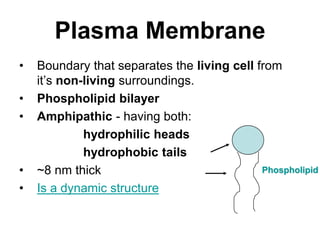
Plasma Membrane
• Boundary that separates the living cell from
it’s non-living surroundings.
• Phospholipid bilayer
• Amphipathic - having both:
hydrophilic heads
hydrophobic tails
• ~8 nm thick
• Is a dynamic structure
Phospholipid
Fluid-Mosaic Model
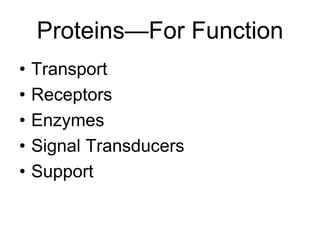
Proteins—For Function
• Transport
• Receptors
• Enzymes
• Signal Transducers
• Support
PROTEINS CAN
MOVE IN THE
MEMBRANE,
TOO!
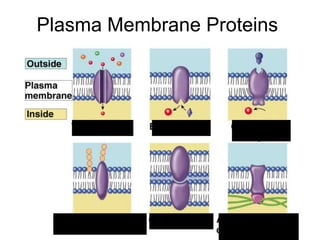
Plasma Membrane Proteins
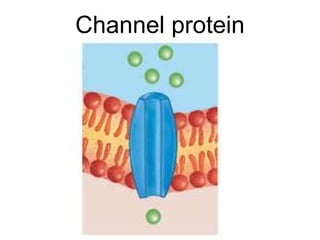
Channel protein
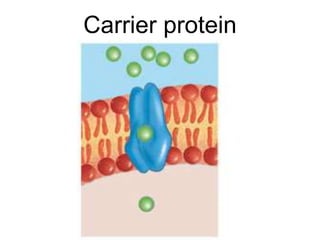
Carrier protein
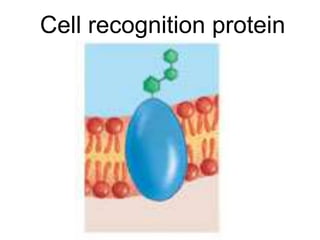
Cell recognition protein
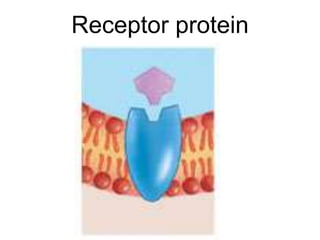
Receptor protein
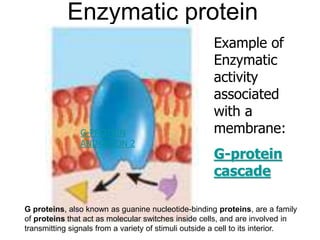
Enzymatic protein
Example of
Enzymatic
activity
associated
with a
membrane:
G-protein
cascade
G-PROTEIN
ANIMATION 2
G proteins, also known as guanine nucleotide-binding proteins, are a family
of proteins that act as molecular switches inside cells, and are involved in
transmitting signals from a variety of stimuli outside a cell to its interior.
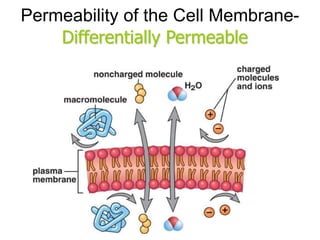
Permeability of the Cell Membrane-
Differentially Permeable
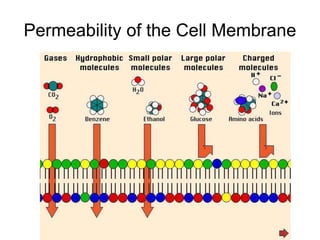
Permeability of the Cell Membrane
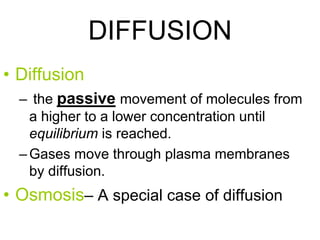
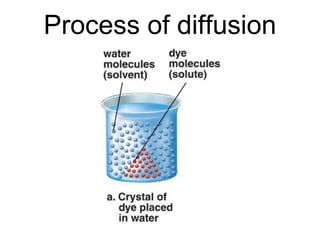
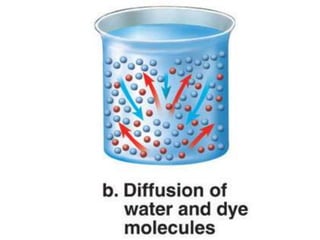
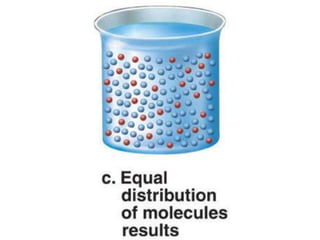
• Diffusion
– the passive movement of molecules from
a higher to a lower concentration until
equilibrium is reached.
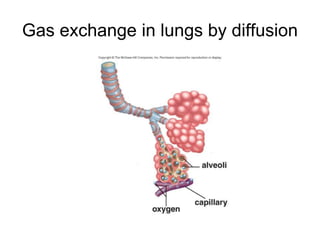
–Gases move through plasma membranes
by diffusion.
• Osmosis– A special case of diffusion
DIFFUSION
Process of diffusion
Gas exchange in lungs by diffusion
Osmosis
The diffusion of water across a
differentially permeable
membrane due to
concentration differences
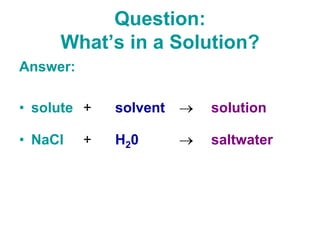
Question:
What’s in a Solution?
Answer:
• solute + solvent  solution
• NaCl + H20  saltwater
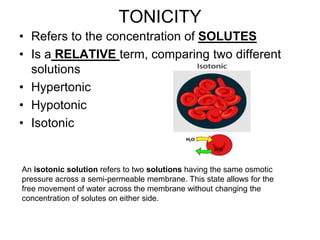
TONICITY
• Refers to the concentration of SOLUTES
• Is a RELATIVE term, comparing two different
solutions
• Hypertonic
• Hypotonic
• Isotonic
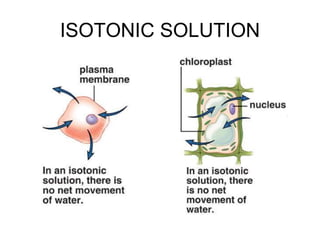
An isotonic solution refers to two solutions having the same osmotic
pressure across a semi-permeable membrane. This state allows for the
free movement of water across the membrane without changing the
concentration of solutes on either side.
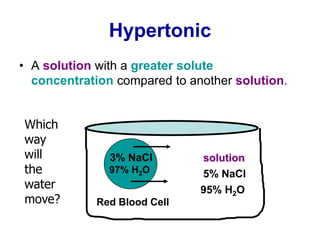
Hypertonic
• A solution with a greater solute
concentration compared to another solution.
3% NaCl
97% H2O
Red Blood Cell
5% NaCl
95% H2O
solution
Which
way
will
the
water
move?
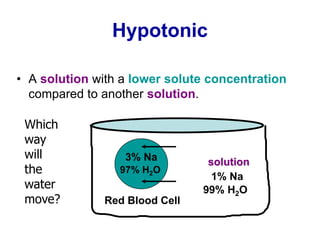
Hypotonic
• A solution with a lower solute concentration
compared to another solution.
3% Na
97% H2O
Red Blood Cell
1% Na
99% H2O
solution
Which
way
will
the
water
move?
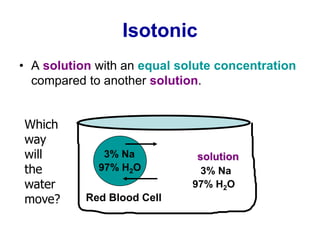
Isotonic
• A solution with an equal solute concentration
compared to another solution.
3% Na
97% H2O
Red Blood Cell
3% Na
97% H2O
solution
Which
way
will
the
water
move?
ISOTONIC SOLUTION
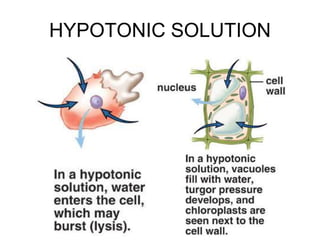
HYPOTONIC SOLUTION
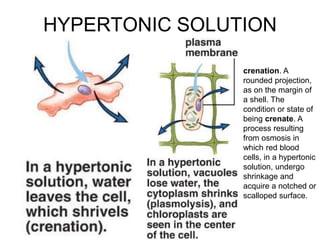
HYPERTONIC SOLUTION
crenation. A
rounded projection,
as on the margin of
a shell. The
condition or state of
being crenate. A
process resulting
from osmosis in
which red blood
cells, in a hypertonic
solution, undergo
shrinkage and
acquire a notched or
scalloped surface.
• Function—Transport. Are specific,
combine with only a certain type of
molecule.
• Types
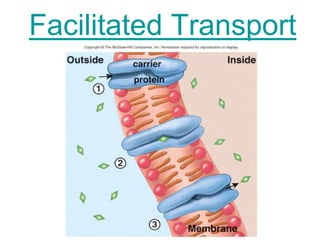
–Facilitated transport--passive
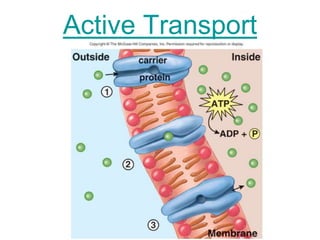
–Active transport—requires energy
Carrier Proteins
Facilitated Transport
Active Transport
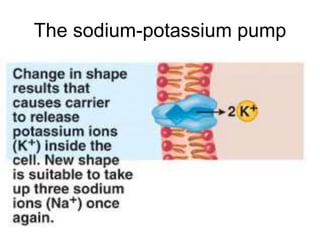
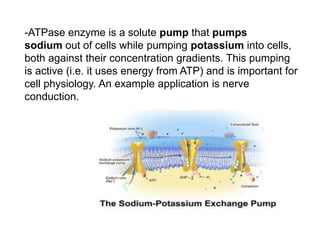
The sodium-potassium pump
-ATPase enzyme is a solute pump that pumps
sodium out of cells while pumping potassium into cells,
both against their concentration gradients. This pumping
is active (i.e. it uses energy from ATP) and is important for
cell physiology. An example application is nerve
conduction.
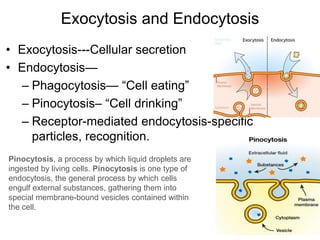
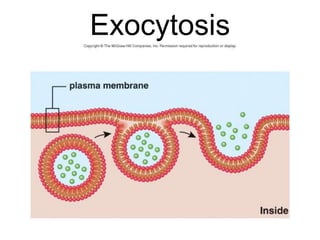
• Exocytosis---Cellular secretion
• Endocytosis—
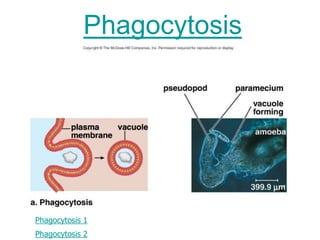
– Phagocytosis— “Cell eating”
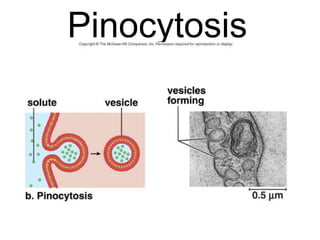
– Pinocytosis– “Cell drinking”
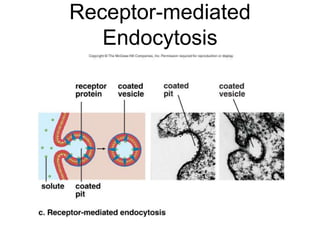
– Receptor-mediated endocytosis-specific
particles, recognition.
Exocytosis and Endocytosis
Pinocytosis, a process by which liquid droplets are
ingested by living cells. Pinocytosis is one type of
endocytosis, the general process by which cells
engulf external substances, gathering them into
special membrane-bound vesicles contained within
the cell.
Exocytosis
Phagocytosis
Phagocytosis 1
Phagocytosis 2
Pinocytosis
Receptor-mediated
Endocytosis
SUMMARY
• Phospholipid Bilayer
• Fluid Mosaic Model
• Membrane Proteins
• Diffusion
• Facilitated Diffusion
• Osmosis
• Bulk Transport
• Active Transport

Cell membrane structure. &and functions