The Cell Cycle
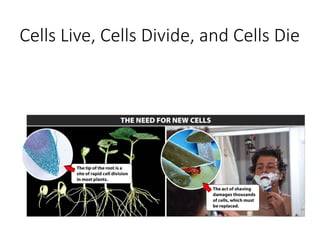
Cells Live, Cells Divide, and Cells Die
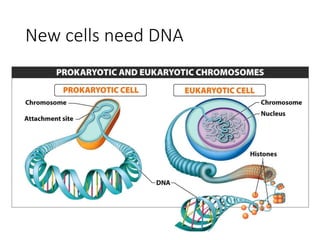
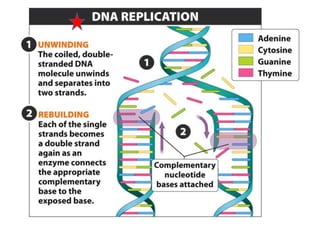
New cells need DNA
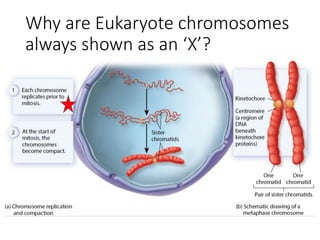
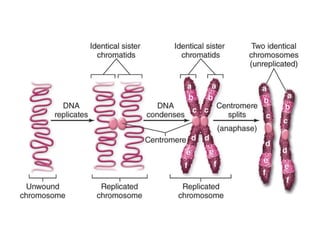
Why are Eukaryote chromosomes
always shown as an ‘X’?
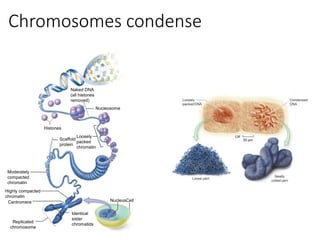
Naked DNA
(all histones
removed)
Nucleosome
Histones
Scaffold
protein
Centromere
Identical
sister
chromatids
Replicated
chromosome
Moderately
compacted
chromatin
Highly compacted
chromatin
NucleusCell
Loosely
packed
chromatin
Chromosomes condense
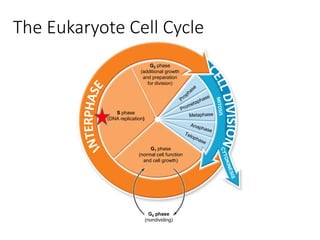
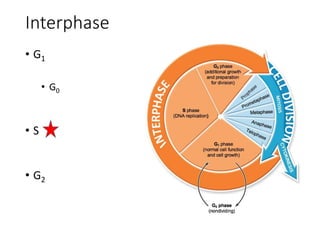
G1 phase
(normal cell function
and cell growth)
S phase
(DNA replication)
G2 phase
(additional growth
and preparation
for division)
G0 phase
(nondividing)
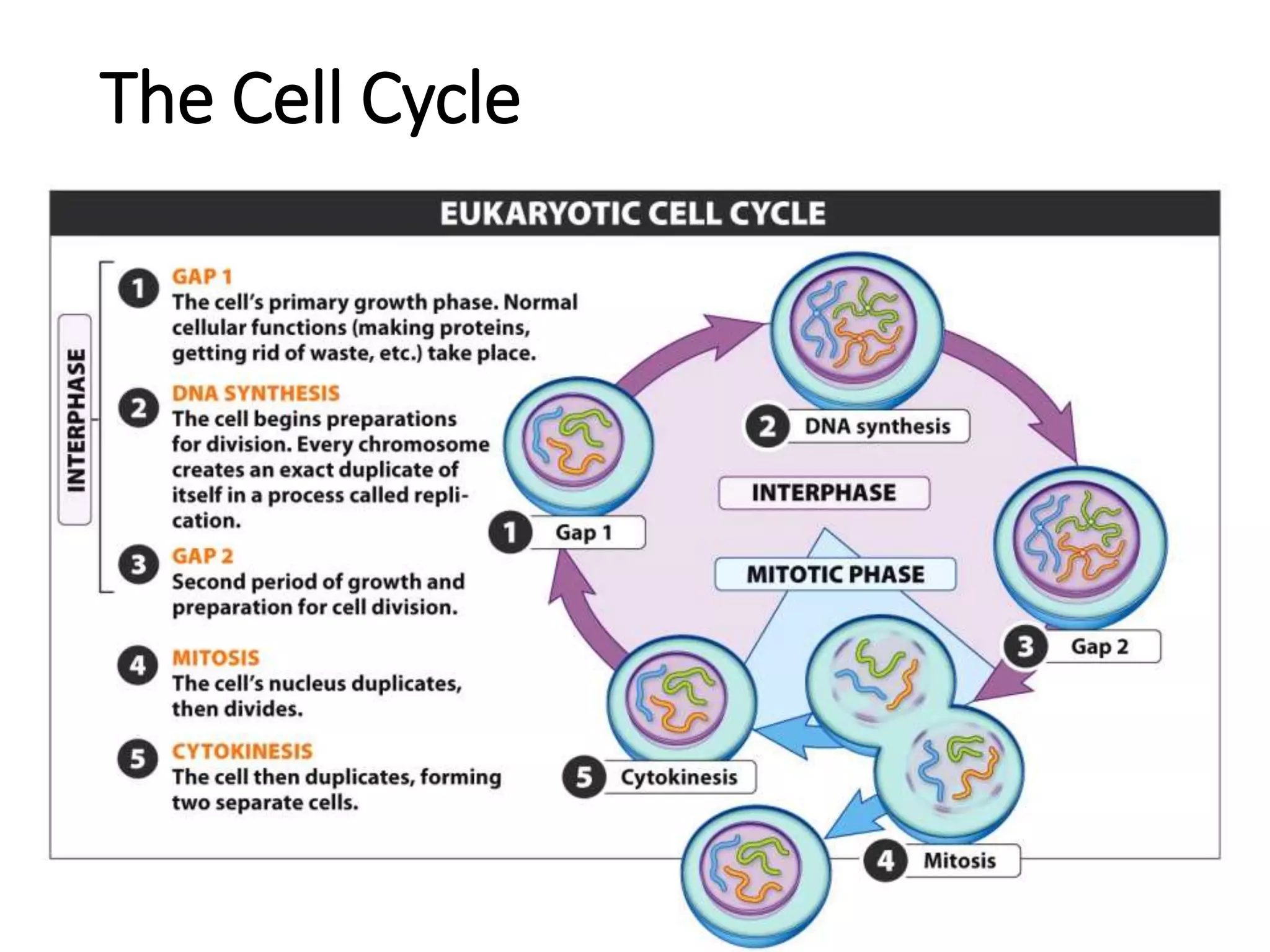
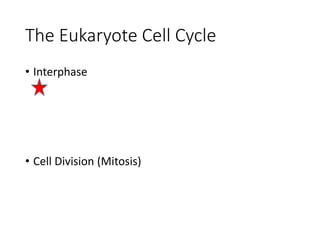
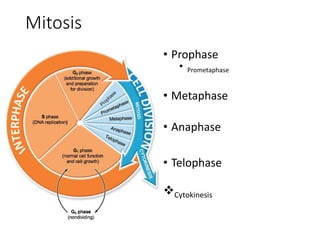
The Eukaryote Cell Cycle
• Interphase
• Cell Division (Mitosis)
Interphase
• G1
• G0
• S
• G2
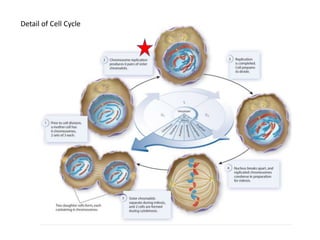
Detail of Cell Cycle
Mitosis
• Prophase
• Prometaphase
• Metaphase
• Anaphase
• Telophase
Cytokinesis
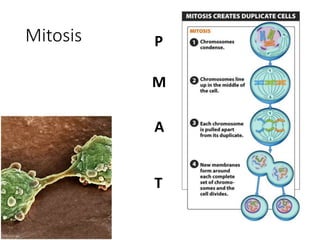
Mitosis P
M
A
T
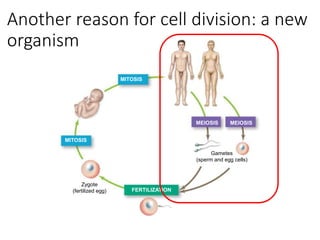
MITOSIS
MITOSIS
FERTILIZATION
MEIOSIS MEIOSIS
Gametes
(sperm and egg cells)
Zygote
(fertilized egg)
Another reason for cell division: a new
organism
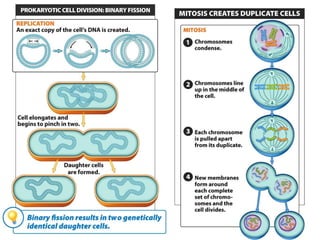
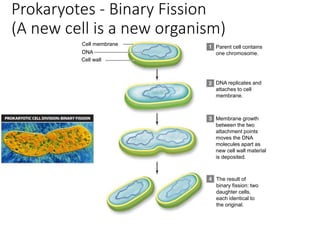
Cell membrane
DNA
Cell wall
Parent cell contains
one chromosome.
DNA replicates and
attaches to cell
membrane.
Membrane growth
between the two
attachment points
moves the DNA
molecules apart as
new cell wall material
is deposited.
The result of
binary fission: two
daughter cells,
each identical to
the original.
Prokaryotes - Binary Fission
(A new cell is a new organism)
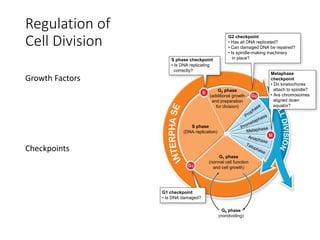
G2 checkpoint
• Has all DNA replicated?
• Can damaged DNA be repaired?
• Is spindle-making machinery
in place?
Metaphase
checkpoint
• Do kinetochores
attach to spindle?
• Are chromosomes
aligned down
equator?
S phase checkpoint
• Is DNA replicating
correctly?
S phase
(DNA replication)
G2 phase
(additional growth
and preparation
for division)
G1 phase
(normal cell function
and cell growth)
G1 checkpoint
• Is DNA damaged?
G0 phase
(nondividing)
Regulation of
Cell Division
Growth Factors
Checkpoints
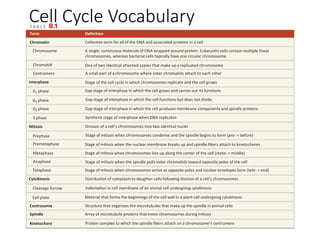
Term Definition
Chromatin
Cleavage furrow
Chromosome A single, continuous molecule of DNA wrapped around protein. Eukaryotic cells contain multiple linear
chromosomes, whereas bacterial cells typically have one circular chromosome.
Collective term for all of the DNA and associated proteins in a cell
Chromatid One of two identical attached copies that make up a replicated chromosome
Centromere A small part of a chromosome where sister chromatids attach to each other
Interphase Stage of the cell cycle in which chromosomes replicate and the cell grows
G1 phase
G0 phase
G2 phase
S phase
Gap stage of interphase in which the cell grows and carries out its functions
Gap stage of interphase in which the cell functions but does not divide
Gap stage of interphase in which the cell produces membrane components and spindle proteins
Synthesis stage of interphase when DNA replicates
Mitosis
Prophase
Prometaphase
Metaphase
Anaphase
Telophase
Cytokinesis
Cell plate
Centrosome
Spindle
Kinetochore Protein complex to which the spindle fibers attach on a chromosome’s centromere
Array of microtubule proteins that move chromosomes during mitosis
Structure that organizes the microtubules that make up the spindle in animal cells
Material that forms the beginnings of the cell wall in a plant cell undergoing cytokinesis
Indentation in cell membrane of an animal cell undergoing cytokinesis
Distribution of cytoplasm to daughter cells following division of a cell’s chromosomes
Stage of mitosis when chromosomes arrive at opposite poles and nuclear envelopes form (telo- = end)
Stage of mitosis when the spindle pulls sister chromatids toward opposite poles of the cell
Stage of mitosis when chromosomes line up along the center of the cell (meta- = middle)
Stage of mitosis when the nuclear membrane breaks up and spindle fibers attach to kinetochores
Stage of mitosis when chromosomes condense and the spindle begins to form (pro- = before)
Division of a cell’s chromosomes into two identical nuclei
Cell Cycle Vocabulary

Cell cycle

  • 1.
  • 2.
    Cells Live, CellsDivide, and Cells Die
  • 4.
  • 6.
    Why are Eukaryotechromosomes always shown as an ‘X’?
  • 8.
  • 9.
    G1 phase (normal cellfunction and cell growth) S phase (DNA replication) G2 phase (additional growth and preparation for division) G0 phase (nondividing) The Eukaryote Cell Cycle
  • 10.
    The Eukaryote CellCycle • Interphase • Cell Division (Mitosis)
  • 11.
  • 12.
  • 13.
    Mitosis • Prophase • Prometaphase •Metaphase • Anaphase • Telophase Cytokinesis
  • 14.
  • 15.
    MITOSIS MITOSIS FERTILIZATION MEIOSIS MEIOSIS Gametes (sperm andegg cells) Zygote (fertilized egg) Another reason for cell division: a new organism
  • 16.
    Cell membrane DNA Cell wall Parentcell contains one chromosome. DNA replicates and attaches to cell membrane. Membrane growth between the two attachment points moves the DNA molecules apart as new cell wall material is deposited. The result of binary fission: two daughter cells, each identical to the original. Prokaryotes - Binary Fission (A new cell is a new organism)
  • 17.
    G2 checkpoint • Hasall DNA replicated? • Can damaged DNA be repaired? • Is spindle-making machinery in place? Metaphase checkpoint • Do kinetochores attach to spindle? • Are chromosomes aligned down equator? S phase checkpoint • Is DNA replicating correctly? S phase (DNA replication) G2 phase (additional growth and preparation for division) G1 phase (normal cell function and cell growth) G1 checkpoint • Is DNA damaged? G0 phase (nondividing) Regulation of Cell Division Growth Factors Checkpoints
  • 18.
    Term Definition Chromatin Cleavage furrow ChromosomeA single, continuous molecule of DNA wrapped around protein. Eukaryotic cells contain multiple linear chromosomes, whereas bacterial cells typically have one circular chromosome. Collective term for all of the DNA and associated proteins in a cell Chromatid One of two identical attached copies that make up a replicated chromosome Centromere A small part of a chromosome where sister chromatids attach to each other Interphase Stage of the cell cycle in which chromosomes replicate and the cell grows G1 phase G0 phase G2 phase S phase Gap stage of interphase in which the cell grows and carries out its functions Gap stage of interphase in which the cell functions but does not divide Gap stage of interphase in which the cell produces membrane components and spindle proteins Synthesis stage of interphase when DNA replicates Mitosis Prophase Prometaphase Metaphase Anaphase Telophase Cytokinesis Cell plate Centrosome Spindle Kinetochore Protein complex to which the spindle fibers attach on a chromosome’s centromere Array of microtubule proteins that move chromosomes during mitosis Structure that organizes the microtubules that make up the spindle in animal cells Material that forms the beginnings of the cell wall in a plant cell undergoing cytokinesis Indentation in cell membrane of an animal cell undergoing cytokinesis Distribution of cytoplasm to daughter cells following division of a cell’s chromosomes Stage of mitosis when chromosomes arrive at opposite poles and nuclear envelopes form (telo- = end) Stage of mitosis when the spindle pulls sister chromatids toward opposite poles of the cell Stage of mitosis when chromosomes line up along the center of the cell (meta- = middle) Stage of mitosis when the nuclear membrane breaks up and spindle fibers attach to kinetochores Stage of mitosis when chromosomes condense and the spindle begins to form (pro- = before) Division of a cell’s chromosomes into two identical nuclei Cell Cycle Vocabulary