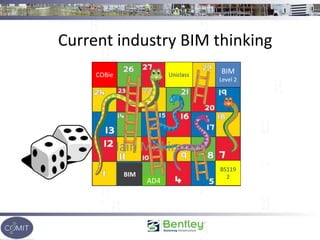
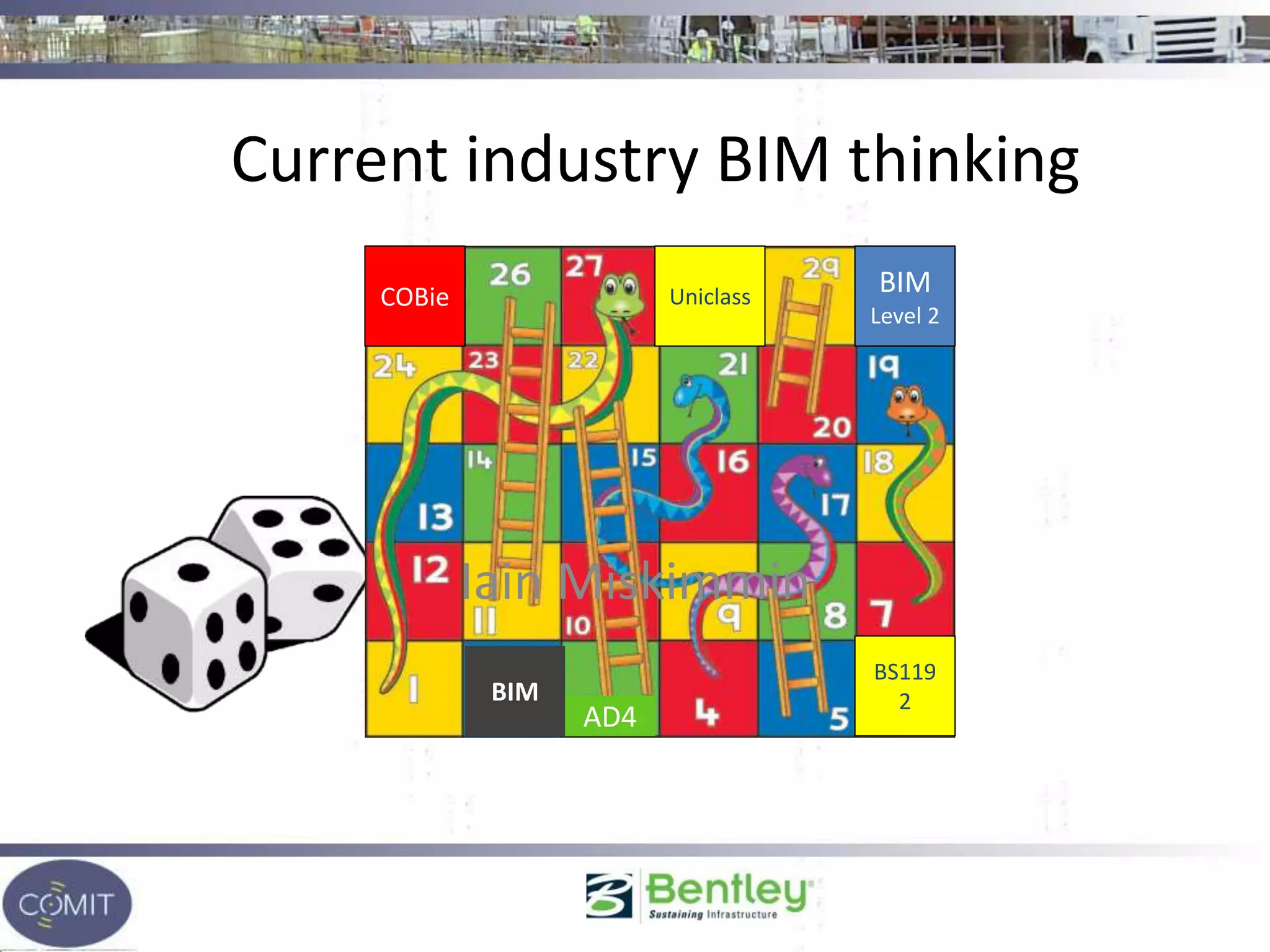
Current industry BIM thinking
Iain Miskimmin
BIM
Level 2
COBie
BS119
2
Uniclass
BIM
AD4
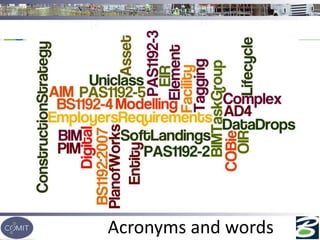
Acronyms and words
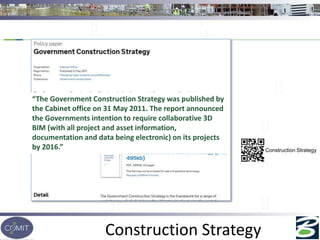
Construction Strategy
“The Government Construction Strategy was published by
the Cabinet office on 31 May 2011. The report announced
the Governments intention to require collaborative 3D
BIM (with all project and asset information,
documentation and data being electronic) on its projects
by 2016.”
Government Soft Landings (GSL)
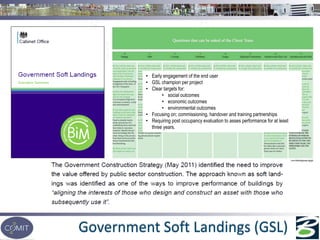
• Early engagement of the end user
• GSL champion per project
• Clear targets for:
• social outcomes
• economic outcomes
• environmental outcomes
• Focusing on; commissioning, handover and training partnerships
• Requiring post occupancy evaluation to asses performance for at least
three years.
NN7654321
Concept
Design
BuildandCommission
Handover&Closeout
Brief
Strategy
Operations
Maintenance
Endoflife
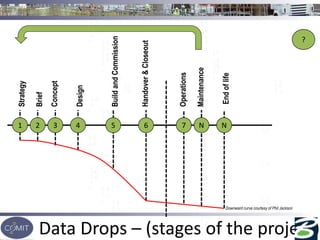
Data Drops – (stages of the project)
?
Downward curve courtesy of Phil Jackson
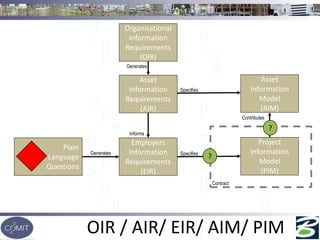
OIR / AIR/ EIR/ AIM/ PIM
Plain
Language
Questions
Organisational
Information
Requirements
(OIR)
Asset
Information
Requirements
(AIR)
Employers
Information
Requirements
(EIR)
Asset
Information
Model
(AIM)
Project
Information
Model
(PIM)
Generates
Informs
Contributes
?
SpecifiesGenerates
Specifies
Contract
?
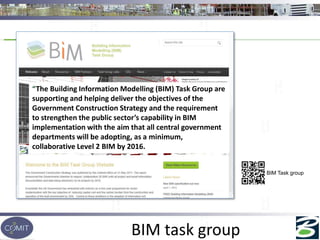
BIM task group
BIM Task group
“The Building Information Modelling (BIM) Task Group are
supporting and helping deliver the objectives of the
Government Construction Strategy and the requirement
to strengthen the public sector’s capability in BIM
implementation with the aim that all central government
departments will be adopting, as a minimum,
collaborative Level 2 BIM by 2016.
Digital Plan of Works
dPoW
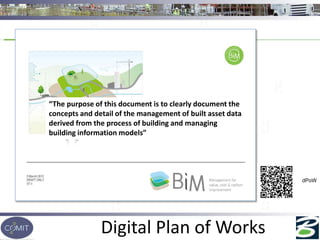
“The purpose of this document is to clearly document the
concepts and detail of the management of built asset data
derived from the process of building and managing
building information models”
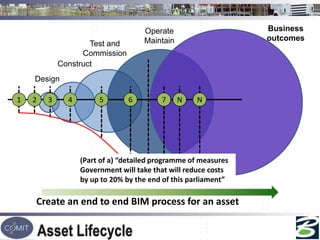
Design
Construct
Test and
Commission
Operate
Maintain
Business
outcomes
Create an end to end BIM process for an asset
Asset Lifecycle
NN7654321
(Part of a) “detailed programme of measures
Government will take that will reduce costs
by up to 20% by the end of this parliament”
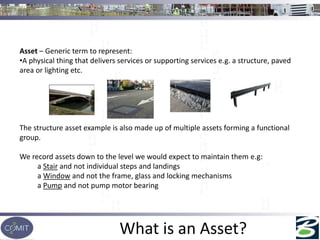
Asset – Generic term to represent:
•A physical thing that delivers services or supporting services e.g. a structure, paved
area or lighting etc.
The structure asset example is also made up of multiple assets forming a functional
group.
We record assets down to the level we would expect to maintain them e.g:
a Stair and not individual steps and landings
a Window and not the frame, glass and locking mechanisms
a Pump and not pump motor bearing
What is an Asset?
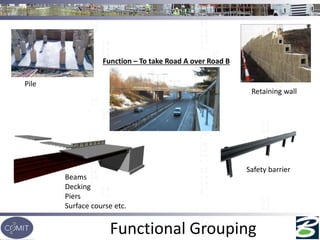
Functional Grouping
Function – To take Road A over Road B
Pile
Retaining wall
Safety barrier
Beams
Decking
Piers
Surface course etc.
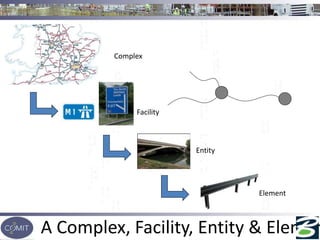
A Complex, Facility, Entity & Elemen
Complex
Facility
Entity
Element
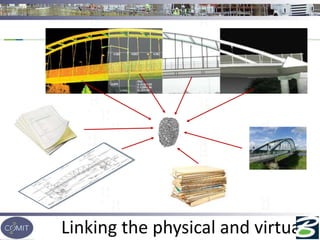
Linking the physical and virtual
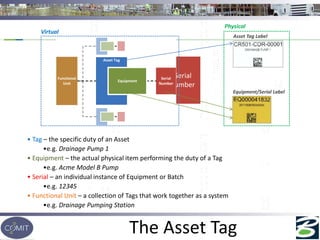
The Asset Tag
Asset Tag
Equipment
Serial
Number
• Tag – the specific duty of an Asset
•e.g. Drainage Pump 1
• Equipment – the actual physical item performing the duty of a Tag
•e.g. Acme Model B Pump
• Serial – an individual instance of Equipment or Batch
•e.g. 12345
• Functional Unit – a collection of Tags that work together as a system
•e.g. Drainage Pumping Station
Functional
Unit
Serial
Number
Equipment
Asset Tag
Asset Tag Label
Equipment/Serial Label
Physical
Virtual
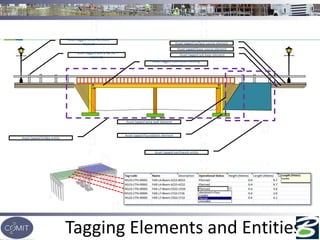
Asset tagged street furniture
element
Asset tagged safety barrier
element
Asset tagged steel beam decking
element
Asset tagged surface course element
Asset tagged base course element
Asset tagged sub base element
Asset tagged wing wall element
Asset tagged earthwork entity
Asset tagged foundation element
Tagging Elements and Entities
Asset tagged bridge entity
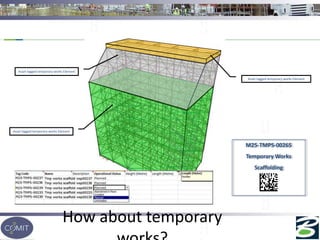
How about temporary
Asset tagged temporary works Element
M25-TMPS-00265
Temporary Works
Scaffolding
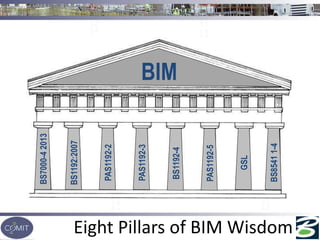
Eight Pillars of BIM Wisdom
BS1192:2007
PAS1192-3
PAS1192-2
BS7000-42013
GSL
BS85411-4
BS1192-4
PAS1192-5
BIM
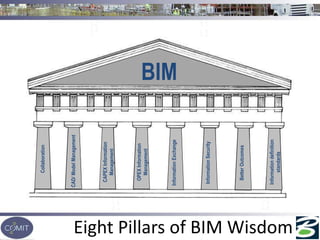
Eight Pillars of BIM Wisdom
BIMBS1192:2007
PAS1192-3
PAS1192-2
BS7000-42013
GSL
BS85411-4
BS1192-4
PAS1192-5
CAD/ModelManagement
OPEXInformation
Management
CAPEXInformation
Management
Collaboration
BetterOutcomes
Informationdefinition
standards
InformationExchange
InformationSecurity
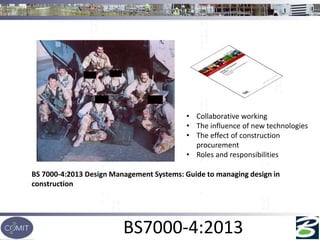
BS7000-4:2013
BS 7000-4:2013 Design Management Systems: Guide to managing design in
construction
• Collaborative working
• The influence of new technologies
• The effect of construction
procurement
• Roles and responsibilities
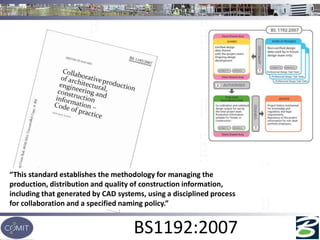
BS1192:2007
“This standard establishes the methodology for managing the
production, distribution and quality of construction information,
including that generated by CAD systems, using a disciplined process
for collaboration and a specified naming policy.”
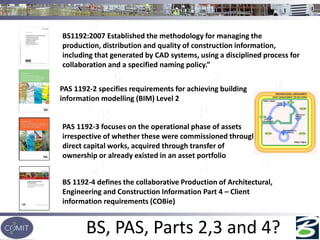
BS, PAS, Parts 2,3 and 4?
PAS 1192-2 specifies requirements for achieving building
information modelling (BIM) Level 2
PAS 1192-3 focuses on the operational phase of assets
irrespective of whether these were commissioned through
direct capital works, acquired through transfer of
ownership or already existed in an asset portfolio
BS 1192-4 defines the collaborative Production of Architectural,
Engineering and Construction Information Part 4 – Client
information requirements (COBie)
BS1192:2007 Established the methodology for managing the
production, distribution and quality of construction information,
including that generated by CAD systems, using a disciplined process for
collaboration and a specified naming policy.”
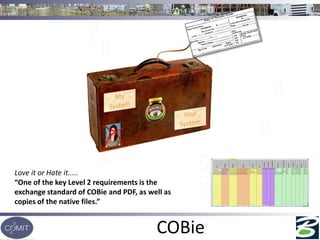
COBie
Love it or Hate it.....
“One of the key Level 2 requirements is the
exchange standard of COBie and PDF, as well as
copies of the native files.”
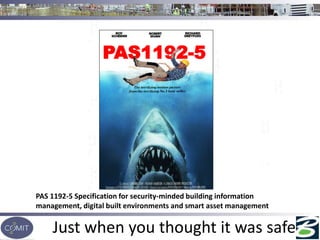
Just when you thought it was safe....
PAS1192-5
PAS 1192-5 Specification for security-minded building information
management, digital built environments and smart asset management
BS8541 1-4
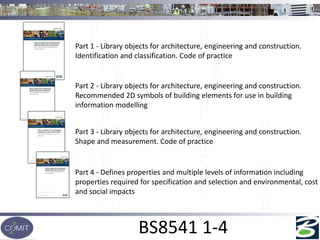
Part 1 - Library objects for architecture, engineering and construction.
Identification and classification. Code of practice
Part 2 - Library objects for architecture, engineering and construction.
Recommended 2D symbols of building elements for use in building
information modelling
Part 3 - Library objects for architecture, engineering and construction.
Shape and measurement. Code of practice
Part 4 - Defines properties and multiple levels of information including
properties required for specification and selection and environmental, cost
and social impacts
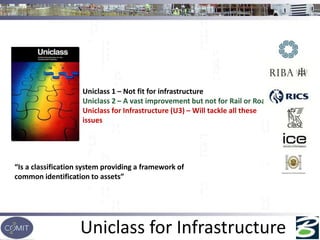
Uniclass 1 – Not fit for infrastructure
Uniclass 2 – A vast improvement but not for Rail or Road.
Uniclass for Infrastructure (U3) – Will tackle all these
issues
Uniclass for Infrastructure
“Is a classification system providing a framework of
common identification to assets”
IADD4UK – part of the AIR
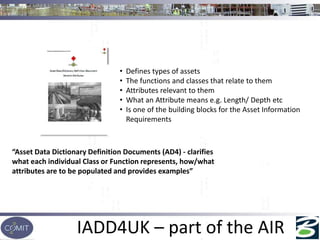
“Asset Data Dictionary Definition Documents (AD4) - clarifies
what each individual Class or Function represents, how/what
attributes are to be populated and provides examples”
• Defines types of assets
• The functions and classes that relate to them
• Attributes relevant to them
• What an Attribute means e.g. Length/ Depth etc
• Is one of the building blocks for the Asset Information
Requirements
dPoW
COBie
NN7654321
How does it fit together?
Uniclass
AD4
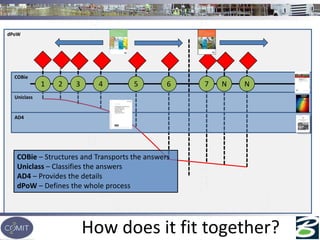
COBie – Structures and Transports the answers
Uniclass – Classifies the answers
AD4 – Provides the details
dPoW – Defines the whole process
NN7654321
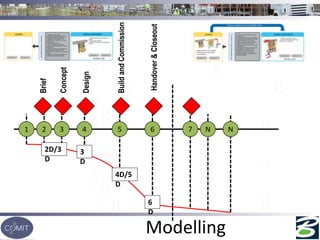
Modelling
Design
BuildandCommission
Handover&Closeout3
D
4D/5
D
6
D
Concept
Brief
2D/3
D
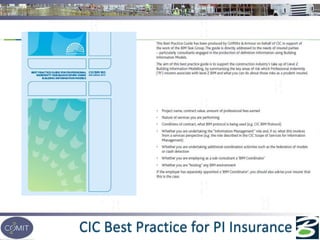
CIC Best Practice for PI Insurance
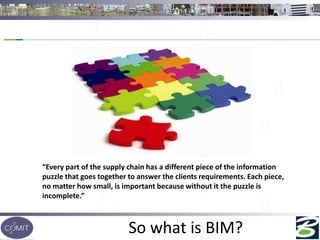
So what is BIM?
“Every part of the supply chain has a different piece of the information
puzzle that goes together to answer the clients requirements. Each piece,
no matter how small, is important because without it the puzzle is
incomplete.”
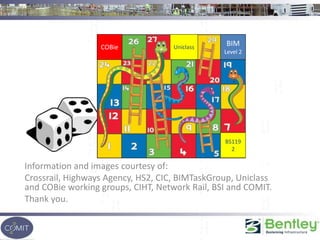
Information and images courtesy of:
Crossrail, Highways Agency, HS2, CIC, BIMTaskGroup, Uniclass
and COBie working groups, CIHT, Network Rail, BSI and COMIT.
Thank you.
BIM
Level 2
COBie
BS119
2
Uniclass

CD March 2015 - Bentley presentation about current BIM thinking

  • 1.
    Current industry BIMthinking Iain Miskimmin BIM Level 2 COBie BS119 2 Uniclass BIM AD4
  • 2.
  • 3.
    Construction Strategy Construction Strategy “TheGovernment Construction Strategy was published by the Cabinet office on 31 May 2011. The report announced the Governments intention to require collaborative 3D BIM (with all project and asset information, documentation and data being electronic) on its projects by 2016.”
  • 4.
    Government Soft Landings(GSL) • Early engagement of the end user • GSL champion per project • Clear targets for: • social outcomes • economic outcomes • environmental outcomes • Focusing on; commissioning, handover and training partnerships • Requiring post occupancy evaluation to asses performance for at least three years.
  • 5.
  • 6.
    OIR / AIR/EIR/ AIM/ PIM Plain Language Questions Organisational Information Requirements (OIR) Asset Information Requirements (AIR) Employers Information Requirements (EIR) Asset Information Model (AIM) Project Information Model (PIM) Generates Informs Contributes ? SpecifiesGenerates Specifies Contract ?
  • 7.
    BIM task group BIMTask group “The Building Information Modelling (BIM) Task Group are supporting and helping deliver the objectives of the Government Construction Strategy and the requirement to strengthen the public sector’s capability in BIM implementation with the aim that all central government departments will be adopting, as a minimum, collaborative Level 2 BIM by 2016.
  • 8.
    Digital Plan ofWorks dPoW “The purpose of this document is to clearly document the concepts and detail of the management of built asset data derived from the process of building and managing building information models”
  • 9.
    Design Construct Test and Commission Operate Maintain Business outcomes Create anend to end BIM process for an asset Asset Lifecycle NN7654321 (Part of a) “detailed programme of measures Government will take that will reduce costs by up to 20% by the end of this parliament”
  • 10.
    Asset – Genericterm to represent: •A physical thing that delivers services or supporting services e.g. a structure, paved area or lighting etc. The structure asset example is also made up of multiple assets forming a functional group. We record assets down to the level we would expect to maintain them e.g: a Stair and not individual steps and landings a Window and not the frame, glass and locking mechanisms a Pump and not pump motor bearing What is an Asset?
  • 11.
    Functional Grouping Function –To take Road A over Road B Pile Retaining wall Safety barrier Beams Decking Piers Surface course etc.
  • 12.
    A Complex, Facility,Entity & Elemen Complex Facility Entity Element
  • 13.
  • 14.
    The Asset Tag AssetTag Equipment Serial Number • Tag – the specific duty of an Asset •e.g. Drainage Pump 1 • Equipment – the actual physical item performing the duty of a Tag •e.g. Acme Model B Pump • Serial – an individual instance of Equipment or Batch •e.g. 12345 • Functional Unit – a collection of Tags that work together as a system •e.g. Drainage Pumping Station Functional Unit Serial Number Equipment Asset Tag Asset Tag Label Equipment/Serial Label Physical Virtual
  • 15.
    Asset tagged streetfurniture element Asset tagged safety barrier element Asset tagged steel beam decking element Asset tagged surface course element Asset tagged base course element Asset tagged sub base element Asset tagged wing wall element Asset tagged earthwork entity Asset tagged foundation element Tagging Elements and Entities Asset tagged bridge entity
  • 16.
    How about temporary Assettagged temporary works Element Asset tagged temporary works Element Asset tagged temporary works Element M25-TMPS-00265 Temporary Works Scaffolding
  • 17.
    Eight Pillars ofBIM Wisdom BS1192:2007 PAS1192-3 PAS1192-2 BS7000-42013 GSL BS85411-4 BS1192-4 PAS1192-5 BIM
  • 18.
    Eight Pillars ofBIM Wisdom BIMBS1192:2007 PAS1192-3 PAS1192-2 BS7000-42013 GSL BS85411-4 BS1192-4 PAS1192-5 CAD/ModelManagement OPEXInformation Management CAPEXInformation Management Collaboration BetterOutcomes Informationdefinition standards InformationExchange InformationSecurity
  • 19.
    BS7000-4:2013 BS 7000-4:2013 DesignManagement Systems: Guide to managing design in construction • Collaborative working • The influence of new technologies • The effect of construction procurement • Roles and responsibilities
  • 20.
    BS1192:2007 “This standard establishesthe methodology for managing the production, distribution and quality of construction information, including that generated by CAD systems, using a disciplined process for collaboration and a specified naming policy.”
  • 21.
    BS, PAS, Parts2,3 and 4? PAS 1192-2 specifies requirements for achieving building information modelling (BIM) Level 2 PAS 1192-3 focuses on the operational phase of assets irrespective of whether these were commissioned through direct capital works, acquired through transfer of ownership or already existed in an asset portfolio BS 1192-4 defines the collaborative Production of Architectural, Engineering and Construction Information Part 4 – Client information requirements (COBie) BS1192:2007 Established the methodology for managing the production, distribution and quality of construction information, including that generated by CAD systems, using a disciplined process for collaboration and a specified naming policy.”
  • 22.
    COBie Love it orHate it..... “One of the key Level 2 requirements is the exchange standard of COBie and PDF, as well as copies of the native files.”
  • 23.
    Just when youthought it was safe.... PAS1192-5 PAS 1192-5 Specification for security-minded building information management, digital built environments and smart asset management
  • 24.
    BS8541 1-4 Part 1- Library objects for architecture, engineering and construction. Identification and classification. Code of practice Part 2 - Library objects for architecture, engineering and construction. Recommended 2D symbols of building elements for use in building information modelling Part 3 - Library objects for architecture, engineering and construction. Shape and measurement. Code of practice Part 4 - Defines properties and multiple levels of information including properties required for specification and selection and environmental, cost and social impacts
  • 25.
    Uniclass 1 –Not fit for infrastructure Uniclass 2 – A vast improvement but not for Rail or Road. Uniclass for Infrastructure (U3) – Will tackle all these issues Uniclass for Infrastructure “Is a classification system providing a framework of common identification to assets”
  • 26.
    IADD4UK – partof the AIR “Asset Data Dictionary Definition Documents (AD4) - clarifies what each individual Class or Function represents, how/what attributes are to be populated and provides examples” • Defines types of assets • The functions and classes that relate to them • Attributes relevant to them • What an Attribute means e.g. Length/ Depth etc • Is one of the building blocks for the Asset Information Requirements
  • 27.
    dPoW COBie NN7654321 How does itfit together? Uniclass AD4 COBie – Structures and Transports the answers Uniclass – Classifies the answers AD4 – Provides the details dPoW – Defines the whole process
  • 28.
  • 29.
    CIC Best Practicefor PI Insurance
  • 30.
    So what isBIM? “Every part of the supply chain has a different piece of the information puzzle that goes together to answer the clients requirements. Each piece, no matter how small, is important because without it the puzzle is incomplete.”
  • 31.
    Information and imagescourtesy of: Crossrail, Highways Agency, HS2, CIC, BIMTaskGroup, Uniclass and COBie working groups, CIHT, Network Rail, BSI and COMIT. Thank you. BIM Level 2 COBie BS119 2 Uniclass

Editor's Notes

  • #23 COBie... What happens if you type in COBie into Google? You get a lovely young lady called Cobie Smulders, however, that’s not what we are here for. COBie stands for “Construction Operations Building Information Exchange” and like the BIM acronym it suffers from having the word building in the title and is currently not fit for infrastructure with an inability to handle linear assets. However the government has mandated that to achieve level 2 BIM you will need to both receive and deliver information in COBie format. It scares most people, who see it as an overly complicated spreadsheet of mind boggling proportions. However you need to think of it simply as a suitcase that delivers information from one place to another. Be that a system, company or project. Love it or Hate it, it is a requirement that all information is transferred in this manner.
  • #28 Employers requirements – plain language questions Data drops – answers to the questions Cobie is the suitcase that transports the answers Uniclass classifies the answers AD4’s provide the details The digital plan of works describes the whole process BS1192:2007 Established the methodology for managing the production, distribution and quality of construction information, including that generated by CAD systems, using a disciplined process for collaboration and a specified naming policy.” PAS 1192-2 specifies requirements for achieving building information modelling (BIM) Level 2 PAS 1192-3 focuses on the operational phase of assets irrespective of whether these were commissioned through direct capital works, acquired through transfer of ownership or already existed in an asset portfolio PAS 1192-4 defines the collaborative Production of Architectural, Engineering and Construction Information Part 4 – Client information requirements (COBie)